Article

The vWF/ADAMTS13 Ratio as a Potential Marker of Endotheliopathy in Malignancies

by
Alexander Vorobev
1,
Victoria Bitsadze
1,
Jamilya Khizroeva
1,
Antonina Solopova
1,
Maria Tretyakova
1,
Nilufar Gashimova
1,*,
Kristina Grigoreva
1,
Irina Kalashnikova
1,
Natalia Makatsariya
1,
Vlada Rubashkina
1,
Yana Sulina
1,
Aidanhanum Iskenderova
1,
Alexandra Antonova
1,
Dmitry Utkin
1,2,
Jean-Christophe Gris
1,3,
Ismail Elalamy
1,4,5,
Grigoris Gerotziafas
1,4,5 and
Alexander Makatsariya
1
1
Department of Obstetrics, Gynecology and Perinatal Medicine, I.M. Sechenov First Moscow State Medical University (Sechenov University), 8 bldg. 2, Trubetskaya Str., Moscow 119048, Russia
2
Moscow Healthcare Department, Yudin City Clinical Hospital, 4 Kolomensky Proezd, Moscow 115446, Russia
3
Faculty of Pharmaceutical and Biological Sciences, University of Montpellier, 163 Rue Auguste Broussonnet, 34090 Montpellier, France
4
Department Hematology and Thrombosis Center, Medicine Sorbonne University, 12 Rue de l’École de Médecine, 75006 Paris, France
5
Thrombosis Center, Tenon—Saint Antoine University Hospital, 4 Rue de la Chine, 75020 Paris, France
*
Author to whom correspondence should be addressed.
Biomedicines 2026, 14(9), 2078; https://doi.org/10.3390/biomedicines14092078

Submission received: 22 August 2026 / Revised: 8 September 2026 / Accepted: 10 September 2026 / Published: 15 September 2026
(This article belongs to the Special Issue Biomarkers in Solid Tumors: Recent Advances and Challenges)

Abstract

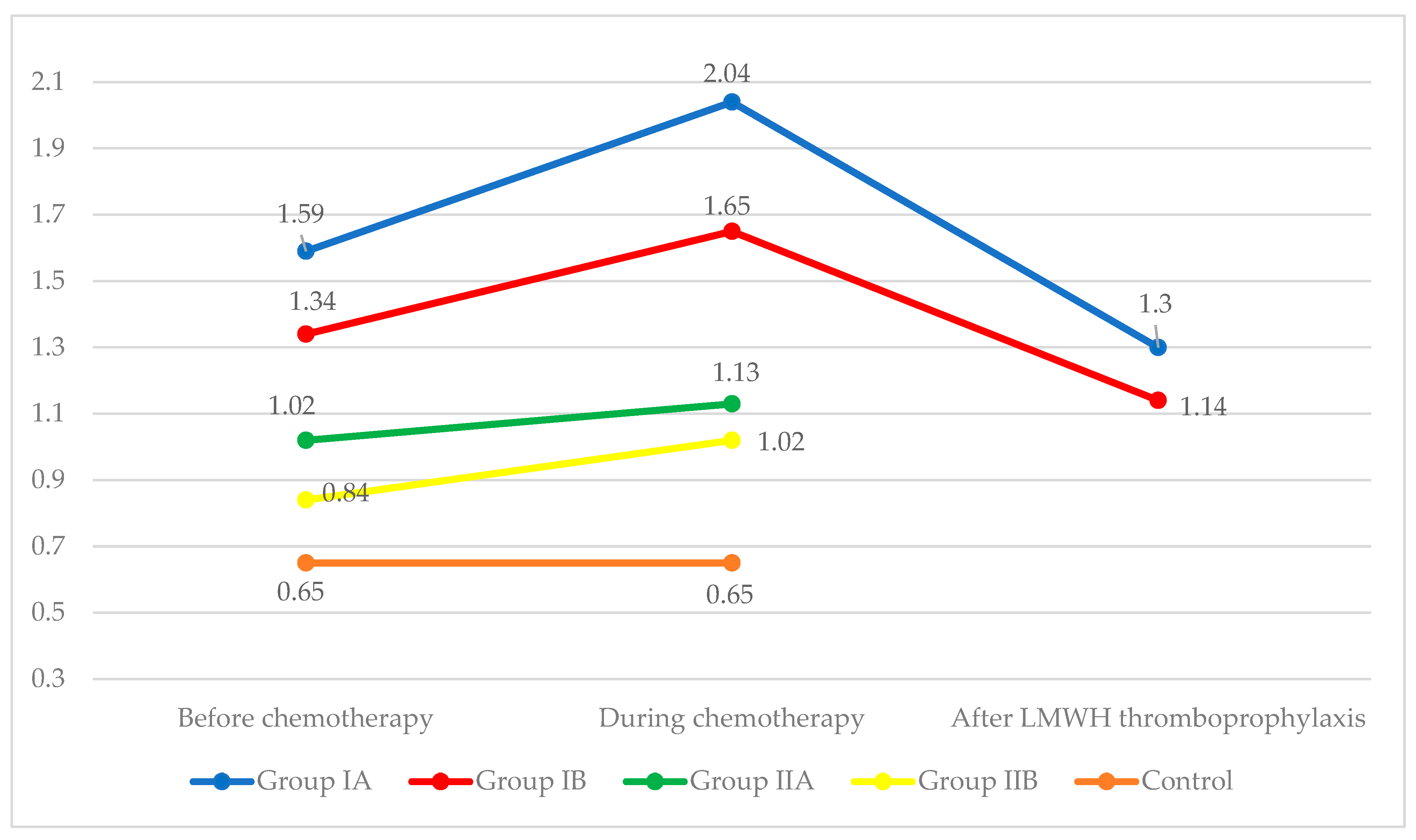
Background: Endothelial activation and thromboinflammation play an important role in cancer-associated thrombosis. An imbalance between von Willebrand factor (vWF) and its physiological regulator ADAMTS13 may reflect the development of a prothrombotic endothelial state in patients with malignancies. However, the dynamics of the vWF-ADAMTS13 axis during chemotherapy and thromboprophylaxis remain insufficiently characterized. Objectives: To characterize the vWF-ADAMTS13 axis as a potential laboratory marker of endotheliopathy in patients with gynecologic malignancies and to assess its dynamics during chemotherapy and thromboprophylaxis with low-molecular-weight heparin (LMWH). Materials and Methods: This prospective comparative study included 74 patients with stage I–III gynecologic malignancies undergoing chemotherapy after surgical treatment. Group I comprised 34 patients with a history of thrombotic complications (VTE), including 23 patients with ovarian cancer and 11 with cervical adenocarcinoma. Group II included 40 patients without previous VTE, including 20 patients with ovarian cancer and 20 with cervical adenocarcinoma. The control group consisted of 25 healthy women. Plasma vWF levels, ADAMTS13 antigen and functional activity, ADAMTS13 inhibitor levels, and the vWF/ADAMTS13 ratio were assessed before chemotherapy and after 1–2 chemotherapy cycles. Patients in Group I additionally received thromboprophylaxis with nadroparin calcium. Results: Before chemotherapy, an imbalance of the vWF-ADAMTS13 axis was observed in patients with malignancies compared with healthy controls and was most pronounced in patients with a history of thrombosis. The vWF/ADAMTS13 ratio was 0.65 in controls, 1.02 and 0.84 in patients without previous VTE with ovarian and cervical cancer, respectively, and 1.59 and 1.34 in the corresponding subgroups with a history of thrombosis (p < 0.05). After 1–2 chemotherapy cycles, the vWF–ADAMTS13 axis showed a further shift toward imbalance, characterized by increased vWF levels, decreased ADAMTS13 antigen levels and functional activity, and increased ADAMTS13 inhibitor concentrations. The vWF/ADAMTS13 ratio increased to 2.04 in patients with ovarian cancer and to 1.65 in those with cervical cancer and a history of thrombosis. In Group I, the subsequent assessment following chemotherapy and LMWH thromboprophylaxis demonstrated partial reversal of these changes: ADAMTS13 antigen levels increased, while vWF levels and ADAMTS13 inhibitor concentrations decreased, and the vWF/ADAMTS13 ratio declined from 2.04 to 1.30 in ovarian cancer and from 1.65 to 1.14 in cervical cancer. Conclusions: The vWF-ADAMTS13 axis is markedly altered in patients with gynecologic malignancies, including those without previous VTE, with the most pronounced imbalance observed in patients with a history of thrombosis. The post-chemotherapy assessment demonstrated a further shift toward imbalance, whereas the subsequent assessment following chemotherapy and LMWH thromboprophylaxis in Group I showed partial reversal of these changes. The vWF/ADAMTS13 ratio may represent a potential integrative and dynamic marker of endothelial–hemostatic imbalance in patients with gynecologic malignancies.
Keywords: cancer-associated thrombosis; endotheliopathy; thromboinflammation; von Willebrand factor; vWF; ADAMTS13; vWF/ADAMTS13 ratio; gynecologic malignancies; chemotherapy; low-molecular-weight heparin; thromboprophylaxis cancer-associated thrombosis; endotheliopathy; thromboinflammation; von Willebrand factor; vWF; ADAMTS13; vWF/ADAMTS13 ratio; gynecologic malignancies; chemotherapy; low-molecular-weight heparin; thromboprophylaxis