

Physical Recovery After CAR-T Cell Therapy vs. Autologous Stem Cell Transplantation Assessed Through Quantitative Rehabilitation Measures


Abstract
1. Introduction
2. Methods
2.1. Patient Population
2.2. Objective Assessment Tools
- Muscle Strength Testing. Manual muscle testing was performed for major muscle groups considered critical for functional mobility and independence, including hip flexors, knee extensors, ankle dorsiflexors, shoulder abductors, and elbow flexors. Strength was graded using the standard 0–5 Medical Research Council (MRC) scale [30].
- TUG. The TUG assesses functional mobility, balance (both static and dynamic), and fall risk [31]. Patients were instructed to stand from a seated position in a standard armchair, walk 3 m at a comfortable pace, turn around, return to the chair, and sit down. Time to completion was recorded in seconds. A cutoff of >13.5 s has been associated with increased fall risk in older adults [32].
- 5×STS. This test measures lower limb muscle strength, power, and functional capacity [33]. Patients were asked to stand up and sit down from a standard chair five times as quickly as possible without using their arms. The total time to complete five repetitions was recorded and compared to age- and sex-specific normative values [34].
- 6MWT. The 6MWT measures functional exercise capacity and endurance [37]. Patients walked at their fastest comfortable pace along a flat, marked 30 m corridor for 6 min, with standardized encouragement provided at 1 min intervals. The total distance covered (in meters) was recorded. Baseline 6MWD was calculated as a percentage of predicted distance using validated reference equations accounting for age, sex, height, and weight [38].
2.3. Subjective Assessment Tools
- Self-Reported Health Status. Patients rated their overall perceived health status on a visual analog scale ranging from 0 (worst imaginable health) to 100 (best imaginable health).
- Visual Analog Scale (VAS) for Fatigue. Fatigue was assessed using a 0–10 VAS, with 0 representing no perceived exertion and 10 representing maximal exertion or exhaustion.
2.4. Data Collection and Management
2.5. Statistical Analysis
3. Results
3.1. Patient Characteristics
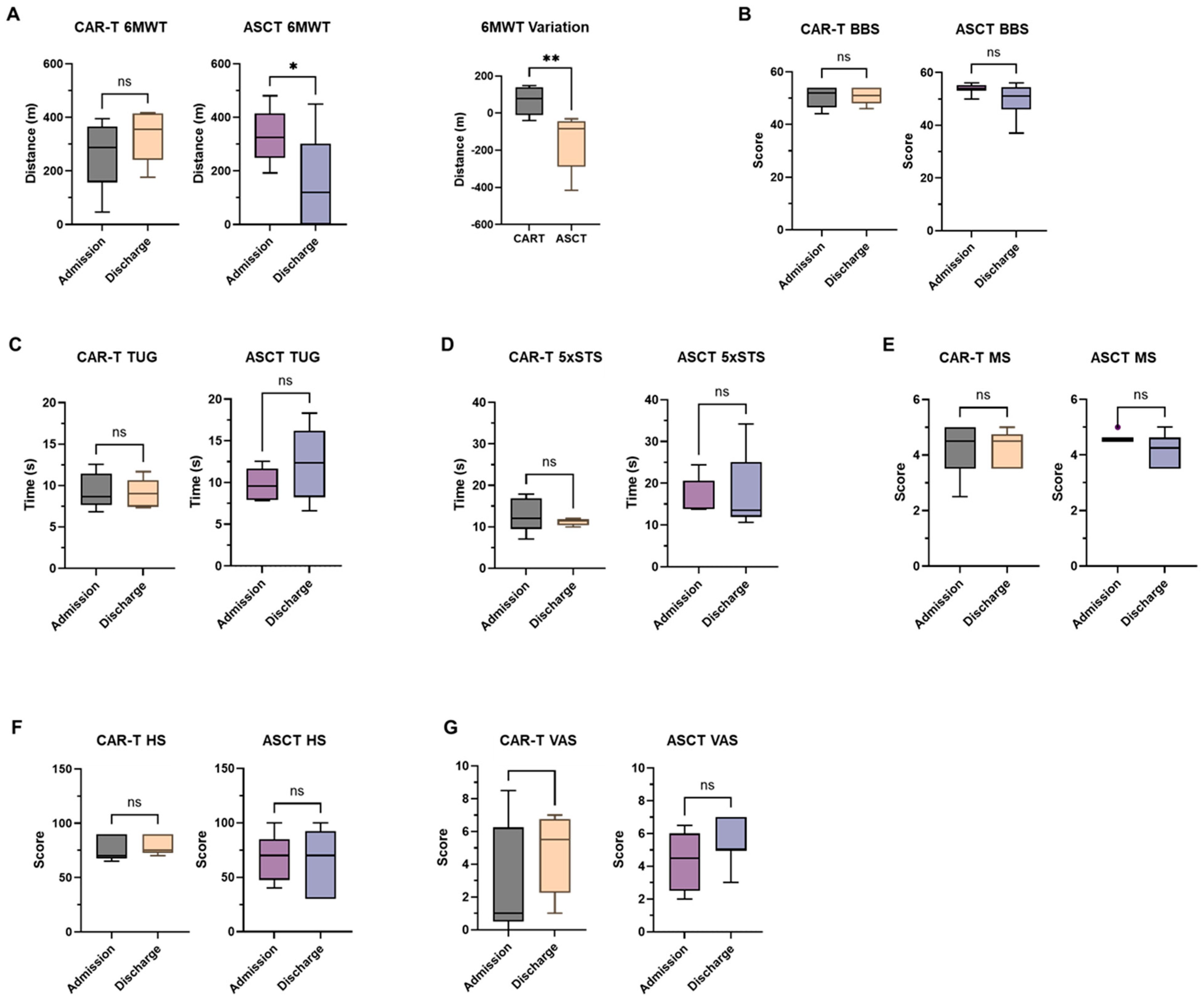
3.2. Functional Assessment Outcomes


| Measure | CAR-T Group (n = 5) | ASCT Group (n = 7) | p-Value |
|---|---|---|---|
| 6-MWD (meters) | |||
| Admission, median (range) | 287 (46–395) | 325 (192–480) | 0.53 |
| Discharge, median (range) | 355 (176–416) | 120 (0–449) | 0.10 |
| Change, median (range) | +79 (−40 to +148) | −84 (−415 to −31) | 0.005 |
| Within-group p-value | 0.19 | 0.016 | |
| BBS (0–56) | |||
| Admission, median (range) | 54 (44–54) | 55 (50–56) | 0.40 |
| Discharge, median (range) | 52 (46–54) | 49 (37–56) | 0.09 |
| Change, median (range) | 0 (−1 to +2) | −1 (−18 to 0) | 0.04 |
| Within-group p-value | 0.79 | 0.06 | |
| TUG (seconds) | |||
| Admission, median (range) | 8.7 (6.8–12.5) | 10 (7.8–12.5) | 0.45 |
| Discharge, median (range) | 9 (7.3–11.7) | 12.5 (6.6–18.3) | 0.08 |
| Change, median (range) | −0.4 (−1.3 to +1) | +1.5 (−1.4 to +7.5) | 0.03 |
| Within-group p-value | 0.69 | 0.09 | |
| 5×STS (seconds) | |||
| Admission, median (range) | 12.5 (7.1–17.9) | 15 (13.8–24.4) | 0.3 |
| Discharge, median (range) | 11.7 (9–12.1) | 15 (10.7–34.2) | 0.12 |
| Change, median (range) | −1 (−7 to +2.9) | 0 (−3.1 to +9.8) | 0.11 |
| Within-group p-value | 0.25 | 0.88 | |
3.3. Subjective Assessments
4. Discussion
Author Contributions
Funding
Institutional Review Board Statement
Informed Consent Statement
Data Availability Statement
Conflicts of Interest
References
- Maziarz, R.T.; Bishop, M.R.; Tam, C.S.; Borchmann, P.; Worel, N.; McGuirk, J.P.; Holte, H.; Waller, E.K.; Jaglowski, S.; Andreadis, C.; et al. Five-Year Analysis of the JULIET Trial of Tisagenlecleucel in Patients with Relapsed/Refractory Large B-Cell Lymphoma. J. Clin. Oncol. 2026, 44, 86–91. [Google Scholar] [CrossRef] [Scilit] [PubMed]
- San-Miguel, J.; Dhakal, B.; Yong, K.; Spencer, A.; Anguille, S.; Mateos, M.V.; Fernández de Larrea, C.; Martínez-López, J.; Moreau, P.; Touzeau, C.; et al. Cilta-cel or Standard Care in Lenalidomide-Refractory Multiple Myeloma. N. Engl. J. Med. 2023, 389, 335–347. [Google Scholar] [CrossRef] [Scilit] [PubMed]
- Abdallah, N.; O’Leary, A.; Schmidt, C.M.; Ailawadhi, S.; Mian, H.; Rosko, A.; Wildes, T.M. Systematic review of frailty, functional status & comorbidities in older adults with multiple myeloma undergoing high dose therapy & autologous stem cell transplant. J. Geriatr. Oncol. 2026, 17, 102846. [Google Scholar] [CrossRef] [Scilit] [PubMed]
- Bishop, M.R. Late complications and long-term care of adult CAR T-cell patients. Hematol. Am. Soc. Hematol. Educ. Program 2024, 2024, 109–115. [Google Scholar] [CrossRef] [Scilit] [PubMed]
- Chavez, J.C.; Bachmeier, C.; Kharfan-Dabaja, M.A. CAR T-cell therapy for B-cell lymphomas: Clinical trial results of available products. Ther. Adv. Hematol. 2019, 10, 2040620719841581. [Google Scholar] [CrossRef] [Scilit] [PubMed]
- Cohen, A.D.; Parekh, S.; Santomasso, B.D.; Pérez-Larraya, J.G.; van de Donk, N.W.C.J.; Arnulf, B.; Mateos, M.-V.; Lendvai, N.; Jackson, C.C.; De Braganca, K.C.; et al. Incidence and management of CAR-T neurotoxicity in patients with multiple myeloma treated with ciltacabtagene autoleucel in CARTITUDE studies. Blood Cancer J. 2022, 12, 32. [Google Scholar] [CrossRef] [Scilit] [PubMed]
- Lee, D.W.; Santomasso, B.D.; Locke, F.L.; Ghobadi, A.; Turtle, C.J.; Brudno, J.N.; Maus, M.V.; Park, J.H.; Mead, E.; Pavletic, S.; et al. ASTCT consensus grading for cytokine release syndrome and neurologic toxicity associated with immune effector cells. Biol. Blood Marrow Transplant. 2019, 25, 625–638. [Google Scholar] [CrossRef] [Scilit] [PubMed]
- Santomasso, B.D.; Gust, J.; Perna, F. How I treat unique and difficult-to-manage cases of CAR T-cell therapy-associated neurotoxicity. Blood 2023, 141, 2443–2451. [Google Scholar] [CrossRef] [Scilit] [PubMed]
- Dahunsi, D.; Eleanya, C.; Akintunde, A.; Oluwole, O. Prolonged Cytopenia with CAR-T Cell Therapy and Management Recommendations. Clin. Hematol. Int. 2025, 7, 47–54. [Google Scholar] [CrossRef] [Scilit] [PubMed]
- Waszczuk-Gajda, A.; Penack, O.; Sbianchi, G.; Koster, L.; Blaise, D.; Reményi, P.; Russell, N.; Ljungman, P.; Trneny, M.; Mayer, J.; et al. Complications of Autologous Stem Cell Transplantation in Multiple Myeloma: Results from the CALM Study. J. Clin. Med. 2022, 11, 3541. [Google Scholar] [CrossRef] [Scilit] [PubMed]
- Brudno, J.N.; Kochenderfer, J.N. Recent advances in CAR T-cell toxicity: Mechanisms, manifestations and management. Blood Rev. 2019, 34, 45–55. [Google Scholar] [CrossRef] [Scilit] [PubMed]
- Cornago, J.; Baile, M.; Acera, M.; Fox, L.; Pérez-Artigas, M.d.M.; Santamaría, A.; Quintela, M.d.C.; Sánchez-Salinas, A.; Salmerón, J.M.; Illana, V.; et al. Prospective implementation of the HCT frailty scale in adults with lymphoproliferative syndromes candidates for autologous haematopoietic stem cell transplantation: Results from a multicentre GETH-TC study. Br. J. Haematol. 2026, 209, 197–209. [Google Scholar] [CrossRef] [Scilit] [PubMed]
- McGoldrick, B.; Evans, E.; Williams, J.; Martin, G.; Warren, M.; Davies, D.; Hillberg, C.; Fletcher, K.; Ford, J.; Downing, A.; et al. The impact of physiotherapy prehabilitation on physical fitness, length of stay (LoS), readmission rates, quality of life (QoL) and patient level costing (PLICS) for haematopoietic stem cell transplant (HSCT) and chimeric antigen receptor T-cell (CAR-T) recipients. Blood 2024, 144, 4796. [Google Scholar] [CrossRef] [Scilit]
- Potiaumpai, M.; Caru, M.; Mineishi, S.; Naik, S.; Zemel, B.S.; Schmitz, K.H. IMPROVE-BMT: A Pilot Randomized Controlled Trial of Prehabilitation Exercise for Adult Hematopoietic Stem Cell Transplant Recipients. J. Clin. Med. 2024, 13, 2052. [Google Scholar] [CrossRef] [Scilit] [PubMed]
- Oken, M.M.; Creech, R.H.; Tormey, D.C.; Horton, J.; Davis, T.E.; McFadden, E.T.; Carbone, P.P. Toxicity and response criteria of the Eastern Cooperative Oncology Group. Am. J. Clin. Oncol. 1982, 5, 649–655. [Google Scholar] [CrossRef] [Scilit]
- Schag, C.C.; Heinrich, R.L.; Ganz, P.A. Karnofsky performance status revisited: Reliability, validity, and guidelines. J. Clin. Oncol. 1984, 2, 187–193. [Google Scholar] [CrossRef] [Scilit] [PubMed]
- Hantel, A.; DuMontier, C.; Odejide, O.O.; Luskin, M.R.; Sperling, A.S.; Hshieh, T.; Chen, R.; Soiffer, R.; Driver, J.A.; Abel, G.A. Gait Speed, Survival, and Recommended Treatment Intensity in Older Adults with Blood Cancers Requiring Treatment. Cancer 2021, 127, 875–883. [Google Scholar] [CrossRef] [Scilit] [PubMed]
- Migdanis, I.; Gioulbasanis, I.; Migdanis, A.; Armeni, E.; Sgantzos, M.; Kapsoritakis, A.; Kontogianni, M.D. Objective Measurements of Physical Function to Predict Survival in Patients with Metastatic Cancer. Nutr. Cancer 2023, 75, 912–922. [Google Scholar] [CrossRef] [Scilit] [PubMed]
- ATS Committee on Proficiency Standards for Clinical Pulmonary Function Laboratories. ATS statement: Guidelines for the six-minute walk test. Am. J. Respir. Crit. Care Med. 2002, 166, 111–117. [Google Scholar] [CrossRef] [Scilit] [PubMed]
- Podsiadlo, D.; Richardson, S. The timed “Up & Go”: A test of basic functional mobility for frail elderly persons. J. Am. Geriatr. Soc. 1991, 39, 142–148. [Google Scholar] [CrossRef] [Scilit] [PubMed]
- Shouse, G.; Tran, R.; Osborn, J.; Budde, L.E. Physical Therapy Assessment of Baseline Function and Endurance Predicts Short Term Outcomes in Commercial CAR T Patients with Lymphoma. Blood 2021, 138, 570. [Google Scholar] [CrossRef] [Scilit]
- Hamada, R.; Arai, Y.; Kitawaki, T.; Nakamura, N.; Murao, M.; Matsushita, M.; Miyasaka, J.; Asano, T.; Jo, T.; Nishikori, M.; et al. Fluctuation of physical function during chimeric antigen receptor T-cell therapy during rehabilitation intervention: Real-world data and risk factor analyses. EJHaem 2024, 5, 1168–1178. [Google Scholar] [CrossRef] [Scilit] [PubMed]
- Parker, N.; Bean, M.; De Vera, M.T.; Carmella, R.; McCoy, J.; Corallo, S.; Delgado, L.C.; Menges, M.; Castaneda, O.; Chavez, J.C.; et al. Exercise prehabilitation for older adults undergoing CAR-T: Feasibility and preliminary outcomes from a single-arm pilot study. Blood 2024, 144, 3446. [Google Scholar] [CrossRef] [Scilit]
- McCourt, O.; Maciocia, P.; Roddie, C.; Hwang, A.; Wood, L.; Panopoulou, A.; Springell, D.A.; Al Bakir, M.; O’REilly, M. Single-centre experience of implementing physiotherapist-led prehabilitation for chimeric antigen receptor T cell therapy. EJHaem 2024, 5, 967–972. [Google Scholar] [CrossRef] [Scilit] [PubMed]
- Jones, L.W.; Courneya, K.S.; Mackey, J.R.; Muss, H.B.; Pituskin, E.N.; Scott, J.M.; Hornsby, W.E.; Coan, A.D.; Herndon, J.E., II; Douglas, P.S.; et al. Cardiopulmonary function and age-related decline across the breast cancer survivorship continuum. J. Clin. Oncol. 2012, 30, 2530–2537. [Google Scholar] [CrossRef] [Scilit] [PubMed]
- Land, J.; Luong, M.K.; Longden, A.; Rabin, N.; Kyriakou, C.; Sive, J.; Fisher, A.; Yong, K.; McCourt, O. Real-world evaluation of physiotherapist-led exercise prehabilitation and rehabilitation during autologous stem cell transplantation in myeloma: A single-centre experience. BMJ Open Qual. 2025, 14, e002936. [Google Scholar] [CrossRef] [Scilit] [PubMed]
- Locke, F.L.; Miklos, D.B.; Jacobson, C.A.; Perales, M.-A.; Kersten, M.-J.; Oluwole, O.O.; Ghobadi, A.; Rapoport, A.P.; McGuirk, J.; Pagel, J.M.; et al. Axicabtagene ciloleucel as second-line therapy for large B-cell lymphoma. N. Engl. J. Med. 2022, 386, 640–654. [Google Scholar] [CrossRef] [Scilit] [PubMed]
- Kamdar, M.; Solomon, S.R.; Arnason, J.; Johnston, P.B.; Glass, B.; Bachanova, V.; Ibrahimi, S.; Mielke, S.; Mutsaers, P.; Hernandez-Ilizaliturri, F.; et al. Lisocabtagene maraleucel versus standard of care with salvage chemotherapy followed by autologous stem cell transplantation as second-line treatment in patients with relapsed or refractory large B-cell lymphoma (TRANSFORM): Results from an interim analysis of an open-label, randomised, phase 3 trial. Lancet 2022, 399, 2294–2308. [Google Scholar] [CrossRef] [Scilit] [PubMed]
- National Comprehensive Cancer Network. NCCN Clinical Practice Guidelines in Oncology: Management of Immunotherapy-Related Toxicities, Version 1. 2023. Available online: https://www.nccn.org/guidelines/guidelines-detail?category=3&id=1486 (accessed on 1 March 2026).
- Shumway-Cook, A.; Brauer, S.; Woollacott, M. Predicting the probability for falls in community-dwelling older adults using the Timed Up & Go Test. Phys. Ther. 2000, 80, 896–903. [Google Scholar] [CrossRef] [Scilit]
- Bischoff, H.A.; Stähelin, H.B.; Monsch, A.U.; Iversen, M.D.; Weyh, A.; von Dechend, M.; Akos, R.; Conzelmann, M.; Dick, W.; Theiler, R. Identifying a cut-off point for normal mobility: A comparison of the timed ’up and go’ test in community-dwelling and institutionalised elderly women. Age Ageing 2003, 32, 315–320. [Google Scholar] [CrossRef] [Scilit] [PubMed]
- Lord, S.R.; Murray, S.M.; Chapman, K.; Munro, B.; Tiedemann, A. Sit-to-stand performance depends on sensation, speed, balance, and psychological status in addition to strength in older people. J. Gerontol. A Biol. Sci. Med. Sci. 2002, 57, M539–M543. [Google Scholar] [CrossRef] [Scilit] [PubMed]
- Bohannon, R.W. Reference values for the five-repetition sit-to-stand test: A descriptive meta-analysis of data from elders. Percept. Mot. Ski. 2006, 103, 215–222. [Google Scholar] [CrossRef] [Scilit] [PubMed]
- Berg, K.O.; Wood-Dauphinee, S.L.; Williams, J.I.; Maki, B. Measuring balance in the elderly: Validation of an instrument. Can. J. Public Health 1992, 83, S7–S11. [Google Scholar] [PubMed]
- Bogle Thorbahn, L.D.; Newton, R.A. Use of the Berg Balance Test to predict falls in elderly persons. Phys. Ther. 1996, 76, 576–583. [Google Scholar] [CrossRef] [Scilit] [PubMed]
- Butland, R.J.; Pang, J.; Gross, E.R.; Woodcock, A.A.; Geddes, D.M. Two-, six-, and 12-minute walking tests in respiratory disease. Br. Med. J. (Clin. Res. Ed.) 1982, 284, 1607–1608. [Google Scholar] [CrossRef] [Scilit] [PubMed]
- Enright, P.L.; Sherrill, D.L. Reference equations for the six-minute walk in healthy adults. Am. J. Respir. Crit. Care Med. 1998, 158, 1384–1387. [Google Scholar] [CrossRef] [Scilit] [PubMed]
- Casanova, C.; Celli, B.; Barria, P.; Casas, A.; Cote, C.; de Torres, J.; Jardim, J.; Lopez, M.; Marin, J.; de Oca, M.M.; et al. The 6-min walk distance in healthy subjects: Reference standards from seven countries. Eur. Respir. J. 2011, 37, 150–156. [Google Scholar] [CrossRef] [Scilit] [PubMed]
- Lin, R.J.; Kim, S.J.; Brown, S.; Elko, T.A.; Ruiz, J.D.; Hanley, D.M.; Palomba, M.L.; Perales, M.-A.; Shah, G.L.; Dahi, P.B.; et al. Prospective geriatric assessment and geriatric consultation in CAR T-cell therapy for older patients with lymphoma. Blood Adv. 2023, 7, 3501–3505. [Google Scholar] [CrossRef] [Scilit] [PubMed]
- Yates, S.J.; Cursio, J.F.; Artz, A.; Kordas, K.; Bishop, M.R.; Derman, B.A.; Kosuri, S.; Riedell, P.A.; Kline, J.; Jakubowiak, A.; et al. Optimization of older adults by a geriatric assessment-guided multidisciplinary clinic before CAR T-cell therapy. Blood Adv. 2024, 8, 3785–3797. [Google Scholar] [CrossRef] [Scilit] [PubMed]
- Bayraktar, U.D.; Stadtmauer, E.A. Fifty years of melphalan use in hematopoietic stem cell transplantation. Bone Marrow Transplant. 2013, 48, 473–490. [Google Scholar] [CrossRef] [Scilit] [PubMed]
- Blijlevens, N.M.; Donnelly, J.P.; De Pauw, B.E. Mucosal barrier injury: Biology, pathology, clinical counterparts and consequences of intensive treatment for haematological malignancy: An overview. Bone Marrow Transplant. 2000, 25, 1269–1278. [Google Scholar] [CrossRef] [Scilit] [PubMed]
- Tisdale, M.J. Mechanisms of cancer cachexia. Physiol. Rev. 2009, 89, 381–410. [Google Scholar] [CrossRef] [Scilit] [PubMed]
- Nissani, A.; Lev-Ari, S.; Meirson, T.; Jacoby, E.; Asher, N.; Ben-Betzalel, G.; Itzhaki, O.; Shapira-Frommer, R.; Schachter, J.; Markel, G.; et al. Comparison of non-myeloablative lymphodepleting preconditioning regimens in patients undergoing adoptive T cell therapy. J. Immunother. Cancer 2021, 9, e001743. [Google Scholar] [CrossRef] [Scilit] [PubMed]
| Characteristic | CAR-T Group (n = 5) | ASCT Group (n = 7) |
|---|---|---|
| Age, years | ||
| Median (range) | 58 (48–64) | 53 (42–64) |
| Sex, n (%) | ||
| Male | 2 (40%) | 3 (60%) |
| Female | 3 (60%) | 4 (40%) |
| ECOG, n (%) | ||
| 0–1 | 4 | 7 |
| >2 | 1 | 0 |
| Body Mass Index, kg/m2 | ||
| Median (range) | 26.98 (19.98–30.96) | 28.39 (19.3–40.27) |
| Length of Stay, days | ||
| Median (range) | 26.8 (24–41) | 23.6 (19–31) |
Disclaimer/Publisher’s Note: The statements, opinions and data contained in all publications are solely those of the individual author(s) and contributor(s) and not of MDPI and/or the editor(s). MDPI and/or the editor(s) disclaim responsibility for any injury to people or property resulting from any ideas, methods, instructions or products referred to in the content. |
© 2026 by the authors. Licensee MDPI, Basel, Switzerland. This article is an open access article distributed under the terms and conditions of the Creative Commons Attribution (CC BY) license.
Share and Cite
Feri, F.; Hutsava, Y.; Monico, R.; Morena, F.; Perriello, V.M. Physical Recovery After CAR-T Cell Therapy vs. Autologous Stem Cell Transplantation Assessed Through Quantitative Rehabilitation Measures. Biomedicines 2026, 14, 1912. https://doi.org/10.3390/biomedicines14091912
Feri F, Hutsava Y, Monico R, Morena F, Perriello VM. Physical Recovery After CAR-T Cell Therapy vs. Autologous Stem Cell Transplantation Assessed Through Quantitative Rehabilitation Measures. Biomedicines. 2026; 14(9):1912. https://doi.org/10.3390/biomedicines14091912
Chicago/Turabian StyleFeri, Flavio, Yuliya Hutsava, Rita Monico, Francesco Morena, and Vincenzo Maria Perriello. 2026. "Physical Recovery After CAR-T Cell Therapy vs. Autologous Stem Cell Transplantation Assessed Through Quantitative Rehabilitation Measures" Biomedicines 14, no. 9: 1912. https://doi.org/10.3390/biomedicines14091912
APA StyleFeri, F., Hutsava, Y., Monico, R., Morena, F., & Perriello, V. M. (2026). Physical Recovery After CAR-T Cell Therapy vs. Autologous Stem Cell Transplantation Assessed Through Quantitative Rehabilitation Measures. Biomedicines, 14(9), 1912. https://doi.org/10.3390/biomedicines14091912