Oxygen Timing as Therapy: Molecular Rationale and Clinical Imperative for Early Oxygen Administration in the Sickle Cell Disease Vaso-Occlusive Crisis—A Structured Narrative Review with Implications for Resource-Constrained Health Systems
 , , and
Abstract
1. Introduction
2. Molecular and Biophysical Basis of Hypoxia-Driven Vaso-Occlusion
2.1. The Structural Origin of HbS Polymerization
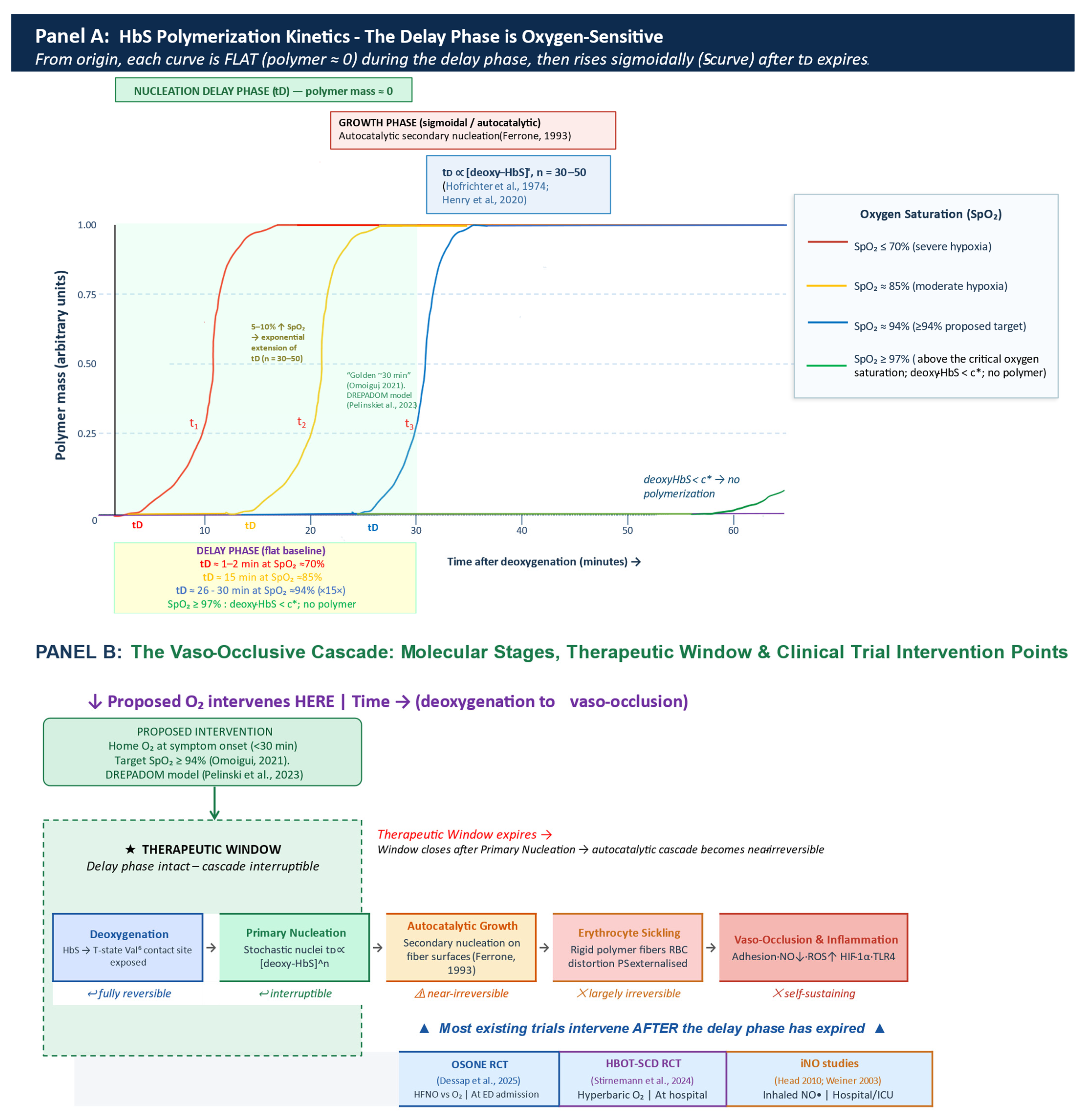
2.2. The Nucleation Delay Phase: A Kinetically Exploitable Therapeutic Window
2.3. Downstream Amplification: From Molecular Sickling to Full Vaso-Occlusion
3. The Curative Frontier and Its Global Accessibility Gap
3.1. Allogeneic Hematopoietic Stem Cell Transplantation
3.2. Gene Therapy: Scientific Milestone, Systemic Barrier
4. Oxygen Therapy Modalities: Clinical Evidence and Comparative Assessment
4.1. Standard Low-Flow Supplemental Oxygen
4.2. High-Flow Nasal Oxygen (HFNO)
4.3. Hyperbaric Oxygen Therapy (HBOT)
4.4. Inhaled Nitric Oxide (iNO)
5. Timing Is the Therapy: The Case for Early Oxygen at VOC Onset
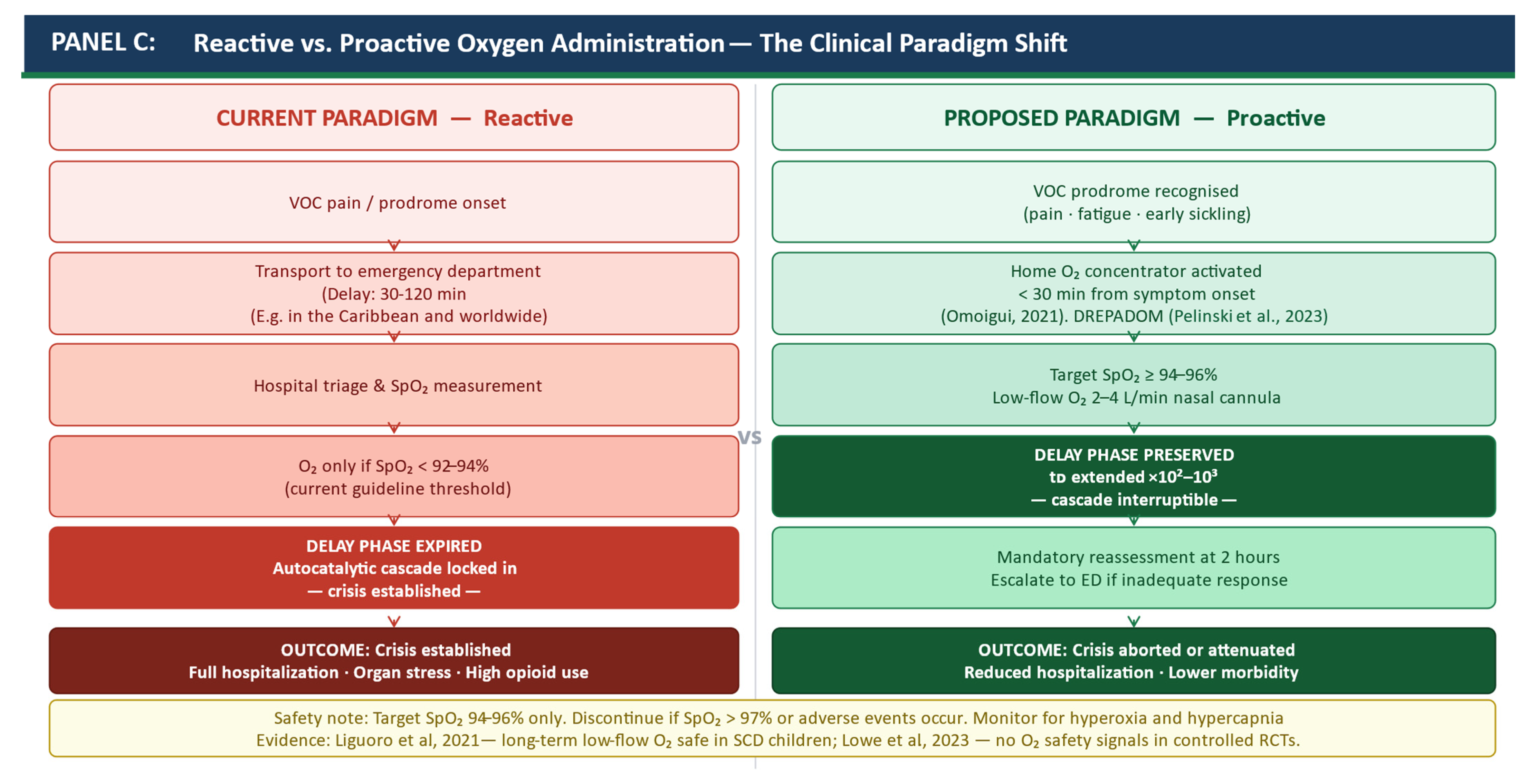
5.1. The Current Reactive Paradigm and Its Biological Paradox
5.2. The Proposed Paradigm Shift: Proactive Delay-Phase Preservation
5.3. Safety Considerations
6. Implementation Considerations for Caribbean and Resource-Constrained Settings
6.1. Structural Challenges Unique to Small-Island Health Systems
6.2. The DREPADOM Model: Operational Proof of Concept
6.3. A Proposed Regional Trial Framework
6.4. Economic Rationale for Community-Level Oxygen Access: A Preliminary Cost–Benefit Framework
7. Discussion
7.1. Limitations
7.2. Potential Harms: Could Oxygen Therapy Worsen the Course of SCD?
8. Conclusions
Author Contributions
Funding
Institutional Review Board Statement
Informed Consent Statement
Data Availability Statement
Acknowledgments
Conflicts of Interest
Abbreviations
| ACS | Acute chest syndrome |
| ATA | Atmospheres absolute |
| c* | Critical deoxy-HbS concentration for polymerization |
| ED | Emergency department |
| exa-cel | Exagamglogene autotemcel (Casgevy™) |
| FiO2 | Fraction of inspired oxygen |
| GVHD | Graft-versus-host disease |
| HbF | Fetal hemoglobin |
| HbS | Hemoglobin S |
| HBOT | Hyperbaric oxygen therapy |
| HFNO | High-flow nasal oxygen |
| HIF-1α | Hypoxia-inducible factor 1-alpha |
| HSCT | Hematopoietic stem cell transplantation |
| HSPC | Hematopoietic stem and progenitor cell |
| iNO | Inhaled nitric oxide |
| ISC | Irreversibly sickled cell |
| LDH | Lactate dehydrogenase |
| lovo-cel | Lovotibeglogene autotemcel (Lyfgenia™) |
| MCHC | Mean corpuscular hemoglobin concentration |
| NIRS | Near-infrared spectroscopy |
| NO | Nitric oxide |
| NRS | Numeric Rating Scale |
| PS | Phosphatidylserine |
| RBC | Red blood cell |
| RCT | Randomized controlled trial |
| ROS | Reactive oxygen species |
| RSC | Reversibly sickled cell |
| rSO2 | Regional tissue oxygen saturation |
| SCD | Sickle cell disease |
| SpO2 | Peripheral oxygen saturation |
| tD | Nucleation delay time |
| TLR4 | Toll-like receptor 4 |
| VCAM-1 | Vascular cell adhesion molecule-1 |
| VOC | Vaso-occlusive crisis |
| WHO-CHOICE | A World Health Organization Choosing Interventions That Are Cost-Effective |
References
- Steinberg, M.H. Sickle cell anemia, the first molecular disease: Overview of molecular etiology, pathophysiology, and therapeutic approaches. Sci. World J. 2008, 8, 1295–1324. [Google Scholar] [CrossRef] [Scilit] [PubMed]
- Piel, F.B.; Patil, A.P.; Howes, R.E.; Nyangiri, O.A.; Gething, P.W.; Dewi, M.; Temperley, W.H.; Williams, T.N.; Weatherall, D.J.; Hay, S.I. Global epidemiology of sickle haemoglobin in neonates: A contemporary geostatistical model-based map and population estimates. Lancet 2013, 381, 142–151. [Google Scholar] [CrossRef] [Scilit] [PubMed]
- Eaton, W.A.; Hofrichter, J. Sickle cell hemoglobin polymerization. Adv. Protein Chem. 1990, 40, 63–279. [Google Scholar] [CrossRef] [Scilit] [PubMed]
- Pace, B.S.; Ofori-Acquah, S.F.; Peterson, K.R. Sickle cell disease: Genetics, cellular and molecular mechanisms, and therapies. Anemia 2012, 2012, 143594. [Google Scholar] [CrossRef] [Scilit] [PubMed]
- Darbari, D.S.; Sheehan, V.A.; Ballas, S.K. The vaso-occlusive pain crisis in sickle cell disease: Definition, pathophysiology, and management. Eur. J. Haematol. 2020, 105, 237–246. [Google Scholar] [CrossRef] [Scilit] [PubMed]
- Ellison, A.M.; Shaw, K.N. Management of vasoocclusive pain events in sickle cell disease. Pediatr. Emerg. Care 2007, 23, 832–838. [Google Scholar] [CrossRef] [Scilit] [PubMed]
- Oza, Y.R.; Vala, L.; Sai, S.R.S.; Valluri, P.; Rahul, S. New horizons in sickle cell crisis treatment. Int. J. Res. Med. Sci. 2024, 12, 3079–3084. [Google Scholar] [CrossRef] [Scilit]
- Gluckman, E.; Cappelli, B.; Bernaudin, F.; Labopin, M.; Volt, F.; Carreras, J.; Pinto Simoes, B.; Ferster, A.; Dupont, S.; de la Fuente, J.; et al. Sickle cell disease: An international survey of results of HLA-identical sibling hematopoietic stem cell transplantation. Blood 2017, 129, 1548–1556. [Google Scholar] [CrossRef] [Scilit] [PubMed]
- Frangoul, H.; Altshuler, D.; Cappellini, M.D.; Chen, Y.S.; Domm, J.; Eustace, B.K.; Foell, J.; de la Fuente, J.; Grupp, S.; Handgretinger, R.; et al. CRISPR-Cas9 gene editing for sickle cell disease and β-thalassaemia. N. Engl. J. Med. 2021, 384, 252–260. [Google Scholar] [CrossRef] [Scilit] [PubMed]
- Frangoul, H.; Locatelli, F.; Sharma, A.; Bhatia, M.; Mapara, M.; Molinari, L.; Wall, D.; Liem, R.I.; Telfer, P.; Shah, A.J.; et al. Exagamglogene autotemcel for severe sickle cell disease. N. Engl. J. Med. 2024, 390, 1649–1662. [Google Scholar] [CrossRef] [Scilit]
- Kanter, J.; Walters, M.C.; Krishnamurti, L.; Mapara, M.Y.; Kwiatkowski, J.L.; Rifkin-Zenenberg, S.; Aygun, B.; Kasow, K.A.; Pierciey, F.J.; Bonner, M.; et al. Biologic and clinical efficacy of LentiGlobin for sickle cell disease. N. Engl. J. Med. 2022, 386, 617–628. [Google Scholar] [CrossRef] [Scilit] [PubMed]
- Vertex Pharmaceuticals Incorporated. Vertex and CRISPR Therapeutics Announce U.S. FDA Approval of CASGEVY™ (Exagamglogene Autotemcel) for the Treatment of Sickle Cell Disease. Press Release. 8 December 2023. Available online: https://teams.public.onecdn.static.microsoft/evergreen-assets/safelinks/2/atp-safelinks.html (accessed on 1 June 2026).
- Bluebird Bio, Inc. Bluebird Bio Announces FDA Approval of LYFGENIA™ (Lovotibeglogene Autotemcel) for Patients 12 Years and Older with Sickle Cell Disease. Press Release. 15 December 2023. Available online: https://www.businesswire.com/news/home/20231208492260/en/bluebird-bio-Announces-FDA-Approval-of-LYFGENIA-lovotibeglogene-autotemcel-for-Patients-Ages-12-and-Older-with-Sickle-Cell-Disease-and-a-History-of-Vaso-Occlusive-Events (accessed on 1 June 2026).
- Shahryari, A.; Saghaeian Jazi, M.; Mohammadi, S.; Razavi Nikoo, H.; Nazari, Z.; Hosseini, E.S.; Burtscher, I.; Mowla, S.J.; Lickert, H. Development and clinical translation of approved gene therapy products for genetic disorders. Front. Genet. 2019, 10, 868. [Google Scholar] [CrossRef] [Scilit] [PubMed]
- Ware, R.E.; de Montalembert, M.; Tshilolo, L.; Abboud, M.R. Sickle cell disease. Lancet 2017, 390, 311–323. [Google Scholar] [CrossRef] [Scilit] [PubMed]
- Khoury, H.; Grimsley, E. Oxygen inhalation in nonhypoxic sickle cell patients during vaso-occlusive crisis. Blood 1995, 86, 3998. [Google Scholar] [CrossRef] [Scilit]
- Okpala, I. Sickle cell crisis. In Practical Management of Haemoglobinopathies; Okpala, I.E., Ed.; Blackwell Publishing: Oxford, UK, 2004; pp. 63–71. [Google Scholar] [CrossRef] [Scilit]
- Omoigui, S. Sickle cell pain crisis: Clinical guidelines for the use of oxygen. Pract. Pain Manag. 2021, 20. Available online: https://www.medcentral.com/pain/sickle-cell-pain-crisis-clinical-guidelines-use-oxygen (accessed on 1 June 2026).
- Mozzarelli, A.; Hofrichter, J.; Eaton, W.A. Delay time of hemoglobin S polymerization prevents most cells from sickling in vivo. Science 1987, 237, 500–506. [Google Scholar] [CrossRef] [Scilit]
- Bartolucci, P. Novel clinical care models for patients with sickle cell disease. Hematol. Am. Soc. Hematol. Educ. Program 2024, 2024, 618–622. [Google Scholar] [CrossRef] [Scilit] [PubMed]
- Pelinski, Y.; De Luna, G.; Kassasseya, C.; Morabito, A.; Ngwem, E.; Arlet, J.B.; Genty, I.; Honsel, V.; Habibi, A.; Le Jeune, S.; et al. DREPADOM—A homecare protocol for vaso-occlusive crisis for sickle cell disease patients. Blood 2023, 142, 793. [Google Scholar] [CrossRef] [Scilit]
- Hofrichter, J.; Ross, P.D.; Eaton, W.A. Kinetics and mechanism of deoxyhemoglobin S gelation: A new approach to understanding sickle cell disease. Proc. Natl. Acad. Sci. USA 1974, 71, 4864–4868. [Google Scholar] [CrossRef] [Scilit] [PubMed]
- Henry, E.R.; Cellmer, T.; Dunkelberger, E.B.; Metaferia, B.; Hofrichter, J.; Li, Q.; Ostrowski, D.; Ghirlando, R.; Louis, J.M.; Moutereau, S.; et al. Allosteric control of hemoglobin S fiber formation by oxygen and its relation to the pathophysiology of sickle cell disease. Proc. Natl. Acad. Sci. USA 2020, 117, 15018–15027. [Google Scholar] [CrossRef] [Scilit] [PubMed]
- Ferrone, F.A. The polymerization of sickle hemoglobin in solutions and cells. Experientia 1993, 49, 110–117. [Google Scholar] [CrossRef] [Scilit] [PubMed]
- Matsui, N.M.; Borsig, L.; Rosen, S.D.; Yaghmai, M.; Varki, A.; Embury, S.H. P-selectin mediates the adhesion of sickle erythrocytes to the endothelium. Blood 2001, 98, 1955–1962. [Google Scholar] [CrossRef] [Scilit] [PubMed]
- Beckman, J.D.; Abdullah, F.; Chen, C.; Kirchner, R.; Rivera-Rodriguez, D.; Kiser, Z.M.; Nguyen, A.; Zhang, P.; Nguyen, J.; Hebbel, R.P.; et al. Endothelial TLR4 expression mediates vaso-occlusive crisis in sickle cell disease. Front. Immunol. 2021, 11, 613278. [Google Scholar] [CrossRef] [Scilit] [PubMed]
- Setty, B.N.; Stuart, M.J.; Dampier, C.; Brodecki, D.; Allen, J.L. Hypoxaemia in sickle cell disease: Biomarker modulation and relevance to pathophysiology. Lancet 2003, 362, 1450–1455. [Google Scholar] [CrossRef] [Scilit] [PubMed]
- Dessap, A.M.; Habibi, A.; Guillaud, C.; Kassasseya, C.; Larrat, C.; Agbakou, M.; Tchoubou, T.; Candille, C.; Carpentier, B.; Landais, M.; et al. High flow oxygen for vaso-occlusive crisis: A multicentre, prospective, randomised, multi-arm, multi-stage clinical trial (OSONE). BMJ Open 2025, 15, e104564. [Google Scholar] [CrossRef] [Scilit] [PubMed]
- Stirnemann, J.; Serratrice, J.; Mann, T.; Louge, P.; Christophe, C.; Samii, K.; Pignel, R.; Agoritsas, T.; Ansari, M.; Cannas, G.; et al. Protocol for a multicentric, double-blind, randomised controlled trial of hyperbaric oxygen therapy (HBOT) versus sham for treating vaso-occlusive crisis (VOC) in sickle cell disease (SCD) in patients aged 8 years or older (HBOT-SCD study). BMJ Open 2024, 14, e084825. [Google Scholar] [CrossRef] [Scilit] [PubMed]
- Head, C.A.; Swerdlow, P.; McDade, W.A.; Joshi, R.M.; Ikuta, T.; Cooper, M.L.; Eckman, J.R. Beneficial effects of nitric oxide breathing in adult patients with sickle cell crisis. Am. J. Hematol. 2010, 85, 800–802. [Google Scholar] [CrossRef] [Scilit] [PubMed]
- Weiner, D.L.; Hibberd, P.L.; Betit, P.; Cooper, A.B.; Botelho, C.A.; Brugnara, C. Preliminary assessment of inhaled nitric oxide for acute vaso-occlusive crisis in pediatric patients with sickle cell disease. JAMA 2003, 289, 1136–1142. [Google Scholar] [CrossRef] [Scilit] [PubMed]
- Rowley, C.A.; Ikeda, A.K.; Seidel, M.; Anaebere, T.C.; Antalek, M.D.; Seamon, C.; Conrey, A.; Mendelsohn, L.; Nichols, J.S.; Gorbach, A.M.; et al. Microvascular oxygen consumption during sickle cell pain crisis. Blood 2014, 123, 3101–3104. [Google Scholar] [CrossRef] [Scilit] [PubMed]
- Liguoro, I.; Arigliani, M.; Singh, B.; Rees, D.C.; Inusa, B.; Gupta, A. Long-term oxygen therapy in children with sickle cell disease and hypoxaemia. Arch. Dis. Child. 2021, 106, 258–262. [Google Scholar] [CrossRef] [Scilit]
- Lowe, M.; Bambhroliya, Z.; Patel, H.; Patel, V.J.; Vudugula, S.A.; Cheruvu, N.P.; Raza, S.; Okunlola, O.I. Emerging therapies for the management of pain and vaso-occlusive crises in patients with sickle cell disease: A systematic review of randomized controlled trials. Cureus 2023, 15, e38014. [Google Scholar] [CrossRef] [Scilit] [PubMed]
- De Franceschi, L. Pathophysiology of sickle cell disease and new drugs for the treatment. Mediterr. J. Hematol. Infect. Dis. 2009, 1, e2009024. [Google Scholar] [CrossRef] [Scilit] [PubMed]
- Davies, S.C. The vaso-occlusive crisis of sickle cell disease. Br. Med. J. 1991, 302, 1551–1552. [Google Scholar] [CrossRef] [Scilit] [PubMed]
- Obeagu, E.I. Nitric oxide dysregulation and vaso-occlusive crisis in sickle cell anemia: A review. Int. J. Med. Sci. Pharma Res. 2024, 10. [Google Scholar] [CrossRef] [Scilit]
- van Beers, E.J.; van Wijk, R. Oxidative stress in sickle cell disease; more than a DAMP squib. Clin. Hemorheol. Microcirc. 2018, 68, 239–250. [Google Scholar] [CrossRef] [Scilit] [PubMed]
- Eaton, W.A.; Bunn, H.F. Treating sickle cell disease by targeting HbS polymerization. Blood 2017, 129, 2719–2726. [Google Scholar] [CrossRef] [Scilit] [PubMed]
- Zipursky, A.; Robieux, I.; Brown, E.J.; Shaw, D.; O’Brodovich, H.; Kellner, J.D.; Coppes, M.J.; Koren, G.; Olivieri, N.F. Oxygen therapy in sickle cell disease. J. Pediatr. Hematol. Oncol. 1992, 14, 222–228. [Google Scholar] [CrossRef] [Scilit] [PubMed]
- Zipursky, A.; Chachula, D.M.; Brown, E.J. The reversibly sickled cell. Am. J. Pediatr. Hematol. Oncol. 1993, 15, 219–225. [Google Scholar] [CrossRef] [Scilit] [PubMed]
- Reese, T.J.; Worth, E.H.; Fugate, M.K.; Levitt, M.T.; Ferrone, F.A. Novel single-cell measurements suggest irreversibly sickled cells are neither dense nor dehydrated. Biophys. J. 2024, 123, 3750–3758. [Google Scholar] [CrossRef] [Scilit] [PubMed]
- Gendreau, S.; Cecchini, J.; Périer, F.; Razazi, K.; Carteaux, G.; de Prost, N.; Bartolucci, P.; Habibi, A.; Mekontso Dessap, A. Effect of high-flow oxygen therapy on regional oxygen saturation during vaso-occlusive pain crisis: An observational study. Br. J. Haematol. 2023, 201, e58–e61. [Google Scholar] [CrossRef] [Scilit] [PubMed]
- Stirnemann, J.; Letellier, E.; Aras, N.; Borne, M.; Brinquin, L.; Fain, O. Hyperbaric oxygen therapy for vaso-occlusive crises in nine patients with sickle-cell disease. Diving Hyperb. Med. 2012, 42, 82–84. [Google Scholar] [PubMed]
- Majhi, S.C.; Nayak, H.; Kiro, S.; Patil, S.; Meher, S.K.; Panda, S.; Murmu, M.C. Arginine in sickle cell vaso-occlusive crisis: A randomised placebo control trial. Panacea J. Med. Sci. 2024, 14, 292–300. [Google Scholar] [CrossRef] [Scilit]
- Shah, N.R.; Bhor, M.; Latremouille-Viau, D.; Sharma, V.K.; Puckrein, G.A.; Gagnon-Sanschagrin, P.; Khare, A.; Singh, M.K.; Serra, E.; Davidson, M.; et al. Vaso-occlusive crises and costs of sickle cell disease in patients with commercial, Medicaid, and Medicare insurance—The perspective of private and public payers. J. Med. Econ. 2020, 23, 1345–1355. [Google Scholar] [CrossRef] [Scilit] [PubMed]
- Shah, N.; Bhor, M.; Xie, L.; Paulose, J.; Yuce, H. Medical resource use and costs of treating sickle cell-related vaso-occlusive crisis episodes: A retrospective claims study. J. Health Econ. Outcomes Res. 2020, 7, 52–60. [Google Scholar] [CrossRef] [Scilit] [PubMed]
- Huang, Y.; Mian, Q.; Conradi, N.; Opoka, R.O.; Conroy, A.L.; Namasopo, S.; Hawkes, M.T. Estimated cost-effectiveness of solar-powered oxygen delivery for pneumonia in young children in low-resource settings. JAMA Netw. Open 2021, 4, e2114686. [Google Scholar] [CrossRef] [Scilit] [PubMed]
- Tshilolo, L.; Tomlinson, G.; Williams, T.N.; Santos, B.; Olupot-Olupot, P.; Lane, A.; Aygun, B.; Stuber, S.E.; Latham, T.S.; McGann, P.T.; et al. Hydroxyurea for children with sickle cell anemia in sub-Saharan Africa. N. Engl. J. Med. 2019, 380, 121–131. [Google Scholar] [CrossRef] [Scilit] [PubMed]
- Embury, S.H.; Garcia, J.F.; Mohandas, N.; Pennathur-Das, R.; Clark, M.R. Effects of oxygen inhalation on endogenous erythropoietin kinetics, erythropoiesis, and properties of blood cells in sickle-cell anemia. N. Engl. J. Med. 1984, 311, 291–295. [Google Scholar] [CrossRef] [Scilit] [PubMed]
- Lane, P.K.; Embury, S.H.; Toy, P.T.C.Y. Oxygen-induced marrow red cell hypoplasia leading to transfusion in sickle painful crisis. Am. J. Hematol. 1988, 27, 67–68. [Google Scholar] [CrossRef] [Scilit] [PubMed]



| Modality | Primary Mechanism | Key Evidence | Evidence Level | Setting/Applicability |
|---|---|---|---|---|
| Low-flow O2 (2–6 L/min) | Raises SpO2; reduces [deoxy-HbS]; extends tD; increases reversibly sickled cells (RSCs); decreases irreversibly sickled cells (ISCs) | Zipursky et al. [40]; Khoury & Grimsley [16]; Okpala [17]; Omoigui [18] and Mozzarelli et al. [19] | Expert consensus; observational | Community; home; hospital; widely available |
| HFNO (20–60 L/min) | Achieves FiO2 approaching 1.0; generates modest nasopharyngeal CPAP effect; improves microvascular rSO2 (NIRS); reduces work of breathing | Gendreau et al. [43]; OSONE trial (Mekontso Dessap et al.) [28] | Observational; RCT ongoing | Hospital; requires specialized equipment |
| HBOT (1.5–3 ATA) | Dramatically increases dissolved plasma O2 independent of Hb transport; oxygenates tissue even through occluded vessels | Stirnemann et al. [29,44] | Case series (n = 9); RCT ongoing (HBOT-SCD) | Specialized hyperbaric center; limited Caribbean availability |
| iNO | Restores NO bioavailability; vasodilation; antiplatelet; addresses hemolysis-driven NO depletion | Head et al. [30]; Weiner et al. [31] | Small RCT; pilot studies; underpowered | Hospital/ICU; mechanistically adjunctive |
| Home O2 concentrator | Enables patient-initiated early delivery at symptom onset; bypasses transport delays; targets delay phase before tD expiry | Bartolucci (DREPADOM) [20]; Pelinski et al. (abstract) [21]; Omoigui [18] | Peer-reviewed program report (>250 patients enrolled) [20]; supporting conference abstract [21]; implementation model | Community/home; central to proposed paradigm |
Disclaimer/Publisher’s Note: The statements, opinions and data contained in all publications are solely those of the individual author(s) and contributor(s) and not of MDPI and/or the editor(s). MDPI and/or the editor(s) disclaim responsibility for any injury to people or property resulting from any ideas, methods, instructions or products referred to in the content. |
© 2026 by the authors. Licensee MDPI, Basel, Switzerland. This article is an open access article distributed under the terms and conditions of the Creative Commons Attribution (CC BY) license.
Share and Cite
Singh, K.; Michaud, D.; Parness, T.; Mgbeke, O.; Okodaso, H.; Jones, K.; Ikolo, B.T.; Thomas, S.; Ikolo, F. Oxygen Timing as Therapy: Molecular Rationale and Clinical Imperative for Early Oxygen Administration in the Sickle Cell Disease Vaso-Occlusive Crisis—A Structured Narrative Review with Implications for Resource-Constrained Health Systems. Biomedicines 2026, 14, 1682. https://doi.org/10.3390/biomedicines14081682
Singh K, Michaud D, Parness T, Mgbeke O, Okodaso H, Jones K, Ikolo BT, Thomas S, Ikolo F. Oxygen Timing as Therapy: Molecular Rationale and Clinical Imperative for Early Oxygen Administration in the Sickle Cell Disease Vaso-Occlusive Crisis—A Structured Narrative Review with Implications for Resource-Constrained Health Systems. Biomedicines. 2026; 14(8):1682. https://doi.org/10.3390/biomedicines14081682
Chicago/Turabian StyleSingh, Kanwarjot, Dervens Michaud, Tal Parness, Odinaka Mgbeke, Henry Okodaso, Kwami Jones, Bawo Teddy Ikolo, Shellon Thomas, and Felicia Ikolo. 2026. "Oxygen Timing as Therapy: Molecular Rationale and Clinical Imperative for Early Oxygen Administration in the Sickle Cell Disease Vaso-Occlusive Crisis—A Structured Narrative Review with Implications for Resource-Constrained Health Systems" Biomedicines 14, no. 8: 1682. https://doi.org/10.3390/biomedicines14081682
APA StyleSingh, K., Michaud, D., Parness, T., Mgbeke, O., Okodaso, H., Jones, K., Ikolo, B. T., Thomas, S., & Ikolo, F. (2026). Oxygen Timing as Therapy: Molecular Rationale and Clinical Imperative for Early Oxygen Administration in the Sickle Cell Disease Vaso-Occlusive Crisis—A Structured Narrative Review with Implications for Resource-Constrained Health Systems. Biomedicines, 14(8), 1682. https://doi.org/10.3390/biomedicines14081682