Hippuric Acid Suppresses Triple-Negative Breast Cancer via the EGFL8-Notch Signaling Axis


Abstract
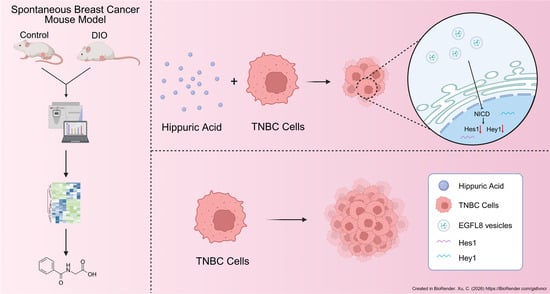
1. Introduction
2. Materials and Methods
2.1. Reagents
2.2. Analysis of Public Database
2.3. Analysis of Metabolomics Analysis
2.4. RNA Sequencing and Differential Expression Analysis
2.5. Serum Samples
2.6. Cell Culture
2.7. CCK8 Assay
2.8. Transwell Assay
2.9. RNA Extraction and Quantitative PCR
2.10. Colony Formation Assay
2.11. Plasmid Construction
2.12. Statistical Analysis
3. Results
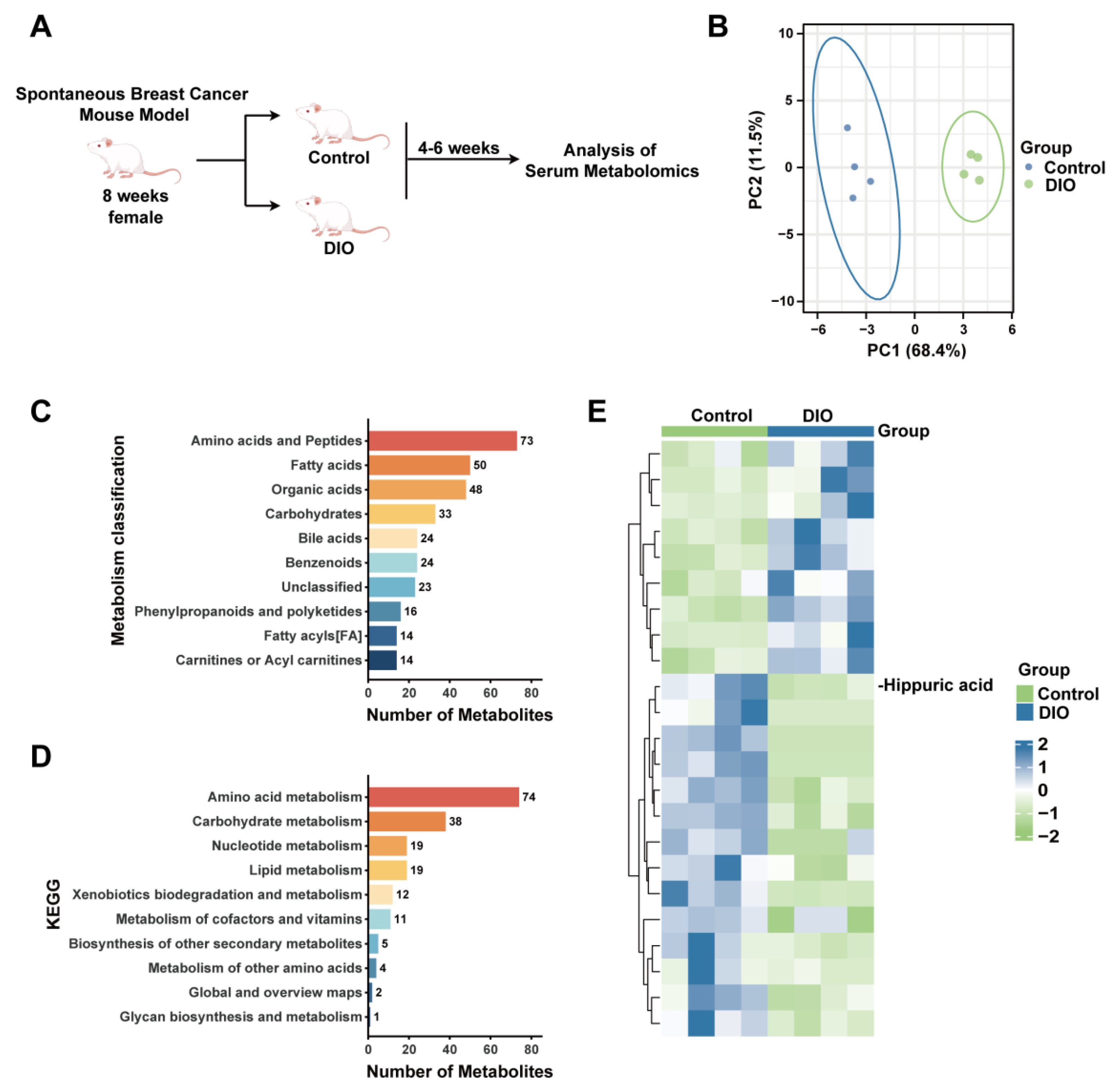
3.1. Metabolomic Analysis Identifies Hippuric Acid as a Key Metabolite Associated with Tumor Progression
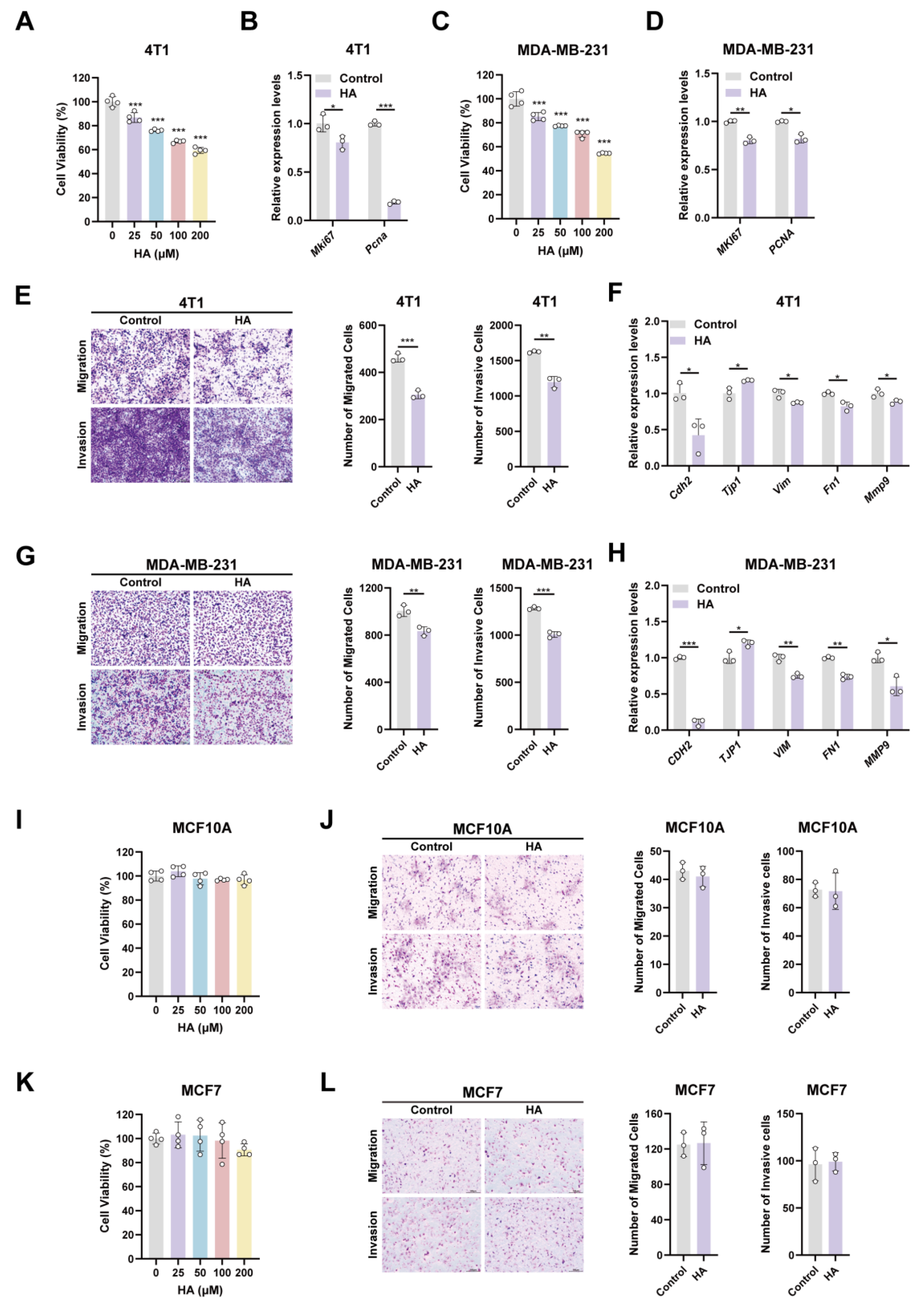
3.2. Hippuric Acid Selectively Inhibits Proliferation, Migration, and Invasion of Triple-Negative Breast Cancer (TNBC) Cells
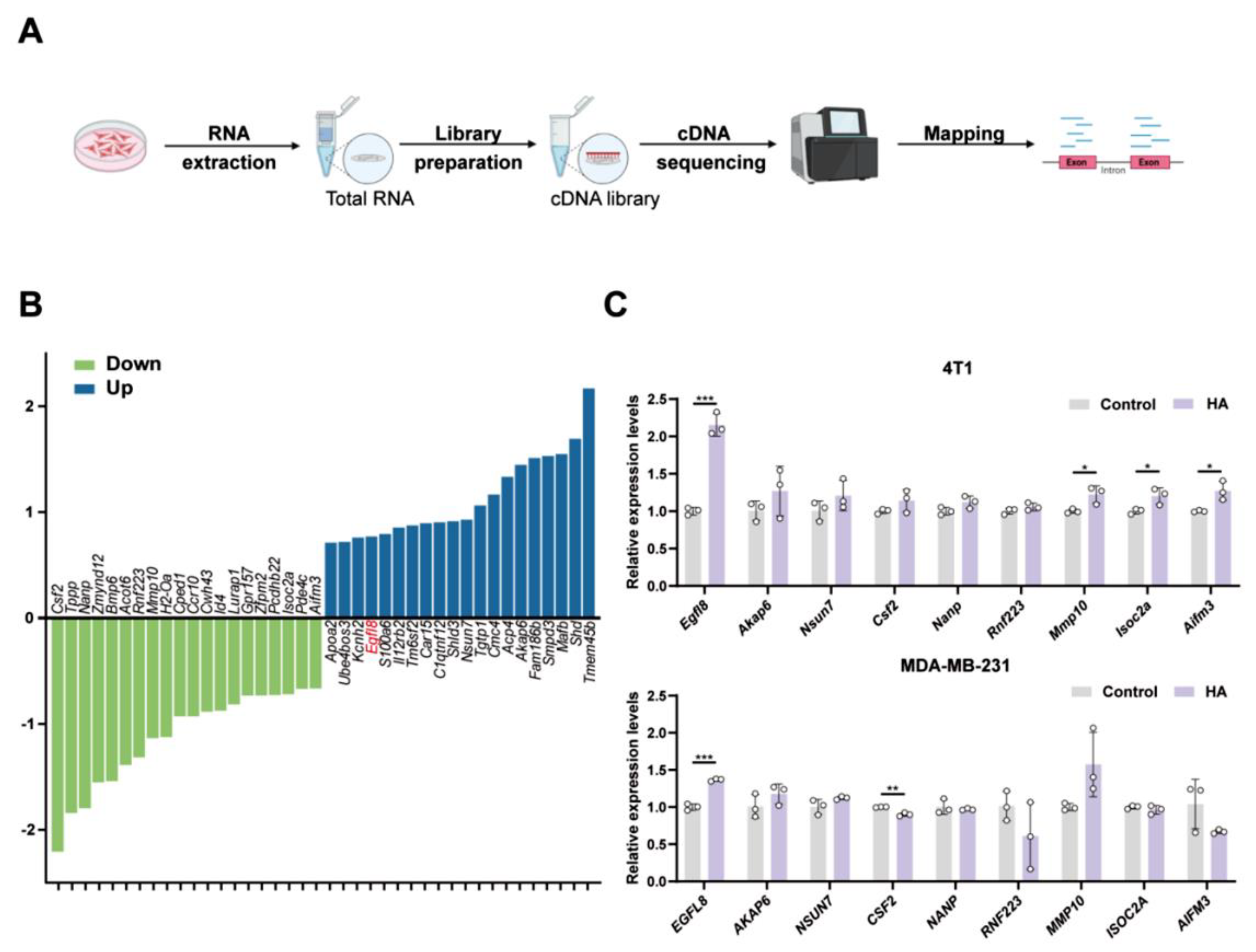
3.3. EGFL8 Is Identified as a Potential Downstream Mediator of Hippuric Acid
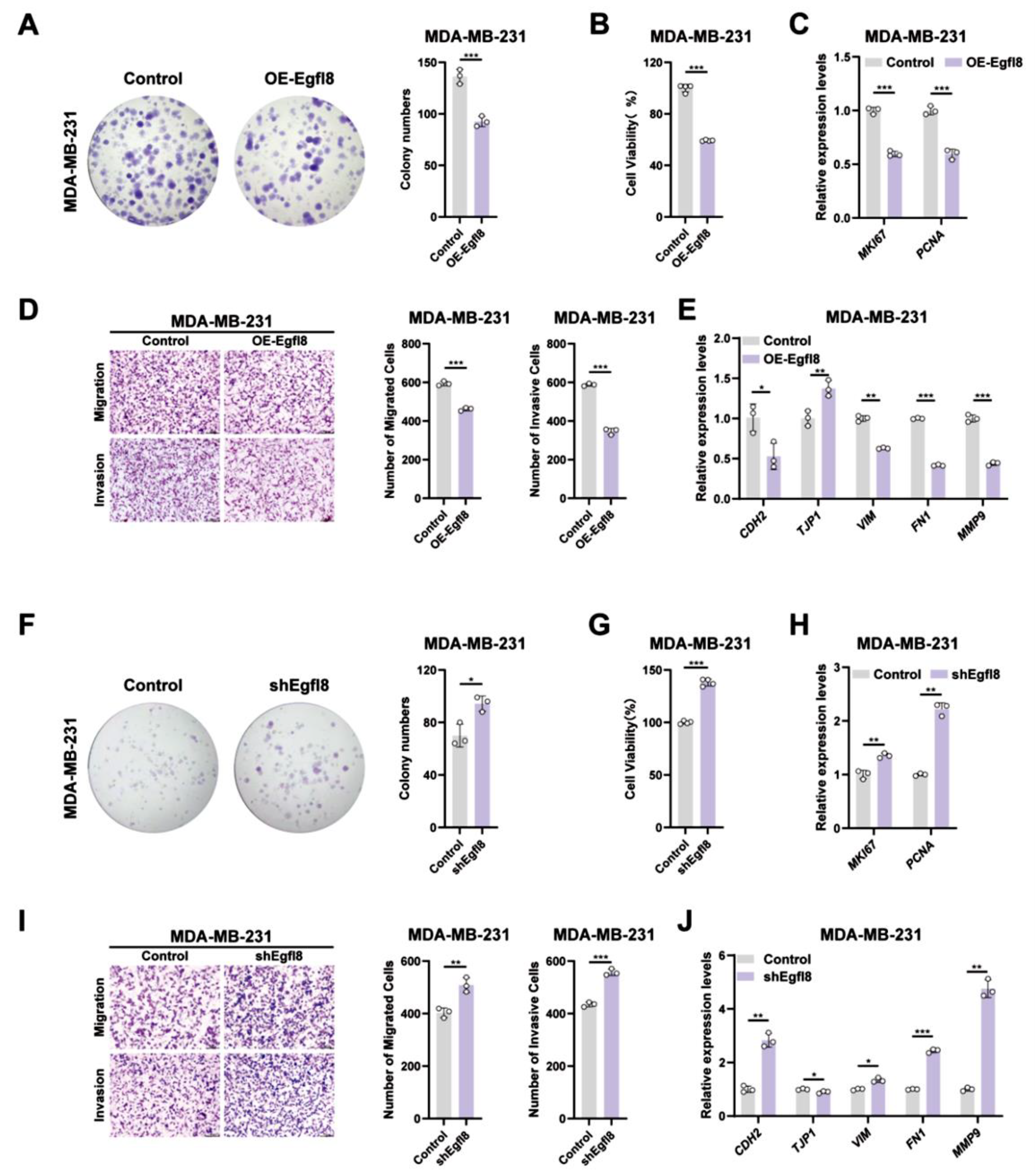
3.4. EGFL8 Suppresses TNBC Cell Proliferation, Migration, and Invasion
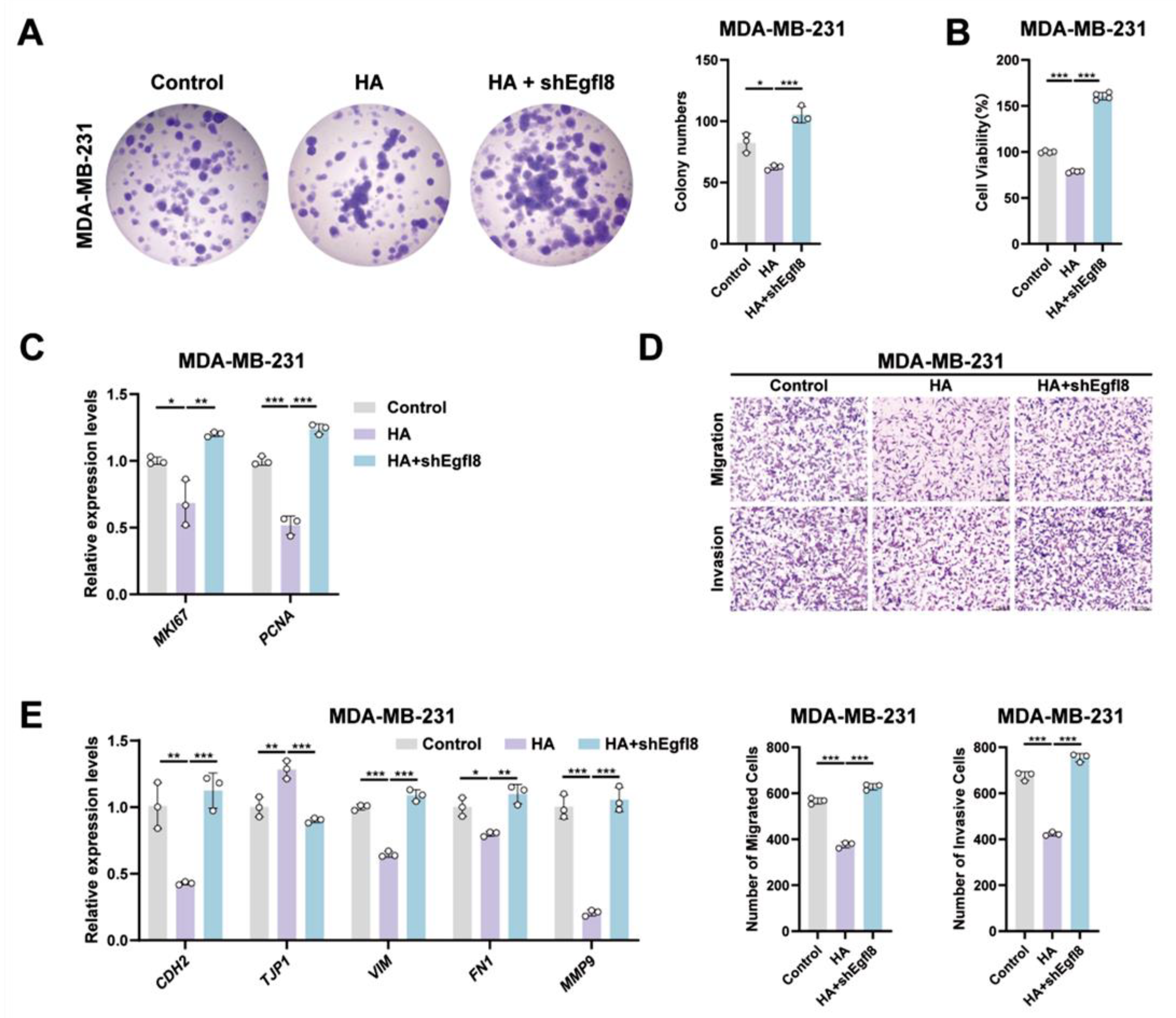
3.5. EGFL8 Mediates the Anti-Tumor Effects of Hippuric Acid
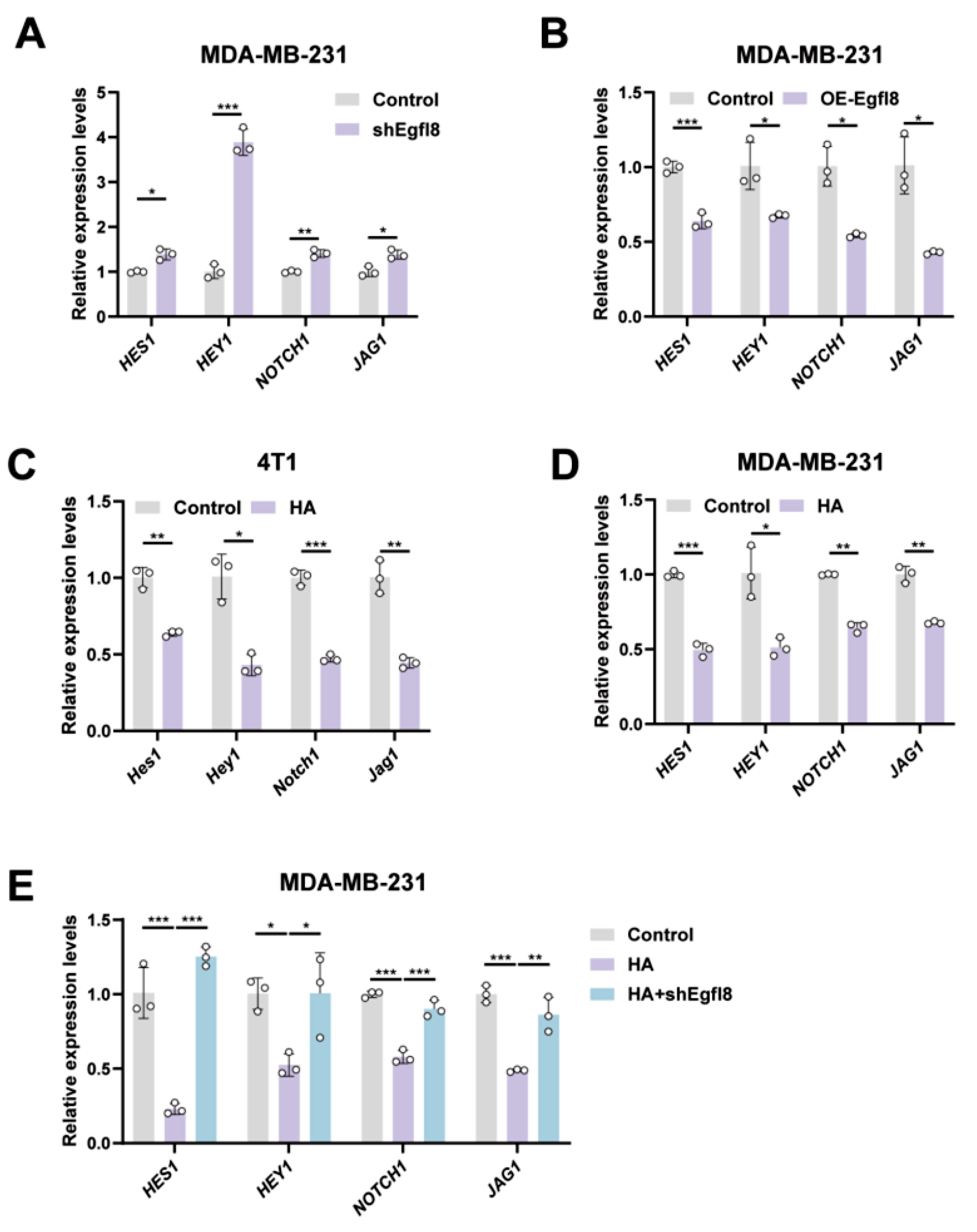
3.6. The EGFL8/Notch Signaling Axis Is Involved in Hippuric Acid-Mediated TNBC Suppression
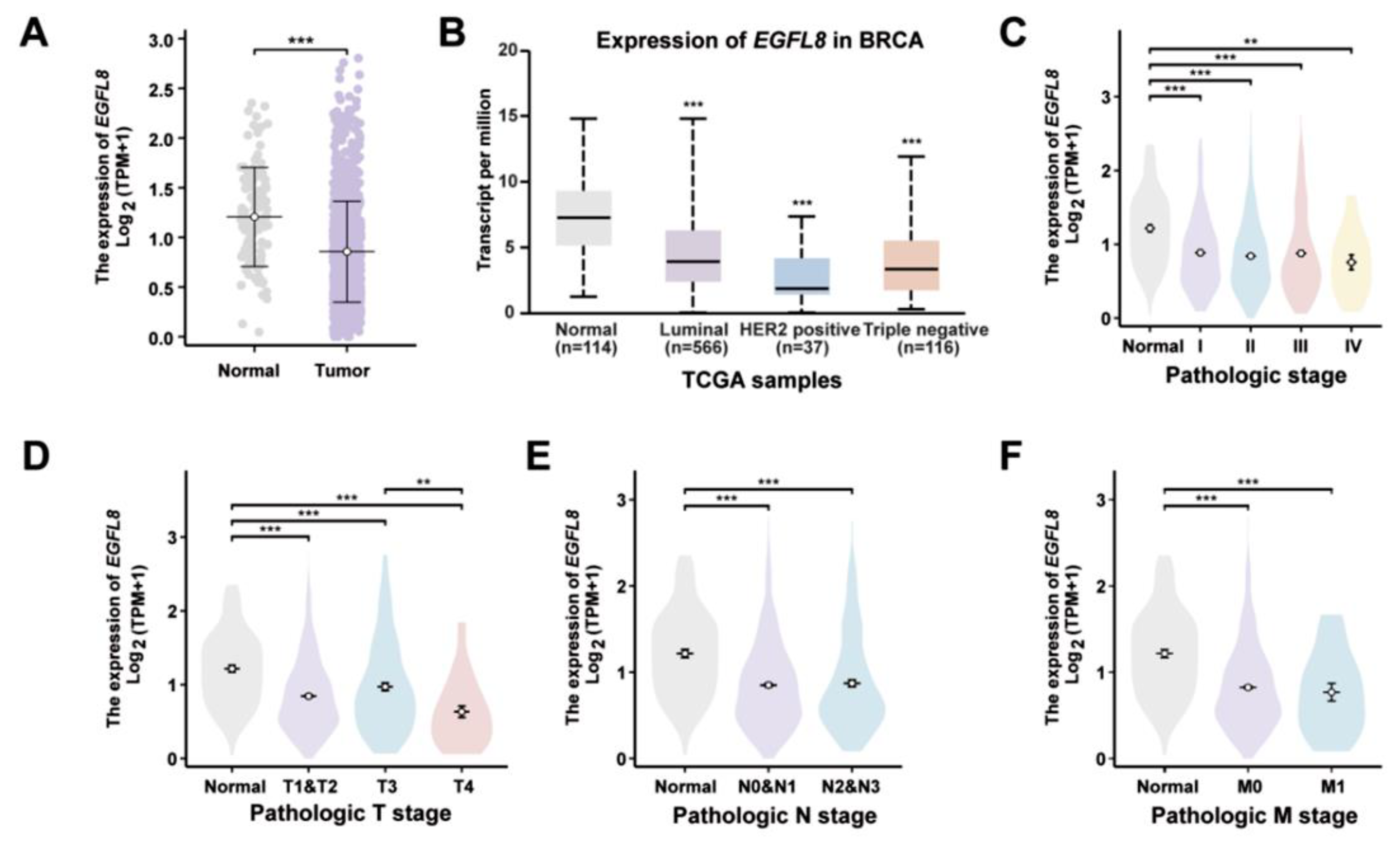
3.7. Clinical Relevance of EGFL8 in Breast Cancer
4. Discussion
5. Conclusions
Supplementary Materials
Author Contributions
Funding
Institutional Review Board Statement
Informed Consent Statement
Data Availability Statement
Acknowledgments
Conflicts of Interest
Abbreviations
| TNBC | Triple-negative breast cancer |
| DIO | Diet-induced obesity |
| MMTV-PyMT | Mouse Mammary Tumor Virus–Polyoma Middle T-antigen |
| ER | Estrogen receptor |
| PR | Progesterone receptor |
| EGFL8 | Epidermal growth factor-like domain-containing protein 8 |
| EGF | Epidermal growth factor |
| PCA | Principal component analysis |
| KEGG | Kyoto encyclopedia of genes and genomes |
| EMT | Epithelial–mesenchymal transition |
| DEGs | differentially expressed genes |
| VIP | Variable importance in projection |
| HA | Hippuric acid |
Appendix A

| Gene Names | Forward 5′-3′ | Reverse 5′-3′ |
|---|---|---|
| hKi67 (NM_001145966.2) | AGAAGAAGTGGTGCTTCGGAA | AGTTTGCGTGGCCTGTACTAA |
| hPcna (NM_002592.2) | CCTGCTGGGATATTAGCTCCA | CAGCGGTAGGTGTCGAAGC |
| hCdh2 (NM_001308176) | ATGCTGACGATCCCAATGC | GCCTTCCATGTCTGTAGCTTGA |
| hTjp1 (NM_003257.4) | CAACATACAGTGACGCTTCACA | CACTATTGACGTTTCCCCACTC |
| hVimentin (NM_003380.5) | GACGCCATCAACACCGAGTT | CTTTGTCGTTGGTTAGCTGGT |
| hFibronectin (NM_212482.3) | CGGTGGCTGTCAGTCAAAG | AAACCTCGGCTTCCTCCATAA |
| hMmp9 (NM_004994.3) | GGGACGCAGACATCGTCATC | TCGTCATCGTCGAAATGGGC |
| hActb (NM_001101.5) | CTGGCACCACACCTTCTACAATGAG | GATAGCACAGCCTGGATAGCAACG |
| hGapdh (NM_001256799) | CCACTGCCAACGTGTCAGTGGT | CCCAGCAGTGAGGGTCTCTCTCT |
| hEgfl8 (NM_030652.4) | TCTGCTCGCACCATTGTTTTA | ACGCTGAGTATGCTGGCAC |
| hAkap6 (NM_004274.5) | AGTTCTCCCTAAAGCTGCTGT | TCTGCCTAGTGTAGTTGCCATT |
| hNsun7 (NM_001330648.3) | GCATTGGCAAGATGTCGAATC | GGCCCTTAGTTCCTGTTTCCTA |
| hCsf2 (NM_000758.4) | TCCTGAACCTGAGTAGAGACAC | TGCTGCTTGTAGTGGCTGG |
| hNanp (NM_152667.3) | GTGAGCCGGTAGCTTCCTTT | GCCACGTGCCTTGCAATTAT |
| hRnf223 (NM_001205252.2) | TGATGCTCTTCTGTGTGGCA | TTATCAGTCAGAGGCCCGAG |
| hMmp10 (NM_002425.3) | TTTGGCTCATGCCTACCCAC | TCTTGCGAAAGGCGGAACTG |
| hIsoc2a (NM_001136201.2) | ATCCTCTGTCCTGTTCCTGTG | CTGAGACGATCTGTGGGAAGTA |
| hAifm3 (NM_001146288.2) | CTGTCTGCCACGTCAAGGAC | GCCGTAGTGCGGACACTTAT |
| hHes1 (NM_005524.4) | ATGACAGTGAAGCACCTCCG | CGTTCATGCACTCGCTGAAG |
| hHey1 (NM_001040708.2) | TGAGAAGCAGGTAATGGAGCAA | TAGTCCATAGCAAGGGCGTG |
| hNotch1 (NM_017617.5) | GCAAGAACGCCGGGACAT | GGTTGGTGAGGCAGGCATTG |
| hJag1 (NM_000214.3) | TGTGAGGCCAAACCTTGTGT | AGGCGTCATTCTGACACTGG |
| mKi67 (NM_001081117.2) | ATCATTGACCGCTCCTTTAGGT | GCTCGCCTTGATGGTTCCT |
| mPcna (NM_011045.2) | TTTGAGGCACGCCTGATCC | GGAGACGTGAGACGAGTCCAT |
| mCdh2 (NM_007664.5) | AGCGCAGTCTTACCGAAGG | TCGCTGCTTTCATACTGAACTTT |
| mTjp1 (NM_009386.2) | GCCGCTAAGAGCACAGCAA | TCCCCACTCTGAAAATGAGGA |
| mVimentin (NM_011701.4) | CGTCCACACGCACCTACAG | GGGGGATGAGGAATAGAGGCT |
| mFibronectin (NM_010233.2) | ATGTGGACCCCTCCTGATAGT | GCCCAGTGATTTCAGCAAAGG |
| mMmp9 (NM_013599.5) | CTGGACAGCCAGACACTAAAG | CTCGCGGCAAGTCTTCAGAG |
| mActb (NM_007393.5) | CACTGTCGAGTCGCGTCC | CGCAGCGATATCGTCATCCA |
| mGapdh (NM_001289726) | AGGTCGGTGTGAACGGATTTG | GGCCTCACCCCATTTGATGT |
| mEgfl8 (NM_152922.4) | AGTTTGGGAGTGTGCTCCAAG | CACGGTATGTGGTCCTGTAGG |
| mAkap6 (NM_198111.2) | GTGGATGTGCATCTAGTTCAGC | CATTGACCGAGTAGGACAGCA |
| mNsun7 (NM_001400914.1) | TGGACCCAACGAGTGAAAGG | GTATTGGCGACTACATCCCCC |
| mCsf2 (NM_009969.4) | GGCCTTGGAAGCATGTAGAGG | GGAGAACTCGTTAGAGACGACTT |
| mNanp (NM_026086.2) | GGACAACACACTCATCGACAC | AGCACTCCTTGCTCAGTTTAAC |
| mRnf223 (NM_001220499.3) | CTGCGTTGCATTAACCGACC | GGTGACCCTAGTTGTTGGCT |
| mMmp10 (NM_019471.3) | CGCTGAGAGGGGAAGTCCTA | AGAGTGGGCCAAAATGCTGA |
| mIsoc2a (NM_001101598.1) | AAGCCTGCATCTTGAACACAG | GCGAGGAAAGCTCCACTCTG |
| mAifm3 (NM_001291070.1) | ACCAACGTGCTCATAGTGGG | AGGACAATCCGGTCTGAGAAG |
| mHes1 (NM_008235.3) | CCAGCCAGTGTCAACACGA | AATGCCGGGAGCTATCTTTCT |
| mHey1 (NM_010423.2) | AGTTAACTCCTCCTTGCCCG | TGGTCTCGTCCAGCTCACTA |
| mNotch1 (NM_008714.3) | TGTGGCTTCCTTCTACTGCG | CTTTGCCGTTGACAGGGTTG |
| mJag1 (NM_013822.5) | GAGCGCCTCAAAGAAGCGA | ATTGGAGCATGCACGACTGG |
| Metabolite | FC(NCD/HFD) | VIP | p Value |
|---|---|---|---|
| Guanosine monophosphate | 0.03 | 1.15 | 0.002 |
| Guanosine (G) | 0.04 | 1.03 | 0.004 |
| Tartaric acid | 0.15 | 1.60 | <0.001 |
| 3,7-Diketocholanic Acid | 0.22 | 2.02 | <0.001 |
| 2-Hydroxy-2-methylbutyric acid | 0.33 | 1.48 | 0.006 |
| Piceid | 0.37 | 1.56 | 0.019 |
| Glutarylcarnitine(C5DC) | 0.42 | 1.63 | 0.003 |
| Oxalacetic acid | 0.43 | 1.51 | 0.006 |
| Ribose 5-phosphate | 0.47 | 1.26 | 0.028 |
| Ursocholic Acid(UCA) | 2.02 | 1.45 | 0.020 |
| 2-Deoxyglucose | 2.26 | 1.52 | 0.013 |
| Octanoylcarnitine(C8) | 2.28 | 1.64 | 0.024 |
| Xanthosine | 2.43 | 1.67 | 0.002 |
| 23,24-bisnor-5-cholenic acid-3beta-OL acetate | 2.63 | 1.50 | 0.015 |
| 4-androsten-17alpha-ol-3-one-17beta-carboxylic acid acetate | 3.19 | 1.56 | 0.007 |
| 7-Ketolithocholic Acid Acetate Methyl Ester | 3.83 | 1.37 | 0.015 |
| 4-Hydroxyphenyl-2-propionic acid | 4.49 | 1.56 | 0.024 |
| Hippuric acid | 8.49 | 1.44 | 0.019 |
| Trigonelline | 8.97 | 2.045 | 0.042 |
| Indole-3-propionic acid | 9.50 | 1.59 | <0.001 |
| myo-Inositol | 145,161.05 | 1.26 | 0.022 |
| Indole-3-methyl acetate | 7,875,433.71 | 1.58 | 0.004 |
| L-Sorbose | 9,819,533.37 | 1.34 | 0.021 |
References
- Bray, F.; Laversanne, M.; Sung, H.; Ferlay, J.; Siegel, R.L.; Soerjomataram, I.; Jemal, A. Global cancer statistics 2022: GLOBOCAN estimates of incidence and mortality worldwide for 36 cancers in 185 countries. CA Cancer J. Clin. 2024, 74, 229–263. [Google Scholar] [CrossRef] [PubMed]
- Kim, J.; Harper, A.; McCormack, V.; Sung, H.; Houssami, N.; Morgan, E.; Mutebi, M.; Garvey, G.; Soerjomataram, I.; Fidler-Benaoudia, M.M. Global patterns and trends in breast cancer incidence and mortality across 185 countries. Nat. Med. 2025, 31, 1154–1162. [Google Scholar] [CrossRef] [PubMed]
- Derakhshan, F.; Reis-Filho, J.S. Pathogenesis of Triple-Negative Breast Cancer. Annu. Rev. Pathol. Mech. Dis. 2022, 17, 181–204. [Google Scholar] [CrossRef] [PubMed]
- Luo, J.; Craver, A.; Moore, K.; Stepniak, L.; King, J.; Herbert, J.; Aschebrook-Kilfoy, B. Etiology of breast cancer: A perspective from epidemiologic studies. J. Natl. Cancer Cent. 2022, 2, 195–197. [Google Scholar] [CrossRef] [PubMed]
- His, M.; Gunter, M.; Keski-Rahkonen, P.; Rinaldi, S. Application of Metabolomics to Epidemiologic Studies of Breast Cancer: New Perspectives for Etiology and Prevention. J. Clin. Oncol. 2024, 42, 103–115. [Google Scholar] [CrossRef] [PubMed]
- Lamabadusuriya, D.; Jayasena, H.; Bopitiya, A.; De Silva, A.; Jayasekera, P. Obesity-driven inflammation and cancer risk: A comprehensive review. Semin. Cancer Biol. 2025, 114, 256–266. [Google Scholar] [CrossRef] [PubMed]
- Brown, K. Metabolic pathways in obesity-related breast cancer. Nat. Rev. Endocrinol. 2021, 17, 350–363. [Google Scholar] [CrossRef] [PubMed]
- Yang, J.; Wei, H.; Zhou, Y.; Szeto, C.; Li, C.; Lin, Y.; Coker, O.; Lau, H.; Chan, A.; Sung, J.; et al. High-Fat Diet Promotes Colorectal Tumorigenesis Through Modulating Gut Microbiota and Metabolites. Gastroenterology 2022, 162, 135–149.e2. [Google Scholar] [CrossRef] [PubMed]
- Chen, J.; Liu, X.; Zou, Y.; Gong, J.; Ge, Z.; Lin, X.; Zhang, W.; Huang, H.; Zhao, J.; Saw, P.; et al. A high- fat diet promotes cancer progression by inducing gut microbiota-mediated leucine production and PMN- MDSC differentiation. Proc. Natl. Acad. Sci. USA 2024, 121, 12. [Google Scholar] [CrossRef] [PubMed]
- Nicholson, J.; Connelly, J.; Lindon, J.; Holmes, E. Metabonomics: A platform for studying drug toxicity and gene function. Nat. Rev. Drug Discov. 2002, 1, 153–161. [Google Scholar] [CrossRef] [PubMed]
- Hoyles, L.; Jiménez-Pranteda, M.; Chilloux, J.; Brial, F.; Myridakis, A.; Aranias, T.; Magnan, C.; Gibson, G.; Sanderson, J.; Nicholson, J.; et al. Metabolic retroconversion of trimethylamine N-oxide and the gut microbiota. Microbiome 2018, 6, 14. [Google Scholar] [CrossRef] [PubMed]
- Jin, H.; Wang, J.; Wang, Z.; Xi, M.; Xia, B.; Deng, K.; Yang, J. Lipid metabolic reprogramming in tumor microenvironment: From mechanisms to therapeutics. J. Hematol. Oncol. 2023, 16, 33. [Google Scholar] [CrossRef] [PubMed]
- Faubert, B.; Solmonson, A.; DeBerardinis, R. Metabolic reprogramming and cancer progression. Science 2020, 368, eaaw5473. [Google Scholar] [CrossRef] [PubMed]
- Guy, C.T.; Cardiff, R.D.; Muller, W.J. Induction of mammary tumors by expression of polyomavirus middle T oncogene: A transgenic mouse model for metastatic disease. Mol. Cell. Biol. 1992, 12, 954–961. [Google Scholar] [CrossRef] [PubMed]
- Yang, Y.; Huang, S.; Liao, Y.; Wu, X.; Zhang, C.; Wang, X.; Yang, Z. Hippuric acid alleviates dextran sulfate sodium-induced colitis via suppressing inflammatory activity and modulating gut microbiota. Biochem. Biophys. Res. Commun. 2024, 710, 12. [Google Scholar] [CrossRef] [PubMed]
- Mirji, G.; Bhat, S.A.; El Sayed, M.; Reiser, S.K.; Gavara, S.P.; Ye, Y.; Miyamoto, T.; Zhang, W.; Vogel, P.; Cassel, J.; et al. Aromatic microbial metabolite hippuric acid enhances inflammatory responses in macrophages via TLR-MyD88 signaling and lipid remodeling. Cell Rep. 2026, 45, 116749. [Google Scholar] [CrossRef] [PubMed]
- Mallafré-Muro, C.; Llambrich, M.; Cumeras, R.; Pardo, A.; Brezmes, J.; Marco, S.; Gumà, J. Comprehensive Volatilome and Metabolome Signatures of Colorectal Cancer in Urine: A Systematic Review and Meta-Analysis. Cancers 2021, 13, 2534. [Google Scholar] [CrossRef] [PubMed]
- Brezmes, J.; Llambrich, M.; Cumeras, R.; Gumà, J. Urine NMR Metabolomics for Precision Oncology in Colorectal Cancer. Int. J. Mol. Sci. 2022, 23, 11171. [Google Scholar] [CrossRef] [PubMed]
- Zheng, W.; Tang, X.; Dong, J.; Feng, J.; Chen, M.; Zhu, X. Metabolomic screening of radioiodine refractory thyroid cancer patients and the underlying chemical mechanism of iodine resistance. Sci. Rep. 2024, 14, 10546. [Google Scholar] [CrossRef] [PubMed]
- Hatae, R.; Chamoto, K.; Kim, Y.H.; Sonomura, K.; Taneishi, K.; Kawaguchi, S.; Yoshida, H.; Ozasa, H.; Sakamori, Y.; Akrami, M.; et al. Combination of host immune metabolic biomarkers for the PD-1 blockade cancer immunotherapy. JCI Insight 2020, 5, e133501. [Google Scholar] [CrossRef] [PubMed]
- Shi, S.; Ma, T.; Xi, Y. A Pan-Cancer Study of Epidermal Growth Factor-Like Domains 6/7/8 as Therapeutic Targets in Cancer. Front. Genet. 2020, 11, 11. [Google Scholar] [CrossRef] [PubMed]
- Wu, F.; Zhang, F.; Tan, G.; Chen, W.; Huang, B.; Yan, L.; Zhang, H.; Chen, S.; Jiao, Y.; Wang, B. Down-regulation of EGFL8 regulates migration, invasion and apoptosis of hepatocellular carcinoma through activating Notch signaling pathway. BMC Cancer 2021, 21, 13. [Google Scholar] [CrossRef] [PubMed]
- Song, Y.; Kim, J.; Rajbongshi, L.; Lim, Y.; Ok, Y.; Hwang, S.; Park, H.; Lee, J.; Oh, S.; Kim, B.; et al. Silencing of Epidermal Growth Factor-like Domain 8 Promotes Proliferation and Cancer Aggressiveness in Human Ovarian Cancer Cells by Activating ERK/MAPK Signaling Cascades. Int. J. Mol. Sci. 2025, 26, 274. [Google Scholar] [CrossRef] [PubMed]
- Weiss, T.; Taschner-Mandl, S.; Janker, L.; Bileck, A.; Rifatbegovic, F.; Kromp, F.; Sorger, H.; Kauer, M.; Frech, C.; Windhager, R.; et al. Schwann cell plasticity regulates neuroblastic tumor cell differentiation via epidermal growth factor-like protein 8. Nat. Commun. 2021, 12, 19. [Google Scholar] [CrossRef] [PubMed]
- Wang, S.; Guo, M.; Xu, L.; Xue, J.; Chen, S.; Xu, K.; Zhou, Y.; Gu, A.; Gao, W.; Zhou, J.; et al. NRG4 suppresses breast cancer metastasis via ERBB4-YAP1-mediated down-regulation of MMPs. Genes Dis. 2026, 13, 101691. [Google Scholar] [CrossRef] [PubMed]
- Subhan, F.; Yoon, T.D.; Choi, H.J.; Muhammad, I.; Lee, J.; Hong, C.; Oh, S.O.; Baek, S.Y.; Kim, B.S.; Yoon, S. Epidermal growth factor-like domain 8 inhibits the survival and proliferation of mouse thymocytes. Int. J. Mol. Med. 2013, 32, 952–958. [Google Scholar] [CrossRef] [PubMed]
- Pruss, K.; Chen, H.; Liu, Y.; Van Treuren, W.; Higginbottom, S.; Jarman, J.; Fischer, C.; Mak, J.; Wong, B.; Cowan, T.; et al. Host-microbe co-metabolism via MCAD generates circulating metabolites including hippuric acid. Nat. Commun. 2023, 14, 12. [Google Scholar] [CrossRef] [PubMed]
- Chantrenne, H. Hippuric acid formation from glycine and dibenzoyl-phosphate. Nature 1947, 160, 603. [Google Scholar] [CrossRef] [PubMed]
- Beyoğlu, D.; Idle, J.R. The glycine deportation system and its pharmacological consequences. Pharmacol. Ther. 2012, 135, 151–167. [Google Scholar] [CrossRef] [PubMed]
- Ni, Q.; Xia, L.; Huang, Y.; Yuan, X.; Gu, W.; Chen, Y.; Wang, Y.; Nian, M.; Wu, S.; Cai, H.; et al. Gut microbiota dysbiosis orchestrates vitiligo-related oxidative stress through the metabolite hippuric acid. Microbiome 2025, 13, 112. [Google Scholar] [CrossRef] [PubMed]
- Pan, Y.; Yang, Y.; Peng, Z.; Wang, W.; Zhang, J.; Sun, G.; Wang, F.; Zhu, Z.; Cao, H.; Lyu, Y.; et al. Gut microbiota may modify the association between dietary polyphenol intake and serum concentrations of hippuric acid: Results from a 1-year longitudinal study in China. Am. J. Clin. Nutr. 2025, 121, 654–662. [Google Scholar] [CrossRef] [PubMed]
- Cai, Y.; Zheng, Y.; Gu, J.; Wang, S.; Wang, N.; Yang, B.; Zhang, F.; Wang, D.; Fu, W.; Wang, Z. Betulinic acid chemosensitizes breast cancer by triggering ER stress-mediated apoptosis by directly targeting GRP78. Cell Death Dis. 2018, 9, 636. [Google Scholar] [CrossRef] [PubMed]
- Weber, D.; Zhang, M.; Zhuang, P.; Zhang, Y.; Wheat, J.; Currie, G.; Al-Eisawi, Z. The efficacy of betulinic acid in triple-negative breast cancer. SAGE Open Med. 2014, 2, 2050312114551974. [Google Scholar] [CrossRef] [PubMed]
- Parker, L.H.; Schmidt, M.; Jin, S.W.; Gray, A.M.; Beis, D.; Pham, T.; Frantz, G.; Palmieri, S.; Hillan, K.; Stainier, D.Y.; et al. The endothelial-cell-derived secreted factor Egfl7 regulates vascular tube formation. Nature 2004, 428, 754–758. [Google Scholar] [CrossRef] [PubMed]
- Chim, S.M.; Tickner, J.; Chow, S.T.; Kuek, V.; Guo, B.; Zhang, G.; Rosen, V.; Erber, W.; Xu, J. Angiogenic factors in bone local environment. Cytokine Growth Factor Rev. 2013, 24, 297–310. [Google Scholar] [CrossRef] [PubMed]
- Shi, Q.; Xue, C.; Zeng, Y.; Yuan, X.; Chu, Q.; Jiang, S.; Wang, J.; Zhang, Y.; Zhu, D.; Li, L. Notch signaling pathway in cancer: From mechanistic insights to targeted therapies. Signal Transduct. Target. Ther. 2024, 9, 128. [Google Scholar] [CrossRef] [PubMed]
- Edwards, A.; Brennan, K. Notch Signalling in Breast Development and Cancer. Front. Cell Dev. Biol. 2021, 9, 692173. [Google Scholar] [CrossRef] [PubMed]
- Takebe, N.; Nguyen, D.; Yang, S.X. Targeting notch signaling pathway in cancer: Clinical development advances and challenges. Pharmacol. Ther. 2014, 141, 140–149. [Google Scholar] [CrossRef] [PubMed]
- Timmerman, L.A.; Grego-Bessa, J.; Raya, A.; Bertrán, E.; Pérez-Pomares, J.M.; Díez, J.; Aranda, S.; Palomo, S.; McCormick, F.; Izpisúa-Belmonte, J.C.; et al. Notch promotes epithelial-mesenchymal transition during cardiac development and oncogenic transformation. Genes Dev. 2004, 18, 99–115. [Google Scholar] [CrossRef]
- Erkert, L.; Kabisch, M.; Gamez-Belmonte, R.; Gonzalez-Acera, M.; Patankar, J.V.; Schödel, L.; Hofmann, K.; Wagner, Y.; Plattner, C.; Spath, E.M.; et al. Pharmacological inhibitors of the gamma-secretase enzyme complex disrupt epithelial cell function triggering colitis in mice. J. Crohns Colitis 2025, 19, jjaf096. [Google Scholar] [CrossRef] [PubMed]


Disclaimer/Publisher’s Note: The statements, opinions and data contained in all publications are solely those of the individual author(s) and contributor(s) and not of MDPI and/or the editor(s). MDPI and/or the editor(s) disclaim responsibility for any injury to people or property resulting from any ideas, methods, instructions or products referred to in the content. |
© 2026 by the authors. Licensee MDPI, Basel, Switzerland. This article is an open access article distributed under the terms and conditions of the Creative Commons Attribution (CC BY) license.
Share and Cite
Xu, T.; Wang, S.; Chen, S.; Zhou, Y.; Wang, D. Hippuric Acid Suppresses Triple-Negative Breast Cancer via the EGFL8-Notch Signaling Axis. Biomedicines 2026, 14, 1400. https://doi.org/10.3390/biomedicines14061400
Xu T, Wang S, Chen S, Zhou Y, Wang D. Hippuric Acid Suppresses Triple-Negative Breast Cancer via the EGFL8-Notch Signaling Axis. Biomedicines. 2026; 14(6):1400. https://doi.org/10.3390/biomedicines14061400
Chicago/Turabian StyleXu, Tianhan, Saijun Wang, Shuai Chen, Yan Zhou, and Dongmei Wang. 2026. "Hippuric Acid Suppresses Triple-Negative Breast Cancer via the EGFL8-Notch Signaling Axis" Biomedicines 14, no. 6: 1400. https://doi.org/10.3390/biomedicines14061400
APA StyleXu, T., Wang, S., Chen, S., Zhou, Y., & Wang, D. (2026). Hippuric Acid Suppresses Triple-Negative Breast Cancer via the EGFL8-Notch Signaling Axis. Biomedicines, 14(6), 1400. https://doi.org/10.3390/biomedicines14061400