Where Does Liquid Biopsy Add Value in Thyroid Cancer? Biological Rationale, Technological Innovation, and Clinical Utility


Abstract
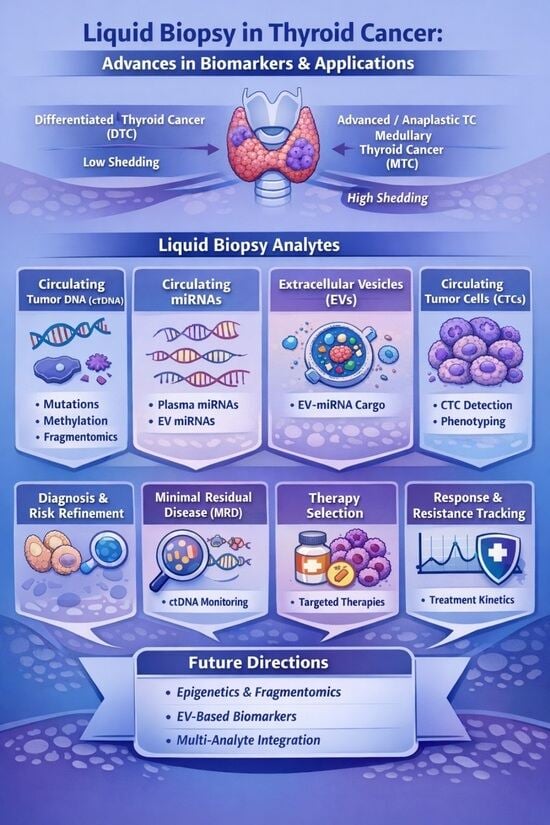
1. Introduction
2. Searching Strategy
3. Circulating Tumor Nucleic Acids
3.1. Circulating Tumor DNA
3.2. Circulating Tumor miRNAs
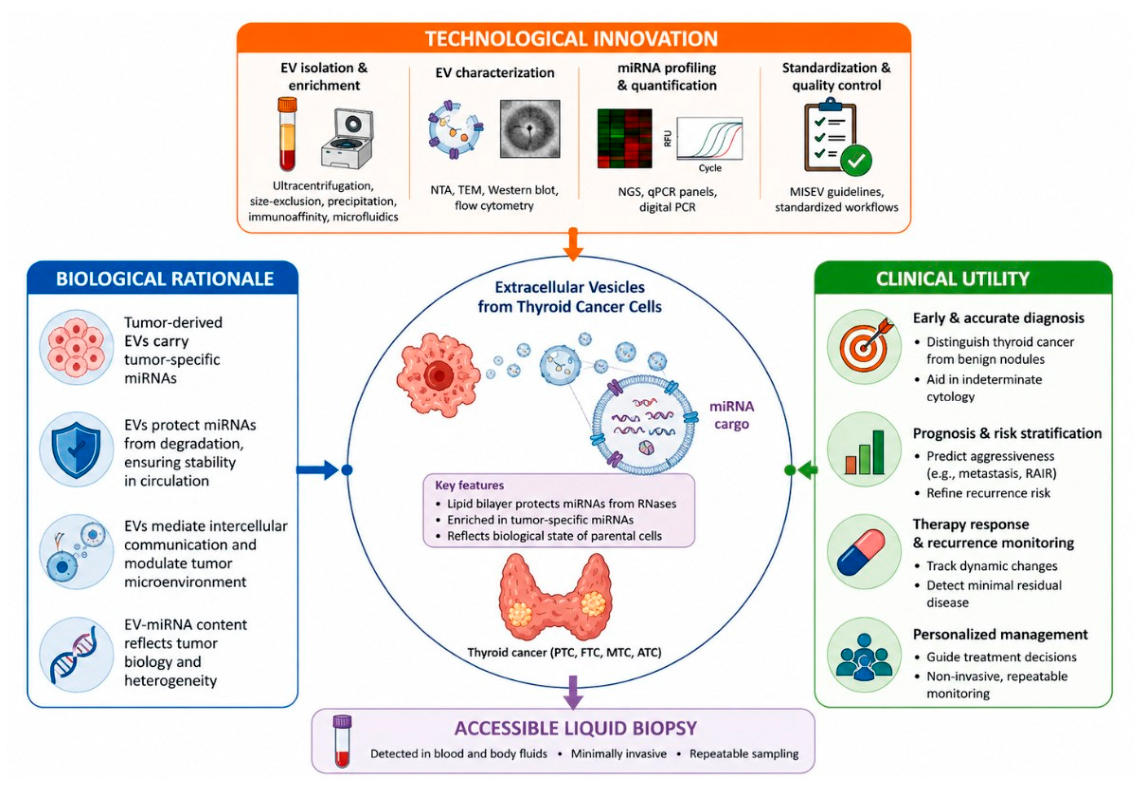
4. Extracellular Vesicles (EVs)
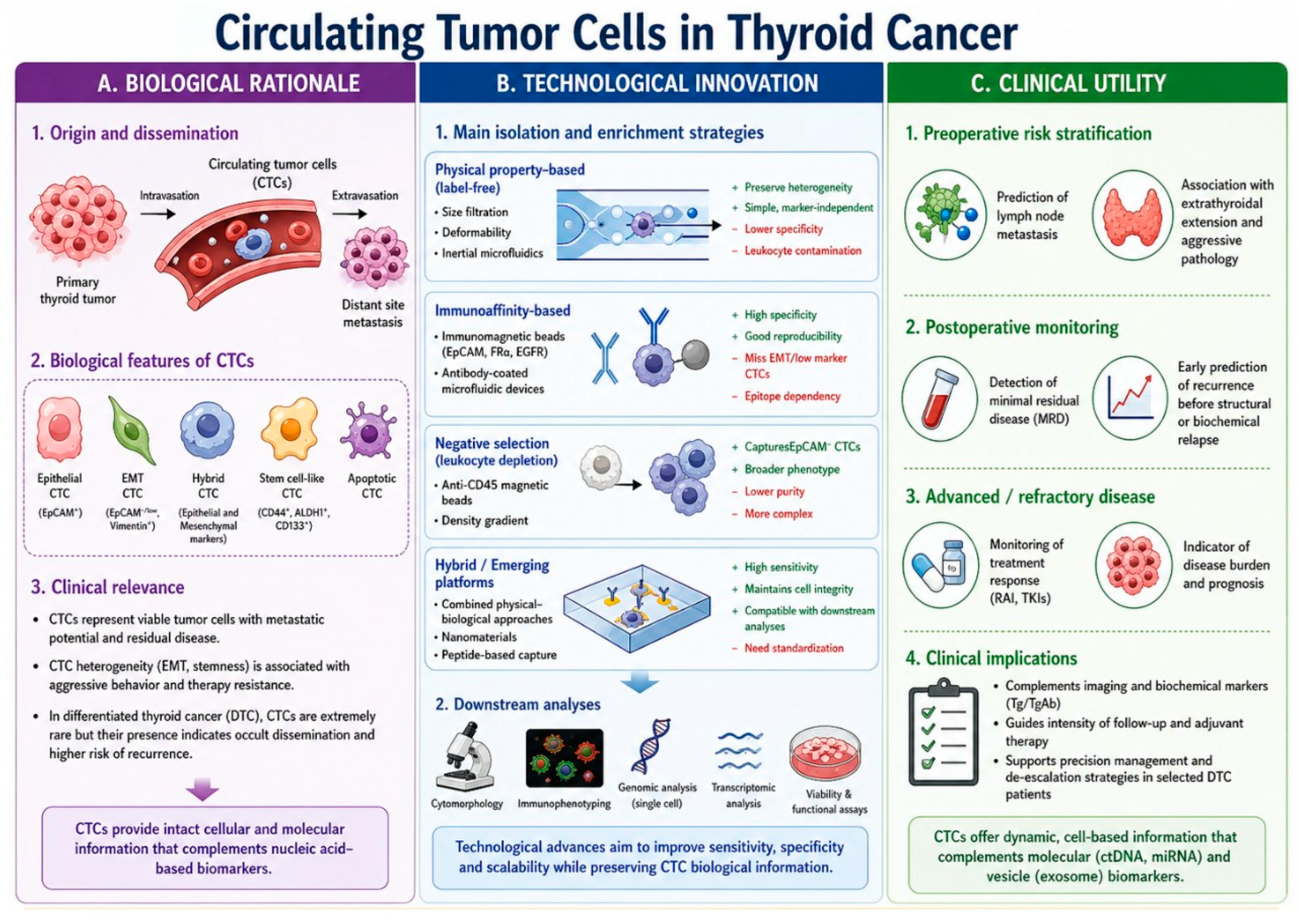
5. Circulating Tumor Cells
6. Conclusions and Future Directions
Author Contributions
Funding
Institutional Review Board Statement
Informed Consent Statement
Data Availability Statement
Acknowledgments
Conflicts of Interest
References
- Fagin, J.A.; Wells, S.A. Biologic and Clinical Perspectives on Thyroid Cancer. N. Engl. J. Med. 2016, 375, 1054–1067. [Google Scholar] [CrossRef]
- Ringel, M.D.; Sosa, J.A.; Baloch, Z.; Bischoff, L.; Bloom, G.; Brent, G.A.; Brock, P.L.; Chou, R.; Flavell, R.R.; Goldner, W.; et al. 2025 American Thyroid Association Management Guidelines for Adult Patients with Differentiated Thyroid Cancer. Thyroid 2025, 35, 841–985. [Google Scholar] [CrossRef] [PubMed]
- Ma, L.; Guo, H.; Zhao, Y.; Liu, Z.; Wang, C.; Bu, J.; Sun, T.; Wei, J. Liquid Biopsy in Cancer Current: Status, Challenges and Future Prospects. Signal Transduct. Target. Ther. 2024, 9, 336. [Google Scholar] [CrossRef]
- Wang, W.; Zheng, Z.; Lei, J. CTC, CtDNA, and Exosome in Thyroid Cancers: A Review. Int. J. Mol. Sci. 2023, 24, 13767. [Google Scholar] [CrossRef]
- Zeyghami, W.; Hansen, M.L.U.; Jakobsen, K.K.; Groenhøj, C.; Feldt-Rasmussen, U.; von Buchwald, C.; Hahn, C.H. Liquid Biopsies in Thyroid Cancers: A Systematic Review and Meta-Analysis. Endocr. Relat. Cancer 2023, 30, e230002. [Google Scholar] [CrossRef] [PubMed]
- Ryška, A.; Capdevila, J.; Dettmer, M.S.; Elisei, R.; Führer, D.; Hadoux, J.; Jarząb, B.; Locati, L.D.; Newbold, K.; Tallini, G.; et al. Molecular Predictive Biomarker Testing in Advanced Thyroid Cancer—A European Consensus. Eur. Thyroid J. 2025, 14, e250024. [Google Scholar] [CrossRef]
- Pietrasz, D.; Sereni, E.; Lancelotti, F.; Pea, A.; Luchini, C.; Innamorati, G.; Salvia, R.; Bassi, C. Circulating Tumour DNA: A Challenging Innovation to Develop “Precision Onco-Surgery” in Pancreatic Adenocarcinoma. Br. J. Cancer 2022, 126, 1676–1683. [Google Scholar] [CrossRef] [PubMed]
- Normanno, N.; Morabito, A.; Rachiglio, A.M.; Sforza, V.; Landi, L.; Bria, E.; Delmonte, A.; Cappuzzo, F.; De Luca, A. Circulating Tumour DNA in Early Stage and Locally Advanced NSCLC: Ready for Clinical Implementation? Nat. Rev. Clin. Oncol. 2025, 22, 215–231. [Google Scholar] [CrossRef]
- Lauer, E.M.; Mutter, J.; Scherer, F. Circulating Tumor DNA in B-Cell Lymphoma: Technical Advances, Clinical Applications, and Perspectives for Translational Research. Leukemia 2022, 36, 2151–2164. [Google Scholar] [CrossRef]
- Crisafulli, G.; Gonzalez, N.S.; Patelli, G.; Bardelli, A. Detecting Cancer Early with Ultrasensitive Multimodal Liquid Biopsy. Cancer Discov. 2025, 15, 1774–1776. [Google Scholar] [CrossRef]
- Bettegowda, C.; Sausen, M.; Leary, R.J.; Kinde, I.; Wang, Y.; Agrawal, N.; Bartlett, B.R.; Wang, H.; Luber, B.; Alani, R.M.; et al. Detection of Circulating Tumor DNA in Early- and Late-Stage Human Malignancies. Sci. Transl. Med. 2014, 6, 224. [Google Scholar] [CrossRef]
- Ciampi, R.; Romei, C.; Ramone, T.; Matrone, A.; Prete, A.; Gambale, C.; Materazzi, G.; De Napoli, L.; Torregrossa, L.; Basolo, F.; et al. Pre- and Post-Operative Circulating Tumoral DNA in Patients With Medullary Thyroid Carcinoma. J. Clin. Endocrinol. Metab. 2022, 107, E3420–E3427. [Google Scholar] [CrossRef] [PubMed]
- Tarasova, V.D.; Tsai, J.; Masannat, J.; Prera, J.C.H.; Johnson, J.H.; Veloski, C.; Salgado, S.A.; McIver, B.; Drusbosky, L.M.; Chung, C.H. Characterization of the Thyroid Cancer Genomic Landscape by Plasma-Based Circulating Tumor DNA Next-Generation Sequencing. Thyroid 2024, 34, 197–205. [Google Scholar] [CrossRef] [PubMed]
- Razavi, P.; Li, B.T.; Brown, D.N.; Jung, B.; Hubbell, E.; Shen, R.; Abida, W.; Juluru, K.; De Bruijn, I.; Hou, C.; et al. High-Intensity Sequencing Reveals the Sources of Plasma Circulating Cell-Free DNA Variants. Nat. Med. 2019, 25, 1928–1937. [Google Scholar] [CrossRef] [PubMed]
- Hu, Y.; Ulrich, B.C.; Supplee, J.; Kuang, Y.; Lizotte, P.H.; Feeney, N.B.; Guibert, N.M.; Awad, M.M.; Wong, K.K.; Janne, P.A.; et al. False-Positive Plasma Genotyping Due to Clonal Hematopoiesis. Clin. Cancer Res. 2018, 24, 4437–4443. [Google Scholar] [CrossRef]
- Hurt, R.T.; Ghosh, A.K.; Dougan, B.M.; Gilman, E.A.; Salonen, B.R.; Adusumalli, J.; Bonnes, S.L.; Andersen, C.A.; Pasha, A.S.; Nanda, S.; et al. Implementation of a Multicancer Detection (MCD) Test in a Tertiary Referral Center in Asymptomatic Patients: An 18-Month Prospective Cohort Study. J. Prim. Care Community Health 2025, 16, 21501319251329290. [Google Scholar] [CrossRef]
- Sasieni, P.; Swanton, C.; Neal, R.D. The NHS-Galleri Multi-Cancer Screening Trial: Explanation and Justification of Unique and Important Design Issues. J. Natl. Cancer Inst. 2026, 118, 573–578. [Google Scholar] [CrossRef]
- Fleck, L.M. Multicancer Early Detection Screening Tools: Not Economically Efficient, Not Ethically Equitable, Marginally Medically Effective. Camb. Q. Healthc. Ethics 2025, 34, 499–512. [Google Scholar] [CrossRef]
- Mota Dias Thomaz, D.; Gomes Rocha, W.; Cavallari Albuquerque, J.; de Oliveira Ribeiro Viana, A.; Maranhão Fagundes Velloni, J.; Elen Costa da Silva, R.; Alberto Curioni, O.; Mesquita Callegari, F.; Roberto Maciel Martins, J.; Paula Mello Biscolla, R.; et al. Tumor-Informed Liquid Biopsy for Monitoring Thyroid Cancer: A Proof-of-Concept Study. Eur. Thyroid J. 2025, 15, ETJ250255. [Google Scholar]
- Hamidi, S.; Dadu, R.; Iyer, P.C.; Busaidy, N.L.; Maniakas, A.; Wang, J.R.; Banuchi, V.E.; Hosseini, S.M.; Williams, M.D.; Zafereo, M.E.; et al. Circulating Tumor DNA as a Biomarker for Disease Surveillance in Anaplastic Thyroid Cancer. JCO Precis. Oncol. 2025, 9, e2500067. [Google Scholar] [CrossRef]
- Wijewardene, A.; Clifton-Bligh, R.J.; Wang, B.; Luxford, C.; Robinson, B.G.; Bullock, M.; Gild, M. Evaluating the Prognostic Potential of Circulating Cell-Free DNA in Advanced Thyroid Cancer. Endocr. Relat. Cancer 2025, 32, e240227. [Google Scholar] [CrossRef] [PubMed]
- Wijewardene, A.A.; Chehade, M.; Gild, M.L.; Clifton-Bligh, R.J.; Bullock, M. Translational Utility of Liquid Biopsies in Thyroid Cancer Management. Cancers 2021, 13, 3443. [Google Scholar] [CrossRef]
- Xu, S.L.; Tian, Y.Y.; Zhou, Y.; Liu, L.Q. Diagnostic Value of Circulating MicroRNAs in Thyroid Carcinoma: A Systematic Review and Meta-Analysis. Clin. Endocrinol. 2020, 93, 489–498. [Google Scholar] [CrossRef]
- Geropoulos, G.; Psarras, K.; Papaioannou, M.; Giannis, D.; Meitanidou, M.; Kapriniotis, K.; Symeonidis, N.; Pavlidis, E.T.; Pavlidis, T.E.; Sapalidis, K.; et al. Circulating MicroRNAs and Clinicopathological Findings of Papillary Thyroid Cancer: A Systematic Review. In Vivo 2022, 36, 1551–1569. [Google Scholar] [CrossRef]
- Verrienti, A.; Pecce, V.; Grani, G.; Del Gatto, V.; Barp, S.; Maranghi, M.; Giacomelli, L.; Di Gioia, C.; Biffoni, M.; Filetti, S.; et al. Serum MicroRNA-146a-5p and MicroRNA-221-3p as Potential Clinical Biomarkers for Papillary Thyroid Carcinoma. J. Endocrinol. Investig. 2025, 48, 619–631. [Google Scholar] [CrossRef]
- Jankovic Miljus, J.; Guillén-Sacoto, M.A.; Makiadi-Alvarado, J.; Wert-Lamas, L.; Ramirez-Moya, J.; Robledo, M.; Santisteban, P.; Riesco-Eizaguirre, G. Circulating MicroRNA Profiles as Potential Biomarkers for Differentiated Thyroid Cancer Recurrence. J. Clin. Endocrinol. Metab. 2022, 107, 1280–1293. [Google Scholar] [CrossRef]
- Kalluri, R.; LeBleu, V.S. The Biology, Function, and Biomedical Applications of Exosomes. Science 2020, 367, eaau6977. [Google Scholar] [CrossRef]
- Garcia-Martin, R.; Wang, G.; Brandão, B.B.; Zanotto, T.M.; Shah, S.; Kumar Patel, S.; Schilling, B.; Kahn, C.R. MicroRNA Sequence Codes for Small Extracellular Vesicle Release and Cellular Retention. Nature 2022, 601, 446–451. [Google Scholar] [CrossRef] [PubMed]
- Delcorte, O.; Degosserie, J.; Pierreux, C.E. Role of Extracellular Vesicles in Thyroid Physiology and Diseases: Implications for Diagnosis and Treatment. Biomedicines 2022, 10, 2585. [Google Scholar] [CrossRef]
- Jia, M.; Liang, J.; Gao, L.; Wei, N.; Qin, Y.; Li, Q.; Wang, X.; Zheng, J.; Wang, H.; Wang, J.; et al. Navigating Thyroid Cancer Complexity: The Emerging Role of EV-Derived Non-Coding RNAs. Cell Death Discov. 2025, 11, 142. [Google Scholar] [CrossRef] [PubMed]
- Toraih, E.A.; Elshazli, R.M.; Trinh, L.N.; Hussein, M.H.; Attia, A.A.; Ruiz, E.M.L.; Zerfaoui, M.; Fawzy, M.S.; Kandil, E. Diagnostic and Prognostic Performance of Liquid Biopsy-Derived Exosomal MicroRNAs in Thyroid Cancer Patients: A Systematic Review and Meta-Analysis. Cancers 2021, 13, 4295. [Google Scholar] [CrossRef] [PubMed]
- Capriglione, F.; Verrienti, A.; Celano, M.; Maggisano, V.; Sponziello, M.; Pecce, V.; Gagliardi, A.; Giacomelli, L.; Aceti, V.; Durante, C.; et al. Analysis of Serum MicroRNA in Exosomal Vehicles of Papillary Thyroid Cancer. Endocrine 2022, 75, 185–193. [Google Scholar] [CrossRef]
- Delcorte, O.; Craps, J.; Mahibullah, S.; Spourquet, C.; D’Auria, L.; Van Der Smissen, P.; Dessy, C.; Marbaix, E.; Mourad, M.; Pierreux, C.E. Two MiRNAs Enriched in Plasma Extracellular Vesicles Are Potential Biomarkers for Thyroid Cancer. Endocr. Relat. Cancer 2022, 29, 389–401. [Google Scholar] [CrossRef]
- D’Amico, G.; Santonocito, R.; Grech, G.; Graceffa, G.; Cipolla, C.; Scalia, F.; Raccosta, S.; Manno, M.; Conway de Macario, E.; Macario, A.J.L.; et al. MiRNAs in Extracellular Vesicles as Biomarkers in Plasma of Papillary Thyroid Cancer Patients: A Proof-of-Concept Study. Biology 2024, 13, 743. [Google Scholar] [CrossRef]
- Li, G.; Chen, W.; Gong, Y.; Wei, T.; Gong, R.; Zhu, J.; Li, Z.; Lei, J. Identification of Circulating Exosomal MicroRNAs Associated with Radioiodine Refractory in Papillary Thyroid Carcinoma. J. Pers. Med. 2022, 12, 2017. [Google Scholar] [CrossRef]
- Li, G.; Chen, W.; Jiang, K.; Huang, J.; Zhong, J.; Liu, X.; Wei, T.; Gong, R.; Li, Z.; Zhu, J.; et al. Exosome-Mediated Delivery of MiR-519e-5p Promotes Malignant Tumor Phenotype and CD8+T-Cell Exhaustion in Metastatic PTC. J. Clin. Endocrinol. Metab. 2024, 109, 1601–1617. [Google Scholar] [CrossRef]
- Li, G.; Wang, H.; Zhong, J.; Bai, Y.; Chen, W.; Jiang, K.; Huang, J.; Shao, Y.; Liu, J.; Gong, Y.; et al. Circulating Small Extracellular Vesicle-Based MiRNA Classifier for Follicular Thyroid Carcinoma: A Diagnostic Study. Br. J. Cancer 2024, 130, 925–933. [Google Scholar] [CrossRef]
- Liang, M.X.; Fei, Y.J.; Yang, K.; Tang, W.J.; Cao, X.H.; Tang, J.H. Potential Values of Circulating Tumor Cell for Detection of Recurrence in Patients of Thyroid Cancer: A Diagnostic Meta-Analysis. BMC Cancer 2022, 22, 954. [Google Scholar] [CrossRef]
- Ricci, C.; Salvemini, A.; Dalmiglio, C.; Castagna, M.G.; Cantara, S. From Circulating Tumor Cells to Mirna: New Challenges in the Diagnosis and Prognosis of Medullary Thyroid Cancer. Cancers 2023, 15, 4009. [Google Scholar] [CrossRef] [PubMed]
- Schmidt, M.; Antke, C.; Mattes-György, K.; Hautzel, H.; Allelein, S.; Haase, M.; Dringenberg, T.; Schott, M.; Ehlers, M. Radioiodine Therapy Reduces the Frequency of Circulating Tumour Cells in Patients with Differentiated Thyroid Cancer. Clin. Endocrinol. 2021, 94, 1004–1011. [Google Scholar] [CrossRef] [PubMed]
- Innaro, N.; Gervasi, R.; Ferrazzo, T.; Garo, N.C.; Curto, L.S.; Lavecchia, A.; Aquila, I.; Donato, G.; Malara, N. Minimal Residual Disease Assessment of Papillary Thyroid Carcinoma through Circulating Tumor Cell-Based Cytology. Cancer Med. 2022, 11, 4830–4837. [Google Scholar] [CrossRef] [PubMed]
- Li, D.; Li, N.; Ding, Y. Epithelial-to-Mesenchymal Transition of Circulating Tumor Cells and CD133 Expression on Predicting Prognosis of Thyroid Cancer Patients. Mol. Clin. Oncol. 2022, 17, 141. [Google Scholar] [CrossRef]
- Zeng, Q.; Zhong, H.; Rao, H.; Wang, Y. Diagnostic Value of Circulating Tumor Cells in Patients with Thyroid Cancer: A Retrospective Study of 1478 Patients. Discov. Oncol. 2024, 15, 114. [Google Scholar] [CrossRef] [PubMed]
- Yu, H.W.; Park, E.; Lee, J.K.; Kim, W.; Kong, J.H.; Sunoo, J.; Hong, S.C.; Choi, J.Y. Analyzing Circulating Tumor Cells and Epithelial-Mesenchymal Transition Status of Papillary Thyroid Carcinoma Patients Following Thyroidectomy: A Prospective Cohort Study. Int. J. Surg. 2024, 110, 3357–3364. [Google Scholar] [CrossRef]
- Yu, M.; Deng, J.; Gu, Y.; Lai, Y. Preoperative High Level of Circulating Tumor Cells Is an Independent Risk Factor for Central Lymph Node Metastasis in Papillary Thyroid Carcinoma with Maximum Lesion Diameter ≤1.0 cm. Int. J. Gen. Med. 2024, 17, 4907–4916. [Google Scholar] [CrossRef]
- Gu, Y.; Yu, M.; Deng, J.; Lai, Y. Preoperative Circulating Tumor Cells Level Is Associated with Lymph Node Metastasis in Patients with Unifocal Papillary Thyroid Carcinoma. World J. Surg. Oncol. 2025, 23, 47. [Google Scholar] [CrossRef]
- Yu, M.; Deng, J.; Gu, Y.; Lai, Y.; Zheng, Z. Positive Preoperative Circulating Tumor Cells Level Associated with Lymph Node Metastasis in Papillary Thyroid Carcinoma Patients with Capsular Invasion. World J. Surg. Oncol. 2025, 23, 190. [Google Scholar] [CrossRef] [PubMed]
- Jiang, L.; Li, X.; Ma, T.; Zeng, P.; Tan, Z.; Zheng, C.; Xu, J.; Zhang, L.; Guo, Y.; Pan, Y.; et al. Clinical Significance for Risk Stratification of Papillary Thyroid Cancer by TUMORFISHER Circulating Tumor Cell Technique. Clin. Cancer Res. 2026, 32, 1313–1324. [Google Scholar] [CrossRef]
- Maansson, C.T.; Nielsen, A.L.; Sorensen, B.S. Liquid Biopsy Epigenetics: Establishing a Molecular Profile Based on Cell-Free DNA. Mol. Oncol. 2025, 20, 588–610. [Google Scholar] [CrossRef]
- Tsui, W.H.A.; Jiang, P.; Lo, Y.M.D. Cell-Free DNA Fragmentomics in Cancer. Cancer Cell 2025, 43, 1792–1814. [Google Scholar] [CrossRef]
- Martín-Arana, J.; Gimeno-Valiente, F.; Henriksen, T.V.; García-Micó, B.; Martínez-Castedo, B.; Gambardella, V.; Martínez-Ciarpaglini, C.; Palomar, B.; Huerta, M.; Camblor, D.G.; et al. Whole-Exome Tumor-Agnostic CtDNA Analysis Enhances Minimal Residual Disease Detection and Reveals Relapse Mechanisms in Localized Colon Cancer. Nat. Cancer 2025, 6, 1000–1016. [Google Scholar] [CrossRef]
- Lockwood, C.M.; Merker, J.D.; Bain, E.; Compton, C.; Grossman, R.L.; Johann, D.; Jones, F.; Jones, G.; Kreifels, M.; LeBlang, S.; et al. Towards Preanalytical Best Practices for Liquid Biopsy Studies: A BLOODPAC Landscape Analysis. Clin. Pharmacol. Ther. 2025, 117, 28–33. [Google Scholar] [CrossRef] [PubMed]
- Welsh, J.A.; Goberdhan, D.C.I.; O’Driscoll, L.; Buzas, E.I.; Blenkiron, C.; Bussolati, B.; Cai, H.; Di Vizio, D.; Driedonks, T.A.P.; Erdbrügger, U.; et al. Minimal Information for Studies of Extracellular Vesicles (MISEV2023): From Basic to Advanced Approaches. J. Extracell. Vesicles 2024, 13, e12404. [Google Scholar] [CrossRef] [PubMed]
- Kim, J.; Yang, J.D.; Agopian, V.G.; Zhu, Y.; Tseng, H.R.; You, S. Computational Frameworks for Enhanced Extracellular Vesicle Biomarker Discovery. Exp. Mol. Med. 2026, 58, 73–81. [Google Scholar] [CrossRef]
- Imanbekova, M.; Sharma, M.; Wachsmann-Hogiu, S. On the Dilemma of Using Single EV Analysis for Liquid Biopsy: The Challenge of Low Abundance of Tumor EVs in Blood. Theranostics 2025, 15, 8031–8048. [Google Scholar] [CrossRef]
- Febbo, P.G.; Allo, M.; Alme, E.B.; Cuyun Carter, G.; Dumanois, R.; Essig, A.; Kiernan, E.; Kubler, C.B.; Martin, N.; Popescu, M.C.; et al. Recommendations for the Equitable and Widespread Implementation of Liquid Biopsy for Cancer Care. JCO Precis. Oncol. 2024, 8, e2300382. [Google Scholar] [CrossRef] [PubMed]



| Study (Author, Year) | Study Design & Population | Thyroid Cancer Type(s) | ctDNA Methodology & Technology | Main Clinical Findings | Key Limitations |
|---|---|---|---|---|---|
| Ciampi et al. 2022 [12] | Prospective peri-operative cohort; n = 29 sporadic cases; paired pre- and post-operative sampling (median follow-up ~8 months) | Medullary thyroid carcinoma (MTC) | Tumor-informed targeted NGS; strict preanalytics (EDTA, rapid processing); deep sequencing (~20,000× ctDNA); positivity VAF > 0.4% | Low pre-op ctDNA detection (15.4%) but enrichment in aggressive disease (RET M918T, higher tumor VAF); post-op ctDNA positivity associated with elevated calcitonin/CEA and persistent disease | Small cohort; relatively high VAF cutoff limits low-level MRD detection; heterogeneous post-op sampling times; CH not studied |
| Tarasova et al. 2024 [13] | Large retrospective database analysis; n = 1094 plasma samples (2016–2021) | Mixed; enriched for advanced disease (ATC, PTC, FTC, MTC, PDTC) | Tumor-agnostic commercial plasma NGS panel (Guardant360); bTMB calculated in subset; CH assessed. | ≥1 alteration detected in 78.3%; subtype-specific landscapes (e.g., BRAF V600E in PTC/ATC, RAS in FTC, RET in MTC); higher bTMB in ATC | No systematic tissue concordance; limited staging/therapy annotation; hypothesis-generating rather than outcome-defining |
| Thomaz et al. 2025 [19] | Cross-sectional feasibility study; n = 34; correlation with ATA response categories | Differentiated thyroid cancer (mixed) | Tumor-informed digital PCR for ctDNA and cfRNA (including fusions) | ctDNA/ctRNA detected in all structural incomplete responses; 91% of excellent responses ctDNA-negative; cfRNA fusion detected despite undetectable thyroglobulin in one case | Small sample size; cross-sectional design; limited longitudinal outcome data; CH not studied |
| Hamidi et al. 2025 [20] | Retrospective cohort; n = 45 baseline; longitudinal monitoring in n = 31 (130 samples) | Anaplastic thyroid carcinoma (ATC) | Plasma ctDNA monitoring (NGS-based); baseline and serial assessments | ctDNA concordant with disease status in 93%; surveillance sensitivity ~77–78% with 100% specificity/PPV for recurrence/progression; false negatives linked to low burden or restricted metastatic sites | Retrospective design; false negatives in low-shedding scenarios; molecular heterogeneity; CH not studied |
| Wijewardene et al. 2025 [21] | Prospective cohort (2020–2024); n = 40 | Advanced/metastatic MTC, PDTC, ATC | Plasma cfDNA NGS (50-gene panel; Ion Torrent Genexus); Streck tubes; serial sampling | cfDNA mutations detected in 50% overall; higher sensitivity pre-TKI (86%) vs on-therapy (54%); higher cfDNA levels and rising cfDNA associated with worse PFS | Limited panel (e.g., no TERT promoter, limited fusion detection); small subtype-specific numbers; reduced shedding under effective therapy; CH not studied |
| Study (Author, Year) | Study Design & Population | Thyroid Cancer Type(s) | EV Isolation/miRNA Detection Methodology | Main Clinical Findings | Key Limitations |
|---|---|---|---|---|---|
| Delcorte et al., 2022 [33] | Case–control, paired tissue–plasma–EV analysis; n ~40 | PTC vs. benign nodules | Iodixanol density cushion and size exclusion chromatography/Targeted qRT-PCR (TaqMan assays) on EV-RNA | In purified plasma-derived EVs, only miR-146b-5p and miR-21-5p among six candidates were significantly different between PTC and benign thyroid disease. No discriminatory signal was observed in bulk plasma, supporting EV-specific enrichment. | Small sample size, limited miRNA panel, miRNA levels did not change after thyroidectomy |
| Capriglione et al., 2022 [32] | Two-stage study: discovery + independent validation; n ~90 | PTC, benign nodules, healthy controls | Polymer-based EV isolation from serum/TaqMan miRNA array → qRT-PCR validation | A four-miRNA EV signature—miR-24-3p, miR-146a-5p, miR-181a-5p, and miR-382-5p—discriminated PTC from healthy controls. Whole plasma/serum did not show comparable discrimination, and the association with nodal metastasis was inconsistent. | Small sample size, Contamination with non-vesicular material. |
| Li G et al., 2022 [35] | Translational study: RAIR models + clinical validation; n ~60 | RAIR vs. RAI-avid PTC | Ultracentrifugation/Small RNA sequencing → qRT-PCR validation | EV miR-1296-5p elevated in RAIR PTC; high diagnostic accuracy; associated with NIS loss | Small sample size, unresolved function and mechanism of exosomal miR-1269-5p. |
| D’Amico et al., 2024 [34] | Proof-of-concept longitudinal perioperative study; n ~30 | PTC vs. benign goiter | Ultracentrifugation/Targeted qRT-PCR on EV-miRNAs | Three EV-miRNAs—miR-1-3p, miR-206, and miR-221-3p—were elevated in PTC compared with benign disease and normalized after surgery, supporting tumor origin and potential value for postoperative monitoring. | Larger cohort, limited miRNA panel, short follow-up after surgery. |
| Li G et al., 2024 (JCEM) [36] | Translational study: discovery + validation cohorts; n > 100 | metastatic vs. non-metastatic PTC | Ultracentrifugation/miRNA microarray → TaqMan stem-loop qRT-PCR | EV miR-519e-5p enriched in metastatic PTC; EV-specific discrimination of metastatic disease | Limited sample size during the initial screening phase and insufficient exploration of clinical heterogeneity. |
| Li G et al., 2024 (Br J Cancer) [37] | Multicenter diagnostic study: training + external validation; n ~190 | FTC vs. benign follicular adenomas | Ultracentrifugation/Small RNA sequencing → qRT-PCR-based EV-miRNA classifier | Five-miRNA EV classifier (miR- 127-3p, miR-223-5p, miR-432-5p, miR-146a-5p and miR-151a-3p) accurately discriminated FTC from benign nodules; EV-miRNAs outperformed cell-free miRNAs | Limited follow-up, lack of prognostic validation, need for technical validation with advanced detection technology |
| Study (Author, Year) | Study Design & Population | Thyroid Cancer Type(s) | CTCs Methodology & Technology | Main Clinical Findings | Key Limitations |
|---|---|---|---|---|---|
| Schmidt, 2021 [40] | Prospective paired study; n ~55 | DTC, before and after radioidine therapy | EpCAM-based immunofluorescence CTCs detection | CTCs counts decreased after radioiodine therapy | Low counts; EpCAM dependence; no long-term outcomes |
| Innaro, 2022 [41] | Observational cohort; n ~40 | PTC after initial therapy | CTCs enrichment with cytology-like evaluation | Feasible cytological assessment from blood | Small cohort; lack of molecular confirmation |
| Li D, 2022 [42] | Retrospective prognostic cohort; n ~349 | PTC, FTC, MTC, ATC | EMT and CD133 phenotyping of CTCs | EMT+/CD133+ CTCs associated with poor prognosis | Single time-point; EMT marker specificity |
| Zeng Q, 2024 [43] | Retrospective preoperative cohort; n ~1478 | Malignant group vs. Benign group | FR + CTCs by immunomagnetic depletion + qPCR | Higher FR + CTCs in malignant and aggressive tumors | Retrospective; moderate diagnostic accuracy |
| Yu HW, 2024 [44] | Prospective postoperative PTC cohort; n ~62 | PTC before and after 2 weeks and 3 months | FR + CTCs longitudinal monitoring | Persistent CTCs linked to recurrence | Short follow-up; perioperative confounding |
| Yu M, 2024 [45] | Retrospective cohort; n ~705 | PTC and Lymph node metastasis | FR + CTCs preoperative detection | CTCs identify aggressive microcarcinomas | Selection bias; retrospective design |
| Gu Y, 2025 [46] | Retrospective cohort; n ~507 | PTC and Lymph node metastasis | Preoperative FR + CTCs assessment | CTCs positivity predicts nodal disease | Single-center; surgical bias |
| Yu M, 2025 [47] | Retrospective cohort; n ~746 | PTC and Capsular invasion and nodal spread | FR + CTCs correlated with pathology | CTCs associated with invasive features | Incremental value not fully assessed |
| Jiang L, 2026 [48] | Prospective technology-driven cohort; n ~200 | Preoperative PTC | Tumorfisher peptide–nanoparticle CTCs capture | Dual-threshold model predicts recurrence risk | Limited metastatic cases; EpCAM reliance |
Disclaimer/Publisher’s Note: The statements, opinions and data contained in all publications are solely those of the individual author(s) and contributor(s) and not of MDPI and/or the editor(s). MDPI and/or the editor(s) disclaim responsibility for any injury to people or property resulting from any ideas, methods, instructions or products referred to in the content. |
© 2026 by the authors. Licensee MDPI, Basel, Switzerland. This article is an open access article distributed under the terms and conditions of the Creative Commons Attribution (CC BY) license.
Share and Cite
Alonso-Chamorro, M.; Mejorada, A.P.; Riesco-Eizaguirre, G. Where Does Liquid Biopsy Add Value in Thyroid Cancer? Biological Rationale, Technological Innovation, and Clinical Utility. Biomedicines 2026, 14, 1274. https://doi.org/10.3390/biomedicines14061274
Alonso-Chamorro M, Mejorada AP, Riesco-Eizaguirre G. Where Does Liquid Biopsy Add Value in Thyroid Cancer? Biological Rationale, Technological Innovation, and Clinical Utility. Biomedicines. 2026; 14(6):1274. https://doi.org/10.3390/biomedicines14061274
Chicago/Turabian StyleAlonso-Chamorro, María, Ainhoa Palacios Mejorada, and Garcilaso Riesco-Eizaguirre. 2026. "Where Does Liquid Biopsy Add Value in Thyroid Cancer? Biological Rationale, Technological Innovation, and Clinical Utility" Biomedicines 14, no. 6: 1274. https://doi.org/10.3390/biomedicines14061274
APA StyleAlonso-Chamorro, M., Mejorada, A. P., & Riesco-Eizaguirre, G. (2026). Where Does Liquid Biopsy Add Value in Thyroid Cancer? Biological Rationale, Technological Innovation, and Clinical Utility. Biomedicines, 14(6), 1274. https://doi.org/10.3390/biomedicines14061274