Article

Multidrug-Resistance Patterns and Predictors in Adult Acute Pyelonephritis: A Three-Year Cohort from a Tertiary Romanian Center with Derivation of the PYELO-MDR-Risk Score

by
Livia Stanga
1,†,
Ovidiu Rosca
2,†,
Iulia Georgiana Bogdan
2,
Ciprian Ilie Roșca
3,*,
Horia Silviu Branea
4,*,
Camelia Vidița Gurban
5 and
Marius Papurica
6
1
Discipline of Microbiology, Faculty of Medicine, Victor Babes University of Medicine and Pharmacy, 300041 Timisoara, Romania
2
Department of Infectious Diseases, Victor Babes University of Medicine and Pharmacy, 300041 Timisoara, Romania
3
Department V, Internal Medicine I—Discipline of Medical Semiology I, Center of Advanced Research in Cardiology and Hemostaseology, Victor Babes University of Medicine and Pharmacy, 300041 Timisoara, Romania
4
Department of Internal Medicine I—Medical Semiotics II, Victor Babes University of Medicine and Pharmacy, 300041 Timisoara, Romania
5
Department IV: Biochemistry and Pharmacology, Discipline of Biochemistry, Victor Babes University of Medicine and Pharmacy, Eftimie Murgu Square 2, 300041 Timisoara, Romania
6
Anaesthesia and Intensive Care Research Center, Faculty of Medicine, Victor Babes University of Medicine and Pharmacy, Eftimie Murgu Square 2, 300041 Timisoara, Romania
*
Authors to whom correspondence should be addressed.
These authors contributed equally to this work.
Biomedicines 2026, 14(6), 1264; https://doi.org/10.3390/biomedicines14061264

Submission received: 8 May 2026 / Revised: 29 May 2026 / Accepted: 30 May 2026 / Published: 1 June 2026
(This article belongs to the Section Molecular and Translational Medicine)

Abstract

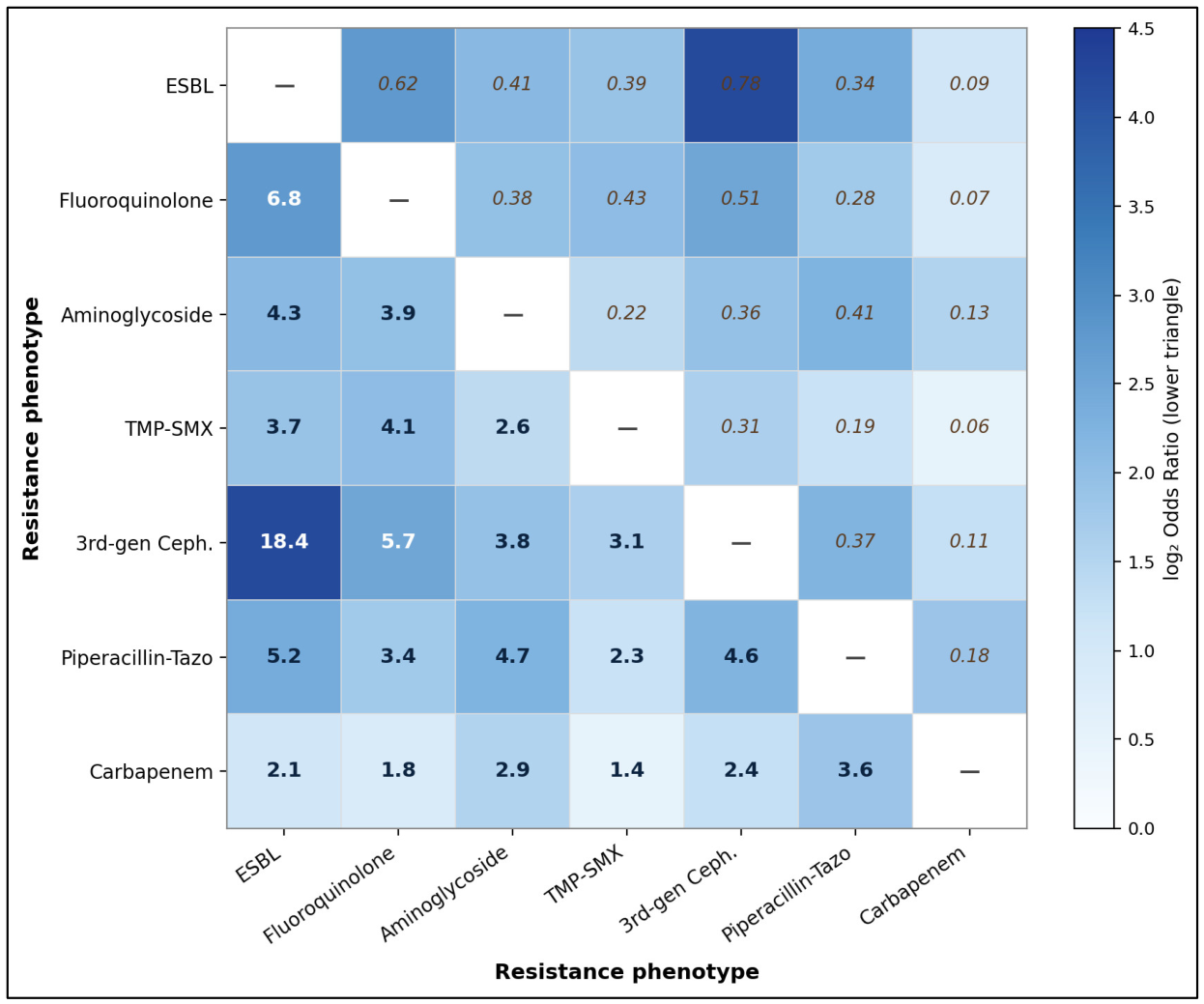
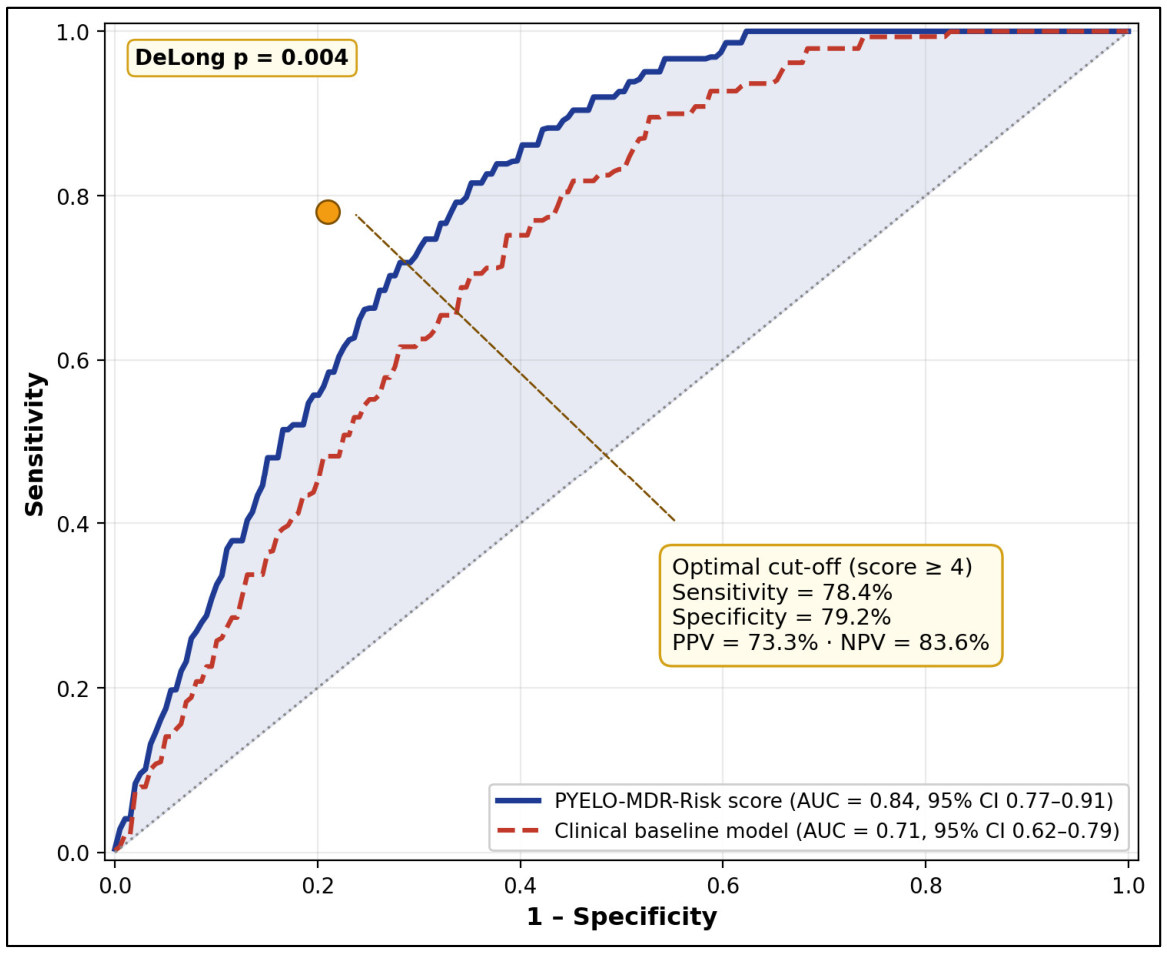
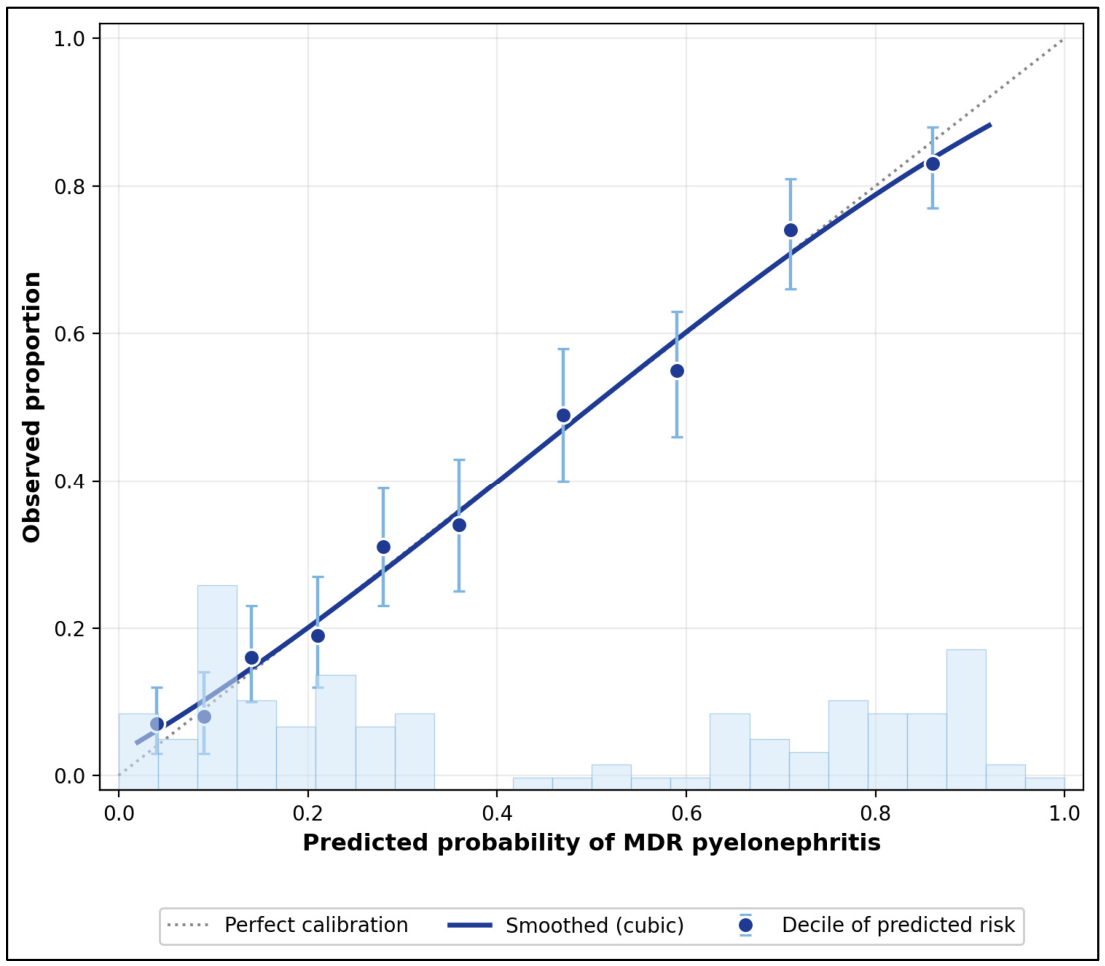
Background and Objectives: Multidrug-resistant (MDR) uropathogens are reshaping the empirical management of acute pyelonephritis, particularly in Eastern European centers. We aimed to describe MDR patterns, identify admission-level predictors, including renal impairment/renal-failure status at presentation and major healthcare exposure variables, and derive a bedside risk score (PYELO-MDR-Risk) for adult pyelonephritis at a Romanian tertiary hospital. Methods: We retrospectively analyzed 129 consecutive culture-confirmed acute pyelonephritis admissions at “Victor Babeș” University Hospital, Timișoara (March 2022–March 2025). MDR was defined as non-susceptibility to ≥1 agent in ≥3 antimicrobial categories. We compared MDR and non-MDR cases on demographics, microbiology, time-to-effective therapy (TTE), and outcomes; multivariable logistic regression identified independent predictors and was the basis for a points-based score with bootstrap-based internal validation (1000 resamples). Results: Fifty-four patients (41.9%) had MDR pyelonephritis. Escherichia coli remained the dominant uropathogen (55.8%) but was less prevalent in the MDR group (40.7% vs. 66.7%; p = 0.003), whereas Klebsiella pneumoniae and Pseudomonas aeruginosa were enriched. Independent predictors of MDR were antibiotic exposure ≤90 days (aOR 5.7, 95% CI 2.4–13.6), recurrent UTI (aOR 3.4, 1.4–8.2), recent hospitalization (aOR 3.1, 1.2–8.0), and renal impairment/renal-failure status at admission (aOR 2.4, 1.0–6.2). Immunosuppression, prior urinary tract instrumentation, and nephrolithiasis/urolithiasis were evaluated as candidate predictors but did not independently improve the final point score after adjustment. MDR was associated with delayed effective therapy (28.4 vs. 9.7 h; p < 0.001), longer hospitalization (13.7 vs. 8.9 days; p < 0.001), and higher 30-day readmission (20.4% vs. 8.0%; p = 0.038). The PYELO-MDR-Risk score (range 0–12) achieved an optimism-corrected AUC of 0.84 with adequate calibration (Hosmer–Lemeshow p = 0.624). Conclusions: MDR drives a substantial fraction of pyelonephritis admissions in Western Romania and tracks closely with prior antibiotic and healthcare exposure. The PYELO-MDR-Risk score offers a transparent bedside tool for empirical-therapy decisions in the local setting, pending national and international external validation.
Keywords: pyelonephritis; drug resistance; multiple; bacterial; anti-bacterial agents; Enterobacteriaceae infections; risk assessment pyelonephritis; drug resistance; multiple; bacterial; anti-bacterial agents; Enterobacteriaceae infections; risk assessment