Admission Inflammatory Blood Cell Ratios as Prognostic Markers of Functional Outcome After Aneurysmal Subarachnoid Hemorrhage: A Single-Center Retrospective Cohort Study


 ,
, 
Abstract
1. Introduction
2. Materials and Methods
2.1. Study Design and Setting
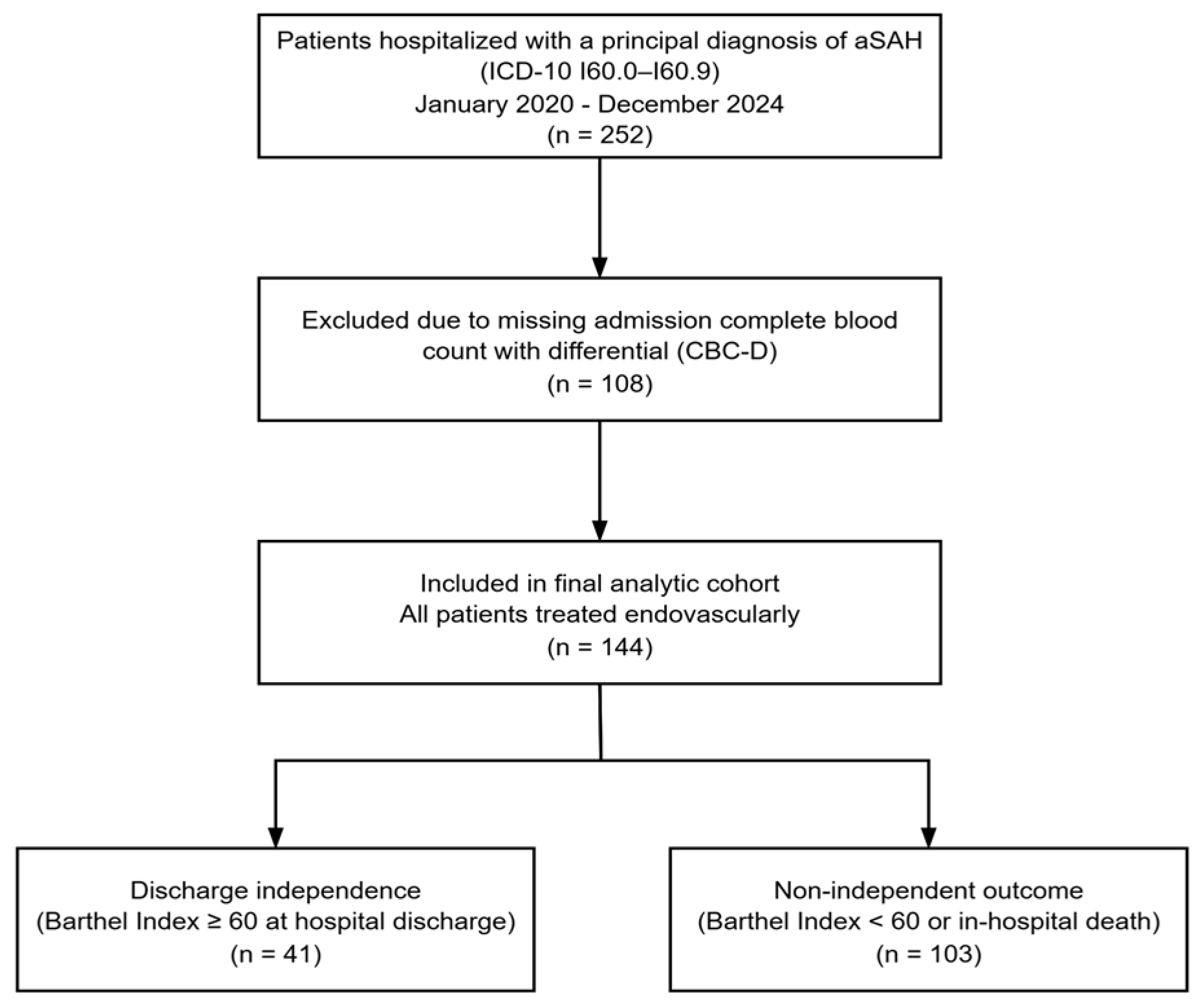
2.2. Study Population and Eligibility Criteria
2.3. Data Sources and Variables
2.4. Inflammatory Indices
2.5. Outcome Definition
2.6. Statistical Analysis
3. Results
3.1. Cohort Characteristics and Univariable Comparisons
3.2. Hospital-Acquired Infections and In-Hospital Mortality
3.3. Multivariable Associations with Discharge Independence
3.4. Incremental Prognostic Information Beyond Clinical Severity Scales
3.5. Exploratory NLR Cut-Off Analysis
4. Discussion
Limitations
5. Conclusions
Supplementary Materials
Author Contributions
Funding
Institutional Review Board Statement
Informed Consent Statement
Data Availability Statement
Conflicts of Interest
Abbreviations
| aSAH | Aneurysmal subarachnoid hemorrhage |
| AUC | Area under the receiver operating characteristic curve |
| BMI | Body mass index |
| CBC-D | Complete blood count with differential |
| CI | Confidence interval |
| GCS | Glasgow Coma Scale |
| HAI | Hospital-acquired infection |
| IQR | Interquartile range |
| LMR | Lymphocyte-to-monocyte ratio |
| NLR | Neutrophil-to-lymphocyte ratio |
| NRS | Nutritional Risk Screening |
| OR | Odds ratio |
| PLR | Platelet-to-lymphocyte ratio |
| ROC | Receiver operating characteristic |
| SII | Systemic immune-inflammation index |
| WFNS | World Federation of Neurosurgical Societies |
References
- Robba, C.; Busl, K.M.; Claassen, J.; Diringer, M.N.; Helbok, R.; Park, S.; Rabinstein, A.; Treggiari, M.; Vergouwen, M.D.I.; Citerio, G. Contemporary management of aneurysmal subarachnoid haemorrhage. An update for the intensivist. Intensive Care Med. 2024, 50, 646–664. [Google Scholar] [CrossRef] [Scilit] [PubMed]
- Claassen, J.; Park, S. Spontaneous subarachnoid haemorrhage. Lancet 2022, 400, 846–862. [Google Scholar] [CrossRef] [Scilit]
- Thilak, S.; Brown, P.; Whitehouse, T.; Gautam, N.; Lawrence, E.; Ahmed, Z.; Veenith, T. Diagnosis and management of subarachnoid haemorrhage. Nat. Commun. 2024, 15, 1850. [Google Scholar] [CrossRef] [Scilit]
- Sagues, E.; Van Dam, A.; Shenoy, N.; Ojeda, D.; Molina, D.; Dier, C.; Gudino, A.; Dlouhy, K.E.; Zanaty, M.; Ortega-Gutierrez, S.; et al. Neuropsychological profile and risk factors for poor cognitive outcomes in survivors of aneurysmal subarachnoid hemorrhage. J. Neurosurg. 2025, 144, 517–525. [Google Scholar] [CrossRef] [Scilit]
- Roquer, J.; Cuadrado-Godia, E.; Guimaraens, L.; Conesa, G.; Rodríguez-Campello, A.; Capellades, J.; García-Arnillas, M.P.; Fernández-Candil, J.L.; Avellaneda-Gómez, C.; Giralt-Steinhauer, E.; et al. Short- and long-term outcome of patients with aneurysmal subarachnoid hemorrhage. Neurology 2020, 95, e1819–e1829. [Google Scholar] [CrossRef] [Scilit]
- Lee, H.S.; Sohn, M.K.; Lee, J.; Kim, D.Y.; Shin, Y.-I.; Oh, G.-J.; Lee, Y.-S.; Joo, M.C.; Lee, S.Y.; Song, M.-K.; et al. Five-year functional outcomes among patients surviving aneurysmal subarachnoid hemorrhage. JAMA Netw. Open 2025, 8, e251678. [Google Scholar] [CrossRef] [Scilit]
- Renaudier, M.; Degos, V.; Pisanu, G.; Granger, B.; Abdennour, L.; Tabillon, C.; Hijazi, D.; Boch, A.-L.; Mathon, B.; Clarençon, F.; et al. Predicting patients with poor functional outcome after spontaneous aneurysmal subarachnoid hemorrhage: The Predicting Subarachnoid Hemorrhage Long-Term Outcome score. J. Neurosurg. 2025, 143, 615–623. [Google Scholar] [CrossRef] [Scilit]
- Hunt, W.E.; Hess, R.M. Surgical risk as related to time of intervention in the repair of intracranial aneurysms. J. Neurosurg. 1968, 28, 14–20. [Google Scholar] [CrossRef] [Scilit]
- World Federation of Neurological Surgeons Committee on a Universal Subarachnoid Hemorrhage Grading Scale. Report of World Federation of Neurological Surgeons Committee on a Universal Subarachnoid Hemorrhage Grading Scale. J. Neurosurg. 1988, 68, 985–986. [Google Scholar] [CrossRef] [Scilit] [PubMed]
- Zhang, Z.; Fang, Y.; Lenahan, C.; Chen, S. The role of immune inflammation in aneurysmal subarachnoid hemorrhage. Exp. Neurol. 2021, 336, 113535. [Google Scholar] [CrossRef] [Scilit] [PubMed]
- Simon, M.; Grote, A. Interleukin 6 and aneurysmal subarachnoid hemorrhage: A narrative review. Int. J. Mol. Sci. 2021, 22, 4133. [Google Scholar] [CrossRef] [Scilit]
- Jin, J.; Duan, J.; Du, L.; Xing, W.; Peng, X.; Zhao, Q. Inflammation and immune cell abnormalities in intracranial aneurysm subarachnoid hemorrhage (SAH): Relevant signaling pathways and therapeutic strategies. Front. Immunol. 2022, 13, 1027756. [Google Scholar] [CrossRef] [Scilit] [PubMed]
- Ujas, T.A.; Anderson, K.L.; Lutshumba, J.; Hart, S.N.; Turchan-Cholewo, J.; Hatton, K.W.; Bachstetter, A.D.; Nikolajczyk, B.S.; Stowe, A.M. Temporal immune profiling in the cerebrospinal fluid and blood of patients with aneurysmal subarachnoid hemorrhage. J. Leukoc. Biol. 2025, 117, qiaf038. [Google Scholar] [CrossRef] [Scilit]
- Cai, L.; Zeng, H.; Tan, X.; Wu, X.; Qian, C.; Chen, G. The role of the blood neutrophil-to-lymphocyte ratio in aneurysmal subarachnoid hemorrhage. Front. Neurol. 2021, 12, 671098. [Google Scholar] [CrossRef] [Scilit]
- Giede-Jeppe, A.; Reichl, J.; Sprügel, M.I.; Lücking, H.; Hoelter, P.; Eyüpoglu, I.Y.; Kuramatsu, J.B.; Huttner, H.B.; Gerner, S.T. Neutrophil-to-lymphocyte ratio as an independent predictor for unfavorable functional outcome in aneurysmal subarachnoid hemorrhage. J. Neurosurg. 2020, 132, 400–407. [Google Scholar] [CrossRef] [Scilit]
- Guo, Y.; Liu, J.; Zeng, H.; Cai, L.; Wang, T.; Wu, X.; Yu, K.; Zheng, Y.; Chen, H.; Peng, Y.; et al. Neutrophil-to-lymphocyte ratio predicting poor outcome after aneurysmal subarachnoid hemorrhage: A retrospective study and updated meta-analysis. Front. Immunol. 2022, 13, 962760. [Google Scholar] [CrossRef] [Scilit]
- Liao, B.; Xu, Q.; Lu, P.; Zhang, Y. The prognostic value of systemic immune-inflammation index in patients with aneurysmal subarachnoid hemorrhage: A systematic review. Neurosurg. Rev. 2023, 46, 219. [Google Scholar] [CrossRef] [Scilit]
- Wang, X.; Tian, W.; Zhao, Y.; Yang, Y.; Deng, L. Systemic immune inflammation index and systemic inflammation response index on the third postoperative day predict poor prognosis of aneurysmal subarachnoid hemorrhage patients. Medicine 2024, 103, e37818. [Google Scholar] [CrossRef] [Scilit]
- Hao, Y.; Zhao, J.; Han, J.; Hao, D. Association between systemic immune-inflammation index, systemic inflammation response index, and adverse outcomes in aneurysmal subarachnoid hemorrhage: A meta-analysis. Front. Neurol. 2025, 16, 1596126. [Google Scholar] [CrossRef] [Scilit] [PubMed]
- World Health Organization. International Statistical Classification of Diseases and Related Health Problems, 10th Revision; World Health Organization: Geneva, Switzerland, 2019. [Google Scholar]
- Mahoney, F.I.; Barthel, D.W. Functional evaluation: The Barthel Index. Md. State Med. J. 1965, 14, 61–65. [Google Scholar] [PubMed]
- Teasdale, G.; Jennett, B. Assessment of coma and impaired consciousness. Lancet 1974, 304, 81–84. [Google Scholar] [CrossRef] [Scilit] [PubMed]
- Kondrup, J. Nutritional risk screening (NRS 2002): A new method based on an analysis of controlled clinical trials. Clin. Nutr. 2003, 22, 321–336. [Google Scholar] [CrossRef] [Scilit]
- Zahorec, R. Ratio of neutrophil to lymphocyte counts—Rapid and simple parameter of systemic inflammation and stress in critically ill. Bratisl. Lek. Listy 2001, 102, 5–14. [Google Scholar] [PubMed]
- Hu, B.; Yang, X.R.; Xu, Y.; Sun, Y.-F.; Sun, C.; Guo, W.; Zhang, X.; Wang, W.-M.; Qiu, S.-J.; Zhou, J.; et al. Systemic immune-inflammation index predicts prognosis of patients after curative resection for hepatocellular carcinoma. Clin. Cancer Res. 2014, 20, 6212–6222. [Google Scholar] [CrossRef] [Scilit]
- Lee, J.S.; Kim, N.Y.; Na, S.H.; Youn, Y.H.; Shin, C.S. Reference values of neutrophil-lymphocyte ratio, lymphocyte-monocyte ratio, platelet-lymphocyte ratio, and mean platelet volume in healthy adults in South Korea. Medicine 2018, 97, e11138. [Google Scholar] [CrossRef] [Scilit]
- Wen, Q.; Meng, X.; Xie, P.; Wang, S.; Sun, X.; Yu, J. Evaluation of factors associated with platinum-sensitivity status and survival in limited-stage small cell lung cancer patients treated with chemoradiotherapy. Oncotarget 2017, 8, 81405–81418. [Google Scholar] [CrossRef] [Scilit]
- Chang, J.J.; Dowlati, E.; Triano, M.; Kalegha, E.; Krishnan, R.; Kasturiarachi, B.M.; Gachechiladze, L.; Pandhi, A.; Themistocleous, M.; Katsanos, A.H.; et al. Admission neutrophil to lymphocyte ratio for predicting outcome in subarachnoid hemorrhage. J. Stroke Cerebrovasc. Dis. 2021, 30, 105936. [Google Scholar] [CrossRef] [Scilit]
- Shi, M.; Yang, C.; Tang, Q.W.; Xiao, L.F.; Chen, Z.H.; Zhao, W.Y. The prognostic value of neutrophil-to-lymphocyte ratio in patients with aneurysmal subarachnoid hemorrhage: A systematic review and meta-analysis of observational studies. Front. Neurol. 2021, 12, 745560. [Google Scholar] [CrossRef] [Scilit]
- Ocagli, H.; Cella, N.; Stivanello, L.; Degan, M.; Canova, C. The Barthel Index as an indicator of hospital outcomes: A retrospective cross-sectional study with healthcare data from older people. J. Adv. Nurs. 2021, 77, 1751–1761. [Google Scholar] [CrossRef] [Scilit] [PubMed]
- Shibahashi, H.; Takakubo, Y.; Murakawa, M.; Takagi, M.; Murakami, M. Factors influencing post-discharge activities of daily living in patients receiving rehabilitation in acute care hospital. Sci. Rep. 2025, 15, 33623. [Google Scholar] [CrossRef] [Scilit]
- Feghali, J.; Kim, J.; Gami, A.; Rapaport, S.; Caplan, J.M.; McDougall, C.G.; Huang, J.; Tamargo, R.J.; Jackson, C.M. Monocyte-based inflammatory indices predict outcomes following aneurysmal subarachnoid hemorrhage. Neurosurg. Rev. 2021, 44, 3499–3507. [Google Scholar] [CrossRef] [Scilit] [PubMed]
- Tian, Q.; Yan, Z.; Cheng, J.; Li, Z.; Jiang, S.; Zhao, X.; Zhang, G.; Chen, Z.; Li, M. The role of neutrophil-related indicators in aneurysmal subarachnoid hemorrhage. Neurobiol. Dis. 2025, 215, 107062. [Google Scholar] [CrossRef] [Scilit] [PubMed]
- Li, W.; Hou, M.; Ding, Z.; Liu, X.; Shao, Y.; Li, X. Prognostic value of neutrophil-to-lymphocyte ratio in stroke: A systematic review and meta-analysis. Front. Neurol. 2021, 12, 686983. [Google Scholar] [CrossRef] [Scilit] [PubMed]
- Nóbrega Lima Rodrigues de Morais, A.; Ribeiro Baylão, V.M.; Martins Silva, T.; Gomes dos Santos, A.; Azevedo, M.; de Oliveira, A.J.M. Is neutrophil-lymphocyte ratio a useful tool for predicting outcome in subarachnoid hemorrhage? A systematic review. Neurosurg. Rev. 2021, 44, 3023–3028. [Google Scholar] [CrossRef] [Scilit]
- Xu, Y.; Liu, Y. The predictive role of composite inflammatory ratio parameters in the conscious awareness recovery after severe acute ischemic stroke: A retrospective cohort study. BMC Neurol. 2025, 25, 90. [Google Scholar] [CrossRef] [Scilit]
- Mijderwijk, H.J.; Steyerberg, E.W.; Steiger, H.J.; Fischer, I.; Kamp, M.A. Fundamentals of clinical prediction modeling for the neurosurgeon. Neurosurgery 2019, 85, 302–311. [Google Scholar] [CrossRef] [Scilit]
- Mazzone, P.J.; Sears, C.R.; Arenberg, D.A.; Gaga, M.; Gould, M.K.; Massion, P.P.; Nair, V.S.; Powell, C.A.; Silvestri, G.A.; Vachani, A.; et al. Evaluating molecular biomarkers for the early detection of lung cancer: When is a biomarker ready for clinical use? An official American Thoracic Society policy statement. Am. J. Respir. Crit. Care Med. 2017, 196, e15–e29. [Google Scholar] [CrossRef] [Scilit]



| Variable | All Patients (n = 144) | Discharge Independent (Barthel ≥ 60) (n = 41) | Not Discharge Independent (Barthel < 60) (n = 103) | p-Value |
|---|---|---|---|---|
| Age, years | 60 (46–67) | 55 (44–63) | 62 (47–70) | 0.031 |
| Female sex, n (%) | 88 (61.1) | 18 (43.9) | 70 (68.0) | 0.013 |
| BMI, kg/m2 (available, n = 69) | 26.7 (23.5–29.7) | 26.9 (24.5–28.5) | 26.2 (23.2–31.9) | 0.986 |
| Hypertension, n (%) | 64 (44.4) | 20 (48.8) | 44 (42.7) | 0.635 |
| Diabetes mellitus, n (%) | 17 (11.8) | 4 (9.8) | 13 (12.6) | 0.779 |
| WFNS grade | 2 (1–4) | 1 (1–2) | 2 (1–5) | <0.001 |
| Hunt–Hess grade | 2 (1–4) | 1 (1–2) | 3 (2–4) | <0.001 |
| GCS on admission | 14 (8–15) | 15 (15–15) | 13 (6–15) | <0.001 |
| NRS-2002 risk (≥3), n (%) | 22 (15.3) | 3 (7.3) | 19 (18.4) | 0.125 |
| NLR | 7.1 (4.4–11.8) | 4.3 (2.5–6.5) | 9.2 (5.6–13.0) | <0.001 |
| LMR | 1.70 (1.13–2.87) | 2.09 (1.35–3.40) | 1.65 (1.01–2.49) | 0.024 |
| PLR | 185.5 (128.0–268.2) | 143.4 (105.4–211.7) | 186.5 (138.7–281.5) | 0.010 |
| SII | 1722.7 (971.6–2787.5) | 1061.1 (686.9–1702.9) | 1892.3 (1204.1–3000.7) | <0.001 |
| Length of hospital stay, days | 3 (1–10) | 8 (2–10) | 2 (1–6.5) | 0.009 |
| Barthel Index on admission | 25 (0–45) | 45 (30–70) | 5 (0–35) | <0.001 |
| Variable | Adjusted OR (95% CI) | p-Value |
|---|---|---|
| Model 1 (clinical reference model) | ||
| Age (per 10 years) | 0.77 (0.58–1.02) | 0.065 |
| WFNS grade (per 1-point increase) | 0.63 (0.31–1.27) | 0.192 |
| Hunt–Hess grade (per 1-point increase) | 0.87 (0.38–2.01) | 0.747 |
| Model 2 (+NLR) | ||
| Age (per 10 years) | 0.76 (0.57–1.02) | 0.064 |
| WFNS grade (per 1-point increase) | 0.60 (0.29–1.24) | 0.168 |
| Hunt–Hess grade (per 1-point increase) | 1.02 (0.43–2.41) | 0.967 |
| NLR (per IQR increase; IQR = 7.33) | 0.47 (0.24–0.90) | 0.022 |
| Model 3 (+LMR) | ||
| Age (per 10 years) | 0.78 (0.59–1.04) | 0.088 |
| WFNS grade (per 1-point increase) | 0.56 (0.27–1.15) | 0.115 |
| Hunt–Hess grade (per 1-point increase) | 1.00 (0.43–2.34) | 0.993 |
| LMR (per IQR increase; IQR = 1.74) | 1.34 (0.85–2.12) | 0.203 |
| Model 4 (+PLR) | ||
| Age (per 10 years) | 0.78 (0.59–1.04) | 0.091 |
| WFNS grade (per 1-point increase) | 0.61 (0.30–1.25) | 0.177 |
| Hunt–Hess grade (per 1-point increase) | 0.91 (0.40–2.09) | 0.824 |
| PLR (per IQR increase; IQR = 140.22) | 0.56 (0.30–1.04) | 0.065 |
| Model 5 (+SII) | ||
| Age (per 10 years) | 0.75 (0.56–1.00) | 0.047 |
| WFNS grade (per 1-point increase) | 0.62 (0.30–1.25) | 0.180 |
| Hunt–Hess grade (per 1-point increase) | 0.97 (0.42–2.26) | 0.946 |
| SII (per IQR increase; IQR = 1815.8) | 0.62 (0.36–1.07) | 0.086 |
| Model | n | AUC | AUC (95% CI) | ΔAUC | p (DeLong) |
|---|---|---|---|---|---|
| Clinical model (age + WFNS + Hunt–Hess) | 144 | 0.737 | 0.650–0.815 | — | — |
| Clinical + NLR | 144 | 0.790 | 0.700–0.867 | 0.053 | 0.039 |
| Clinical + LMR | 144 | 0.749 | 0.658–0.826 | 0.012 | 0.347 |
| Clinical + PLR | 144 | 0.763 | 0.677–0.846 | 0.026 | 0.248 |
| Clinical + SII | 144 | 0.764 | 0.674–0.847 | 0.027 | 0.178 |
| Metric | Apparent Performance | Optimism-Corrected Performance |
|---|---|---|
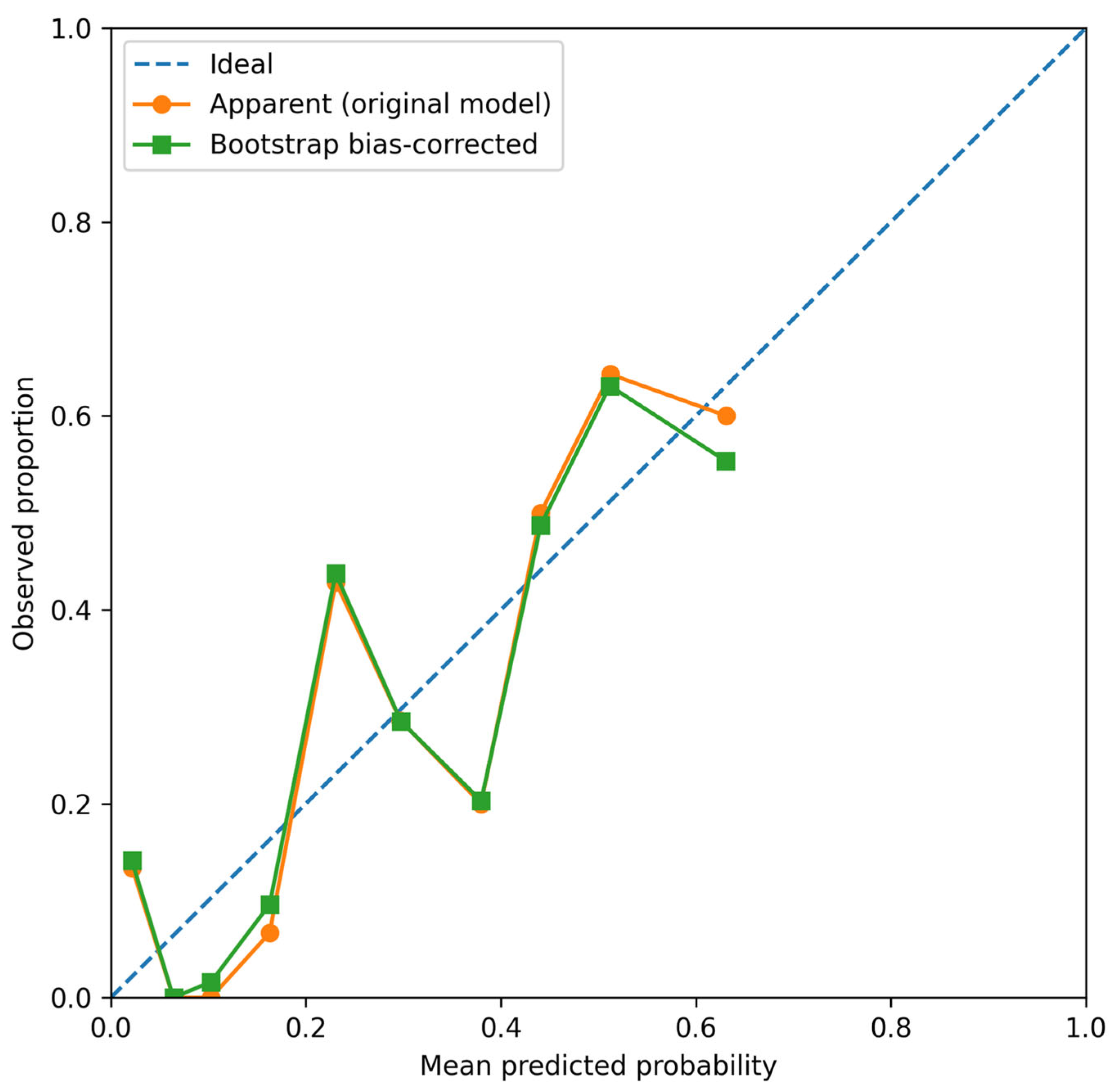
| Area under the ROC curve (AUC) | 0.790 | 0.767 |
| Calibration slope | 1.00 | 0.861 |
| Calibration intercept | 0.00 | −0.088 |
| Brier score | 0.160 | 0.171 |
Disclaimer/Publisher’s Note: The statements, opinions and data contained in all publications are solely those of the individual author(s) and contributor(s) and not of MDPI and/or the editor(s). MDPI and/or the editor(s) disclaim responsibility for any injury to people or property resulting from any ideas, methods, instructions or products referred to in the content. |
© 2026 by the authors. Licensee MDPI, Basel, Switzerland. This article is an open access article distributed under the terms and conditions of the Creative Commons Attribution (CC BY) license.
Share and Cite
Jabłońska, R.; Ślusarz, R.; Królikowska, A.; Filipska-Blejder, K.; Zając, M.; Sokal, P. Admission Inflammatory Blood Cell Ratios as Prognostic Markers of Functional Outcome After Aneurysmal Subarachnoid Hemorrhage: A Single-Center Retrospective Cohort Study. Biomedicines 2026, 14, 1186. https://doi.org/10.3390/biomedicines14061186
Jabłońska R, Ślusarz R, Królikowska A, Filipska-Blejder K, Zając M, Sokal P. Admission Inflammatory Blood Cell Ratios as Prognostic Markers of Functional Outcome After Aneurysmal Subarachnoid Hemorrhage: A Single-Center Retrospective Cohort Study. Biomedicines. 2026; 14(6):1186. https://doi.org/10.3390/biomedicines14061186
Chicago/Turabian StyleJabłońska, Renata, Robert Ślusarz, Agnieszka Królikowska, Karolina Filipska-Blejder, Magdalena Zając, and Paweł Sokal. 2026. "Admission Inflammatory Blood Cell Ratios as Prognostic Markers of Functional Outcome After Aneurysmal Subarachnoid Hemorrhage: A Single-Center Retrospective Cohort Study" Biomedicines 14, no. 6: 1186. https://doi.org/10.3390/biomedicines14061186
APA StyleJabłońska, R., Ślusarz, R., Królikowska, A., Filipska-Blejder, K., Zając, M., & Sokal, P. (2026). Admission Inflammatory Blood Cell Ratios as Prognostic Markers of Functional Outcome After Aneurysmal Subarachnoid Hemorrhage: A Single-Center Retrospective Cohort Study. Biomedicines, 14(6), 1186. https://doi.org/10.3390/biomedicines14061186