Rho-Kinase Inhibitor—A Molecule for Pharmacological Treatment of Decompensated Corneas: Case Series


Abstract
1. Introduction
2. Materials and Methods
2.1. Inclusion and Exclusion Criteria
2.2. Study Protocol and Treatment Regimen
2.3. Outcome Measures
2.4. Statistical Analysis
3. Results
3.1. Clinical Cohort
3.2. Outcomes
3.3. Safety Outcomes
4. Discussion
5. Conclusions
Author Contributions
Funding
Institutional Review Board Statement
Informed Consent Statement
Data Availability Statement
Conflicts of Interest
Abbreviations
| AS-OCT | anterior segment optical coherence tomography |
| BCVA | best-corrected visual acuity |
| CCT | central corneal thickness |
| FECD | Fuchs endothelial corneal dystrophy |
| ICE | iridocorneal endothelial syndrome |
| OCT | optical coherence tomography |
| ROCK | Rho/Rho-associated protein kinase |
| U.S. FDA | United States Food and Drug Administration |
References
- Bonanno, J.A. Molecular mechanisms underlying the corneal endothelial pump. Exp. Eye Res. 2012, 95, 2–7. [Google Scholar] [CrossRef]
- Edelhauser, H.F. The balance between corneal transparency and edema: The Proctor Lecture. Investig. Ophthalmol. Vis. Sci. 2006, 47, 1755–1767. [Google Scholar] [CrossRef]
- Bhujel, B.; Oh, S.-H.; Kim, C.-M.; Yoon, Y.-J.; Kim, Y.-J.; Chung, H.-S.; Ye, E.-A.; Lee, H.; Kim, J.-Y. Mesenchymal Stem Cells and Exosomes: A Novel Therapeutic Approach for Corneal Diseases. Int. J. Mol. Sci. 2023, 24, 10917. [Google Scholar] [CrossRef]
- Kobal, N.; Marzidovšek, M.; Schollmayer, P.; Maličev, E.; Hawlina, M.; Marzidovšek, Z.L. Molecular and Cellular Mechanisms of the Therapeutic Effect of Mesenchymal Stem Cells and Extracellular Vesicles in Corneal Regeneration. Int. J. Mol. Sci. 2024, 25, 11121. [Google Scholar] [CrossRef]
- Vedana, G.; Villarreal, G., Jr.; Jun, A.S. Fuchs endothelial corneal dystrophy: Current perspectives. Clin. Ophthalmol. 2016, 10, 321–330. [Google Scholar] [CrossRef][Green Version]
- Nanda, G.G.; Alone, D.P. REVIEW: Current understanding of the pathogenesis of Fuchs’ endothelial corneal dystrophy. Mol. Vis. 2019, 25, 295–310. [Google Scholar]
- Geroski, D.H.; Matsuda, M.; Yee, R.W.; Edelhauser, H.F. Pump function of the human corneal endothelium. Effects of age and cornea guttata. Ophthalmology 1985, 92, 759–763. [Google Scholar] [CrossRef]
- Amano, M.; Nakayama, M.; Kaibuchi, K. Rho-kinase/ROCK: A key regulator of the cytoskeleton and cell polarity. Cytoskeleton 2010, 67, 545–554. [Google Scholar] [CrossRef]
- Pagano, L.; Lee, J.W.; Posarelli, M.; Giannaccare, G.; Kaye, S.; Borgia, A. ROCK Inhibitors in Corneal Diseases and Glaucoma-A Comprehensive Review of These Emerging Drugs. J. Clin. Med. 2023, 12, 6736. [Google Scholar] [CrossRef]
- Patel, P.; Patel, B.C. Netarsudil Ophthalmic Solution; StatPearls Publishing LLC.: Treasure Island, FL, USA, 2026. [Google Scholar]
- Singh, N.K.; Sahu, S.K. Rho-kinase inhibitors: Role in corneal endothelial disorders. Semin. Ophthalmol. 2022, 38, 9–14. [Google Scholar] [CrossRef]
- Lin, J.B.; Harris, J.M.; Baldwin, G.; Goss, D.; Margeta, M.A. Ocular effects of Rho kinase (ROCK) inhibition: A systematic review. Eye 2024, 38, 3418–3428. [Google Scholar] [CrossRef]
- Meekins, L.C.; Rosado-Adames, N.; Maddala, R.; Zhao, J.J.; Rao, P.V.; Afshari, N.A. Corneal Endothelial Cell Migration and Proliferation Enhanced by Rho Kinase (ROCK) Inhibitors in In Vitro and In Vivo Models. Investig. Ophthalmol. Vis. Sci. 2016, 57, 6731–6738. [Google Scholar] [CrossRef]
- Okumura, N.; Okazaki, Y.; Inoue, R.; Kakutani, K.; Nakano, S.; Kinoshita, S.; Koizumi, N. Effect of the Rho-Associated Kinase Inhibitor Eye Drop (Ripasudil) on Corneal Endothelial Wound Healing. Investig. Ophthalmol. Vis. Sci. 2016, 57, 1284–1292. [Google Scholar] [CrossRef]
- Pipparelli, A.; Arsenijevic, Y.; Thuret, G.; Gain, P.; Nicolas, M.; Majo, F. ROCK inhibitor enhances adhesion and wound healing of human corneal endothelial cells. PLoS ONE 2013, 8, e62095. [Google Scholar] [CrossRef]
- Peh, G.S.L.; Adnan, K.; George, B.L.; Ang, H.-P.; Seah, X.-Y.; Tan, D.T.; Mehta, J.S. The effects of Rho-associated kinase inhibitor Y-27632 on primary human corneal endothelial cells propagated using a dual media approach. Sci. Rep. 2015, 5, 9167. [Google Scholar] [CrossRef]
- Okumura, N.; Koizumi, N.; Ueno, M.; Sakamoto, Y.; Takahashi, H.B.; Hamuro, J.; Kinoshita, S. The new therapeutic concept of using a rho kinase inhibitor for the treatment of corneal endothelial dysfunction. Cornea 2011, 30, S54–S59. [Google Scholar] [CrossRef] [PubMed]
- Okumura, N.; Koizumi, N.; Ueno, M.; Sakamoto, Y.; Takahashi, H.; Hirata, K.; Torii, R.; Hamuro, J.; Kinoshita, S. Enhancement of corneal endothelium wound healing by Rho-associated kinase (ROCK) inhibitor eye drops. Br. J. Ophthalmol. 2011, 95, 1006–1009. [Google Scholar] [CrossRef]
- Okumura, N.; Nakano, S.; Kay, E.P.; Numata, R.; Ota, A.; Sowa, Y.; Sakai, T.; Ueno, M.; Kinoshita, S.; Koizumi, N. Involvement of cyclin D and p27 in cell proliferation mediated by ROCK inhibitors Y-27632 and Y-39983 during corneal endothelium wound healing. Investig. Ophthalmol. Vis. Sci. 2014, 55, 318–329. [Google Scholar] [CrossRef]
- Parekh, M.; Miall, A.; Chou, A.; Buhl, L.; Deshpande, N.; Price, M.O.; Price, F.W.; Jurkunas, U.V. Enhanced Migration of Fuchs Corneal Endothelial Cells by Rho Kinase Inhibition: A Novel Ex Vivo Descemet’s Stripping Only Model. Cells 2024, 13, 1218. [Google Scholar] [CrossRef]
- Schlötzer-Schrehardt, U.; Zenkel, M.; Strunz, M.; Gießl, A.; Schondorf, H.; da Silva, H.; Schmidt, G.A.; Greiner, M.A.; Okumura, N.; Koizumi, N.; et al. Potential Functional Restoration of Corneal Endothelial Cells in Fuchs Endothelial Corneal Dystrophy by ROCK Inhibitor (Ripasudil). Am. J. Ophthalmol. 2021, 224, 185–199. [Google Scholar] [CrossRef]
- Okumura, N.; Inoue, R.; Okazaki, Y.; Nakano, S.; Nakagawa, H.; Kinoshita, S.; Koizumi, N. Effect of the Rho Kinase Inhibitor Y-27632 on Corneal Endothelial Wound Healing. Investig. Ophthalmol. Vis. Sci. 2015, 56, 6067–6074. [Google Scholar] [CrossRef] [PubMed]
- Miyagi, H.; Kim, S.; Li, J.; Murphy, C.J.; Thomasy, S.M. Topical Rho-Associated Kinase Inhibitor, Y27632, Accelerates Corneal Endothelial Regeneration in a Canine Cryoinjury Model. Cornea 2018, 38, 352–359. [Google Scholar] [CrossRef]
- Fujimoto, H.; Setoguchi, Y.; Kiryu, J. The ROCK Inhibitor Ripasudil Shows an Endothelial Protective Effect in Patients With Low Corneal Endothelial Cell Density After Cataract Surgery. Transl. Vis. Sci. Technol. 2021, 10, 18. [Google Scholar] [CrossRef]
- Antonini, M.; Coassin, M.; Gaudenzi, D.; Di Zazzo, A. Rho-Associated Kinase Inhibitor Eye Drops in challenging cataract surgery. Am. J. Ophthalmol. Case Rep. 2021, 25, 101245. [Google Scholar] [CrossRef]
- Lindstrom, R.L.; Lewis, A.E.; Holland, E.J.; Sheppard, J.D.; Hovanesian, J.A.; Senchyna, M.; Hollander, D.A. Phase 2, Randomized, Open-Label Parallel-Group Study of Two Dosing Regimens of Netarsudil for the Treatment of Corneal Edema Due to Fuchs Corneal Dystrophy. J. Ocul. Pharmacol. Ther. 2022, 38, 657–663. [Google Scholar] [CrossRef]
- Price, M.O.; Price, F.W., Jr. Randomized, Double-Masked, Pilot Study of Netarsudil 0.02% Ophthalmic Solution for Treatment of Corneal Edema in Fuchs Dystrophy. Am. J. Ophthalmol. 2021, 227, 100–105. [Google Scholar] [CrossRef]
- Srinivas, S.P. Cell signaling in regulation of the barrier integrity of the corneal endothelium. Exp. Eye Res. 2012, 95, 8–15. [Google Scholar] [CrossRef] [PubMed]
- Beckers, C.M.; Knezevic, N.; Valent, E.T.; Tauseef, M.; Krishnan, R.; Rajendran, K.; Hardin, C.C.; Aman, J.; van Bezu, J.; Sweetnam, P.; et al. ROCK2 primes the endothelium for vascular hyperpermeability responses by raising baseline junctional tension. Vasc. Pharmacol. 2015, 70, 45–54. [Google Scholar] [CrossRef]
- Lass, J.H.; Eriksson, G.L.; Osterling, L.; Simpson, C.V. Comparison of the corneal effects of latanoprost, fixed combination latanoprost-timolol, and timolol: A double-masked, randomized, one-year study. Ophthalmology 2001, 108, 264–271. [Google Scholar] [CrossRef]
- Wisely, C.E.; Sheng, H.; Heah, T.; Kim, T. Effects of Netarsudil and Latanoprost Alone and in Fixed Combination on Corneal Endothelium and Corneal Thickness: Post-Hoc Analysis of MERCURY-2. Adv. Ther. 2020, 37, 1114–1123. [Google Scholar] [CrossRef] [PubMed]
- Kadri, R.; Shetty, A.; Parameshwar, D.; A Kudva, A.; Achar, A.; Shetty, J. Effect of prostaglandin analogues on central corneal thickness in patients with glaucoma: A systematic review and meta-analysis with trial sequential analysis. Indian J. Ophthalmol. 2022, 70, 1502–1512. [Google Scholar] [CrossRef] [PubMed]
- Dong, M.; Yan, B.P.; Liao, J.K.; Lam, Y.-Y.; Yip, G.W.; Yu, C.-M. Rho-kinase inhibition: A novel therapeutic target for the treatment of cardiovascular diseases. Drug Discov. Today 2010, 15, 622–629. [Google Scholar] [CrossRef] [PubMed]
- Troup, D.; Chauhan, M.; Guo, Z.; Sanvicente, C.; Warner, D.; Sallam, A. Netarsudil and Corneal Edema: An Update and Review of the Literature. Clin. Ophthalmol. 2025, 19, 4709–4724. [Google Scholar] [CrossRef]
- Tran, J.A.; Jurkunas, U.V.; Yin, J.; Davies, E.C.; Valle, D.A.S.-D.; Chen, T.C.; Lin, M.M. Netarsudil-associated reticular corneal epithelial edema. Am. J. Ophthalmol. Case Rep. 2022, 25, 101287. [Google Scholar] [CrossRef]
- Wisely, C.E.; Liu, K.C.; Gupta, D.; Carlson, A.N.; Asrani, S.G.; Kim, T. Reticular Bullous Epithelial Edema in Corneas Treated with Netarsudil: A Case Series. Arch. Ophthalmol. 2020, 217, 20–26. [Google Scholar] [CrossRef]
- Mandlik, K.M.; Christy, S.J.M.; Ravisankar, R.D. Netarsudil-Induced Honeycomb Hypertrophy. Asia-Pac. J. Ophthalmol. 2023, 12, 504–505. [Google Scholar] [CrossRef]
- Jeang, L.J.; Shah, A.S.; Hammer, J.D.; Tuli, S.S. Reticular epithelial edema after penetrating keratoplasty in a patient taking netarsudil. Digit. J. Ophthalmol. 2022, 28, 34–37. [Google Scholar] [CrossRef] [PubMed]
- Yin, J.; Yu, F.S. Rho kinases regulate corneal epithelial wound healing. Am. J. Physiol. Physiol. 2008, 295, C378–C387. [Google Scholar] [CrossRef]



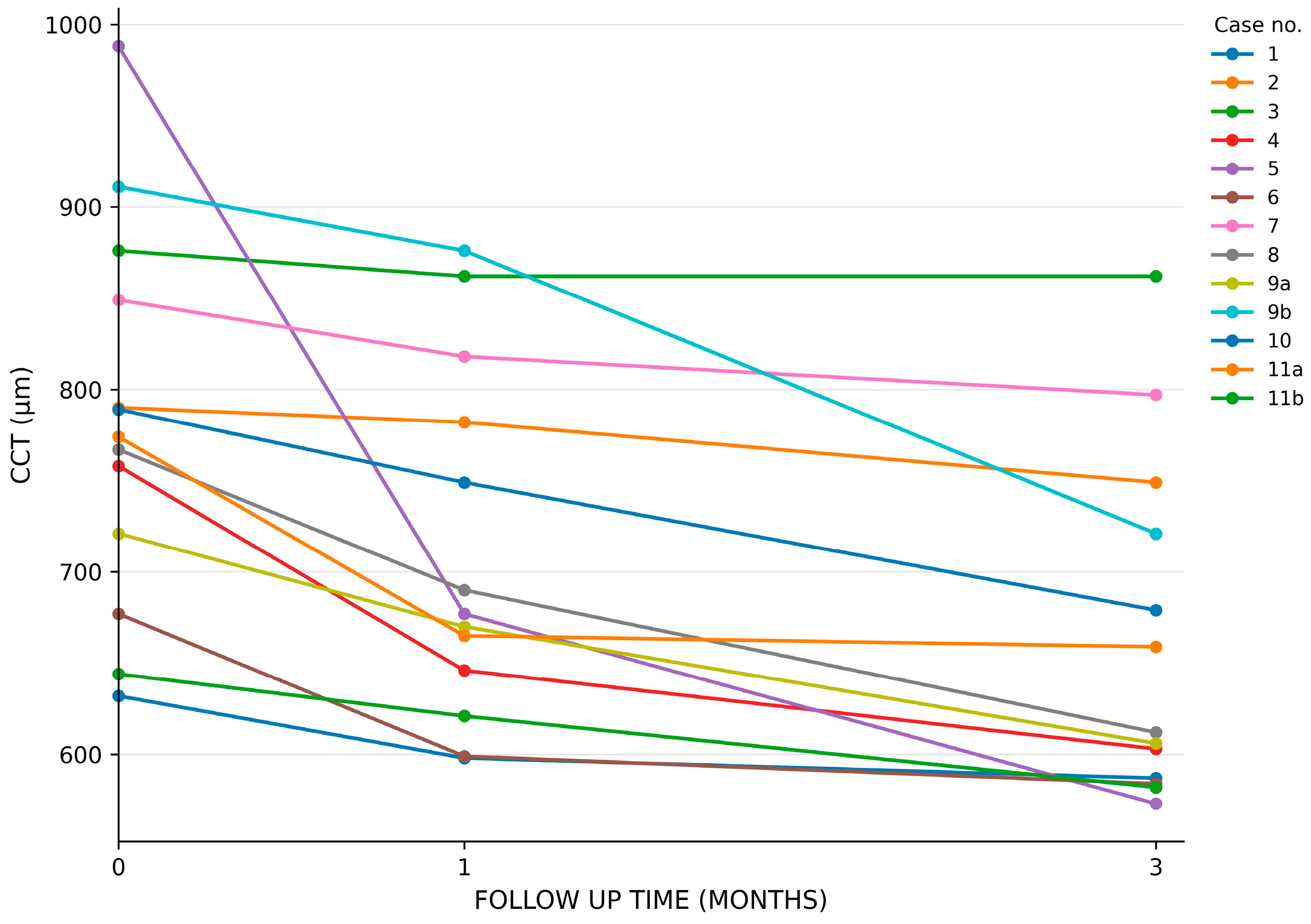
| Case Number | Sex | Age (Years) | Etiology of Corneal Decompensation | Additional Diagnoses | Duration of Postoperative Edema (Days) | CCT0 (μm) | CCT1 (μm) | CCT3 (μm) |
|---|---|---|---|---|---|---|---|---|
| 1 | M | 86 | Edema after cataract surgery | Epiretinal membrane | 284 | 632 | 598 | 587 |
| 2 | F | 87 | Edema after cataract surgery | Status post branch retinal artery occlusion | 445 | 790 | 782 | 749 |
| 3 | M | 89 | Edema after complicated cataracy surgery (bullous keratopathy) | 150 | 876 | 862 | 862 | |
| 4 | M | 76 | Edema after complicated cataract surgery | Postoperative aphakia, postoperative cystoid macular edema | 186 | 758 | 646 | 603 |
| 5 | F | 82 | Edema after complicated cataract surgery | Postoperative aphakia | 48 | 988 | 677 | 573 |
| 6 | F | 75 | Edema after complicated cataract surgery combined with vitrectomy | Epiretinal membrane | 1046 | 677 | 599 | 584 |
| 7 | F | 81 | Edema after Descemet stripping only | FECD | 236 | 849 | 818 | 797 |
| 8 | F | 73 | Edema after acute angle-closure attack (bullous keratopathy) | 251 | 767 | 690 | 612 | |
| 9a | M | 73 | Edema after cataract surgery | FECD | 311 | 721 | 670 | 606 |
| 9b | M | 73 | Edema after cataract surgery (bullous keratopathy) | FECD | 259 | 911 | 876 | 721 |
| 10 | F | 69 | Edema after cataract surgery (bullous keratopathy) | FECD | 128 | 789 | 749 | 679 |
| 11a | F | 64 | Edema after cataract surgery | FECD | 62 | 774 | 665 | 659 |
| 11b | F | 64 | Edema after cataract surgery | FECD | 110 | 644 | 621 | 582 |
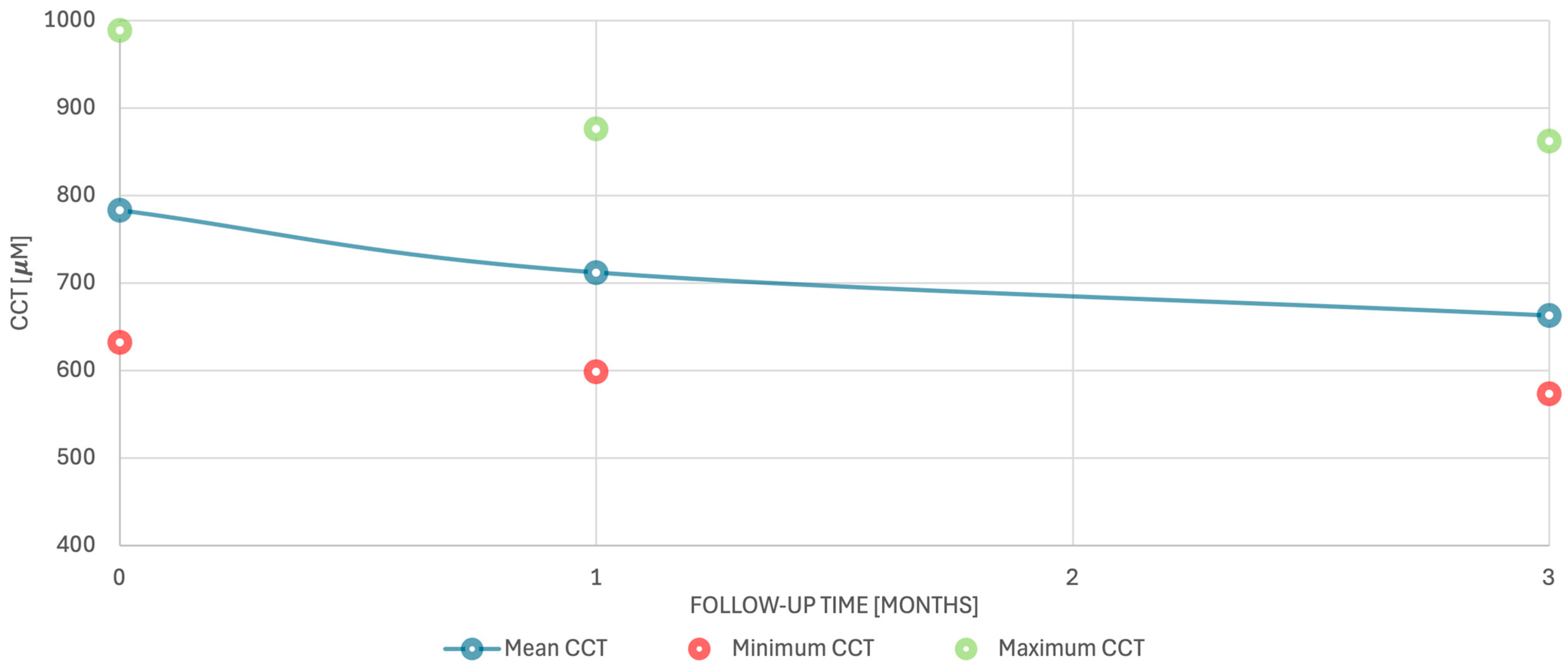
| Mean CCT0 (µm) | Mean CCT1 and Mean Reduction (µm) | Mean CCT3 and Mean Reduction (µm) |
|---|---|---|
| 783 (632–988) | 712 (598–876) | 663 (573–862) |
| −71 (8–311) | −120 (14–415) |
| Mean CCT0 (µm) | Mean CCT1 and Mean Reduction (µm) | Mean CCT3 and Mean Reduction (µm) |
|---|---|---|
| 801 (632–988) | 724 (598–876) | 675 (573–862) |
| −77 (8–311) | −126 (14–415) |
| Case Number | Baseline BCVA in Snellen Decimal | Baseline BCVA (logMAR) | BCVA After 3 Months of Treatment in Snellen Decimal | BCVA After 3 Months of Treatment in logMAR | Change in BCVA (Baseline—3 Months) in logMAR |
|---|---|---|---|---|---|
| 1 | 0.2 | 0.699 | 0.2 | 0.699 | 0.0 |
| 2 | 0.16 | 0.796 | 0.3 | 0.523 | 0.273 |
| 3 | 0.005 | 2.301 | 0.01 | 2.00 | 0.301 |
| 4 | 0.2 | 0.699 | 0.3 | 0.523 | 0.176 |
| 5 | 0.1 | 1.0 | 0.6 | 0.222 | 0.778 |
| 6 | 0.16 | 0.796 | 0.3 | 0.523 | 0.273 |
| 7 | 0.7 | 0.155 | 0.9 | 0.046 | 0.109 |
| 8 | 0.2 | 0.699 | 0.2 | 0.699 | 0.0 |
| 9a | 0.5 | 0.301 | 0.7 | 0.155 | 0.146 |
| 9b | 0.3 | 0.523 | 0.5 | 0.301 | 0.222 |
| 10 | 0.1 | 1.0 | 0.3 | 0.523 | 0.477 |
| 11a | 0.4 | 0.398 | 0.6 | 0.222 | 0.176 |
| 11b | 0.5 | 0.301 | 0.5 | 0.301 | 0.0 |
| Mean | Minimum | Maximum | |
|---|---|---|---|
| Baseline BCVA | 0.744 | 0.155 | 2.301 |
| BCVA after 3 months | 0.518 | 0.046 | 2.00 |
| Improvement in BCVA (baseline—3 months) | 0.226 | 0.0 | 0.778 |
| Mean | Minimum | Maximum | |
|---|---|---|---|
| Baseline BCVA | 0.795 | 0.155 | 2.301 |
| BCVA after 3 months | 0.565 | 0.046 | 2.00 |
| Improvement in BCVA (baseline—3 months) | 0.230 | 0.0 | 0.778 |
| Adverse Effect | Number of Patients Affected | Severity | Time to Onset | Management | Outcome |
|---|---|---|---|---|---|
| Conjunctival hypermia | 8/13 (62%) | Mild to moderate | In the first week of treatment | Treatment continued | Resolved after completion of planned treatment |
| Irritation after instillation | 5/13 (38%) | Mild to moderate | Immediately | Treatment continued | Resolved in a few minutes |
| Increased photosensitivity | 1/13 (8%) | Mild | In the first week of treatment | Treatment continued | Resolved after completion of planned treatment |
| Reticular epithelial edema | 1/13 (8%) | Mild to moderate | In the second month of treatment | Treatment continued | Resolved after completion of planned treatment |
Disclaimer/Publisher’s Note: The statements, opinions and data contained in all publications are solely those of the individual author(s) and contributor(s) and not of MDPI and/or the editor(s). MDPI and/or the editor(s) disclaim responsibility for any injury to people or property resulting from any ideas, methods, instructions or products referred to in the content. |
© 2026 by the authors. Licensee MDPI, Basel, Switzerland. This article is an open access article distributed under the terms and conditions of the Creative Commons Attribution (CC BY) license.
Share and Cite
Kobal Mikša, N.; Stunf Pukl, S. Rho-Kinase Inhibitor—A Molecule for Pharmacological Treatment of Decompensated Corneas: Case Series. Biomedicines 2026, 14, 1099. https://doi.org/10.3390/biomedicines14051099
Kobal Mikša N, Stunf Pukl S. Rho-Kinase Inhibitor—A Molecule for Pharmacological Treatment of Decompensated Corneas: Case Series. Biomedicines. 2026; 14(5):1099. https://doi.org/10.3390/biomedicines14051099
Chicago/Turabian StyleKobal Mikša, Nina, and Spela Stunf Pukl. 2026. "Rho-Kinase Inhibitor—A Molecule for Pharmacological Treatment of Decompensated Corneas: Case Series" Biomedicines 14, no. 5: 1099. https://doi.org/10.3390/biomedicines14051099
APA StyleKobal Mikša, N., & Stunf Pukl, S. (2026). Rho-Kinase Inhibitor—A Molecule for Pharmacological Treatment of Decompensated Corneas: Case Series. Biomedicines, 14(5), 1099. https://doi.org/10.3390/biomedicines14051099