Cellular Senescence in Keloid Pathology: Mechanisms, Biomarkers, and Potential Therapeutic Targets


Abstract
1. Introduction
2. Basic Concepts of Cellular Senescence
2.1. Cellular Senescence
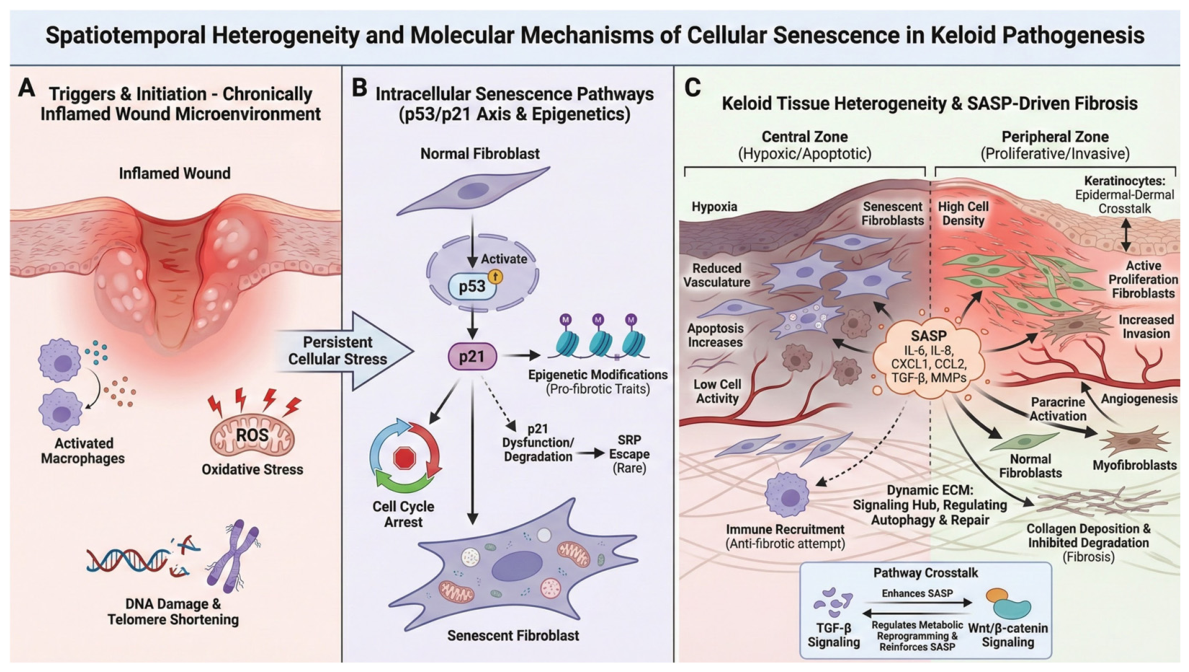
2.2. Cellular Senescence in Keloids
2.2.1. Accumulation of Senescent Cells
2.2.2. SASP
2.2.3. SRP
3. The Relationship Between Cellular Senescence and Keloids
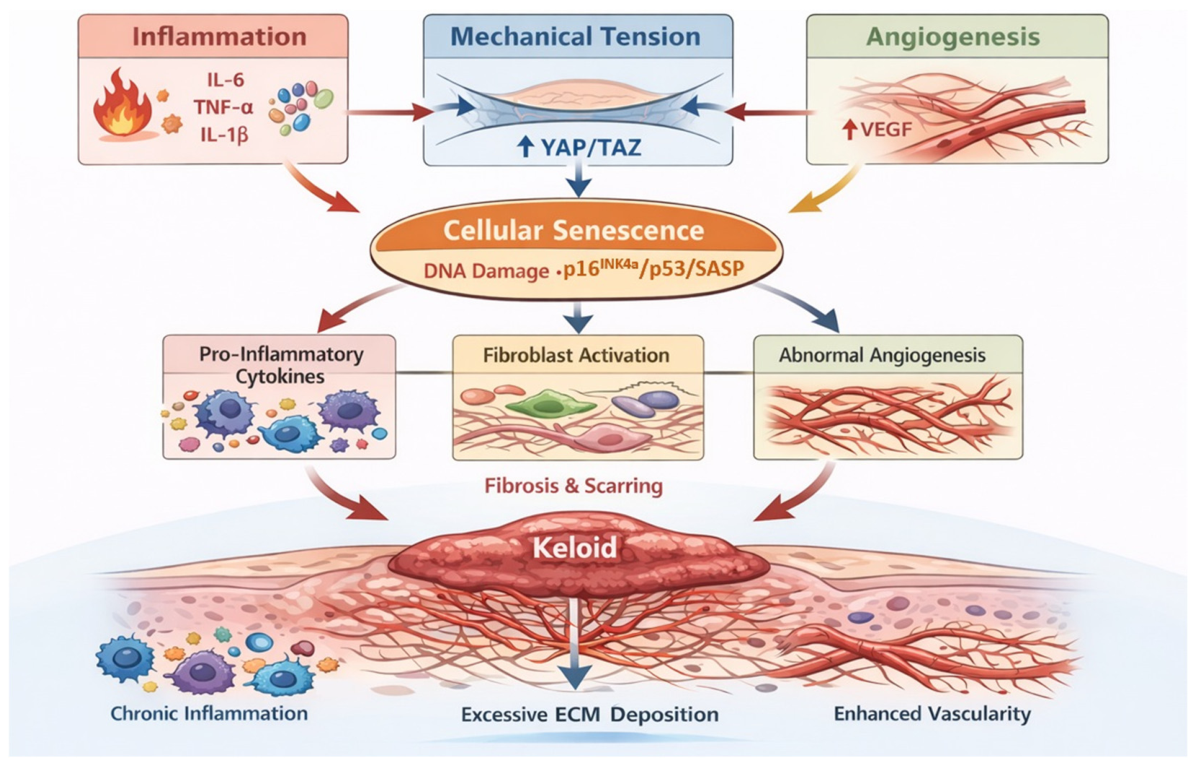
3.1. Senescence-Associated Inflammation in Keloid Development
3.2. Mechanical Tension Modulates Cellular Senescence and Amplifies Fibrotic Responses
3.3. Aberrant Angiogenesis and Cellular Senescence in Keloid Progression
4. Markers of Cellular Senescence
5. Potential Therapeutic Targets
5.1. Targeting Senescent Cells and Senescence-Associated Plasticity
5.2. Targeting SASP and Its Regulatory Networks
5.3. Intervening in Senescence-Inducing Signals
5.3.1. Wnt/β-Catenin Signaling Pathway
5.3.2. TGF-β Signaling Pathway
5.3.3. PI3K/AKT/mTOR Pathway
5.3.4. p53/p21 Signaling Pathway
5.3.5. Hedgehog-GLI1 Signaling Pathway

| Signaling Pathway | Core Mechanism of Action | Function in Keloids | Key Intervention Targets/Strategies | Literature Support |
|---|---|---|---|---|
| Wnt/β-catenin | Regulates cell proliferation, differentiation, and extracellular matrix (ECM) deposition. Upregulates target genes like Cyclin D1, c-Myc upon activation. | Promotes abnormal fibroblast proliferation and migration, a core pathway in keloid formation. | Target Frizzled receptor (e.g., using siRNA); inhibit β-catenin activity. | [59,60] |
| TGF-β | Mainly transmits signals through Smad (e.g., Smad2/3) and non-Smad pathways. A potent pro-fibrotic factor. | Promotes fibroblast proliferation, differentiation, and excessive synthesis and deposition of ECM (especially collagen). TGF-β1/2 expression is upregulated. | Target TGF-β ligands or their receptors; inhibit Smad phosphorylation; utilize antagonism from subtypes (e.g., TGF-β3). | [120] |
| PI3K/Akt | Regulates cell survival, proliferation, and metabolism. Its activation is closely related to anti-apoptosis and ECM deposition. | Promotes fibroblast proliferation, migration, and inhibits apoptosis, leading to ECM accumulation. | Inhibit PI3K/Akt kinase activity; target upstream regulatory molecules (e.g., circRNA). | [125,126] |
| p53/p21 | p53 is a main tumor suppressor gene, regulating cell cycle arrest and apoptosis; p21 is an important downstream cell cycle inhibitor of p53. | Downregulated p53 expression or functional loss leads to reduced apoptosis and uncontrolled fibroblast proliferation. High WWP1 expression further inhibits p53 activity. | Restore p53 activity or function; inhibit its negative regulators (e.g., WWP1); utilize p21-mediated cell cycle braking. | [128,129,130] |
| Hedgehog-GLI1 | Activated during tissue repair; its abnormal activation is associated with fibrosis. Downstream transcription factor GLI1 drives fibrotic gene expression. | Pathway activity is upregulated, promoting the expression of fibrotic genes like collagen (COL1A1) and α-SMA, showing synergy with the TGF-β pathway. | Use SMO inhibitors (e.g., Vismodegib) to inhibit pathway signal transduction. | [73,131] |
5.4. Senescent Cell Reprogramming
6. Future Research Direction
7. Conclusions
Author Contributions
Funding
Institutional Review Board Statement
Informed Consent Statement
Data Availability Statement
Acknowledgments
Conflicts of Interest
Abbreviations
| ECM | Extracellular matrix |
| SASP | Senescence-associated secretory phenotype |
| SRP | Senescence-resumed proliferation |
| QoL | Quality of life |
| scRNA-seq | Single-cell RNA sequencing |
| KFs | Keloid fibroblasts |
| SA-β-Gal | Senescence-associated β-galactosidase |
| DDR | DNA damage response |
| CDKs | Cyclin-dependent kinases |
| RB | Retinoblastoma protein |
| AKT/Akt | RAC-alpha serine/threonine-protein kinase |
| mTOR | Mechanistic target of rapamycin |
| NF-κB | Nuclear factor kappa-light-chain-enhancer of activated B cells |
| SNVs | Single nucleotide variants |
| cGAS-STING | Cyclic GMP-AMP synthase-stimulator of interferon genes |
| cGAMP | Cyclic GMP–AMP |
| sHLA-E | Soluble human leukocyte antigen E |
| YAP/TAZ | Yes-associated protein/transcriptional coactivator with PDZ-binding motif |
| COL1A2 | Collagen type I alpha 2 chain |
| COL1A1 | Collagen type I alpha 1 chain |
| HMGB1 | High-mobility group box 1 |
| AKR1C3 | Aldo-keto reductase family 1 member C3 |
| MMPs | Matrix metalloproteinases |
| D | Dasatinib |
| Q | Quercetin |
| siRNA | Small interfering RNA |
| TGF-β | Transforming growth factor-β |
| TGFBR2 | Transforming growth factor beta receptor 2 |
| FAK | Focal adhesion kinase |
| ERK | Extracellular signal-regulated kinase |
| SSc | Systemic sclerosis |
| PI3K | Phosphatidylinositol 3-kinase |
| circCOL5A1 | Circular RNA collagen type V alpha 1 chain |
| IGFBP5 | Insulin-like growth factor-binding protein 5 |
| TRAF4 | TNF receptor-associated factor 4 |
| GLI1 | GLI family zinc finger 1 |
| α-SMA | Alpha-smooth muscle actin |
| SMO | Smoothened |
| IL-6 | Interleukin-6 |
| IL-8/ CXCL8 | Interleukin-8 |
| IL-4 | Interleukin-4 |
| IL-13 | Interleukin-13 |
| TNF-α | Tumor necrosis factor-alpha |
| VEGF | Vascular endothelial growth factor |
| IFN | Interferon |
| CDK4/6 | Cyclin-dependent kinase 4/6 |
| CDK2 | Cyclin-dependent kinase 2 |
| JAK | Janus kinase |
| STAT3 | Signal transducer and activator of transcription 3 |
| CAR T cells | Chimeric antigen receptor T cells |
| uPAR | Urokinase-type plasminogen activator receptor |
| RCTs | Randomized controlled trials |
| PDKX | Patient-derived keloid xenograft |
| PRDX6 | Peroxiredoxin 6 |
| PLA2 | Phospholipase A2 |
| MTZs | Microthermal zones |
| FP | Fractional photothermolysis |
| ROBO2–EID1 | Roundabout guidance receptor 2–EP300 interacting inhibitor of differentiation 1 |
| EP300 | E1A binding protein p300 |
| TSA | Trichostatin A |
| BCL2/Bcl-2 | B-cell lymphoma 2 |
| FB-P30 | Replicative senescence fibroblast model |
| FB-E | Aged fibroblasts |
| LNPs | Lipid nanoparticles |
| ROS | Reactive oxygen species |
References
- Yu, Y.; Wu, H.; Zhang, Q.; Ogawa, R.; Fu, S. Emerging Insights into the Immunological Aspects of Keloids. J. Dermatol. 2021, 48, 1817–1826. [Google Scholar] [CrossRef] [PubMed]
- Jeschke, M.G.; Wood, F.M.; Middelkoop, E.; Bayat, A.; Teot, L.; Ogawa, R.; Gauglitz, G.G. Scars. Nat. Rev. Dis. Primers 2023, 9, 64. [Google Scholar] [CrossRef] [PubMed]
- Lv, X.; He, Z.; Yang, M.; Wang, L.; Fu, S. Analysis of Subsets and Localization of Macrophages in Skin Lesions and Peripheral Blood of Patients with Keloids. Heliyon 2024, 10, e24034. [Google Scholar] [CrossRef] [PubMed]
- Lee, C.C.; Tsai, C.H.; Chen, C.H.; Yeh, Y.C.; Chung, W.H.; Chen, C.B. An Updated Review of the Immunological Mechanisms of Keloid Scars. Front. Immunol. 2023, 14, 1117630. [Google Scholar] [CrossRef]
- Hinz, B. Formation and Function of the Myofibroblast during Tissue Repair. J. Investig. Dermatol. 2007, 127, 526–537. [Google Scholar] [CrossRef]
- Grace, C.; Frank, B.; Rik, J.; Susan, G. The Keloid Disorder: Heterogeneity, Histopathology, Mechanisms and Models. Front. Cell Dev. Biol. 2020, 8, 360. [Google Scholar] [CrossRef]
- Zhang, M.; Chen, H.; Qian, H.; Wang, C. Characterization of the Skin Keloid Microenvironment. Cell Commun. Signal. 2023, 21, 207. [Google Scholar] [CrossRef]
- Hyun, J.; Yeong, H. Comprehensive Insights into Keloid Pathogenesis and Advanced Therapeutic Strategies. Int. J. Mol. Sci. 2024, 25, 8776. [Google Scholar] [CrossRef]
- Merlino, L.; Dominoni, M.; Pano, M.R.; Pasquali, M.F.; Senatori, R.; Zino, G.; Gardella, B. Recent Progress in Keloid Mechanism and Treatment: A Comprehensive Review. Biomedicines 2025, 13, 2276. [Google Scholar] [CrossRef]
- Dong, X.; Gao, M.; Guo, H.; Wang, P.; Zhang, Y.; Shang, Q.; Wang, Q. The Regulatory Role of Immune Microenvironment-Related Cells and Pathways in the Pathogenesis of Keloids. Front. Immunol. 2025, 16, 1529564. [Google Scholar] [CrossRef]
- Cao, N.; Xiong, X.; Liu, S.; Kong, W.; Zhao, Y. Keloids as a Spectrum of Auto-Inflammatory Fibrotic Disorders: Beyond the Conventional Wound-Healing Paradigm. Clin. Cosmet. Investig. Dermatol. 2025, 18, 3719–3733. [Google Scholar] [CrossRef] [PubMed]
- Zhang, W.; Lu, J.; Tong, X.; Xie, S.; Xian, S.; Liu, Y.; Yan, J.; Qian, W.; Sun, H.; Zhu, Y.; et al. Uncovering a Fibroblast Differentiation-Based Keloid Classification by Integration of Single-Cell and Bulk RNA Sequencing. Commun. Biol. 2025, 8, 1387. [Google Scholar] [CrossRef] [PubMed]
- Ogawa, R.; Xia, G.; Ai, J. Keloid May Be a Modern Inflammatory Disease: A Historical and Clinicopathological Perspective. J. Plast. Reconstr. Aesthetic Surg. 2026; in press. [CrossRef] [PubMed]
- Chen, Z.; Yang, Y.; Wang, X.; Xia, L.; Wang, W.; Wu, X.; Gao, Z. Keloids and Inflammation: The Crucial Role of IL-33 in Epidermal Changes. Front. Immunol. 2025, 16, 1514618. [Google Scholar] [CrossRef]
- Narvaez, M.C.M.; Jain, E.; Suciu, T.; Asgharpour, S.; Hu, Q.; Stoleriu, M.-G.; Cabeza-Boeddinghaus, N.; Staab-Weijnitz, C.; Burgstaller, G.; Yildirim, A.Ö.; et al. LSC—2024—Novel SASP Factor Mediates Fibroblast Reprogramming in Aging-Associated Pulmonary Fibrosis. Eur. Respir. J. 2024, 64, OA5480. [Google Scholar] [CrossRef]
- Nan, L.; Guo, P.; Hui, W.; Xia, F.; Yi, C. Recent Advances in Dermal Fibroblast Senescence and Skin Aging: Unraveling Mechanisms and Pioneering Therapeutic Strategies. Front. Pharmacol. 2025, 16, 1592596. [Google Scholar] [CrossRef]
- Sahu, P.; Satapathy, T. Immunopharmacology of Senescence: Targeting the Senescence-Associated Secretory Phenotype (SASP)—A Mechanism-Based Review. Inflammopharmacology 2025, 33, 4291–4310. [Google Scholar] [CrossRef]
- Wang, C.-Y.; Wu, C.-W.; Lin, T.-Y. Role of Senescence-Resumed Proliferation in Keloid Pathogenesis. Future Pharmacol. 2023, 3, 198–212. [Google Scholar] [CrossRef]
- Kong, Y.-X.; Li, Z.-S.; Liu, Y.-B.; Pan, B.; Fu, X.; Xiao, R.; Yan, L. FOXO4-DRI Induces Keloid Senescent Fibroblast Apoptosis by Promoting Nuclear Exclusion of Upregulated P53-Serine 15 Phosphorylation. Commun. Biol. 2025, 8, 299. [Google Scholar] [CrossRef]
- Bourgeois, B.; Spreitzer, E.; Platero-Rochart, D.; Paar, M.; Zhou, Q.; Usluer, S.; de Keizer, P.L.J.; Burgering, B.M.T.; Sánchez-Murcia, P.A.; Madl, T. The Disordered P53 Transactivation Domain Is the Target of FOXO4 and the Senolytic Compound FOXO4-DRI. Nat. Commun. 2025, 16, 5672. [Google Scholar] [CrossRef]
- Varela-Eirín, M.; Demaria, M. Cellular Senescence. Curr. Biol. 2022, 32, R448–R452. [Google Scholar] [CrossRef] [PubMed]
- Campisi, J.; d’Adda di Fagagna, F. Cellular Senescence: When Bad Things Happen to Good Cells. Nat. Rev. Mol. Cell Biol. 2007, 8, 729–740. [Google Scholar] [CrossRef] [PubMed]
- Calcinotto, A.; Kohli, J.; Zagato, E.; Pellegrini, L.; Demaria, M.; Alimonti, A. Cellular Senescence: Aging, Cancer, and Injury. Physiol. Rev. 2019, 99, 1047–1078. [Google Scholar] [CrossRef] [PubMed]
- Yang, H.; Zhang, X.; Xue, B. New Insights into the Role of Cellular Senescence and Chronic Wounds. Front. Endocrinol. 2024, 15, 1400462. [Google Scholar] [CrossRef]
- Beauséjour, C.M.; Krtolica, A.; Galimi, F.; Narita, M.; Lowe, S.W.; Yaswen, P.; Campisi, J. Reversal of Human Cellular Senescence: Roles of the P53 and P16 Pathways. EMBO J. 2003, 22, 4212–4222. [Google Scholar] [CrossRef]
- Dańczak-Pazdrowska, A.; Gornowicz-Porowska, J.; Polańska, A.; Krajka-Kuźniak, V.; Stawny, M.; Gostyńska, A.; Rubiś, B.; Nourredine, S.; Ashiqueali, S.; Schneider, A.; et al. Cellular Senescence in Skin-Related Research: Targeted Signaling Pathways and Naturally Occurring Therapeutic Agents. Aging Cell 2023, 22, e13845. [Google Scholar] [CrossRef]
- Varmeh, S.; Egia, A.; McGrouther, D.; Tahan, S.R.; Bayat, A.; Pandolfi, P.P. Cellular Senescence as a Possible Mechanism for Halting Progression of Keloid Lesions. Genes Cancer 2011, 2, 1061–1066. [Google Scholar] [CrossRef]
- Reimann, M.; Lee, S.; Schmitt, C.A. Cellular Senescence: Neither Irreversible nor Reversible. J. Exp. Med. 2024, 221, e20232136. [Google Scholar] [CrossRef]
- Valieva, Y.; Igrunkova, A.; Fayzullin, A.; Serejnikova, N.; Kurkov, A.; Fayzullina, N.; Valishina, D.; Bakulina, A.; Timashev, P.; Shekhter, A. Epimorphic Regeneration of Elastic Cartilage: Morphological Study into the Role of Cellular Senescence. Biology 2023, 12, 565. [Google Scholar] [CrossRef]
- Gorgoulis, V.; Adams, P.D.; Alimonti, A.; Bennett, D.C.; Bischof, O.; Bishop, C.; Campisi, J.; Collado, M.; Evangelou, K.; Ferbeyre, G.; et al. Cellular Senescence: Defining a Path Forward. Cell 2019, 179, 813–827. [Google Scholar] [CrossRef]
- Mahmud, S.; Pitcher, L.E.; Torbenson, E.; Robbins, P.D.; Zhang, L.; Dong, X. Developing Transcriptomic Signatures as a Biomarker of Cellular Senescence. Ageing Res. Rev. 2024, 99, 102403. [Google Scholar] [CrossRef] [PubMed]
- Feng, C.; Shan, M.; Xia, Y.; Zheng, Z.; He, K.; Wei, Y.; Song, K.; Meng, T.; Liu, H.; Hao, Y.; et al. Single-Cell RNA Sequencing Reveals Distinct Immunology Profiles in Human Keloid. Front. Immunol. 2022, 13, 940645. [Google Scholar] [CrossRef] [PubMed]
- Yu, G.T.; Ganier, C.; Allison, D.B.; Tchkonia, T.; Khosla, S.; Kirkland, J.L.; Lynch, M.D.; Wyles, S.P. Mapping Epidermal and Dermal Cellular Senescence in Human Skin Aging. Aging Cell 2025, 24, e14358. [Google Scholar] [CrossRef] [PubMed]
- Wang, B.; Han, J.; Elisseeff, J.H.; Demaria, M. The Senescence-Associated Secretory Phenotype and Its Physiological and Pathological Implications. Nat. Rev. Mol. Cell Biol. 2024, 25, 958–978. [Google Scholar] [CrossRef]
- Deng, C.-C.; Hu, Y.-F.; Zhu, D.-H.; Cheng, Q.; Gu, J.-J.; Feng, Q.-L.; Zhang, L.-X.; Xu, Y.-P.; Wang, D.; Rong, Z.; et al. Single-Cell RNA-Seq Reveals Fibroblast Heterogeneity and Increased Mesenchymal Fibroblasts in Human Fibrotic Skin Diseases. Nat. Commun. 2021, 12, 3709. [Google Scholar] [CrossRef]
- Cheng, X.; Gao, Z.; Shan, S.; Shen, H.; Zheng, H.; Jin, L.; Li, Q.; Zhou, J. Single Cell Transcriptomics Reveals the Cellular Heterogeneity of Keloids and the Mechanism of Their Aggressiveness. Commun. Biol. 2024, 7, 1647. [Google Scholar] [CrossRef]
- Alkouz, Z.; Al Suwait, A.; Zhang, L.; Alhejairi, R.; Gahimbare, F.; Qalalwa, M.; Yang, B. Fibroblast Dynamics in Keloid Pathogenesis: Unraveling Cellular Crosstalk and Novel Therapeutic Targets. Dermatol. Res. Pract. 2026, 2026, 2528205. [Google Scholar] [CrossRef]
- Shim, J.; Oh, S.J.; Yeo, E.; Park, J.H.; Bae, J.H.; Kim, S.-H.; Lee, D.; Lee, J.H. Integrated Analysis of Single-Cell and Spatial Transcriptomics in Keloids: Highlights on Fibrovascular Interactions in Keloid Pathogenesis. J. Investig. Dermatol. 2022, 142, 2128–2139.e11. [Google Scholar] [CrossRef]
- Zhang, Y.; Liu, J.; Zheng, R.; Hou, K.; Zhang, Y.; Jia, T.; Lu, X.; Samarawickrama, P.N.; Jia, S.; He, Y.; et al. Curcumin Analogue EF24 Prevents Alveolar Epithelial Cell Senescence to Ameliorate Idiopathic Pulmonary Fibrosis via Activation of PTEN. Phytomedicine 2024, 133, 155882. [Google Scholar] [CrossRef]
- Fagagna, F.d.A.d. Living on a Break: Cellular Senescence as a DNA-Damage Response. Nat. Rev. Cancer 2008, 8, 512–522. [Google Scholar] [CrossRef]
- Yang, J.-H.; Hayano, M.; Griffin, P.T.; Amorim, J.A.; Bonkowski, M.S.; Apostolides, J.K.; Salfati, E.L.; Blanchette, M.; Munding, E.M.; Bhakta, M.; et al. Loss of Epigenetic Information as a Cause of Mammalian Aging. Cell 2023, 186, 305–326.e27. [Google Scholar] [CrossRef]
- Herranz, N.; Gil, J. Mechanisms and Functions of Cellular Senescence. J. Clin. Investig. 2018, 128, 1238–1246. [Google Scholar] [CrossRef] [PubMed]
- Jun, J.-I.; Lau, L.F. The Matricellular Protein CCN1 Induces Fibroblast Senescence and Restricts Fibrosis in Cutaneous Wound Healing. Nat. Cell Biol. 2010, 12, 676–685. [Google Scholar] [CrossRef] [PubMed]
- Ogawa, R. Keloid and Hypertrophic Scars Are the Result of Chronic Inflammation in the Reticular Dermis. Int. J. Mol. Sci. 2017, 18, 606. [Google Scholar] [CrossRef] [PubMed]
- Cohn, R.L.; Gasek, N.S.; Kuchel, G.A.; Xu, M. The Heterogeneity of Cellular Senescence: Insights at the Single-Cell Level. Trends Cell Biol. 2023, 33, 9–17. [Google Scholar] [CrossRef]
- Han, X.; Lei, Q.; Xie, J.; Liu, H.; Li, J.; Zhang, X.; Zhang, T.; Gou, X. Potential Regulators of the Senescence-Associated Secretory Phenotype During Senescence and Aging. J. Gerontol. A Biol. Sci. Med. Sci. 2022, 77, 2207–2218. [Google Scholar] [CrossRef]
- Suda, M.; Tchkonia, T.; Kirkland, J.L.; Minamino, T. Targeting Senescent Cells for the Treatment of Age-Associated Diseases. J. Biochem. 2024, 177, 177–187. [Google Scholar] [CrossRef]
- Cohen, A.J.; Nikbakht, N.; Uitto, J. Keloid Disorder: Genetic Basis, Gene Expression Profiles, and Immunological Modulation of the Fibrotic Processes in the Skin. Cold Spring Harb. Perspect. Biol. 2023, 15, a041245. [Google Scholar] [CrossRef]
- Salminen, A.; Kauppinen, A.; Kaarniranta, K. Emerging Role of NF-κB Signaling in the Induction of Senescence-Associated Secretory Phenotype (SASP). Cell. Signal. 2011, 24, 835–845. [Google Scholar] [CrossRef]
- Herranz, N.; Gallage, S.; Mellone, M.; Wuestefeld, T.; Klotz, S.; Hanley, C.J.; Raguz, S.; Acosta, J.C.; Innes, A.J.; Banito, A.; et al. Author Correction: mTOR Regulates MAPKAPK2 Translation to Control the Senescence-Associated Secretory Phenotype. Nat. Cell Biol. 2024, 26, 1019. [Google Scholar] [CrossRef]
- Qin, C.; Dong, M.-H.; Zhou, L.-Q.; Wang, W.; Cai, S.-B.; You, Y.-F.; Shang, K.; Xiao, J.; Wang, D.; Li, C.-R.; et al. Single-Cell Analysis of Refractory Anti-SRP Necrotizing Myopathy Treated with Anti-BCMA CAR-T Cell Therapy. Proc. Natl. Acad. Sci. USA 2024, 121, e2315990121. [Google Scholar] [CrossRef] [PubMed]
- Deng, C.-C.; Zhang, L.-X.; Xu, X.-Y.; Zhu, D.-H.; Cheng, Q.; Ma, S.; Rong, Z.; Yang, B. Risk Single-Nucleotide Polymorphism-Mediated Enhancer-Promoter Interaction Drives Keloids through Long Noncoding RNA down Expressed in Keloids. Br. J. Dermatol. 2023, 188, 84–93. [Google Scholar] [CrossRef] [PubMed]
- Shook, B.A.; Wasko, R.R.; Rivera-Gonzalez, G.C.; Salazar-Gatzimas, E.; López-Giráldez, F.; Dash, B.C.; Muñoz-Rojas, A.R.; Aultman, K.D.; Zwick, R.K.; Lei, V.; et al. Myofibroblast Proliferation and Heterogeneity Are Supported by Macrophages during Skin Repair. Science 2018, 362, eaar2971. [Google Scholar] [CrossRef] [PubMed]
- Zhou, C.; Zhang, B.; Yang, Y.; Jiang, Q.; Li, T.; Gong, J.; Tang, H.; Zhang, Q. Stem Cell-Derived Exosomes: Emerging Therapeutic Opportunities for Wound Healing. Stem Cell Res. Ther. 2023, 14, 107. [Google Scholar] [CrossRef]
- Darmawan, C.C.; Hur, K.; Kusumaningrum, N.; Chung, J.H.; Lee, S.-H.; Mun, J.-H. Dasatinib Attenuates Fibrosis in Keloids by Decreasing Senescent Cell Burden. Acta Derm. Venereol. 2023, 103, adv4475. [Google Scholar] [CrossRef]
- Mizuno, H.; Cagri Uysal, A.; Koike, S.; Hyakusoku, H. Squamous Cell Carcinoma of the Auricle Arising from Keloid after Radium Needle Therapy. J. Craniofacial Surg. 2006, 17, 360–362. [Google Scholar] [CrossRef]
- Kerr-Valentic, M.A.; Samimi, K.; Rohlen, B.H.; Agarwal, J.P.; Rockwell, W.B. Marjolin’s Ulcer: Modern Analysis of an Ancient Problem. Plast. Reconstr. Surg. 2009, 123, 184–191. [Google Scholar] [CrossRef]
- Goder, M.; Kornhaber, R.; Bordoni, D.; Winkler, E.; Haik, J.; Tessone, A. Cutaneous Basal Cell Carcinoma Arising within a Keloid Scar: A Case Report. Onco Targets Ther. 2016, 9, 4793–4796. [Google Scholar] [CrossRef]
- Park, M.; Kim, S.W.; Kim, J. Sarcomatoid Squamous Cell Carcinoma Arising in a Post-Acupuncture Keloid Scar: A Case Report and Literature Review. Arch. Craniofacial Surg. 2025, 26, 160–164. [Google Scholar] [CrossRef]
- Majumder, A.; Srivastava, S.; Ranjan, P. Squamous Cell Carcinoma Arising in a Keloid Scar. Med. J. Armed Forces India 2019, 75, 222–224. [Google Scholar] [CrossRef]
- Liu, Y.; Chen, X.; Fischer, K.S.; Fu, S.; Yuan, L.; Hu, X. Keloids Revisited: Current Concepts in Treatment and Differential Diagnosis. Cancer Lett. 2025, 625, 217802. [Google Scholar] [CrossRef]
- Nangole, F.W.; Agak, G.W. Keloid Pathophysiology: Fibroblast or Inflammatory Disorders? JPRAS Open 2019, 22, 44–54. [Google Scholar] [CrossRef] [PubMed]
- Ogawa, R. Keloid and Hypertrophic Scarring May Result from a Mechanoreceptor or Mechanosensitive Nociceptor Disorder. Med. Hypotheses 2008, 71, 493–500. [Google Scholar] [CrossRef] [PubMed]
- Fang, X.; Zhang, S.; Wu, M.; Luo, Y.; Chen, X.; Zhou, Y.; Zhang, Y.; Liu, X.; Yao, X. Systemic Comparison of Molecular Characteristics in Different Skin Fibroblast Senescent Models. Chin. Med. J. 2025, 138, 2180–2191. [Google Scholar] [CrossRef] [PubMed]
- Hao, Y.; Liang, Z.; Liu, H.; Shan, M.; Xia, Y.; Song, K.; Wang, Y. A Nomogram with the Keloid Activity Assessment Scale for Predicting the Recurrence of Chest Keloid after Surgery and Radiotherapy. Aesthetic Plast. Surg. 2023, 47, 872–879. [Google Scholar] [CrossRef]
- Tian, J.; Cao, Y.; Li, Y.; Sun, J.; Zhan, C.; Ni, W.; Zheng, Y.; Wang, Y.; Liu, S. A Sympathetic-Eosinophil Axis Orchestrates Psychological Stress to Exacerbate Skin Inflammation. Science 2026, 391, 1269–1277. [Google Scholar] [CrossRef]
- Ferrucci, L.; Fabbri, E. Inflammageing: Chronic Inflammation in Ageing, Cardiovascular Disease, and Frailty. Nat. Rev. Cardiol. 2018, 15, 505–522. [Google Scholar] [CrossRef]
- Fu, S.; Panayi, A.; Fan, J.; Mayer, H.F.; Daya, M.; Khouri, R.K.; Gurtner, G.C.; Ogawa, R.; Orgill, D.P. Mechanotransduction in Wound Healing: From the Cellular and Molecular Level to the Clinic. Adv. Skin Wound Care 2021, 34, 67–74. [Google Scholar] [CrossRef]
- Fu, S.; Du, C.; Zhang, Q.; Liu, J.; Zhang, X.; Deng, M. A Novel Peptide from Polypedates Megacephalus Promotes Wound Healing in Mice. Toxins 2022, 14, 753. [Google Scholar] [CrossRef]
- Simon, M.; Van Meter, M.; Ablaeva, J.; Ke, Z.; Gonzalez, R.S.; Taguchi, T.; De Cecco, M.; Leonova, K.I.; Kogan, V.; Helfand, S.L.; et al. LINE1 Derepression in Aged Wild-Type and SIRT6-Deficient Mice Drives Inflammation. Cell Metab. 2019, 29, 871–885.e5. [Google Scholar] [CrossRef]
- Wang, S.; Huo, T.; Lu, M.; Zhao, Y.; Zhang, J.; He, W.; Chen, H. Recent Advances in Aging and Immunosenescence: Mechanisms and Therapeutic Strategies. Cells 2025, 14, 499. [Google Scholar] [CrossRef]
- Hopfner, K.-P.; Hornung, V. Molecular Mechanisms and Cellular Functions of cGAS-STING Signalling. Nat. Rev. Mol. Cell Biol. 2020, 21, 501–521. [Google Scholar] [CrossRef] [PubMed]
- Ruiyang, B.; Panayi, A.; Ruifang, W.; Peng, Z.; Siqi, F. Adiponectin in Psoriasis and Its Comorbidities: A Review. Lipids Health Dis. 2021, 20, 87. [Google Scholar] [CrossRef]
- Yu, Z.; Xu, C.; Song, B.; Zhang, S.; Chen, C.; Li, C.; Zhang, S. Tissue Fibrosis Induced by Radiotherapy: Current Understanding of the Molecular Mechanisms, Diagnosis and Therapeutic Advances. J. Transl. Med. 2023, 21, 708. [Google Scholar] [CrossRef] [PubMed]
- Chen, C.; Xu, P. Cellular Functions of cGAS-STING Signaling. Trends Cell Biol. 2023, 33, 630–648. [Google Scholar] [CrossRef] [PubMed]
- Victorelli, S.; Salmonowicz, H.; Chapman, J.; Martini, H.; Vizioli, M.G.; Riley, J.S.; Cloix, C.; Hall-Younger, E.; Machado Espindola-Netto, J.; Jurk, D.; et al. Apoptotic Stress Causes mtDNA Release during Senescence and Drives the SASP. Nature 2023, 622, 627–636. [Google Scholar] [CrossRef]
- Zhang, Z.; Zhang, C. Regulation of cGAS-STING Signalling and Its Diversity of Cellular Outcomes. Nat. Rev. Immunol. 2025, 25, 425–444. [Google Scholar] [CrossRef]
- Li, X.; Li, X.; Xie, C.; Cai, S.; Li, M.; Jin, H.; Wu, S.; Cui, J.; Liu, H.; Zhao, Y. cGAS Guards against Chromosome End-to-End Fusions during Mitosis and Facilitates Replicative Senescence. Protein Cell 2022, 13, 47–64. [Google Scholar] [CrossRef]
- Fumagalli, M.; Fagagna, F.D. SASPense and DDRama in Cancer and Ageing. Nat. Cell Biol. 2009, 11, 921–923. [Google Scholar] [CrossRef]
- Rodier, F.; Coppé, J.P.; Patil, C.K.; Hoeijmakers, W.A.; Muñoz, D.P.; Raza, S.R.; Freund, A.; Campeau, E.; Davalos, A.R.; Campisi, J. Persistent DNA Damage Signalling Triggers Senescence-Associated Inflammatory Cytokine Secretion. Nat. Cell Biol. 2009, 11, 973–979. [Google Scholar] [CrossRef]
- Xu, H.; Zhu, Z.; Hu, J.; Sun, J.; Wo, Y.; Wang, X.; Zou, H.; Li, B.; Zhang, Y. Downregulated Cytotoxic CD8+ T-Cell Identifies with the NKG2A-Soluble HLA-E Axis as a Predictive Biomarker and Potential Therapeutic Target in Keloids. Cell Mol. Immunol. 2022, 19, 527–539. [Google Scholar] [CrossRef]
- Chao, H.; Zheng, L.; Hsu, P.; He, J.; Wu, R.; Xu, S.; Zeng, R.; Zhou, Y.; Ma, H.; Liu, H.; et al. IL-13RA2 Downregulation in Fibroblasts Promotes Keloid Fibrosis via JAK/STAT6 Activation. JCI Insight 2023, 8, e157091. [Google Scholar] [CrossRef] [PubMed]
- Chen, J.-Y.; Feng, Q.-L.; Pan, H.-H.; Zhu, D.-H.; He, R.-L.; Deng, C.-C.; Yang, B. An Open-Label, Uncontrolled, Single-Arm Clinical Trial of Tofacitinib, an Oral JAK1 and JAK3 Kinase Inhibitor, in Chinese Patients with Keloid. Dermatology 2023, 239, 818–827. [Google Scholar] [CrossRef] [PubMed]
- Kabakova, M.; Bitterman, D.; Zafar, K.; Gupta, N.; Jagdeo, J. The Role of the JAK/STAT Pathway in the Pathogenesis and Treatment of Keloids: A Systematic Review. Dermatol. Surg. 2025. [Google Scholar] [CrossRef] [PubMed]
- Zhou, B.; Gao, Z.; Liu, W.; Wu, X.; Wang, W. Important Role of Mechanical Microenvironment on Macrophage Dysfunction during Keloid Pathogenesis. Exp. Dermatol. 2022, 31, 375–380. [Google Scholar] [CrossRef]
- Kuan, C.-H.; Wang, Y.-N.; Liao, E.-F.; Wang, W.-H.; Kung, P.-J.; Huang, W.-Y.; Chen, S.-H.; Chen, S.-H.; Hu, J.-J.; Lin, S.-J.; et al. Viscoelastic Hydrogel with Mechanomodulatory Tension Shielding and Time-Dependent Immunomodulatory Effects for Scarless Healing. Adv. Healthc. Mater. 2025, 14, e01954. [Google Scholar] [CrossRef]
- Gao, N.; Lu, L.; Ma, X.; Liu, Z.; Yang, S.; Han, G. Targeted Inhibition of YAP/TAZ Alters the Biological Behaviours of Keloid Fibroblasts. Exp. Dermatol. 2021, 31, 320–329. [Google Scholar] [CrossRef]
- Zeng, X.; Li, J.; Wang, J.; Zhang, J.; Wang, Y.; Wang, Y.; Wang, Y.; Tian, L.; Zhu, Z. Matrix Stiffness Promotes DRP1-Mediated Myofibroblast Senescence to Drive Silica-Induced Pulmonary Fibrosis. Aging Cell 2025, 24, e70275. [Google Scholar] [CrossRef]
- Akita, S.; Ikehara, S.; Kiuchi, M.; Kokubo, K.; Azuma, K.; Ohki, S.; Matsuyama, H.; Kadarman, J.T.; Hosokawa, Y.; Akimoto, Y.; et al. Increased Expression of the PIEZO2 Mechanoreceptor in Fibroblasts and Endothelial Cells within the Lymphatic and Vascular Vessels of Keloids. J. Pathol. 2025, 267, 105–119. [Google Scholar] [CrossRef]
- Zhao, S.; Xie, J.; Zhang, Q.; Ni, T.; Lin, J.; Gao, W.; Zhao, L.; Yi, M.; Tu, L.; Zhang, P.; et al. New Anti-Fibrotic Strategies for Keloids: Insights From Single-Cell Multi-Omics. Cell Prolif. 2025, 58, e13818. [Google Scholar] [CrossRef]
- Wen, J.; Li, Z.; Tan, Y.; Tey, H.L.; Yu, N.; Wang, X. Endothelial Dysfunction in Keloid Formation and Therapeutic Insights. J. Investig. Dermatol. 2025, 145, 2436–2448. [Google Scholar] [CrossRef] [PubMed]
- Hernandez-Segura, A.; Nehme, J.; Demaria, M. Hallmarks of Cellular Senescence. Trends Cell Biol. 2018, 28, 436–453. [Google Scholar] [CrossRef] [PubMed]
- Yang, H.; Lv, D.; Li, X.; Chen, Y.; Xu, H.; Wu, H.; Wang, Z.; Cao, X.; Tang, B.; Deng, W.; et al. Comprehensive Analysis of Keloid Super-Enhancer Networks Reveals FOXP1-Mediated Anti-Senescence Mechanisms in Fibrosis. Cell. Mol. Biol. Lett. 2025, 30, 88. [Google Scholar] [CrossRef] [PubMed]
- Crouch, J.; Shvedova, M.; Thanapaul, R.J.R.S.; Botchkarev, V.; Roh, D. Epigenetic Regulation of Cellular Senescence. Cells 2022, 11, 672. [Google Scholar] [CrossRef]
- Kang, E.; Kang, C.; Lee, Y.S.; Lee, S.V. Brief Guide to Senescence Assays Using Cultured Mammalian Cells. Mol. Cells 2024, 47, 100102. [Google Scholar] [CrossRef]
- Thau, H.; Gerjol, B.P.; Hahn, K.; von Gudenberg, R.W.; Knoedler, L.; Stallcup, K.; Emmert, M.Y.; Buhl, T.; Wyles, S.P.; Tchkonia, T.; et al. Senescence as a Molecular Target in Skin Aging and Disease. Ageing Res. Rev. 2025, 105, 102686. [Google Scholar] [CrossRef]
- Korolchuk, V.I.; Miwa, S.; Carroll, B.; von Zglinicki, T. Mitochondria in Cell Senescence: Is Mitophagy the Weakest Link? EBioMedicine 2017, 21, 7–13. [Google Scholar] [CrossRef]
- Li, Y.; Li, M.; Qu, C.; Li, Y.; Tang, Z.; Zhou, Z.; Yu, Z.; Wang, X.; Xin, L.; Shi, T. The Polygenic Map of Keloid Fibroblasts Reveals Fibrosis-Associated Gene Alterations in Inflammation and Immune Responses. Front. Immunol. 2021, 12, 810290. [Google Scholar] [CrossRef]
- Chen, Y.; Xu, Y.; Zhang, J.; Feng, C.; Chen, J.; Song, Y.; Pan, J.; Zhu, J.; Cheng, H. Glutamate Enhances the Production of Inflammatory Cytokines IL-6 and IL-11, as Well as Chemokines CXCL2, CXCL3, and CXCL8 in Keloid Fibroblasts. Front. Mol. Biosci. 2025, 12, 1720876. [Google Scholar] [CrossRef]
- Mantel, A.; Newsome, A.; Thekkudan, T.; Frazier, R.; Katdare, M. The Role of Aldo-Keto Reductase 1C3 (AKR1C3)-Mediated Prostaglandin D2 (PGD2) Metabolism in Keloids. Exp. Dermatol. 2016, 25, 38–43. [Google Scholar] [CrossRef]
- Xiong, W.; Zhao, J.; Yu, H.; Li, X.; Sun, S.; Li, Y.; Xia, Q.; Zhang, C.; He, Q.; Gao, X.; et al. Elevated Expression of AKR1C3 Increases Resistance of Cancer Cells to Ionizing Radiation via Modulation of Oxidative Stress. PLoS ONE 2014, 9, e111911. [Google Scholar] [CrossRef] [PubMed]
- Yepuru, M.; Wu, Z.; Kulkarni, A.; Yin, F.; Barrett, C.M.; Kim, J.; Steiner, M.S.; Miller, D.D.; Dalton, J.T.; Narayanan, R. Steroidogenic Enzyme AKR1C3 Is a Novel Androgen Receptor-Selective Coactivator That Promotes Prostate Cancer Growth. Clin. Cancer Res. 2013, 19, 5613–5625. [Google Scholar] [CrossRef] [PubMed]
- Baek, W.; Park, S.; Lee, Y.; Roh, H.; Yun, C.-O.; Roh, T.S.; Lee, W.J. Ethyl Pyruvate Decreases Collagen Synthesis and Upregulates MMP Activity in Keloid Fibroblasts and Keloid Spheroids. Int. J. Mol. Sci. 2024, 25, 5844. [Google Scholar] [CrossRef] [PubMed]
- Zhao, W.; Zhang, H.; Liu, R.; Cui, R. Advances in Immunomodulatory Mechanisms of Mesenchymal Stem Cells-Derived Exosome on Immune Cells in Scar Formation. Int. J. Nanomed. 2023, 18, 3643–3662. [Google Scholar] [CrossRef]
- Jia, C.; Yang, F.; Li, Y. Machine Learning and Network Pharmacology Identify Keloid Biomarkers (AMPH, TNFRSF9) and Therapeutic Targets (IL6, HAS2) for Aloe-Derived Quercetin. PLoS ONE 2026, 21, e0340960. [Google Scholar] [CrossRef]
- Schafer, M.J.; White, T.A.; Iijima, K.; Haak, A.J.; Ligresti, G.; Atkinson, E.J.; Oberg, A.L.; Birch, J.; Salmonowicz, H.; Zhu, Y.; et al. Cellular Senescence Mediates Fibrotic Pulmonary Disease. Nat. Commun. 2017, 8, 14532. [Google Scholar] [CrossRef]
- Chaib, S.; Tchkonia, T.; Kirkland, J.L. Cellular Senescence and Senolytics: The Path to the Clinic. Nat. Med. 2022, 28, 1556–1568. [Google Scholar] [CrossRef]
- Li, R.; Shi, C.; Wei, C.; Wang, C.; Du, H.; Liu, R.; Wang, X.; Hong, Q.; Chen, X. Fufang Shenhua Tablet Inhibits Renal Fibrosis by Inhibiting PI3K/AKT. Phytomedicine 2023, 116, 154873. [Google Scholar] [CrossRef]
- Guo, X.; Wen, S.; Wang, J.; Zeng, X.; Yu, H.; Chen, Y.; Zhu, X.; Xu, L. Senolytic Combination of Dasatinib and Quercetin Attenuates Renal Damage in Diabetic Kidney Disease. Phytomedicine 2024, 130, 155705. [Google Scholar] [CrossRef]
- Delenko, J.; Xue, X.; Chatterjee, P.K.; Hyman, N.; Shih, A.J.; Adelson, R.P.; Safaric Tepes, P.; Gregersen, P.K.; Metz, C.N. Quercetin Enhances Decidualization through AKT-ERK-P53 Signaling and Supports a Role for Senescence in Endometriosis. Reprod. Biol. Endocrinol. 2024, 22, 100. [Google Scholar] [CrossRef]
- Liu, X.; Liang, Q.; Qin, Y.; Chen, Z.; Yue, R. Advances and Perspectives on the Anti-Fibrotic Mechanisms of the Quercetin. Am. J. Chin. Med. 2025, 53, 1411–1440. [Google Scholar] [CrossRef] [PubMed]
- Limandjaja, G.C.; Belien, J.M.; Scheper, R.J.; Niessen, F.B.; Gibbs, S. Hypertrophic and Keloid Scars Fail to Progress from the CD34- /α-Smooth Muscle Actin (α-SMA)+ Immature Scar Phenotype and Show Gradient Differences in α-SMA and P16 Expression. Br. J. Dermatol. 2020, 182, 974–986. [Google Scholar] [CrossRef] [PubMed]
- Tapking, C.; Prasai, A.; Branski, L.K. Are Hypertrophic Scars and Keloids the Same? Br. J. Dermatol. 2020, 182, 832–833. [Google Scholar] [CrossRef] [PubMed]
- Schweiger, A.; Diniz, B.; Nicol, G.; Schweiger, J.; Dasklakis-Perez, A.E.; Lenze, E.J. Protocol for a Pilot Clinical Trial of the Senolytic Drug Combination Dasatinib Plus Quercetin to Mitigate Age-Related Health and Cognitive Decline in Mental Disorders. F1000Research 2025, 13, 1072. [Google Scholar] [CrossRef]
- Feng, T.; Xie, F.; Lee, L.M.Y.; Lin, Z.; Tu, Y.; Lyu, Y.; Yu, P.; Wu, J.; Chen, B.; Zhang, G.; et al. Cellular Senescence in Cancer: From Mechanism Paradoxes to Precision Therapeutics. Mol. Cancer 2025, 24, 213. [Google Scholar] [CrossRef]
- Dong, Z.; Luo, Y.; Yuan, Z.; Tian, Y.; Jin, T.; Xu, F. Cellular Senescence and SASP in Tumor Progression and Therapeutic Opportunities. Mol. Cancer 2024, 23, 181. [Google Scholar] [CrossRef]
- Morabito, G.; Dönertas, H.M.; Sperti, L.; Seidel, J.; Poursadegh Zonouzi, A.; Poeschla, M.; Valenzano, D.R. Spontaneous Aging-Associated Inflammation and Genome Instability in the Immune System of Turquoise Killifish. Nat. Aging 2026, 6, 665–681. [Google Scholar] [CrossRef]
- Xiao, Y.; Lin, N.; Chen, H.; Xiao, H. MeCP2 Promotes Keloid Progression by Regulating ADAM12 Expression and Wnt/β-Catenin Pathway. Arch. Dermatol. Res. 2025, 317, 621. [Google Scholar] [CrossRef]
- Zhao, L.; Feng, P.; Quan, X.; Zhou, M.; Yang, K.; Cui, A.; Jin, Z. SDC1 Influences Keloid Fibroblasts Migration and Invasion via Targeting Wnt/β-Catenin Signaling Pathway Mediated EMT. J. Craniofacial Surg. 2025, 36, 727–731. [Google Scholar] [CrossRef]
- Chen, Y.; Gong, Y.; Shi, M.; Zhu, H.; Tang, Y.; Huang, D.; Wang, W.; Shi, C.; Xia, X.; Zhang, Y.; et al. miR-3606-3p Alleviates Skin Fibrosis by Integratively Suppressing the Integrin/FAK, p-AKT/p-ERK, and TGF-β Signaling Cascades. J. Adv. Res. 2025, 75, 271–290. [Google Scholar] [CrossRef]
- Liu, J.; Xiao, Y.; Liu, L.; Xiao, X.; Pi, Z.; Song, Z.; Yang, Q.; Zeng, Z.; Zhu, R.; Shi, Y.; et al. Cystathionine γ-Lyase-Dependent S-Sulfhydration of Smad3: A Novel Target to Alleviate Fibrosis in Systemic Sclerosis. Arthritis Rheumatol. 2026. [Google Scholar] [CrossRef] [PubMed]
- Liu, J.; Yan, J.; Qi, S.; Zhang, J.; Zhang, X.; Zhao, Y. The PI3K/AKT/mTOR Pathway in Scar Remodeling and Keloid Formation: Mechanisms and Therapeutic Perspectives. Front. Pharmacol. 2025, 16, 1678953. [Google Scholar] [CrossRef] [PubMed]
- Chen, Y.; Chen, C.; Fang, J.; Su, K.; Yuan, Q.; Hou, H.; Xin, H.; Sun, J.; Huang, C.; Li, S.; et al. Targeting the Akt/PI3K/mTOR Signaling Pathway for Complete Eradication of Keloid Disease by Sunitinib. Apoptosis 2022, 27, 812–824. [Google Scholar] [CrossRef] [PubMed]
- Liu, C.; Khairullina, L.; Qin, Y.; Zhang, Y.; Xiao, Z. Adipose Stem Cell Exosomes Promote Mitochondrial Autophagy through the PI3K/AKT/mTOR Pathway to Alleviate Keloids. Stem Cell Res. Ther. 2024, 15, 305. [Google Scholar] [CrossRef]
- Lv, W.; Liu, S.; Zhang, Q.; Hu, W.; Wu, Y.; Ren, Y. Circular RNA CircCOL5A1 Sponges the MiR-7-5p/Epac1 Axis to Promote the Progression of Keloids Through Regulating PI3K/Akt Signaling Pathway. Front. Cell Dev. Biol. 2021, 9, 626027. [Google Scholar] [CrossRef]
- Wang, Q.; Wang, P.; Qin, Z.; Yang, X.; Pan, B.; Nie, F.; Bi, H. Altered Glucose Metabolism and Cell Function in Keloid Fibroblasts under Hypoxia. Redox Biol. 2021, 38, 101815. [Google Scholar] [CrossRef]
- Ogawa, R. The Most Current Algorithms for the Treatment and Prevention of Hypertrophic Scars and Keloids: A 2020 Update of the Algorithms Published 10 Years Ago. Plast. Reconstr. Surg. 2022, 149, 79e–94e. [Google Scholar] [CrossRef]
- Deng, C.-C.; Zhu, D.-H.; Chen, Y.-J.; Huang, T.-Y.; Peng, Y.; Liu, S.-Y.; Lu, P.; Xue, Y.-H.; Xu, Y.-P.; Yang, B.; et al. TRAF4 Promotes Fibroblast Proliferation in Keloids by Destabilizing P53 via Interacting with the Deubiquitinase USP10. J. Investig. Dermatol. 2019, 139, 1925–1935.e5. [Google Scholar] [CrossRef]
- Xia, Y.; Wang, Y.; Hao, Y.; Shan, M.; Liu, H.; Liang, Z.; Kuang, X. Deciphering the Single-Cell Transcriptome Network in Keloids with Intra-Lesional Injection of Triamcinolone Acetonide Combined with 5-Fluorouracil. Front. Immunol. 2023, 14, 1106289. [Google Scholar] [CrossRef]
- Wei, K.; Shi, Y.; Wang, M.; He, L.; Xu, H.; Wang, H.; Chai, L.; Zhou, L.; Zou, Y.; Guo, L. Schwann Cells Secrete IGFBP5 to Facilitate the Growth of Keloids. Life Sci. 2025, 369, 123534. [Google Scholar] [CrossRef]
- Tosa, M.; Abe, Y.; Egawa, S.; Hatakeyama, T.; Iwaguro, C.; Mitsugi, R.; Moriyama, A.; Sano, T.; Ogawa, R.; Tanaka, N. The HEDGEHOG-GLI1 Pathway Is Important for Fibroproliferative Properties in Keloids and as a Candidate Therapeutic Target. Commun. Biol. 2023, 6, 1235. [Google Scholar] [CrossRef]
- Kuo, S.-H.; Tsai, H.-J.; Lin, C.-W.; Yeh, K.-H.; Lee, H.-W.; Wei, M.-F.; Shun, C.-T.; Wu, M.-S.; Hsu, P.-N.; Chen, L.-T.; et al. The B-Cell-Activating Factor Signalling Pathway Is Associated with Helicobacter Pylori Independence in Gastric Mucosa-Associated Lymphoid Tissue Lymphoma without t(11;18)(Q21;Q21). J. Pathol. 2017, 241, 420–433. [Google Scholar] [CrossRef] [PubMed]
- Zhang, X.; Wu, X.; Li, D. The Communication from Immune Cells to the Fibroblasts in Keloids: Implications for Immunotherapy. Int. J. Mol. Sci. 2023, 24, 15475. [Google Scholar] [CrossRef]
- Audrey, J.; Eingun, J. Dupilumab as an Adjuvant Treatment for Keloid-Associated Symptoms. JAAD Case Rep. 2021, 13, 73–74. [Google Scholar] [CrossRef]
- Wittmer, A.; Finklea, L.; Joseph, J. Effects of Dupilumab on Keloid Stabilization and Prevention. JAAD Case Rep. 2023, 27, 103–105. [Google Scholar] [CrossRef] [PubMed]
- Bitterman, D.; Patel, P.; Wang, J.Y.; Kabakova, M.; Zafar, K.; Lee, A.; Gollogly, J.M.; Cohen, M.; Austin, E.; Jagdeo, J. Systematic Review of Dupilumab Safety and Efficacy for Treatment of Keloid Scars. Arch. Dermatol. Res. 2024, 316, 560. [Google Scholar] [CrossRef] [PubMed]
- Amor, C.; Feucht, J.; Leibold, J.; Ho, Y.J.; Zhu, C.; Alonso-Curbelo, D.; Mansilla-Soto, J.; Boyer, J.A.; Li, X.; Giavridis, T.; et al. Senolytic CAR T Cells Reverse Senescence-Associated Pathologies. Nature 2020, 583, 127–132. [Google Scholar] [CrossRef]
- Lee, A.R.; Lee, S.-Y.; Choi, J.W.; Um, I.G.; Na, H.S.; Lee, J.H.; Cho, M.-L. Establishment of a Humanized Mouse Model of Keloid Diseases Following the Migration of Patient Immune Cells to the Lesion: Patient-Derived Keloid Xenograft (PDKX) Model. Exp. Mol. Med. 2023, 55, 1713–1719. [Google Scholar] [CrossRef]
- Park, T.H.; Rah, D.K.; Chang, C.H.; Kim, S.Y. Establishment of Patient-Derived Keloid Xenograft Model. J. Craniofacial Surg. 2016, 27, 1670–1673. [Google Scholar] [CrossRef]
- Zhang, H.; Xu, Q.; Jiang, Z.; Sun, R.; Wang, Q.; Liu, S.; Luan, X.; Campisi, J.; Kirkland, J.L.; Zhang, W.; et al. Targeting Senescence with Apigenin Improves Chemotherapeutic Efficacy and Ameliorates Age-Related Conditions in Mice. Adv. Sci. 2025, 12, 2412950. [Google Scholar] [CrossRef]
- Hilton, L.K.; Collinge, B.; Ben-Neriah, S.; Alduaij, W.; Shaalan, H.; Weng, A.P.; Cruz, M.; Slack, G.W.; Farinha, P.; Miyata-Takata, T.; et al. Motive and Opportunity: MYC Rearrangements in High-Grade B-Cell Lymphoma with MYC and BCL2 Rearrangements (an LLMPP Study). Blood 2024, 144, 525–540. [Google Scholar] [CrossRef]
- Kuan, C.-H.; Tai, K.-Y.; Lu, S.-C.; Wu, Y.-F.; Wu, P.-S.; Kwang, N.; Wang, W.-H.; Mai-Yi Fan, S.; Wang, S.-H.; Chien, H.-F.; et al. Delayed Collagen Production without Myofibroblast Formation Contributes to Reduced Scarring in Adult Skin Microwounds. J. Investig. Dermatol. 2024, 144, 1124–1133.e7. [Google Scholar] [CrossRef] [PubMed]
- Griffin, M.F.; Li, D.J.; Chen, K.; Parker, J.B.L.; Guo, J.L.; Kim, S.; Kraft, K.; Downer, M.; Morgan, A.G.; Kuhnert, M.M.; et al. Fibroblasts of Disparate Developmental Origins Harbor Anatomically Variant Scarring Potential. Cell 2026, 189, 783–799.e20. [Google Scholar] [CrossRef] [PubMed]
- Nataliya, B.; Mikhail, A.; Vladimir, P.; Olga, G.; Maksim, V.; Ivan, Z.; Ekaterina, N.; Georgy, S.; Natalia, D.; Pavel, M.; et al. Mesenchymal Stromal Cells Facilitate Resolution of Pulmonary Fibrosis by miR-29c and miR-129 Intercellular Transfer. Exp. Mol. Med. 2023, 55, 1399–1412. [Google Scholar] [CrossRef] [PubMed]
- Li, Q.; Fang, L.; Chen, J.; Zhou, S.; Zhou, K.; Cheng, F.; Cen, Y.; Qing, Y.; Wu, J. Exosomal MicroRNA-21 Promotes Keloid Fibroblast Proliferation and Collagen Production by Inhibiting Smad7. J. Burn. Care Res. 2021, 42, 1266–1274. [Google Scholar] [CrossRef]
- Jian, X.; Qu, L.; Wang, Y.; Zou, Q.; Zhao, Q.; Chen, S.; Gao, X.; Chen, H.; He, C. Trichostatin A-induced miR-30a-5p Regulates Apoptosis and Proliferation of Keloid Fibroblasts via Targeting BCL2. Mol. Med. Rep. 2019, 19, 5251–5262. [Google Scholar] [CrossRef]


| Marker Type | Molecular Marker | Core Function | Refs. |
|---|---|---|---|
| Core Senescence Markers | SA-β-gal | Phenotypic marker; elevated activity indicates the enrichment of senescent fibroblasts, yet it exhibits weak representative characteristics in terms of inflammation, immunity and senescence | [55,92,93] |
| p16INK4a | Cell cycle inhibitor; induces G1 arrest via CDK4/6 inhibition; core molecular marker for keloid fibroblast senescence | [55,92,93] | |
| p21CIP1 | p53-regulated cell cycle inhibitor; blocks CDK2/cyclin E activity; mediates senescence-associated growth arrest in keloid fibroblasts | [55,92,93] | |
| SASP Factors | TGF-β | Pro-fibrotic SASP component; paracrinally promotes non-senescent fibroblast proliferation and excessive ECM deposition, driving keloid expansion | [55,64,92,93] |
| IL-6 | Pro-inflammatory SASP factor; recruits immune cells, activates fibroblasts, and reinforces pro-fibrotic microenvironment in keloids | [34,99] | |
| CXCL8/IL-8 | Chemotactic SASP factor; enhances fibroblast migration/proliferation and inflammatory infiltration in keloid tissues | [34,99] | |
| MMPs | Matrix-modifying SASP factors; mediate ECM remodeling and immune cell recruitment, amplifying keloid progression | [98] | |
| HMGB1 | Pro-inflammatory SASP mediator; mediates paracrine senescence and immune cell recruitment to exacerbate keloid fibrosis | [96,103] | |
| Potential Mediator | AKR1C3 | Attenuates oxidative stress and enhances cell survival; hypothesized to promote senescent fibroblast persistence in keloids (needs keloid-specific validation) | [100,101,102] |
Disclaimer/Publisher’s Note: The statements, opinions and data contained in all publications are solely those of the individual author(s) and contributor(s) and not of MDPI and/or the editor(s). MDPI and/or the editor(s) disclaim responsibility for any injury to people or property resulting from any ideas, methods, instructions or products referred to in the content. |
© 2026 by the authors. Licensee MDPI, Basel, Switzerland. This article is an open access article distributed under the terms and conditions of the Creative Commons Attribution (CC BY) license.
Share and Cite
Luo, Y.; Deng, Y.; Yuan, L.; Fu, S. Cellular Senescence in Keloid Pathology: Mechanisms, Biomarkers, and Potential Therapeutic Targets. Biomedicines 2026, 14, 912. https://doi.org/10.3390/biomedicines14040912
Luo Y, Deng Y, Yuan L, Fu S. Cellular Senescence in Keloid Pathology: Mechanisms, Biomarkers, and Potential Therapeutic Targets. Biomedicines. 2026; 14(4):912. https://doi.org/10.3390/biomedicines14040912
Chicago/Turabian StyleLuo, Yujiang, Yaxiong Deng, Li Yuan, and Siqi Fu. 2026. "Cellular Senescence in Keloid Pathology: Mechanisms, Biomarkers, and Potential Therapeutic Targets" Biomedicines 14, no. 4: 912. https://doi.org/10.3390/biomedicines14040912
APA StyleLuo, Y., Deng, Y., Yuan, L., & Fu, S. (2026). Cellular Senescence in Keloid Pathology: Mechanisms, Biomarkers, and Potential Therapeutic Targets. Biomedicines, 14(4), 912. https://doi.org/10.3390/biomedicines14040912