Explainable Machine Learning Reveals Time-Dependent Cognitive Risk in Minor Neurocognitive Disorder: Implications for Health Promotion and Early Risk Stratification

 ,
, 
 , , ,
, , ,
Abstract
1. Introduction
2. Materials and Methods
2.1. Study Design
2.2. Participants
2.3. Inclusion and Exclusion Criteria
2.4. Measurements
2.5. Machine Learning Workflow
2.5.1. Data Acquisition and Preparation
2.5.2. Data Splitting, Preprocessing, and Validation
2.5.3. Feature Selection
2.5.4. Machine Learning Algorithms
2.5.5. Model Interpretation
3. Results
3.1. Demographic and Clinical Characteristics of the Group
3.2. Prediction of Diagnostic Change at 12 Months
3.2.1. Prediction of Diagnostic Change at 12 Months
3.2.2. Best Performing Classifier for the 12-Month Diagnostic Change



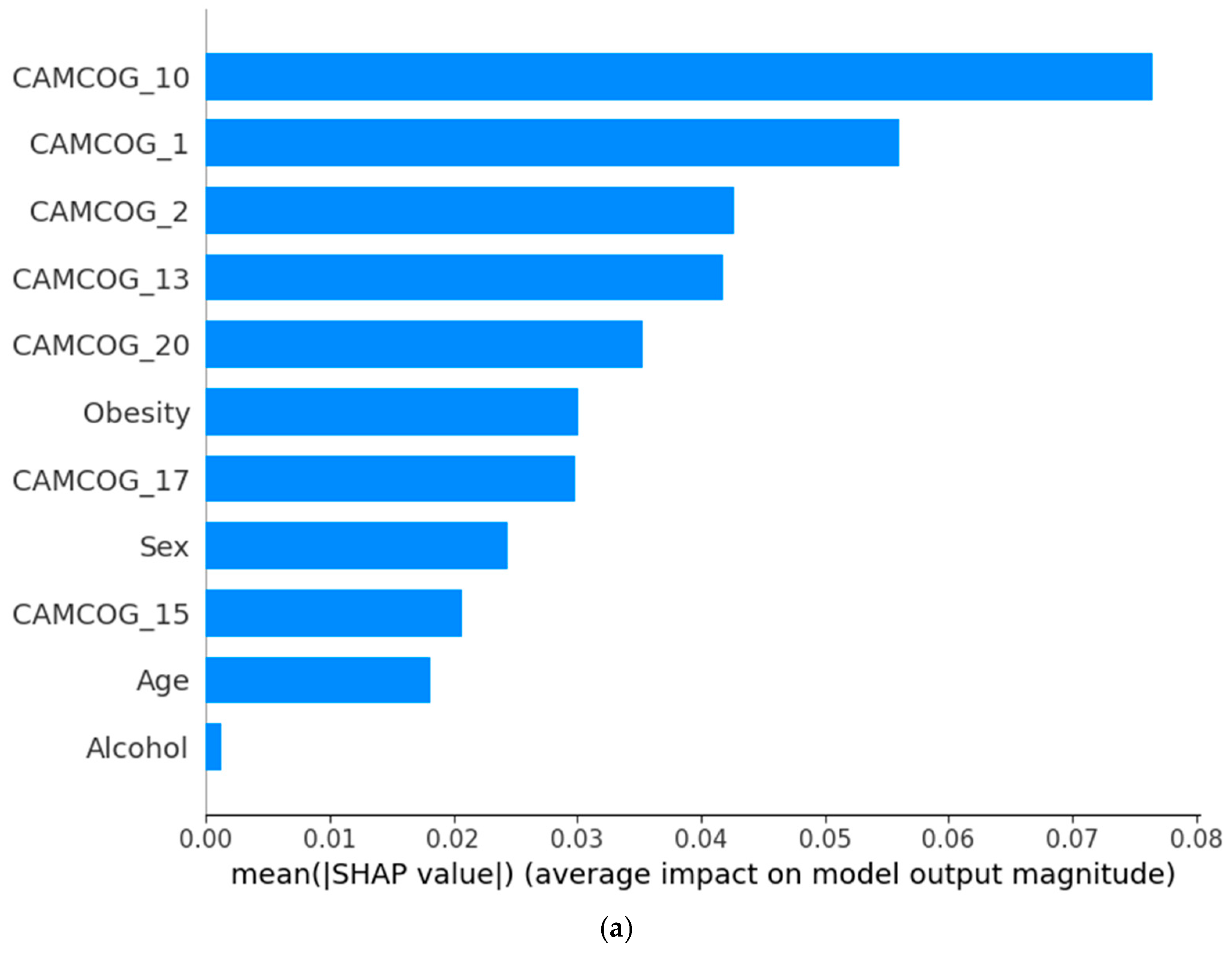
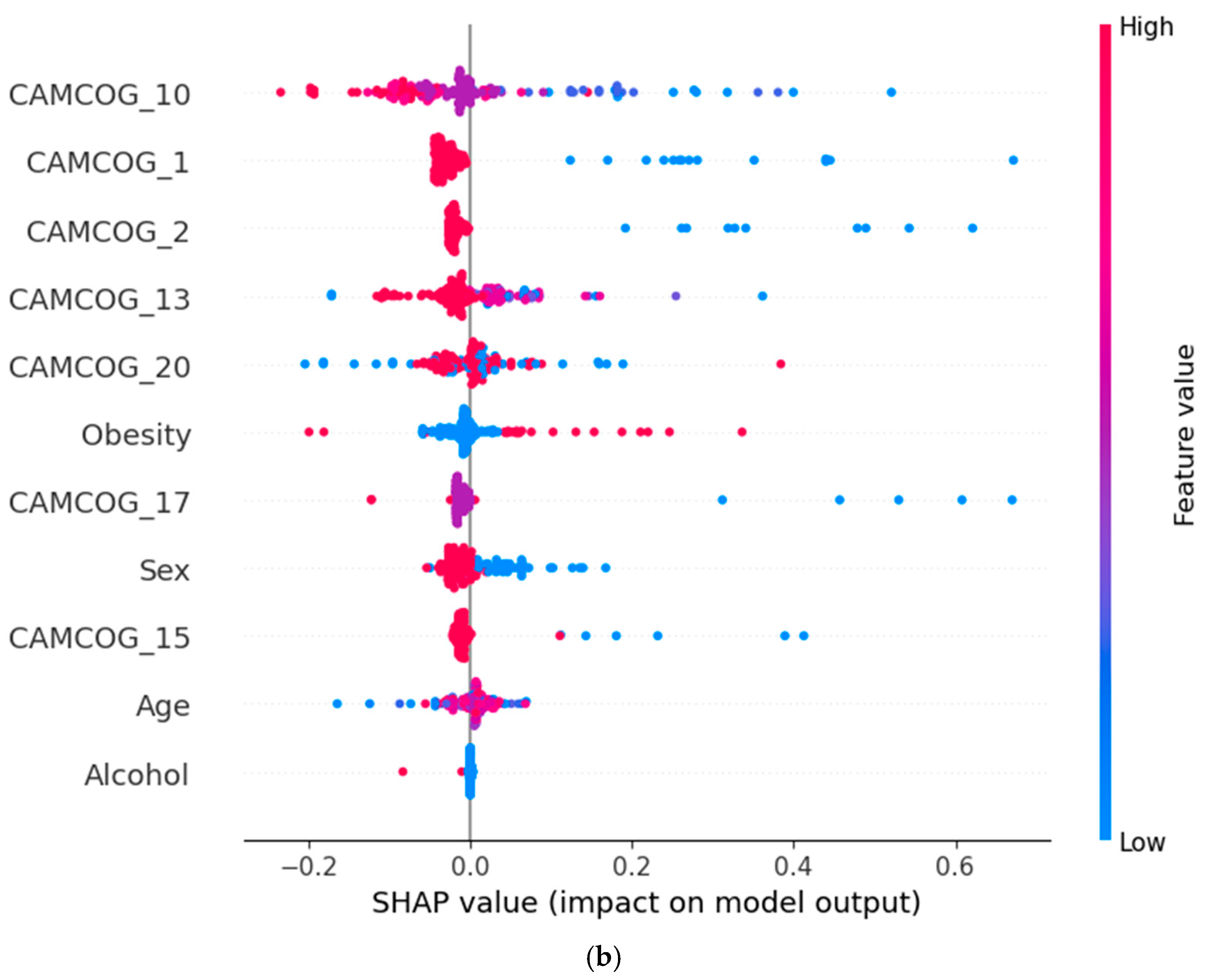
| Selected Feature | Description |
|---|---|
| CAMCOG_2 | Place orientation score (baseline) |
| CAMCOG_1 | Time orientation score (baseline) |
| CAMCOG_10 | Memory recall of remote information score (baseline) |
| CAMCOG_17 | Spontaneous writing score (baseline) |
| Age | Age (in years) |
| Obesity | Presence (BMI ≥ 25); Absence (BMI < 25) |
| Alcohol | Presence; Absence |
| CAMCOG_13 | Attention/Concentration score (baseline) |
| CAMCOG_15 | Written comprehension score (baseline) |
| CAMCOG_20 | Ideomotor praxis score (baseline) |
| Sex | Sex (Male; Female) |
3.2.3. Prediction of Diagnostic Change at 24 Months
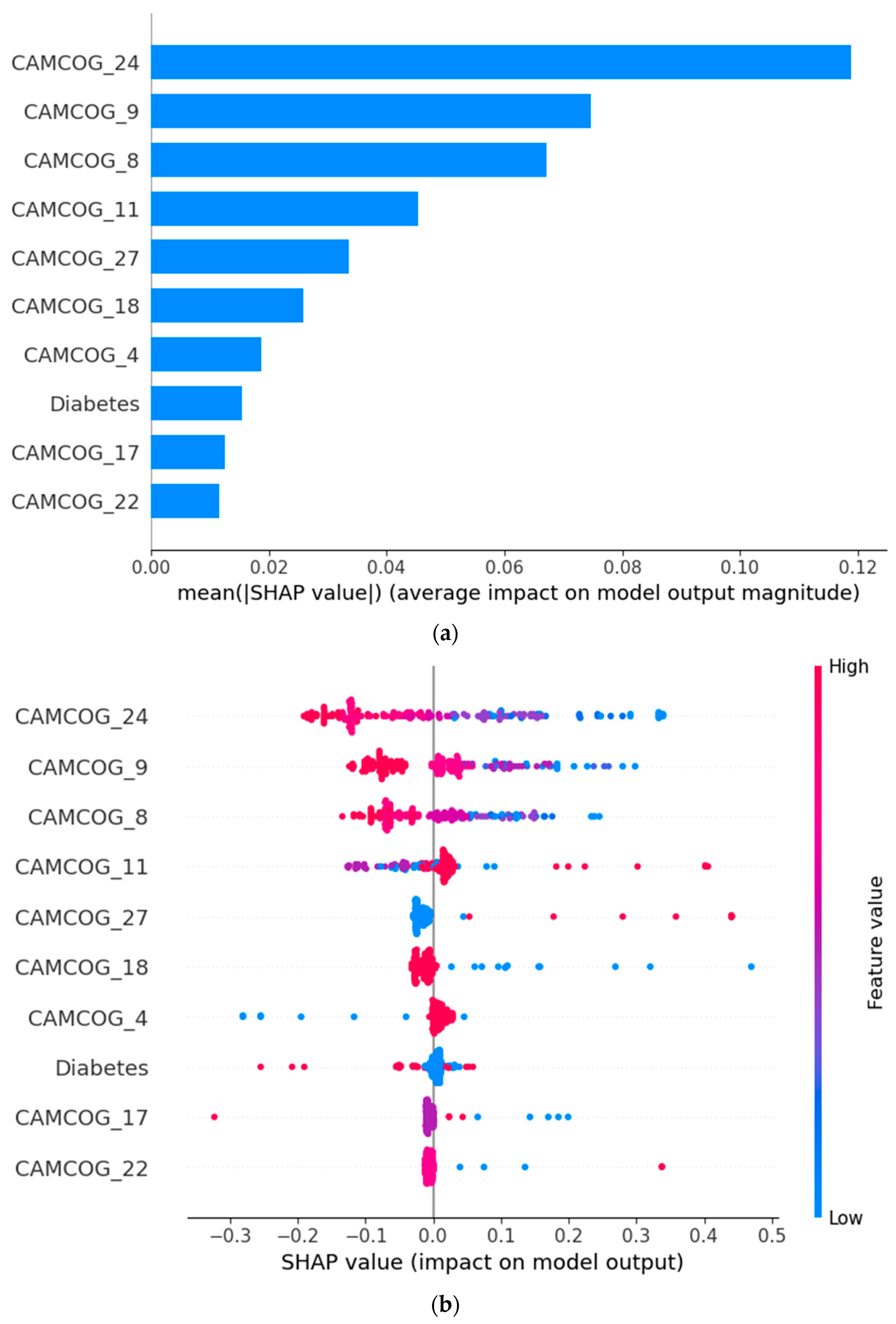
3.2.4. Best Performing Classifier for the 24-Month Diagnostic Change

| Selected Feature | Description |
|---|---|
| CAMCOG_8 | Recall score (baseline) |
| CAMCOG_27 | Function recognition score (baseline) |
| CAMCOG_24 | Abstract thinking score (baseline) |
| CAMCOG_22 | Numerical calculations score (baseline) |
| CAMCOG_9 | Recognition score (baseline) |
| CAMCOG_18 | Ideational praxis score (baseline) |
| CAMCOG_11 | Memory recall of recent information score (baseline) |
| Diabetes | Presence; Absence |
| CAMCOG_4 | Comprehension-verbal response score (baseline) |
| CAMCOG_17 | Spontaneous writing score (baseline) |
4. Discussion
4.1. Interpretation of Short-Term Prediction (12-Month Horizon)
4.2. Interpretation of Medium-Term Prediction (24-Month Horizon)
4.3. Conceptual Model: Cognitive Vulnerability with Gradual Modulation
4.4. Methodological Contribution and Limitations
4.5. Clinical Implications
5. Conclusions
Author Contributions
Funding
Institutional Review Board Statement
Informed Consent Statement
Data Availability Statement
Acknowledgments
Conflicts of Interest
References
- Arora, S.; Lojo-Seoane, C.; Leiva-Ureña, D.; Blanco, L.P.; Mallo, S.C.; Nieto-Vieites, A.; Pereiro, A.X. Moderating effect of the domains of the cognitive reserve index questionnaire (CRIq) on longitudinal change slopes in episodic memory across the cognitive aging continuum. Sci. Rep. 2026, 16, 2196. [Google Scholar] [CrossRef] [PubMed]
- Mirmosayyeb, O.; Balconi, J.; Santivasci, C.; Dong, X.; Young, N.; Szigeti, K.; Benedict, R.H.B. Predictive role of Neuroticism and Conscientiousness in conversion from mild cognitive impairment to Alzheimer’s disease. Aging Ment. Health 2026, 30, 739–746. [Google Scholar] [CrossRef]
- Ren, J.; Xie, D.; Wu, Z.; Xie, H.; Wang, L.; Chen, F.; Xu, J.; Jin, Q.; Huang, H.; Luo, Y.; et al. Cortical thinning predicts cognitive impairment and progression in Parkinson’s disease: The mediating role of p-Tau. Behav. Brain Res. 2026, 499, 115937. [Google Scholar] [CrossRef]
- Li, J.; Xu, L.; Liu, F.; Wang, J.; Shao, X.; Lin, J.; Chen, C.; Zeng, M.; Cheng, X.; Liu, S. Deep medullar veins: Predictors of clinical progression in Alzheimer’s disease. Quant. Imaging Med. Surg. 2026, 16, 27. [Google Scholar] [CrossRef]
- Guillen, N.; Esteller-Gauxax, D.; Sarto, J.; Perales, I.; Ríos-Guillermo, J.; Massons, M.; Martín-Sobrino, I.; Augé, J.M.; Naranjo, L.; Ruiz-Garcia, R.; et al. Plasma p-Tau217 and GFAP predict widespread cognitive decline in Alzheimer’s disease. J. Neurol. 2026, 273, 28. [Google Scholar] [CrossRef]
- Ding, X.; Zheng, Z.; Wang, H.; Shao, Y.; Zhu, S.; Ma, Z.; Gu, X.; Xia, T. Persistent depressive-symptom trajectories predict conversion from mild cognitive impairment to Alzheimer’s disease: A longitudinal ADNI study. J. Affect. Disord. 2025, 391, 120066. [Google Scholar] [CrossRef]
- Gavett, B.E.; Mungas, D.; Fletcher, E.; Widaman, K.; Fan, A.; DeCarli, C.; Whitmer, R.A.; Tomaszewski-Farias, S. Domain-specific changes in everyday cognition: Associations with diagnosis change and gray matter volume change. Neuropsychology 2026, 40, 3–16. [Google Scholar] [CrossRef]
- Russo, M.J.; Bueri, J.; Alba-Ferrara, L.; Labos, E.; Sevlever, G.E.; Allegri, R.F. Recognition memory in individuals with mild cognitive impairment and Alzheimer’s dementia: A systematic review. Appl. Neuropsychol. Adult 2026, 6, 1–21. [Google Scholar] [CrossRef]
- Elkana, O.; Beheshti, I. Brain age as an accurate biomarker of preclinical cognitive decline: Evidence from a 12-year longitudinal study. J. Neurol. 2025, 272, 672. [Google Scholar] [CrossRef] [PubMed]
- Labos, E.; Zabala, K.; Renato, A.; Seinhart, D.; Schapira, M.; Guajardo, M.E. Clinical and neuropsychological predictors of progression to dementia in a follow-up study of a population of patients with mild cognitive impairment. Neurol. Argent. 2025, 17, 20–27. [Google Scholar] [CrossRef]
- Mitterova, K.; Výtvarova, E.; Kovářová, A.; Lamoš, M.; Fousek, J.; Rektorová, I. Early functional changes in lewy body dementia: Roles of dynamics, locus coeruleus, and compensation. Alzheimer’s Res. Ther. 2025, 17, 199. [Google Scholar] [CrossRef] [PubMed]
- Elkana, O.; Eisikovits, O.R.; Oren, N.; Betzale, V.; Giladi, N.; Ash, E.L. Sensitivity of neuropsychological tests to identify cognitive decline in highly educated elderly individuals: 12 months follow up. J. Alzheimer’s Dis. 2015, 49, 607–616. [Google Scholar] [CrossRef]
- Sheng, J.; Yang, Z.; Wang, Y.; Zhang, Q.; Xin, Y.; Song, Y.; Wang, L. Metabolism fluctuation coupling can track the progression of dementia and describe MST1 gene-related pathology. Commun. Med. 2026, 6, 24. [Google Scholar] [CrossRef]
- Platero, C.; Bengoa, J. Benchmarking parametric models of disease progression for early detection of cognitive decline. Comput. Methods Programs Biomed. 2026, 274, 109162. [Google Scholar] [CrossRef]
- Rudolf, J.G.; Wiesman, A.I.; Baillet, S.; Villeneuve, S. Time-dependent biomarker accuracy in forecasting mild cognitive impairment. Alzheimer’s Dement. 2025, 21, e110285. [Google Scholar] [CrossRef]
- Tsiakiri, A.; Bakirtzis, C.; Plakias, S.; Vlotinou, P.; Vadikolias, K.; Terzoudi, A.; Christidi, F. Predictive Models for the Transition from Mild Neurocognitive Disorder to Major Neurocognitive Disorder: Insights from Clinical, Demographic, and Neuropsychological Data. Biomedicines 2024, 12, 1232. [Google Scholar] [CrossRef]
- Shijin Knox, G.U.; Anurenjan, A.; Pradeep, R.; Sreeni, K.G. AlzFusionFormer: Integrating multiple transformers for early Alzheimer’s disease detection from multi-modal data. Biomed. Signal Process. Control 2026, 112, 108601. [Google Scholar] [CrossRef]
- Zarei, S.; Saffar, M.; Shalbaf, R.; Abharian, P.; Shalbaf, A. Explainable hierarchical machine-learning approaches for multimodal prediction of conversion from mild cognitive impairment to Alzheimer’s disease. Phys. Eng. Sci. Med. 2025, 48, 1741–1759. [Google Scholar] [CrossRef] [PubMed]
- Afifi, I.; Elgendy, M.; Abdelfatah, M.; El–Sappagh, S. Vision and convolutional transformers for Alzheimer’s disease diagnosis: A systematic review of architectures, multimodal fusion and critical gaps. Brain Inform. 2026, 13, 1. [Google Scholar] [CrossRef]
- Valizadeh, G.; Elahi, R.; Hasankhani, Z.; Saligheh Rad, H.S.; Shalbaf, A. Deep Learning Approaches for Early Prediction of Conversion from MCI to AD using MRI and Clinical Data: A Systematic Review. Arch. Comput. Methods Eng. 2025, 32, 1229–1298. [Google Scholar] [CrossRef]
- Fernández-Blázquez, M.A.; Ruiz-Sánchez de León, J.M.; Sanz-Blasco, R.; Verche, E.; Ávila-Villanueva, M.; Gil-Moreno, M.J.; Montenegro-Peña, M.; Terrón-Cuadrado, C.; Fernández García, C.; Gómez Ramirez, J. XGBoost models based on non imaging features for the prediction of mild cognitive impairment in older adults. Sci. Rep. 2025, 15, 29732. [Google Scholar] [CrossRef]
- Gelir, F.; Akan, T.; Alp, S.; Gecili, E.; Bhuiyan, M.S.; Disbrow, E.A.; Conrad, S.A.; Vanchiere, J.A.; Kevil, C.G.; Bhuiyan, M.A.N. Machine Learning Approaches for Predicting Progression to Alzheimer’s Disease in Patients with Mild Cognitive Impairment. J. Med. Biol. Eng. 2025, 45, 63–83. [Google Scholar] [CrossRef]
- Jiang, J.; Li, C.; Lu, J.; Sun, J.; Sun, X.; Yang, J.; Wang, L.; Zuo, C.; Shi, K. Using interpretable deep learning radiomics model to diagnose and predict progression of early AD disease spectrum: A preliminary [18F]FDG PET study. Eur. Radiol. 2025, 35, 2620–2633. [Google Scholar] [CrossRef]
- Moradi, E.; Dahnke, R.; Imani, V.; Gaser, C.; Solomon, A.; Tohka, J. Integrating plasma, MRI, and cognitive biomarkers for personalized prediction of decline across cognitive domains. Neurobiol. Aging 2025, 155, 53–65. [Google Scholar] [CrossRef]
- Afroughi, F.; Seyedalinaghi, S.; Mirzapour, P.; Shirdel, S.; Parmoon, Z.; Khorshidi, M.M.; Mansouri, S.; Sheykhi, M.; Popoola, Y.; Mehraeen, E. The potential of artificial intelligence in advancing neuroscience: A systematic review of current applications and models. Intell.-Based Med. 2026, 13, 100338. [Google Scholar] [CrossRef]
- Ogundokun, R.O.; Olawoye, P.O.; Clifford-Ordor, N.R.; Adeniji, O.A.; Ehimika, O.E. A Systematic Review of Deep Learning Models and Multimodal Fusion Techniques for Alzheimer’s Disease Prediction. NIPES—J. Sci. Technol. Res. 2025, 7, 2142–2152. [Google Scholar] [CrossRef]
- Wu, X.; Yao, X.; Shi, J.; Tang, M.; Zhou, Q.; Chen, K. Development and validation of a machine learning model for early screening of high-risk mild cognitive impairment from the multi-cohort data. Int. J. Med. Inform. 2025, 203, 106030. [Google Scholar] [CrossRef] [PubMed]
- Christodoulou, R.C.; Vamvouras, G.; Sarquis, M.D.; Petrou, V.; Papageorgiou, P.S.; Rivera, L.; Morales Gonzalez, C.; Rivera, G.; Papageorgiou, S.G.; Vassiliou, E. From Microbleeds to Iron: AI Prediction of Cerebrospinal Fluid Erythrocyte Load in Alzheimer’s Disease. J. Clin. Med. 2025, 14, 7360. [Google Scholar] [CrossRef]
- Valoor, A.; Gangadharan, G.R. Unveiling the decision making process in Alzheimer’s disease diagnosis: A case-based counterfactual methodology for explainable deep learning. J. Neurosci. Methods 2025, 413, 110318. [Google Scholar] [CrossRef] [PubMed]
- Grueso, S.; Viejo-Sobera, R. Machine learning methods for predicting progression from mild cognitive impairment to Alzheimer’s disease dementia: A systematic review. Alzheimer’s Res Ther 2021, 13, 162. [Google Scholar] [CrossRef]
- Adelson, R.P.; Garikipati, A.; Maharjan, J.; Ciobanu, M.; Barnes, G.; Singh, N.P.; Dinenno, F.A.; Mao, Q.; Das, R. Machine Learning Approach for Improved Longitudinal Prediction of Progression from Mild Cognitive Impairment to Alzheimer’s Disease. Diagnostics 2023, 14, 13. [Google Scholar] [CrossRef]
- Ding, H.; Wang, B.; Hamel, A.P.; Melkonyan, M.; Ang, T.F.A.; Alzheimer’s Disease Neuroimaging, I.; Au, R.; Lin, H. Prediction of Progression from Mild Cognitive Impairment to Alzheimer’s disease with Longitudinal and Multimodal Data. Front. Dement. 2023, 2, 1271680. [Google Scholar] [CrossRef]
- Sachdev, P.S.; Blacker, D.; Blazer, D.G.; Ganguli, M.; Jeste, D.V.; Paulsen, J.S.; Petersen, R.C. Classifying neurocognitive disorders: The DSM-5 approach. Nat. Rev. Neurol. 2014, 10, 634–642. [Google Scholar] [CrossRef] [PubMed]
- Mougias, A.; Christidi, F.; Kaldi, M.; Kerossi, M.-I.; Athanasouli, P.; Politis, A. Mini-mental state examination: Greek normative data stratified by age and education in a large sample of 925 community-dwelling healthy participants. In GeNeDis 2018: Geriatrics; Springer: Berlin/Heidelberg, Germany, 2020; pp. 93–102. [Google Scholar]
- Tsiakiri, A.; Vadikolias, K.; Tripsianis, G.; Vlotinou, P.; Serdari, A.; Terzoudi, A.; Heliopoulos, I. Influence of social and demographic factors on the Montreal Cognitive Assessment (MoCA) Test in rural population of north-eastern Greece. Geriatrics 2021, 6, 43. [Google Scholar] [CrossRef] [PubMed]
- Tsolaki, M.; Fountoulakis, K.N.; Chantzi, H.; Kazis, A. The Cambridge Cognitive Examination (CAMCOG): A validation study in outpatients suffering from dementia and non-demented elderly subjects (including age associated cognitive decline patients) in Greece. Am. J. Alzheimer’s Dis. Other Dement. 2000, 15, 269–276. [Google Scholar] [CrossRef]
- Roth, M.; Tym, E.; Mountjoy, C.; Huppert, F.A.; Hendrie, H.; Verma, S.; Goddard, R. CAMDEX: A standardised instrument for the diagnosis of mental disorder in the elderly with special reference to the early detection of dementia. Br. J. Psychiatry 1986, 149, 698–709. [Google Scholar] [CrossRef] [PubMed]
- Weir, C.B.; Jan, A. BMI Classification Percentile and Cut off Points; StatPearls: Treasure Island, FL, USA, 2019. [Google Scholar]
- Choe, Y.M.; Lee, B.C.; Choi, I.G.; Suh, G.H.; Lee, D.Y.; Kim, J.W. Mmse subscale scores as useful predictors of ad conversion in mild cognitive impairment. Neuropsychiatr. Dis. Treat. 2020, 16, 1767–1775. [Google Scholar] [CrossRef] [PubMed]
- Thabtah, F.; Peebles, D. Cognitive feature evaluation for disease progression in dementia and its precursors using feature selection. Health Technol. 2025, 15, 1075–1086. [Google Scholar] [CrossRef]
- Tsiakiri, A.; Plakias, S.; Vlotinou, P.; Athanasouli, P.; Terzoudi, A.; Kyriazidou, S.; Serdari, A.; Karakitsiou, G.; Megari, K.; Aggelousis, N.; et al. Ιnnovative Health Promotion Strategies: A 6-Month Longitudinal Study on Computerized Cognitive Training for Older Adults with Minor Neurocognitive Disorders. Eur. J. Investig. Health Psychol. Educ. 2025, 15, 34. [Google Scholar] [CrossRef]
- Levassort, H.; Boucquemont, J.; Alencar-de Pinho, N.; Lambert, O.; Helmer, C.; Metzger, M.; Teillet, L.; Frimat, L.; Combe, C.; Fouque, D.; et al. A new approach for cognitive impairment pattern in chronic kidney disease. Nephrol. Dial. Transplant. 2024, 39, 848–859. [Google Scholar] [CrossRef]
- Oltra-Cucarella, J.; Ferrer-Cascales, R.; Alegret, M.; Gasparini, R.; Díaz-Ortiz, L.M.; Ríos, R.; Martínez-Nogueras, Á.L.; Onandia, I.; Pérez-Vicente, J.A.; Cabello-Rodríguez, L.; et al. Risk of progression to Alzheimer’s disease for different neuropsychological Mild Cognitive Impairment subtypes: A hierarchical meta-analysis of longitudinal studies. Psychol. Aging 2018, 33, 1007–1021. [Google Scholar] [CrossRef]
- Swanberg, M.M.; Tractenberg, R.E.; Mohs, R.; Thal, L.J.; Cummings, J.L. Executive dysfunction in Alzheimer disease. Arch. Neurol. 2004, 61, 556–560. [Google Scholar] [CrossRef]
- Corriveau-Lecavalier, N.; Gunter, J.L.; Kamykowski, M.; Dicks, E.; Botha, H.; Kremers, W.K.; Graff-Radford, J.; Wiepert, D.A.; Schwarz, C.G.; Yacoub, E. Default mode network failure and neurodegeneration across aging and amnestic and dysexecutive Alzheimer’s disease. Brain Commun. 2023, 5, fcad058. [Google Scholar] [CrossRef] [PubMed]
- Berlot, R.; O’Sullivan, M.J. What can the topology of white matter structural networks tell us about mild cognitive impairment? Future Neurol. 2017, 12, 35–50. [Google Scholar] [CrossRef]
- Delano-Wood, L.; Bondi, M.W.; Jak, A.J.; Stricker, N.R.; Schweinsburg, B.C.; Frank, L.R.; Wierenga, C.E.; Delis, D.C.; Theilmann, R.J.; Salmon, D.P. Stroke risk modifies regional white matter differences in mild cognitive impairment. Neurobiol. Aging 2010, 31, 1721–1731. [Google Scholar] [CrossRef] [PubMed]
- Daulatzai, M.A. Dysfunctional Sensory Modalities, Locus Coeruleus, and Basal Forebrain: Early Determinants that Promote Neuropathogenesis of Cognitive and Memory Decline and Alzheimer’s Disease. Neurotox. Res. 2016, 30, 295–337. [Google Scholar] [CrossRef]
- Sandell, R.; Torok, J.; Nagaragan, S.; Ranasinghe, K.G.; Ma, D.; Raj, A. Integrating Event-Based and Network Diffusion Models to Predict Individual Tau Progression in Alzheimer’s Disease. Alzheimer’s Dement. 2025, 21, e109738. [Google Scholar] [CrossRef]
- Zhang, J.; Shi, Y. Surface-Based Multi-axis Longitudinal Disentanglement Using Contrastive Learning for Alzheimer’s Disease. In Lecture Notes in Computer Science; Springer Nature: Cham, Switzerland, 2026; pp. 585–594. [Google Scholar]
- Cho, H.; Ahn, H.; Wu, G.; Kim, W.H. Adaptive Adversarial Data Augmentation with Trajectory Constraint for Alzheimer’s Disease Conversion Prediction. In Lecture Notes in Computer Science; Springer Nature: Cham, Switzerland, 2026; pp. 13–23. [Google Scholar]
- Bahroun, S.; Jeon, G. Longitudinal Alzheimer’s Disease Progression Modelling via Hybrid Vision Transformers and Recurrent Neural Networks With Cross-Modal Feature Fusion. Expert Syst. 2026, 43, e70191. [Google Scholar] [CrossRef]
- Guo, J.; Azcona, E.A.; López-Tapia, S.; Katsaggelos, A.K. Stage Detection of Mild Cognitive Impairment: Region-dependent Graph Representation Learning on Brain Morphable Meshes. In Proceedings of Machine Learning Research; PMLR: New York, NY, USA, 2023; pp. 888–904. [Google Scholar]
- Reiter, K.; Butts, A.M.; Janecek, J.K.; Correro, A.N.; Nencka, A.; Agarwal, M.; Franczak, M.; Glass-Umfleet, L. Relationship between cognitive reserve, brain volume, and neuropsychological performance in amnestic and nonamnestic MCI. Aging Neuropsychol. Cogn. 2023, 30, 940–956. [Google Scholar] [CrossRef]
- Liu, S.; Zhang, B.; Zimmer, V.A.; Rueckert, D. Multi-modal Data Fusion with Missing Data Handling for Mild Cognitive Impairment Progression Prediction. In Lecture Notes in Computer Science; Springer Nature: Cham, Switzerland, 2024; pp. 293–302. [Google Scholar]
- Wang, X.; Ye, T.; Zhou, W.; Zhang, J. Uncovering heterogeneous cognitive trajectories in mild cognitive impairment: A data-driven approach. Alzheimer’s Res. Ther. 2023, 15, 57. [Google Scholar] [CrossRef]
- Iinuma, Y.; Nobukawa, S.; Mizukami, K.; Kawaguchi, M.; Higashima, M.; Tanaka, Y.; Yamanishi, T.; Takahashi, T. Enhanced temporal complexity of EEG signals in older individuals with high cognitive functions. Front. Neurosci. 2022, 16, 878495. [Google Scholar] [CrossRef] [PubMed]
- Veitch, D.P.; Weiner, M.W.; Miller, M.; Aisen, P.S.; Ashford, M.A.; Beckett, L.A.; Green, R.C.; Harvey, D.; Jack, C.R.; Jagust, W.; et al. The Alzheimer’s Disease Neuroimaging Initiative in the era of Alzheimer’s disease treatment: A review of ADNI studies from 2021 to 2022. Alzheimer’s Dement. 2024, 20, 652–694. [Google Scholar] [CrossRef]
- MacAulay, R.K.; Halpin, A.; Cohen, A.S.; Calamia, M.; Boeve, A.; Zhang, L.; Brouillette, R.M.; Foil, H.C.; Bruce-Keller, A.; Keller, J.N. Predictors of heterogeneity in cognitive function: Apoe-e4, sex, education, depression, and vascular risk. Arch. Clin. Neuropsychol. 2020, 35, 660–670. [Google Scholar] [CrossRef] [PubMed]
- Aguilar-Navarro, S.G.; Mimenza-Alvarado, A.J.; Yeverino-Castro, S.G.; Caicedo-Correa, S.M.; Cano-Gutierrez, C. Cognitive Frailty and Aging: Clinical Characteristics, Pathophysiological Mechanisms, and Potential Prevention Strategies. Arch. Med. Res. 2025, 56, 103106. [Google Scholar] [CrossRef] [PubMed]
- Huang, Y.L.; Lin, C.H.; Tsai, T.H.; Huang, C.H.; Li, J.L.; Chen, L.K.; Li, C.H.; Tsai, T.F.; Wang, P.N. Discovery of a metabolic signature predisposing high risk patients with mild cognitive impairment to converting to alzheimer’s disease. Int. J. Mol. Sci. 2021, 22, 10903. [Google Scholar] [CrossRef]
- Huang, V.; Hogan, D.B.; Ismail, Z.; Maxwell, C.J.; Smith, E.E.; Callahan, B.L. Evaluating the real-world representativeness of participants with mild cognitive impairment in Canadian research protocols: A comparison of the characteristics of a memory clinic patients and research samples. Can. Geriatr. J. 2020, 23, 297–328. [Google Scholar] [CrossRef]
- Li, W.; Wang, X.; Sun, L.; Yue, L.; Xiao, S. Correlation between the APOE ε4 genotype, lifestyle habits, and cognitive deficits in Chinese adults over 60: A cross-sectional analysis in China. Front. Public Health 2024, 12, 1417499. [Google Scholar] [CrossRef]
- Olofsson, J.K.; Larsson, M.; Roa, C.; Wilson, D.A.; Jonsson Laukka, E. Interaction Between Odor Identification Deficit and APOE4 Predicts 6-Year Cognitive Decline in Elderly Individuals. Behav. Genet. 2020, 50, 3–13. [Google Scholar] [CrossRef]
- Martin, J.; Reid, N.; Ward, D.D.; King, S.; Hubbard, R.E.; Gordon, E.H. Investigating Sex Differences in Risk and Protective Factors in the Progression of Mild Cognitive Impairment to Dementia: A Systematic Review. J. Alzheimer’s Dis. 2024, 97, 101–119. [Google Scholar] [CrossRef]
- Salwierz, P.; Davenport, C.; Sumra, V.; Iulita, M.F.; Ferretti, M.T.; Tartaglia, M.C. Sex and gender differences in dementia. In International Review of Neurobiology; Academic Press: Cambridge, MA, USA, 2022; Volume 164, pp. 179–233. [Google Scholar]
- Villemagne, V.L.; Doré, V.; Burnham, S.; Rowe, C.C. Aβ Imaging in Aging, Alzheimer’s Disease, and Other Neurodegenerative Conditions. In PET and SPECT in Neurology; Springer International Publishing: Cham, Switzerland, 2020; pp. 283–343. [Google Scholar]
- Wolters, E.E.; Dodich, A.; Boccardi, M.; Corre, J.; Drzezga, A.; Hansson, O.; Nordberg, A.; Frisoni, G.B.; Garibotto, V.; Ossenkoppele, R. Clinical validity of increased cortical uptake of [18F]flortaucipir on PET as a biomarker for Alzheimer’s disease in the context of a structured 5-phase biomarker development framework. Eur. J. Nucl. Med. Mol. Imaging 2021, 48, 2097–2109. [Google Scholar] [CrossRef]
- Callow, D.D.; Spira, A.P.; Zipunnikov, V.; Pettigrew, C.; Faria, A.; Wanigatunga, S.K.; Albert, M.; Bakker, A.; Soldan, A. Independent associations of sleep and physical activity with cognition are mediated by hippocampal microstructure in middle-aged and older adults. Neurobiol. Aging 2025, 147, 22–31. [Google Scholar] [CrossRef] [PubMed]
- Tzekaki, E.E.; Tsolaki, M.; Pantazaki, A.A.; Geromichalos, G.; Lazarou, E.; Kozori, M.; Sinakos, Z. The pleiotropic beneficial intervention of olive oil intake on the Alzheimer’s disease onset via fibrinolytic system. Exp. Gerontol. 2021, 150, 111344. [Google Scholar] [CrossRef] [PubMed]


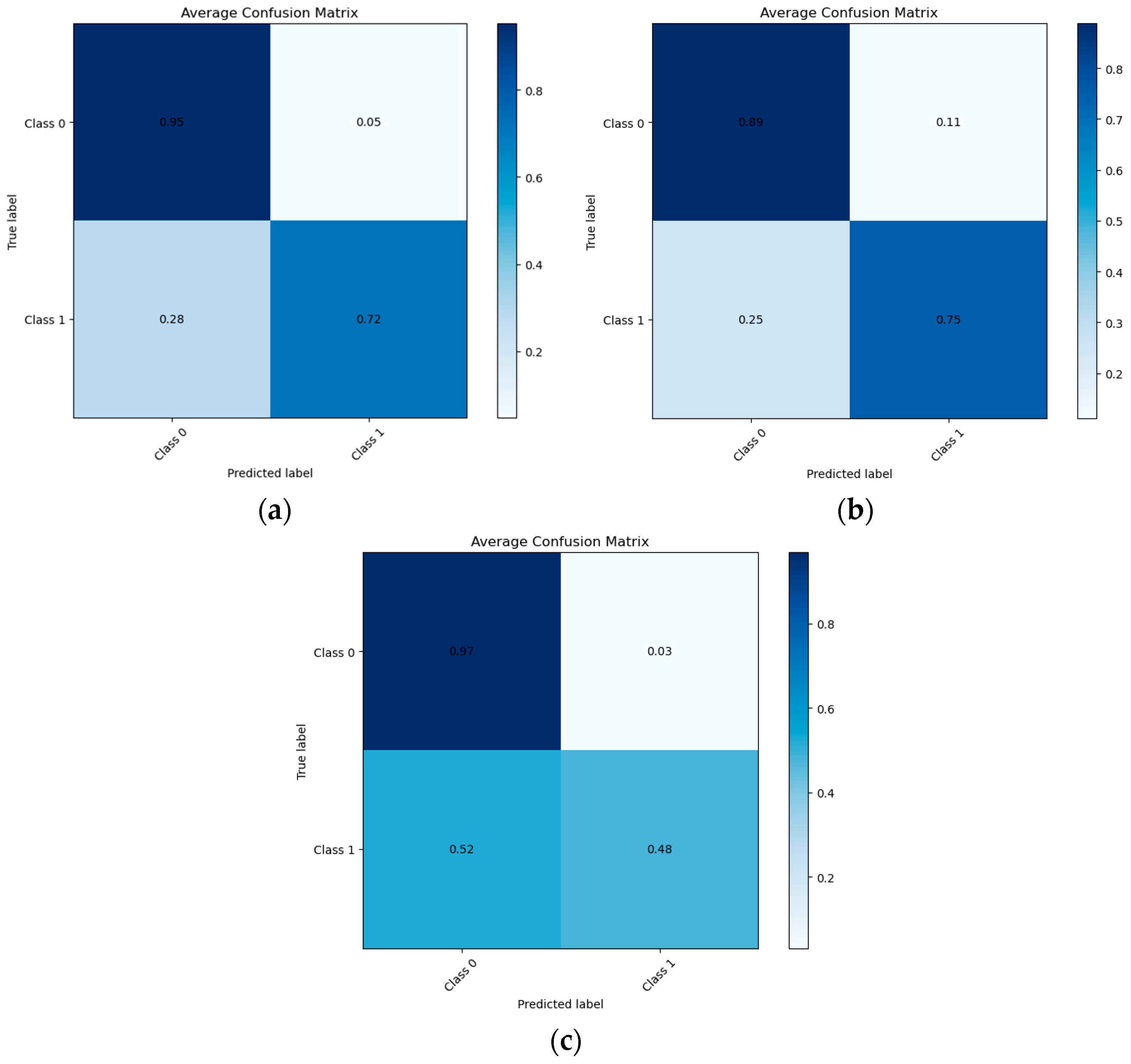
| Model | Accuracy | ROC–AUC | Precision | Recall | F1-Score | Selected Features |
|---|---|---|---|---|---|---|
| LR | 0.8576 | 0.8640 | 0.6929 | 0.7500 | 0.7149 | 14 |
| SVM | 0.9011 | 0.8560 | 0.8350 | 0.7179 | 0.7576 | 11 |
| XGBoost | 0.8580 | 0.7565 | 0.8033 | 0.4786 | 0.5939 | 8 |
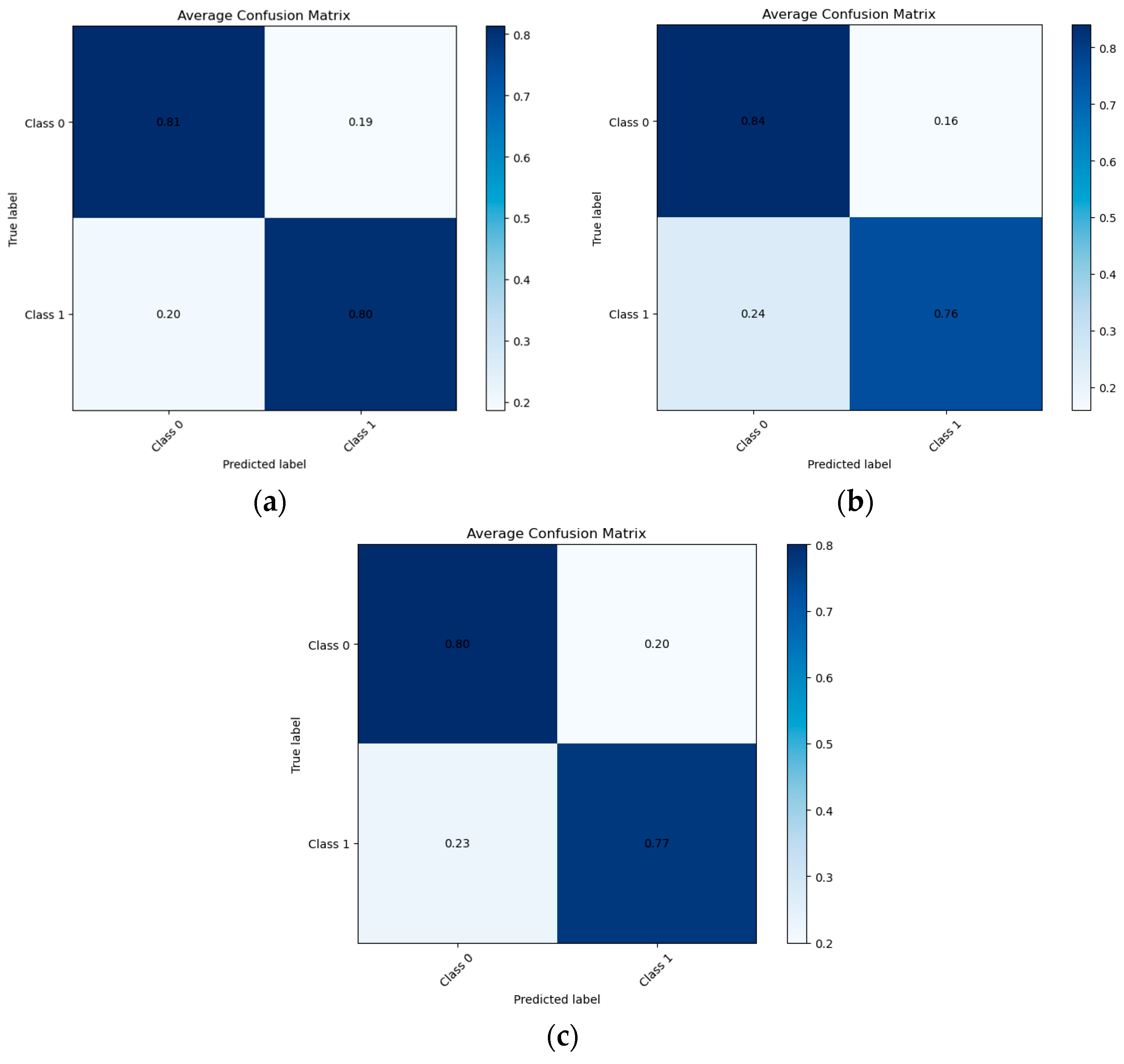
| Model | Accuracy | ROC–AUC | Precision | Recall | F1-Score | Selected Features |
|---|---|---|---|---|---|---|
| LR | 0.7964 | 0.8269 | 0.8558 | 0.7601 | 0.7995 | 8 |
| SVM | 0.8083 | 0.8223 | 0.8360 | 0.8039 | 0.8183 | 10 |
| XGBoost | 0.7843 | 0.8181 | 0.8231 | 0.7725 | 0.7919 | 21 |
Disclaimer/Publisher’s Note: The statements, opinions and data contained in all publications are solely those of the individual author(s) and contributor(s) and not of MDPI and/or the editor(s). MDPI and/or the editor(s) disclaim responsibility for any injury to people or property resulting from any ideas, methods, instructions or products referred to in the content. |
© 2026 by the authors. Licensee MDPI, Basel, Switzerland. This article is an open access article distributed under the terms and conditions of the Creative Commons Attribution (CC BY) license.
Share and Cite
Tsiakiri, A.; Kokkotis, C.; Tsiptsios, D.; Panos, L.; Aggelousis, N.; Vadikolias, K.; Christidi, F. Explainable Machine Learning Reveals Time-Dependent Cognitive Risk in Minor Neurocognitive Disorder: Implications for Health Promotion and Early Risk Stratification. Biomedicines 2026, 14, 880. https://doi.org/10.3390/biomedicines14040880
Tsiakiri A, Kokkotis C, Tsiptsios D, Panos L, Aggelousis N, Vadikolias K, Christidi F. Explainable Machine Learning Reveals Time-Dependent Cognitive Risk in Minor Neurocognitive Disorder: Implications for Health Promotion and Early Risk Stratification. Biomedicines. 2026; 14(4):880. https://doi.org/10.3390/biomedicines14040880
Chicago/Turabian StyleTsiakiri, Anna, Christos Kokkotis, Dimitrios Tsiptsios, Leonidas Panos, Nikolaos Aggelousis, Konstantinos Vadikolias, and Foteini Christidi. 2026. "Explainable Machine Learning Reveals Time-Dependent Cognitive Risk in Minor Neurocognitive Disorder: Implications for Health Promotion and Early Risk Stratification" Biomedicines 14, no. 4: 880. https://doi.org/10.3390/biomedicines14040880
APA StyleTsiakiri, A., Kokkotis, C., Tsiptsios, D., Panos, L., Aggelousis, N., Vadikolias, K., & Christidi, F. (2026). Explainable Machine Learning Reveals Time-Dependent Cognitive Risk in Minor Neurocognitive Disorder: Implications for Health Promotion and Early Risk Stratification. Biomedicines, 14(4), 880. https://doi.org/10.3390/biomedicines14040880