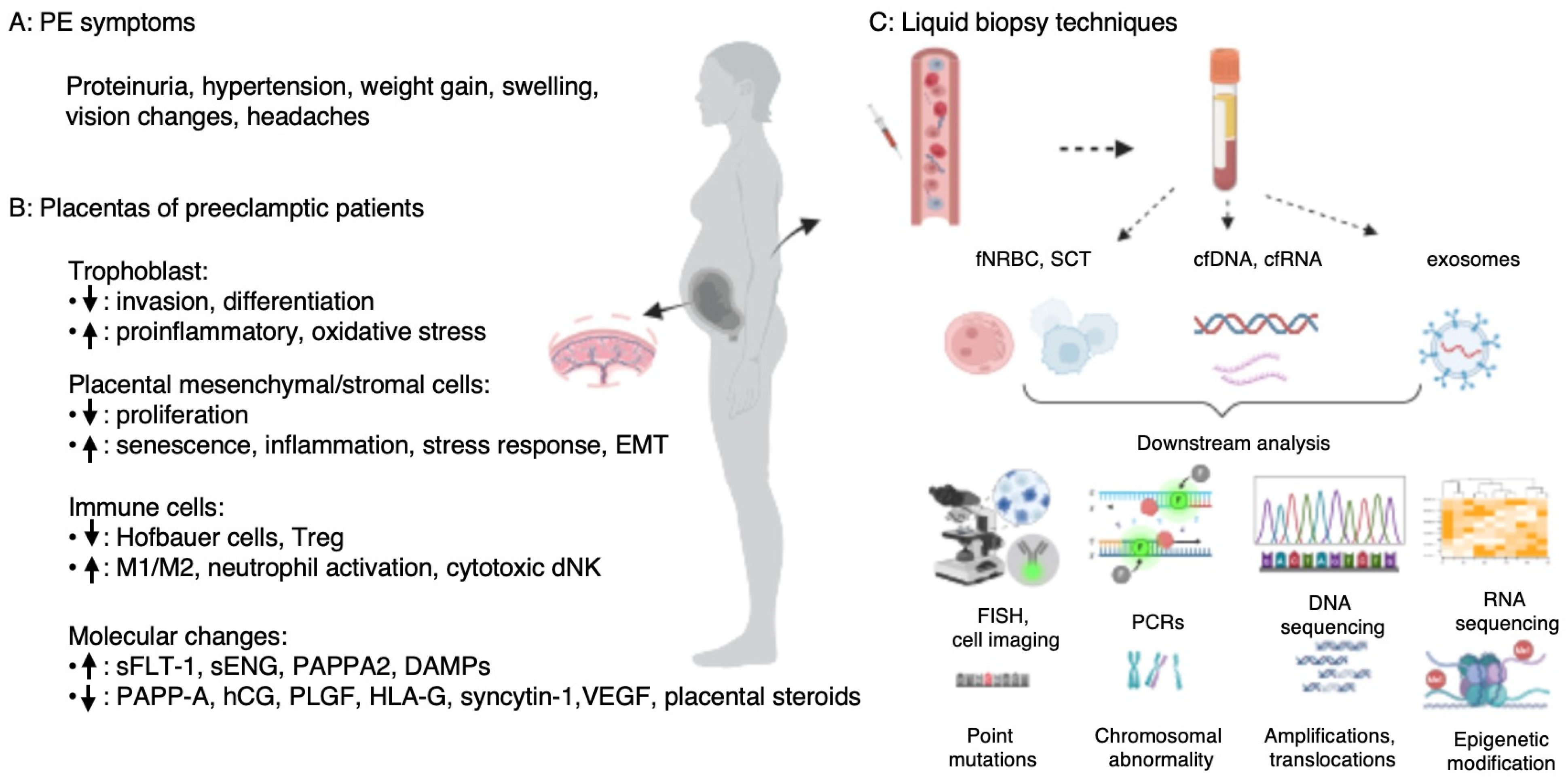
Cell-Based and Cell-Free Non-Invasive Prenatal Analysis of Preeclampsia: An Updated Review of Liquid Biopsy



Abstract
1. Introduction
2. Biology of PE
3. Liquid Biopsy for Preeclampsia Screening and Diagnosis
3.1. Cell-Based Approaches
3.2. Cell-Free Approaches
3.2.1. Cell-Free DNA (cfDNA)

| Author, Year | Patients; Sample Type | Study Type (Sampling Time) | Methods | Findings and Implications of PE |
|---|---|---|---|---|
| Adil et al., 2025 [56] | 395 FF-training cohort, 450 PE-training cohort, 831 validation cohort, 141 external validation cohort; plasma and tissues | PE prediction (≤GW 16) | QIAsymphony Circulating DNA Kit and Low coverage (0.5X) WGS for plasma, and ATAC-seq, DNase-seq and ChIP–seq for tissue | A PE prediction model with validated prediction performance (81% sensitivity at 80% specificity) for preterm PE was established based on maternal and fetal tissue signatures (≤GW 16). Lower estimated FF in early PE, while FF increased across gestation in normal pregnancies. |
| Li et al., 2025 [28] | 8 non-pregnant women, 14 healthy, 12 PE pregnancy women; plasma | PE diagnosis | cfDNA WGS | Different nucleosome footprints indicate specific gene expression profiles for different groups. 1978 differential genes predominantly modulate immunology, cell cycle regulation, and sensory perception between healthy and pre-eclamptic pregnancies. |
| Stanley et al., 2024 [16] | 301 healthy controls, 18 PE and 30 healthy; plasma | PE diagnosis | cfDNA deconvolution | Identify major trophoblast (EVT, etc) contributions to cfDNA, establish cell type signature for PE at diagnosis: AFP+ ALB+ cytotrophoblasts and liver neutrophils and monocytes. |
| Khalil et al., 2024 [55] | 72 EOPE, 251 preterm PE, 420 term PE, and 16,849 healthy pregnant women | PE prediction (T1) | An artificial intelligence model, machine learning algorithms for classification | Lower FF and higher total cfDNA in the PE group. |
| Baetens et al., 2024 [66] | 27 PE and 50 healthy women; plasma | PE prediction (GW 11-13), PE diagnosis (GW 24-37), longitudinal study | Maxwell RSC LV ccfDNA kit, bisulfite sequencing | 42 distinct early pregnancy DMRs associate with severe PE. |
| Yu et al., 2024 [67] | 143 EOPE, 580 LOPE and 2004 healthy; plasma | PE prediction (GW 12-22) | Machine learning on NIPT data | EOPE women and healthy pregnant controls differed in pTSS coverages of an 8-gene panel. The early and later onset PE classifiers outperformed the FMF predicting model. |
| He et al., 2023 [62] | 135 pregnant and 50 non-pregnant women; plasma and placenta | PE prediction (T1 and early T2) | MagPure cDNA LQ kit, Methylation capture bisulphite sequencing | cfDNA specific methylation haplotypes and nucleosome positioning patterns were established to predict EOPE. |
| Gekas et al., 2023 [59] | 4 EOPE, 8 LOPE, 83 healthy pregnant women; plasma | PE prediction (T1 and early T2) | Illumina’s VeriSeq™ NIPT Solution v2 assay | cfDNA concentration, FF and fragment size distribution are significantly different at T1, while only FF and concentration are different between PE and controls at T2. |
| Gai et al., 2023 [61] | 10 PE, 16 healthy pregnant controls; plasma | PE diagnosis (T3) | QIAamp cNA kit, ddPCR | PE patients have lower median percentage of long cfDNA |
| De Borre et al., 2023 [60] | 498 pregnant women; plasma | PE prediction (T1 and early T2) | Maxwell HT cfDNA kit and methylome profiling | cfDNA methylome predicts PE pre-symptomatically at GW 9-14. Combined risk score predicted 72% patient with EOPE at 80% specificity. |
| Spinelli et al., 2022 [31] | 5 PE and no chromic HT vs. 5 chronic HT vs. 5 controls; serum | PE prediction (T1 and early T2) | MagMAX Cell-Free DNA Isolation Kit and WGBS | significant DMRs and annotated genes imply a common cardiovascular predisposition in PE and HT groups at T1. |
| Madala et al., 2022 [54] | 534 pregnant women; plasma | PE prediction | massive parallel signature sequencing | Low FF is associated with an increased risk of HDP. |
| Liu et al., 2021 [29] | 41 GH, 62 PE, 148 normal pregnancies; plasma | PE diagnosis | qPCR | cfDNA and ST2 concentrations higher in GH and PE patients, cfDNA is not increased in T3. |
| Kolarova et al., 2021 [52] | 20 PE vs. 22 healthy; plasma | PE diagnosis | sequencing | cfDNA fraction did not differ between groups; however, total cfDNA was >10 times higher in PE and associated with early delivery |
| Karapetian et al., 2021 [64] | 20 PE vs. 22 healthy; plasma | PE prediction | PCR based on RASSF1A methylation | Higher cfDNA level in the PE group. cfDNA level increased significantly for the three stages during uncomplicated pregnancy, while in the PE group, cfDNA elevation was significant only in the second half of pregnancy |
| Kwak et al., 2020 [68] | 68 HDP vs. 136 controls; plasma | PE prediction (T2), PE diagnosis (T3) | PCR based on methylated HYP2 genes as total cfDNA marker | Total cfDNA levels as measured with methylated HYP2 gene can be used to predict EOPE and PE with small for gestational age neonate. |
| Guo et al., 2020 [65] | 2,199 pregnancies (578 with complications vs. 1621 controls); plasma | PE prediction | Low coverage WGS | Classifiers based on nucleosome positioning predict complications with an accuracy of 80.3%, 78.9%, 72.1%, and 83.0% for macrosomia, FGR, GDM, and PE, respectively. |
| Yuan et al., 2019 [53] | 831 pregnant women; plasma | PE prediction (GW 12-22) | KingFisher Flex cfDNA extraction system | Total cfDNA levels were significantly higher in women diagnosed with PE. Increase in cfDNA levels were associated with an increased risk for PE. |
3.2.2. Cell-Free RNA (cfRNA)
3.2.3. Exosome and Exosomal Proteins
| Author, Year | Patients; Sample Type | Study Type (Sampling Time) | Methods | Findings and Implications of PE |
|---|---|---|---|---|
| Than et al., 2024 [76] | 24 term PE, 23 preterm PE and 94 healthy controls; plasma | GW 25-31 with 6–7 week before diagnosis | Multiplexed immunoassays for analyzing 82 proteins | While angiogenin, CD40L, endoglin, galectin-1, IL-27, CCL19, and TIMP1 were found to be changed only in the whole plasma fraction, PLGF, PTX3, and VEGFR-1 showed differential abundance in both the plasma and EV fractions in preterm PE. |
| Gibson et al., 2024 [97] | 8 EOPE, 4 LOPE and 14 healthy pregnant controls; plasma | PE prediction (GW 26-32) | miRNeasy Serum/ Plasma Kit, qPCR and Taqman MiRNA RT kit | Exosomal HIF-1α protein and miR-210 were detectable in exosomes. EOPE exosomes carry higher HIF-1a levels vs. controls. |
| Ghosh et al., 2024 [98] | 14 PE and 12 healthy controls; plasma | PE prediction (T1) | miRNeasy Mini Kit, miRNA sequencing | Several C19 and C14 miRNAs were altered in EVs from PE patients. Various miRNAs were identified at T1, T2 and delivery. miRNAs for T1 prediction included miR1307-3p and miR-520a-5p. |
| Wang et al., 2024 [99] | 5 EOPE patients vs. 5 healthy controls, validation: 20 EOPE and 20 healthy controls; plasma | PE diagnosis (GW 30-33) | TrIzol kit and small RNA sequencing, qPCR | miR-7151–5p, miR-1301-3p and miR148b-3p show differential expression. |
| Ga’l et al., 2024 [81] | 6 preterm PE with IUGR and 14 healthy controls, plasma | PE prediction (T1) | exoRNeasy Midi Kit, small RNA seq, and quantitative real-time PCR. | In PE, 16 differentially expressed miRNAs were up-regulated, the six discovered Piwi-associated RNAs had both up- and down-regulated components. |
| Xu et al., 2024 [77] | Severe PE vs. FGR vs. healthy pregnant women (n = 35 each); serum | PE prediction (T1) | miRCURY Exosome Isolation Tissue Kit and qRT-PCR | Placental-derived exosomes exhibited lower levels of miR-520a-5p in both the PE and FGR groups. |
| Yang et al., 2024 [36] | Severe PE vs. healthy pregnant controls (n = 10 each); serum | PE pathophysiology (delivery) | exoEasy Maxi Kit and qRT-PCR | miR-26a-5p, miR-152 and miR-155 were upregulated in the PE vs. control group. miR-18a and miR-221-3p were downregulated (p < 0.05). |
| Navajas et al., 2022 [38] | 3 PE vs. 3 healthy pregnant controls; serum | PE pathophysiology (delivery) | qEV Izon exosome isolation, LC-MS/MS | Pregnancy-associated marker proteins (ALPP, PZP) were confirmed from serum exosome. |
| Li et al., 2020 [37] | 20 PE vs. 20 FGR vs. 20 healthy pregnant women; plasma | PE pathophysiology (delivery) | DGU and Taqman miRNA array card | 7 exosomal miRNAs were differentially expressed in PE women. Only one exosomal miRNA was also significantly different in whole plasma miRNA analysis. |
| Pillay et al., 2019 [100] | 15 EOPE vs. 15 LOPE vs. 30 healthy controls; plasma | PE diagnosis | Qiagen miRCURY kit, Nanostring ncounter miRNA assay | Higher exosome and placenta associated exosome numbers are related to EOPE and LOPE. Exosomal miRNA signatures associated PE pathophysiology were identified. |
| Hromadnikova et al., 2019 [78] | 102 healthy controls vs. 43 PE vs. 63 FGR vs. 57 GH; plasma | PE prediction (T1) | miRCURY exosome kit and RT-PCR | Selection of C19MC miRNAs with diagnostical potential were tested. The downregulation of miR-517-5p, miR-520a-5p, and miR-525-5p was observed in patients with later occurrence of GH and PE. The predictive accuracy of first trimester C19MC miRNA screening (miR-517-5p, miR-520a-5p, and miR-525-5p) for the diagnosis of GH and PE was significantly higher for expression profiling of maternal plasma exosomes compared to whole plasma. |
| Dong et al., 2019 [101] | 10 non-pregnancies, 20 LOPE, 20 EOPE and 40 healthy pregnancies; plasma | PE diagnosis | miRcute miRNA kit and RT-PCR | Downregulation of miR31 and miR21 is associated with PE. |
4. Limitations and Future Directions
4.1. Technical Challenges in Isolation and Analysis
4.2. Innovations in OMIC Technologies and Precision Medicine
4.3. Limitations Across Various Studies and Future Prospectives
5. Conclusions
Author Contributions
Funding
Institutional Review Board Statement
Informed Consent Statement
Data Availability Statement
Acknowledgments
Conflicts of Interest
References
- Dimitriadis, E.; Rolnik, D.L.; Zhou, W.; Estrada-Gutierrez, G.; Koga, K.; Francisco, R.P.V.; Whitehead, C.; Hyett, J.; da Silva Costa, F.; Nicolaides, K.; et al. Pre-eclampsia. Nat. Rev. Dis. Primers 2023, 9, 8. [Google Scholar] [CrossRef]
- Staff, A.C. The two-stage placental model of preeclampsia: An update. J. Reprod. Immunol. 2019, 134–135, 1–10. [Google Scholar] [CrossRef]
- Stepan, H.; Hund, M.; Andraczek, T. Combining Biomarkers to Predict Pregnancy Complications and Redefine Preeclampsia: The Angiogenic-Placental Syndrome. Hypertension 2020, 75, 918–926. [Google Scholar] [CrossRef]
- Horgan, R.; Hage Diab, Y.; Waller, J.; Abuhamad, A.; Saade, G. Low-dose aspirin therapy for the prevention of preeclampsia: Time to reconsider our recommendations? Am. J. Obstet. Gynecol. 2023, 229, 410–418. [Google Scholar] [CrossRef]
- Greenbaum, S.; Averbukh, I.; Soon, E.; Rizzuto, G.; Baranski, A.; Greenwald, N.F.; Kagel, A.; Bosse, M.; Jaswa, E.G.; Khair, Z.; et al. A spatially resolved timeline of the human maternal–fetal interface. Nature 2023, 619, 595–605. [Google Scholar] [CrossRef] [PubMed]
- Admati, I.; Skarbianskis, N.; Hochgerner, H.; Ophir, O.; Weiner, Z.; Yagel, S.; Solt, I.; Zeisel, A. Two distinct molecular faces of preeclampsia revealed by single-cell transcriptomics. Med 2023, 4, 687–709.e7. [Google Scholar] [CrossRef]
- Yang, J.; Gong, L.; Liu, Q.; Zhao, H.; Wang, Z.; Li, X.; Tian, W.; Zhou, Q. Single-cell RNA-seq reveals developmental deficiencies in both the placentation and the decidualization in women with late-onset preeclampsia. Front. Immunol. 2023, 14, 1142273. [Google Scholar] [CrossRef]
- Luo, F.; Liu, F.; Guo, Y.; Xu, W.; Li, Y.; Yi, J.; Fournier, T.; Degrelle, S.; Zitouni, H.; Hernandez, I.; et al. Single-cell profiling reveals immune disturbances landscape and HLA-F-mediated immune tolerance at the maternal-fetal interface in preeclampsia. Front. Immunol. 2023, 14, 1234577. [Google Scholar] [CrossRef]
- Elkin, E.R.; Campbell, K.A.; Lapehn, S.; Harris, S.M.; Padmanabhan, V.; Bakulski, K.M.; Paquette, A.G. Placental single cell transcriptomics: Opportunities for endocrine disrupting chemical toxicology. Mol. Cell. Endocrinol. 2023, 578, 112066. [Google Scholar] [CrossRef] [PubMed]
- Arutyunyan, A.; Roberts, K.; Troulé, K.; Wong, F.C.K.; Sheridan, M.A.; Kats, I.; Garcia-Alonso, L.; Velten, B.; Hoo, R.; Ruiz-Morales, E.R.; et al. Spatial multiomics map of trophoblast development in early pregnancy. Nature 2023, 616, 143–151. [Google Scholar] [CrossRef] [PubMed]
- Naydenov, D.D.; Vashukova, E.S.; Barbitoff, Y.A.; Nasykhova, Y.A.; Glotov, A.S. Current Status and Prospects of the Single-Cell Sequencing Technologies for Revealing the Pathogenesis of Pregnancy-Associated Disorders. Genes 2023, 14, 756. [Google Scholar] [CrossRef] [PubMed]
- Pourakbari, R.; Parhizkar, F.; Soltani-Zangbar, M.S.; Samadi, P.; Zamani, M.; Aghebati-Maleki, L.; Motavalli, R.; Mahmoodpoor, A.; Jadidi-Niaragh, F.; Yousefi, B.; et al. Preeclampsia-Derived Exosomes Imbalance the Activity of Th17 and Treg in PBMCs from Healthy Pregnant Women. Reprod. Sci. 2023, 30, 1186–1197. [Google Scholar] [CrossRef]
- Yu, H.; Chen, L.; Du, B. Necroptosis in the pathophysiology of preeclampsia. Cell Cycle 2023, 22, 1713–1725. [Google Scholar] [CrossRef] [PubMed]
- Cheng, S.B.; Nakashima, A.; Huber, W.J.; Davis, S.; Banerjee, S.; Huang, Z.; Saito, S.; Sadovsky, Y.; Sharma, S. Pyroptosis is a critical inflammatory pathway in the placenta from early onset preeclampsia and in human trophoblasts exposed to hypoxia and endoplasmic reticulum stressors. Cell Death Dis. 2019, 10, 927. [Google Scholar] [CrossRef] [PubMed]
- Zhu, Y.; Xiang, Y.; Swamiappan, S.; Li, Z.; Peng, X. Pyroptosis as a therapeutic target in preeclampsia: Current research and future directions. Front. Immunol. 2025, 16, 1622550. [Google Scholar] [CrossRef]
- Stanley, K.E.; Jatsenko, T.; Tuveri, S.; Sudhakaran, D.; Lannoo, L.; Van Calsteren, K.; de Borre, M.; Van Parijs, I.; Van Coillie, L.; Van Den Bogaert, K.; et al. Cell type signatures in cell-free DNA fragmentation profiles reveal disease biology. Nat. Commun. 2024, 15, 2220. [Google Scholar] [CrossRef]
- Moufarrej, M.N.; Winn, V.D.; Quake, S.R. Cell-Free Nucleic Acids for Early Prediction of Preeclampsia. Curr. Hypertens. Rep. 2023, 26, 175–182. [Google Scholar] [CrossRef]
- Jansen, M.W.; Korver-Hakkennes, K.; van Leenen, D.; Visser, W.; in’t Veld, P.A.; de Groot, C.J.; Wladimiroff, J.W. Significantly higher number of fetal cells in the maternal circulation of women with pre-eclampsia. Prenat. Diagn. 2001, 21, 1022–1026. [Google Scholar] [CrossRef]
- Chen, Y.; Wu, Z.; Sutlive, J.; Wu, K.; Mao, L.; Nie, J.; Zhao, X.-Z.; Guo, F.; Chen, Z.; Huang, Q. Noninvasive prenatal diagnosis targeting fetal nucleated red blood cells. J. Nanobiotechnol. 2022, 20, 546, Erratum in J. Nanobiotechnol. 2023, 21, 67. [Google Scholar] [CrossRef]
- Feng, C.; He, Z.; Cai, B.; Peng, J.; Song, J.; Yu, X.; Sun, Y.; Yuan, J.; Zhao, X.; Zhang, Y. Non-invasive Prenatal Diagnosis of Chromosomal Aneuploidies and Microdeletion Syndrome Using Fetal Nucleated Red Blood Cells Isolated by Nanostructure Microchips. Theranostics 2018, 8, 1301–1311. [Google Scholar] [CrossRef]
- Wei, X.; Ao, Z.; Cheng, L.; He, Z.; Huang, Q.; Cai, B.; Rao, L.; Meng, Q.; Wang, Z.; Sun, Y.; et al. Highly sensitive and rapid isolation of fetal nucleated red blood cells with microbead-based selective sedimentation for non-invasive prenatal diagnostics. Nanotechnology 2018, 29, 434001. [Google Scholar] [CrossRef] [PubMed]
- Cheng, L.; Wei, X.; Wang, Z.; Feng, C.; Gong, Q.; Fu, Y.; Zhao, X.; Zhang, Y. Silica microbeads capture fetal nucleated red blood cells for noninvasive prenatal testing of fetal ABO genotype. Electrophoresis 2020, 41, 966–972. [Google Scholar] [CrossRef] [PubMed]
- Afshar, Y.; Dong, J.; Zhao, P.; Li, L.; Wang, S.; Zhang, R.Y.; Zhang, C.; Yin, O.; Han, C.S.; Einerson, B.D.; et al. Circulating trophoblast cell clusters for early detection of placenta accreta spectrum disorders. Nat. Commun. 2021, 12, 4408. [Google Scholar] [CrossRef]
- Crovetti, B.; Maktabi, M.A.; Erfani, H.; Panchalee, T.; Wang, Q.; Vossaert, L.; Van den Veyver, I. Circulating trophoblast numbers as a potential marker for pregnancy complications. Prenat. Diagn. 2022, 42, 1182–1189. [Google Scholar] [CrossRef]
- Ravn, K.; Singh, R.; Hatt, L.; Kølvraa, M.; Schelde, P.; Vogel, I.; Uldbjerg, N.; Hindkjær, J. The Number of Circulating Fetal Extravillous Trophoblasts Varies from Gestational Week 6 to 20. Reprod. Sci. 2020, 27, 2170–2174. [Google Scholar] [CrossRef] [PubMed]
- Vossaert, L.; Wang, Q.; Salman, R.; McCombs, A.K.; Patel, V.; Qu, C.; Mancini, M.A.; Edwards, D.P.; Malovannaya, A.; Liu, P.; et al. Validation Studies for Single Circulating Trophoblast Genetic Testing as a Form of Noninvasive Prenatal Diagnosis. Am. J. Hum. Genet. 2019, 105, 1262–1273. [Google Scholar] [CrossRef]
- Weymaere, J.; Vander Plaetsen, A.S.; Van Den Branden, Y.; Pospisilova, E.; Tytgat, O.; Deforce, D.; Van Nieuwerburgh, F. Enrichment of circulating trophoblasts from maternal blood using filtration-based Metacell® technology. PLoS ONE 2022, 17, e0271226. [Google Scholar] [CrossRef]
- Li, K.; Guo, Z.; Li, F.; Lu, S.; Zhang, M.; Wei, X.; Sheng, C.; Hao, W.; Yang, X. Maternal plasma cell-free DNA nucleosome footprints can reveal changes in gene expression profiles during pregnancy and pre-eclampsia. BMC Pregnancy Childbirth 2025, 25, 304. [Google Scholar] [CrossRef]
- Liu, L.; Li, H.; Wang, N.; Song, X.; Zhao, K.; Zhang, C. Assessment of plasma cell-free DNA and ST2 as parameters in gestational hypertension and preeclampsia. Hypertens. Res. 2021, 44, 996–1001. [Google Scholar] [CrossRef]
- Liu, W.; Lu, Q.; Xie, W.; Hu, L.; Wen, L.; Zeng, S.; Zhong, J.; Lin, N.; Chen, Y.; Wang, Y. Characterization of Ultra-Short plasma Cell-Free DNA in maternal blood and its preliminary potential as a screening marker for preeclampsia. Mol. Med. 2025, 31, 256. [Google Scholar] [CrossRef]
- Spinelli, M.; Zdanowicz, J.A.; Keller, I.; Nicholson, P.; Raio, L.; Amylidi-Mohr, S.; Mosimann, B.; Surbek, D.; Mueller, M. Hypertensive disorders of pregnancy share common cfDNA methylation profiles. Sci. Rep. 2022, 12, 19837. [Google Scholar] [CrossRef] [PubMed]
- Castillo-Marco, N.; Cordero, T.; Igual, M.; Muñoz-Blat, I.; Gómez-Álvarez, C.; Bernat-González, N.; Gaspar-Doménech, Á.; Ortiz-Domingo, É.; Vives, A.; Ortega-Sanchís, S.; et al. Maternal plasma cell-free RNA as a predictor of early and late-onset preeclampsia throughout pregnancy. Nat. Commun. 2025, 16, 9208. [Google Scholar] [CrossRef]
- Gong, S.; Randise-Hinchliff, C.; Rohrback, S.; Weng, J.Y.; Singh, K.; Shultzaberger, S.; Sovio, U.; Cook, E.; Kaper, F.; Smith, G.C.S.; et al. Raised Leptin and Pappalysin2 cell-free RNAs are the hallmarks of pregnancies complicated by preeclampsia with fetal growth restriction. Nat. Commun. 2025, 16, 6614. [Google Scholar] [CrossRef] [PubMed]
- Pei, Z.; Tang, H.; Wu, J.; Wang, J.; Liu, D.; Cao, C.; Pan, W.; Li, T.; Duan, H.; Wang, Z.; et al. Identification of syncytiotrophoblast-derived cf-RNA OPA1 to predict the occurrence of preeclampsia. Placenta 2025, 160, 1–10. [Google Scholar] [CrossRef] [PubMed]
- Rasmussen, M.; Reddy, M.; Nolan, R.; Camunas-Soler, J.; Khodursky, A.; Scheller, N.M.; Cantonwine, D.E.; Engelbrechtsen, L.; Mi, J.D.; Dutta, A.; et al. RNA profiles reveal signatures of future health and disease in pregnancy. Nature 2022, 601, 422–427. [Google Scholar] [CrossRef]
- Yang, Y.; An, R.; Yuan, Y.; Chen, Y.; Zhao, J.; Zhu, X.; Ma, Y. Placenta-derived exosomes as carriers of non-coding RNAs in maternal circulation of patients with preeclampsia. Biotechnol. Genet. Eng. Rev. 2024, 40, 2683–2703. [Google Scholar] [CrossRef]
- Li, H.; Ouyang, Y.; Sadovsky, E.; Parks, W.T.; Chu, T.; Sadovsky, Y. Unique microRNA Signals in Plasma Exosomes from Pregnancies Complicated by Preeclampsia. Hypertension 2020, 75, 762–771. [Google Scholar] [CrossRef]
- Navajas, R.; Ramos-Fernandez, A.; Herraiz, I.; Galindo, A.; Bartha, J.L.; Corrales, F.; Paradela, A. Quantitative proteomic analysis of serum-purified exosomes identifies putative pre-eclampsia-associated biomarkers. Clin. Proteom. 2022, 19, 5. [Google Scholar] [CrossRef]
- Yuen, N.; Lemaire, M.; Wilson, S.L. Cell-free placental DNA: What do we really know? PLoS Genet. 2024, 20, e1011484. [Google Scholar] [CrossRef]
- Ma, L.; Guo, H.; Zhao, Y.; Liu, Z.; Wang, C.; Bu, J.; Sun, T.; Wei, J. Liquid biopsy in cancer: Current status, challenges and future prospects. Signal Transduct. Target. Ther. 2024, 9, 336. [Google Scholar] [CrossRef]
- Oellerich, M.; Sherwood, K.; Keown, P.; Schütz, E.; Beck, J.; Stegbauer, J.; Rump, L.C.; Walson, P.D. Liquid biopsies: Donor-derived cell-free DNA for the detection of kidney allograft injury. Nat. Rev. Nephrol. 2021, 17, 591–603. [Google Scholar] [CrossRef] [PubMed]
- Suciu, I.; Galeva, S.; Abdel Azim, S.; Pop, L.; Toader, O. First-trimester screening-biomarkers and cell-free DNA. J. Matern. Fetal Neonatal Med. 2021, 34, 3983–3989. [Google Scholar] [CrossRef] [PubMed]
- Minior, V.K.; Shatzkin, E.; Divon, M.Y. Nucleated red blood cell count in the differentiation of fetuses with pathologic growth restriction from healthy small-for-gestational-age fetuses. Am. J. Obstet. Gynecol. 2000, 182, 1107–1109. [Google Scholar] [CrossRef] [PubMed]
- Phelan, J.P.; Ahn, M.O.; Korst, L.M.; Martin, G.I. Nucleated red blood cells: A marker for fetal asphyxia? Am. J. Obstet. Gynecol. 1995, 173, 1380–1384. [Google Scholar] [CrossRef]
- Gänshirt, D.; Smeets, F.W.; Dohr, A.; Walde, C.; Steen, I.; Lapucci, C.; Falcinelli, C.; Sant, R.; Velasco, M.; Garritsen, H.S.; et al. Enrichment of fetal nucleated red blood cells from the maternal circulation for prenatal diagnosis: Experiences with triple density gradient and MACS based on more than 600 cases. Fetal Diagn. Ther. 1998, 13, 276–286. [Google Scholar] [CrossRef]
- Hebbar, S.; Misha, M.; Rai, L. Significance of maternal and cord blood nucleated red blood cell count in pregnancies complicated by preeclampsia. J. Pregnancy 2014, 2014, 496416. [Google Scholar] [CrossRef]
- Alhur, N.F.; Al Qahtani, N.H.; AlSuhaibani, E.S.; Alsulmi, E.; Almandil, N.B.; AbdulAzeez, S.; Borgio, J.F. Fetal Nucleated Red Blood Cells Preferable Than Cell-Free Fetal DNA for Early Determination of Gender Among Invasive and Non-Invasive Source Using Novel Four Genes Multiplex PCR. Int. J. Gen. Med. 2021, 14, 9697–9705. [Google Scholar] [CrossRef] [PubMed]
- Panchalee, T.; Vossaert, L.; Wang, Q.; Crovetti, B.R.; McCombs, A.K.; Wapner, R.J.; Van den Veyver, I.B.; Beaudet, A.L. The effect of maternal body mass index and gestational age on circulating trophoblast yield in cell-based noninvasive prenatal testing. Prenat. Diagn. 2020, 40, 1383–1389. [Google Scholar] [CrossRef]
- Zhang, L.; Wang, Y.; Liao, A.H. Quantitative abnormalities of fetal trophoblast cells in maternal circulation in preeclampsia. Prenat. Diagn. 2008, 28, 1160–1166. [Google Scholar] [CrossRef]
- Rolnik, D.L.; da Silva Costa, F.; Lee, T.J.; Schmid, M.; McLennan, A.C. Association between fetal fraction on cell-free DNA testing and first-trimester markers for pre-eclampsia. Ultrasound Obstet. Gynecol. 2018, 52, 722–727. [Google Scholar] [CrossRef]
- Chiu, R.W.K.; Lo, Y.M.D. Cell-free fetal DNA coming in all sizes and shapes. Prenat. Diagn. 2021, 41, 1193–1201. [Google Scholar] [CrossRef]
- Kolarova, T.R.; Gammill, H.S.; Nelson, J.L.; Lockwood, C.M.; Shree, R. At Preeclampsia Diagnosis, Total Cell-Free DNA Concentration is Elevated and Correlates with Disease Severity. J. Am. Heart Assoc. 2021, 10, e021477. [Google Scholar] [CrossRef]
- Yuan, X.; Zhou, L.; Zhang, B.; Wang, H.; Jiang, J.; Yu, B. Early second-trimester plasma cell free DNA levels with subsequent risk of pregnancy complications. Clin. Biochem. 2019, 71, 46–51. [Google Scholar] [CrossRef]
- Madala, D.; Maktabi, M.A.; Sabbagh, R.; Erfani, H.; Moon, A.; Van den Veyver, I.B. Lower fetal fraction in clinical cell-free DNA screening results is associated with increased risk of hypertensive disorders of pregnancy. Prenat. Diagn. 2022, 42, 1253–1261. [Google Scholar] [CrossRef]
- Khalil, A.; Bellesia, G.; Norton, M.E.; Jacobsson, B.; Haeri, S.; Egbert, M.; Malone, F.D.; Wapner, R.J.; Roman, A.; Faro, R.; et al. The role of cell-free DNA biomarkers and patient data in the early prediction of preeclampsia: An artificial intelligence model. Am. J. Obstet. Gynecol. 2024, 231, e551.e1–e554.e18. [Google Scholar] [CrossRef]
- Adil, M.; Kolarova, T.R.; Doebley, A.-L.; Chen, L.A.; Tobey, C.L.; Galipeau, P.; Rosen, S.; Yang, M.; Colbert, B.; Patton, R.D.; et al. Preeclampsia risk prediction from prenatal cell-free DNA screening. Nat. Med. 2025, 31, 1312–1318. [Google Scholar] [CrossRef] [PubMed]
- Srivastava, A.; Srivastava, P.; Mathur, S.; Mishra, S.; Abbas, S.; Gupta, A.; Mishra, P.; Tiwari, M.; Sharma, L.K. Analysis of cellular and cell free mitochondrial DNA content and reactive oxygen species levels in maternal blood during normal pregnancy: A pilot study. BMC Pregnancy Childbirth 2022, 22, 845. [Google Scholar] [CrossRef] [PubMed]
- Cushen, S.C.; Ricci, C.A.; Bradshaw, J.L.; Silzer, T.; Blessing, A.; Sun, J.; Zhou, Z.; Scroggins, S.M.; Santillan, M.K.; Santillan, D.A.; et al. Reduced Maternal Circulating Cell-Free Mitochondrial DNA Is Associated with the Development of Preeclampsia. J. Am. Heart Assoc. 2022, 11, e021726. [Google Scholar] [CrossRef] [PubMed]
- Gekas, J.; Boomer, T.H.; Rodrigue, M.A.; Jinnett, K.N.; Bhatt, S. Use of cell-free signals as biomarkers for early and easy prediction of preeclampsia. Front. Med. 2023, 10, 1191163. [Google Scholar] [CrossRef]
- De Borre, M.; Che, H.; Yu, Q.; Lannoo, L.; De Ridder, K.; Vancoillie, L.; Dreesen, P.; Van Den Ackerveken, M.; Aerden, M.; Galle, E.; et al. Cell-free DNA methylome analysis for early preeclampsia prediction. Nat. Med. 2023, 29, 2206–2215. [Google Scholar] [CrossRef]
- Gai, W.; Yu, S.C.Y.; Chan, W.T.C.; Peng, W.; Lau, S.L.; Leung, T.Y.; Jiang, P.; Chan, K.C.A.; Lo, Y.M.D. Droplet digital PCR is a cost-effective method for analyzing long cell-free DNA in maternal plasma: Application in preeclampsia. Prenat. Diagn. 2023, 43, 1385–1393. [Google Scholar] [CrossRef]
- He, W.; Zhang, Y.; Wu, K.; Wang, Y.; Zhao, X.; Lv, L.; Ren, C.; Lu, J.; Yang, J.; Yin, A.; et al. Epigenetic phenotype of plasma cell-free DNA in the prediction of early-onset preeclampsia. J. Obstet. Gynaecol. 2023, 43, 2282100. [Google Scholar] [CrossRef] [PubMed]
- Kim, S.Y.; Kim, H.J.; Park, S.Y.; Han, Y.J.; Choi, J.S.; Ryu, H.M. Early Prediction of Hypertensive Disorders of Pregnancy Using Cell-Free Fetal DNA, Cell-Free Total DNA, and Biochemical Markers. Fetal Diagn. Ther. 2016, 40, 255–262. [Google Scholar] [CrossRef]
- Karapetian, A.O.; Baev, O.R.; Sadekova, A.; Krasnyi, A.; Sukhikh, G.T. Cell-Free Foetal DNA as a Useful Marker for Preeclampsia Prediction. Reprod. Sci. 2021, 28, 1563–1569. [Google Scholar] [CrossRef]
- Guo, Z.; Yang, F.; Zhang, J.; Zhang, Z.; Li, K.; Tian, Q.; Hou, H.; Xu, C.; Lu, Q.; Ren, Z.; et al. Whole-Genome Promoter Profiling of Plasma DNA Exhibits Diagnostic Value for Placenta-Origin Pregnancy Complications. Adv. Sci. 2020, 7, 1901819. [Google Scholar] [CrossRef]
- Baetens, M.; Van Gaever, B.; Deblaere, S.; De Koker, A.; Meuris, L.; Callewaert, N.; Janssens, S.; Roelens, K.; Roets, E.; Van Dorpe, J.; et al. Advancing diagnosis and early risk assessment of preeclampsia through noninvasive cell-free DNA methylation profiling. Clin. Epigenetics 2024, 16, 182. [Google Scholar] [CrossRef]
- Yu, Y.; Xu, W.; Zhang, S.; Feng, S.; Feng, F.; Dai, J.; Zhang, X.; Tian, P.; Wang, S.; Zhao, Z.; et al. Non-invasive prediction of preeclampsia using the maternal plasma cell-free DNA profile and clinical risk factors. Front. Med. 2024, 11, 1254467. [Google Scholar] [CrossRef]
- Kwak, D.W.; Kim, S.Y.; Kim, H.J.; Lim, J.H.; Kim, Y.H.; Ryu, H.M. Maternal total cell-free DNA in preeclampsia with and without intrauterine growth restriction. Sci. Rep. 2020, 10, 11848. [Google Scholar] [CrossRef] [PubMed]
- Moufarrej, M.N.; Wong, R.J.; Shaw, G.M.; Stevenson, D.K.; Quake, S.R. Investigating Pregnancy and Its Complications Using Circulating Cell-Free RNA in Women’s Blood During Gestation. Front. Pediatr. 2020, 8, 605219, Erratum in Front. Pediatr. 2021, 9, 680201. [Google Scholar] [CrossRef] [PubMed]
- Zhou, S.; Li, J.; Yang, W.; Xue, P.; Yin, Y.; Wang, Y.; Tian, P.; Peng, H.; Jiang, H.; Xu, W.; et al. Noninvasive preeclampsia prediction using plasma cell-free RNA signatures. Am. J. Obstet. Gynecol. 2023, 229, 551.e1–553.e16. [Google Scholar] [CrossRef]
- Moufarrej, M.N.; Vorperian, S.K.; Wong, R.J.; Campos, A.A.; Quaintance, C.C.; Sit, R.V.; Tan, M.; Detweiler, A.M.; Mekonen, H.; Neff, N.F.; et al. Early prediction of preeclampsia in pregnancy with cell-free RNA. Nature 2022, 602, 689–694. [Google Scholar] [CrossRef]
- Chen, J.; Xu, X.; Xu, X.; Yang, S.; Wang, X.; Ye, A.; Yu, B. Prediction of preeclampsia using maternal circulating mRNAs in early pregnancy. Arch. Gynecol. Obstet. 2024, 310, 327–335. [Google Scholar] [CrossRef]
- Seydabadi, S.; Nikukar, H.; Ghotbizadeh Vahdani, F.; Ramezanali, F.; Shahhoseini, M.; Favaedi, R.; Ghaheri, A.; Etesami, E.; Zamanian, M. TIMPs Expression as A Maternal Cell Free Plasma Biomarker of Severe Preeclampsia: A Case-Control Study. Cell J. 2023, 25, 45–50. [Google Scholar] [CrossRef]
- Jelena, M.; Sopić, M.; Joksić, I.; Zmrzljak, U.P.; Karadžov-Orlić, N.; Košir, R.; Egić, A.; Miković, Ž.; Ninić, A.; Spasojević-Kalimanovska, V. Placenta-specific plasma miR518b is a potential biomarker for preeclampsia. Clin. Biochem. 2020, 79, 28–33, Erratum in Clin. Biochem. 2020, 85, 57. [Google Scholar] [CrossRef]
- Sekar, D.; Lakshmanan, G.; Mani, P.; Biruntha, M. Methylation-dependent circulating microRNA 510 in preeclampsia patients. Hypertens. Res. 2019, 42, 1647–1648. [Google Scholar] [CrossRef]
- Than, N.G.; Romero, R.; Fitzgerald, W.; Gudicha, D.W.; Gomez-Lopez, N.; Posta, M.; Zhou, F.; Bhatti, G.; Meyyazhagan, A.; Awonuga, A.O.; et al. Proteomic Profiles of Maternal Plasma Extracellular Vesicles for Prediction of Preeclampsia. Am. J. Reprod. Immunol. 2024, 92, e13928. [Google Scholar] [CrossRef] [PubMed]
- Xu, X.R.; Cheng, L.; Wang, Y.P. Prediction of severe preeclampsia and intrauterine growth restriction based on serum placental exosome miR-520a-5p levels during the first-trimester. Medicine 2024, 103, e38188. [Google Scholar] [CrossRef]
- Hromadnikova, I.; Dvorakova, L.; Kotlabova, K.; Krofta, L. The Prediction of Gestational Hypertension, Preeclampsia and Fetal Growth Restriction via the First Trimester Screening of Plasma Exosomal C19MC microRNAs. Int. J. Mol. Sci. 2019, 20, 2972. [Google Scholar] [CrossRef] [PubMed]
- Lip, S.V.; Boekschoten, M.V.; Hooiveld, G.J.; van Pampus, M.G.; Scherjon, S.A.; Plösch, T.; Faas, M.M. Early-onset preeclampsia, plasma microRNAs, and endothelial cell function. Am. J. Obstet. Gynecol. 2020, 222, 497.e1–497.e12. [Google Scholar] [CrossRef] [PubMed]
- Ping, Z.; Feng, Y.; Lu, Y.; Ai, L.; Jiang, H. Integrated analysis of microRNA and mRNA expression profiles in Preeclampsia. BMC Med. Genom. 2023, 16, 309. [Google Scholar] [CrossRef]
- Gál, L.; Fóthi, Á.; Orosz, G.; Nagy, S.; Than, N.G.; Orbán, T.I. Exosomal small RNA profiling in first-trimester maternal blood explores early molecular pathways of preterm preeclampsia. Front. Immunol. 2024, 15, 1321191. [Google Scholar] [CrossRef]
- Giannubilo, S.R.; Cecati, M.; Marzioni, D.; Ciavattini, A. Circulating miRNAs and Preeclampsia: From Implantation to Epigenetics. Int. J. Mol. Sci. 2024, 25, 1418. [Google Scholar] [CrossRef]
- Senousy, M.A.; Shaker, O.G.; Elmaasrawy, A.H.Z.; Ashour, A.M.; Alsufyani, S.E.; Arab, H.H.; Ayeldeen, G. Serum lncRNAs TUG1, H19, and NEAT1 and their target miR-29b/SLC3A1 axis as possible biomarkers of preeclampsia: Potential clinical insights. Non Coding RNA Res. 2024, 9, 995–1008. [Google Scholar] [CrossRef]
- Morey, R.; Poling, L.; Srinivasan, S.; Martinez-King, C.; Anyikam, A.; Zhang-Rutledge, K.; To, C.; Hakim, A.; Mochizuki, M.; Verma, K.; et al. Discovery and verification of extracellular microRNA biomarkers for diagnostic and prognostic assessment of preeclampsia at triage. Sci. Adv. 2023, 9, eadg7545. [Google Scholar] [CrossRef]
- Mirzakhani, H.; Handy, D.E.; Lu, Z.; Oppenheimer, B.; Litonjua, A.A.; Loscalzo, J.; Weiss, S.T. Integration of circulating microRNAs and transcriptome signatures identifies early-pregnancy biomarkers of preeclampsia. Clin. Transl. Med. 2023, 13, e1446. [Google Scholar] [CrossRef]
- Demirer, S.; Hocaoglu, M.; Turgut, A.; Karateke, A.; Komurcu-Bayrak, E. Expression profiles of candidate microRNAs in the peripheral blood leukocytes of patients with early- and late-onset preeclampsia versus normal pregnancies. Pregnancy Hypertens. 2020, 19, 239–245. [Google Scholar] [CrossRef]
- Youssef, H.M.G.; Marei, E.S. Association of MicroRNA-210 and MicroRNA-155 with severity of preeclampsia. Pregnancy Hypertens. 2019, 17, 49–53. [Google Scholar] [CrossRef]
- David, M.; Maharaj, N.; Krishnan, A. Exosomal-complement system activation in preeclampsia. J. Obstet. Gynaecol. Res. 2025, 51, e16255. [Google Scholar] [CrossRef] [PubMed]
- Sun, Q.; Chang, H.; Wang, H.; Zheng, L.; Weng, Y.; Zheng, D.; Zheng, D. Regulatory roles of extracellular vesicles in pregnancy complications. J. Adv. Res. 2025, 78, 363–375. [Google Scholar] [CrossRef] [PubMed]
- Bai, K.; Lee, C.L.; Liu, X.; Li, J.; Cao, D.; Zhang, L.; Hu, D.; Li, H.; Hou, Y.; Xu, Y.; et al. Human placental exosomes induce maternal systemic immune tolerance by reprogramming circulating monocytes. J. Nanobiotechnol. 2022, 20, 86. [Google Scholar] [CrossRef] [PubMed]
- Nguyen, C.M.; Sallam, M.; Islam, M.S.; Clack, K.; Soda, N.; Nguyen, N.T.; Shiddiky, M.J.A. Placental Exosomes as Biomarkers for Maternal Diseases: Current Advances in Isolation, Characterization, and Detection. ACS Sens. 2023, 8, 2493–2513. [Google Scholar] [CrossRef]
- Wang, Z.; Zhao, G.; Zeng, M.; Feng, W.; Liu, J. Overview of extracellular vesicles in the pathogenesis of preeclampsia. Biol. Reprod. 2021, 105, 32–39. [Google Scholar] [CrossRef]
- Pillay, P.; Moodley, K.; Moodley, J.; Mackraj, I. Placenta-derived exosomes: Potential biomarkers of preeclampsia. Int. J. Nanomed. 2017, 12, 8009–8023. [Google Scholar] [CrossRef]
- Barnes, M.V.C.; Pantazi, P.; Holder, B. Circulating extracellular vesicles in healthy and pathological pregnancies: A scoping review of methodology, rigour and results. J. Extracell. Vesicles 2023, 12, e12377. [Google Scholar] [CrossRef]
- Salomon, C.; Guanzon, D.; Scholz-Romero, K.; Longo, S.; Correa, P.; Illanes, S.E.; Rice, G.E. Placental Exosomes as Early Biomarker of Preeclampsia: Potential Role of Exosomal MicroRNAs Across Gestation. J. Clin. Endocrinol. Metab. 2017, 102, 3182–3194. [Google Scholar] [CrossRef]
- Ramos, A.; Youssef, L.; Molina, P.; Torramadé-Moix, S.; Martinez-Sanchez, J.; Moreno-Castaño, A.B.; Blasco, M.; Guillén-Olmos, E.; De Moner, B.; Pino, M.; et al. Circulating extracellular vesicles and neutrophil extracellular traps contribute to endothelial dysfunction in preeclampsia. Front. Immunol. 2024, 15, 1488127. [Google Scholar] [CrossRef]
- Bowman-Gibson, S.; Chandiramani, C.; Stone, M.L.; Waker, C.A.; Rackett, T.M.; Maxwell, R.A.; Dhanraj, D.N.; Brown, T.L. Streamlined Analysis of Maternal Plasma Indicates Small Extracellular Vesicles are Significantly Elevated in Early-Onset Preeclampsia. Reprod. Sci. 2024, 31, 2771–2782. [Google Scholar] [CrossRef]
- Ghosh, S.; Thamotharan, S.; Fong, J.; Lei, M.Y.Y.; Janzen, C.; Devaskar, S.U. Circulating extracellular vesicular microRNA signatures in early gestation show an association with subsequent clinical features of pre-eclampsia. Sci. Rep. 2024, 14, 16770. [Google Scholar] [CrossRef] [PubMed]
- Wang, W.; Zhang, W.; Chen, L.; Wu, X.; Gu, J.; Yang, F.; Wang, B.; Qin, S.; Tang, P. Identification of differentially expressed miRNAs in plasma exosomes from patients with early-onset pre-eclampsia using next generation sequencing. Heliyon 2024, 10, e24543. [Google Scholar] [CrossRef] [PubMed]
- Pillay, P.; Vatish, M.; Duarte, R.; Moodley, J.; Mackraj, I. Exosomal microRNA profiling in early and late onset preeclamptic pregnant women reflects pathophysiology. Int. J. Nanomed. 2019, 14, 5637–5657. [Google Scholar] [CrossRef] [PubMed]
- Dong, K.; Zhang, X.; Ma, L.; Gao, N.; Tang, H.; Jian, F.; Ma, Y. Downregulations of circulating miR-31 and miR-21 are associated with preeclampsia. Pregnancy Hypertens. 2019, 17, 59–63. [Google Scholar] [CrossRef]
- Wei, X.; Chen, K.; Guo, S.; Liu, W.; Zhao, X.Z. Emerging Microfluidic Technologies for the Detection of Circulating Tumor Cells and Fetal Nucleated Red Blood Cells. ACS Appl. Bio Mater. 2021, 4, 1140–1155. [Google Scholar] [CrossRef] [PubMed]
- Khan, T.; Becker, T.M.; Po, J.W.; Chua, W.; Ma, Y. Single-Circulating Tumor Cell Whole Genome Amplification to Unravel Cancer Heterogeneity and Actionable Biomarkers. Int. J. Mol. Sci. 2022, 23, 8386. [Google Scholar] [CrossRef]
- Li, X.; Zhang, D.; Zhao, X.; Huang, S.; Han, M.; Wang, G.; Li, Y.; Kang, D.; Zhang, X.; Dai, P.; et al. Exploration of a Novel Noninvasive Prenatal Testing Approach for Monogenic Disorders Based on Fetal Nucleated Red Blood Cells. Clin. Chem. 2023, 69, 1396–1408. [Google Scholar] [CrossRef]
- Del Vecchio, G.; Li, Q.; Li, W.; Thamotharan, S.; Tosevska, A.; Morselli, M.; Sung, K.; Janzen, C.; Zhou, X.; Pellegrini, M.; et al. Cell-free DNA Methylation and Transcriptomic Signature Prediction of Pregnancies with Adverse Outcomes. Epigenetics 2021, 16, 642–661. [Google Scholar] [CrossRef]
- Benton, S.J.; Leavey, K.; Grynspan, D.; Cox, B.J.; Bainbridge, S.A. The clinical heterogeneity of preeclampsia is related to both placental gene expression and placental histopathology. Am. J. Obstet. Gynecol. 2018, 219, 604.e1–604.e25. [Google Scholar] [CrossRef]
- Humardani, F.M.; Endharti, A.T.; Ningrum, R.A.; Arsana Wiyasa, I.W.; Mulyanata, L.T.; Antonius, Y.; Jonathan, J.; Dwi Putra, S.E. Unique motif Sequences for early diagnosis of preeclampsia. Clin. Chim. Acta 2025, 574, 120339. [Google Scholar] [CrossRef]
- Stanley, K.E.; Thienpont, B.; Vermeesch, J.R. Expanding the scope of non-invasive prenatal screening. Nat. Genet. 2025, 57, 2644–2654. [Google Scholar] [CrossRef]
- Yoffe, L.; Polsky, A.; Gilam, A.; Raff, C.; Mecacci, F.; Ognibene, A.; Crispi, F.; Gratacós, E.; Kanety, H.; Mazaki-Tovi, S.; et al. Early diagnosis of gestational diabetes mellitus using circulating microRNAs. Eur. J. Endocrinol. 2019, 181, 565–577. [Google Scholar] [CrossRef]
- Juchnicka, I.; Kuźmicki, M.; Niemira, M.; Bielska, A.; Sidorkiewicz, I.; Zbucka-Krętowska, M.; Krętowski, A.J.; Szamatowicz, J. miRNAs as Predictive Factors in Early Diagnosis of Gestational Diabetes Mellitus. Front. Endocrinol. 2022, 13, 839344. [Google Scholar] [CrossRef] [PubMed]
- Dinesen, S.; El-Faitarouni, A.; Dalgaard, L.T. Circulating microRNAs associated with gestational diabetes mellitus: Useful biomarkers? J. Endocrinol. 2023, 256, e220170. [Google Scholar] [CrossRef] [PubMed]
- Hopkins, M.K.; Koelper, N.; Bender, W.; Durnwald, C.; Sammel, M.; Dugoff, L. Association between cell-free DNA fetal fraction and gestational diabetes. Prenat. Diagn. 2020, 40, 724–727. [Google Scholar] [CrossRef] [PubMed]

| Enrichment/ Isolation Methods | Markers or Features | Limitations and Advantages | Downstream Analysis | |
|---|---|---|---|---|
| Cell based | ||||
| fNRBC [18,19,20,21,22] | Density gradient centrifugation; silica microbeads; FACS and MACS; immunoaffinity microfluidic chips, nanomaterials | Several to tens per mL blood; early detectable; erythroblast markers include CD71, CD147, glycophorin A, ε-HbF and gamma-HbF | Fragile and short-lived cells; long procedure; markers are erythroblast specific but not fetal specific; morphologically distinct from maternal cells | Enumeration, FISH, dPCR and RT-PCR, array CGH, WGA and WGS |
| SCT [23,24,25,26,27] | MACS plus FACS; size-based filtration (Metacell); immunoaffinity microfluidic (NanoVelcro chips); single cell picker | One to a few per mL; early detectable; fetal specific markers include HLA-G, hCG, endoglin, cytokeratins | Rare; long procedure; potential placental mosaicism | Enumeration, FISH, dPCR and RT-PCR, CGH, WGA and WGS |
| Cell free | ||||
| Cell free DNA [28,29,30,31] | Commercially available kits from Qiagen QIAamp, Norgen Biotek, Promega Maxwell RSC, Macherey-Nagel | Early detectable, fragment size and epigenetic features vary | Confined placental mosaicism; low predictive accuracy is associated with low fetal fraction; relatively simpler procedure | Fragment analyser, PCR, STR analysis, whole genome bisulphite sequencing, target sequencing |
| Cell free RNA [32,33,34,35] | Commercially available kits, generally same as cfDNA | Early detectable, multi-types (mRNA, miRNA, lncRNA) | Tend to degrade, potential contamination from platelets, relatively simpler procedure | RT-PCR, Nanostring nCounter for miRNA profiling, transcriptomic profiling, PALM-seq |
| Exosome [36,37,38] | UC, SEC, PEG precipitation, membrane-filtration, Immunoaffinity capture | Variable size; exosome specific marker CD63 and others, placenta derived exosome marker PLAP and HLA-G | Potential contamination from other particles | RT-PCR, miRNA profiling, EM, WB, NTA, etc |
| Author, Year | Patients; Sample Type | Study Type (Sampling Time) | Methods | Findings and Implications of PE |
|---|---|---|---|---|
| Gong et al., 2025 [33] | 39 PE with FGR, 156 controls | PE prediction, longitudinal study | QIAamp® Circulating Nucleic Acid Isolation, whole transcriptome sequencing, machine learning | Leptin and pappalysin 2 cfRNA are the strongest predictors with AUC of 0.82 each and an AUC~0.951 of combined performance in validation cohort. |
| Castillo-Marco et al., 2025 [32] | 42 EOPE, 43 LOPE and 131 controls | PE prediction (T1), longitudinal study sampling at T1, T2 and diagnosis | MiRNeasy Serum/Plasma Advanced Kit, cfRNA sequencing | A predictive model for EOPE (at T1) consisting of 36 cfRNA transcripts achieved sensitivity of 83% and specificity of 90% with an AUC of 0.88, while the predictive model for LOPE shows limited performance. For PE prediction at T2, the models to predict EOPE with 87 cfRNA transcripts and LOPE with 92 cfRNA are established and further validated. |
| Pei et al., 2025 [34] | 11 EOPE, 53 LOPE and 105 healthy pregnant control; plasma and placental tissues | PE prediction (T1) | CfRNA isolation, qPCR and Transcriptome analysis | Serum and placental tissues from PE patients at different gestational weeks show a substantial increase in transcripts of mitochondrial dynamin-like GTPase (OPA1). Combination of OPA1 levels and MAP yielded an AUC of 0.825 (95% CI: 0.759–0.879) for predicting PE. |
| Chen et al., 2024 [72] | Cohort 1: 31 PE and 20 controls, cohort 2: 11 PE and 17 controls; plasma | PE prediction and diagnosis | QIAamp® Circulating Nucleic Acid Isolation Kit, qPCR | Establish a nine gene panel. The model combined cfRNA and ultrasonographic indicators to achieve high AUC of 0.91 and sensitivity of 1.0 at T1. |
| Zhou et al., 2023 [70] | 715 healthy and 202 PE patients; plasma | PE prediction (GW 12-33) | Trizol cfRNA extraction and PALM-seq | DEGs are generally mRNA and miRNA, associated with known PE etiology. 2 classifiers and 2 clinical features show strong performance in predicting preterm and EOPE. Down regulation of miRNAs up-regulate PE relevant target genes. Biggest patient cohort to-date. |
| Seydabadi et al., 2023 [73] | PE vs. normal (n = 20 each); plasma | PE prediction (GW 14, GW 28) | QIAamp cfDNA kit and RT-PCR | Significant higher expression of TIMP1-4 in the PE women (vs. controls) |
| Moufarrej et al., 2022 [71] | Discovery: 49 normotensives, 24 with PE; Validation1: 32 normotensive, 7 PE; Validation2: 61 normotensives, 26 PE | PE prediction and pathogenesis (≤ GW 12, GW 13-20, ≥GW 23, post-partum), longitudinal | Norgen plasma/serum circulating and exosomal RNA purification kit, SMARTer Stranded Total RNAseq kit V2 | A reduced placental signal occurs in early gestation of PE, and platelets and endothelial cells drives cfRNA changes before GW 20, immune system demonstrate marked shift changes. A panel of 18 genes identify patients at risk of PE at T1. |
| Rasmussen et al., 2022 [35] | 1840 pregnancies and 2539 banked samples; plasma | PE prediction (GW 14.5 ± 4.5 before delivery) | Norgen RNA kit and cfRNA sequencing | cfRNA robustly predicts PE, with a sensitivity of 75% and a PPV of 32.3%. |
| Author, Year | Patients; Sample Type | Study Type (Sampling Time) | Methods | Findings and Implications of PE |
|---|---|---|---|---|
| Senousy et al., 2024 [83] | 82 PE vs. 78 healthy pregnant women; serum | PE diagnosis | Qiagen miRNeasy Serum/Plasma kit and RT-qPCR | Lower H19 levels and higher miR-29b levels when EOPE vs. LOPE or control vs. PE. H19 (AUC = 0.818, 95%CI = 0.744–0.894) and miR-29b (AUC = 0.82, 95%CI = 0.755–0.885) are potential EOPE diagnostic markers. |
| Ping et al., 2023 [80] | PE vs. healthy (n = 3 each); plasma | PE diagnosis | TRIzol reagent and mRNA whole transcriptome sequencing and small RNA sequencing | miRNA-mRNA regulatory network was revealed. 51 significantly upregulated miRNA and 19 significant downregulated miRNAs were identified in PE. |
| Morey et al., 2023 [84] | 123 pregnant women; serum | GW 20-40 with suspected PE for PE diagnosis | Norgen Biotek kit and Small RNA-seq | Three bivariate miRNA biomarkers (miR-522-3p/miR-4732-5p, miR-516a-5p/miR-144-3p, and miR-27b-3p/let-7b-5p), when applied serially, distinguished between PE cases of different severity and from controls with a sensitivity of 93%, specificity of 79%, PPV of 55%, and NPV of 89%. |
| Mirzakhani et al., 2023 [85] | 110 healthy controls vs. 47 PE; whole blood | PE prediction (GW 10-18) | Norgen Biotek kit and OpenArray miRNA profiling with RT-PCR | 16 differentially expressed miRNAs and 32 unique targets of miRNA signatures were identified. |
| Lip et al., 2020 [79] | Nonpregnant vs. pregnant vs. EOPE (n = 10 each); plasma | PE diagnosis | miRNA 3.1. arrays (Affymetrix) and RT-PCR | Top 3 differentially expressed miRNAs are miR-574-5p, miR-1972, and miR-4793-3p, which regulate endothelial cell functions (proliferation and tube formation). |
| Jelena et al., 2020 [74] | 17 healthy vs. 19 PE patients; plasma | PE pathophysiology (GW 20-39) | QIAzol RNA extraction and DDPCR | miR-518b was significantly elevated in PE (vs. healthy controls). |
| Demirer et al., 2020 [86] | 48 EOPE vs. 48 LOPE vs. 52 healthy controls; periphery leucocytes | PE diagnosis | RT-PCR | miR-518b was upregulated in the EOPE and LOPE groups, compared to controls. |
| Youssef et al., 2019 [87] | 30 PE vs. 20 healthy controls; serum | PE diagnosis | RT-PCR | Higher levels of miR-210 and miR-155 in the PE vs. control group. |
| Sekar et al., 2019 [75] | 50 PE vs. 50 healthy pregnant women; blood | PE diagnosis | RT-PCR | miR-510 is upregulated in PE blood samples and is correlated with promoter methylation. |
Disclaimer/Publisher’s Note: The statements, opinions and data contained in all publications are solely those of the individual author(s) and contributor(s) and not of MDPI and/or the editor(s). MDPI and/or the editor(s) disclaim responsibility for any injury to people or property resulting from any ideas, methods, instructions or products referred to in the content. |
© 2026 by the authors. Licensee MDPI, Basel, Switzerland. This article is an open access article distributed under the terms and conditions of the Creative Commons Attribution (CC BY) license.
Share and Cite
Ma, Y.; Chiang, Y.-W.; Becker, T.M.; Hyett, J. Cell-Based and Cell-Free Non-Invasive Prenatal Analysis of Preeclampsia: An Updated Review of Liquid Biopsy. Biomedicines 2026, 14, 851. https://doi.org/10.3390/biomedicines14040851
Ma Y, Chiang Y-W, Becker TM, Hyett J. Cell-Based and Cell-Free Non-Invasive Prenatal Analysis of Preeclampsia: An Updated Review of Liquid Biopsy. Biomedicines. 2026; 14(4):851. https://doi.org/10.3390/biomedicines14040851
Chicago/Turabian StyleMa, Yafeng, Ya-Wen Chiang, Therese M. Becker, and Jon Hyett. 2026. "Cell-Based and Cell-Free Non-Invasive Prenatal Analysis of Preeclampsia: An Updated Review of Liquid Biopsy" Biomedicines 14, no. 4: 851. https://doi.org/10.3390/biomedicines14040851
APA StyleMa, Y., Chiang, Y.-W., Becker, T. M., & Hyett, J. (2026). Cell-Based and Cell-Free Non-Invasive Prenatal Analysis of Preeclampsia: An Updated Review of Liquid Biopsy. Biomedicines, 14(4), 851. https://doi.org/10.3390/biomedicines14040851