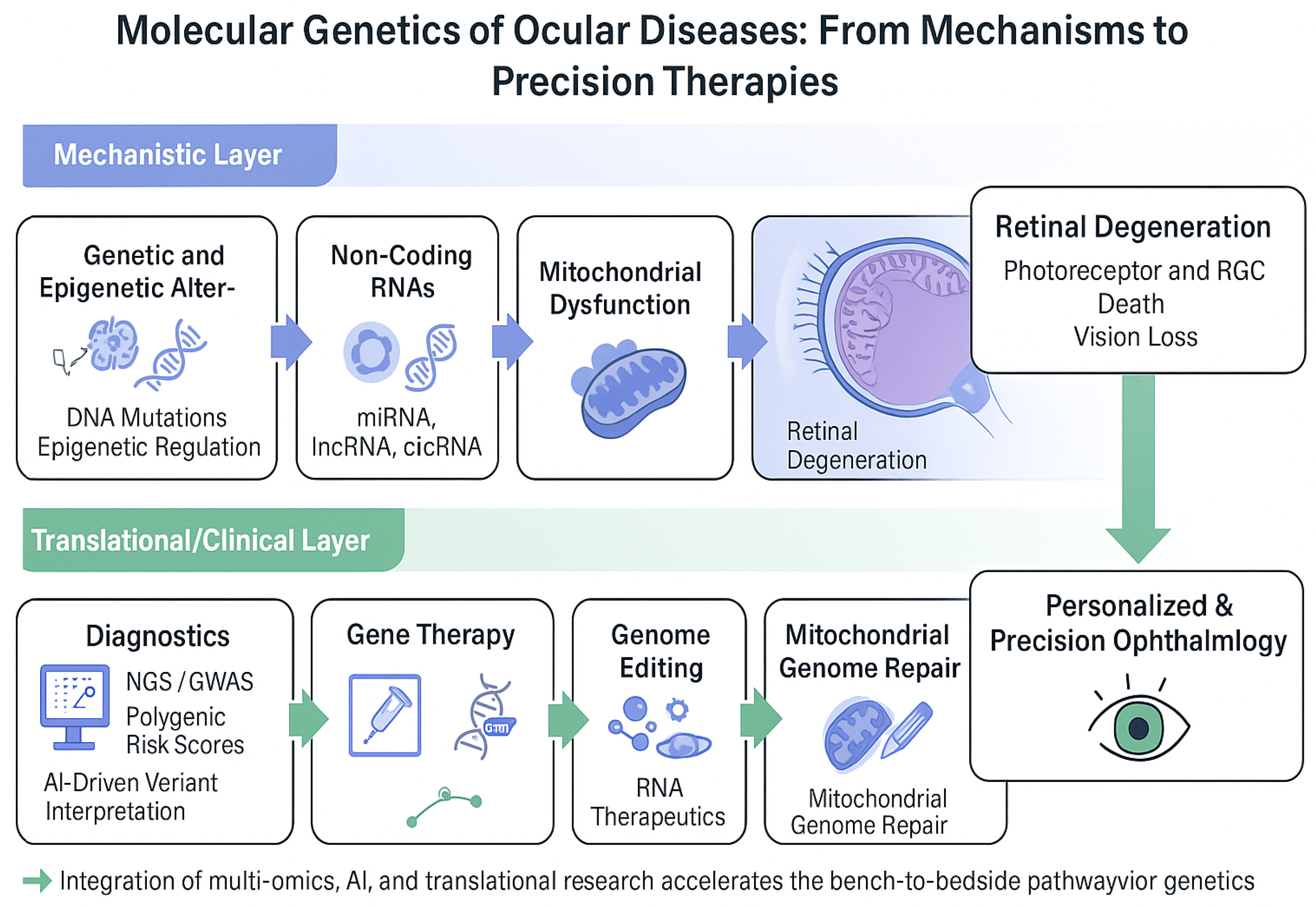
From Genetic Diagnosis to Therapeutic Implementation in Retinal Diseases: Translational Advances and Persistent Bottlenecks

 ,
, 
 , , , and
Abstract
1. Introduction
2. Inherited Monogenic Ocular Diseases
2.1. Retinitis Pigmentosa: Heterogeneity as a Translational Challenge
2.2. Leber Congenital Amaurosis: Timing and Reversibility
2.3. Stargardt Disease: Toxic Metabolite Accumulation and Functional Stratification
2.4. Next-Generation Sequencing: Beyond Diagnostic Yield
3. Complex and Polygenic Eye Diseases
3.1. Glaucoma: Genetic Risk as a Modifier of Vulnerability
3.2. Age-Related Macular Degeneration: Complement Biology and Incomplete Therapeutic Alignment
3.3. Pathological Myopia: Polygenicity in the Context of Environmental Amplification
3.4. Polygenic Risk Scores: Promise and Structural Limitations
4. Epigenetic Regulation in Retinal and Optic Nerve Disorders: Modulation, Plasticity, and Translational Uncertainty
5. Mitochondrial Genetics and Optic Neuropathies: Energetic Vulnerability, Incomplete Penetrance, and Therapeutic Frontiers
5.1. Leber Hereditary Optic Neuropathy: Mutation Is Necessary but Not Sufficient
5.2. Dominant Optic Atrophy: Mitochondrial Dynamics and Structural Fragility
5.3. Emerging Mitochondrial Therapeutic Strategies: Promise and Biological Constraints
5.4. Translational Challenges Unique to Mitochondrial Genetics
6. Gene Therapy in Retinal Diseases: Biological Alignment, Delivery Constraints, and Durability Challenges
7. Pharmacogenomics and Precision Therapeutics in Ophthalmology: Between Biological Plausibility and Clinical Implementation
8. Future Perspectives
9. Conclusions
Author Contributions
Funding
Institutional Review Board Statement
Informed Consent Statement
Data Availability Statement
Conflicts of Interest
Abbreviations
| AAV | Adeno-Associated Virus |
| ABCA4 | ATP-Binding Cassette Subfamily A Member 4 |
| AI | Artificial Intelligence |
| AMD | Age-Related Macular Degeneration |
| ANG2 | Angiopoietin-2 |
| CFH | Complement Factor H |
| CNV | Choroidal Neovascularization |
| CRISPR | Clustered Regularly Interspaced Short Palindromic Repeats |
| DOA | Dominant Optic Atrophy |
| DNMT | DNA Methyltransferase |
| DR | Diabetic Retinopathy |
| EOSRD | Early-Onset Severe Retinal Dystrophy |
| GWAS | Genome-Wide Association Study |
| HDAC | Histone Deacetylase |
| IOP | Intraocular Pressure |
| IRD | Inherited Retinal Disease |
| LCA | Leber Congenital Amaurosis |
| LHON | Leber’s Hereditary Optic Neuropathy |
| lncRNA | Long Non-Coding RNA |
| miRNA | MicroRNA |
| mtDNA | Mitochondrial DNA |
| ncRNA | Non-Coding RNA |
| NGS | Next-Generation Sequencing |
| OCT | Optical Coherence Tomography |
| OPA1 | Optic Atrophy 1 |
| PM | Pathological Myopia |
| POAG | Primary Open-Angle Glaucoma |
| PRS | Polygenic Risk Score |
| RGC | Retinal Ganglion Cell |
| RHO | Rhodopsin |
| RNA-seq | RNA Sequencing |
| RP | Retinitis Pigmentosa |
| RPE | Retinal Pigment Epithelium |
| STGD1 | Stargardt Disease Type 1 |
| VEGF | Vascular Endothelial Growth Factor |
| WES | Whole-Exome Sequencing |
| WGS | Whole-Genome Sequencing |
References
- Bourne, R.R.A.; Steinmetz, J.D.; Flaxman, S.; Briant, P.S.; Taylor, H.R.; Resnikoff, S.; Casson, R.J.; Abdoli, A.; Abu-Gharbieh, E.; Afshin, A.; et al. Trends in prevalence of blindness and distance and near vision impairment over 30 years: An analysis for the Global Burden of Disease Study. Lancet Glob. Health 2020, 9, e130–e143. [Google Scholar] [CrossRef] [Scilit] [PubMed]
- Teo, Z.L.; Tham, Y.C.; Yu, M.; Chee, M.L.; Rim, T.H.; Cheung, N.; Bikbov, M.M.; Wang, Y.X.; Tang, Y.; Lu, Y.; et al. Global prevalence of diabetic retinopathy and projection of burden through 2045: Systematic review and meta-analysis. Ophthalmology 2021, 128, 1580–1591. [Google Scholar] [CrossRef] [Scilit] [PubMed]
- Fujinami, K.; Waheed, N.; Laich, Y.; Yang, P.; Fujinami-Yokokawa, Y.; Higgins, J.J.; Lu, J.T.; Curtiss, D.; Clary, C.; Michaelides, M. Stargardt macular dystrophy and therapeutic approaches. Br. J. Ophthalmol. 2024, 108, 495–505. [Google Scholar] [CrossRef] [Scilit] [PubMed]
- Verbakel, S.K.; van Huet, R.A.C.; Boon, C.J.F.; den Hollander, A.I.; Collin, R.W.J.; Klaver, C.C.W.; Hoyng, C.B.; Roepman, R.; Klevering, B.J. Non-syndromic retinitis pigmentosa. Prog. Retin. Eye Res. 2018, 66, 157–186. [Google Scholar] [CrossRef] [Scilit] [PubMed]
- Gharahkhani, P.; Jorgenson, E.; Hysi, P.G.; Khawaja, A.P.; Pendergrass, S.; Han, X.; Ong, J.S.; Hewitt, A.W.; Segrè, A.V.; Rouhana, J.M.; et al. Genome-wide meta-analysis identifies 127 open-angle glaucoma risk loci with consistent effect across ancestries. Nat. Commun. 2021, 12, 1258. [Google Scholar] [CrossRef] [Scilit] [PubMed]
- Swarup, G.; Kaur, J.; Kumar, A. Altered functions and interactions of glaucoma-associated mutants of optineurin. Front. Immunol. 2018, 9, 1287. [Google Scholar] [CrossRef] [Scilit] [PubMed]
- Despriet, D.D.G.; Klaver, C.C.W.; Witteman, J.C.M.; Bergen, A.A.B.; Kardys, I.; de Maat, M.P.M.; Boekhoorn, S.S.; Vingerling, J.R.; Hofman, A.; Oostra, B.A.; et al. Complement factor H polymorphism, complement activators, and risk of age-related macular degeneration. JAMA 2006, 296, 301–309. [Google Scholar] [CrossRef] [Scilit] [PubMed]
- Pan, Y.; Fu, Y.; Baird, P.N.; Guymer, R.H.; Das, T.; Iwata, T. Exploring the contribution of ARMS2 and HTRA1 genetic risk factors in age-related macular degeneration. Prog. Retin. Eye Res. 2023, 97, 101159. [Google Scholar] [CrossRef] [Scilit] [PubMed]
- Han, X.; Gharahkhani, P.; Hamel, A.R.; Ong, J.S.; Rentería, M.E.; Mehta, P.; Dong, X.; Pasutto, F.; Hammond, C.; Young, T.L.; et al. Large-scale multitrait genome-wide association analyses identify hundreds of glaucoma risk loci. Nat. Genet. 2023, 55, 1348–1358. [Google Scholar] [CrossRef] [Scilit] [PubMed]
- Shim, M.S.; Kim, K.Y.; Noh, M.; Ko, J.Y.; Ahn, S.; An, M.A.; Iwata, T.; Perkins, G.A.; Weinreb, R.N.; Ju, W.K. Optineurin E50K triggers BDNF-deficiency–mediated mitochondrial dysfunction and RGC death. Biochem. Biophys. Res. Commun. 2018, 503, 2690–2697. [Google Scholar] [CrossRef] [Scilit] [PubMed]
- Hage, R.; Vignal-Clermont, C. Leber Hereditary Optic Neuropathy: Review of Treatment and Management. Front. Neurol. 2021, 12, 651639. [Google Scholar] [CrossRef] [Scilit] [PubMed]
- Stingl, K.; Priglinger, C.S.; Herrmann, P. RPE65-associated retinal dystrophies: Phenotypes and treatment effects with voretigene neparvovec. Klin. Monbl. Augenheilkd. 2023, 241, 259–265. [Google Scholar] [CrossRef] [Scilit] [PubMed]
- Weisschuh, N.; Mayer, A.K.; Strom, T.M.; Kohl, S.; Glöckle, N.; Schubach, M.; Andreasson, S.; Bernd, A.; Birch, D.G.; Hamel, C.; et al. Mutation spectrum of the OPA1 gene in a large cohort of patients with suspected dominant optic atrophy: Identification and classification of 48 novel variants. PLoS ONE 2021, 16, e0253987. [Google Scholar] [CrossRef] [Scilit]
- Toomes, C.; Marchbank, N.J.; Mackey, D.A.; Craig, J.E.; Newbury-Ecob, R.A.; Bennett, C.P.; Votruba, M.; Bhattacharya, S.S. Spectrum, frequency and penetrance of OPA1 mutations in dominant optic atrophy. Hum. Mol. Genet. 2001, 10, 1369–1378. [Google Scholar] [CrossRef] [Scilit]
- Voogelaar, M.; Tedja, M.S.; Guggenheim, J.A.; Saw, S.M.; Tjon-Fo-Sang, M.; Mackey, D.A.; Hammond, C.J.; Klaver, C.C.; Verhoeven, V.J. IMI—Myopia Genetics Report. Investig. Ophthalmol. Vis. Sci. 2025, 66, 22. [Google Scholar] [CrossRef] [Scilit] [PubMed]
- Jiang, Y.; Liu, X.; Fu, J.; Wu, Y.; Yu, S.; Yao, K. Alternative Splicing Dysregulation in Retinitis Pigmentosa: Pathogenic Mechanisms and Therapeutic Opportunities. Biomolecules 2025, 15, 1624. [Google Scholar] [CrossRef] [Scilit]
- Yang, C.; Wang, Y.; Zhang, Y.; Li, X.; Zhang, L.; Liu, X.; Chen, H.; Wu, J.; Xu, H.; Zhao, C.; et al. Pre-mRNA processing factors and retinitis pigmentosa: RNA splicing and beyond. Front. Cell Dev. Biol. 2021, 9, 700276. [Google Scholar] [CrossRef] [Scilit]
- Buskin, A.; Zhu, L.; Chichagova, V.; Basu, B.; Moosajee, M.; Collin, J.; Yu, T.; Mardon, H.J.; Pontikos, N.; Micheal, S.; et al. Disrupted alternative splicing for genes implicated in splicing and ciliogenesis causes PRPF31 retinitis pigmentosa. Nat. Commun. 2018, 9, 4234. [Google Scholar] [CrossRef] [Scilit]
- Dayma, K.; Rajanala, K.; Upadhyay, A. Stargardt’s disease: Molecular pathogenesis and current therapeutic landscape. Int. J. Mol. Sci. 2025, 26, 7006. [Google Scholar] [CrossRef] [Scilit]
- López, D.A.R.; López, D.E.S.; Velázquez, C.L.D.; Vega, E.E.; Ruiz, M.F.C.; Vargas, E.C. Stargardt disease: A comprehensive review of pathophysiology, clinical features, and emerging therapeutic strategies. Int. J. Med. Sci. Clin. Res. Stud. 2025, 5, 589–596. [Google Scholar] [CrossRef] [Scilit]
- Lenis, T.; Hu, J.; Ng, S.Y.; Jiang, Z.; Sarfare, S.; Lloyd, M.B.; Esposito, E.; Kwon, H.J.; Stauffer, W.; Zhang, H.; et al. Expression of ABCA4 in the retinal pigment epithelium and its implications for Stargardt macular degeneration. Proc. Natl. Acad. Sci. USA 2018, 115, E11120–E11127. [Google Scholar] [CrossRef] [Scilit]
- Ng, E.S.Y.; Kady, N.; Hu, J.; Dave, A.; Jiang, Z.; Pei, J.; Gorin, M.B.; Matynia, A.; Radu, R.A. Membrane attack complex mediates retinal pigment epithelium cell death in Stargardt macular degeneration. Cells 2022, 11, 3462. [Google Scholar] [CrossRef] [Scilit]
- Kaltak, M.; de Bruijn, P.; van Leeuwen, W.; Platenburg, G.; Cremers, F.P.; Collin, R.W.; Swildens, J. QR-1011 restores defective ABCA4 splicing caused by multiple severe ABCA4 variants underlying Stargardt disease. Sci. Rep. 2024, 14, 684. [Google Scholar] [CrossRef] [Scilit]
- Klopstock, T.; Yu-Wai-Man, P.; Dimitriadis, K.; Rouleau, J.; Heck, S.; Bailie, M.; Atawan, A.; Chinnery, P.F.; Griffiths, P.G.; Hudson, G.; et al. A randomized placebo-controlled trial of idebenone in LHON (RHODOS). Brain 2011, 134, 2677–2686. [Google Scholar] [CrossRef] [Scilit] [PubMed]
- Zanfardino, P.; Amati, A.; Perrone, M.; Petruzzella, V. The Balance of MFN2 and OPA1 in Mitochondrial Dynamics, Cellular Homeostasis, and Disease. Biomolecules 2025, 15, 433. [Google Scholar] [CrossRef] [Scilit] [PubMed]
- Lo, J.; Mehta, K.; Dhillon, A.; Huang, Y.K.; Luo, Z.; Nam, M.H.; Al Diri, I.; Chang, K.C. Therapeutic strategies for glaucoma and optic neuropathies. Mol. Asp. Med. 2023, 94, 101219. [Google Scholar] [CrossRef] [Scilit] [PubMed]
- Lim, K. Mitochondrial genome editing: Strategies, challenges, and applications. BMB Rep. 2024, 57, 19–29. [Google Scholar] [CrossRef] [Scilit] [PubMed]
- Huang, J.; Li, J.; Xu, X.; Li, K. Adeno-Associated Virus Vectors in Retinal Gene Therapy: Challenges, Innovations, and Future Directions. Biomolecules 2025, 15, 940. [Google Scholar] [CrossRef] [Scilit]
- Abbouda, A.; Avogaro, F.; Moosajee, M.; Vingolo, E.M. Update on Gene Therapy Clinical Trials for Choroideremia and Potential Experimental Therapies. Medicina 2021, 57, 64. [Google Scholar] [CrossRef] [Scilit] [PubMed]
- Garafalo, A.V.; Cideciyan, A.V.; Héon, E.; Sheplock, R.; Pearson, A.; Yu, C.W.; Sumaroka, A.; Aguirre, G.D.; Jacobson, S.G. Clinical trials and future directions in retinal gene therapy. Prog. Retin. Eye Res. 2020, 77, 100827. [Google Scholar] [CrossRef] [Scilit]
- Lonfat, N.; Moreno-Leon, L.; Punzo, C.; Khanna, H. Update on Gene Therapy Clinical Trials for Eye Diseases. Hum. Gene Ther. 2025, 36, 1287–1300. [Google Scholar] [CrossRef] [Scilit] [PubMed]
- Dockery, A.; Whelan, L.; Humphries, P.; Farrar, G.J. Next-generation sequencing applications for inherited retinal diseases. Int. J. Mol. Sci. 2021, 22, 5684. [Google Scholar] [CrossRef] [Scilit]
- Fabian-Morales, G.E.; Ordoñez-Labastida, V.; Rowell, W.J.; McClements, M.E.; MacLaren, R.E.; Webster, A.R.; Hardcastle, A.J.; Pontikos, N.; Arno, G.; Downes, S.M.; et al. Resolving the diagnostic odyssey in inherited retinal dystrophies through long-read genome sequencing. Am. J. Med. Genet. A 2025, 197, e64139. [Google Scholar] [CrossRef] [Scilit]
- Maggi, J.; Koller, S.; Feil, S.; Bachmann-Gagescu, R.; Gerth-Kahlert, C.; Berger, W. Limited added diagnostic value of whole genome sequencing in genetic testing of inherited retinal diseases in a Swiss patient cohort. Int. J. Mol. Sci. 2024, 25, 6540. [Google Scholar] [CrossRef] [Scilit] [PubMed]
- Esteve-Garcia, A.; Martínez-Fernández, J.; Riveiro-Álvarez, R.; Vallespín, E.; Avila-Fernández, A.; García-García, G.; López-Martínez, M.A.; Trujillo-Tiebas, M.J.; Lorda-Sánchez, I.; Ayuso, C.; et al. Personalised genomic strategies improve diagnostic yield in inherited retinal dystrophies: A stepwise, patient-centred approach. Eye 2025, 39, 2899–2911. [Google Scholar] [CrossRef] [Scilit]
- Ellingford, J.M.; Horn, B.; Campbell, C.; Arno, G.; Barton, S.; Chakarova, C.; Pontikos, N.; Webster, A.R.; Michaelides, M.; Hardcastle, A.J.; et al. Assessment of the incorporation of CNV surveillance into gene panel next-generation sequencing testing for inherited retinal diseases. J. Med. Genet. 2018, 55, 114–121. [Google Scholar] [CrossRef] [Scilit]
- Limoli, P.G.; Vingolo, E.M.; Limoli, C.; Nebbioso, M. Antioxidant and biological properties of mesenchymal cells used for therapy in retinitis pigmentosa. Antioxidants 2020, 9, 983. [Google Scholar] [CrossRef] [Scilit]
- Dias, M.F.; Joo, K.; Kemp, J.A.; Fialho, S.L.; da Silva Cunha, A., Jr.; Woo, S.J.; Kwon, Y.J. Molecular genetics and emerging therapies for retinitis pigmentosa: Basic research and clinical perspectives. Prog. Retin. Eye Res. 2018, 63, 107–131. [Google Scholar] [CrossRef] [Scilit] [PubMed]
- Vingolo, E.M.; Mascolo, S.; Miccichè, F.; Manco, G. Retinitis pigmentosa: From pathomolecular mechanisms to therapeutic strategies. Medicina 2024, 60, 189. [Google Scholar] [CrossRef] [Scilit]
- Vingolo, E.M.; Rocco, M.; Grenga, P.L.; Salvatore, S.; Pelaia, P. Slowing the degenerative process: Long-lasting effect of hyperbaric oxygen therapy in retinitis pigmentosa. Graefe’s Arch. Clin. Exp. Ophthalmol. 2008, 246, 93–98. [Google Scholar] [CrossRef] [Scilit] [PubMed]
- McCully, J.D.; Levitsky, S.; Del Nido, P.J.; Cowan, D.B. Mitochondrial transplantation for therapeutic use. Clin. Transl. Med. 2016, 5, 16. [Google Scholar] [CrossRef] [Scilit] [PubMed]
- Carelli, V.; La Morgia, C.; Yu-Wai-Man, P. Mitochondrial optic neuropathies. Handb. Clin. Neurol. 2023, 194, 23–42. [Google Scholar] [CrossRef] [Scilit] [PubMed]
- Trapani, I.; Auricchio, A. Has retinal gene therapy come of age? From bench to bedside and back to bench. Hum. Mol. Genet. 2019, 28, R108–R118. [Google Scholar] [CrossRef] [Scilit] [PubMed]
- Michaelides, M.; Hunt, D.M.; Moore, A.T. The genetics of inherited macular dystrophies. J. Med. Genet. 2003, 40, 641–650. [Google Scholar] [CrossRef] [Scilit]
- Miraldi Utz, V.; Pfeifer, W.; Longmuir, S.Q.; Olson, R.J.; Wang, K.; Drack, A.V. Presentation of TRPM1-Associated Congenital Stationary Night Blindness in Children. JAMA Ophthalmol. 2018, 136, 389–398. [Google Scholar] [CrossRef] [PubMed]
- Russell, S.; Bennett, J.; Wellman, J.A.; Chung, D.C.; Yu, Z.-F.; Tillman, A.; Wittes, J.; Pappas, J.; Elci, O.; McCague, S.; et al. Efficacy and safety of voretigene neparvovec (AAV2-hRPE65v2) in patients with RPE65-mediated inherited retinal dystrophy: A randomised, controlled, open-label, phase 3 trial. Lancet 2017, 390, 849–860. [Google Scholar] [CrossRef] [Scilit] [PubMed]
- Pierce, E.A.; Aleman, T.S.; Jayasundera, K.T.; Ashimatey, B.S.; Kim, K.; Rashid, A.; Jaskolka, M.C.; Myers, R.L.; Lam, B.L.; Bailey, S.T.; et al. Gene Editing for CEP290-Associated Retinal Degeneration. N. Engl. J. Med. 2024, 390, 1972–1984. [Google Scholar] [CrossRef] [Scilit] [PubMed]
- Maeder, M.L.; Stefanidakis, M.; Wilson, C.J.; Baral, R.; Barrera, L.A.; Bounoutas, G.S.; Bumcrot, D.; Chao, H.; Ciulla, D.M.; DaSilva, J.A.; et al. Development of a gene-editing approach to restore vision loss in Leber congenital amaurosis type 10. Nat. Med. 2019, 25, 229–233. [Google Scholar] [CrossRef] [Scilit] [PubMed]
- Collin, R.W.J.; Leroy, B.P. In vivo genome editing for inherited retinal disease: Opportunities and challenges. Mol. Ther. 2024, 32, 2433–2434. [Google Scholar] [CrossRef] [Scilit] [PubMed]
- Satam, H.; Joshi, K.; Mangrolia, U.; Waghoo, S.; Zaidi, G.; Rawool, S.; Thakare, S.; Banday, S.; Mishra, A.K.; Das, G.; et al. Next-generation sequencing technology: Current trends and advancements. Biology 2023, 12, 997. [Google Scholar] [CrossRef] [Scilit]
- Tedja, M.S.; Wojciechowski, R.; Hysi, P.G.; Eriksson, N.; Furlotte, N.A.; Verhoeven, V.J.M.; Iglesias, A.I.; Meester-Smoor, M.A.; Tompson, S.W.; Fan, Q.; et al. Genome-wide association meta-analysis highlights light-induced signaling as a driver for refractive error. Nat. Genet. 2018, 50, 834–848. [Google Scholar] [CrossRef] [Scilit] [PubMed]
- Hysi, P.G.; Choquet, H.; Khawaja, A.P.; Wojciechowski, R.; Tedja, M.S.; Yin, J.; Simcoe, M.J.; Patasova, K.; Mahroo, O.A.; Thai, K.K.; et al. Meta-analysis of 542,934 subjects identifies new genes and mechanisms predisposing to refractive error and myopia. Nat. Genet. 2020, 52, 401–407. [Google Scholar] [CrossRef] [Scilit] [PubMed]
- Fan, Q.; Barathi, V.A.; Cheng, C.-Y.; Zhou, X.; Meguro, A.; Nakata, I.; Khor, C.-C.; Goh, L.-K.; Li, Y.-J.; Lim, W.; et al. Genetic Variants on Chromosome 1q41 Influence Ocular Axial Length and High Myopia. PLoS Genet. 2012, 8, e1002753. [Google Scholar] [CrossRef] [Scilit] [PubMed]
- Nakanishi, H.; Yamada, R.; Gotoh, N.; Hayashi, H.; Yamashiro, K.; Shimada, N.; Ohno-Matsui, K.; Mochizuki, M.; Saito, M.; Iida, T.; et al. A genome-wide association analysis identified a novel susceptible locus for pathological myopia at 11q24.1. PLoS Genet. 2009, 5, e1000660. [Google Scholar] [CrossRef] [Scilit] [PubMed]
- Hsi, E.; Wang, Y.S.; Huang, C.W.; Yu, M.L.; Juo, S.H.; Liang, C.L. Genome-wide DNA hypermethylation and homocysteine increase a risk for myopia. Int. J. Ophthalmol. 2019, 12, 38–45. [Google Scholar] [CrossRef] [Scilit] [PubMed]
- Dong, X.X.; Chen, D.L.; Chen, H.M.; Li, D.L.; Hu, D.N.; Lanca, C.; Grzybowski, A.; Pan, C.W. DNA methylation biomarkers and myopia: A multi-omics study integrating GWAS, mQTL and eQTL data. Clin. Epigenet. 2024, 16, 157. [Google Scholar] [CrossRef] [Scilit]
- Swierkowska, J.; Vishweswaraiah, S.; Mrugacz, M.; Radhakrishna, U.; Gajecka, M. Differential methylation of microRNA-encoding genes may contribute to high myopia. Front. Genet. 2023, 13, 1089784. [Google Scholar] [CrossRef] [Scilit]
- Yu, Q.; Zhou, J.B. Scleral remodeling in myopia development. Int. J. Ophthalmol. 2022, 15, 510–514. [Google Scholar] [CrossRef] [Scilit] [PubMed]
- Schloesser, L.; Terheyden, J.H.; Behning, C.; Klinkhammer, H.; Garzone, D.; Saßmannshausen, M.; Thiele, S.; Schmitz-Valckenberg, S.; Hoyng, C.; Sánchez, C.I.; et al. Associations between structural phenotype and polygenic risk scores in intermediate age-related macular degeneration: A MACUSTAR report. Transl. Vis. Sci. Technol. 2025, 14, 37. [Google Scholar] [CrossRef] [Scilit]
- Cunza, N.L.; Tan, L.X.; Thamban, T.; Germer, C.J.; Rathnasamy, G.; Toops, K.A.; Lakkaraju, A. Mitochondria-dependent phase separation of disease-relevant proteins drives pathological features of age-related macular degeneration. JCI Insight 2021, 6, e142254. [Google Scholar] [CrossRef] [Scilit]
- Fritsche, L.G.; Fleckenstein, M.; Fiebig, B.S.; Schmitz-Valckenberg, S.; Bindewald-Wittich, A.; Keilhauer, C.N.; Renner, A.B.; Mackensen, F.; Mößner, A.; Pauleikhoff, D.; et al. A subgroup of age-related macular degeneration is associated with mono-allelic sequence variants in the ABCA4 gene. Investig. Ophthalmol. Vis. Sci. 2012, 53, 2112–2118. [Google Scholar] [CrossRef] [Scilit]
- Moore, S.M.; Christoforidis, J.B. Advances in ophthalmic epigenetics and implications for epigenetic therapies: A review. Genes 2023, 14, 417. [Google Scholar] [CrossRef] [Scilit]
- Barnstable, C.J. Epigenetics and degenerative retinal diseases: Prospects for new therapeutic approaches. Asia Pac. J. Ophthalmol. 2022, 11, 328–334. [Google Scholar] [CrossRef] [Scilit]
- Cai, C.; Meng, C.; He, S.; Gu, C.; Lhamo, T.; Draga, D.; Luo, D.; Qiu, Q. DNA methylation in diabetic retinopathy: Pathogenetic role and potential therapeutic targets. Cell Biosci. 2022, 12, 186. [Google Scholar] [CrossRef] [Scilit] [PubMed]
- Wong, Y.L.; Sabanayagam, C.; Ding, Y.; Wong, C.W.; Yeo, A.C.; Cheung, Y.B.; Cheung, G.; Chia, A.; Ohno-Matsui, K.; Wong, T.Y.; et al. Prevalence, Risk Factors, and Impact of Myopic Macular Degeneration on Visual Impairment and Functioning Among Adults in Singapore. Investig. Ophthalmol. Vis. Sci. 2018, 59, 4603–4613. [Google Scholar] [CrossRef] [Scilit] [PubMed]
- Sepp, T.; Khan, J.C.; Thurlby, D.A.; Shahid, H.; Clayton, D.G.; Moore, A.T.; Bird, A.C.; Yates, J.R.W. Complement factor H variant Y402H is a major risk for age-related macular degeneration. Investig. Ophthalmol. Vis. Sci. 2006, 47, 4050–4056. [Google Scholar] [CrossRef] [Scilit] [PubMed]
- Landowski, M.; Kelly, U.; Klingeborn, M. Human complement factor H Y402H polymorphism causes an age-related macular degeneration phenotype and lipoprotein dysregulation in mice. iScience 2019, 116, 3703–3711. [Google Scholar] [CrossRef] [Scilit] [PubMed]
- May, A.; Su, F.; Dinh, B.; Ehlen, R.; Tran, C.; Adivikolanu, H.; Shaw, P.X. Ongoing controversies and recent insights of the ARMS2-HTRA1 locus in age-related macular degeneration. Exp. Eye Res. 2021, 210, 108605. [Google Scholar] [CrossRef] [Scilit] [PubMed]
- Radu, R.A.; Hu, J.; Yuan, Q.; Welch, D.L.; Makshanoff, J.; Lloyd, M.; McMullen, S.; Travis, G.H.; Bok, D. Complement system dysregulation and inflammation in the retinal pigment epithelium of a mouse model for Stargardt macular degeneration. J. Biol. Chem. 2011, 286, 18593–18601. [Google Scholar] [CrossRef] [Scilit]
- Yung, M.; Klufas, M.A.; Sarraf, D. Clinical applications of fundus autofluorescence in retinal disease. Int. J. Retin. Vitr. 2016, 2, 12. [Google Scholar] [CrossRef] [Scilit]
- Meleppat, R.; Ronning, K.E.; Karlen, S.; Burns, M.E.; Pugh, E.N.; Zawadzki, R.J. In vivo multimodal retinal imaging of disease-related pigmentary changes in retinal pigment epithelium. Sci. Rep. 2021, 11, 16252. [Google Scholar] [CrossRef] [Scilit]
- Yang, B.; Yang, K.; Chen, Y.; Li, Q.; Chen, J.; Li, S.; Wu, Y. Exposure of A2E to blue light promotes ferroptosis in the retinal pigment epithelium. Cell Mol. Biol. Lett. 2025, 30, 22. [Google Scholar] [CrossRef] [Scilit]
- Tan, P.L.; Rickman, C.B.; Katsanis, N. AMD and the alternative complement pathway: Genetics and functional implications. Hum. Genom. 2016, 10, 23. [Google Scholar] [CrossRef] [Scilit]
- Crabb, J.W. The proteomics of drusen. Cold Spring Harb. Perspect. Med. 2014, 4, a017194. [Google Scholar] [CrossRef] [Scilit]
- Hagstrom, S.A.; Ying, G.S.; Pauer, G.J.; Sturgill-Short, G.M.; Huang, J.; Maguire, M.G.; Martin, D.F. Comparison of Age-Related Macular Degeneration Treatments Trials (CATT) Research Group. VEGFA and VEGFR2 gene polymorphisms and response to anti-vascular endothelial growth factor therapy: Comparison of age-related macular degeneration treatments trials (CATT). JAMA Ophthalmol. 2014, 132, 521–527. [Google Scholar] [CrossRef] [Scilit] [PubMed]
- Dedania, V.S.; Grob, S.; Zhang, K.; Bakri, S.J. Pharmacogenomics of response to anti-VEGF therapy in exudative age-related macular degeneration. Retina 2015, 35, 381–391. [Google Scholar] [CrossRef] [Scilit] [PubMed]
- Bobadilla, M.; Pariente, A.; Oca, A.I.; Peláez, R.; Pérez-Sala, Á.; Larráyoz, I.M. Biomarkers as Predictive Factors of Anti-VEGF Response. Biomedicines 2022, 10, 1003. [Google Scholar] [CrossRef] [Scilit] [PubMed]
- Kiefer, A.K.; Tung, J.Y.; Do, C.B.; Hinds, D.A.; Mountain, J.L.; Francke, U.; Eriksson, N. Genome-wide analysis points to roles for extracellular matrix remodeling, the visual cycle, and neuronal development in myopia. PLoS Genet. 2013, 9, e1003299. [Google Scholar] [CrossRef] [Scilit]
- Tedja, M.S.; Iglesias, A.I.; Wojciechowski, R.; Fan, Q.; Hysi, P.G.; Verhoeven, V.J.M.; Höhn, R.; Khawaja, A.P.; Simcoe, M.J.; Patasova, K.; et al. A genome-wide scan of non-coding RNAs and enhancers for refractive error and myopia. Hum. Genet. 2025, 144, 67–91. [Google Scholar] [CrossRef] [Scilit]
- Penha, F.M.; Masud, M.; Khanani, Z.A.; Thomas, M.; Fong, R.D.; Smith, K.; Chand, A.; Khan, M.; Gahn, G.; Melo, G.B.; et al. Review of real-world evidence of dual inhibition of VEGF-A and ANG-2 with faricimab in NAMD and DME. Int. J. Retin. Vitr. 2024, 10, 5. [Google Scholar] [CrossRef] [Scilit] [PubMed]
- Menna, F.; Meduri, A.; Lupo, S.; Vingolo, E.M. WAMD: From Pathophysiology to Therapeutic Treatments. Biomedicines 2022, 10, 1996. [Google Scholar] [CrossRef] [Scilit]
- Wang, J.; Cheng, X.; Liang, Q.; Owen, L.A.; Lu, J.; Zheng, Y.; Wang, M.; Chen, S.; DeAngelis, M.M.; Li, Y.; et al. Single-cell multiomics of the human retina reveals hierarchical transcription factor collaboration in mediating cell type-specific effects of genetic variants on gene regulation. Genome Biol. 2023, 24, 269. [Google Scholar] [CrossRef] [Scilit] [PubMed]
- Advani, J.; Mehta, P.A.; Hamel, A.R.; Mehrotra, S.; Kiel, C.; Strunz, T.; Corso-Díaz, X.; Kwicklis, M.; van Asten, F.; Ratnapriya, R.; et al. QTL mapping of human retina DNA methylation identifies 87 gene–epigenome interactions in age-related macular degeneration. Nat. Commun. 2024, 15, 1972. [Google Scholar] [CrossRef] [Scilit]
- Grunin, M.; Triffon, D.; Beykin, G.; Rahmani, E.; Schweiger, R.; Tiosano, L.; Khateb, S.; Hagbi-Levi, S.; Rinsky, B.; Munitz, R.; et al. Genome wide association study and genomic risk prediction of age related macular degeneration in Israel. Sci. Rep. 2024, 14, 13034. [Google Scholar] [CrossRef] [Scilit]
- Yuan, J.; Qiu, R.; Wang, Y.; Chen, Z.J.; Sun, H.; Dai, W.; Yao, Y.; Zhuo, R.; Li, K.; Xing, S.; et al. Exome-wide genetic risk score (ExGRS) to predict high myopia across multi-ancestry populations. Commun. Med. 2024, 4, 280. [Google Scholar] [CrossRef] [Scilit]
- Gao, X.R. Multi-trait polygenic probability risk score enhances glaucoma prediction across ancestries. medRxiv 2025. [Google Scholar] [CrossRef] [Scilit]
- Singh, R.K.; Zhao, Y.; Elze, T.; Fingert, J.; Gordon, M.; Kass, M.A.; Luo, Y.; Pasquale, L.R.; Scheetz, T.; Segrè, A.V.; et al. Polygenic risk scores for glaucoma onset in the ocular hypertension treatment study. JAMA Ophthalmol. 2024, 142, 356–363. [Google Scholar] [CrossRef] [Scilit]
- Sekimitsu, S.; Xiang, D.; Smith, S.L.; Curran, K.; Elze, T.; Friedman, D.S.; Foster, P.J.; Luo, Y.; Pasquale, L.R.; Peto, T.; et al. Deep ocular phenotyping across primary open-angle glaucoma genetic burden. JAMA Ophthalmol. 2023, 141, 891–899. [Google Scholar] [CrossRef] [Scilit]
- Tideman, J.W.L.; Pärssinen, O.; Haarman, A.E.; Khawaja, A.P.; Wedenoja, J.; Williams, K.M.; Biino, G.; Ding, X.; Kähönen, M.; Lehtimäki, T.; et al. Evaluation of shared genetic susceptibility to high and low myopia and hyperopia. JAMA Ophthalmol. 2021, 139, 601–609. [Google Scholar] [CrossRef] [Scilit]
- Lin, H.J.; Huang, Y.T.; Liao, W.L.; Huang, Y.C.; Chang, Y.W.; Weng, A.; Tsai, F.J. Developing a polygenic risk score with age and sex to identify high-risk myopia in Taiwan. Biomedicines 2024, 12, 1619. [Google Scholar] [CrossRef] [Scilit]
- Heesterbeek, T.J.; de Jong, E.K.; Acar, I.E.; Groenewoud, J.M.; Liefers, B.; Sánchez, C.I.; Peto, T.; Hoyng, C.B.; Pauleikhoff, D.; Hense, H.W.; et al. Genetic risk score has added value over initial clinical grading stage in predicting disease progression in age-related macular degeneration. Sci. Rep. 2019, 9, 6611. [Google Scholar] [CrossRef] [Scilit]
- Recalde, S.; Fernandez-Robredo, P.; Altarriba, M.; Salinas-Alaman, A.; García-Layana, A. Age-related macular degeneration genetics. Ophthalmology 2008, 115, 916. [Google Scholar] [CrossRef] [Scilit] [PubMed]
- Zhang, Y.; Yang, Z.; Zhang, M.; Yang, Y.; Ma, Z.; Wu, M.; Bi, H.; Guo, D. Research Progress of Epigenetic Modifications in Myopia. Int. J. Med. Sci. 2025, 22, 3084–3100. [Google Scholar] [CrossRef] [Scilit] [PubMed]
- Hao, J.; Yang, Z.; Zhang, R.; Ma, Z.; Liu, J.; Bi, H.; Guo, D. Crosstalk between heredity and environment in myopia: An overview. Heliyon 2024, 10, e29715. [Google Scholar] [CrossRef] [Scilit] [PubMed]
- D’Esposito, F.; Gagliano, C.; Bloom, P.A.; Cordeiro, M.F.; Avitabile, A.; Gagliano, G.; Costagliola, C.; Avitabile, T.; Musa, M.; Zeppieri, M. Epigenetics in glaucoma. Medicina 2024, 60, 905. [Google Scholar] [CrossRef] [Scilit] [PubMed]
- Zhou, Y.; Li, S.; Yoshida, S. Editorial: Non-coding RNAs in ophthalmic diseases. Front. Genet. 2022, 13, 1055701. [Google Scholar] [CrossRef] [Scilit] [PubMed]
- Shu, Y.; Li, Z.; Zong, T.; Mu, T.; Zhou, H.; Yang, Q.; Wu, M.; Liu, Y.; Xie, T.; Tan, C.; et al. MiR-21-5p promotes RPE cell necroptosis by targeting Peli1 in a rat model of AMD. In Vitro Cell Dev. Biol. Anim. 2025, 61, 801–815. [Google Scholar] [CrossRef] [Scilit] [PubMed]
- Zhang, R.; Tao, Y.; Huang, J. The Application of MicroRNAs in Glaucoma Research: A Bibliometric and Visualized Analysis. Int. J. Mol. Sci. 2023, 24, 15377. [Google Scholar] [CrossRef] [Scilit] [PubMed]
- Zhang, H.; Dai, X.; Qi, Y.; He, Y.; Du, W.; Pang, J. Histone Deacetylases Inhibitors in the Treatment of Retinal Degenerative Diseases: Overview and Perspectives. J. Ophthalmol. 2015, 2015, 250812. [Google Scholar] [CrossRef] [Scilit] [PubMed]
- Wu, M.; Xiong, H.; Xu, Y.; Xiong, X.; Zou, H.; Zheng, M.; Wang, X.; Zhou, X. Association between VEGF-A and VEGFR-2 polymorphisms and response to treatment of neovascular AMD with anti-VEGF agents: A meta-analysis. Br. J. Ophthalmol. 2017, 101, 976–984, Correction in Br. J. Ophthalmol. 2025, 109, 496. https://doi.org/10.1136/bjophthalmol-2016-309418.corr1. [Google Scholar] [CrossRef] [Scilit]
- Chrysostomou, V.; Rezania, F.; Trounce, I.A.; Crowston, J.G. Oxidative stress and mitochondrial dysfunction in glaucoma. Curr. Opin. Pharmacol. 2013, 13, 12–15. [Google Scholar] [CrossRef] [Scilit] [PubMed]
- Ju, W.K.; Perkins, G.A.; Kim, K.Y.; Bastola, T.; Choi, W.Y.; Choi, S.H. Glaucomatous optic neuropathy: Mitochondrial dynamics, dysfunction and protection in retinal ganglion cells. Prog. Retin. Eye Res. 2023, 95, 101136. [Google Scholar] [CrossRef] [Scilit] [PubMed]
- Karali, M.; Guadagnino, I.; Marrocco, E.; De Cegli, R.; Carissimo, A.; Pizzo, M.; Casarosa, S.; Conte, I.; Surace, E.M.; Banfi, S. AAV-miR-204 Protects from Retinal Degeneration by Attenuation of Microglia Activation and Photoreceptor Cell Death. Mol. Ther. Nucleic Acids 2020, 19, 144–156. [Google Scholar] [CrossRef] [Scilit] [PubMed]
- Li, Q.; Weng, J.; Wong, S.N.; Thomas Lee, W.Y.; Chow, S.F. Nanoparticulate Drug Delivery to the Retina. Mol. Pharm. 2020, 18, 506–521. [Google Scholar] [CrossRef] [Scilit] [PubMed]
- Antas, P.; Carvalho, C.; Cabral-Teixeira, J.; de Lemos, L.; Seabra, M.C. Toward low-cost gene therapy: mRNA-based therapeutics for treatment of inherited retinal diseases. Trends Mol. Med. 2024, 30, 136–146. [Google Scholar] [CrossRef] [Scilit]
- Girach, A.; Audo, I.; Birch, D.G.; Huckfeldt, R.M.; Lam, B.L.; Leroy, B.P.; Michaelides, M.; Russell, S.R.; Sallum, J.M.F.; Stingl, K.; et al. RNA-based therapies in inherited retinal diseases. Ther. Adv. Ophthalmol. 2022, 14, 25158414221134602. [Google Scholar] [CrossRef] [Scilit] [PubMed]
- Yu-Wai-Man, P.; Griffiths, P.G.; Hudson, G.; Chinnery, P.F. Inherited mitochondrial optic neuropathies. J. Med. Genet. 2009, 46, 145–158, Correction in J. Med. Genet. 2011, 48, 284. https://doi.org/10.1136/jmg.2007.054270corr1. [Google Scholar] [CrossRef] [Scilit] [PubMed]
- Shukla, S.; Tekwani, B.L. Histone Deacetylases Inhibitors in Neurodegenerative Diseases, Neuroprotection and Neuronal Differentiation. Front. Pharmacol. 2020, 11, 537. [Google Scholar] [CrossRef] [Scilit] [PubMed]
- Zhang, Y.; Hu, J.; Qu, X.; Hu, K. Circular RNA RSU1 promotes retinal vascular dysfunction by regulating miR-345-3p/TAZ. Commun. Biol. 2023, 6, 719. [Google Scholar] [CrossRef] [Scilit] [PubMed]
- Hu, J.L.; Hsu, C.C.; Hsiao, Y.J.; Lin, Y.Y.; Lai, W.Y.; Liu, Y.H.; Wang, C.L.; Ko, Y.L.; Tsai, M.L.; Tseng, H.C.; et al. Leber’s hereditary optic neuropathy: Update on the novel genes and therapeutic options. J. Chin. Med. Assoc. 2024, 87, 12–16. [Google Scholar] [CrossRef] [Scilit] [PubMed]
- Carelli, V.; Ross-Cisneros, F.N.; Sadun, A.A. Mitochondrial dysfunction as a cause of optic neuropathies. Prog. Retin. Eye Res. 2004, 23, 53–89. [Google Scholar] [CrossRef] [Scilit] [PubMed]
- Kirkman, M.A.; Yu-Wai-Man, P.; Korsten, A.; Leonhardt, M.; Dimitriadis, K.; De Coo, I.F.; Klopstock, T.; Chinnery, P.F. Gene-environment interactions in Leber hereditary optic neuropathy. Brain 2009, 132, 2317–2326. [Google Scholar] [CrossRef] [Scilit] [PubMed]
- Battista, M.; Carelli, V.; Bottazzi, L.; Bandello, F.; Cascavilla, M.L.; Barboni, P. Gene therapy for Leber hereditary optic neuropathy. Expert Opin. Biol. Ther. 2024, 24, 521–528. [Google Scholar] [CrossRef] [Scilit] [PubMed]
- Yin, Z.; Ge, L.; Cha, Z.; Gao, H.; A, L.; Zeng, Y.; Huang, X.; Cheng, X.; Yao, K.; Tao, Z.; et al. Identifying Hmga2 preserving visual function by promoting a shift of Müller glia cell fate in mice with acute retinal injury. Stem Cell Res. Ther. 2024, 15, 54. [Google Scholar] [CrossRef] [Scilit] [PubMed]
- Liu, C.H.; Huang, S.; Britton, W.R.; Chen, J. MicroRNAs in vascular eye diseases. Int. J. Mol. Sci. 2020, 21, 649. [Google Scholar] [CrossRef] [Scilit] [PubMed]
- Song, J.; Kim, Y.K. Targeting non-coding RNAs for the treatment of retinal diseases. Mol. Ther. Nucleic Acids 2021, 24, 284–293. [Google Scholar] [CrossRef] [Scilit] [PubMed]
- Zhang, C.; Hu, J.; Yu, Y. circRNA is a rising star in researches of ocular diseases. Front. Cell Dev. Biol. 2020, 8, 850. [Google Scholar] [CrossRef] [Scilit] [PubMed]
- Liu, P.; Jia, S.B.; Shi, J.M.; Li, W.J.; Tang, L.S.; Zhu, X.H.; Tong, P. LncRNA-MALAT1 promotes neovascularization in diabetic retinopathy through regulating miR-125b/VE-cadherin axis. Biosci. Rep. 2019, 39, BSR20181469. [Google Scholar] [CrossRef] [Scilit] [PubMed]
- Fernando, N.; Wong, J.H.; Das, S.; Dietrich, C.; Aggio-Bruce, R.; Cioanca, A.V.; Wooff, Y.; Chu-Tan, J.A.; Schumann, U.; Ngo, C.; et al. MicroRNA-223 regulates retinal function and inflammation in the healthy and degenerating retina. Front. Cell Dev. Biol. 2020, 8, 516. [Google Scholar] [CrossRef] [Scilit]
- Zanna, C.; Ghelli, A.; Porcelli, A.M.; Karbowski, M.; Youle, R.J.; Schimpf, S.; Wissinger, B.; Pinti, M.; Cossarizza, A.; Vidoni, S.; et al. OPA1 mutations associated with dominant optic atrophy impair oxidative phosphorylation and mitochondrial fusion. Brain 2008, 131, 352–367. [Google Scholar] [CrossRef] [Scilit] [PubMed]
- Wong, D.C.S.; Harvey, J.P.; Jurkute, N.; Thomasy, S.M.; Moosajee, M.; Yu-Wai-Man, P.; Gilhooley, M.J. OPA1 Dominant Optic Atrophy: Pathogenesis and Therapeutic Targets. J. Neuroophthalmol. 2023, 43, 464–474. [Google Scholar] [CrossRef] [Scilit] [PubMed]
- Rupaimoole, R.; Slack, F.J. MicroRNA therapeutics: Towards a new era for the management of cancer and other diseases. Nat. Rev. Drug Discov. 2017, 16, 203–222. [Google Scholar] [CrossRef] [Scilit]
- Anzalone, A.V.; Randolph, P.B.; Davis, J.R.; Sousa, A.A.; Koblan, L.W.; Levy, J.M.; Chen, P.J.; Wilson, C.; Newby, G.A.; Raguram, A. Search-and-replace genome editing without double-strand breaks or donor DNA. Nature 2019, 576, 149–157. [Google Scholar] [CrossRef] [Scilit] [PubMed]
- Begum, S.N.; Hasan, S.K. Prime Editing Driven Functional Genomics: Bridging Genotype to Phenotype in the Post-Genomic Era. Int. J. Mol. Sci. 2026, 27, 1703. [Google Scholar] [CrossRef] [Scilit]
- Mingozzi, F.; High, K.A. Immune responses to AAV vectors: Overcoming barriers to successful gene therapy. Blood 2013, 122, 23–36. [Google Scholar] [CrossRef] [Scilit] [PubMed]
- Li, C.; Samulski, R.J. Engineering adeno-associated virus capsids for gene therapy. Nat. Rev. Genet. 2020, 21, 255–272. [Google Scholar] [CrossRef] [Scilit]
- Tawfik, M.; Chen, F.; Goldberg, J.L.; Sabel, B.A. Nanomedicine and drug delivery to the retina: Current status and implications for gene therapy. Naunyn-Schmiedeberg’s Arch. Pharmacol. 2022, 395, 1477–1507. [Google Scholar] [CrossRef] [Scilit] [PubMed]
- Ji, M.H.; Kreymerman, A.; Belle, K.; Ghiam, B.K.; Muscat, S.R.; Mahajan, V.B.; Enns, G.M.; Mercola, M.; Wood, E.H. The present and future of mitochondrial-based therapeutics for eye disease. Transl. Vis. Sci. Technol. 2021, 10, 4. [Google Scholar] [CrossRef] [Scilit] [PubMed]
- Mack, H.G.; Kowalski, T.; Lucattini, A.; Symons, R.A.; Wicks, I.; Hall, A.J. Genetic susceptibility to hydroxychloroquine retinal toxicity. Ophthalmic Genet. 2020, 41, 159–170. [Google Scholar] [CrossRef] [Scilit] [PubMed]
- Sadee, W.; Wang, D.; Hartmann, K.; Toland, A.E. Pharmacogenomics: Driving Personalized Medicine. Pharmacol. Rev. 2023, 75, 789–814. [Google Scholar] [CrossRef] [Scilit] [PubMed]
- De Fauw, J.; Ledsam, J.R.; Romera-Paredes, B.; Nikolov, S.; Tomasev, N.; Blackwell, S.; Askham, H.; Glorot, X.; O’Donoghue, B.; Visentin, D.; et al. Clinically applicable deep learning for retinal disease diagnosis. Nat. Med. 2018, 24, 1342–1350. [Google Scholar] [CrossRef] [Scilit]
- Ting, D.S.W.; Pasquale, L.R.; Peng, L.; Campbell, J.P.; Lee, A.Y.; Raman, R.; Tan, G.S.W.; Schmetterer, L.; Keane, P.A.; Wong, T.Y. Artificial intelligence and deep learning in ophthalmology. Br. J. Ophthalmol. 2019, 103, 167–175. [Google Scholar] [CrossRef] [Scilit] [PubMed]
- Wang, C.; Deng, Z.; Song, L.; Sun, W.; Zhao, S. Diagnosis and Management of Fingolimod-Associated Macular Edema. Front. Neurol. 2022, 13, 918086. [Google Scholar] [CrossRef] [Scilit] [PubMed]
- Fini, M.E.; Schwartz, S.G.; Gao, X.; Jeong, S.; Patel, N.; Itakura, T.; Price, M.O.; Price, F.W., Jr.; Varma, R.; Stamer, W.D. Steroid-induced ocular hypertension/glaucoma: Focus on pharmacogenomics and implications for precision medicine. Prog. Retin. Eye Res. 2017, 56, 58–83. [Google Scholar] [CrossRef] [Scilit] [PubMed]
- Khanani, A.M.; Kotecha, A.; Chang, A.; Chen, S.J.; Chen, Y.; Guymer, R.; Heier, J.S.; Holz, F.G.; Iida, T.; Ives, J.A.; et al. TENAYA and LUCERNE: Two-Year Results from the Phase 3 Neovascular Age-Related Macular Degeneration Trials of Faricimab with Treat-and-Extend Dosing in Year 2. Ophthalmology 2024, 131, 914–926. [Google Scholar] [CrossRef] [Scilit] [PubMed]
- Chaudhary, V.; Mar, F.; Amador, M.J.; Chang, A.; Gibson, K.; Joussen, A.M.; Kim, J.E.; Lee, J.; Margaron, P.; Saffar, I.; et al. Emerging clinical evidence of a dual role for Ang-2 and VEGF-A blockade with faricimab in retinal diseases. Graefe’s Arch. Clin. Exp. Ophthalmol. 2025, 263, 1239–1247. [Google Scholar] [CrossRef] [Scilit] [PubMed]
- Jain, N.; Bhatti, M.T. Fingolimod-associated macular edema (FAME). Neurology 2012, 78, 672–680. [Google Scholar] [CrossRef] [Scilit]
- Lei, Y.; Guo, J.; He, S.; Yan, H. Essential Role of Multi-Omics Approaches in the Study of Retinal Vascular Diseases. Cells 2022, 12, 103. [Google Scholar] [CrossRef] [Scilit] [PubMed]
- Liang, Q.; Cheng, X.; Wang, J.; Owen, L.; Shakoor, A.; Lillvis, J.L.; Zhang, C.; Farkas, M.; Kim, I.K.; Li, Y.; et al. A multi-omics atlas of the human retina at single-cell resolution. Cell Genom. 2023, 3, 100298. [Google Scholar] [CrossRef] [Scilit]
- Cheng, J.; Novati, G.; Pan, J.; Bycroft, C.; Žemgulytė, A.; Applebaum, T.; Pritzel, A.; Wong, L.H.; Zielinski, M.; Sargeant, T.; et al. Accurate proteome-wide missense variant effect prediction with AlphaMissense. Science 2023, 381, eadg7492. [Google Scholar] [CrossRef] [Scilit] [PubMed]
- Wang, S.; He, X.; Jian, Z.; Li, J.; Xu, C.; Chen, Y.; Liu, Y.; Chen, H.; Huang, C.; Hu, J.; et al. Advances and prospects of multi-modal ophthalmic artificial intelligence based on deep learning: A review. Eye Vis. 2024, 11, 38. [Google Scholar] [CrossRef] [Scilit] [PubMed]
- Fadul, S.M.; Arshad, A.; Mehmood, R. CRISPR-based epigenome editing: Mechanisms and applications. Epigenomics 2023, 15, 1137–1155. [Google Scholar] [CrossRef] [Scilit] [PubMed]


| Mechanistic Class | Representative Diseases (Genes) | Core Cellular Vulnerability | Therapeutic Logic | Major Translational Constraints |
|---|---|---|---|---|
| Phototransduction/Visual Cycle Dysfunction | LCA (RPE65, GUCY2D) [11,12,13,14,15]; RP (PDE6A/B, RHO) [4] | Impaired chromophore recycling or phototransduction cascade; metabolic stress | Gene augmentation effective when viable photoreceptors remain | Limited window of intervention; reduced benefit in advanced degeneration |
| Ciliary Trafficking/Structural Integrity Defects | RP (RPGR, USH2A) [4]; Usher syndrome [16,17,18] | Protein mislocalization; outer-segment instability | Early gene replacement; potential RNA-based strategies | Large gene size; delivery constraints; advanced-stage irreversibility |
| RNA Splicing/Transcript Processing Defects | RP (PRPF genes) [16,17,18] | Aberrant pre-mRNA processing in metabolically demanding photoreceptors | Antisense or splice-modulating therapies | Need for transcript-level validation; tissue accessibility; VUS interpretation challenges |
| Toxic Metabolite Accumulation | Stargardt disease (ABCA4) [3,19,20,21,22,23] | Lipofuscin accumulation; RPE oxidative stress | Visual-cycle modulation; RNA editing; gene replacement | High allelic heterogeneity; large coding sequence; functional severity stratification required |
| Mitochondrial Dysfunction (RGC vulnerability) | LHON (MT-ND genes) [11,24,25,26,27]; DOA (OPA1) [28,29,30,31] | Oxidative phosphorylation failure; ATP depletion | Allotopic gene expression; metabolic support; mitochondrial-targeted therapy | Heteroplasmy variability; incomplete penetrance; delivery to RGCs |
| Testing Method | Strengths/Diagnostic Yield | Limitations | Clinical Indications |
|---|---|---|---|
| Targeted NGS Panels | 50–70% yield in many IRDs; high coverage of known genes; low cost; rapid workflow | Misses deep-intronic variants, structural variants, novel genes; limited ability to detect mosaicism | First-line testing for well-characterized IRDs; cost-effective screening in large cohorts |
| Whole-Exome Sequencing (WES) | Up to 80% yield when combined with phenotype-driven filtering; detects rare coding variants across genome | Limited coverage of non-coding regions; variable exon capture performance; higher rate of VUS | Recommended when panel testing is negative; useful for genetically heterogeneous IRDs |
| Whole-Genome Sequencing (WGS) | Detects intronic, regulatory, structural, and copy-number variants; highest sensitivity; resolves 10–15% of previously unsolved cases | Higher cost; larger VUS burden; requires advanced bioinformatic interpretation | Complex or unsolved IRD cases; structural variant suspicion; research settings transitioning to clinical use |
| Mitochondrial DNA Sequencing | Essential for LHON and other mitochondrial optic neuropathies; detects heteroplasmy | Does not detect nuclear mitochondrial gene defects; interpretation of low-level heteroplasmy may be challenging | Optic neuropathies, suspected mitochondrial disorders |
| Polygenic Risk Scores (PRSs) | Useful for glaucoma, AMD, and pathological myopia risk prediction; integrates multiple common variants | Limited performance in non-European ancestries; not diagnostic; requires population-specific calibration | Risk stratification, personalized screening intervals, and preventive strategies |
| RNA Sequencing (research use) | Reveals splicing defects and expression abnormalities; valuable when DNA testing is inconclusive | Not widely available clinically; requires tissue accessibility; complex interpretation | Selective use in unresolved IRDs with suspected splicing anomalies |
| Disease/Target | Gene/Pathway | Platform/Delivery | Clinical Status | Main Clinical Signal | Key Translational Challenges |
|---|---|---|---|---|---|
| RPE65-associated IRD (LCA/EOSRD) | RPE65 | AAV2 (subretinal) | Approved (voretigene neparvovec) | Improved light sensitivity and navigation performance; sustained benefit in many patients | Durability variability; high cost; requires viable photoreceptors; limited indication scope |
| Choroideremia | CHM | AAV2 (subretinal) | Phase I/II, long-term follow-up | Structural stabilization and variable visual gains | Limited panretinal coverage; inflammation at higher doses; heterogeneous response |
| X-linked Retinoschisis (XLRS) | RS1 | AAV8 (intravitreal) | Phase I/II (halted) | Early anatomical improvement in selected cases | Dose-dependent inflammation; development interruption; uncertain long-term benefit |
| Achromatopsia (CNGA3/CNGB3) | CNGA3, CNGB3 | AAV2/8 (subretinal) | Phase I/II | Modest improvement in contrast sensitivity and photophobia in some cohorts | Developmental cone deficits limit recovery; variable efficacy; ceiling effect |
| CEP290-associated LCA10 | CEP290 | CRISPR-Cas9 (EDIT-101) | Phase I/II | Demonstrated feasibility of in vivo genome editing; limited functional improvement in subsets | Editing efficiency; durability unknown; long-term safety; delivery constraints |
| Usher Syndrome Type 1B | MYO7A | Dual-AAV (subretinal) | Phase I/II | Acceptable short-term safety; early functional trends | Large gene size; recombination efficiency; limited retinal coverage |
| Optogenetic therapy (late-stage IRD) | Channelrhodopsin/engineered opsins | AAV + external stimulation device | Phase I/II | Restoration of light perception in advanced disease | Low spatial resolution; dependence on stimulation device; adaptation challenges |
| Anti-VEGF gene therapy (nAMD, DME) | VEGF inhibition | AAV (intravitreal) | Phase II | Reduced injection burden; sustained intraocular expression | Risk of over-inhibition; inflammation; limited controllability of long-term expression |
| LHON (ND4 allotopic expression) | MT-ND4 | AAV2 (intravitreal) | Phase III/extensions | Bilateral visual improvement despite unilateral injection | Variable response; mitochondrial import efficiency; unclear inter-eye diffusion mechanism |
| Drug/Therapy Context | Gene(s) | Association/Proposed Mechanism | Evidence Level | Clinical Actionability | Supported by Clinical Guidelines (Yes/No) |
|---|---|---|---|---|---|
| Anti-VEGF therapy (nAMD, DME) | VEGFA, KDR | Polymorphisms may influence VEGF ligand–receptor interaction and variability in anatomical/functional response | Moderate; meta-analyses with inconsistent replication | Not used for treatment selection; insufficient predictive power | No |
| Anti-VEGF therapy (nAMD) | IL-8, CFH, ARMS2/HTRA1 | Modulation of inflammatory and complement pathways influencing treatment response | Heterogeneous; population-dependent effects | Experimental relevance only | No |
| Faricimab (dual VEGF-A/Ang-2 inhibition) | ANG2 pathway regulators | Genetic variation may affect dual-pathway inhibition efficacy | Emerging; limited studies | No current clinical implementation | No |
| Fingolimod-associated macular edema (FAME) | SPHK1, PLPP3, CYP4F2 | Variants alter sphingolipid metabolism and vascular permeability, modifying edema susceptibility | Moderate; supported by functional rationale | Potential monitoring relevance; not standard screening | No |
| Steroid-induced ocular hypertension | MYOC, FKBP5 | Genetic variants influence trabecular meshwork sensitivity and glucocorticoid receptor signaling | Mechanistic and clinical data available; not universally replicated | May justify increased caution; not formally adopted | No |
| Hydroxychloroquine retinopathy risk | ABCA4, RDH8 | Variants may predispose to increased photoreceptor susceptibility to retinoid toxicity | Limited; not consistently replicated | Not used in clinical risk stratification | No |
| LHON therapy response (idebenone) | mtDNA haplogroups | Haplogroups influence disease penetrance and possibly therapeutic variability | Strong for penetrance; weak for treatment prediction | Used for prognostic counseling, not treatment decision | No |
Disclaimer/Publisher’s Note: The statements, opinions and data contained in all publications are solely those of the individual author(s) and contributor(s) and not of MDPI and/or the editor(s). MDPI and/or the editor(s) disclaim responsibility for any injury to people or property resulting from any ideas, methods, instructions or products referred to in the content. |
© 2026 by the authors. Licensee MDPI, Basel, Switzerland. This article is an open access article distributed under the terms and conditions of the Creative Commons Attribution (CC BY) license.
Share and Cite
Menna, F.; Pinelli, C.; De Luca, L.; Meduri, A.; Baldascino, A.; Lupo, S.; Vingolo, E.M. From Genetic Diagnosis to Therapeutic Implementation in Retinal Diseases: Translational Advances and Persistent Bottlenecks. Biomedicines 2026, 14, 782. https://doi.org/10.3390/biomedicines14040782
Menna F, Pinelli C, De Luca L, Meduri A, Baldascino A, Lupo S, Vingolo EM. From Genetic Diagnosis to Therapeutic Implementation in Retinal Diseases: Translational Advances and Persistent Bottlenecks. Biomedicines. 2026; 14(4):782. https://doi.org/10.3390/biomedicines14040782
Chicago/Turabian StyleMenna, Feliciana, Corrado Pinelli, Laura De Luca, Alessandro Meduri, Antonio Baldascino, Stefano Lupo, and Enzo Maria Vingolo. 2026. "From Genetic Diagnosis to Therapeutic Implementation in Retinal Diseases: Translational Advances and Persistent Bottlenecks" Biomedicines 14, no. 4: 782. https://doi.org/10.3390/biomedicines14040782
APA StyleMenna, F., Pinelli, C., De Luca, L., Meduri, A., Baldascino, A., Lupo, S., & Vingolo, E. M. (2026). From Genetic Diagnosis to Therapeutic Implementation in Retinal Diseases: Translational Advances and Persistent Bottlenecks. Biomedicines, 14(4), 782. https://doi.org/10.3390/biomedicines14040782