Reconsidering Placebo Effects in Neuromodulation for Parkinson’s Disease: Lessons for Clinical Trials and Therapeutic Translation
 , , , ,
  and
and 
Abstract
1. Introduction
2. Materials and Methods
3. Results
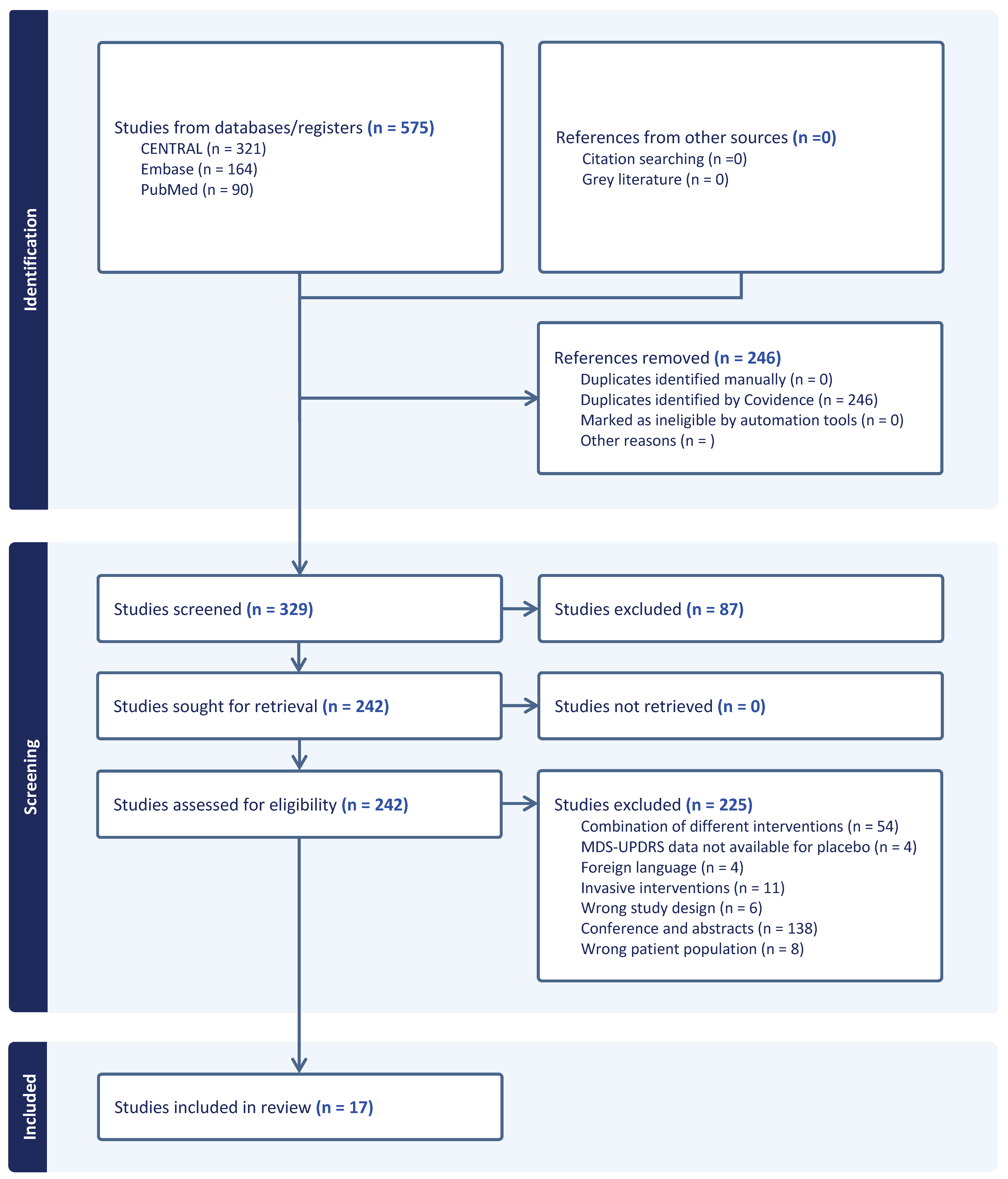
3.1. Study Selection
3.2. Study Characteristics
3.3. Quality of the Studies
3.4. Clinical Effects of rTMS on PD
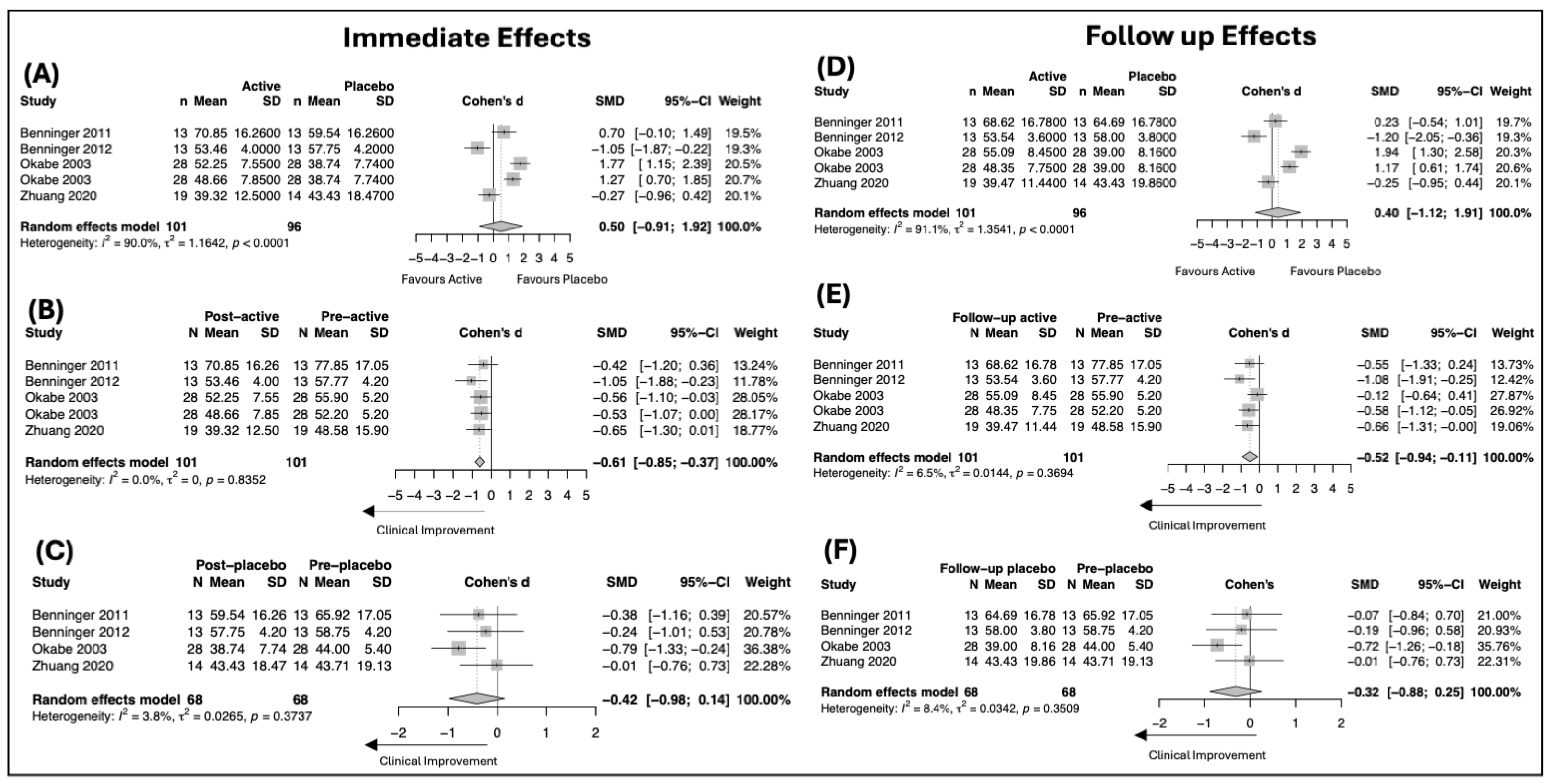
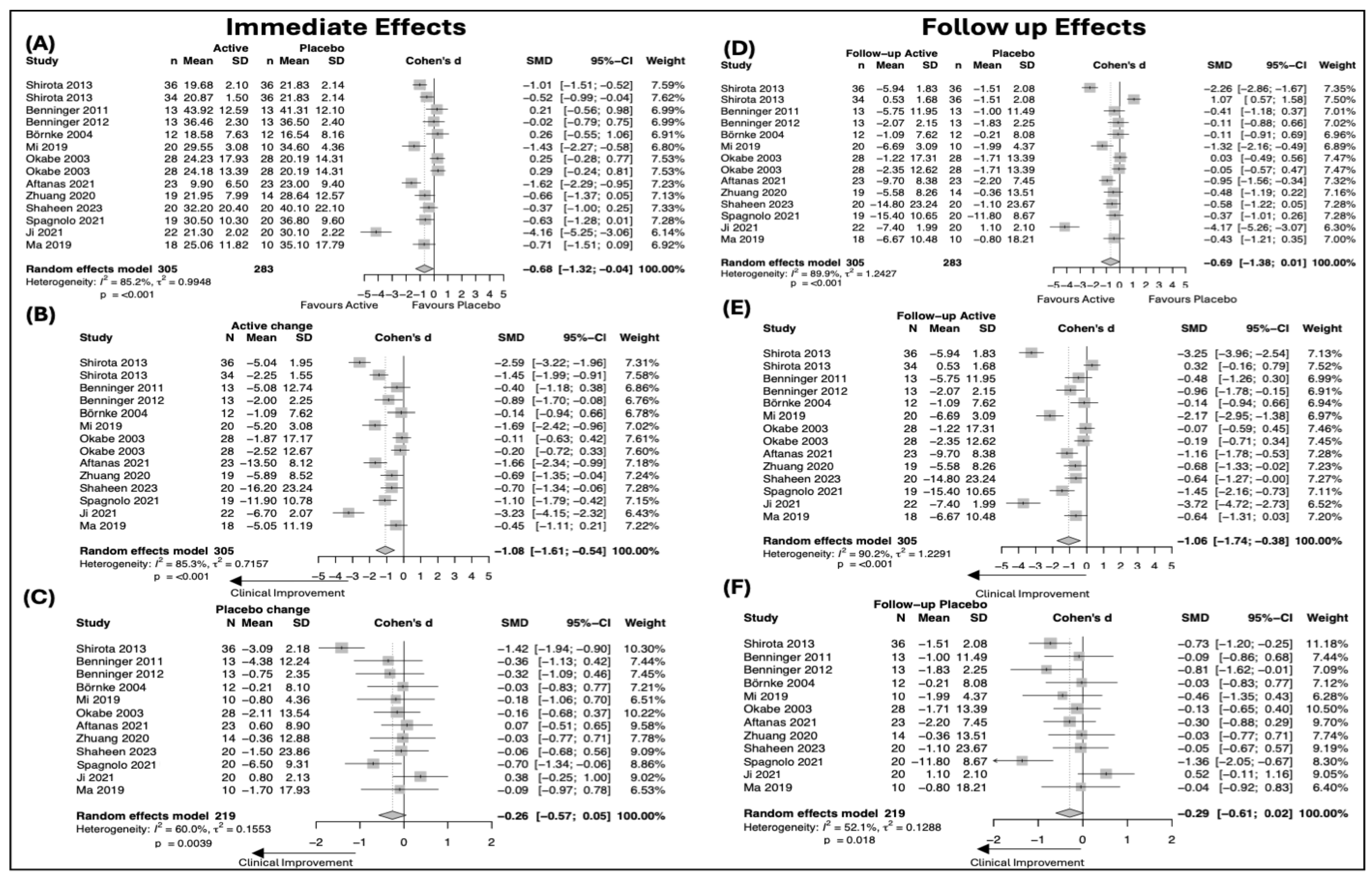
3.4.1. Placebo-Related Effects on UPDRS Outcomes
3.4.2. Active Intervention Effects on UPDRS Outcomes
4. Discussion
4.1. Placebo Effects Are Outcome-Specific and Limited in Magnitude
4.2. Implications for the Design of Clinical Trials
4.3. Strengths and Limitations
5. Conclusions
Supplementary Materials
Author Contributions
Funding
Informed Consent Statement
Data Availability Statement
Conflicts of Interest
References
- Wager, T.D.; Atlas, L.Y. The neuroscience of placebo effects: Connecting context, learning and health. Nat. Rev. Neurosci. 2015, 16, 403–418. [Google Scholar] [CrossRef] [PubMed]
- Burke, M.J.; Romanella, S.M.; Mencarelli, L.; Greben, R.; Fox, M.D.; Kaptchuk, T.J.; Pascual-Leone, A.; Santarnecchi, E. Placebo effects and neuromodulation for depression: A meta-analysis and evaluation of shared mechanisms. Mol. Psychiatry 2022, 27, 1658–1666. [Google Scholar] [CrossRef] [PubMed]
- Quattrone, A.; Barbagallo, G.; Cerasa, A.; Stoessl, A.J. Neurobiology of placebo effect in Parkinson’s disease: What we have learned and where we are going. Mov. Disord. 2018, 33, 1213–1227. [Google Scholar] [CrossRef] [PubMed]
- Lidstone, S.C. Great Expectations: The Placebo Effect in Parkinson’s Disease. In Placebo; Benedetti, F., Enck, P., Frisaldi, E., Schedlowski, M., Eds.; Springer: Berlin/Heidelberg, Germany, 2014; pp. 139–147. [Google Scholar]
- Botvinik-Nezer, R.; Petre, B.; Ceko, M.; Lindquist, M.A.; Friedman, N.P.; Wager, T.D. Placebo treatment affects brain systems related to affective and cognitive processes, but not nociceptive pain. Nat. Commun. 2024, 15, 6017. [Google Scholar] [CrossRef]
- Diederich, N.J.; Goetz, C.G. The placebo treatments in neurosciences: New insights from clinical and neuroimaging studies. Neurology 2008, 71, 677–684. [Google Scholar] [CrossRef]
- Benedetti, F.; Carlino, E.; Piedimonte, A. Increasing uncertainty in CNS clinical trials: The role of placebo, nocebo, and Hawthorne effects. Lancet Neurol. 2016, 15, 736–747. [Google Scholar] [CrossRef]
- de la Fuente-FernánDez, R.; Ruth, T.J.; Sossi, V.; Schulzer, M.; Calne, D.B.; Stoessl, A.J. Expectation and Dopamine Release: Mechanism of the Placebo Effect in Parkinson’s Disease. Science 2001, 293, 1164–1166. [Google Scholar] [CrossRef]
- Benedetti, F.; Colloca, L.; Torre, E.; Lanotte, M.; Melcarne, A.; Pesare, M.; Bergamasco, B.; Lopiano, L. Placebo-responsive Parkinson patients show decreased activity in single neurons of subthalamic nucleus. Nat. Neurosci. 2004, 7, 587–588. [Google Scholar] [CrossRef]
- Goetz, C.G.; Tilley, B.C.; Shaftman, S.R.; Stebbins, G.T.; Fahn, S.; Martinez-Martin, P.; Poewe, W.; Sampaio, C.; Stern, M.B.; Dodel, R.; et al. Movement Disorder Society-sponsored revision of the Unified Parkinson’s Disease Rating Scale (MDS-UPDRS): Scale presentation and clinimetric testing results. Mov. Disord. 2008, 23, 2129–2170. [Google Scholar] [CrossRef]
- Frisaldi, E.; Zamfira, D.A.; Benedetti, F. The subthalamic nucleus and the placebo effect in Parkinson’s disease. Handb. Clin. Neurol. 2021, 180, 433–444. [Google Scholar] [CrossRef]
- Goetz, C.G.; Wuu, J.; McDermott, M.P.; Adler, C.H.; Fahn, S.; Freed, C.R.; Hauser, R.A.; Olanow, W.C.; Shoulson, I.; Tandon, P.; et al. Placebo response in Parkinson’s disease: Comparisons among 11 trials covering medical and surgical interventions. Mov. Disord. 2008, 23, 690–699. [Google Scholar] [CrossRef] [PubMed]
- Lu, Q.-Q.; Zhu, P.-A.; Li, Z.-L.; Holmes, C.; Zhong, Y.; Liu, H.; Bao, X.; Xie, J.-Y. Efficacy of Repetitive Transcranial Magnetic Stimulation Over the Supplementary Motor Area on Motor Function in Parkinson’s Disease. Am. J. Phys. Med. Rehabil. 2025, 104, 318–324. [Google Scholar] [CrossRef] [PubMed]
- Chen, Y.; Jiang, H.; Wei, Y.; Ye, S.; Jiang, J.; Mak, M.K.; Pang, M.Y.; Gao, Q.; Huang, M. Effects of non-invasive brain stimulation over the supplementary motor area on motor function in Parkinson’s disease: A systematic review and meta-analysis. Brain Stimul. 2025, 18, 1–14. [Google Scholar] [CrossRef] [PubMed]
- Chou, Y.-H.; Hickey, P.T.; Sundman, M.; Song, A.W.; Chen, N.-K. Effects of repetitive transcranial magnetic stimulation on motor symptoms in Parkinson disease: A systematic review and meta-analysis. JAMA Neurol. 2015, 72, 432–440. [Google Scholar] [CrossRef]
- Fregni, F.; Boggio, P.S.; Bermpohl, F.; Maia, F.; Rigonatti, S.P.; Barbosa, E.R.; Pascual-Leone, A. Immediate placebo effect in parkinson’s disease—Is the subjective relief accompanied by objective improvement? Eur. Neurol. 2006, 56, 222–229. [Google Scholar] [CrossRef]
- Mollica, A.; Greben, R.; Cyr, M.; Olson, J.A.; Burke, M.J. Placebo Effects and Neuromodulation: Ethical Considerations and Recommendations. Can. J. Neurol. Sci./J. Can. Des. Sci. Neurol. 2023, 50, s34–s41. [Google Scholar] [CrossRef]
- Davidson, B.; Bhattacharya, A.; Sarica, C.; Darmani, G.; Raies, N.; Chen, R.; Lozano, A.M. Neuromodulation techniques—From non-invasive brain stimulation to deep brain stimulation. Neurotherapeutics 2024, 21, e00330. [Google Scholar] [CrossRef]
- Page, M.J.; McKenzie, J.E.; Bossuyt, P.M.; Boutron, I.; Hoffmann, T.C.; Mulrow, C.D.; Shamseer, L.; Tetzlaff, J.M.; Akl, E.A.; Brennan, S.E.; et al. The PRISMA 2020 statement: An updated guideline for reporting systematic reviews. BMJ 2021, 372, 71. [Google Scholar] [CrossRef]
- Cumpston, M.; Li, T.; Page, M.; Chandler, J.; Welch, V.; Higgins, J.P.; Thomas, J. Updated guidance for trusted systematic reviews: A new edition of the Cochrane Handbook for Systematic Reviews of Interventions. Cochrane Database Syst. Rev. 2019, 10, ED000142. [Google Scholar] [CrossRef]
- Fugl-Meyer, A.R.; Jääskö, L.; Leyman, I.; Olsson, S.; Steglind, S. The post-stroke hemiplegic patient. 1. A method for evaluation of physical performance. J. Rehabil. Med. 1975, 7, 13–31. [Google Scholar] [CrossRef]
- A.R. Web Plot Digitizer. Available online: https://apps.automeris.io/wpd4/ (accessed on 20 November 2025).
- Sterne, J.A.C.; Savović, J.; Page, M.J.; Elbers, R.G.; Blencowe, N.S.; Boutron, I.; Cates, C.J.; Cheng, H.Y.; Corbett, M.S.; Eldridge, S.M.; et al. RoB 2: A revised tool for assessing risk of bias in randomised trials. BMJ 2019, 366, l4898. [Google Scholar] [CrossRef]
- Hozo, S.P.; Djulbegovic, B.; Hozo, I. Estimating the mean and variance from the median, range, and the size of a sample. BMC Med. Res. Methodol. 2005, 5, 13. [Google Scholar] [CrossRef] [PubMed]
- Borenstein, M.; Hedges, L.V.; Higgins, J.P.T.; Rothstein, H.R. A basic introduction to fixed-effect and random-effects models for meta-analysis. Res. Synth. Methods 2010, 1, 97–111. [Google Scholar] [CrossRef] [PubMed]
- Seide, S.E.; Röver, C.; Friede, T. Likelihood-based random-effects meta-analysis with few studies: Empirical and simulation studies. BMC Med. Res. Methodol. 2019, 19, 16. [Google Scholar] [CrossRef]
- Higgins, J.; Thomas, J. Cochrane Handbook for Systematic Reviews of Interventions, 2nd ed.; John Wiley: Hoboken, NJ, USA, 2019. [Google Scholar]
- Cheung, M.W.-L.; Vijayakumar, R. A Guide to Conducting a Meta-Analysis. Neuropsychol. Rev. 2016, 26, 121–128. [Google Scholar] [CrossRef]
- Sullivan, G.M.; Feinn, R. Using Effect Size—Or Why the P Value Is Not Enough. J. Grad. Med. Educ. 2012, 4, 279–282. [Google Scholar] [CrossRef]
- Higgins, J.P.T.; Thompson, S.G. Quantifying heterogeneity in a meta-analysis. Stat. Med. 2002, 21, 1539–1558. [Google Scholar] [CrossRef]
- Shirota, Y.; Ohtsu, H.; Hamada, M.; Enomoto, H.; Ugawa, Y. For the Research Committee on rTMS Treatment of Parkinson’s Disease Supplementary motor area stimulation for Parkinson disease. Neurology 2013, 80, 1400–1405. [Google Scholar] [CrossRef]
- Aftanas, L.I.; Zhanaeva, S.Y.; Al’perina, E.L.; Idova, G.V.; Gevorgyan, M.M.; Dzemidovich, S.S.; Kulikova, K.I. Effect of Repetitive Transcranial Magnetic Stimulation on Serum Levels of Steroid Adrenal Hormones in Parkinson’s Disease: Sex Differences. Bull. Exp. Biol. Med. 2022, 173, 322–325. [Google Scholar] [CrossRef]
- Aftanas, L.I.; Brack, I.V.; Kulikova, K.I.; Filimonova, E.A.; Dzemidovich, S.S.; Piradov, M.A.; Suponeva, N.A.; Poidasheva, A.G. Clinical and Neurophysiological Effects of the Therapeutic Combination of High-Frequency Rhythmic Transcranial Magnetic Stimulation of the Motor and Frontal Cortex in Parkinson’s Disease. Neurosci. Behav. Physiol. 2021, 51, 135–141. [Google Scholar] [CrossRef]
- Benninger, D.H.; Berman, B.D.; Houdayer, E.; Pal, N.; Luckenbaugh, D.A.; Schneider, L.; Miranda, S.; Hallett, M. Intermittent theta-burst transcranial magnetic stimulation for treatment of Parkinson disease. Neurology 2011, 76, 601–609. [Google Scholar] [CrossRef]
- Benninger, D.H.; Iseki, K.; Kranick, S.; Luckenbaugh, D.A.; Houdayer, E.; Hallett, M. Controlled study of 50-Hz repetitive Transcranial magnetic stimulation for the treatment of Parkinson disease. Neurorehabilit. Neural Repair. 2012, 26, 1096–1105. [Google Scholar] [CrossRef] [PubMed]
- Börnke, C.; Schulte, T.; Przuntek, H.; Müller, T. Clinical effects of repetitive transcranial magnetic stimulation versus acute levodopa challenge in Parkinson’s disease. J. Neural. Transm. Suppl. 2004, 68, 85–90. [Google Scholar] [CrossRef]
- Mi, T.-M.; Garg, S.; Ba, F.; Liu, A.-P.; Wu, T.; Gao, L.-L.; Dan, X.-J.; Chan, P.; McKeown, M.J. High-frequency rTMS over the supplementary motor area improves freezing of gait in Parkinson’s disease: A randomized controlled trial. Park. Relat. Disord. 2019, 68, 85–90. [Google Scholar] [CrossRef] [PubMed]
- Okabe, S.; Ugawa, Y.; Kanazawa, I. Effectiveness of rTMS on Parkinson’s Disease Study Group 0.2-Hz repetitive transcranial magnetic stimulation has no add-on effects as compared to a realistic sham stimulation in Parkinson’s disease. Mov. Disord. 2003, 18, 382–388. [Google Scholar] [CrossRef]
- Zhuang, S.; Wang, F.-Y.; Gu, X.; Wu, J.-J.; Mao, C.-J.; Gui, H.; Chen, J.; Liu, C.-F. Low-Frequency Repetitive Transcranial Magnetic Stimulation over Right Dorsolateral Prefrontal Cortex in Parkinson’s Disease. Park. Dis. 2020, 2020, 7295414. [Google Scholar] [CrossRef]
- Shaheen, H.A.; Gomaa, M.; Maarouf, M.M.; Daker, L.I. Exploring the effect of transcranial magnetic stimulation on quality of sleep in Parkinson’s disease. Egypt. J. Neurol. Psychiatry Neurosurg. 2023, 59, 173. [Google Scholar] [CrossRef]
- Spagnolo, F.; Fichera, M.; Chieffo, R.; Costa, G.D.; Pisa, M.; Volonté, M.A.; Falautano, M.; Zangen, A.; Comi, G.; Leocani, L. Bilateral Repetitive Transcranial Magnetic Stimulation with the H-Coil in Parkinson’s Disease: A Randomized, Sham-Controlled Study. Front. Neurol. 2021, 11, 584713. [Google Scholar] [CrossRef]
- Valentino, F.; Cosentino, G.; Brighina, F.; Pozzi, N.G.; Sandrini, G.; Fierro, B.; Savettieri, G.; D’Amelio, M.; Pacchetti, C. Transcranial direct current stimulation for treatment of freezing of gait: A cross-over study. Mov. Disord. 2014, 29, 1064–1069. [Google Scholar] [CrossRef]
- Benninger, D.H.; Lomarev, M.; Lopez, G.; Wassermann, E.M.; Li, X.; Considine, E.; Hallett, M. Transcranial direct current stimulation for the treatment of Parkinson’s disease. J. Neurol. Neurosurg. Psychiatry 2010, 81, 1105–1111. [Google Scholar] [CrossRef]
- da Silva, D.C.L.M.; Lemos, T.D.; Ferreira, A.D.d.S.; Horsczaruk, C.H.R.M.; Pedron, C.A.; Rodrigues, E.D.d.C.; de Oliveira, L.A.S.D. Effects of Acute Transcranial Direct Current Stimulation on Gait Kinematics of Individuals with Parkinson Disease. Top. Geriatr. Rehabil. 2018, 34, 262–268. [Google Scholar] [CrossRef]
- Fregni, F.; Boggio, P.S.; Santos, M.C.; Lima, M.; Vieira, A.L.; Rigonatti, S.P.; Silva, M.T.A.; Barbosa, E.R.; Nitsche, M.A.; Pascual-Leone, A. Noninvasive cortical stimulation with transcranial direct current stimulation in Parkinson’s disease. Mov. Disord. 2006, 21, 1693–1702. [Google Scholar] [CrossRef] [PubMed]
- Ji, G.J.; Liu, T.; Li, Y.; Liu, P.; Sun, J.; Chen, X.; Tian, Y.; Chen, X.; Dahmani, L.; Liu, H.; et al. Structural correlates underlying accelerated magnetic stimulation in Parkinson’s disease. Hum. Brain Mapp. 2021, 42, 1670–1681. [Google Scholar] [CrossRef] [PubMed]
- Ma, J.; Gao, L.; Mi, T.; Sun, J.; Chan, P.; Wu, T. Repetitive Transcranial Magnetic Stimulation Does Not Improve the Sequence Effect in Freezing of Gait. Park. Dis. 2019, 2019, 2196195. [Google Scholar] [CrossRef]
- Bae, E.H.; Theodore, W.H.; Fregni, F.; Cantello, R.; Pascual-Leone, A.; Rotenberg, A. An estimate of placebo effect of repetitive transcranial magnetic stimulation in epilepsy. Epilepsy Behav. 2011, 20, 355–359. [Google Scholar] [CrossRef]
- Brunoni, A.R.; Lopes, M.; Kaptchuk, T.J.; Fregni, F. Placebo response of non-pharmacological and pharmacological trials in major depression: A systematic review and meta-analysis. PLoS ONE 2009, 4, e4824. [Google Scholar] [CrossRef]
- Wang, M.; Lu, S.; Hao, L.; Xia, Y.; Shi, Z.; Su, L. Placebo effects of repetitive transcranial magnetic stimulation on negative symptoms and cognition in patients with schizophrenia spectrum disorders: A systematic review and meta-analysis. Front. Psychiatry 2024, 15, 1377257. [Google Scholar] [CrossRef]
- Razza, L.B.; Moffa, A.H.; Moreno, M.L.; Carvalho, A.F.; Padberg, F.; Fregni, F.; Brunoni, A.R. A systematic review and meta-analysis on placebo response to repetitive transcranial magnetic stimulation for depression trials. Prog. Neuro-Psychopharmacol. Biol. Psychiatry 2018, 81, 105–113. [Google Scholar] [CrossRef]
- Hróbjartsson, A.; Gøtzsche, P.C. Is the Placebo Powerless? N. Engl. J. Med. 2001, 344, 1594–1602. [Google Scholar] [CrossRef]
- Wiggerts, Y.; van der Weide, A.; Markidis, E.; Dijk, J.M.; Odekerken, V.J.; Bot, M.; Munckhof, P.v.D.; Schuurman, P.R.; de Bie, R.M.; Beudel, M. The correlation between motor improvement and disability in activities of daily living after DBS in Parkinson’s disease, tremor and dystonia. Deep. Brain Stimul. 2024, 6, 29–33. [Google Scholar] [CrossRef]
- Horváth, K.; Aschermann, Z.; Ács, P.; Deli, G.; Janszky, J.; Komoly, S.; Balázs, É.; Takács, K.; Karádi, K.; Kovács, N. Minimal clinically important difference on the Motor Examination part of MDS-UPDRS. Park. Relat. Disord. 2015, 21, 1421–1426. [Google Scholar] [CrossRef] [PubMed]
- Shulman, L.M.; Gruber-Baldini, A.L.; Anderson, K.E.; Fishman, P.S.; Reich, S.G.; Weiner, W.J. The Clinically Important Difference on the Unified Parkinson’s Disease Rating Scale. Arch. Neurol. 2010, 67, 64–70. [Google Scholar] [CrossRef] [PubMed]
- Colloca, L. How do placebo effects and patient-clinician relationships influence behaviors and clinical outcomes? Pain Rep. 2019, 4, e758. [Google Scholar] [CrossRef] [PubMed]
- Witek, N.; Stebbins, G.T.; Goetz, C.G. What influences placebo and nocebo responses in Parkinson’s disease? Mov. Disord. 2018, 33, 1204–1212. [Google Scholar] [CrossRef]
- Lidstone, S.C.; Schulzer, M.; Dinelle, K.; Mak, E.; Sossi, V.; Ruth, T.J.; de la Fuente-Fernández, R.; Phillips, A.G.; Stoessl, A.J. Effects of Expectation on Placebo-Induced Dopamine Release in Parkinson Disease. Arch. Gen. Psychiatry 2010, 67, 857–865. [Google Scholar] [CrossRef]
- Yang, C.; Xu, Y.; Feng, X.; Wang, B.; Du, Y.; Wang, K.; Lü, J.; Huang, L.; Qian, Z.; Wang, Z.; et al. Transcranial Temporal Interference Stimulation of the Right Globus Pallidus in Parkinson’s Disease. Mov. Disord. 2025, 40, 1061–1069. [Google Scholar] [CrossRef]
- Pisano, F.; Mellace, D.; Fugatti, A.; Aiello, E.N.; Diotti, S.; Curti, B.; Giust, A.; Marfoli, A.; Perin, C.; De Sandi, A.; et al. Cerebellar tDCS combined with augmented reality treadmill for freezing of gait in Parkinson’s disease: A randomized controlled trial. J. Neuroeng. Rehabil. 2024, 21, 173. [Google Scholar] [CrossRef]
- Zhang, Z.; Liu, D.; Song, W.; Li, J.; Wang, X.; Yin, P.; Liu, Y.; Xu, M.; Li, F.; Li, Y.; et al. Multi-Target Repetitive Transcranial Magnetic Stimulation Improves Freezing of Gait in Parkinson’s Disease: A Randomized Controlled Trial. CNS Neurosci. Ther. 2025, 31, e70582. [Google Scholar] [CrossRef]
- Zhang, W.; Ling, Y.; Chen, Z.; Ren, K.; Chen, S.; Huang, P.; Tan, Y. Wearable sensor-based quantitative gait analysis in Parkinson’s disease patients with different motor subtypes. npj Digit. Med. 2024, 7, 169. [Google Scholar] [CrossRef]
- Perumal, S.V.; Sankar, R. Gait and tremor assessment for patients with Parkinson’s disease using wearable sensors. ICT Express 2016, 2, 168–174. [Google Scholar] [CrossRef]
- Bougea, A. Application of Wearable Sensors in Parkinson’s Disease: State of the Art. J. Sens. Actuator Netw. 2025, 14, 23. [Google Scholar] [CrossRef]
- Lin, S.; Gao, C.; Li, H.; Huang, P.; Ling, Y.; Chen, Z.; Ren, K.; Chen, S. Wearable sensor-based gait analysis to discriminate early Parkinson’s disease from essential tremor. J. Neurol. 2023, 270, 2283–2301. [Google Scholar] [CrossRef] [PubMed]
- Kolahi, J.; Bang, H.; Park, J. Towards a proposal for assessment of blinding success in clinical trials: Up-to-date review. Community Dent. Oral. Epidemiol. 2009, 37, 477–484. [Google Scholar] [CrossRef] [PubMed]
- Oken, B.S. Placebo effects: Clinical aspects and neurobiology. Brain 2008, 131, 2812–2823. [Google Scholar] [CrossRef]
- Dileone, M.; Carrasco-López, M.C.; Segundo-Rodriguez, J.C.; Mordillo-Mateos, L.; López-Ariztegui, N.; Alonso-Frech, F.; Catalan-Alonso, M.J.; Obeso, J.A.; Oliviero, A.; Foffani, G. Dopamine-dependent changes of cortical excitability induced by transcranial static magnetic field stimulation in Parkinson’s disease. Sci. Rep. 2017, 7, 4329. [Google Scholar] [CrossRef]
- Mi, T.-M.; Garg, S.; Ba, F.; Liu, A.-P.; Liang, P.-P.; Gao, L.-L.; Jia, Q.; Xu, E.-H.; Li, K.-C.; Chan, P.; et al. Repetitive transcranial magnetic stimulation improves Parkinson’s freezing of gait via normalizing brain connectivity. npj Park. Dis. 2020, 6, 16. [Google Scholar] [CrossRef]
- Hadoush, H.; A Banihani, S.; Khalil, H.; Al-Qaisi, Y.; Al-Sharman, A.; Al-Jarrah, M. Dopamine, BDNF and Motor Function Postbilateral Anodal Transcranial Direct Current Stimulation in Parkinson’s Disease. Neurodegener. Dis. Manag. 2018, 8, 171–179. [Google Scholar] [CrossRef]
- Mestre, T.A.; Shah, P.; Marras, C.; Tomlinson, G.; Lang, A.E. Another face of placebo: The lessebo effect in Parkinson disease. Neurology 2014, 82, 1402–1409. [Google Scholar] [CrossRef]
- von Wernsdorff, M.; Loef, M.; Tuschen-Caffier, B.; Schmidt, S. Effects of open-label placebos in clinical trials: A systematic review and meta-analysis. Sci. Rep. 2021, 11, 17436, Erratum in Sci. Rep. 2021, 11, 3855. https://doi.org/10.1038/s41598-021-83148-6. [Google Scholar] [CrossRef]


Disclaimer/Publisher’s Note: The statements, opinions and data contained in all publications are solely those of the individual author(s) and contributor(s) and not of MDPI and/or the editor(s). MDPI and/or the editor(s) disclaim responsibility for any injury to people or property resulting from any ideas, methods, instructions or products referred to in the content. |
© 2026 by the authors. Licensee MDPI, Basel, Switzerland. This article is an open access article distributed under the terms and conditions of the Creative Commons Attribution (CC BY) license.
Share and Cite
Reyhanli, A.; Ortega-Márquez, J.; Pastora-Sesin, C.; Perin, J.P.; Gianlorenço, A.C.; Camargo, L.; Fregni, F. Reconsidering Placebo Effects in Neuromodulation for Parkinson’s Disease: Lessons for Clinical Trials and Therapeutic Translation. Biomedicines 2026, 14, 532. https://doi.org/10.3390/biomedicines14030532
Reyhanli A, Ortega-Márquez J, Pastora-Sesin C, Perin JP, Gianlorenço AC, Camargo L, Fregni F. Reconsidering Placebo Effects in Neuromodulation for Parkinson’s Disease: Lessons for Clinical Trials and Therapeutic Translation. Biomedicines. 2026; 14(3):532. https://doi.org/10.3390/biomedicines14030532
Chicago/Turabian StyleReyhanli, Aybike, Jorge Ortega-Márquez, Carla Pastora-Sesin, Joao Pedro Perin, Anna Carolyna Gianlorenço, Lucas Camargo, and Felipe Fregni. 2026. "Reconsidering Placebo Effects in Neuromodulation for Parkinson’s Disease: Lessons for Clinical Trials and Therapeutic Translation" Biomedicines 14, no. 3: 532. https://doi.org/10.3390/biomedicines14030532
APA StyleReyhanli, A., Ortega-Márquez, J., Pastora-Sesin, C., Perin, J. P., Gianlorenço, A. C., Camargo, L., & Fregni, F. (2026). Reconsidering Placebo Effects in Neuromodulation for Parkinson’s Disease: Lessons for Clinical Trials and Therapeutic Translation. Biomedicines, 14(3), 532. https://doi.org/10.3390/biomedicines14030532