

Reproductive and Developmental Toxicity of Human Umbilical Cord Blood Mononuclear Cells

 , , ,
, , ,
Abstract
1. Introduction
2. Materials and Methods
2.1. Animals and Maintenance
2.2. hUCB-MNCs Administration
2.3. Study Design
2.4. Statistical Analysis
3. Results
3.1. Reproductive Toxicity Study
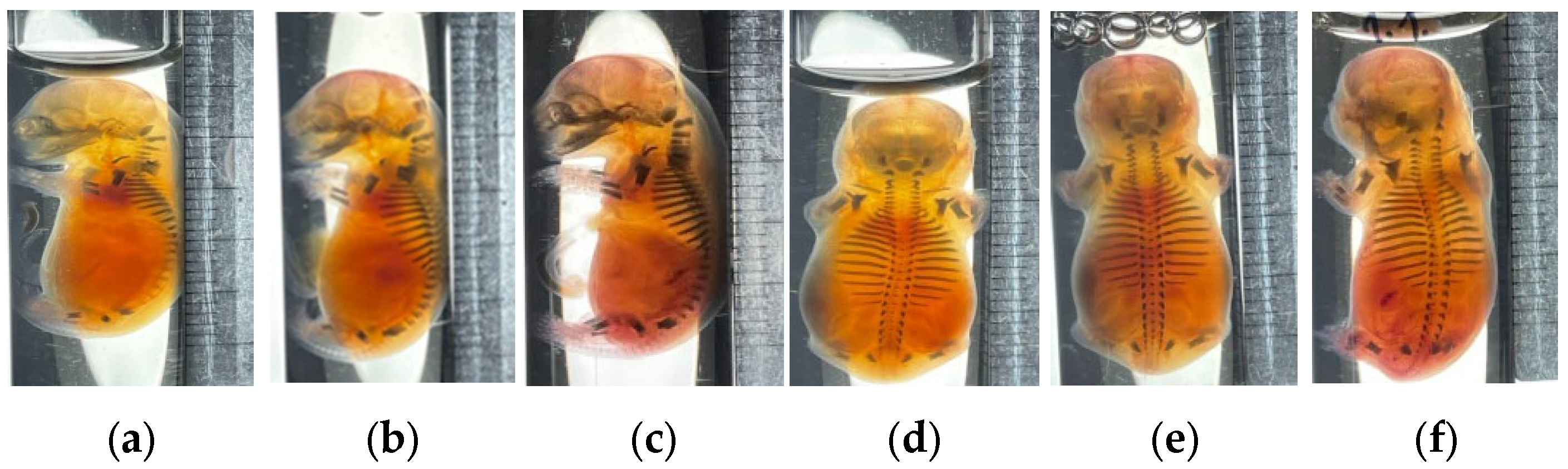
3.2. Embryo–Fetal Development Study
4. Discussion
5. Conclusions
Author Contributions
Funding
Institutional Review Board Statement
Informed Consent Statement
Data Availability Statement
Conflicts of Interest
Abbreviations
| D | Diestrus |
| E | Estrus |
| EGF | Epidermal growth factor |
| EPCs | Endothelial progenitor cells |
| HGF | Hepatocyte growth factor |
| HSCs | Hematopoietic stem cells |
| hUCB | Human umbilical cord blood cell |
| hUCB-MNCs | Human umbilical cord mononuclear blood cells |
| IL-10 | Interleukin-10 |
| IL-1β | Interleukin-1β |
| IL-4 | Interleukin-4 |
| IL-8 | Interleukin-8 |
| KGF | Keratinocyte growth factor |
| M | Metestrus |
| MSCs | Mesenchymal stem cells |
| NK | Natural killer |
| NOAEL | No-observed-adverse-effect level |
| OECD | Organization for Economic Co-operation and Development |
| P | Proestrus |
| TM | Transport medium |
| TNF-α | Tumor necrosis factor-α |
| USSCs | Unrestricted somatic stem cells |
References
- Gao, L.; Xu, W.; Li, T.; Chen, J.; Shao, A.; Ya, F.; Chen, G. Stem Cell Therapy: A Promising Therapeutic Method for Intracerebral Hemorrhage. Cell Transplant. 2018, 27, 1809–1824. [Google Scholar] [CrossRef] [PubMed]
- Jamali, F.; Aldughmi, M.; Atiani, S.; Al-Radaideh, A.; Dahbour, S.; Alhattab, D.; Khwaireh, H.; Arafat, S.; Al Jaghbeer, J.; Rahmeh, R.; et al. Human Umbilical Cord-Derived Mesenchymal Stem Cells in the Treatment of Multiple Sclerosis Patients: Phase I/II Dose-Finding Clinical Study. Cell Transplant. 2024, 33, 9636897241233045. [Google Scholar] [CrossRef] [PubMed]
- Rallapalli, S.; Guhathakurta, S.; Narayan, S.; Bishi, D.K.; Balasubramanian, V.; Korrapati, P.S. Generation of clinical-grade red blood cells from human umbilical cord blood mononuclear cells. Cell Tissue Res. 2019, 375, 437–449. [Google Scholar] [CrossRef] [PubMed]
- Gatina, D.Z.; Gazizov, I.M.; Zhuravleva, M.N.; Arkhipov, S.S.; Golubenko, M.A.; Gomzikova, M.O.; Garanina, E.E.; Islamov, R.R.; Rizvanov, A.A.; Salafutdinov, I.I. Induction of Angiogenesis by Genetically Modified Human Umbilical Cord Blood Mononuclear Cells. Int. J. Mol. Sci. 2023, 24, 4396. [Google Scholar] [CrossRef]
- Pimentel-Coelho, P.M.; Rosado-de Castro, P.H.; Da Fonseca, L.M.B. Mendez-Otero RUmbilical cord blood mononuclear cell transplantation for neonatal hypoxic-ischemic encephalopathy. Pediatr. Res. 2012, 71, 464–473. [Google Scholar] [CrossRef]
- Goradel, N.H.; Hour, F.G.; Negahdari, B.; Malekshahi, Z.V.; Hashemzehi, M.; Masoudifar, A.; Mirzaei, H. Stem Cell Therapy: A New Therapeutic Option for Cardiovascular Diseases. J. Cell. Biochem. 2018, 119, 95–104. [Google Scholar] [CrossRef]
- Shehjar, F.; Maktabi, B.; Rahman, Z.A.; Bahader, G.A.; James, A.W.; Naqvi, A.; Mahajan, R.; Shah, Z.A. Stroke: Molecular mechanisms and therapies: Update on recent developments. Neurochem. Int. 2023, 162, 105458. [Google Scholar] [CrossRef]
- Hu, Z.; Wang, D.; Gong, J.; Li, Y.; Ma, Z.; Lu, T.; Ji, X.; Shi, Y.; Son, Z. MSCs Deliver Hypoxia-Treated Mitochondria Reprogramming Acinar Metabolism to Alleviate Severe Acute Pancreatitis Injury. Adv. Sci. 2023, 10, e2207691. [Google Scholar] [CrossRef]
- Umer, A.; Khan, N.; Greene, D.L.; Habiba, U.E.; Shamim, S.; Khayam, A.U. The Therapeutic Potential of Human Umbilical Cord Derived Mesenchymal Stem Cells for the Treatment of Premature Ovarian Failure. Stem Cell Rev. Rep. 2023, 19, 651–666. [Google Scholar] [CrossRef]
- Zhou, J.; Gao, T.; Tang, W.; Qian, T.; Wang, Z.; Xu, P.; Wang, L. Progress in the treatment of neonatal hypoxic-ischemic encephalopathy with umbilical cord blood mononuclear cells. Brain Dev. 2023, 45, 533–546. [Google Scholar] [CrossRef]
- Purcell, E.; Nguyen, T.; Smith, M.; Penny, T.; Paton, M.; Zhou, L.; Jenkin, G.; Miller, S.L.; McDonald, C.A.; Malhotra, A. Factors Influencing the Efficacy of Umbilical Cord Blood-Derived Cell Therapy for Perinatal Brain Injury. Stem Cells Transl. Med. 2023, 12, 125–139. [Google Scholar] [CrossRef] [PubMed]
- Xi, Y.; Yue, G.; Gao, S.; Ju, R.; Wang, Y. Human umbilical cord blood mononuclear cells transplantation for perinatal brain injury. Stem Cell Res. Ther. 2022, 13, 458. [Google Scholar] [CrossRef] [PubMed]
- Grochowski, C.; Radzikowska, E.; Maciejewski, R. Neural Stem Cell Therapy-Brief Review. Clin. Neurol. 2018, 173, 8–14. [Google Scholar] [CrossRef] [PubMed]
- Carresi, C.; Scicchitano, M.; Scarano, F.; Macrì, R.; Bosco, F.; Nucera, S.; Ruga, S.; Zito, M.C.; Mollace, R.; Guarnieri, L.; et al. The Potential Properties of Natural Compounds in Cardiac Stem Cell Activation: Their Role in Myocardial Regeneration. Nutrients 2021, 13, 275. [Google Scholar] [CrossRef]
- Jia, N.N.; Yao, M.F.; Zhu, C.X.; He, M.J.; Zhu, H.F.; Chen, Z.Y.; Huang, H.P.; Qiao, C. Chronic Intermittent Hypoxia-Induced Neural Injury: Pathophysiology, Neurodegenerative Implications, and Therapeutic Insights. CNS Neurosci. Ther. 2025, 31, e70384. [Google Scholar] [CrossRef]
- Cheng, T.; Mao, M.; Liu, Y.; Xie, L.; Shi, F.; Liu, H.; Li, X. The potential therapeutic effect of human umbilical cord mesenchymal stem cell-derived exosomes in bronchopulmonary dysplasia. Life Sci. 2024, 15, 123047. [Google Scholar] [CrossRef]
- Cai, X.; Li, Y.; Gao, F.; Muhammad, B.; Yang, H. Therapeutic effect and study of human umbilical cord blood mononuclear cells in patients with ischaemic bowel disease. Sci. Rep. 2024, 14, 6121. [Google Scholar] [CrossRef]
- Zhang, Y.; Zhuang, H.; Ren, X.; Jiang, F.; Zhou, P. Therapeutic effects of different intervention forms of human umbilical cord mesenchymal stem cells in the treatment of osteoarthritis. Front. Cell Dev. Biol. 2023, 11, 1246504. [Google Scholar] [CrossRef]
- Zang, L.; Li, Y.; Hao, H.; Liu, J.; Zhang, Q.; Gao, F.; Wang, H.; Chen, Y.; Gu, W.; Du, J.; et al. Efficacy of Umbilical Cord-Derived Mesenchymal Stem Cells in the Treatment of Type 2 Diabetes Assessed by Retrospective Continuous Glucose Monitoring. Stem Cells Transl. Med. 2023, 12, 775–782. [Google Scholar] [CrossRef]
- Dehghani, L.; Owliaee, I.; Sadeghian, F.; Shojaeian, A. The Therapeutic Potential of Human Umbilical Cord Mesenchymal Stromal Cells Derived Exosomes for Wound Healing: Harnessing Exosomes as a Cell-free Therapy. J. Stem Cells Regen. Med. 2024, 20, 14–23. [Google Scholar]
- Yu, X.; Liu, P.; Li, Z.; Zhang, Z. Function and mechanism of mesenchymal stem cells in the healing of diabetic foot wounds. Front. Endocrinol. 2023, 14, 1099310. [Google Scholar] [CrossRef] [PubMed]
- Zhou, C.; Zhang, B.; Yang, Y.; Jiang, Q.; Li, T.; Gong, J.; Tang, H.; Zhang, Q. Stem cell-derived exosomes: Emerging therapeutic opportunities for wound healing. Stem Cell Res. Ther. 2023, 14, 107. [Google Scholar] [CrossRef] [PubMed]
- Wu, X.; Tang, Y.; Lu, X.; Liu, Y.; Liu, X.; Sun, Q.; Wang, L.; Huang, W.; Liu, A.; Liu, L.; et al. Endothelial cell-derived extracellular vesicles modulate the therapeutic efficacy of mesenchymal stem cells through IDH2/TET pathway in ARDS. Cell Commun. Signal. 2024, 22, 293. [Google Scholar] [CrossRef] [PubMed]
- Dai, W.; Yang, H.; Xu, B.; He, T.; Liu, L.; Ma, X.; Ma, J.; Yang, G.; Si, R.; Pei, X.; et al. Human umbilical cord-derived mesenchymal stem cells (hUC-MSCs) alleviate excessive autophagy of ovarian granular cells through VEGFA/PI3K/AKT/mTOR pathway in premature ovarian failure rat model. J. Ovarian Res. 2023, 16, 198. [Google Scholar] [CrossRef]
- Che, J.; Wang, H.; Dong, J.; Wu, Y.; Zhang, H.; Fu, L.; Zhang, J. Human umbilical cord mesenchymal stem cell-derived exosomes attenuate neuroinflammation and oxidative stress through the NRF2/NF-κB/NLRP3 pathway. CNS Neurosci. Ther. 2024, 30, e14454. [Google Scholar] [CrossRef]
- Xie, Q.; Liu, R.; Jiang, J. What is the impact of human umbilical cord mesenchymal stem cell transplantation on clinical treatment? Stem Cell Res. Ther. 2020, 11, 519. [Google Scholar] [CrossRef]
- Alatyyat, S.M.; Alasmari, H.M.; Aleid, O.A.; Abdel-Maksoud, M.S.; Elsherbiny, N. Umbilical cord stem cells: Background, processing and applications. Tissue Cell 2020, 65, 101351. [Google Scholar] [CrossRef]
- Chung, S.; Rho, S.; Kim, G.; Kim, S.R.; Baek, K.H.; Kang, M.; Lew, H. Human umbilical cord blood mononuclear cells and chorionic plate-derived mesenchymal stem cells promote axon survival in a rat model of optic nerve crush injury. Int. J. Mol. Med. 2016, 37, 1170–1180. [Google Scholar] [CrossRef]
- Lyu, H.; Sun, D.M.; Ng, C.P.; Cheng, W.S.; Chen, J.F.; He, Y.Z.; Lam, S.Y.; Zheng, Z.Y.; Huang, G.D.; Wang, C.C.; et al. Umbilical Cord Blood Mononuclear Cell Treatment for Neonatal Rats with Hypoxic Ischemia. Front. Cell. Neurosci. 2022, 16, 823320. [Google Scholar] [CrossRef]
- Oztekin, C.V.; Yilmaz-Oral, D.; Kaya-Sezginer, E.; Kirlangic, O.F.; Ozen, F.Z.; Ozdal, B.; Topcu, H.O.; Gur, S. Beneficial Effects of Human Umbilical Cord Blood Mononuclear Cells on Persistent Erectile Dysfunction After Treatment of 5-Alpha Reductase Inhibitor in Rats. J. Sex. Med. 2021, 18, 889–899. [Google Scholar] [CrossRef]
- Solana, C.; Balanian, N.; Machado, S.; Binda, V.; Kuperman, S.; Gamba, C.; Roca, V. Using autologous umbilical cord blood and placental cells for hypoxic-ischemic encephalopathy: An exploratory safety and feasibility study. Arch. Argent. Pediatr. 2025, 123, e202410366. [Google Scholar]
- Zhuxiao, R.; Jiangxue, H.; Yongsheng, L.; Jingjun, P.; Shuo, Y.; Fang, X.; Qi, Z.; Shandan, Z.; Chuan, N.; Jie, Y. Umbilical cord blood cell characteristics in very preterm neonates for autologous cell therapy of preterm-associated complications. BMC Pediatr. 2024, 24, 214. [Google Scholar] [CrossRef] [PubMed]
- Salafutdinov, I.I.; Gatina, D.Z.; Markelova, M.I.; Garanina, E.E.; Malanin, S.Y.; Gazizov, I.M.; Izmailov, A.A.; Rizvanov, A.A.; Islamov, R.R.; Palotás, A.; et al. A Biosafety Study of Human Umbilical Cord Blood Mononuclear Cells Transduced with Adenoviral Vector Carrying Human Vascular Endothelial Growth Factor cDNA In Vitro. Biomedicines 2023, 11, 2020. [Google Scholar] [CrossRef] [PubMed]
- Pan, W.; Gu, L.; Yang, H.; Xu, C.; Yang, Z.; Lu, Q.; Shi, Y.; Zhang, L.; Shao, J.; Chen, Y.; et al. Repeat-dose toxicity study of human umbilical cord mesenchymal stem cells in cynomolgus monkeys by intravenous and subcutaneous injection. Front. Cell Dev. Biol. 2023, 11, 1273723. [Google Scholar] [CrossRef] [PubMed]
- Huang, Y.; Hao, X.; Lin, Z.; Li, L.; Jiang, H.; Zhang, H.; Geng, X.; Zhu, H.; Wen, H. Biodistribution and toxicity potential of human umbilical cord mesenchymal stem cells in cynomolgus monkeys. Sci. Rep. 2024, 14, 12251. [Google Scholar] [CrossRef]
- Gasanov, V.O.; Kashirskikh, D.A.; Khotina, V.A.; Kuzmina, D.M.; Nikitochkina, S.Y.; Mukhina, I.V.; Vorotelyak, E.A.; Vasiliev, A.V. Preclinical Evaluation of the Safety, Toxicity and Efficacy of Genetically Modified Wharton’s Jelly Mesenchymal Stem/Stromal Cells Expressing the Antimicrobial Peptide SE-33. Cells 2025, 14, 341. [Google Scholar] [CrossRef]
- Chin, S.P.; Saffery, N.S.; Then, K.Y.; Cheong, S.K. Preclinical assessments of safety and tumorigenicity of very high doses of allogeneic human umbilical cord mesenchymal stem cells. In Vitro Cell Dev. Biol. Anim. 2024, 60, 307–319. [Google Scholar] [CrossRef]
- Chan, A.M.L.; Ng, A.M.H.; MohdYunus, M.H.; HjIdrus, R.B.; Law, J.X.; Yazid, M.D.; Chin, K.Y.; Shamsuddin, S.A.; MohdYusof, M.R.; Razali, R.A.; et al. Safety study of allogeneic mesenchymal stem cell therapy in animal model. Regen. Ther. 2022, 19, 158–165. [Google Scholar] [CrossRef]
- Yun, J.W.; Ahn, J.H.; Kwon, E.; Kim, S.H.; Kim, H.; Jang, J.J.; Kim, W.H.; Kim, J.H.; Han, S.Y.; Kim, J.T.; et al. Human umbilical cord-derived mesenchymal stem cells in acute liver injury: Hepatoprotective efficacy, subchronic toxicity, tumorigenicity, and biodistribution. Regul. Toxicol. Pharmacol. 2016, 81, 437–447. [Google Scholar] [CrossRef]
- Rodrigues, S.C.; Cardoso, R.M.S.; Freire, P.C.; Gomes, C.F.; Duarte, F.V.; Neves, R.P.D.; Simões-Correia, J. Immunomodulatory Properties of Umbilical Cord Blood-Derived Small Extracellular Vesicles and Their Therapeutic Potential for Inflammatory Skin Disorders. Int. J. Mol. Sci. 2021, 22, 9797. [Google Scholar] [CrossRef]
- Xu, W.; Jieda, X.; Wu, Y.; Du, F.; Ma, L.; Luo, L.; Liu, D.; Guo, L.; Liu, J.; Dong, W. Safety, Efficacy and Bio-Distribution Analysis of Exosomes Derived from Human Umbilical Cord Mesenchymal Stem Cells for Effective Treatment of Bronchopulmonary Dysplasia by Intranasal Administration in Mice Model. Int. J. Nanomed. 2025, 20, 2521–2553. [Google Scholar] [CrossRef]
- Gilevich, I.V.; Polyakov, I.S.; Porhanov, V.A.; Storozhuk, A.P.; Bodnya, V.N.; Zavgorodnyaya, A.G.; Kolomiytseva, E.A.; Sotnichenko, A.S. Application of cells of cord blood and umbilical cord: Achievements, challenges and perspectives. Innov. Med. Kuban. 2022, 2, 67–76. [Google Scholar] [CrossRef]
- Li, X.; Huang, Q.; Zhang, X.; Xi, C.; Liu, M.; Yuan, Y.; Feng, J.; Xing, H.; Ru, L.; Yuan, Z.; et al. Reproductive and Developmental Toxicity Assessment of Human Umbilical Cord Mesenchymal Stem Cells in Rats. Front. Cell Dev. Biol. 2022, 10, 883996. [Google Scholar] [CrossRef] [PubMed]
- Skupnevskiy, S.V.; Saveljev, R.V.; Pukhaeva, E.G.; Morozova, Y.V.; Radaev, S.M.; Smirnov, V.A.; Grin, A.A. Mononuclear cells from human umbilical cord/placental blood: Assessment of allergenicity and impact on immune status in experimental warm-blooded animals. Med. Immunol. 2025, 27, 303–310. [Google Scholar] [CrossRef]
- Luo, Y.L.; Li, Y.F.; Zhu, Y.P.; Liang, J.Q.; Chen, D.F.; Chen, H.J.; Huang, C.Q.; Li, J.; Li, S.Y. Effects of human umbilical cord blood mononuclear cells on ovalbumin-induced asthma in mice. J. Thorac. Dis. 2023, 15, 5454–5465. [Google Scholar] [CrossRef]
- Penny, T.R.; Pham, Y.; Sutherland, A.E.; Lee, J.; Jenkin, G.; Fahey, M.C.; Miller, S.L.; McDonald, C.A. Umbilical cord blood therapy modulates neonatal hypoxic ischemic brain injury in both females and males. Sci. Rep. 2021, 11, 15788. [Google Scholar] [CrossRef]
- McDonald, C.A.; Penny, T.R.; Paton, M.C.B.; Sutherland, A.E.; Nekkanti, L.; Yawno, T.; Castillo-Melendez, M.; Fahey, M.C.; Jones, N.M.; Jenkin, G.; et al. Effects of umbilical cord blood cells, and subtypes, to reduce neuroinflammation following perinatal hypoxic-ischemic brain injury. J. Neuroinflammation 2018, 15, 47. [Google Scholar] [CrossRef]
- El-Ashmawy, N.E.; Khedr, E.G.; El-Bahrawy, H.A.; El-Berashy, S.A. Effect of human umbilical cord blood-derived mononuclear cells on diabetic nephropathy in rats. Biomed. Pharmacother. 2018, 97, 1040–1045. [Google Scholar] [CrossRef]
- Hashem, M.M.; Abd-Elhakim, Y.M.; Abo-El-Sooud, K.; Eleiwa, M.M. Embryotoxic and Teratogenic Effects of Tartrazine in Rats. Toxicol. Res. 2019, 35, 75–81. [Google Scholar] [CrossRef]
- Cheng, W.D.; Bin, L.; Lin, Z.X.; Yu, D.; Xiang, D.K.; Lo, S.; Ravichandran, M.; Kong, T.S. Human umbilical cord mesenchymal stem cells toxicity and allergy effects: In vivo assessment. PLoS ONE 2024, 19, e0309429. [Google Scholar] [CrossRef]
- Shi, L.; Zhang, Y.; Dong, X.; Pan, Y.; Ying, H.; Chen, J.; Yang, W.; Zhang, Y.; Fei, H.; Liu, X.; et al. Toxicity from a single injection of human umbilical cord mesenchymal stem cells into rat ovaries. Reprod. Toxicol. 2022, 110, 9–18. [Google Scholar] [CrossRef] [PubMed]
- Shao, J.; Xia, L.; Ye, Z.; Yang, Q.; Zhang, C.; Shi, Y.; Zhang, L.; Gu, L.; Xu, C.; Chen, Y.; et al. A repeat-dose toxicity study of human umbilical cord mesenchymal stem cells in NOG mice by intravenous injection. Expert Opin. Drug Metab. Toxicol. 2023, 19, 857–866. [Google Scholar] [CrossRef] [PubMed]
- Li, S.; Fu, X.; Wang, J.; Yang, H.; Wang, D.; Dong, X.; Duan, Y.; Wang, H.; Yan, Y.; Si, W. Therapeutic efficacy and in vivo distribution of human umbilical cord-derived mesenchymal stem cell spheroids transplanted via B-Ultrasound-guided percutaneous portal vein puncture in rhesus monkey models of liver fibrosis. Stem Cell Res. Ther. 2024, 15, 315. [Google Scholar] [CrossRef] [PubMed]
- Zhang, Y.; Liu, Y.; Teng, Z.; Wang, Z.; Zhu, P.; Wang, Z.; Liu, F.; Liu, X. Human umbilical cord mesenchymal stem cells (hUC-MSCs) alleviate paclitaxel-induced spermatogenesis defects and maintain male fertility. Biol. Res. 2023, 56, 47. [Google Scholar] [CrossRef]
- Abdulrazzak, H.; Moschidou, D.; Jones, G.; Guillot, P.V. Biological characteristics of stem cells from foetal, cord blood and extraembryonic tissues. J. R. Soc. Interface 2010, 7, 689–706. [Google Scholar] [CrossRef]
- Deng, T.; He, J.; Yao, Q.; Wu, L.; Xue, L.; Wu, M.; Wu, D.; Li, C.; Li, Y. Human Umbilical Cord Mesenchymal Stem Cells Improve Ovarian Function in Chemotherapy-Induced Premature Ovarian Failure Mice through Inhibiting Apoptosis and Inflammation via a Paracrine Mechanism. Reprod. Sci. 2021, 28, 1718–1732. [Google Scholar] [CrossRef]
- Ga, Y.; Chi, Y.; Chen, Y.; Wang, W.; Li, H.; Zheng, W.; Zhu, P.; An, J.; Duan, Y.; Sun, T.; et al. Multi-omics analysis of human mesenchymal stem cells shows cell aging that alters immunomodulatory activity through the downregulation of PD-L1. Nat. Commun. 2023, 14, 4373. [Google Scholar] [CrossRef]


| 1 Week | 2 Week | 3 Week | |
|---|---|---|---|
| NC | 139 ± 18 | 146 ± 20 | 152 ± 22 |
| LD | 134 ± 14 | 141 ± 13 | 149 ± 17 |
| HD | 147 ± 17 | 153 ± 16 | 160 ± 16 |
| 0–7 Days | 0–14 Days | 0–20 Days | |
|---|---|---|---|
| NC | 32 ± 7 | 64 ± 8 | 142 ± 10 |
| LD | 33 ± 8 | 63 ± 11 | 139 ± 26 |
| HD | 30 ± 10 | 60 ± 14 | 139 ± 18 |
| 0–4 Days | 0–7 Days | 0–14 Days | |
|---|---|---|---|
| NC | 34 ± 15 | 37 ± 15 | 51 ± 17 |
| LD | 32 ± 16 | 36 ± 18 | 51 ± 19 |
| HD | 28 ± 18 | 29 ± 16 | 40 ± 17; * p = 0.02 |
| NC | LD | HD | |
|---|---|---|---|
| Fertility | 90% | 80% | 95% |
| Pregnancy rate | 100% | 100% | 100% |
| Corpora lutea count | 13 ± 0.8 | 12 ± 0.5 | 13.5 ± 0.5 |
| Implantation sites count | 12 ± 0.9 | 11 ± 0.8 | 12 ± 0.7 |
| NC | LD | HD | |
|---|---|---|---|
| Live fetuses count in a generation | 235/235 (100%) | 205/205 (100%) | 257/257 (100%) |
| Dead and resorbed fetuses | 0/235 (0%) | 0/205 (0%) | 0/257 (0%). |
| Body weight (g) | 5.4 ± 0.38 | 5.6 ± 0.29 | 5.38 ± 0.31 |
| Craniocaudal size (mm) | 4.5 ± 0.5 | 4.7 ± 0.4 | 4.9 ± 0.3 |
| Skeleton deformity | 0/120 (0%) | 0/100 (0%) | 0/130 (0%) |
| Visceral deformity | 0/115 (0%) | 0/105 (0%) | 0/127 (0%) |
| 1 Week | 2 Week | 3 Week | |
|---|---|---|---|
| NC | 211 ± 22 | 220 ± 24 | 229 ± 25 |
| LD | 218 ± 32 | 231 ± 33 | 238± 34 |
| HD | 215 ± 21 | 224 ± 20 | 234 ± 21 |
| 0–7 Days | 0–14 Days | 0–20 Days | |
|---|---|---|---|
| NC | 31 ± 6 | 63 ± 7 | 137 ± 16 |
| LD | 33 ± 9 | 68 ± 11 | 147 ± 19 |
| HD | 29 ± 9 | 62 ± 11 | 134 ± 21 |
| NC | LD | HD | |
|---|---|---|---|
| Live females count | 20/20 (100%) | 20/20 (100%) | 20/20 (100%) |
| Fertility | 95% | 95% | 90% |
| Corpora lutea count | 13 ± 2.5 | 15 ± 1.8 | 14.3 ± 1.4 |
| Implantation sites | 12.1 ± 2.4 | 12.9 ± 3.3 | 12.06 ± 2.8 |
| NC | LD | HD | |
|---|---|---|---|
| Dead and resorbed fetuses | 3/228 (1.32%) | 3/253 (1.19%) | 1/230 (0.43%) |
| Body weight (male) | 6.7 ± 2.6 n = 108 | 6.5 ± 1.5 n = 123 | 6.6 ± 1.5 n = 120 |
| Body weight (female) | 6.2 ± 2.8 n = 117 | 6.7 ± 1.9 n = 127 | 6.05 ± 2.5 n = 109 |
| The male/female ratio | 0.480 | 0.492 | 0.524 |
| Fetal development anomalies | 0/225 | 0/250 | 0/229 |
| Skeleton deformity | 0/110 (0%) | 0/125 (0%) | 0/110 (0%) |
| Visceral deformity | 0/110 (0%) | 0/125 (0%) | 0/110 (0%) |
Disclaimer/Publisher’s Note: The statements, opinions and data contained in all publications are solely those of the individual author(s) and contributor(s) and not of MDPI and/or the editor(s). MDPI and/or the editor(s) disclaim responsibility for any injury to people or property resulting from any ideas, methods, instructions or products referred to in the content. |
© 2026 by the authors. Licensee MDPI, Basel, Switzerland. This article is an open access article distributed under the terms and conditions of the Creative Commons Attribution (CC BY) license.
Share and Cite
Dzampaeva, Z.; Skupnevskii, S.; Saveljev, R.; Morozova, Y.; Radaev, S.; Smirnov, V.; Grin, A. Reproductive and Developmental Toxicity of Human Umbilical Cord Blood Mononuclear Cells. Biomedicines 2026, 14, 508. https://doi.org/10.3390/biomedicines14030508
Dzampaeva Z, Skupnevskii S, Saveljev R, Morozova Y, Radaev S, Smirnov V, Grin A. Reproductive and Developmental Toxicity of Human Umbilical Cord Blood Mononuclear Cells. Biomedicines. 2026; 14(3):508. https://doi.org/10.3390/biomedicines14030508
Chicago/Turabian StyleDzampaeva, Zhanna, Sergey Skupnevskii, Rodion Saveljev, Yana Morozova, Sergey Radaev, Vladimir Smirnov, and Andrey Grin. 2026. "Reproductive and Developmental Toxicity of Human Umbilical Cord Blood Mononuclear Cells" Biomedicines 14, no. 3: 508. https://doi.org/10.3390/biomedicines14030508
APA StyleDzampaeva, Z., Skupnevskii, S., Saveljev, R., Morozova, Y., Radaev, S., Smirnov, V., & Grin, A. (2026). Reproductive and Developmental Toxicity of Human Umbilical Cord Blood Mononuclear Cells. Biomedicines, 14(3), 508. https://doi.org/10.3390/biomedicines14030508