SPP1+ Macrophages and the Orchestration of Spatially Organized Immunosuppression in Cancer

 ,
,
Abstract
1. Introduction
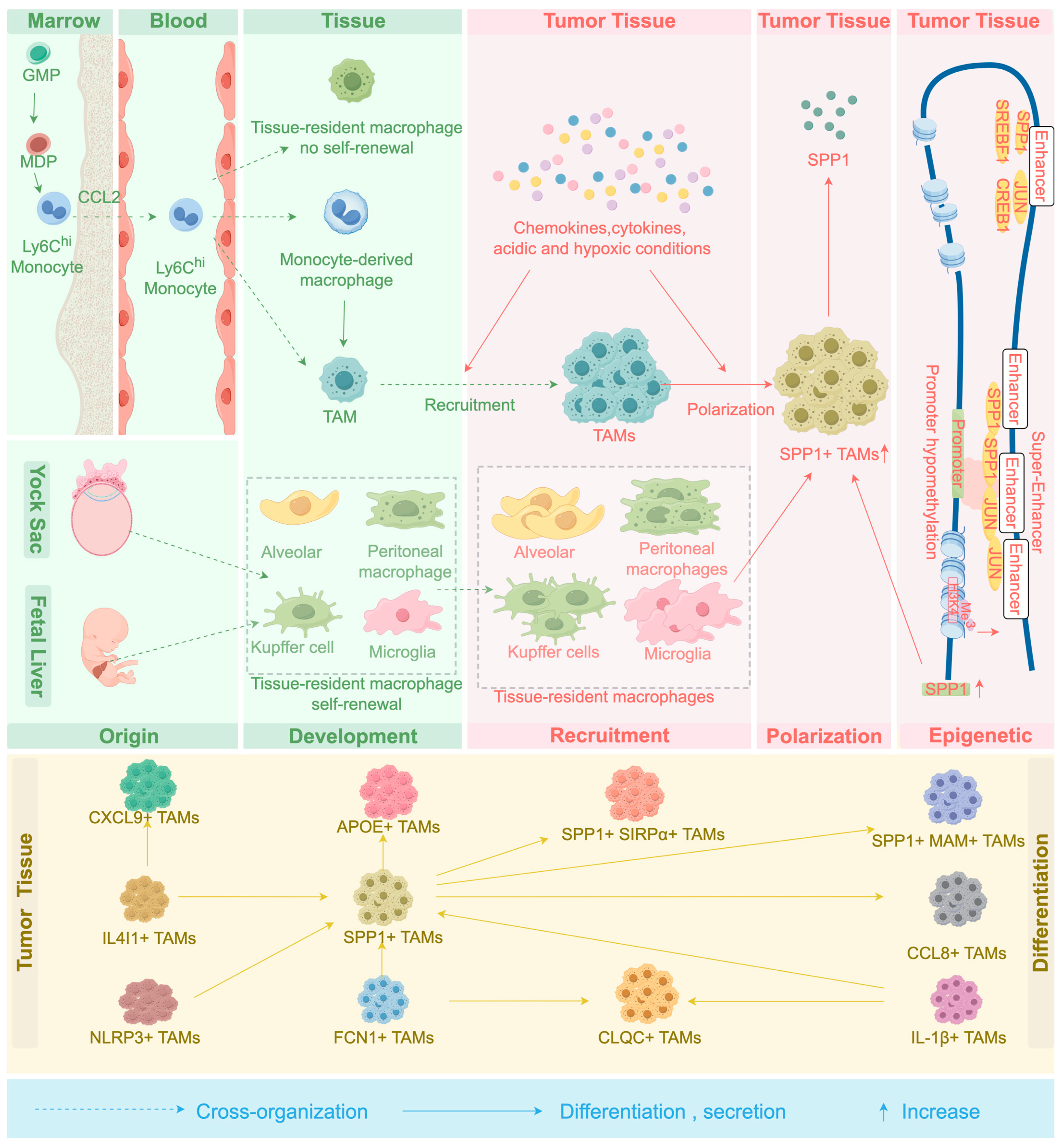
2. SPP1+ TAMs: Identification and Developmental Origins
2.1. Identification: How to Recognize SPP1+ TAMs
2.2. Developmental Origin: Where Do SPP1+ TAMs Come from?
2.2.1. Monocyte-Derived Macrophages (MDMs)
2.2.2. Tissue-Resident Macrophages
3. The Polarization Process of SPP1+ TAMs
3.1. The First Stage: Recruitment
3.2. The Second Stage: Polarization and Differentiation
3.2.1. Polarization
3.2.2. Differentiation
3.3. The Third Stage: Epigenetic Locking
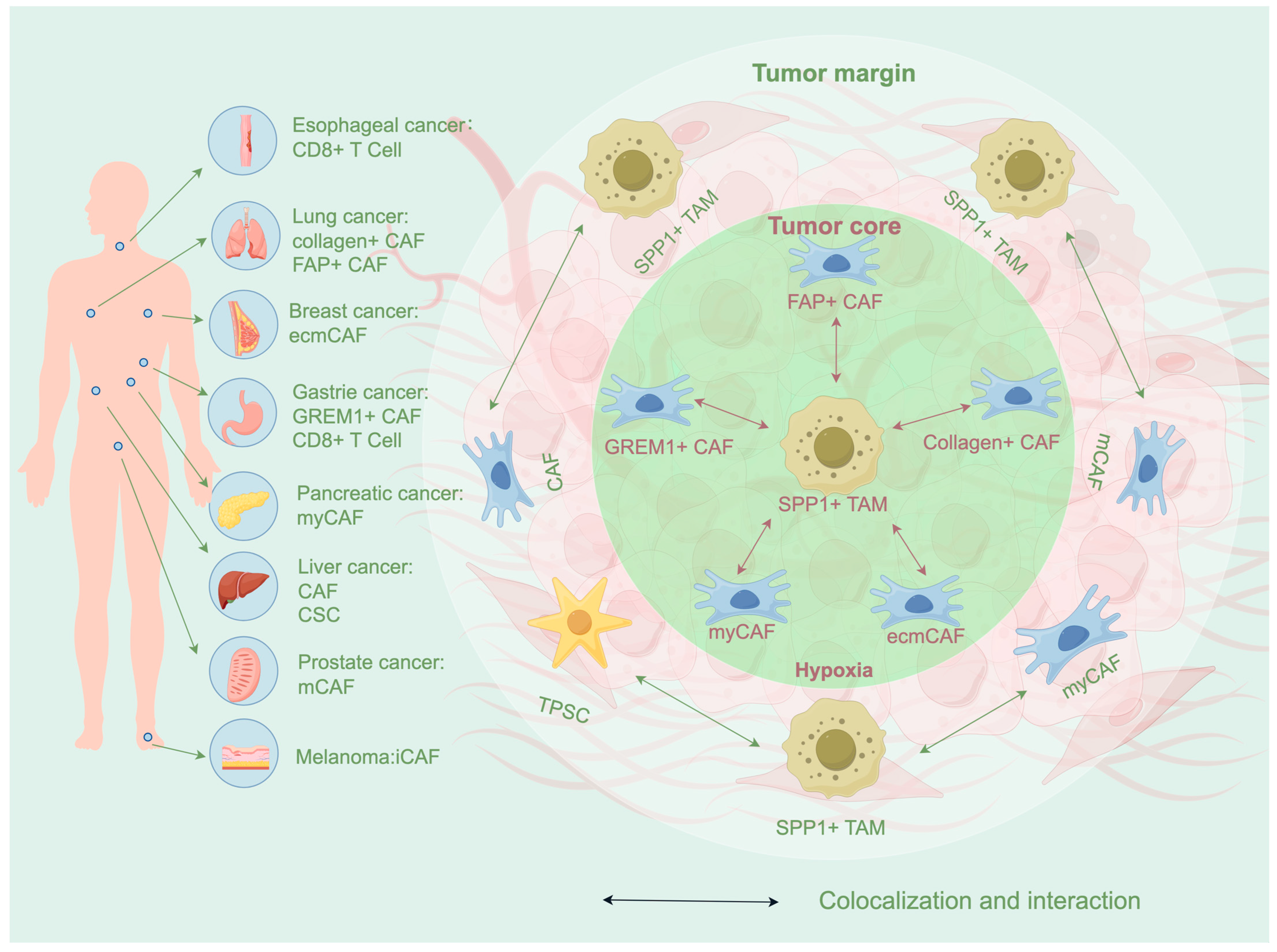
4. Spatial Distribution and Niche Construction of SPP1+ TAMs
4.1. SPP1+ TAMs in the Tumor Core
4.2. SPP1+ TAMs at the Tumor Margin
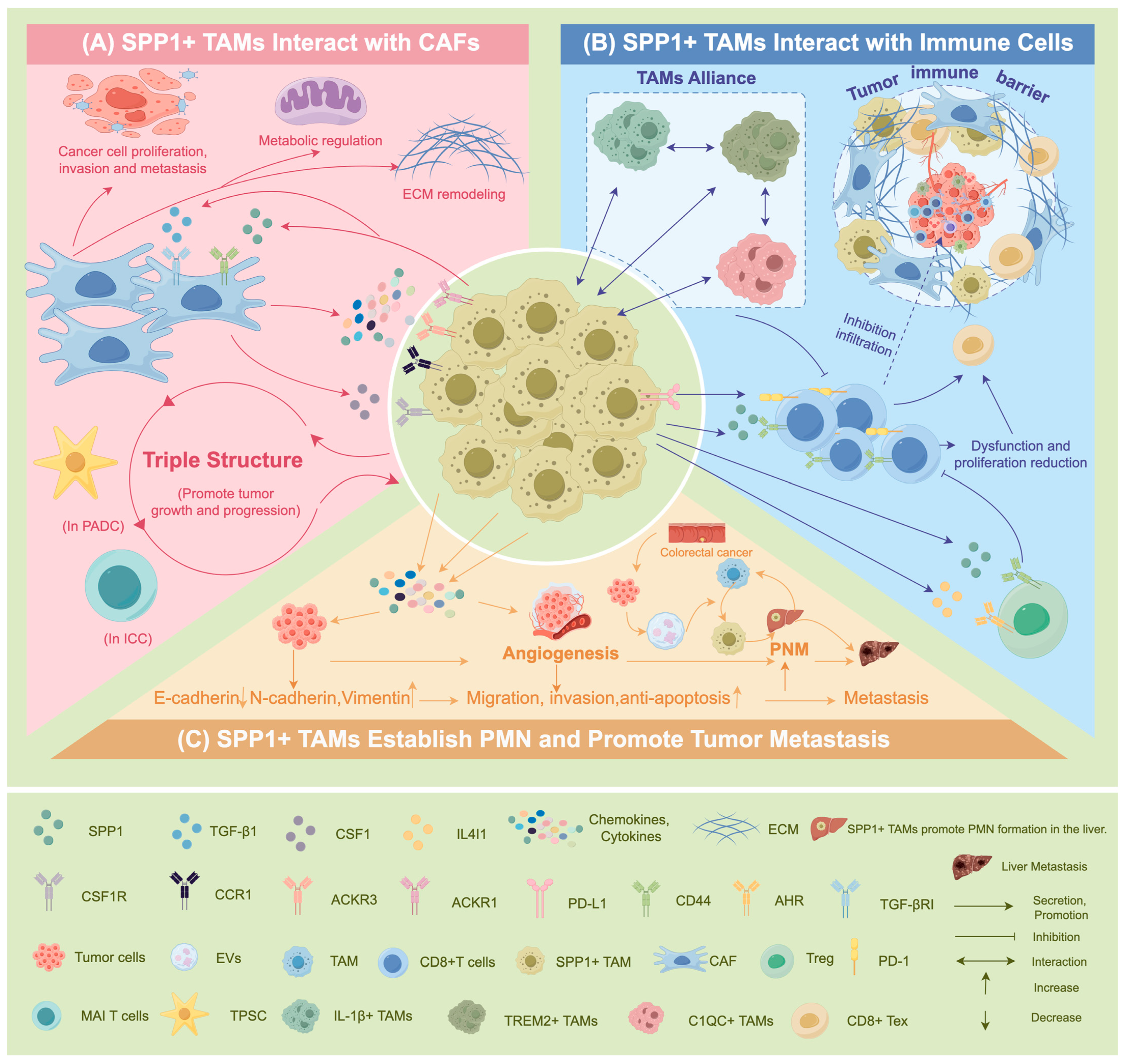
5. Core Functional Modules of SPP1+ TAMs
5.1. SPP1+ TAMs Interact with CAFs: Promoting Matrix Fibrosis and Immunosuppression
5.1.1. Heterogeneity of CAFs: The Interaction Partners of SPP1+ TAMs Are Not Random
5.1.2. Signal Axis: Mediating the Interaction Between SPP1+ TAMs and CAFs
5.1.3. Formation of the “Multi-Linked” Immunosuppressive Alliance
5.2. SPP1+ TAMs Interact with Immune Cells: Regulating the Immune Microenvironment
5.2.1. Inhibiting of T Cell Reaction
5.2.2. Recruitment of Tregs
5.2.3. Collaborative Myeloid Cell Alliances and Metabolic Interference
5.3. SPP1+ TAMs Establish PMN and Promote Tumor Metastasis
5.3.1. EMT and Angiogenesis: Synergistic Mechanisms in Tumor Metastasis
5.3.2. Construction of PMNs: Creating Prerequisites for Tumor Metastasis
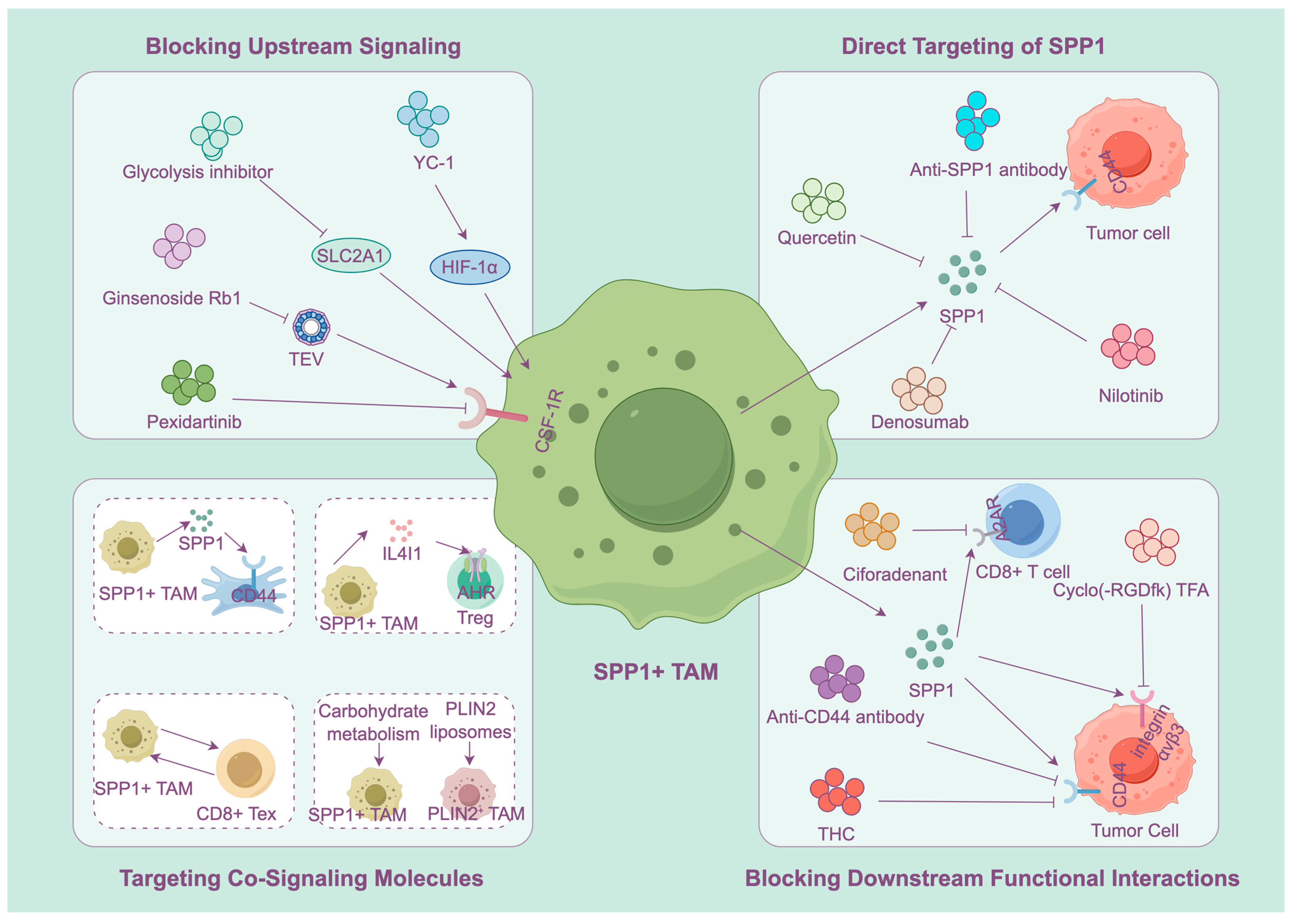
6. Tumor Therapeutic Strategies: Targeting SPP1+ TAMs
6.1. Direct Targeting of SPP1
6.2. Blocking Upstream Signaling: Modulating SPP1 Expression and SPP1+ TAM Polarization
6.3. Blocking Downstream Functional Interactions: Suppressing the Function of SPP1+ TAM
6.4. Targeting Co-Signaling Molecules
7. Conclusions and Future Perspectives
Author Contributions
Funding
Institutional Review Board Statement
Informed Consent Statement
Data Availability Statement
Acknowledgments
Conflicts of Interest
Abbreviations
| A2AR | Adenosine A2A Receptor |
| ADRB1 | Adrenoceptor Beta 1 |
| apCAFs | Antigen-Presenting Cancer-Associated Fibroblasts |
| APC | Antigen-Presenting Cell |
| APOC2 | Apolipoprotein C2 |
| APOE | Apolipoprotein E |
| BLCA | Bladder Cancer |
| CAFs | Cancer-Associated Fibroblasts |
| CAR T | Chimeric Antigen Receptor T-cell |
| CCL18 | C-C Motif Chemokine Ligand 18 |
| CCL2 | C-C Motif Chemokine Ligand 2 |
| CCR1 | C-C Motif Chemokine Receptor 1 |
| CCR2 | C-C Motif Chemokine Receptor 2 |
| CD | Cluster of Differentiation |
| CD163 | Cluster of Differentiation 163 |
| CD206 | Cluster of Differentiation 206 |
| CD44 | Cluster of Differentiation 44 |
| CD68 | Cluster of Differentiation 68 |
| CEBPB | CCAAT/Enhancer Binding Protein Beta |
| Circ-0034880 | Circular RNA 0034880 |
| C1QC | Complement C1q C Chain |
| CRC | Colorectal Cancer |
| CSF1 | Colony-Stimulating Factor 1 |
| CSF1R | Colony-Stimulating Factor 1 Receptor |
| CSCs | Cancer Stem Cells |
| CXCL | C-X-C Motif Chemokine Ligand |
| CXCL10 | C-X-C Motif Chemokine Ligand 10 |
| CXCL12 | C-X-C Motif Chemokine Ligand 12 |
| CXCL8 | C-X-C Motif Chemokine Ligand 8 |
| CXCR | C-X-C Motif Chemokine Receptor |
| DCs | Dendritic Cells |
| ECM | Extracellular Matrix |
| ecmCAFs | Extracellular Matrix-associated Cancer-Associated Fibroblasts |
| EIRS | Epigenetic Immune-Related Scoring |
| EMT | Epithelial–Mesenchymal Transition |
| EVs | Extracellular Vesicles |
| FAP | Fibroblast Activation Protein |
| FABP1 | Fatty Acid Binding Protein 1 |
| FN1 | Fibronectin 1 |
| GBM | Glioblastoma |
| GEO | Gene Expression Omnibus |
| GPNMB | Glycoprotein NMB |
| GREM1 | Gremlin 1 |
| H3K18 | Histone 3 Lysine 18 |
| H3K4me3 | Histone 3 Lysine 4 Trimethylation |
| HCC | Hepatocellular Carcinoma |
| HIF-1α | Hypoxia-Inducible Factor 1-alpha |
| HNSCC | Head and Neck Squamous Cell Carcinoma |
| HPSCC | Hypopharyngeal Squamous Cell Carcinoma |
| IFN-γ | Interferon Gamma |
| IGF2BP2 | Insulin-like Growth Factor 2 mRNA-Binding Protein 2 |
| iCAFs | Proinflammatory Cancer-Associated Fibroblasts |
| IL-12 | Interleukin 12 |
| IL-1β | Interleukin 1 Beta |
| IL-1 | Interleukin 1 |
| IL-4I1 | Interleukin 4 Induced 1 |
| IL-6 | Interleukin 6 |
| INHBA | Inhibin Beta A |
| IRF5 | Interferon Regulatory Factor 5 |
| ITGA5 | Integrin Subunit Alpha 5 |
| ITGAV | Integrin Subunit Alpha V |
| ITGB1 | Integrin Subunit Beta 1 |
| LRRC15 | Leucine Rich Repeat Containing 15 |
| LRP1 | Low-Density Lipoprotein Receptor-Related Protein 1 |
| MAFB | MAF BZIP Transcription Factor B |
| MAIT | Mucosal-Associated Invariant T |
| MDMs | Monocyte-Derived Macrophages |
| MDP | Monocyte and Dendritic Cell Progenitor |
| MDSCs | Myeloid-Derived Suppressor Cells |
| MHC-II | Major Histocompatibility Complex Class II |
| MIF | Macrophage Migration Inhibitory Factor |
| MMP2 | Matrix Metalloproteinase 2 |
| MMP9 | Matrix Metalloproteinase 9 |
| m6A | N6-methyladenosine |
| mTOR | Mechanistic Target of Rapamycin |
| MYBL2 | MYB Proto-Oncogene Like 2 |
| myCAFs | Myofibroblast-like Cancer-Associated Fibroblasts |
| NAMPT | Nicotinamide Phosphoribosyltransferase |
| NF-κB | Nuclear Factor Kappa B |
| NSCLC | Non-Small Cell Lung Cancer |
| PD-1 | Programmed Cell Death Protein 1 |
| PDAC | Pancreatic Ductal Adenocarcinoma |
| PI3K | Phosphatidylinositol-4,5-Bisphosphate 3-Kinase |
| PLAU | Plasminogen Activator, Urokinase |
| PLIN2 | Perilipin 2 |
| PLXDC1 | Plexin Domain Containing 1 |
| PMN | Pre-Metastatic Niche |
| PitNETs | Pituitary Neuroendocrine Tumors |
| POSTN | Periostin |
| PRAME | Preferentially Expressed Antigen in Melanoma |
| PTGER4 | Prostaglandin E Receptor 4 |
| scRNA-seq | Single-Cell RNA Sequencing |
| SPIC | Spi-C Transcription Factor |
| SPP1 | Secreted Phosphoprotein 1 |
| STAT1 | Signal Transducer and Activator of Transcription 1 |
| STAT3 | Signal Transducer and Activator of Transcription 3 |
| TAMs | Tumor-Associated Macrophages |
| TCGA | The Cancer Genome Atlas |
| TEVs | Tumor-Derived Extracellular Vesicles |
| TGF-β1 | Transforming Growth Factor Beta 1 |
| TGF-βR1 | Transforming Growth Factor Beta Receptor 1 |
| THC | Tetrahydrocurcumin |
| TIB | Tumor Immune Barrier |
| TME | Tumor Microenvironment |
| TNBC | Triple-Negative Breast Cancer |
| TPSCs | Tumor-Associated Pancreatic Stellate Cells |
| TREM2 | Triggering Receptor Expressed on Myeloid Cells 2 |
| TP53 | Tumor Protein P53 |
| VEGF | Vascular Endothelial Growth Factor |
| VEGFA | Vascular Endothelial Growth Factor A |
| VSIG4 | V-Set Immunoglobulin Domain Containing 4 |
| WDR5 | WD Repeat Domain 5 |
| ZCCHC12 | Zinc Finger CCHC-Type Containing 12 |
References
- Binnewies, M.; Roberts, E.W.; Kersten, K.; Chan, V.; Fearon, D.F.; Merad, M.; Coussens, L.M.; Gabrilovich, D.I.; Ostrand-Rosenberg, S.; Hedrick, C.C.; et al. Understanding the tumor immune microenvironment (TIME) for effective therapy. Nat. Med. 2018, 24, 541–550. [Google Scholar] [CrossRef]
- Noy, R.; Pollard, J.W. Tumor-associated macrophages: From mechanisms to therapy. Immunity 2014, 41, 49–61. [Google Scholar] [CrossRef]
- Mantovani, A.; Allavena, P. The interaction of anticancer therapies with tumor-associated macrophages. J. Exp. Med. 2015, 212, 435–445. [Google Scholar] [CrossRef]
- Sun, X.; Gao, D.; Gao, L.; Zhang, C.; Yu, X.; Jia, B.; Wang, F.; Liu, Z. Molecular imaging of tumor-infiltrating macrophages in a preclinical mouse model of breast cancer. Theranostics 2015, 5, 597–608. [Google Scholar] [CrossRef]
- Li, M.; Yang, Y.; Xiong, L.; Jiang, P.; Wang, J.; Li, C. Metabolism, metabolites, and macrophages in cancer. J. Hematol. Oncol. 2023, 16, 80. [Google Scholar] [CrossRef]
- Cassetta, L.; Pollard, J.W. Targeting macrophages: Therapeutic approaches in cancer. Nat. Rev. Drug Discov. 2018, 17, 887–904. [Google Scholar] [CrossRef]
- Mantovani, A.; Sica, A.; Sozzani, S.; Allavena, P.; Vecchi, A.; Locati, M. The chemokine system in diverse forms of macrophage activation and polarization. Trends Immunol. 2004, 25, 677–686. [Google Scholar] [CrossRef]
- Christofides, A.; Strauss, L.; Yeo, A.; Cao, C.; Charest, A.; Boussiotis, V.A. The complex role of tumor-infiltrating macrophages. Nat. Immunol. 2022, 23, 1148–1156. [Google Scholar] [CrossRef]
- Filiberti, S.; Russo, M.; Lonardi, S.; Bugatti, M.; Vermi, W.; Tournier, C.; Giurisato, E. Self-Renewal of Macrophages: Tumor-Released Factors and Signaling Pathways. Biomedicines 2022, 10, 2709. [Google Scholar] [CrossRef]
- Zeng, W.; Li, F.; Jin, S.; Ho, P.C.; Liu, P.S.; Xie, X. Functional polarization of tumor-associated macrophages dictated by metabolic reprogramming. J. Exp. Clin. Cancer Res. CR 2023, 42, 245. [Google Scholar] [CrossRef]
- Ma, R.Y.; Black, A.; Qian, B.Z. Macrophage diversity in cancer revisited in the era of single-cell omics. Trends Immunol. 2022, 43, 546–563. [Google Scholar] [CrossRef]
- van Vlerken-Ysla, L.; Tyurina, Y.Y.; Kagan, V.E.; Gabrilovich, D.I. Functional states of myeloid cells in cancer. Cancer Cell 2023, 41, 490–504. [Google Scholar] [CrossRef]
- Xu, L.; Chen, Y.; Liu, L.; Hu, X.; He, C.; Zhou, Y.; Ding, X.; Luo, M.; Yan, J.; Liu, Q.; et al. Tumor-associated macrophage subtypes on cancer immunity along with prognostic analysis and SPP1-mediated interactions between tumor cells and macrophages. PLoS Genet. 2024, 20, e1011235. [Google Scholar] [CrossRef]
- Meng, X.; Zheng, Y.; Zhang, L.; Liu, P.; Liu, Z.; He, Y. Single-Cell Analyses Reveal the Metabolic Heterogeneity and Plasticity of the Tumor Microenvironment during Head and Neck Squamous Cell Carcinoma Progression. Cancer Res. 2024, 84, 2468–2483. [Google Scholar] [CrossRef]
- Bill, R.; Wirapati, P.; Messemaker, M.; Roh, W.; Zitti, B.; Duval, F.; Kiss, M.; Park, J.C.; Saal, T.M.; Hoelzl, J.; et al. CXCL9:SPP1 macrophage polarity identifies a network of cellular programs that control human cancers. Science 2023, 381, 515–524. [Google Scholar] [CrossRef]
- Li, X.; Lian, J.; Lu, H. The role of SPP1+TAMs in cancer: Impact on patient prognosis and future therapeutic targets. Int. J. Cancer 2025, 157, 1763–1771. [Google Scholar] [CrossRef]
- Ren, Y.F.; Ma, Q.; Zeng, X.; Huang, C.X.; Ren, J.L.; Li, F.; Tong, J.J.; He, J.W.; Zhong, Y.; Tan, S.Y.; et al. Single-cell RNA sequencing reveals immune microenvironment niche transitions during the invasive and metastatic processes of ground-glass nodules and part-solid nodules in lung adenocarcinoma. Mol. Cancer 2024, 23, 263. [Google Scholar] [CrossRef]
- Ozato, Y.; Kojima, Y.; Kobayashi, Y.; Hisamatsu, Y.; Toshima, T.; Yonemura, Y.; Masuda, T.; Kagawa, K.; Goto, Y.; Utou, M.; et al. Spatial and single-cell transcriptomics decipher the cellular environment containing HLA-G+ cancer cells and SPP1+ macrophages in colorectal cancer. Cell Rep. 2023, 42, 111929. [Google Scholar] [CrossRef]
- Luo, W.; Zeng, Z.; Jin, Y.; Yang, L.; Fan, T.; Wang, Z.; Pan, Y.; Yang, Y.; Yao, M.; Li, Y.; et al. Distinct immune microenvironment of lung adenocarcinoma in never-smokers from smokers. Cell Rep. Med. 2023, 4, 101078. [Google Scholar] [CrossRef]
- Lan, Y.; Zhang, X.; Liu, S.; Guo, C.; Jin, Y.; Li, H.; Wang, L.; Zhao, J.; Hao, Y.; Li, Z.; et al. Fate mapping of Spp1 expression reveals age-dependent plasticity of disease-associated microglia-like cells after brain injury. Immunity 2024, 57, 349–363.e349. [Google Scholar] [CrossRef]
- Qi, J.; Sun, H.; Zhang, Y.; Wang, Z.; Xun, Z.; Li, Z.; Ding, X.; Bao, R.; Hong, L.; Jia, W.; et al. Single-cell and spatial analysis reveal interaction of FAP+ fibroblasts and SPP1+ macrophages in colorectal cancer. Nat. Commun. 2022, 13, 1742. [Google Scholar] [CrossRef]
- Jung, S.; Ha, J.; Park, J.H.; Yoo, K.H. Decoding SPP1 regulation: Genetic and nongenetic insights into its role in disease progression. Mol. Cells 2025, 48, 100215. [Google Scholar] [CrossRef]
- Kundu, G.; Elangovan, S. Investigating the Role of Osteopontin (OPN) in the Progression of Breast, Prostate, Renal and Skin Cancers. Biomedicines 2025, 13, 173. [Google Scholar] [CrossRef]
- Gao, J.; Li, Z.; Lu, Q.; Zhong, J.; Pan, L.; Feng, C.; Tang, S.; Wang, X.; Tao, Y.; Lin, J.; et al. Single-cell RNA sequencing reveals cell subpopulations in the tumor microenvironment contributing to hepatocellular carcinoma. Front. Cell Dev. Biol. 2023, 11, 1194199. [Google Scholar] [CrossRef]
- Zhang, X.; Guo, L.; Tian, W.; Yang, Y.; Yin, Y.; Qiu, Y.; Wang, W.; Li, Y.; Zhang, G.; Zhao, X.; et al. CD36+ Proinflammatory Macrophages Interact with ZCCHC12+ Tumor Cells in Papillary Thyroid Cancer Promoting Tumor Progression and Recurrence. Cancer Immunol. Res. 2024, 12, 1621–1639. [Google Scholar] [CrossRef]
- Dong, Q.Z.; Zhang, X.F.; Zhao, Y.; Jia, H.L.; Zhou, H.J.; Dai, C.; Sun, H.J.; Qin, Y.; Zhang, W.D.; Ren, N.; et al. Osteopontin promoter polymorphisms at locus -443 significantly affect the metastasis and prognosis of human hepatocellular carcinoma. Hepatology 2013, 57, 1024–1034. [Google Scholar] [CrossRef]
- Rajendran, S.; Hu, Y.; Canella, A.; Peterson, C.; Gross, A.; Cam, M.; Nazzaro, M.; Haffey, A.; Serin-Harmanci, A.; Distefano, R.; et al. Single-cell RNA sequencing reveals immunosuppressive myeloid cell diversity during malignant progression in a murine model of glioma. Cell Rep. 2023, 42, 112197. [Google Scholar] [CrossRef]
- Tang, W.; Lo, C.W.S.; Ma, W.; Chu, A.T.W.; Tong, A.H.Y.; Chung, B.H.Y. Revealing the role of SPP1+ macrophages in glioma prognosis and therapeutic targeting by investigating tumor-associated macrophage landscape in grade 2 and 3 gliomas. Cell Biosci. 2024, 14, 37. [Google Scholar] [CrossRef]
- Matusiak, M.; Hickey, J.W.; van, I.D.G.P.; Lu, G.; Kidziński, L.; Zhu, S.; Colburg, D.R.C.; Luca, B.; Phillips, D.J.; Brubaker, S.W.; et al. Spatially Segregated Macrophage Populations Predict Distinct Outcomes in Colon Cancer. Cancer Discov. 2024, 14, 1418–1439. [Google Scholar] [CrossRef]
- Liu, Y.; Zhang, Q.; Xing, B.; Luo, N.; Gao, R.; Yu, K.; Hu, X.; Bu, Z.; Peng, J.; Ren, X.; et al. Immune phenotypic linkage between colorectal cancer and liver metastasis. Cancer Cell 2022, 40, 424–437.e425. [Google Scholar] [CrossRef]
- De Zuani, M.; Xue, H.; Park, J.S.; Dentro, S.C.; Seferbekova, Z.; Tessier, J.; Curras-Alonso, S.; Hadjipanayis, A.; Athanasiadis, E.I.; Gerstung, M.; et al. Single-cell and spatial transcriptomics analysis of non-small cell lung cancer. Nat. Commun. 2024, 15, 4388. [Google Scholar] [CrossRef]
- Park, M.D.; Reyes-Torres, I.; LeBerichel, J.; Hamon, P.; LaMarche, N.M.; Hegde, S.; Belabed, M.; Troncoso, L.; Grout, J.A.; Magen, A.; et al. TREM2 macrophages drive NK cell paucity and dysfunction in lung cancer. Nat. Immunol. 2023, 24, 792–801. [Google Scholar] [CrossRef]
- Alchahin, A.M.; Mei, S.; Tsea, I.; Hirz, T.; Kfoury, Y.; Dahl, D.; Wu, C.L.; Subtelny, A.O.; Wu, S.; Scadden, D.T.; et al. A transcriptional metastatic signature predicts survival in clear cell renal cell carcinoma. Nat. Commun. 2022, 13, 5747. [Google Scholar] [CrossRef]
- Mulder, K.; Patel, A.A.; Kong, W.T.; Piot, C.; Halitzki, E.; Dunsmore, G.; Khalilnezhad, S.; Irac, S.E.; Dubuisson, A.; Chevrier, M.; et al. Cross-tissue single-cell landscape of human monocytes and macrophages in health and disease. Immunity 2021, 54, 1883–1900.e1885. [Google Scholar] [CrossRef]
- Zhang, Y.; Chen, H.; Mo, H.; Hu, X.; Gao, R.; Zhao, Y.; Liu, B.; Niu, L.; Sun, X.; Yu, X.; et al. Single-cell analyses reveal key immune cell subsets associated with response to PD-L1 blockade in triple-negative breast cancer. Cancer Cell 2021, 39, 1578–1593.e1578. [Google Scholar] [CrossRef]
- Gu, Y.; Zhang, Z.; Huang, H.; Zhu, W.; Liu, H.; Zhang, R.; Weng, N.; Sun, X. The dual role of CXCL9/SPP1 polarized tumor-associated macrophages in modulating anti-tumor immunity in hepatocellular carcinoma. Front. Immunol. 2025, 16, 1528103. [Google Scholar] [CrossRef]
- Ray, A.; Hu, K.H.; Kersten, K.; Courau, T.; Kuhn, N.F.; Zaleta-Linares, I.; Samad, B.; Combes, A.J.; Krummel, M.F. Targeting CD206+ macrophages disrupts the establishment of a key antitumor immune axis. J. Exp. Med. 2025, 222, e20240957. [Google Scholar] [CrossRef]
- Seo, E.S.; Park, S.; Cho, E.Y.; Lee, J.E.; Jung, H.H.; Hyeon, J.; An, S.; Kim, S.W.; Shin, J.; Ahn, J.S.; et al. Spatial and genomic profiling of residual breast cancer after neoadjuvant chemotherapy unveil divergent fates for each breast cancer subtype. Cell Rep. Med. 2025, 6, 102164. [Google Scholar] [CrossRef]
- Zhou, C.; Shan, S.; Wen, L.; Liu, D.; Shan, C.; Jin, X.; Zhou, Z.; Li, H.; Li, J.; Wang, L.; et al. Immunological and pathological characteristics of brain parenchymal and leptomeningeal metastases from non-small cell lung cancer. Cell Discov. 2025, 11, 72. [Google Scholar] [CrossRef]
- Xie, L.; Ning, Z.; Hua, Y.; Wang, P.; Meng, Z. Single-cell transcriptome analysis revealed the immune profile of PD-1 blockade in gallbladder carcinoma liver metastasis. Hepatol. Commun. 2023, 7, e0131. [Google Scholar] [CrossRef]
- Su, X.; Liang, C.; Chen, R.; Duan, S. Deciphering tumor microenvironment: CXCL9 and SPP1 as crucial determinants of tumor-associated macrophage polarity and prognostic indicators. Mol. Cancer 2024, 23, 13. [Google Scholar] [CrossRef]
- Clark, M.L.; Simeonov, K.P.; Mowel, W.K.; Michieletto, M.F.; Joannas, L.; Wright, J.M.; Erickson, I.; Johnson, L.R.; Krishnan, R.; de la Fuente-Núñez, C.; et al. Mitochondrial complex IV remodeling in tumor-associated macrophages amplifies interferon signaling and promotes anti-tumor immunity. Immunity 2025, 58, 1670–1687.e1612. [Google Scholar] [CrossRef]
- Cheng, S.; Li, Z.; Gao, R.; Xing, B.; Gao, Y.; Yang, Y.; Qin, S.; Zhang, L.; Ouyang, H.; Du, P.; et al. A pan-cancer single-cell transcriptional atlas of tumor infiltrating myeloid cells. Cell 2021, 184, 792–809.e723. [Google Scholar] [CrossRef]
- Caronni, N.; La Terza, F.; Vittoria, F.M.; Barbiera, G.; Mezzanzanica, L.; Cuzzola, V.; Barresi, S.; Pellegatta, M.; Canevazzi, P.; Dunsmore, G.; et al. IL-1β(+) macrophages fuel pathogenic inflammation in pancreatic cancer. Nature 2023, 623, 415–422. [Google Scholar] [CrossRef] [PubMed]
- Molgora, M.; Esaulova, E.; Vermi, W.; Hou, J.; Chen, Y.; Luo, J.; Brioschi, S.; Bugatti, M.; Omodei, A.S.; Ricci, B.; et al. TREM2 Modulation Remodels the Tumor Myeloid Landscape Enhancing Anti-PD-1 Immunotherapy. Cell 2020, 182, 886–900.e817. [Google Scholar] [CrossRef]
- Azizi, E.; Carr, A.J.; Plitas, G.; Cornish, A.E.; Konopacki, C.; Prabhakaran, S.; Nainys, J.; Wu, K.; Kiseliovas, V.; Setty, M.; et al. Single-Cell Map of Diverse Immune Phenotypes in the Breast Tumor Microenvironment. Cell 2018, 174, 1293–1308.e1236. [Google Scholar] [CrossRef] [PubMed]
- Dick, S.A.; Wong, A.; Hamidzada, H.; Nejat, S.; Nechanitzky, R.; Vohra, S.; Mueller, B.; Zaman, R.; Kantores, C.; Aronoff, L.; et al. Three tissue resident macrophage subsets coexist across organs with conserved origins and life cycles. Sci. Immunol. 2022, 7, eabf7777. [Google Scholar] [CrossRef] [PubMed]
- Li, E.; Cheung, H.C.Z.; Ma, S. CTHRC1+ fibroblasts and SPP1+ macrophages synergistically contribute to pro-tumorigenic tumor microenvironment in pancreatic ductal adenocarcinoma. Sci. Rep. 2024, 14, 17412. [Google Scholar] [CrossRef]
- Wang, J.; Zhu, N.; Su, X.; Gao, Y.; Yang, R. Novel tumor-associated macrophage populations and subpopulations by single cell RNA sequencing. Front. Immunol. 2023, 14, 1264774. [Google Scholar] [CrossRef]
- Rangaswami, H.; Bulbule, A.; Kundu, G.C. Osteopontin: Role in cell signaling and cancer progression. Trends Cell Biol. 2006, 16, 79–87. [Google Scholar] [CrossRef]
- Du, F.; Ju, J.; Zheng, F.; Gao, S.; Yuan, P. The Identification of Novel Prognostic and Predictive Biomarkers in Breast Cancer via the Elucidation of Tumor Ecotypes Using Ecotyper. Cancer Innov. 2025, 4, e70013. [Google Scholar] [CrossRef]
- Dong, L.; Hu, S.; Li, X.; Pei, S.; Jin, L.; Zhang, L.; Chen, X.; Min, A.; Yin, M. SPP1+ TAM Regulates the Metastatic Colonization of CXCR4+ Metastasis-Associated Tumor Cells by Remodeling the Lymph Node Microenvironment. Adv. Sci. 2024, 11, e2400524. [Google Scholar] [CrossRef]
- Ma, J.; Huang, L.; Gao, Y.B.; Li, M.X.; Chen, L.L.; Yang, L. M2 macrophage facilitated angiogenesis in cutaneous squamous cell carcinoma via circ_TNFRSF21/miR-3619-5p/ROCK axis. Kaohsiung J. Med. Sci. 2022, 38, 761–771. [Google Scholar] [CrossRef]
- Gao, Y.; Qi, Y.; Shen, Y.; Zhang, Y.; Wang, D.; Su, M.; Liu, X.; Wang, A.; Zhang, W.; He, C.; et al. Signatures of tumor-associated macrophages correlate with treatment response in ovarian cancer patients. Aging 2024, 16, 207–225. [Google Scholar] [CrossRef] [PubMed]
- Sami, A.; Raza, A. Reprogramming the tumor microenvironment—Macrophages emerge as key players in breast cancer immunotherapy. Front. Immunol. 2024, 15, 1457491. [Google Scholar] [CrossRef]
- Miyashita, M.; Shimizu, T.; Ashihara, E.; Ukimura, O. Strategies to Improve the Antitumor Effect of γδ T Cell Immunotherapy for Clinical Application. Int. J. Mol. Sci. 2021, 22, 8910. [Google Scholar] [CrossRef]
- Papayannakos, C.J.; Israr, M.; DeVoti, J.A.; Lam, F.; Arazi, A.; Frank, D.K.; Kamdar, D.P.; Pereira, L.M.; Seetharamu, N.; Steinberg, B.M.; et al. Oropharyngeal carcinomas induce circulating monocytes to express a TAM-like pro-tumor expression profile that suppresses T-cell proliferation. Front. Immunol. 2025, 16, 1539780. [Google Scholar] [CrossRef]
- Lyu, A.; Fan, Z.; Clark, M.; Lea, A.; Luong, D.; Setayesh, A.; Starzinski, A.; Wolters, R.; Arias-Badia, M.; Allaire, K.; et al. Evolution of myeloid-mediated immunotherapy resistance in prostate cancer. Nature 2025, 637, 1207–1217. [Google Scholar] [CrossRef] [PubMed]
- Nisenbaum, E.; Wiefels, M.; Telischi, J.; Marasigan, M.; Kanumuri, V.; Pena, S.; Thielhelm, T.; Bracho, O.; Bhatia, R.; Scaglione, T.; et al. Cytokine Profiling of Cyst Fluid and Tumor-Associated Macrophages in Cystic Vestibular Schwannoma. Otol. Neurotol. Off. Publ. Am. Otol. Soc. Am. Neurotol. Soc. Eur. Acad. Otol. Neurotol. 2023, 44, 1073–1081. [Google Scholar] [CrossRef] [PubMed]
- Xu, W.X.; Ye, Y.M.; Chen, J.L.; Guo, X.Y.; Li, C.; Luo, J.; Lu, L.B.; Chen, X. SPP1+ tumor-associated macrophages define a high-risk subgroup and inform personalized therapy in hepatocellular carcinoma. Front. Oncol. 2025, 15, 1606195. [Google Scholar] [CrossRef]
- Li, Y.; Wang, Z.; Lu, F.; Miao, Y.; Feng, Q.; Zhu, W.; Kang, Q.; Chen, Y.; Zhang, Q. Novel T cell exhaustion gene signature to predict prognosis and immunotherapy response in thyroid carcinoma from integrated RNA-sequencing analysis. Sci. Rep. 2024, 14, 8375. [Google Scholar] [CrossRef]
- van Baarle, L.; De Simone, V.; Schneider, L.; Santhosh, S.; Abdurahiman, S.; Biscu, F.; Schneider, R.; Zanoletti, L.; Siqueira de Mello, R.; Verbandt, S.; et al. IL-1R signaling drives enteric glia-macrophage interactions in colorectal cancer. Nat. Commun. 2024, 15, 6079. [Google Scholar] [CrossRef]
- Zhang, X.M.; Chen, D.G.; Li, S.C.; Zhu, B.; Li, Z.J. Embryonic Origin and Subclonal Evolution of Tumor-Associated Macrophages Imply Preventive Care for Cancer. Cells 2021, 10, 903. [Google Scholar] [CrossRef]
- Irie, T.; Matsuda, T.; Hayashi, Y.; Matsuda-Ito, K.; Kamiya, A.; Masuda, T.; Prinz, M.; Isobe, N.; Kira, J.I.; Nakashima, K. Direct neuronal conversion of microglia/macrophages reinstates neurological function after stroke. Proc. Natl. Acad. Sci. USA 2023, 120, e2307972120. [Google Scholar] [CrossRef]
- Tu, W.; Gong, J.; Zhou, Z.; Tian, D.; Wang, Z. TCF4 enhances hepatic metastasis of colorectal cancer by regulating tumor-associated macrophage via CCL2/CCR2 signaling. Cell Death Dis. 2021, 12, 882. [Google Scholar] [CrossRef] [PubMed]
- Gu, Y.; Zhu, W.; Zhang, Z.; Shu, H.; Huang, H.; Sun, X. Integrated Single-Cell Analysis Dissects Regulatory Mechanisms Underlying Tumor-Associated Macrophage Plasticity in Hepatocellular Carcinoma. Genes 2025, 16, 817. [Google Scholar] [CrossRef]
- Zhou, J.; Song, Q.; Li, H.; Han, Y.; Pu, Y.; Li, L.; Rong, W.; Liu, X.; Wang, Z.; Sun, J.; et al. Targeting circ-0034880-enriched tumor extracellular vesicles to impede SPP1highCD206+ pro-tumor macrophages mediated pre-metastatic niche formation in colorectal cancer liver metastasis. Mol. Cancer 2024, 23, 168. [Google Scholar] [CrossRef]
- Saris, J.; Li Yim, A.Y.F.; Bootsma, S.; Lenos, K.J.; Franco Fernandez, R.; Khan, H.N.; Verhoeff, J.; Poel, D.; Mrzlikar, N.M.; Xiong, L.; et al. Peritoneal resident macrophages constitute an immunosuppressive environment in peritoneal metastasized colorectal cancer. Nat. Commun. 2025, 16, 3669. [Google Scholar] [CrossRef] [PubMed]
- Hadjigol, S.; Shah, B.A.; O’Brien-Simpson, N.M. The ‘Danse Macabre’-Neutrophils the Interactive Partner Affecting Oral Cancer Outcomes. Front. Immunol. 2022, 13, 894021. [Google Scholar] [CrossRef] [PubMed]
- Shi, C.; Pamer, E.G. Monocyte recruitment during infection and inflammation. Nat. Rev. Immunol. 2011, 11, 762–774. [Google Scholar] [CrossRef]
- Qian, B.Z.; Li, J.; Zhang, H.; Kitamura, T.; Zhang, J.; Campion, L.R.; Kaiser, E.A.; Snyder, L.A.; Pollard, J.W. CCL2 recruits inflammatory monocytes to facilitate breast-tumour metastasis. Nature 2011, 475, 222–225. [Google Scholar] [CrossRef]
- Khyzha, N.; Khor, M.; DiStefano, P.V.; Wang, L.; Matic, L.; Hedin, U.; Wilson, M.D.; Maegdefessel, L.; Fish, J.E. Regulation of CCL2 expression in human vascular endothelial cells by a neighboring divergently transcribed long noncoding RNA. Proc. Natl. Acad. Sci. USA 2019, 116, 16410–16419. [Google Scholar] [CrossRef]
- Qin, X.; Niu, Z.; Chen, H.; Hu, Y. Macrophage-derived exosomal HMGB3 regulates silica-induced pulmonary inflammation by promoting M1 macrophage polarization and recruitment. Part. Fibre Toxicol. 2024, 21, 12. [Google Scholar] [CrossRef]
- Wei, J.; Chen, Z.; Hu, M.; He, Z.; Jiang, D.; Long, J.; Du, H. Characterizing Intercellular Communication of Pan-Cancer Reveals SPP1+ Tumor-Associated Macrophage Expanded in Hypoxia and Promoting Cancer Malignancy Through Single-Cell RNA-Seq Data. Front. Cell Dev. Biol. 2021, 9, 749210. [Google Scholar] [CrossRef]
- Qu, Y.; Wang, X.; Li, J.; Luo, H.; Liu, H.; Wang, T.; Han, X. TAMs-derived SPP1, regulated by HIF-1α/STAT3 signaling pathway, influences colorectal cancer malignant progression by activation of EMT via integrin αvβ3. Int. Immunopharmacol. 2025, 159, 114947. [Google Scholar] [CrossRef]
- Hong, S.M.; Lee, A.Y.; Kim, B.J.; Lee, J.E.; Seon, S.Y.; Ha, Y.J.; Ng, J.T.; Yoon, G.; Lim, S.B.; Morgan, M.J.; et al. NAMPT-Driven M2 Polarization of Tumor-Associated Macrophages Leads to an Immunosuppressive Microenvironment in Colorectal Cancer. Adv. Sci. 2024, 11, e2303177. [Google Scholar] [CrossRef]
- Pan, Z.; Chen, J.; Xu, T.; Cai, A.; Han, B.; Li, Y.; Fang, Z.; Yu, D.; Wang, S.; Zhou, J.; et al. VSIG4+ tumor-associated macrophages mediate neutrophil infiltration and impair antigen-specific immunity in aggressive cancers through epigenetic regulation of SPP1. J. Exp. Clin. Cancer Res. CR 2025, 44, 45. [Google Scholar] [CrossRef]
- He, H.; Chen, S.; Fan, Z.; Dong, Y.; Wang, Y.; Li, S.; Sun, X.; Song, Y.; Yang, J.; Cao, Q.; et al. Multi-dimensional single-cell characterization revealed suppressive immune microenvironment in AFP-positive hepatocellular carcinoma. Cell Discov. 2023, 9, 60. [Google Scholar] [CrossRef]
- Caronni, N.; La Terza, F.; Frosio, L.; Ostuni, R. IL-1β+ macrophages and the control of pathogenic inflammation in cancer. Trends Immunol. 2025, 46, 403–415. [Google Scholar] [CrossRef]
- Matusiak, M.; Hickey, J.W.; Luca, B.; Lu, G.; Kidziński, L.; Zhu, S.; Colburg, D.R.C.; Phillips, D.J.; Brubaker, S.W.; Charville, G.W.; et al. A spatial map of human macrophage niches reveals context-dependent macrophage functions in colon and breast cancer. Res. Sq. 2023. preprint. [Google Scholar]
- Cai, Z.; Chen, L.; Chen, S.; Fang, R.; Chen, X.; Lei, W. Single-cell RNA sequencing reveals pro-invasive cancer-associated fibroblasts in hypopharyngeal squamous cell carcinoma. Cell Commun. Signal. CCS 2023, 21, 292. [Google Scholar] [CrossRef] [PubMed]
- Ge, J.; Xiao, X.; Zhou, H.; Tang, M.; Bai, J.; Zou, X.; Zhang, C.; Huang, C.; Feng, X.; Liu, T.; et al. Single-cell profiling reveals tumour cell heterogeneity accompanying a pre-malignant and immunosuppressive microenvironment in gastric adenocarcinoma. Clin. Transl. Med. 2023, 13, e1490. [Google Scholar] [CrossRef]
- Chen, K.; Li, Y.; Ni, J.; Yang, X.; Zhou, Y.; Pang, Y.; Ye, R.; Chen, H.; Yu, S.; Wang, P.; et al. Identification of a novel subtype of SPP1 + macrophages expressing SIRPα: Implications for tumor immune evasion and treatment response prediction. Exp. Hematol. Oncol. 2024, 13, 119. [Google Scholar] [CrossRef] [PubMed]
- Ouyang, J.F.; Mishra, K.; Xie, Y.; Park, H.; Huang, K.Y.; Petretto, E.; Behmoaras, J. Systems level identification of a matrisome-associated macrophage polarisation state in multi-organ fibrosis. eLife 2023, 12, e85530. [Google Scholar] [CrossRef]
- Gao, Z.J.; Fang, H.; Sun, S.; Liu, S.Q.; Fang, Z.; Liu, Z.; Li, B.; Wang, P.; Sun, S.R.; Meng, X.Y.; et al. Single-cell analyses reveal evolution mimicry during the specification of breast cancer subtype. Theranostics 2024, 14, 3104–3126. [Google Scholar] [CrossRef]
- Li, X.; Zhang, Q.; Chen, G.; Luo, D. Multi-Omics Analysis Showed the Clinical Value of Gene Signatures of C1QC+ and SPP1+ TAMs in Cervical Cancer. Front. Immunol. 2021, 12, 694801. [Google Scholar] [CrossRef] [PubMed]
- Reis-Sobreiro, M.; Teixeira da Mota, A.; Jardim, C.; Serre, K. Bringing Macrophages to the Frontline against Cancer: Current Immunotherapies Targeting Macrophages. Cells 2021, 10, 2364. [Google Scholar] [CrossRef]
- Zhang, L.; Li, Z.; Skrzypczynska, K.M.; Fang, Q.; Zhang, W.; O’Brien, S.A.; He, Y.; Wang, L.; Zhang, Q.; Kim, A.; et al. Single-Cell Analyses Inform Mechanisms of Myeloid-Targeted Therapies in Colon Cancer. Cell 2020, 181, 442–459.e429. [Google Scholar] [CrossRef]
- Wang, W.; Li, T.; Cheng, Y.; Li, F.; Qi, S.; Mao, M.; Wu, J.; Liu, Q.; Zhang, X.; Li, X.; et al. Identification of hypoxic macrophages in glioblastoma with therapeutic potential for vasculature normalization. Cancer Cell 2024, 42, 815–832.e812. [Google Scholar] [CrossRef]
- Huang, Y.; Lei, X.; Sun, L.; Liu, Y.; Yang, J. Leveraging various extracellular matrix levels to assess prognosis and sensitivity to immunotherapy in patients with ovarian cancer. Front. Oncol. 2023, 13, 1163695. [Google Scholar] [CrossRef]
- Huang, L.; Wang, X.; Pei, S.; Li, X.; Dong, L.; Bian, X.; Sun, H.; Jin, L.; Hou, H.; Shi, W.; et al. Single-Cell Profiling Reveals Sustained Immune Infiltration, Surveillance, and Tumor Heterogeneity in Infiltrative Basal Cell Carcinoma. J. Investig. Dermatol. 2023, 143, 2283–2294.e2217. [Google Scholar] [CrossRef]
- Liu, L.; Zhang, R.; Deng, J.; Dai, X.; Zhu, X.; Fu, Q.; Zhang, H.; Tong, Z.; Zhao, P.; Fang, W.; et al. Construction of TME and Identification of crosstalk between malignant cells and macrophages by SPP1 in hepatocellular carcinoma. Cancer Immunol. Immunother. CII 2022, 71, 121–136. [Google Scholar] [CrossRef]
- Prutsch, N.; He, S.; Berezovskaya, A.; Durbin, A.D.; Dharia, N.V.; Maher, K.A.; Matthews, J.D.; Hare, L.; Turner, S.D.; Stegmaier, K.; et al. STAT3 couples activated tyrosine kinase signaling to the oncogenic core transcriptional regulatory circuitry of anaplastic large cell lymphoma. Cell Rep. Med. 2024, 5, 101472. [Google Scholar] [CrossRef]
- Jiang, Y.; Jiang, Y.Y.; Lin, D.C. Super-enhancer-mediated core regulatory circuitry in human cancer. Comput. Struct. Biotechnol. J. 2021, 19, 2790–2795. [Google Scholar] [CrossRef]
- Wilflingseder, J.; Willi, M.; Lee, H.K.; Olauson, H.; Jankowski, J.; Ichimura, T.; Erben, R.; Valerius, M.T.; Hennighausen, L.; Bonventre, J.V. Enhancer and super-enhancer dynamics in repair after ischemic acute kidney injury. Nat. Commun. 2020, 11, 3383. [Google Scholar] [CrossRef]
- Yan, B.; Wang, D.; Ettwiller, L. Simultaneous assessment of human genome and methylome data in a single experiment using limited deamination of methylated cytosine. Genome Res. 2024, 34, 904–913. [Google Scholar] [CrossRef]
- Liu, Y.; Ye, G.; Dong, B.; Huang, L.; Zhang, C.; Sheng, Y.; Wu, B.; Han, L.; Wu, C.; Qi, Y. A pan-cancer analysis of the oncogenic role of secreted phosphoprotein 1 (SPP1) in human cancers. Ann. Transl. Med. 2022, 10, 279. [Google Scholar] [CrossRef] [PubMed]
- Wang, C.; Chen, B.; Liang, S.; Shao, J.; Li, J.; Yang, L.; Ren, P.; Wang, Z.; Luo, W.; Zhang, L.; et al. China Protocol for early screening, precise diagnosis, and individualized treatment of lung cancer. Signal Transduct. Target. Ther. 2025, 10, 175. [Google Scholar] [CrossRef]
- Kourtidou, C.; Tziomalos, K. The Role of Histone Modifications in the Pathogenesis of Diabetic Kidney Disease. Int. J. Mol. Sci. 2023, 24, 6007. [Google Scholar] [CrossRef]
- Lu, C.; Liu, Z.; Klement, J.D.; Yang, D.; Merting, A.D.; Poschel, D.; Albers, T.; Waller, J.L.; Shi, H.; Liu, K. WDR5-H3K4me3 epigenetic axis regulates OPN expression to compensate PD-L1 function to promote pancreatic cancer immune escape. J. Immunother. Cancer 2021, 9, e002624. [Google Scholar] [CrossRef]
- Zhou, W.; Jia, Y.; Liu, Y.; Chen, Y.; Zhao, P. Tumor Microenvironment-Based Stimuli-Responsive Nanoparticles for Controlled Release of Drugs in Cancer Therapy. Pharmaceutics 2022, 14, 2346. [Google Scholar] [CrossRef]
- Xie, Z.; Zheng, G.; Niu, L.; Du, K.; Li, R.; Dan, H.; Duan, L.; Wu, H.; Ren, G.; Dou, X.; et al. SPP1+ macrophages in colorectal cancer: Markers of malignancy and promising therapeutic targets. Genes Dis. 2025, 12, 101340. [Google Scholar] [CrossRef]
- Su, Z.; He, Y.; You, L.; Chen, J.; Zhang, G.; Liu, Z. SPP1+ macrophages and FAP+ fibroblasts promote the progression of pMMR gastric cancer. Sci. Rep. 2024, 14, 26221. [Google Scholar] [CrossRef]
- Fan, G.; Xie, T.; Li, L.; Tang, L.; Han, X.; Shi, Y. Single-cell and spatial analyses revealed the co-location of cancer stem cells and SPP1+ macrophage in hypoxic region that determines the poor prognosis in hepatocellular carcinoma. NPJ Precis. Oncol. 2024, 8, 75. [Google Scholar] [CrossRef] [PubMed]
- Wang, Z.; Wang, J.; Wang, S.; Xu, W.; Zhang, Y. Case Report: FAP+ fibroblasts and SPP1+ macrophages in SMARCA2-deficient while SMARCA4-preserved poorly differentiated lung adenocarcinoma: Two case reports and multi-omics analysis. Front. Immunol. 2025, 16, 1568556. [Google Scholar] [CrossRef]
- Lu, X.; Gou, Z.; Chen, H.; Li, L.; Chen, F.; Bao, C.; Bu, H.; Zhang, Z. Extracellular matrix cancer-associated fibroblasts promote stromal fibrosis and immune exclusion in triple-negative breast cancer. J. Pathol. 2025, 265, 385–399. [Google Scholar] [CrossRef]
- Zhao, W.; Kepecs, B.; Mahadevan, N.R.; Segerstolpe, A.; Weirather, J.L.; Besson, N.R.; Giotti, B.; Soong, B.Y.; Li, C.; Vigneau, S.; et al. A cellular and spatial atlas of TP53 -associated tissue remodeling in lung adenocarcinoma. bioRxiv 2024. preprint. [Google Scholar]
- Qiu, L.; Zhao, X.; Yao, S.; Fei, Y.; Gong, Y.; Zhou, Z.; Jiao, S.; Xu, J. Multi-omics analyses reveal interactions between GREM1+ fibroblasts and SPP1+ macrophages in gastric cancer. NPJ Precis. Oncol. 2025, 9, 164. [Google Scholar] [CrossRef]
- Zhao, F.; Zeng, J.; Chen, C.; Zhao, X.; Zhang, T.; Thomas, G.V.; Sears, R.C.; Alumkal, J.J.; Moran, A.E.; Mills, G.B.; et al. Deciphering single-cell heterogeneity and cellular ecosystem dynamics during prostate cancer progression. bioRxiv 2024. preprint. [Google Scholar] [CrossRef]
- Du, Y.; Zhao, Y.; Li, J.; Wang, J.; You, S.; Zhang, Y.; Zhang, L.; Yang, J.; Alinejad-Rokny, H.; Cheng, S.; et al. PLXDC1+ Tumor-Associated Pancreatic Stellate Cells Promote Desmoplastic and Immunosuppressive Niche in Pancreatic Ductal Adenocarcinoma. Adv. Sci. 2025, 12, e2415756. [Google Scholar] [CrossRef]
- Liu, Y.; Xun, Z.; Ma, K.; Liang, S.; Li, X.; Zhou, S.; Sun, L.; Liu, Y.; Du, Y.; Guo, X.; et al. Identification of a tumour immune barrier in the HCC microenvironment that determines the efficacy of immunotherapy. J. Hepatol. 2023, 78, 770–782. [Google Scholar] [CrossRef]
- Zhang, H.; Gan, L.; Duan, X.; Tuo, B.; Zhang, H.; Liu, S.; Lian, Y.; Liu, E.; Sun, Z. Single-cell transcriptomics reveals hypoxia-driven iCAF_PLAU is associated with stemness and immunosuppression in anorectal malignant melanoma. J. Gastroenterol. 2025, 60, 1242–1258. [Google Scholar] [CrossRef]
- Trehan, R.; Zhu, X.B.; Huang, P.; Wang, X.; Soliman, M.; Strepay, D.; Nur, A.; Kedei, N.; Arhin, M.; Ghabra, S.; et al. A Paradoxical Tumor Antigen Specific Response in the Liver. bioRxiv 2024. preprint. [Google Scholar] [CrossRef]
- Ma, G.; Liu, X.; Jiang, Q.; Li, S.; Wu, Q.; Liang, B.; Sun, F.; Gu, C.; Liao, W.; Zhang, Z.; et al. Identification of a stromal immunosuppressive barrier orchestrated by SPP1+/C1QC+ macrophages and CD8+ exhausted T cells driving gastric cancer immunotherapy resistance. Front. Immunol. 2025, 16, 1618591. [Google Scholar] [CrossRef]
- Sharma, U.; Medina-Saenz, K.; Miller, P.C.; Troness, B.; Spartz, A.; Sandoval-Leon, A.; Parke, D.N.; Seagroves, T.N.; Lippman, M.E.; El-Ashry, D. Heterotypic clustering of circulating tumor cells and circulating cancer-associated fibroblasts facilitates breast cancer metastasis. Breast Cancer Res. Treat. 2021, 189, 63–80. [Google Scholar] [CrossRef]
- Vokurka, M.; Lacina, L.; Brábek, J.; Kolář, M.; Ng, Y.Z.; Smetana, K., Jr. Cancer-Associated Fibroblasts Influence the Biological Properties of Malignant Tumours via Paracrine Secretion and Exosome Production. Int. J. Mol. Sci. 2022, 23, 964. [Google Scholar] [CrossRef]
- Yamamoto, Y.; Kasashima, H.; Fukui, Y.; Tsujio, G.; Yashiro, M.; Maeda, K. The heterogeneity of cancer-associated fibroblast subpopulations: Their origins, biomarkers, and roles in the tumor microenvironment. Cancer Sci. 2023, 114, 16–24. [Google Scholar] [CrossRef]
- Kieffer, Y.; Hocine, H.R.; Gentric, G.; Pelon, F.; Bernard, C.; Bourachot, B.; Lameiras, S.; Albergante, L.; Bonneau, C.; Guyard, A.; et al. Single-Cell Analysis Reveals Fibroblast Clusters Linked to Immunotherapy Resistance in Cancer. Cancer Discov. 2020, 10, 1330–1351. [Google Scholar] [CrossRef]
- Li, B.; Pei, G.; Yao, J.; Ding, Q.; Jia, P.; Zhao, Z. Cell-type deconvolution analysis identifies cancer-associated myofibroblast component as a poor prognostic factor in multiple cancer types. Oncogene 2021, 40, 4686–4694. [Google Scholar] [CrossRef]
- Chen, X.; Zhou, Z.; Yazgan, Z.; Xie, L.; Rossi, F.; Liu, Y.; Zhang, B.; Polanco, P.M.; Zeh, H.J.; Kim, A.C.; et al. Single-cell resolution spatial analysis of antigen-presenting cancer-associated fibroblast niches. bioRxiv 2024. preprint. [Google Scholar] [CrossRef]
- Xu, K.; Wang, H.; Zou, Y.X.; Zhang, H.H.; Wang, Y.N.; Ren, X.R.; Wang, H.Q.; Xu, Y.H.; Li, J.J.; Tang, H.; et al. Distinct fibroblast subpopulations associated with bone, brain or intrapulmonary metastasis in advanced non-small-cell lung cancer. Clin. Transl. Med. 2024, 14, e1605. [Google Scholar] [CrossRef]
- Liu, X.; Qin, J.; Nie, J.; Gao, R.; Hu, S.; Sun, H.; Wang, S.; Pan, Y. ANGPTL2+cancer-associated fibroblasts and SPP1+macrophages are metastasis accelerators of colorectal cancer. Front. Immunol. 2023, 14, 1185208. [Google Scholar] [CrossRef]
- Wang, H.; Liang, Y.; Liu, Z.; Zhang, R.; Chao, J.; Wang, M.; Liu, M.; Qiao, L.; Xuan, Z.; Zhao, H.; et al. POSTN+ cancer-associated fibroblasts determine the efficacy of immunotherapy in hepatocellular carcinoma. J. Immunother. Cancer 2024, 12, e008721. [Google Scholar] [CrossRef]
- Chen, C.; Guo, Q.; Liu, Y.; Hou, Q.; Liao, M.; Guo, Y.; Zang, Y.; Wang, F.; Liu, H.; Luan, X.; et al. Single-cell and spatial transcriptomics reveal POSTN+ cancer-associated fibroblasts correlated with immune suppression and tumour progression in non-small cell lung cancer. Clin. Transl. Med. 2023, 13, e1515. [Google Scholar] [CrossRef]
- Xiao, M.; Deng, Y.; Guo, H.; Ren, Z.; He, Y.; Ren, X.; Huang, L.B.; Zhang, W.H.; Chen, H.N.; Shu, Y.; et al. Single-cell and spatial transcriptomics profile the interaction of SPP1+ macrophages and FAP+ fibroblasts in non-small cell lung cancer. Transl. Lung Cancer Res. 2025, 14, 2646–2669. [Google Scholar] [CrossRef]
- Chen, Z.; Chen, M.; Yang, C.; Wang, J.; Gao, Y.; Feng, Y.; Yuan, D.; Chen, P. Integration of Multi-Scale Profiling and Machine Learning Reveals the Prognostic Role of Extracellular Matrix-Related Cancer-Associated Fibroblasts in Lung Adenocarcinoma. Int. J. Med. Sci. 2025, 22, 2956–2972. [Google Scholar] [CrossRef]
- Li, Y.; Zheng, Y.; Huang, J.; Nie, R.C.; Wu, Q.N.; Zuo, Z.; Yuan, S.; Yu, K.; Liang, C.C.; Pan, Y.Q.; et al. CAF-macrophage crosstalk in tumour microenvironments governs the response to immune checkpoint blockade in gastric cancer peritoneal metastases. Gut 2025, 74, 350–363. [Google Scholar] [CrossRef]
- Wu, J.; Dai, T.; Li, Z.; Pan, M.; Zhang, W.; Chen, H.; Zheng, G.; Qiao, L.; Lian, Q.; Liu, Y.; et al. Integrating multi-modal transcriptomics identifies cellular subtypes with distinct roles in PDAC progression. Cell. Oncol. 2025, 48, 1571–1592. [Google Scholar] [CrossRef]
- Chen, Z.; Hu, J.; Ou, Y.; Ye, F.; Li, W.; Liu, S.; Jiang, H. Integrating single-cell transcriptomics to reveal the ferroptosis regulators in the tumor microenvironment that contribute to bladder urothelial carcinoma progression and immunotherapy. Front. Immunol. 2024, 15, 1427124. [Google Scholar] [CrossRef]
- Wu, T.; Li, X.; Zheng, F.; Liu, H.; Yu, Y. Intercellular communication between FAP+ fibroblasts and SPP1+ macrophages in prostate cancer via multi-omics. Front. Immunol. 2025, 16, 1560998. [Google Scholar] [CrossRef]
- Liu, Z.L.; Meng, X.Y.; Bao, R.J.; Shen, M.Y.; Sun, J.J.; Chen, W.D.; Liu, F.; He, Y. Single cell deciphering of progression trajectories of the tumor ecosystem in head and neck cancer. Nat. Commun. 2024, 15, 2595. [Google Scholar] [CrossRef]
- Zuyin, L.; Zhao, L.; Qian, C.; Changkun, Z.; Delin, M.; Jialing, H.; Zhuomiaoyu, C.; Yuzi, L.; Jiaxi, Z.; Jie, G.; et al. Single-Cell and Spatial Transcriptomics Delineate the Microstructure and Immune Landscape of Intrahepatic Cholangiocarcinoma in the Leading-Edge Area. Adv. Sci. 2025, 12, e2412740. [Google Scholar] [CrossRef]
- Chen, T.; Guo, J.; Ai, L.; Wang, Y.; Wang, Y.; Chen, B.; Liu, M.; Zhuang, S.; Liu, K.; Zhao, Z.; et al. Up-regulated SPP1 increases the risk from IPF to lung cancer via activating the pro-tumor macrophages. Comput. Struct. Biotechnol. J. 2023, 21, 5751–5764. [Google Scholar] [CrossRef] [PubMed] [PubMed Central]
- Palma, A. The Landscape of SPP1+ Macrophages Across Tissues and Diseases: A Comprehensive Review. Immunology 2025, 176, 179–196. [Google Scholar] [CrossRef]
- Wang, X.; Ramos, R.; Phan, A.Q.; Yamaga, K.; Flesher, J.L.; Jiang, S.; Oh, J.W.; Jin, S.; Jahid, S.; Kuan, C.H.; et al. Signalling by senescent melanocytes hyperactivates hair growth. Nature 2023, 618, 808–817. [Google Scholar] [CrossRef] [PubMed]
- Pervaiz, N.; Kathuria, I.; Aithabathula, R.V.; Singla, B. Matricellular proteins in atherosclerosis development. Matrix Biol. J. Int. Soc. Matrix Biol. 2023, 120, 1–23. [Google Scholar] [CrossRef]
- Tong, W.; Wang, T.; Bai, Y.; Yang, X.; Han, P.; Zhu, L.; Zhang, Y.; Shen, Z. Spatial transcriptomics reveals tumor-derived SPP1 induces fibroblast chemotaxis and activation in the hepatocellular carcinoma microenvironment. J. Transl. Med. 2024, 22, 840. [Google Scholar] [CrossRef]
- Tan, Y.; Yang, Y.G.; Zhang, X.; Zhao, L.; Wang, X.; Liu, W. Tumor cell-derived osteopontin promotes tumor fibrosis indirectly via tumor-associated macrophages. J. Transl. Med. 2025, 23, 432. [Google Scholar] [CrossRef]
- Yin, M.; Zhang, Y.; Wang, W.; Zhao, S.; Su, J.; Li, S.; Chen, X. Identification of two molecularly and prognostically distinct subtypes in acral melanoma using network prediction method. J. Eur. Acad. Dermatol. Venereol. JEADV 2025, 39, 1254–1266. [Google Scholar] [CrossRef]
- Chen, X.; Wu, C.; Tang, F.; Zhou, J.; Mo, L.; Li, Y.; He, J. The Immune Microenvironment: New Therapeutic Implications in Organ Fibrosis. Adv. Sci. 2025, 12, e05067. [Google Scholar] [CrossRef] [PubMed]
- Huang, D.; Ma, N.; Li, X.; Gou, Y.; Duan, Y.; Liu, B.; Xia, J.; Zhao, X.; Wang, X.; Li, Q.; et al. Advances in single-cell RNA sequencing and its applications in cancer research. J. Hematol. Oncol. 2023, 16, 98. [Google Scholar] [CrossRef]
- Sathe, A.; Mason, K.; Grimes, S.M.; Zhou, Z.; Lau, B.T.; Bai, X.; Su, A.; Tan, X.; Lee, H.; Suarez, C.J.; et al. Colorectal Cancer Metastases in the Liver Establish Immunosuppressive Spatial Networking between Tumor-Associated SPP1+ Macrophages and Fibroblasts. Clin. Cancer Res. Off. J. Am. Assoc. Cancer Res. 2023, 29, 244–260. [Google Scholar] [CrossRef]
- Wang, L.; Ma, L.; Song, Z.; Zhou, L.; Chen, K.; Wang, X.; Liu, Z.; Wang, B.; Shen, C.; Guo, X.; et al. Single-cell transcriptome analysis profiling lymphatic invasion-related TME in colorectal cancer. Sci. Rep. 2024, 14, 8911. [Google Scholar] [CrossRef]
- Wang, H.; Qiu, B.; Li, X.; Ying, Y.; Wang, Y.; Chen, H.; Zeng, F.; Shi, J.; Huang, J.; Wu, Z.; et al. Single cell analysis reveals that SPP1(+) macrophages enhance tumor progression by triggering fibroblast extracellular vesicles. Transl. Oncol. 2025, 55, 102347. [Google Scholar] [CrossRef]
- Rimal, R.; Desai, P.; Daware, R.; Hosseinnejad, A.; Prakash, J.; Lammers, T.; Singh, S. Cancer-associated fibroblasts: Origin, function, imaging, and therapeutic targeting. Adv. Drug Deliv. Rev. 2022, 189, 114504. [Google Scholar] [CrossRef]
- Jin, H.; Kim, W.; Yuan, M.; Li, X.; Yang, H.; Li, M.; Shi, M.; Turkez, H.; Uhlen, M.; Zhang, C.; et al. Identification of SPP1+ macrophages as an immune suppressor in hepatocellular carcinoma using single-cell and bulk transcriptomics. Front. Immunol. 2024, 15, 1446453. [Google Scholar] [CrossRef] [PubMed]
- Trehan, R.; Huang, P.; Zhu, X.B.; Wang, X.; Soliman, M.; Strepay, D.; Nur, A.; Kedei, N.; Arhin, M.; Ghabra, S.; et al. SPP1+ macrophages cause exhaustion of tumor-specific T cells in liver metastases. Nat. Commun. 2025, 16, 4242. [Google Scholar] [CrossRef] [PubMed]
- Cha, S.M.; Park, J.W.; Lee, Y.J.; Lee, H.J.; Lee, H.; Lee, I.W.; Gong, G.; Park, S.H.; Lee, H.J.; Jeong, B.K. SPP1+ macrophages in HR+ breast cancer are associated with tumor-infiltrating lymphocytes. NPJ Breast Cancer 2024, 10, 83. [Google Scholar] [CrossRef]
- Hou, L.; Jiang, M.; Li, Y.; Cheng, J.; Liu, F.; Han, X.; Guo, J.; Feng, L.; Li, Z.; Yi, J.; et al. Targeting SPP1+ macrophages via the SPP1-CD44 axis reveals a key mechanism of immune suppression and tumor progression in ovarian cancer. Int. Immunopharmacol. 2025, 160, 114906. [Google Scholar] [CrossRef]
- Li, Q.; Xu, S.; Ren, Y.; Zhang, C.; Li, K.; Liu, Y. Single-cell RNA sequencing reveals adrb1 as a sympathetic nerve-regulated immune checkpoint driving T cell exhaustion and impacting immunotherapy in esophageal squamous cell carcinoma. Front. Immunol. 2025, 16, 1520766. [Google Scholar] [CrossRef]
- Liu, S.; Feng, C.; Tan, L.; Zhang, D.; Li, Y.X.; Han, Y.; Wang, C. Single-cell dissection of multifocal bladder cancer reveals malignant and immune cells variation between primary and recurrent tumor lesions. Commun. Biol. 2024, 7, 1659. [Google Scholar] [CrossRef]
- Gan, Q.; Li, Y.; Li, Y.; Liu, H.; Chen, D.; Liu, L.; Peng, C. Pathways and molecules for overcoming immunotolerance in metastatic gastrointestinal tumors. Front. Immunol. 2024, 15, 1359914. [Google Scholar] [CrossRef]
- Wang, Z.T.; Guan, R.Y.; Gan, W.; Yang, Z.F.; Sun, B.Y.; Wu, J.F.; Zhang, D.; Sun, G.Q.; Gao, X.K.; Huang, J.L.; et al. Effective Antiviral Therapy Improves Immunosuppressive Activities in the Immune Microenvironment of Hepatocellular Carcinoma by Alleviating Inflammation and Fibrosis. Cancer Med. 2024, 13, e70459. [Google Scholar] [CrossRef]
- Hao, B.; Zhang, Z.; Lu, Z.; Xiong, J.; Fan, T.; Song, C.; He, R.; Zhang, L.; Pan, S.; Li, D.; et al. Single-cell RNA sequencing analysis revealed cellular and molecular immune profiles in lung squamous cell carcinoma. Transl. Oncol. 2023, 27, 101568. [Google Scholar] [CrossRef]
- Yang, Z.; Tian, H.; Chen, X.; Li, B.; Bai, G.; Cai, Q.; Xu, J.; Guo, W.; Wang, S.; Peng, Y.; et al. Single-cell sequencing reveals immune features of treatment response to neoadjuvant immunochemotherapy in esophageal squamous cell carcinoma. Nat. Commun. 2024, 15, 9097. [Google Scholar] [CrossRef]
- Zhao, S.; Zhang, Y.; Meng, X.; Wang, Y.; Li, Y.; Li, H.; Zhao, X.; Yang, P.; Liu, S.; Yang, C. INHBA+ macrophages and Pro-inflammatory CAFs are associated with distinctive immunosuppressive tumor microenvironment in submucous Fibrosis-Derived oral squamous cell carcinoma. BMC Cancer 2025, 25, 857. [Google Scholar] [CrossRef]
- Park, Y.J.; Oh, J.W.; Chung, H.; Kwon, J.W.; Na, Y.R.; Kim, K.P.; Seok, S.H. Peripheral blood proteome biomarkers distinguish immunosuppressive features of cancer progression. Mol. Oncol. 2025, 19, 2233–2248. [Google Scholar] [CrossRef]
- Panda, V.K.; Mishra, B.; Nath, A.N.; Butti, R.; Yadav, A.S.; Malhotra, D.; Khanra, S.; Mahapatra, S.; Mishra, P.; Swain, B.; et al. Osteopontin: A Key Multifaceted Regulator in Tumor Progression and Immunomodulation. Biomedicines 2024, 12, 1527. [Google Scholar] [CrossRef] [PubMed]
- Mei, S.; Zhang, H.; Hirz, T.; Jeffries, N.E.; Xu, Y.; Baryawno, N.; Wu, S.; Wu, C.L.; Patnaik, A.; Saylor, P.J.; et al. Single-Cell and Spatial Transcriptomics Reveal a Tumor-Associated Macrophage Subpopulation that Mediates Prostate Cancer Progression and Metastasis. Mol. Cancer Res. MCR 2025, 23, 653–665. [Google Scholar] [CrossRef] [PubMed]
- Luo, H.; She, X.; Zhang, Y.; Xie, B.; Zhang, S.; Li, Q.; Zhou, Y.; Guo, S.; Zhang, S.; Jiang, Y.; et al. PLIN2 Promotes Lipid Accumulation in Ascites-Associated Macrophages and Ovarian Cancer Progression by HIF1α/SPP1 Signaling. Adv. Sci. 2025, 12, e2411314. [Google Scholar] [CrossRef] [PubMed]
- Shen, L.; Liu, J.; Hu, F.; Fang, Y.; Wu, Y.; Zhao, W.; Ma, S. Single-cell RNA sequencing reveals aberrant sphingolipid metabolism in non-small cell lung cancer impacts tumor-associated macrophages and stimulates angiogenesis via macrophage inhibitory factor signaling. Thorac. Cancer 2024, 15, 1164–1175. [Google Scholar] [CrossRef]
- Patras, L.; Shaashua, L.; Matei, I.; Lyden, D. Immune determinants of the pre-metastatic niche. Cancer Cell 2023, 41, 546–572. [Google Scholar] [CrossRef]
- Zhang, J.; Jin, X.; Hou, Y.; Gu, B.; Li, H.; Yi, L.; Wu, W.; Hu, S. Comprehensive analysis of the critical role of the epithelial mesenchymal transition subtype—TAGLN-positive fibroblasts in colorectal cancer progression and immunosuppression. Cell Biosci. 2025, 15, 66. [Google Scholar] [CrossRef]
- Shi, Y.; Cui, D.; Xia, L.; Shi, D.; Jin, G.; Wang, S.; Lin, Y.; Tang, X.; Chi, J.; Wang, T.; et al. Efficacy and safety of lenvatinib plus gefitinib in lenvatinib-resistant hepatocellular carcinomas: A prospective, single-arm exploratory trial. Signal Transduct. Target. Ther. 2024, 9, 359. [Google Scholar] [CrossRef]
- Pang, X.; Zhang, J.; He, X.; Gu, Y.; Qian, B.Z.; Xie, R.; Yu, W.; Zhang, X.; Li, T.; Shi, X.; et al. SPP1 Promotes Enzalutamide Resistance and Epithelial-Mesenchymal-Transition Activation in Castration-Resistant Prostate Cancer via PI3K/AKT and ERK1/2 Pathways. Oxidative Med. Cell. Longev. 2021, 2021, 5806602. [Google Scholar] [CrossRef] [PubMed]
- Matsubara, E.; Yano, H.; Pan, C.; Komohara, Y.; Fujiwara, Y.; Zhao, S.; Shinchi, Y.; Kurotaki, D.; Suzuki, M. The Significance of SPP1 in Lung Cancers and Its Impact as a Marker for Protumor Tumor-Associated Macrophages. Cancers 2023, 15, 2250. [Google Scholar] [CrossRef] [PubMed]
- Yang, Y.; Gong, Y.; Ding, Y.; Sun, S.; Bai, R.; Zhuo, S.; Zhang, Z. LINC01133 promotes pancreatic ductal adenocarcinoma epithelial-mesenchymal transition mediated by SPP1 through binding to Arp3. Cell Death Dis. 2024, 15, 492. [Google Scholar] [CrossRef]
- Ogden, S.; Metic, N.; Leylek, O.; Smith, E.A.; Berner, A.M.; Baker, A.M.; Uddin, I.; Buzzetti, M.; Gerlinger, M.; Graham, T.; et al. Phenotypic heterogeneity and plasticity in colorectal cancer metastasis. Cell Genom. 2025, 5, 100881. [Google Scholar] [CrossRef] [PubMed]
- Tabe, S.; Takeuchi, K.; Aoshima, K.; Okumura, A.; Yamamoto, Y.; Yanagisawa, K.; Eto, R.; Matsuo, M.; Ueno, Y.; Konishi, T.; et al. A pancreatic cancer organoid incorporating macrophages reveals the correlation between the diversity of tumor-associated macrophages and cancer cell survival. Biomaterials 2025, 314, 122838. [Google Scholar] [CrossRef]
- Chen, H.; Jin, Z.; Peng, Y.; Li, Y.; Li, Z.; Zhang, X.; Xie, Y.; Dong, J.; Ma, L.; Ji, Z. Malevolent alliance of MYBL2(hi) cancer stem cell and SPP1+ macrophage confers resistance to neoadjuvant immunotherapy in bladder cancer. J. Immunother. Cancer 2025, 13, e011319. [Google Scholar] [CrossRef]
- Wu, J.; Shen, Y.; Zeng, G.; Liang, Y.; Liao, G. SPP1+ TAM subpopulations in tumor microenvironment promote intravasation and metastasis of head and neck squamous cell carcinoma. Cancer Gene Ther. 2024, 31, 311–321. [Google Scholar] [CrossRef] [PubMed]
- Li, J.; Jiang, Y.; Ma, M.; Wang, L.; Jing, M.; Yang, Z.; Wang, L.; Qiu, Q.; Song, R.; Pu, Y.; et al. IGF2BP2 Shapes the Tumor Microenvironment by Regulating Monocyte and Macrophage Recruitment in Bladder Cancer. Cancer Med. 2024, 13, e70506. [Google Scholar] [CrossRef]
- Zhang, W.; Xu, J.; Huang, D.; Qin, Y.; Lou, X.; Gao, H.; Ye, Z.; Wang, F.; Wang, Y.; Jing, D.; et al. Small extracellular vesicle-miR-183-5p mediated crosstalk between tumor cells and macrophages in high-risk pancreatic neuroendocrine tumors. Oncogene 2025, 44, 2907–2923. [Google Scholar] [CrossRef] [PubMed]
- Yang, C.L.; Song, R.; Hu, J.W.; Huang, J.T.; Li, N.N.; Ni, H.H.; Li, Y.K.; Zhang, J.; Lu, Z.; Zhou, M.; et al. Integrating single-cell and bulk RNA sequencing reveals CK19+ cancer stem cells and their specific SPP1+ tumor-associated macrophage niche in HBV-related hepatocellular carcinoma. Hepatol. Int. 2024, 18, 73–90. [Google Scholar] [CrossRef] [PubMed]
- Lu, C.; Fang, S.; Weng, Q.; Lv, X.; Meng, M.; Zhu, J.; Zheng, L.; Hu, Y.; Gao, Y.; Wu, X.; et al. Integrated analysis reveals critical glycolytic regulators in hepatocellular carcinoma. Cell Commun. Signal. CCS 2020, 18, 97. [Google Scholar] [CrossRef]
- Cao, L.; Meng, X.; Zhang, Z.; Liu, Z.; He, Y. Macrophage heterogeneity and its interactions with stromal cells in tumour microenvironment. Cell Biosci. 2024, 14, 16. [Google Scholar] [CrossRef]
- Gholamin, S.; Natri, H.M.; Zhao, Y.; Xu, S.; Aftabizadeh, M.; Comin-Anduix, B.; Saravanakumar, S.; Masia, C.; Wong, R.A.; Peter, L.; et al. Overcoming myeloid-driven resistance to CAR T therapy by targeting SPP1. bioRxiv 2025. preprint. [Google Scholar] [CrossRef]
- Su, Z.; Yeung, M.C.F.; Han, S.; Yau, R.C.H.; Lam, Y.L.; Ho, K.W.Y.; Shek, T.W.; Shi, F.; Feng, S.; Chen, H.; et al. Denosumab Enhances Antitumor Immunity by Suppressing SPP1 and Boosting Cytotoxic T Cells. Cancer Immunol. Res. 2025, 13, 646–660. [Google Scholar] [CrossRef]
- Gau, Y.C.; Yeh, T.J.; Hsu, C.M.; Hsiao, S.Y.; Hsiao, H.H. Pathogenesis and Treatment of Myeloma-Related Bone Disease. Int. J. Mol. Sci. 2022, 23, 3112. [Google Scholar] [CrossRef]
- Zhou, M.; Li, R.; Lian, G.; Yang, M.; Li, L.; Yin, Z.; Li, G.; Zhao, J.; Tan, R. Tetrahydrocurcumin alleviates colorectal tumorigenesis by modulating the SPP1/CD44 axis and preventing M2 tumor-associated macrophage polarization. Phytomedicine Int. J. Phytother. Phytopharm. 2025, 141, 156674. [Google Scholar] [CrossRef]
- Ouyang, G.; Zhu, Y.; Ouyang, Z. Investigation of Scutellaria Barbata’s immunological mechanism against thyroid cancer using network pharmacology and experimental validation. Sci. Rep. 2025, 15, 2490. [Google Scholar] [CrossRef]
- Hao, B.; Dong, H.; Xiong, R.; Song, C.; Xu, C.; Li, N.; Geng, Q. Identification of SLC2A1 as a predictive biomarker for survival and response to immunotherapy in lung squamous cell carcinoma. Comput. Biol. Med. 2024, 171, 108183. [Google Scholar] [CrossRef]
- Mougel, A.; Adriaenssens, E.; Guyot, B.; Tian, L.; Gobert, S.; Chassat, T.; Persoons, P.; Hannebique, D.; Bauderlique-Le Roy, H.; Vicogne, J.; et al. Macrophage-Colony-Stimulating Factor Receptor Enhances Prostate Cancer Cell Growth and Aggressiveness In Vitro and In Vivo and Increases Osteopontin Expression. Int. J. Mol. Sci. 2022, 23, 16028. [Google Scholar] [CrossRef] [PubMed]
- Zhao, R.; Pan, Z.; Qiu, J.; Li, B.; Qi, Y.; Gao, Z.; Qiu, W.; Tang, W.; Guo, X.; Deng, L.; et al. Blocking ITGA5 potentiates the efficacy of anti-PD-1 therapy on glioblastoma by remodeling tumor-associated macrophages. Cancer Commun. 2025, 45, 677–701. [Google Scholar] [CrossRef] [PubMed]
- Su, W.; Ye, Z.; Liu, J.; Deng, K.; Liu, J.; Zhu, H.; Duan, L.; Shi, C.; Wang, L.; Zhao, Y.; et al. Single-cell and spatial transcriptome analyses reveal tumor heterogeneity and immune remodeling involved in pituitary neuroendocrine tumor progression. Nat. Commun. 2025, 16, 5007. [Google Scholar] [CrossRef] [PubMed]
- Yamauchi, R.; Ito, T.; Yoshio, S.; Yamamoto, T.; Mizuno, K.; Ishigami, M.; Kawashima, H.; Yasuda, S.; Shimose, S.; Iwamoto, H.; et al. Serum osteopontin predicts the response to atezolizumab plus bevacizumab in patients with hepatocellular carcinoma. J. Gastroenterol. 2023, 58, 565–574. [Google Scholar] [CrossRef]
- Geng, Z.; Li, F.; Yang, Z.; Li, B.; Xu, Y.; Wu, B.; Sheng, Y.; Yuan, P.; Huang, L.; Qi, Y. Integrative analyses of bulk and single-cell RNA-seq reveals the correlation between SPP1+ macrophages and resistance to neoadjuvant chemoimmunotherapy in esophageal squamous cell carcinoma. Cancer Immunol. Immunother. CII 2024, 73, 257. [Google Scholar] [CrossRef]
- Chen, Y.; Huang, Y.; Li, W.; Zhu, T.; Cheng, M.; Wu, C.; Zhang, L.; Peng, H.; Wang, K. Intratumoral microbiota-aided fusion radiomics model for predicting tumor response to neoadjuvant chemoimmunotherapy in triple-negative breast cancer. J. Transl. Med. 2025, 23, 352. [Google Scholar] [CrossRef]



| Tumor Type | CAF Subtypes | Primary Functions and Impacts | Reference |
|---|---|---|---|
| Colorectal cancer | SPP1+ TAMs ↔ FAP+ CAFs | Forming a structured network promotes fibrosis, restricts T-cell infiltration, and leads to resistance to immunotherapy. | [21] |
| SPP1+ TAMs ↔ ANGPTL2+ CAFs | As a metastasis accelerator, it jointly promotes liver metastasis. | [122] | |
| Triple-negative breast cancer | SPP1+ TAMs ↔ ecmCAFs | Under hypoxic conditions, SPP1+ TAMs promote the differentiation of normal mammary fibroblasts into ecmCAFs, thereby enhancing ECM remodeling and stromal fibrosis. | [106] |
| Liver cancer | SPP1+ TAMs ↔ POSTN+ CAFs | High infiltration of POSTN+ CAFs and SPP1+ TAMs is associated with immunotherapy resistance. | [123] |
| Non-small cell lung cancer | SPP1+ TAMs ↔ POSTN+ CAFs | Co-localization is associated with T cell exhaustion and low infiltration, and is linked to poor prognosis. | [124] |
| SPP1+ TAMs ↔ FAP+ CAFs | Patients with high expression of SPP1+ TAMs and FAP+ CAFs in the tumor show significantly poor outcomes during immunotherapy. | [125] | |
| SPP1+ TAMs ↔ ecmCAFs | Through the interaction of the SPP1-CD44 axis, an immune-rejecting microenvironment is formed. | [126] | |
| Gastric cancer | SPP1+ TAMs ↔ GREM1+ CAFs | Patients with significant co-localization of SPP1+ TAMs and GREM1+ CAFs exhibit markedly shortened overall survival (OS). | [108] |
| SPP1+ TAMs ↔ THBS2+ mCAFs | The formation of an immunosuppressive microenvironment in peritoneal metastasis mediates resistance to immunotherapy. | [127] | |
| Pancreatic cancer | SPP1+ TAMs ↔ myCAFs | Associated with poor prognosis. | [15] |
| SPP1+ TAMs ↔ CTHRC1+ CAFs | Through active ECM deposition and EMT, leading to worse prognosis. | [48] | |
| SPP1+ TAMs ↔ POSTN+ CAFs | Targeting the stromal interactions mediated by POSTN+ CAFs and SPP1+ TAMs may offer a novel therapeutic strategy for PDAC. | [128] | |
| Bladder cancer | SPP1+ TAMs ↔ ACSL4+ CAFs | Interactions promote tumor progression and resistance to immunotherapy. | [129] |
| Prostate cancer | SPP1+ TAMs ↔ mCAFs | Co-localization of SPP1+ TAMs and mCAFs at the tumor margin is associated with poor patient prognosis. | [109] |
| SPP1+ TAMs ↔ FAP+ CAFs | Through signaling interactions involving CSF1/CSF1R and other molecules, an immunosuppressive microenvironment is established, which correlates with poor prognosis. | [130] | |
| Head and neck squamous cell carcinoma | SPP1+ TAMs ↔ POSTN+ CAFs | As tumors progress and infiltrate, they shape a fibrotic microenvironment that promotes tumor progression. | [131] |
| Intrahepatic cholangiocarcinoma | SPP1+ TAMs ↔ POSTN+ FAP+ CAFs | Forming a “tripartite structure” with MAIT cells, promoting CD8+ T cell exhaustion and tumor progression. | [132] |
| Lung cancer in Idiopathic Pulmonary Fibrosis | SPP1+ TAMs ↔ iCAFs | Promotes the progression of Idiopathic Pulmonary Fibrosis toward high-risk subtypes of lung cancer. | [133] |
| Core Function | Key Mechanisms | Therapeutic Strategies | Representative Drugs |
|---|---|---|---|
| Promoting stromal fibrosis and immunosuppression | TGF-β1/TGF-βR1 signaling axis activates FAP+ CAFs and ecmCAFs [81]; SPP1 binds to CAF subtypes mediated by CD44, activating the PI3K/AKT pathway [126,137]; Formation of “tripartite structure” or other multi-component immune barriers with CAFs and other cells [132]; CSF1/CSF1R pathway regulates bidirectional crosstalk between SPP1+ TAMs and CAFs [139]; | Blocking the interaction between SPP1 and CAFs; Inhibiting CAF activation pathways; Combined targeting of SPP1+ TAMs and CAFs Blocking the interaction between SPP1 and CAFs; Inhibiting CAF activation pathways; Combined targeting of SPP1+ TAMs and CAFs | Anti-SPP1 antibody; Tetrahydrocurcumin (THC); CSF1R inhibitors (e.g., Pexidartinib); Anti-CD44 antibody; TGF-β inhibitors |
| Regulating the immune microenvironment | Synergizing with other immunosuppressive macrophage subsets (e.g., TREM2+ TAMs, C1QC+ TAMs) to inhibit dendritic cell (DC) maturation [114,159]; SPP1 secreted by SPP1+ TAMs induces CD8+ T cell exhaustion via the CD44 axis [149]; High expression of IL4I1 activates the aryl hydrocarbon receptor (AHR) signaling pathway to recruit regulatory T cells (Tregs) [151]; Forming a “metabolic alliance” with other metabolically abnormal cells to deplete nutrients required by T cells [160,161] | Blocking SPP1-mediated CD8+ T cell exhaustion; Targeting the recruitment of regulatory immune cells; Combining metabolic inhibitors with immunotherapy | Nilotinib; Quercetin; A2AR inhibitors (e.g., Ciforadenant); PD-1 inhibitors; PLIN2 liposomes; Glycolysis inhibitors (targeting SLC2A1) |
| Promoting tumor metastasis | Secreting chemokines and activating CAFs via CD44, thereby constructing a pre-metastatic niche (PMN) [67] Hypoxia/acidic conditions in the tumor microenvironment activate the HIF-1α/STAT3 signaling pathway to upregulate SPP1 expression, thereby inducing epithelial–mesenchymal transition (EMT) and activating the PI3K/AKT and MAPK pathways [164,165]; Secreting SPP1 and VEGFA to activate endothelial cells and promote angiogenesis, and upregulating enzymes such as MMP9 to degrade the extracellular matrix (ECM) [174]; | Inhibiting EMT-related signaling pathways; Blocking angiogenesis; Disrupting PMN construction; Inhibiting EV-mediated polarization | HIF-1α inhibitors (e.g., YC-1); Integrin antagonists (e.g., Cyclo(-RGDfk) TFA); VEGFA inhibitors; Ginsenoside Rb1 (inhibiting circ-0034880) |
| Polarization and recruitment | Hypoxia/lactic acid activates transcription factors such as HIF-1α, CEBPB, and STAT3 to initiate SPP1+ TAM polarization [74,76]; Epigenetic locking (super-enhancers, DNA hypomethylation, H3K4me3 modification) maintains the stable phenotype of SPP1+ TAMs [100] The complement C3/C3aR1 axis regulates SPP1+ TAM polarization [127]; The CCL2/CCR2 axis mediates monocyte recruitment to the tumor site [172]; | Blocking monocyte recruitment; Inhibiting upstream signals of polarization; Epigenetic modulators; Targeting the exosome pathway | IGF2BP2 inhibitors; C3aR1 antagonists; Histone modification inhibitors; DNA methylation modulators; Bisphosphonates (e.g., Denosumab) |
Disclaimer/Publisher’s Note: The statements, opinions and data contained in all publications are solely those of the individual author(s) and contributor(s) and not of MDPI and/or the editor(s). MDPI and/or the editor(s) disclaim responsibility for any injury to people or property resulting from any ideas, methods, instructions or products referred to in the content. |
© 2026 by the authors. Licensee MDPI, Basel, Switzerland. This article is an open access article distributed under the terms and conditions of the Creative Commons Attribution (CC BY) license.
Share and Cite
Li, F.; Xu, D.; Tang, Z.; Lai, Y.; Liu, Q.; Liang, H.; Dong, H.; Song, J. SPP1+ Macrophages and the Orchestration of Spatially Organized Immunosuppression in Cancer. Biomedicines 2026, 14, 294. https://doi.org/10.3390/biomedicines14020294
Li F, Xu D, Tang Z, Lai Y, Liu Q, Liang H, Dong H, Song J. SPP1+ Macrophages and the Orchestration of Spatially Organized Immunosuppression in Cancer. Biomedicines. 2026; 14(2):294. https://doi.org/10.3390/biomedicines14020294
Chicago/Turabian StyleLi, Fanshu, Dafeng Xu, Zhen Tang, Yangfeng Lai, Qiumeng Liu, Huifang Liang, Hanhua Dong, and Jia Song. 2026. "SPP1+ Macrophages and the Orchestration of Spatially Organized Immunosuppression in Cancer" Biomedicines 14, no. 2: 294. https://doi.org/10.3390/biomedicines14020294
APA StyleLi, F., Xu, D., Tang, Z., Lai, Y., Liu, Q., Liang, H., Dong, H., & Song, J. (2026). SPP1+ Macrophages and the Orchestration of Spatially Organized Immunosuppression in Cancer. Biomedicines, 14(2), 294. https://doi.org/10.3390/biomedicines14020294