The Differences Between Dopamine Agonist-Resistant and -Non-Resistant Prolactinomas: Are There Any Predictors of a Good Response?
 , , , , ,
  ,
,  and
and
Abstract
1. Introduction
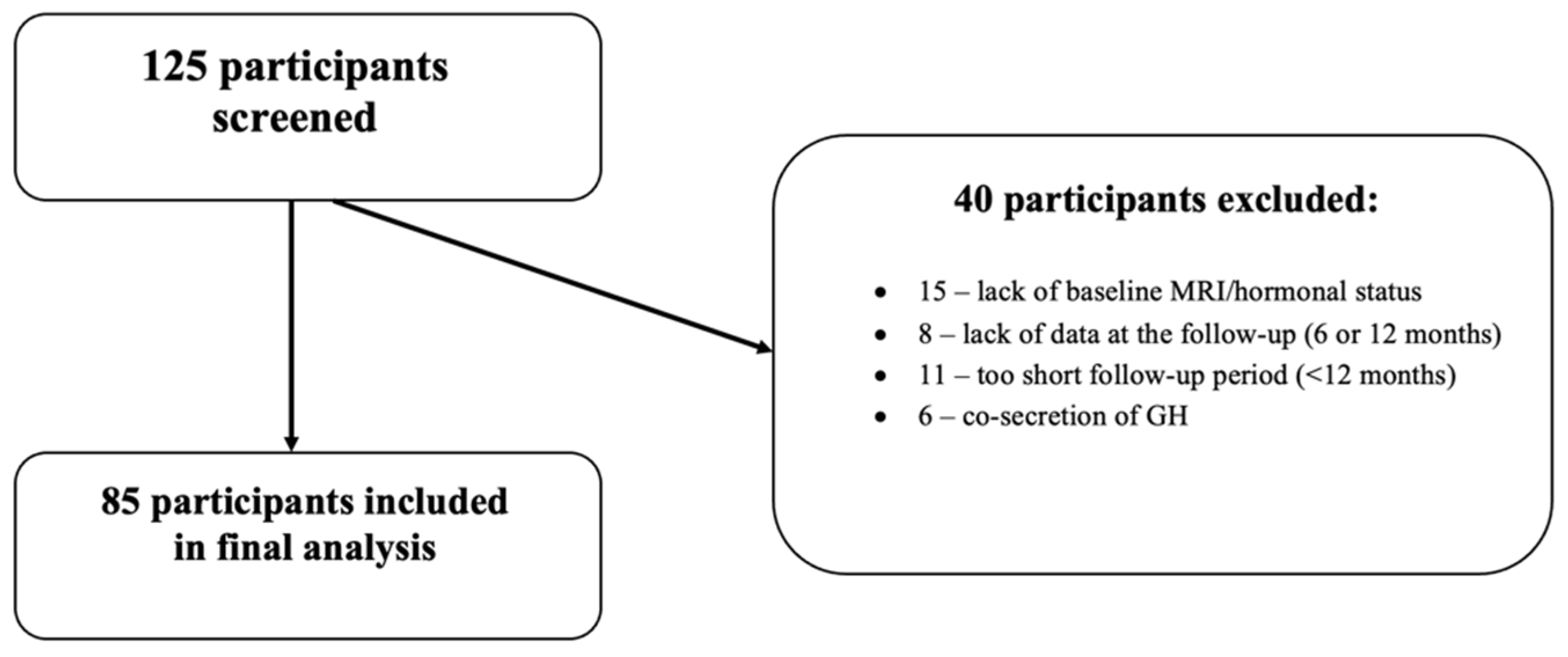
2. Materials and Methods
3. Results
3.1. Baseline Characteristics
3.1.1. Evaluation at 6 Months
3.1.2. Evaluation at 12 Months
3.1.3. Long-Term Follow-Up
3.2. Other Methods of Treatment
3.2.1. Comparison of Resistant and Non-Resistant Prolactinomas
3.2.2. Sex Differences
3.2.3. Correlations
3.2.4. Association with Resistance and Response to DA
4. Discussion
Limitations of the Study
5. Conclusions
Author Contributions
Funding
Institutional Review Board Statement
Informed Consent Statement
Data Availability Statement
Conflicts of Interest
Abbreviations
| DA | Dopamine Agonists |
| PRL | Prolactin concentration |
| ER | Estrogen Receptor |
| PRLR | Prolactin Receptor |
| PRL | Prolactin |
| MRI | Magnetic Resonance Imaging |
| GH | Growth Hormone |
| CT | Computed Tomography |
| aOR | Adjusted Odds Ratio |
| CI | Confidence Interval |
| MEN1 | Multiple Endocrine Neoplasia type 1 |
| AIP | Aryl hydrocarbon receptor Interacting Protein |
| NGFR | Nerve Growth Factor Receptor |
References
- Daly, A.F.; Beckers, A. The Epidemiology of Pituitary Adenomas. Endocrinol. Metab. Clin. N. Am. 2020, 49, 347–355. [Google Scholar] [CrossRef]
- Maiter, D. Management of Dopamine Agonist-Resistant Prolactinoma. Neuroendocrinology 2019, 109, 42–50. [Google Scholar] [CrossRef]
- Petersenn, S.; Fleseriu, M.; Casanueva, F.F.; Giustina, A.; Biermasz, N.; Biller, B.M.; Bronstein, M.; Chanson, P.; Fukuoka, H.; Gadelha, M.; et al. Diagnosis and management of prolactin-secreting pituitary adenomas: A Pituitary Society international Consensus Statement. Nat. Rev. Endocrinol. 2023, 19, 722–740. [Google Scholar] [CrossRef] [PubMed]
- Melmed, S.; Casanueva, F.F.; Hoffman, A.R.; Kleinberg, D.L.; Montori, V.M.; Schlechte, J.A.; Wass, J.A. Diagnosis and treatment of hyperprolactinemia: An endocrine society clinical practice guideline. J. Clin. Endocrinol. Metab. 2011, 96, 273–288. [Google Scholar] [CrossRef]
- Colao, A.; Di Sarno, A.; Landi, M.L.; Scavuzzo, F.; Cappabianca, P.; Pivonello, R.; Volpe, R.; Di Salle, F.; Cirillo, S.; Annunziato, L.; et al. Macroprolactinoma Shrinkage during Cabergoline Treatment Is Greater in Naive Patients Than in Patients Pretreated with Other Dopamine Agonists: A Prospective Study in 110 Patients. J. Clin. Endocrinol. Metab. 2000, 85, 2247–2252. [Google Scholar] [CrossRef] [PubMed]
- Colao, A.; di Sarno, A.; Pivonello, R.; di Somma, C.; Lombardi, G. Dopamine receptor agonists for treating prolactinomas. Expert Opin. Investig. Drugs 2002, 11, 787–800. [Google Scholar] [CrossRef]
- Trouillas, J.; Delgrange, E.; Wierinckx, A.; Vasiljevic, A.; Jouanneau, E.; Burman, P.; Raverot, G. Clinical, Pathological, and Molecular Factors of Aggressiveness in Lactotroph Tumours. Neuroendocrinology 2019, 109, 70–76. [Google Scholar] [CrossRef]
- Mahboobifard, F.; Bidari-Zerehpoosh, F.; Davoudi, Z.; Panahi, M.; Dargahi, L.; Pourgholami, M.H.; Sharifi, G.; Izadi, N.; Jorjani, M. Expression patterns of ERα66 and its novel variant isoform ERα36 in lactotroph pituitary adenomas and associations with clinicopathological characteristics. Pituitary 2020, 23, 232–245. [Google Scholar] [CrossRef] [PubMed]
- De Castro Moreira, A.R.; Trarbach, E.; Bueno, C.B.; Monteiro, A.L.; Grande, I.P.; Padula, M.; Maciel, G.A.; Glezer, A. PRL-R Variants Are Not Only Associated with Prolactinomas but Also with Dopamine Agonist Resistance. J. Clin. Endocrinol. Metab. 2023, 108, E450–E457. [Google Scholar] [CrossRef]
- Dogansen, S.C.; Yalin, G.Y.; Tanrikulu, S.; Tekin, S.; Nizam, N.; Bilgic, B.; Sencer, S.; Yarman, S. Clinicopathological significance of baseline T2-weighted signal intensity in functional pituitary adenomas. Pituitary 2018, 21, 347–354. [Google Scholar] [CrossRef]
- Di Sarno, A.; Landi, M.L.; Cappabianca, P.; Di Salle, F.; Rossi, F.W.; Pivonello, R.; Di Somma, C.; Faggiano, A.; Lombardi, G.; Colao, A. Resistance to cabergoline as compared with bromocriptine in hyperprolactinemia: Prevalence, clinical definition, and therapeutic strategy. J. Clin. Endocrinol. Metab. 2001, 86, 5256–5261. [Google Scholar] [CrossRef]
- Shimon, I. Prolactinomas Resistant to Dopamine Agonists: Pathophysiology and Treatment. Arch. Med. Res. 2023, 54, 102883. [Google Scholar] [CrossRef]
- Nakhleh, A.; Shehadeh, N.; Hochberg, I.; Zloczower, M.; Zolotov, S.; Taher, R.; Daoud Naccache, D. Management of cystic prolactinomas: A review. Pituitary 2018, 21, 425–430. [Google Scholar] [CrossRef]
- Bhavsar, K.R.; Silver, K.D. Cystic Prolactinoma: A Surgical Disease? AACE Clin. Case Rep. 2019, 5, e66–e69. [Google Scholar] [CrossRef]
- Faje, A.; Chunharojrith, P.; Nency, J.; Biller, B.M.K.; Swearingen, B.; Klibanski, A. Dopamine Agonists Can Reduce Cystic Prolactinomas. J. Clin. Endocrinol. Metab. 2016, 101, 3709–3715. [Google Scholar] [CrossRef] [PubMed]
- Kontogeorgos, G.; Horvath, E.; Kovacs, K.; Coire, C.; Lloyd, R.V.; Scheithauer, B.W.; Smyth, H.S. Morphologic changes of prolactin-producing pituitary adenomas after short treatment with dopamine agonists. Acta Neuropathol. 2006, 111, 46–52. [Google Scholar] [CrossRef]
- Gen, M.; Uozumi, T.; Ohta, M.; Ito, A.; Kajiwara, H.; Mori, S. Necrotic changes in prolactinomas after long term administration of bromocriptine. J. Clin. Endocrinol. Metab. 1984, 59, 463–470. [Google Scholar] [CrossRef] [PubMed]
- Yousem, D.M.; Arrington, J.A.; Zinreich, S.J.; Kumar, A.J.; Bryan, R.N. Pituitary adenomas: Possible role of bromocriptine in intratumoral hemorrhage. Radiology 1989, 170, 239–243. [Google Scholar] [CrossRef]
- Sharif, D.A.; Nkonge, F.M.; Chawda, S.; Benjamin, J.; Stojanovic, N.D. Cystic Degeneration of Macroprolactinoma on Long-Term Cabergoline. J. Clin. Endocrinol. Metab. 2010, 95, 3593–3594. [Google Scholar] [CrossRef] [PubMed][Green Version]
- Su, W.; He, K.; Yang, Y.; Xu, J.; Li, X.; Tang, H.; Yang, J.; Yang, L. Operative treatment of cystic prolactinomas: A retrospective study. BMC Endocr. Disord. 2023, 23, 99. [Google Scholar] [CrossRef]
- Kreutz, J.; Vroonen, L.; Cattin, F.; Petrossians, P.; Thiry, A.; Rostomyan, L.; Tshibanda, L.; Beckers, A.; Bonneville, J.F. Intensity of prolactinoma on T2-weighted magnetic resonance imaging: Towards another gender difference. Neuroradiology 2015, 57, 679–684. [Google Scholar] [CrossRef] [PubMed]
- Varlamov, E.V.; Hinojosa-Amaya, J.M.; Fleseriu, M. Magnetic resonance imaging in the management of prolactinomas; a review of the evidence. Pituitary 2020, 23, 16–26. [Google Scholar] [CrossRef]
- De Sousa, S.M.C. Dopamine agonist therapy for prolactinomas: Do we need to rethink the place of surgery in prolactinoma management? Endocr. Oncol. 2022, 2, R31–R50. [Google Scholar] [CrossRef]
- Vermeulen, E.; D’Haens, J.; Stadnik, T.; Unuane, D.; Barbe, K.; Van Velthoven, V.; Gläsker, S. Predictors of dopamine agonist resistance in prolactinoma patients. BMC Endocr. Disord. 2020, 20, 68. [Google Scholar] [CrossRef]
- Delgrange, E.; Daems, T.; Verhelst, J.; Abs, R.; Maiter, D. Characterization of resistance to the prolactin-lowering effects of cabergoline in macroprolactinomas: A study in 122 patients. Eur. J. Endocrinol. 2009, 160, 747–752. [Google Scholar] [CrossRef]
- Himonakos, C.; Burman, P.; Borg, H.; Dahlqvist, P.; Engström, B.E.; Ekman, B.; Emilsson, L.; Olsson, D.S.; Ragnarsson, O.; Wahlberg, J.; et al. Long-term Follow-up of 84 Patients with Giant Prolactinomas—A Swedish Nationwide Study. J. Clin. Endocrinol. Metab. 2023, 108, e1506–e1514. [Google Scholar] [CrossRef]
- Espinosa, E.; Sosa, E.; Mendoza, V.; Ramírez, C.; Melgar, V.; Mercado, M. Giant prolactinomas: Are they really different from ordinary macroprolactinomas? Endocrine 2016, 52, 652–659. [Google Scholar] [CrossRef] [PubMed]
- Lee, Y.; Ku, C.R.; Kim, E.H.; Hong, J.W.; Lee, E.J.; Kim, S.H. Early prediction of long-term response to cabergoline in patients with macroprolactinomas. Endocrinol. Metab. 2014, 29, 280–292. [Google Scholar] [CrossRef]
- Biagetti, B.; Sarria-Estrada, S.; Ng-Wong, Y.K.; Martinez-Saez, E.; Casteràs, A.; Cordero Asanza, E.; Hernandez, I.; Giralt-Arnaiz, M.; Simò, R. Shrinkage by the third month predicts long-term response of macroprolactinoma after cabergoline. Eur. J. Endocrinol. 2021, 185, 587–595. [Google Scholar] [CrossRef]
- Kim, D.; Ku, C.R.; Kim, K.; Jung, H.; Lee, E.J. Prolactin ≤1 ng/mL predicts macroprolactinoma reduction after cabergoline therapy. Eur. J. Endocrinol. 2020, 182, 177–183. [Google Scholar] [CrossRef] [PubMed]
- Valea, A.; Sandru, F.; Petca, A.; Dumitrascu, M.C.; Carsote, M.; Petca, R.C.; Ghemigian, A. Aggressive prolactinoma (Review). Exp. Ther. Med. 2022, 23, 74. [Google Scholar] [CrossRef]
- Lasolle, H.; Vasiljevic, A.; Borson-Chazot, F.; Raverot, G. Pasireotide: A potential therapeutic alternative for resistant prolactinoma. Ann. Endocrinol. 2019, 80, 84–88. [Google Scholar] [CrossRef]
- Coopmans, E.C.; Van Meyel, S.W.; Pieterman, K.J.; Van Ipenburg, J.A.; Hofland, L.J.; Donga, E.; Daly, A.F.; Beckers, A.; van der Lely, A.J.; Neggers, S.J. Excellent response to pasireotide therapy in an aggressive and dopamine-resistant prolactinoma. Eur. J. Endocrinol. 2019, 181, K21–K27. [Google Scholar] [CrossRef]
- Komisarz-Calik, M.; Zieliński, G.; Ciszek, K.; Bogusławska, A.; Hubalewska-Dydejczyk, A.; Gilis-Januszewska, A. Pasireotide treatment in giant prolactinoma resistant to dopamine agonists. Endokrynol. Pol. 2024, 75, 697–698. [Google Scholar] [CrossRef] [PubMed]
- Fleseriu, M.; Varlamov, E.V.; Akirov, A.; Langlois, F.; Petersenn, S.; Melmed, S. Prolactin-secreting adenomas: Pathogenesis, diagnosis, and management. Lancet Diabetes Endocrinol. 2025, 13, 874–890. [Google Scholar] [CrossRef] [PubMed]
- Li, C.; Xie, W.; Rosenblum, J.S.; Zhou, J.; Guo, J.; Miao, Y.; Shen, Y.; Wang, H.; Gong, L.; Li, M.; et al. Somatic SF3B1 hotspot mutation in prolactinomas. Nat. Commun. 2020, 11, 2506. [Google Scholar] [CrossRef] [PubMed]
- Brandi, M.L.; Agarwal, S.K.; Perrier, N.D.; Lines, K.E.; Valk, G.D.; Thakker, R.V. Multiple Endocrine Neoplasia Type 1: Latest Insights. Endocr. Rev. 2021, 42, 133–170. [Google Scholar] [CrossRef]
- Martínez de LaPiscina, I.; Portillo Najera, N.; Rica, I.; Gaztambide, S.; Webb, S.M.; Santos, A.; Moure, M.D.; Paja Fano, M.; Hernandez, M.I.; Chueca-Guindelain, M.J.; et al. Clinical and genetic characteristics in patients under 30 years with sporadic pituitary adenomas. Eur. J. Endocrinol. 2021, 185, 485–496. [Google Scholar] [CrossRef]


| Variable 1 | Value 2 |
|---|---|
| Age, years, mean ± SD | 41.52 ± 17.19 |
| Gender | |
| Male, n (%) | 54 (63.5) |
| Female, n (%) | 31 (36.5) |
| Giant prolactinoma, n (%) | 19 (22.4) |
| Symptoms, n (%) | |
| Headache | 59/85 (69.4) |
| Visual field loss | 30/85 (35.3) |
| Loss of libido | 16/85 (18.8) |
| Erectile dysfunction | 15/54 (27.8) |
| Irregular menes | 21/31 (67.7) |
| Gallacthorrea | 14/85 (16.5); gynecomastia 5/54 (9.3) |
| Central hypogonadism | 65/85 (76.5) |
| Central hypothyroidism | 21/85 (24.7) |
| Central hypocortisolism | 19/85 (22.4) |
| Baseline characteristics | |
| Prolactin [ng/mL], Me (q1 − q3) | 545.7 (173.2 − 2023.0) |
| Maximum diameter of the tumor [mm], Me (q1 − q3) | 22.0 (13.0 − 36.0) |
| Tumor volume [mm3], Me (q1 − q3) | 3364.65 (630.28 − 14,168.62) |
| KNOSP classification | |
| KNOSP grade 0, n (%) | 15/85 (17.6) |
| KNOSP grade 1, n (%) | 14/85 (16.5) |
| KNOSP grade 2, n (%) | 20/85 (23.5) |
| KNOSP grade 3, n (%) | 22/85 (25.9) |
| KNOSP grade 4, n (%) | 14/85 (16.5) |
| Cavernous sinus invasion, n (%) | 69/85 (81.2) |
| Suprasellar invasion, n (%) | 30/85 (35.3) |
| Optic chiasm compression, n (%) | 37/85 (44.6) |
| Sphenoid sinus invasion, n (%) | 51/85 (61.4) |
| Cystic component, n (%) | 19/85 (22.4) |
| Surgical treatment, n (%) | 13/85 (15.5) |
| Total follow-up duration [months]; Me (q1 − q3) | 52.0 (31.50 − 86.75) |
| Variable 1 | Evaluation at 6 Months | Evaluation at 12 Months | Evaluation at Last Visit |
|---|---|---|---|
| Value 2 | Value 2 | Value 2 | |
| Prolactin [ng/mL], Me (q1 − q3) | 47.4 (14.45 − 241.35) | 24.8 (6.85 − 61.15) | 15.9 (8.45 − 55.25) |
| Prolactin normalization, n (%) | 21/85 (24.7) | 34/85 (40.0) | 47/85 (55.3) |
| Δ Prolactin, Me (q1 − q3) 3 | 391.42 (45.05 − 1476.85) | 457.97 (105.40 − 1995.95) | 504.00 (117.05 − 1992.35) |
| Tumor shrinkage, n (%) 4 | 44/85 (51.8) | 57/85 (67.1) | 59/85 (69.4) |
| Tumor volume reduction (%), Me (q1 − q3) | 23.15 (0.0 − 57.11) | 43.70 (17.27 − 78.25) | 63.48 (27.29 − 93.83) |
| ≥50% reduction in tumor volume, n (%) | 25/85 (29.4) | 35/85 (41.2) | 44/85 (51.8) |
| Maximum diameter of the tumor [mm], Me (q1 − q3) | 18.00 (11.50 − 28.00) | 18.00 (10.25 − 25.00) | 15.00 (10.00 − 24.50) |
| Maximum tumor diameter reduction (%), Me (q1 − q3) | 7.69 (0.00 − 26.36) | 15.40 (0.00 − 33.33) | 15.88 (0.00 − 43.15) |
| Maximum tumor diameter reduction ≥ 30%, n (%) | 16/85 (18.8) | 24/85 (28.2) | 31/85 (36.5) |
| Responders | 6/85 (7.1) | 9/85 (10.6) | 22/85 (25.9) |
| Partial responders | 54/85 (63.5) | 49/85 (57.6) | 43/85 (50.6) |
| Resistant to DA | 25/85 (29.4) | 27/85 (31.8) | 20/85 (23.5) |
| Maximum cabergoline dose [mg/week]; Me (q1 − q3) 5 | 1.0 (0.75 − 2.0) | 1.0 (0.75 − 2.0) | 1.0 (0.75 − 2.0) |
| Variable 1 | Non-Resistant (n = 60) | Resistant (n = 25) | p-Value 2 |
|---|---|---|---|
| Baseline Characteristics | |||
| Age [years] | 44.36 + − 17.887 | 36.68 + − 13.074 | 0.119 |
| Male gender, n (%) | 34/60 (56.7) | 20/25 (80.0) | 0.042 |
| Giant prolactinoma, n (%) | 8/60 (13.3) | 11/25 (44.0) | 0.002 |
| Basal prolactin [ng/mL], Me (q1 − q3) | 478.985 (175.00 − 1038.00) | 2000.000 (470.00 − 4810.00) | 0.012 |
| Maximum diameter of tumor [mm], Me (q1 − q3) | 19.0 (13.0 − 27.0) | 30.0 (15.0 − 56.0) | 0.012 |
| Basal tumor volume [mm3], Me (q1 − q3) | 2111.157 (600.831 − 8494.886) | 10,306.540 (1429.430 − 49,553.504) | 0.014 |
| Symptoms, n (%) | |||
| Headache | 39/60 (65.0) | 20/25 (80.0) | 0.171 |
| Visual field loss | 21/650 (35.0) | 9/25 (36.0) | 0.930 |
| Loss of libido | 10/60 (16.7) | 6/25 (24.0) | 0.544 |
| Invasion of the structures in MRI | |||
| Cavernous sinus invasion | 49/60 (81.7) | 20/25 (80.0) | 1.000 |
| Suprasellar invasion | 17/60 (28.3) | 13/25 (52.0) | 0.037 |
| Optic chiasm compression | 23/60 (38.3) | 14/25 (56.0) | 0.134 |
| Sphenoid sinus invasion | 35/60 (58.3) | 16/25 (64.0) | 0.627 |
| Evaluation at 6 months | |||
| Prolactin [ng/mL], Me (q1 − q3) | 29.805 (8.20 − 116.60) | 148.000 (86.00 − 479.00) | <0.001 |
| Prolactin normalization, n (%) | 20/60 (33.3) | 1/25 (4.0) | 0.004 |
| Δ Prolactin at 6 months [ng/mL], Me (q1 − q3) 3 | 235.185 (48.90 − 868.23) | 1134.000 (155.60 − 4778.40) | 0.054 |
| Maximum diameter of tumor [mm], Me (q1 − q3) | 17.0 (11.0 − 24.5) | 26.0 (15.0 − 41.0) | 0.004 |
| Maximum tumor diameter reduction (%), Me (q1 − q3) | 8.535 (0.00 − 28.57) | 4.350 (0.00 − 20.00) | 0.637 |
| Maximum tumor diameter reduction ≥ 30%, n (%) | 13/60 (21.7) | 4/25 (16.0) | 0.552 |
| Tumor volume reduction (%) | 20.145 (0.00 − 56.56) | 29.040 (0.70 − 53.24) | 0.502 |
| ≥50% reduction in tumor volume, n (%) | 19/60 (31.7) | 6/25 (24.0) | 0.480 |
| Maximal cabergoline dose [mg/week] 3, Me (q1 − q3) 4 | 1.0 (0.5 − 1.0) (0.25 − 4) | 2.0 (2.0 − 3.0) (2.0 − 4.0) | <0.001 |
| Evaluation at 12 months | |||
| Prolactin [ng/mL], Me (q1 − q3) | 14.750 (5.30 − 30.00) | 60.000 (25.00 − 267.00) | <0.001 |
| Prolactin normalization, n (%) | 30/60 (50.0) | 4/25 (16.0) | 0.004 |
| Δ Prolactin at 12 months [ng/mL], Me (q1 − q3) 3 | 435.500 (116.69 − 1036.00) | 1048.000 (96.40 − 4798.70) | 0.203 |
| Maximum diameter of tumor [mm], Me (q1 − q3) | 14.75 (10.00 − 22.00) | 22.00 (12.00 − 40.00) | 0.018 |
| Maximum tumor diameter reduction (%), Me (q1 − q3) | 14.835 (0.00 − 33.34) | 16.667 (0.00 − 43.24) | 0.888 |
| Maximum tumor diameter reduction ≥ 30%, n (%) | 17/60 (28.3) | 7/25 (28.0) | 0.975 |
| Tumor volume reduction (%), Me (q1 − q3) | 49.610 (18.75 − 77.13) | 34.000 (14.29 − 80.49) | 0.688 |
| ≥50% reduction in tumor volume, n (%) | 26/60 (43.3) | 9/25 (36.0) | 0.531 |
| Maximal cabergoline dose [mg/week] 4, Me (q1 − q3) 4 | 1.0 (0.5 − 1.25) (0.25 − 4.0) | 2.5 (2.0 − 3.5) (2.0 – 4.5) | <0.001 |
| Last follow-up | |||
| Prolactin [ng/mL], Me (q1 − q3) | 13.150 (5.90 − 27.80) | 32.100 (15.11 − 200.40) | 0.005 |
| Prolactin normalization, n (%) | 38/60 (63.3) | 9/25 (36.0) | 0.021 |
| Δ Prolactin at last visit [ng/mL], Me (q1 − q3) 3 | 424.535 (116.10 − 1023.58) | 1950.000 (46.00 − 4684.89) | 0.019 |
| Maximum diameter of tumor [mm], Me (q1 − q3) | 12.50 (9.0 − 22.0) | 22.00 (15.0 − 38.0) | 0.004 |
| Maximum tumor diameter reduction (%), Me (q1 − q3) | 19.375 (0.00 − 42.86) | 11.630 (0.00 − 43.24) | 0.906 |
| Tumor volume reduction (%), Me (q1 − q3) | 61.535 (26.11 − 89.37) | 72.780 (27.51 − 99.76) | 0.385 |
| ≥50% reduction in tumor volume, n (%) | 32/60 (53.3) | 12/25 (48.0) | 0.654 |
| Total follow-up time [months], Me (q1 − q3) | 50.50 (32.0 − 85.0) | 61.00 (38.0 − 92.0) | 0.386 |
| Variable 1 | Male (n = 54) | Female (n = 31) | p-Value 2 |
|---|---|---|---|
| Age [years], mean ± SD | 44.04 ± 16.9 | 37.9 ± 16.9 | 0.074 |
| Maximum tumor diameter at baseline [mm], Me (q1 − q3) | 26.5 (18.0 − 47.0) | 12.5 (9.75 − 19.5) | <0.001 |
| Prolactin at baseline [ng/mL], Me (q1 − q3) | 976.68 (364.9 − 4832.5) | 204.35 (94.3 − 620.7) | <0.001 |
| Prolactin at 6 months [ng/mL], Me (q1 − q3) | 66.6 (15.35 − 312.35) | 44.6 (10.48 − 1256.6) | 0.485 |
| Prolactin at 12 months [ng/mL], Me (q1 − q3) | 24.8 (8.23 − 65.48) | 19.8 (5.2 − 60.23) | 0.729 |
| Prolactin at last visit [ng/mL], Me (q1; q3) | 16.85 (8.48 − 65.3) | 15.85 (7.8 − 55.13) | 0.837 |
| Maximum tumor diameter at baseline [mm], Me (q1 − q3) | 21 (12.75 − 26.25) | 10.5 (5.93 − 15.8) | <0.001 |
| Tumor volume at baseline [mm3], Me (q1 − q3) | 7961.86 (2069.14 − 22,555.12) | 605.67 (93.86 − 2227.39) | <0.001 |
| Tumor volume at 12 months [mm3], Me (q1 − q3) | 2333.16 (510.25 − 8906.44) | 367.6 (72.77 − 1277.06) | <0.001 |
| Resistant at 6 months | 20/54 (37.0%) | 5/31 (16.1%) | 0.042 |
| Resistant at 12 months | 22/54 (40.7%) | 5/31 (16.1%) | 0.019 |
| Resistant at last follow-up | 16/54 (29.6%) | 4/31 (12.9%) | 0.080 |
| Total follow-up duration [months], Me (q1 − q3) | 52.0 (30.0 − 80.0) | 51.5 (33.5 − 138.75) | 0.383 |
| Maximal cabergoline dose at 6 months [mg/week], Me (q1 − q3) 3 | 1.0 (1.0 − 2.0) | 1.0 (0.5 − 1.5) | 0.013 |
| Maximal cabergoline dose at 12 months [mg/week], Me (q1 − q3) 3 | 1.5 (1.0 − 2.5) | 1.0 (1.0 − 1.5) | 0.002 |
| Variable | OR | 95% CI | p-Value |
|---|---|---|---|
| 6 months | |||
| Sex (M = 1, W = 0) | 3.059 | 1.013–9.236 | 0.047 |
| Baseline maximal tumor diameter | 1.044 | 1.016–1.073 | 0.002 |
| 12 months | |||
| Sex (M = 1, W = 0) | 3.575 | 1.190–10.743 | 0.023 |
| Baseline maximal tumor diameter | 1.047 | 1.018–1.076 | 0.001 |
Disclaimer/Publisher’s Note: The statements, opinions and data contained in all publications are solely those of the individual author(s) and contributor(s) and not of MDPI and/or the editor(s). MDPI and/or the editor(s) disclaim responsibility for any injury to people or property resulting from any ideas, methods, instructions or products referred to in the content. |
© 2026 by the authors. Licensee MDPI, Basel, Switzerland. This article is an open access article distributed under the terms and conditions of the Creative Commons Attribution (CC BY) license.
Share and Cite
Komisarz-Calik, M.; Bogusławska, A.; Gamrat-Żmuda, A.; Minasyan, M.; Piwońska-Solska, B.; Kunicki, J.; Zieliński, G.; Faron-Górecka, A.; Hubalewska-Dydejczyk, A.; Gilis-Januszewska, A. The Differences Between Dopamine Agonist-Resistant and -Non-Resistant Prolactinomas: Are There Any Predictors of a Good Response? Biomedicines 2026, 14, 234. https://doi.org/10.3390/biomedicines14010234
Komisarz-Calik M, Bogusławska A, Gamrat-Żmuda A, Minasyan M, Piwońska-Solska B, Kunicki J, Zieliński G, Faron-Górecka A, Hubalewska-Dydejczyk A, Gilis-Januszewska A. The Differences Between Dopamine Agonist-Resistant and -Non-Resistant Prolactinomas: Are There Any Predictors of a Good Response? Biomedicines. 2026; 14(1):234. https://doi.org/10.3390/biomedicines14010234
Chicago/Turabian StyleKomisarz-Calik, Maria, Anna Bogusławska, Aleksandra Gamrat-Żmuda, Mari Minasyan, Beata Piwońska-Solska, Jacek Kunicki, Grzegorz Zieliński, Agata Faron-Górecka, Alicja Hubalewska-Dydejczyk, and Aleksandra Gilis-Januszewska. 2026. "The Differences Between Dopamine Agonist-Resistant and -Non-Resistant Prolactinomas: Are There Any Predictors of a Good Response?" Biomedicines 14, no. 1: 234. https://doi.org/10.3390/biomedicines14010234
APA StyleKomisarz-Calik, M., Bogusławska, A., Gamrat-Żmuda, A., Minasyan, M., Piwońska-Solska, B., Kunicki, J., Zieliński, G., Faron-Górecka, A., Hubalewska-Dydejczyk, A., & Gilis-Januszewska, A. (2026). The Differences Between Dopamine Agonist-Resistant and -Non-Resistant Prolactinomas: Are There Any Predictors of a Good Response? Biomedicines, 14(1), 234. https://doi.org/10.3390/biomedicines14010234