
This is an early access version, the complete PDF, HTML, and XML versions will be available soon.
Article

Distribution of Thrombophilia-Related Genetic Polymorphisms in Women with Reproductive Disorders


by
Almagul Kurmanova
1,
Madina Khalmirzaeva
1,*,
Nagima Mamedalieva
1,
Gulfiruz Urazbayeva
2,
Damilya Salimbayeva
2,
Damira Ibrayeva
3,
Alfiya Dzheksembekova
1,
Zhanar Kypshakbayeva
1,
Altynay Nurmakova
2 and
Elif Salar
1
1
Department of Obstetrics and Gynecology, Faculty of Medicine and Healthcare, Al-Farabi Kazakh National University, Almaty 050040, Kazakhstan
2
Department of Strategic Development and Science, Scientific Center for Obstetrics, Gynecology and Perinatology, Almaty 050010, Kazakhstan
3
Department of Surgical Diseases, Faculty of Medicine, Khoja Akhmet Yassawi International Kazakh-Turkish University, Turkestan 161200, Kazakhstan
*
Author to whom correspondence should be addressed.
Biomedicines 2026, 14(1), 199; https://doi.org/10.3390/biomedicines14010199

Submission received: 14 December 2025 / Revised: 9 January 2026 / Accepted: 15 January 2026 / Published: 16 January 2026
(This article belongs to the Special Issue Role of Factors in Embryo Implantation and Placental Development)

Abstract

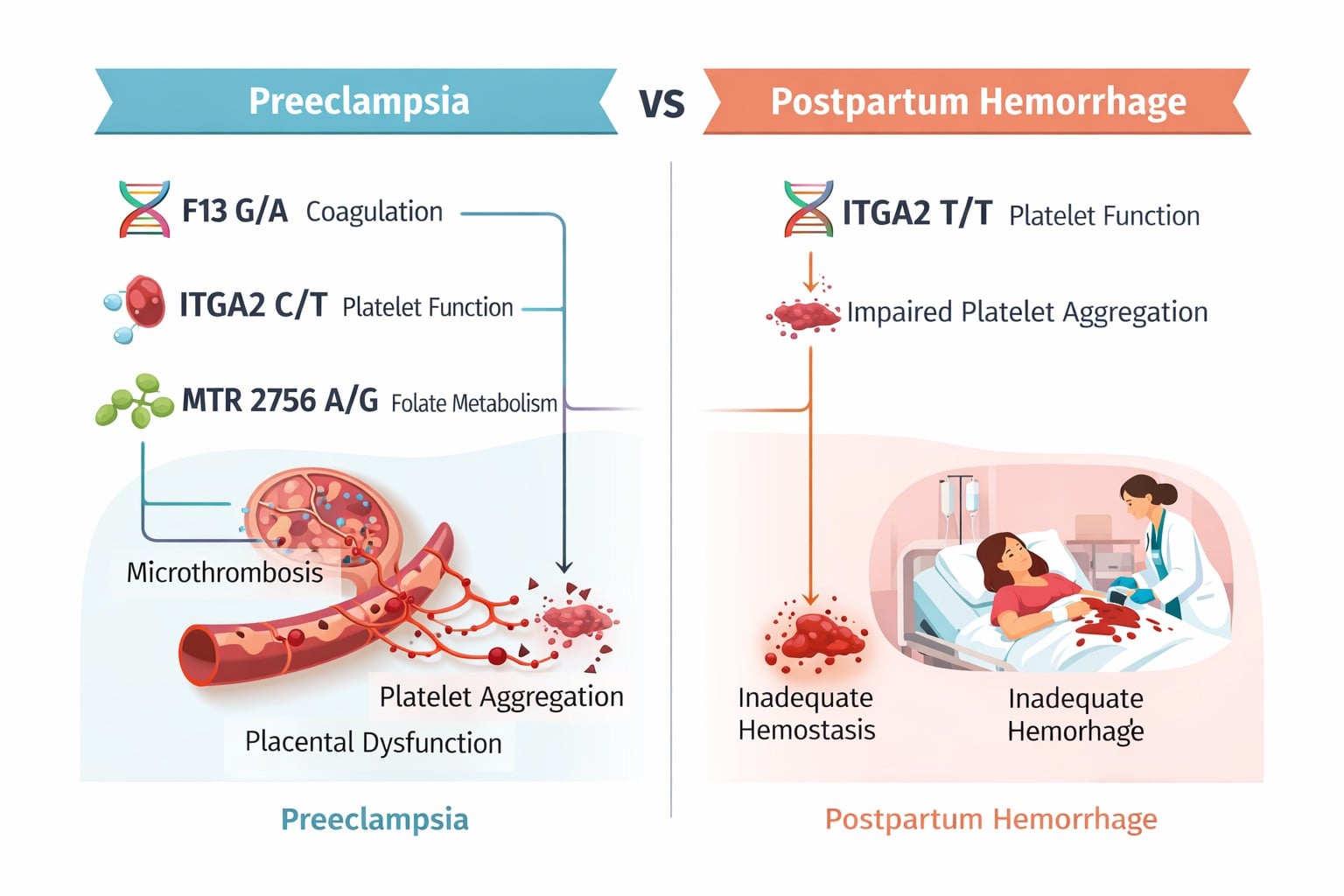
Thrombophilia is considered one of the key mechanisms underlying reproductive disorders. Clinical heterogeneity of reproductive disorders and a lack of stratification by phenotype often limit interpretation. Therefore, evaluating thrombophilia-associated genetic markers separately in fetal loss syndrome, postpartum hemorrhage (PPH), and hypertensive disorders of pregnancy is essential. Background/Objectives: To assess the frequency of thrombophilia-related genetic polymorphisms in women with various reproductive disorders and evaluate their association with clinical–anamnestic characteristics and obstetric antiphospholipid syndrome. Methods: A total of 132 women with reproductive disorders (fetal loss syndrome, postpartum hemorrhage, preeclampsia). Results: Statistically significant differences were found when comparing between the groups. Thus, heterozygous F13 genetic polymorphisms were statistically more common in the group with a history of preeclampsia compared to the group with PPH (the G/A genotype was detected in 22.2% versus 10.7%, p = 0.045), and heterozygous ITGA2 gene genetic polymorphisms were also more common (the C/T genotype was detected in 66.7% versus 42.9%, p = 0.023). In women with a history of PPH, homozygous ITGA2 genetic polymorphisms were statistically more common (the T/T genotype was detected 2.6 times more often—21.4% versus 8.8% compared to the group with fetal loss syndrome, p = 0.022; and 3.8 times more often—21.4% versus 5.6% compared to the group with PE, p = 0.022). Conclusions: A study of thrombophilia gene polymorphisms in women with reproductive disorders showed that the G/A genotype of F13, the C/T genotype of ITGA2, and the A/G genotype of MTR:2756 were significantly more common in women with preeclampsia than in the group with postpartum hemorrhage; the T/T genotype of the ITGA2 gene was detected in postpartum hemorrhage. The MTHFR 1286A > C (A/C) polymorphism was associated with a reduced risk of postpartum hemorrhage. In contrast, the MTR 2756A > G (A/G) genotype was associated with an increased risk of preeclampsia.
Keywords: gene polymorphism; thrombophilia; early pregnancy loss; fetal loss syndrome; preeclampsia; postpartum hemorrhage; antiphospholipid syndrome gene polymorphism; thrombophilia; early pregnancy loss; fetal loss syndrome; preeclampsia; postpartum hemorrhage; antiphospholipid syndrome
Graphical Abstract