Clinical Benefits of Aloe vera Gel in 0.3% Hyaluronate Eyedrops in Glaucoma Therapy-Related Ocular Surface Disease

 ,
,  ,
,  and
and
Abstract
1. Introduction
2. Materials and Methods
2.1. OSGLA Registry
2.1.1. Study Design (OSGLA Registry)
2.1.2. Registry Outcomes (OSGLA Registry)
2.1.3. Protocol (OSGLA Registry Protocol)
2.2. Current Study: Lubricant Cohort Sub-Analysis
2.2.1. Outcomes
2.2.2. Statistical Analysis
3. Results
3.1. PF HA 0.3% Treatment Regimen
3.2. PF Aloe vera/0.3% HA Treatment Regimen
3.3. Correlation Analysis
4. Discussion
Author Contributions
Funding
Institutional Review Board Statement
Data Availability Statement
Conflicts of Interest
References
- Leung, E.W.; Medeiros, F.A.; Weinreb, R.N. Prevalence of ocular surface disease in Glaucoma patients. J. Glaucoma 2008, 17, 350–355. [Google Scholar] [CrossRef] [PubMed]
- Mastropasqua, R.; Agnifili, L.; Mastropasqua, L. Structural and Molecular Tear Film Changes in Glaucoma. Curr. Med. Chem. 2019, 26, 4225–4240. [Google Scholar] [CrossRef]
- Agnifili, L.; Sacchi, M.; Figus, M.; Posarelli, C.; Lizzio, R.A.U.; Nucci, P.; Mastropasqua, L. Preparing the ocular surface for glaucoma filtration surgery: An unmet clinical need. Acta Ophthalmol. 2022, 100, 740–751. [Google Scholar] [CrossRef]
- Agnifili, L.; Figus, M.; Sacchi, M.; Oddone, F.; Villani, E.; Ferrari, G.; Posarelli, C.; Carnevale, C.; Nucci, P.; Nubile, M.; et al. Managing the ocular surface after glaucoma filtration surgery: An orphan topic. Graefes Arch. Clin. Exp. Ophthalmol. 2024, 262, 2039–2056. [Google Scholar] [CrossRef]
- Aragona, P.; Di Stefano, G.; Ferreri, F.; Spinella, R.; Stilo, A. Sodium hyaluronate eye drops of different osmolarity for the treatment of dry eye in Sjögren’s syndrome patients. Br. J. Ophthalmol. 2002, 86, 879–884. [Google Scholar] [CrossRef]
- Campo, G.M.; Avenoso, A.; Nastasi, G.; Micali, A.; Prestipino, V.; Vaccaro, M.; D’AScola, A.; Calatroni, A.; Campo, S. Hyaluronan reduces inflammation in experimental arthritis by modulating TLR-2 and TLR-4 cartilage expression. Biochim. Biophys. Acta 2011, 1812, 1170–1181. [Google Scholar] [CrossRef] [PubMed]
- Choi, S.; Chung, M.H. A review on the relationship between Aloe vera components and their biologic effects. Semin. Integr. Med. 2003, 1, 53–62. [Google Scholar] [CrossRef]
- Sarkar, D.; Dutta, A.; Das, M.; Sarkar, K.; Mandal, C.; Chatterjee, M. Effect of Aloe vera on nitric oxide production by macrophages during inflammation. Indian J. Pharmacol. 2005, 37, 371–375. [Google Scholar] [CrossRef]
- Yoo, E.A.; Kim, S.D.; Lee, W.M.; Park, H.J.; Kim, S.K.; Cho, J.Y.; Min, W.; Rhee, M.H. Evaluation of antioxidant, antinociceptive, and anti-inflammatory activities of ethanol extracts from Aloe Saponaria Haw. Phytother. Res. 2008, 22, 1389–1395. [Google Scholar] [CrossRef]
- Wozniak, A.; Paduch, R. Aloe vera extract activity on human corneal cells. Pharm. Biol. 2012, 50, 147–154. [Google Scholar] [CrossRef] [PubMed]
- Rodriguez-Pomar, C.; Carpena-Torres, C.; Serramito, M.; Perez-de-Lara, M.J.; Martinez-Aguila, A.; Martin-Gil, A.; Carracedo, G. Decreased inflammatory biomarkers after using artificial tears with Aloe vera and hypromellose for dry eye. Clin. Exp. Optom. 2025, 108, 973–979. [Google Scholar] [CrossRef]
- Goudarzi, M.; Fazeli, M.; Azad, M.; Seyedjavadi, S.S.; Mousavi, R. Aloe vera gel: Effective therapeutic agent against multidrug-resistant Pseudomonas aeruginosa isolates recovered from burn wound infections. Chemother. Res. Pract. 2015, 2015, 639806. [Google Scholar] [CrossRef] [PubMed]
- Vijayalakshmi, D.; Dhandapani, R.; Jayaveni, S.; Jithendra, P.S.; Rose, C.; Mandal, A.B. In vitro anti-inflammatory activity of Aloe vera by down regulation of MMP-9 in peripheral blood mononuclear cells. J. Ethnopharmacol. 2012, 141, 542–546. [Google Scholar] [CrossRef]
- Barrantes, E.; Guinea, M. Inhibition of collagenase and metalloproteinases by aloins and aloe gel. Life Sci. 2003, 72, 843–850. [Google Scholar] [CrossRef] [PubMed]
- Wolffsohn, J.S.; Arita, R.; Chalmers, R.; Djalilian, A.; Dogru, M.; Dumbleton, K.; Gupta, P.K.; Karpecki, P.; Lazreg, S.; Pult, H.; et al. TFOS DEWS II diagnostic methodology report. Ocul. Surf. 2017, 15, 539–574. [Google Scholar] [CrossRef]
- Mandell, R.B. Slit lamp classification system. J. Am. Optom. Assoc. 1987, 58, 198–201. [Google Scholar]
- Bron, A.J.; Evans, V.E.; Smith, J.A. Grading of corneal and conjunctival staining in the context of other dry eye tests. Cornea 2003, 22, 640–650. [Google Scholar] [CrossRef]
- Mastropasqua, L.; Agnifili, L.; Mastropasqua, R.; Fasanella, V. Conjunctival modifications induced by medical and surgical therapies in patients with glaucoma. Curr. Opin. Pharmacol. 2013, 13, 56–64. [Google Scholar] [CrossRef] [PubMed]
- Kojima, T.; Nagata, T.; Kudo, H.; Müller-Lierheim, W.G.K.; van Setten, G.B.; Dogru, M.; Tsubota, K. The Effects of High Molecular Weight Hyaluronic Acid Eye Drop Application in Environmental Dry Eye Stress Model Mice. Int. J. Mol. Sci. 2020, 21, 3516. [Google Scholar] [CrossRef]
- Figus, M.; Agnifili, L.; Lanzini, M.; Brescia, L.; Sartini, F.; Mastropasqua, L.; Posarelli, C. Topical preservative-free ophthalmic treatments: An unmet clinical need. Expert Opin. Drug Deliv. 2021, 18, 655–672. [Google Scholar] [CrossRef]
- Ito, T.; Ohguro, H.; Mamiya, K.; Ohguro, I.; Nakazawa, M. Effects of antiglaucoma drops on MMP and TIMP balance in conjunctival and subconjunctival tissue. Investig. Ophthalmol. Vis. Sci. 2006, 47, 823–830. [Google Scholar] [CrossRef] [PubMed]
- Lopilly Park, H.Y.; Kim, J.H.; Lee, K.M.; Park, C.K. Effect of prostaglandin analogues on tear proteomics and expression of cytokines and matrix metalloproteinases in the conjunctiva and cornea. Exp. Eye Res. 2012, 94, 13–21. [Google Scholar] [CrossRef] [PubMed]
- Matei, C.E.; Visan, A.I.; Cristescu, R. Aloe vera Polysaccharides as Therapeutic Agents: Benefits Versus Side Effects in Biomedical Applications. Polysaccharides 2025, 6, 36. [Google Scholar] [CrossRef]
- Miller, K.L.; Walt, J.G.; Mink, D.R.; Satram-Hoang, S.; Wilson, S.E.; Perry, H.D.; Asbell, P.A.; Pflugfelder, S.C. Minimal clinically important difference for the ocular surface disease index. Arch. Ophthalmol. 2010, 128, 94–101. [Google Scholar] [CrossRef]
- Lanza, N.L.; McClellan, A.L.; Batawi, H.; Felix, E.R.; Sarantopoulos, K.D.; Levitt, R.C.; Galor, A. Dry Eye Profiles in Patients with a Positive Elevated Surface Matrix Metalloproteinase 9 Point-of-Care Test Versus Negative Patients. Ocul. Surf. 2016, 14, 216–223. [Google Scholar] [CrossRef]
- Mejía-Salgado, G.; Rojas-Carabali, W.; Cifuentes-González, C.; Zárate-Pinzón, L.; Rodríguez-Rodríguez, C.A.; Marroquín-Gómez, G.; Moreno-Pardo, M.L.; Tirado-Ángel, J.; de-la-Torre, A. Real-world performance of the inflammadry test in dry eye diagnosis: An analysis of 1,515 patients. Graefes Arch. Clin. Exp. Ophthalmol. 2025, 263, 1623–1631. [Google Scholar] [CrossRef]



| GENDER (M/F) | AGE (Years) | IOP (mmHg) | MD (dB) | DURATION OF IOP-LOWERING THERAPY (Years) | N. OF IOP- LOWERING MEDICATIONS | STATUS OF THE LENS (P/Ps) | |
|---|---|---|---|---|---|---|---|
| PF Aloe vera/0.3% HA | 14/13 | 73 (77.5–66.5) | 18 (20–17) | −3.66 (−2.46/−12.25) | 10 (20–5.5) | 1 (2–1) | 16/11 |
| PF 0.3% HA | 8/4 | 67 (71.5–58.5) | 18.5 (20.25–15.75) | −3.16 (−2.09/−4.37) | 9 (13.5–5.75) | 1 (2–1) | 7/5 |
| PF HA 0.3% | PF Aloe vera/HA 0.3% | |||||
|---|---|---|---|---|---|---|
| VARIABLE | Baseline | Follow-Up | p-Value | Baseline | Follow-Up | p-Value |
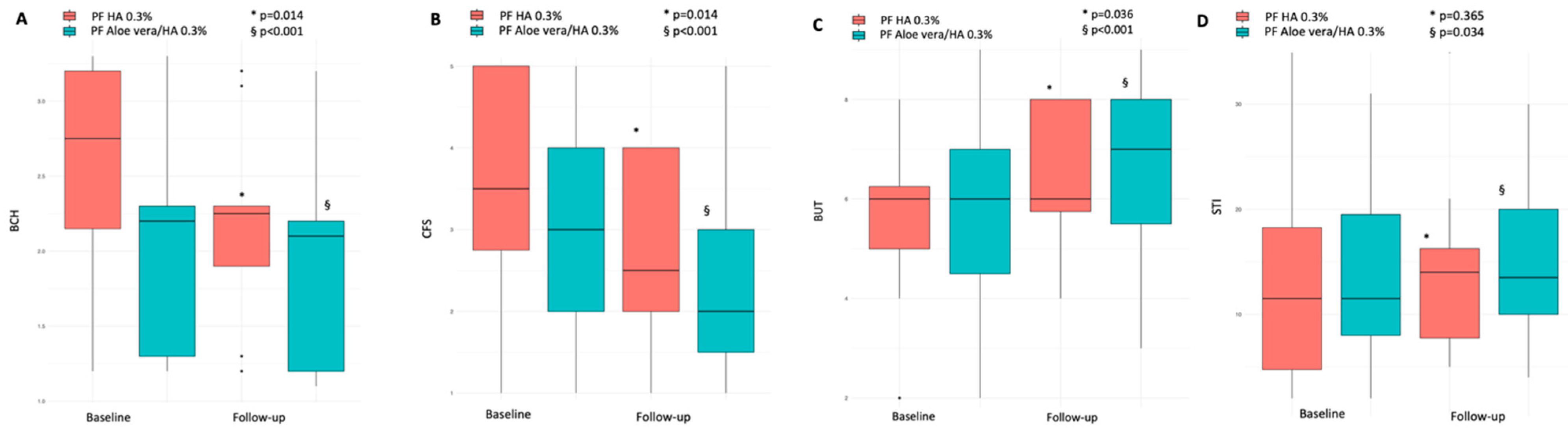
| BCH score (0–5) | 2.75 (3.20–2.15) | 2.25 (2.30–1.90) | 0.014 | 2.2 (2.3–1.3) | 2.1 (2.2–1.2) | <0.001 |
| CFS score (0–5) | 3.5 (5–2.75) | 2.5 (4–2) | 0.014 | 3 (4–2) | 2 (3.0–1.5) | <0.001 |
| BUT (s) | 6 (6.25–5) | 6 (8–5.75) | 0.036 | 5 (7–4.5) | 7 (8–5.5) | <0.001 |
| STI (mm) | 11.5 (18.25–4.75) | 14 (16.25–7.75) | 0.365 | 12 (19.5–8) | 13.5 (20–10) | 0.034 |
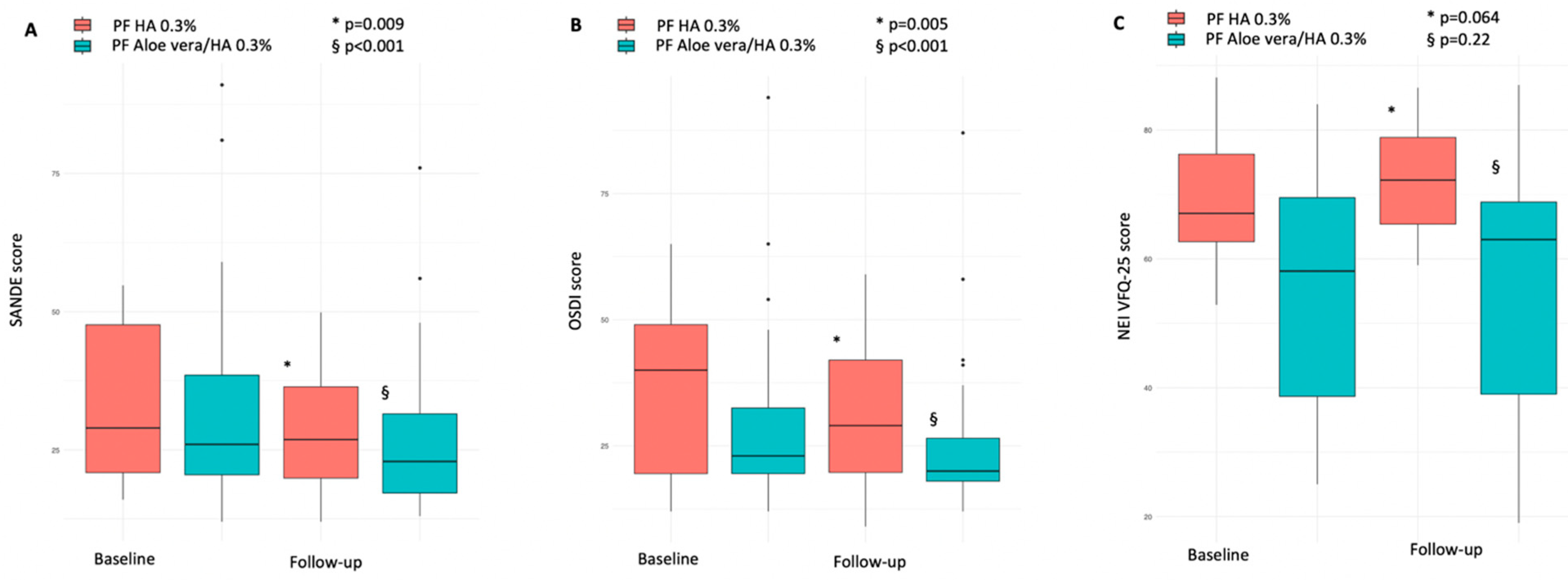
| SANDE score | 28.95 (47.6–20.9) | 26.86 (36.41–19.90) | 0.009 | 36.18 (38.5–20.5) | 22.91 (31.5–17.21) | <0.001 |
| OSDI score | 40 (49–19.5) | 29 (42–19.75) | 0.005 | 29.5 (32.5–19.5) | 20 (26.5–18) | <0.001 |
| NEI VFQ-25 score | 69.05 (76.25–62.67) | 77.22 (78.85–65.40) | 0.064 | 61.56 (69.5–38.65) | 63 (68.82–39) | 0.22 |
| MMP-9 IMMUNOASSAY | 4/8 | 6/6 | 0.479 | 11/16 | 16/11 | 0.0736 |
Disclaimer/Publisher’s Note: The statements, opinions and data contained in all publications are solely those of the individual author(s) and contributor(s) and not of MDPI and/or the editor(s). MDPI and/or the editor(s) disclaim responsibility for any injury to people or property resulting from any ideas, methods, instructions or products referred to in the content. |
© 2026 by the authors. Licensee MDPI, Basel, Switzerland. This article is an open access article distributed under the terms and conditions of the Creative Commons Attribution (CC BY) license.
Share and Cite
Agnifili, L.; Celani, D.; Sferra, A.; Ruggeri, M.L.; Mastropasqua, R.; Figus, M.; Sacchi, M. Clinical Benefits of Aloe vera Gel in 0.3% Hyaluronate Eyedrops in Glaucoma Therapy-Related Ocular Surface Disease. Biomedicines 2026, 14, 186. https://doi.org/10.3390/biomedicines14010186
Agnifili L, Celani D, Sferra A, Ruggeri ML, Mastropasqua R, Figus M, Sacchi M. Clinical Benefits of Aloe vera Gel in 0.3% Hyaluronate Eyedrops in Glaucoma Therapy-Related Ocular Surface Disease. Biomedicines. 2026; 14(1):186. https://doi.org/10.3390/biomedicines14010186
Chicago/Turabian StyleAgnifili, Luca, Davide Celani, Alessandro Sferra, Maria Ludovica Ruggeri, Rodolfo Mastropasqua, Michele Figus, and Matteo Sacchi. 2026. "Clinical Benefits of Aloe vera Gel in 0.3% Hyaluronate Eyedrops in Glaucoma Therapy-Related Ocular Surface Disease" Biomedicines 14, no. 1: 186. https://doi.org/10.3390/biomedicines14010186
APA StyleAgnifili, L., Celani, D., Sferra, A., Ruggeri, M. L., Mastropasqua, R., Figus, M., & Sacchi, M. (2026). Clinical Benefits of Aloe vera Gel in 0.3% Hyaluronate Eyedrops in Glaucoma Therapy-Related Ocular Surface Disease. Biomedicines, 14(1), 186. https://doi.org/10.3390/biomedicines14010186