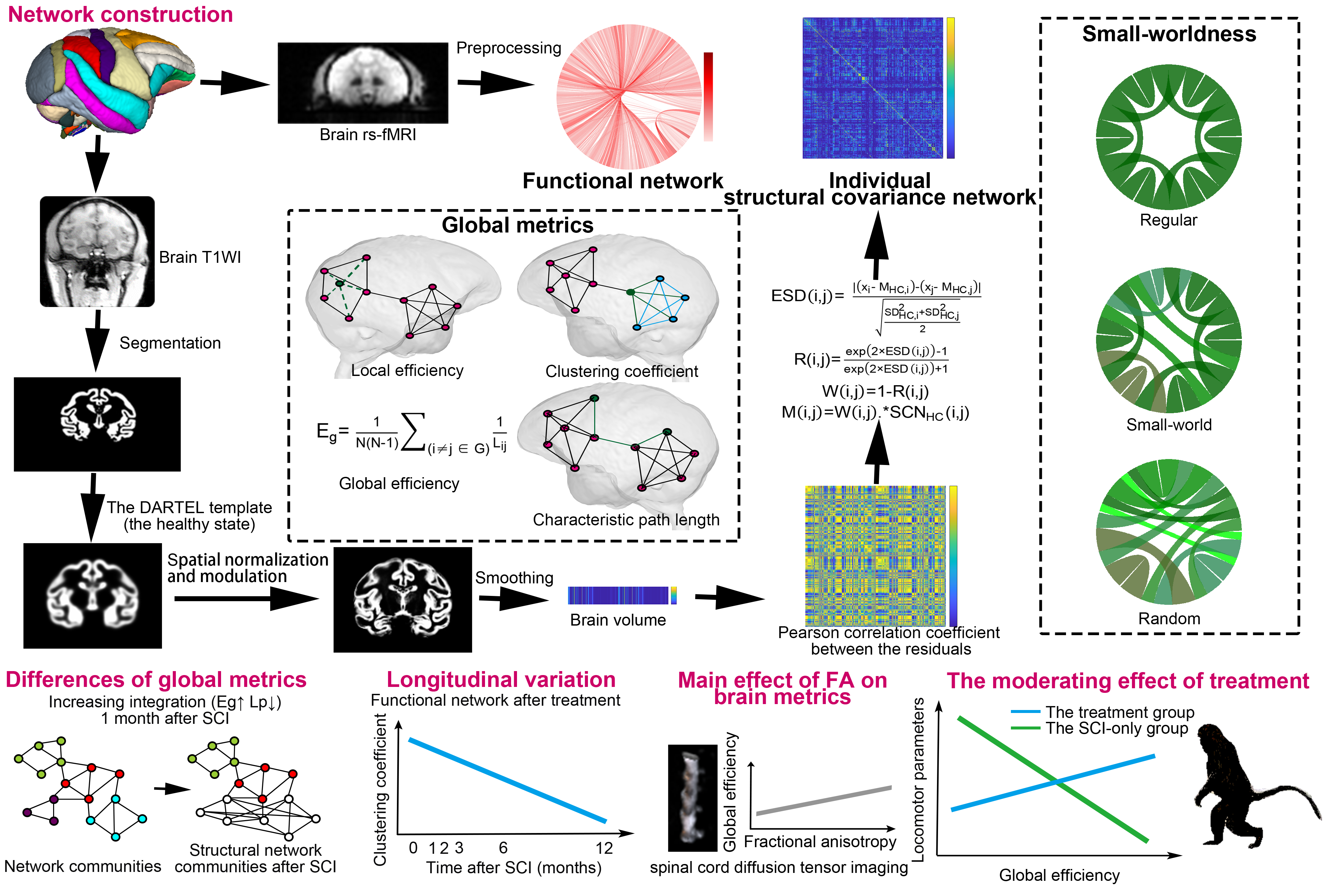
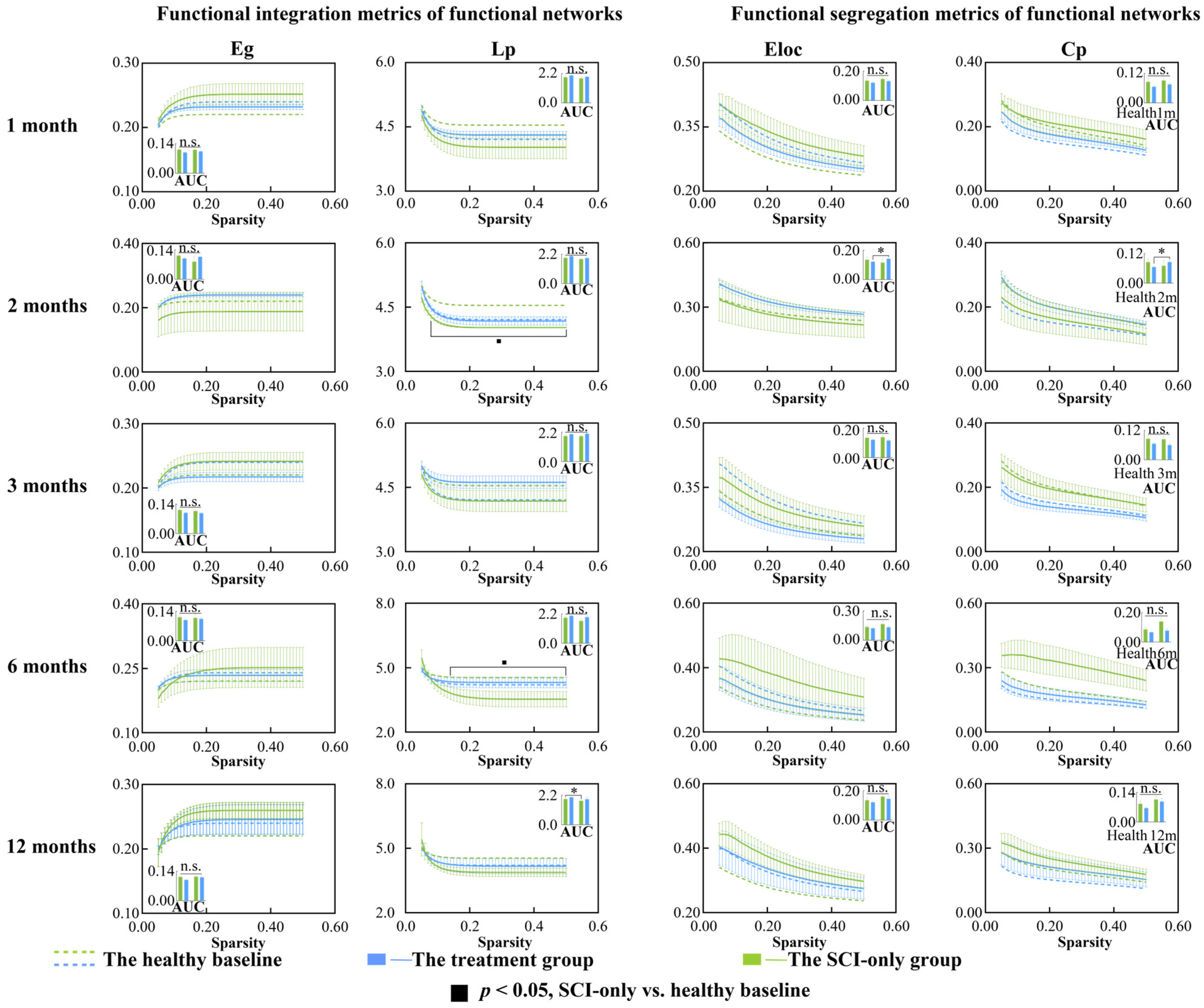
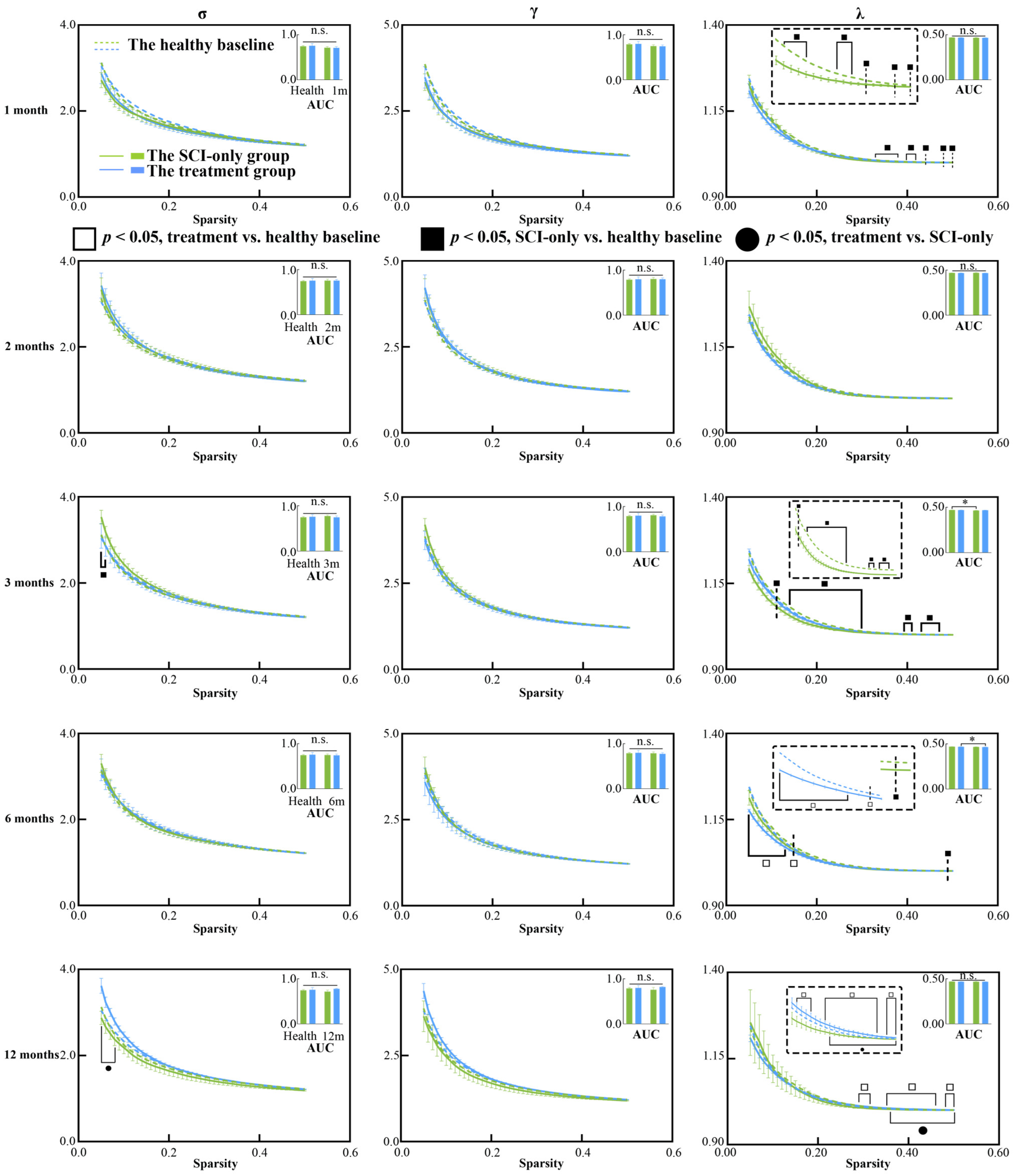
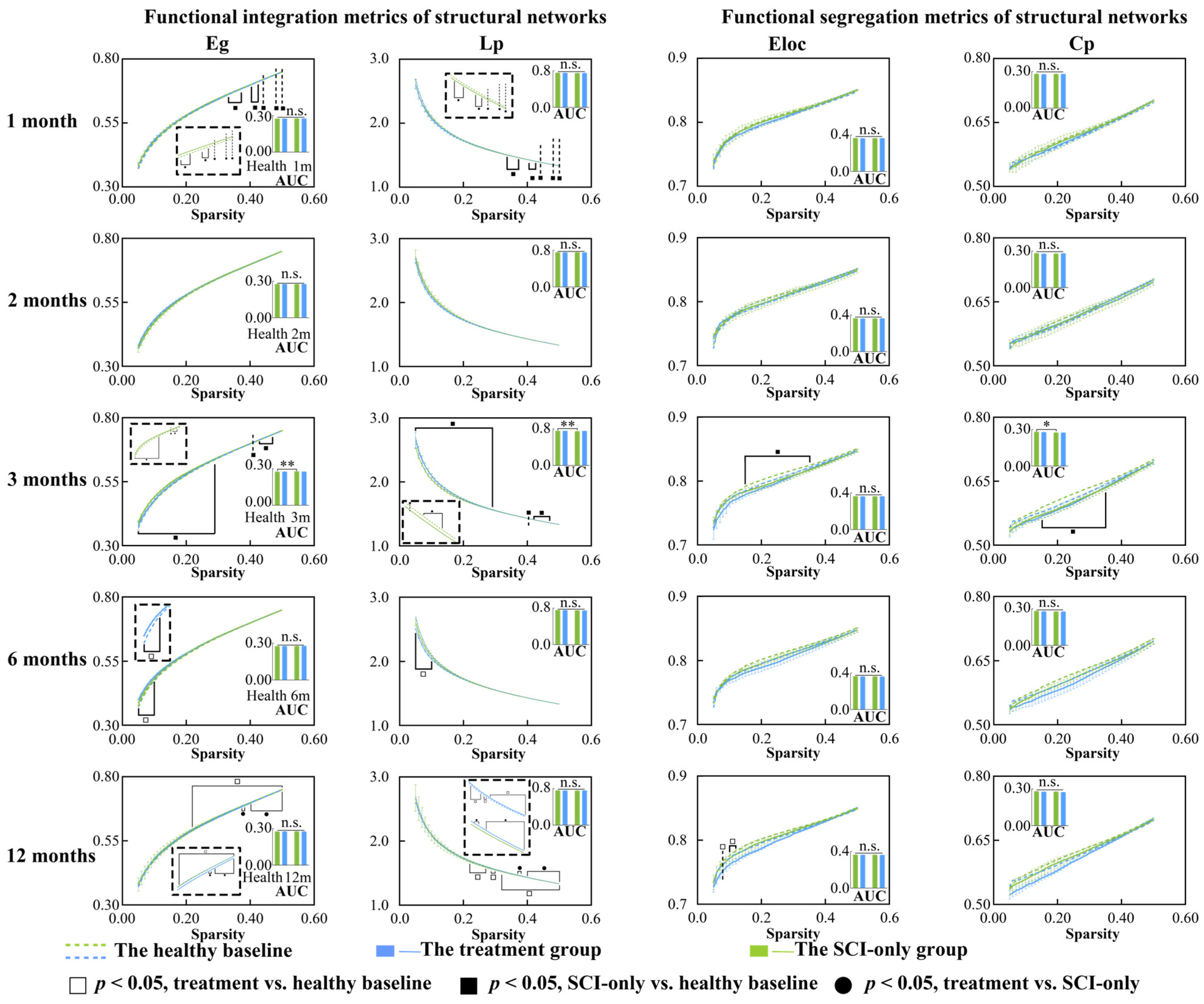
Longitudinal Changes in Brain Network Metrics and Their Correlations with Spinal Cord Diffusion Tensor Imaging Parameters Following Spinal Cord Injury and Regenerative Therapy
 ,
,
Abstract
1. Introduction
2. Materials and Methods
2.1. Spinal Cord Injury Modeling
2.2. MRI Protocol
2.3. Preprocessing of MRI Data
2.4. Functional Network and Structural Covariance Network Construction
2.5. Calculation of Global Metrics and Their Area Under the Curve in Brain Network
2.6. Calculation of Spinal Cord DTI Parameters
2.7. Hindlimb Locomotor Function Evaluation
2.8. Longitudinal Trajectories of Global Metrics
2.9. Linear Mixed-Effects Models Examining the Interaction of Brain Network Metrics and Group on Locomotor Parameters
2.10. Linear Mixed-Effects Models Examining the Interaction of Spinal Cord DTI Parameters and Group on Brain Network Metrics
2.11. Statistical Analysis
3. Results
3.1. SCI Facilitates the Integration of Functional Brain Network
3.2. Regenerative Therapy Reverses the Properties of SCN Disrupted by SCI
3.3. Regenerative Therapy Preserves the Integrity of Spinal Cord Microstructure
3.4. The Integrity of Spinal Cord Microstructure Is Associated with Partial Brain Network Properties
3.5. Regenerative Therapy Continuously Reduces the Cp of SCN
3.6. SCI and Treatment Reconfiguring the Relationship Between Global Metrics and Locomotor Performance
4. Discussion
4.1. Increased Integration of Functional Network After SCI
4.2. Aberrant Integration and Segregation of Structural Networks After SCI
4.3. Correlations Between Global Efficiency of Functional Networks and Fractional Anisotropy
4.4. Consistently Improved Clustering Coefficient over Time After Treatment
4.5. Altered Brain Network-Motor Function Relationship After SCI
4.6. Limitations
Supplementary Materials
Author Contributions
Funding
Institutional Review Board Statement
Data Availability Statement
Acknowledgments
Conflicts of Interest
References
- Leemhuis, E.; De Gennaro, L.; Pazzaglia, A.M. Disconnected Body Representation: Neuroplasticity Following Spinal Cord Injury. J. Clin. Med. 2019, 8, 2144. [Google Scholar] [CrossRef] [Scilit]
- Mohammed, H.; Hollis, E.R., II. Cortical Reorganization of Sensorimotor Systems and the Role of Intracortical Circuits After Spinal Cord Injury. Neurotherapeutics 2018, 15, 588–603. [Google Scholar] [CrossRef] [Scilit]
- Ramu, J.; Bockhorst, K.H.; Mogatadakala, K.V.; Narayana, P.A. Functional magnetic resonance imaging in rodents: Methodology and application to spinal cord injury. J. Neurosci. Res. 2006, 84, 1235–1244. [Google Scholar] [CrossRef] [Scilit]
- Wang, L.; Yang, B.; Zheng, W.; Liang, T.; Chen, X.; Chen, Q.; Du, J.; Lu, J.; Li, B.; Chen, N. Alterations in cortical thickness and volumes of subcortical structures in pediatric patients with complete spinal cord injury. CNS Neurosci. Ther. 2024, 30, e14810. [Google Scholar] [CrossRef] [Scilit]
- Freund, P.; Weiskopf, N.; Ward, N.S.; Hutton, C.; Gall, A.; Ciccarelli, O.; Craggs, M.; Friston, K.; Thompson, A.J. Disability, atrophy and cortical reorganization following spinal cord injury. Brain 2011, 134, 1610–1622. [Google Scholar] [CrossRef] [Scilit]
- Freund, P.; Weiskopf, N.; Ashburner, J.; Wolf, K.; Sutter, R.; Altmann, D.R.; Friston, K.; Thompson, A.; Curt, A. MRI investigation of the sensorimotor cortex and the corticospinal tract after acute spinal cord injury: A prospective longitudinal study. Lancet Neurol. 2013, 12, 873–881. [Google Scholar] [CrossRef] [Scilit]
- Nardone, R.; Holler, Y.; Sebastianelli, L.; Versace, V.; Saltuari, L.; Brigo, F.; Lochner, P.; Trinka, E. Cortical morphometric changes after spinal cord injury. Brain Res. Bull. 2018, 137, 107–119. [Google Scholar] [CrossRef] [Scilit]
- Hou, J.M.; Yan, R.B.; Xiang, Z.M.; Zhang, H.; Liu, J.; Wu, Y.T.; Zhao, M.; Pan, Q.Y.; Song, L.H.; Zhang, W.; et al. Brain sensorimotor system atrophy during the early stage of spinal cord injury in humans. Neuroscience 2014, 266, 208–215. [Google Scholar] [CrossRef] [Scilit]
- Sporns, O. The human connectome: A complex network. Ann. N. Y. Acad. Sci. 2011, 1224, 109–125. [Google Scholar] [CrossRef] [Scilit]
- Matsubayashi, K.; Shinozaki, M.; Hata, J.; Komaki, Y.; Nagoshi, N.; Tsuji, O.; Fujiyoshi, K.; Nakamura, M.; Okano, H. A shift of brain network hub after spinal cord injury. Front. Mol. Neurosci. 2023, 16, 1245902. [Google Scholar] [CrossRef] [Scilit]
- Park, E.; Park, J.W.; Kim, E.; Min, Y.S.; Lee, H.J.; Jung, T.D.; Chang, Y. Effects of Alterations in Resting-State Neural Networks on the Severity of Neuropathic Pain after Spinal Cord Injury. Bioengineering 2023, 10, 860. [Google Scholar] [CrossRef] [Scilit]
- Min, Y.S.; Chang, Y.; Park, J.W.; Lee, J.M.; Cha, J.; Yang, J.J.; Kim, C.H.; Hwang, J.M.; Yoo, J.N.; Jung, T.D. Change of Brain Functional Connectivity in Patients with Spinal Cord Injury: Graph Theory Based Approach. Ann. Rehabil. Med. 2015, 39, 374–383. [Google Scholar] [CrossRef] [Scilit]
- Hawasli, A.H.; Rutlin, J.; Roland, J.L.; Murphy, R.K.J.; Song, S.K.; Leuthardt, E.C.; Shimony, J.S.; Ray, W.Z. Spinal Cord Injury Disrupts Resting-State Networks in the Human Brain. J. Neurotrauma 2018, 35, 864–873. [Google Scholar] [CrossRef] [Scilit]
- Kaushal, M.; Oni-Orisan, A.; Chen, G.; Li, W.; Leschke, J.; Ward, D.; Kalinosky, B.; Budde, M.; Schmit, B.; Li, S.J.; et al. Large-Scale Network Analysis of Whole-Brain Resting-State Functional Connectivity in Spinal Cord Injury: A Comparative Study. Brain Connect. 2017, 7, 413–423. [Google Scholar] [CrossRef] [Scilit]
- Alizadeh, M.; Manmatharayan, A.R.; Johnston, T.; Thalheimer, S.; Finley, M.; Detloff, M.; Sharan, A.; Harrop, J.; Newburg, A.; Krisa, L.; et al. Graph theoretical structural connectome analysis of the brain in patients with chronic spinal cord injury: Preliminary investigation. Spinal Cord. Ser. Cases 2021, 7, 60. [Google Scholar] [CrossRef] [Scilit]
- Wang, W.L.; Li, Y.L.; Zheng, M.X.; Hua, X.Y.; Wu, J.J.; Yang, F.F.; Yang, N.; He, X.; Ao, L.J.; Xu, J.G. Altered Topological Properties of Grey Matter Structural Covariance Networks in Complete Thoracic Spinal Cord Injury Patients: A Graph Theoretical Network Analysis. Neural Plast. 2021, 2021, 8815144. [Google Scholar] [CrossRef] [Scilit]
- de Schipper, L.J.; van der Grond, J.; Marinus, J.; Henselmans, J.M.L.; van Hilten, J.J. Loss of integrity and atrophy in cingulate structural covariance networks in Parkinson’s disease. Neuroimage Clin. 2017, 15, 587–593. [Google Scholar] [CrossRef] [Scilit]
- Li, K.; Luo, X.; Zeng, Q.; Huang, P.; Shen, Z.; Xu, X.; Xu, J.; Wang, C.; Zhou, J.; Zhang, M.; et al. Gray matter structural covariance networks changes along the Alzheimer’s disease continuum. Neuroimage Clin. 2019, 23, 101828. [Google Scholar] [CrossRef] [Scilit]
- Yang, B.; Xin, H.; Wang, L.; Qi, Q.; Wang, Y.; Jia, Y.; Zheng, W.; Sun, C.; Chen, X.; Du, J.; et al. Distinct brain network patterns in complete and incomplete spinal cord injury patients based on graph theory analysis. CNS Neurosci. Ther. 2024, 30, e14910. [Google Scholar] [CrossRef] [Scilit]
- Simpson, L.A.; Eng, J.J.; Hsieh, J.T.; Wolfe, D.L.; Spinal Cord Injury Rehabilitation Evidence (SCIRE) Research Team. The health and life priorities of individuals with spinal cord injury: A systematic review. J. Neurotrauma 2012, 29, 1548–1555. [Google Scholar] [CrossRef] [Scilit]
- Yang, Z.; Zhang, A.; Duan, H.; Zhang, S.; Hao, P.; Ye, K.; Sun, Y.E.; Li, X. NT3-chitosan elicits robust endogenous neurogenesis to enable functional recovery after spinal cord injury. Proc. Natl. Acad. Sci. USA 2015, 112, 13354–13359. [Google Scholar] [CrossRef] [Scilit]
- Rao, J.S.; Zhao, C.; Zhang, A.; Duan, H.; Hao, P.; Wei, R.H.; Shang, J.; Zhao, W.; Liu, Z.; Yu, J.; et al. NT3-chitosan enables de novo regeneration and functional recovery in monkeys after spinal cord injury. Proc. Natl. Acad. Sci. USA 2018, 115, E5595–E5604. [Google Scholar] [CrossRef] [Scilit]
- Li, X.; Yang, Z.; Zhang, A.; Wang, T.; Chen, W. Repair of thoracic spinal cord injury by chitosan tube implantation in adult rats. Biomaterials 2009, 30, 1121–1132. [Google Scholar] [CrossRef] [Scilit]
- Rohlfing, T.; Kroenke, C.D.; Sullivan, E.V.; Dubach, M.F.; Bowden, D.M.; Grant, K.A.; Pfefferbaum, A. The INIA19 Template and NeuroMaps Atlas for Primate Brain Image Parcellation and Spatial Normalization. Front. Neuroinform 2012, 6, 27. [Google Scholar] [CrossRef] [Scilit]
- Murphy, K.; Fox, M.D. Towards a consensus regarding global signal regression for resting state functional connectivity MRI. NeuroImage 2017, 154, 169–173. [Google Scholar] [CrossRef] [Scilit]
- Walhovd, K.B.; Westlye, L.T.; Amlien, I.; Espeseth, T.; Reinvang, I.; Raz, N.; Agartz, I.; Salat, D.H.; Greve, D.N.; Fischl, B.; et al. Consistent neuroanatomical age-related volume differences across multiple samples. Neurobiol. Aging 2011, 32, 916–932. [Google Scholar] [CrossRef] [Scilit]
- Huang, S.Y.; Hsu, J.L.; Lin, K.J.; Hsiao, I.T. A Novel Individual Metabolic Brain Network for 18F-FDG PET Imaging. Front. Neurosci. 2020, 14, 344. [Google Scholar] [CrossRef] [Scilit]
- Sporns, O. Networks of the Brain; The MIT Press: Cambridge, MA, USA, 2010. [Google Scholar]
- Garrison, K.A.; Scheinost, D.; Finn, E.S.; Shen, X.; Constable, R.T. The (in)stability of functional brain network measures across thresholds. NeuroImage 2015, 118, 651–661. [Google Scholar] [CrossRef] [Scilit]
- Zhu, J.; Xu, C.; Zhang, X.; Qiao, L.; Wang, X.; Zhang, X.; Yan, X.; Ni, D.; Yu, T.; Zhang, G.; et al. Altered topological properties of brain functional networks in drug-resistant epilepsy patients with vagus nerve stimulators. Seizure 2021, 92, 149–154. [Google Scholar] [CrossRef] [Scilit]
- Zhang, W.; Zhao, W.; Wang, J.; Xu, Q.; Li, S.; Yin, C. Imaging Diagnosis of Central Nervous System Damage in Patients with T2DM. Neurosci. Lett. 2020, 733, 135092. [Google Scholar] [CrossRef] [Scilit]
- Amarasinghe, A.; Wijewickrama, D.; De Fonseka, I.; Lawanya, M.; Fernando, W.; Wishwanthi, D.; Senanayake, G.; Pushpakumara, S.; Arachchi, W.M.E. Graph Theory Structural brain network topology in migraine vs. healthy subjects: A graph theory study. J. Natl. Sci. Found. Sri Lanka 2024, 52, 321–330. [Google Scholar] [CrossRef] [Scilit]
- Kaiser, M.; Hilgetag, C.C. Nonoptimal component placement, but short processing paths, due to long-distance projections in neural systems. PLoS Comput. Biol. 2006, 2, e95. [Google Scholar] [CrossRef] [Scilit]
- Hosseini, S.M.; Hoeft, F.; Kesler, S.R. GAT: A graph-theoretical analysis toolbox for analyzing between-group differences in large-scale structural and functional brain networks. PLoS ONE 2012, 7, e40709. [Google Scholar] [CrossRef] [Scilit]
- Zhang, J.; Wang, J.; Wu, Q.; Kuang, W.; Huang, X.; He, Y.; Gong, Q. Disrupted brain connectivity networks in drug-naive, first-episode major depressive disorder. Biol. Psychiatry 2011, 70, 334–342. [Google Scholar] [CrossRef] [Scilit]
- De Leener, B.; Levy, S.; Dupont, S.M.; Fonov, V.S.; Stikov, N.; Louis Collins, D.; Callot, V.; Cohen-Adad, J. SCT: Spinal Cord Toolbox, an open-source software for processing spinal cord MRI data. Neuroimage 2017, 145, 24–43. [Google Scholar] [CrossRef] [Scilit]
- Yeo, B.T.; Vercauteren, T.; Fillard, P.; Peyrat, J.M.; Pennec, X.; Golland, P.; Ayache, N.; Clatz, O. DT-REFinD: Diffusion tensor registration with exact finite-strain differential. IEEE Trans. Med. Imaging 2009, 28, 1914–1928. [Google Scholar] [CrossRef] [Scilit]
- Rao, J.S.; Liu, Z.; Zhao, C.; Wei, R.H.; Liu, R.X.; Zhao, W.; Zhou, X.; Tian, P.Y.; Yang, Z.Y.; Li, X.G. Image correction for diffusion tensor imaging of Rhesus monkey thoracic spinal cord. J. Med. Primatol. 2019, 48, 320–328. [Google Scholar] [CrossRef] [Scilit]
- Alizadeh, M.; Fisher, J.; Saksena, S.; Sultan, Y.; Conklin, C.J.; Middleton, D.M.; Finsterbusch, J.; Krisa, L.; Flanders, A.E.; Faro, S.H.; et al. Reduced Field of View Diffusion Tensor Imaging and Fiber Tractography of the Pediatric Cervical and Thoracic Spinal Cord Injury. J. Neurotrauma 2018, 35, 452–460. [Google Scholar] [CrossRef] [Scilit]
- Wood, S.N. Fast stable restricted maximum likelihood and marginal likelihood estimation of semiparametric generalized linear models. J. R. Stat. Soc. Ser. B-Stat. Methodol. 2011, 73, 3–36. [Google Scholar] [CrossRef] [Scilit]
- Liu, J.; Huang, M.; Hu, K.; Xia, N.; Linli, Z. Functional Alterations in Gray Matter Networks Mediated by White Matter During the Aging Process. J. Neuroimaging 2025, 35, e70036. [Google Scholar] [CrossRef] [Scilit]
- Nakagawa, S.; Johnson, P.C.D.; Schielzeth, H. The coefficient of determination R2 and intra-class correlation coefficient from generalized linear mixed-effects models revisited and expanded. J. R. Soc. Interface 2017, 14, 20170213. [Google Scholar] [CrossRef] [Scilit] [PubMed]
- Selya, A.S.; Rose, J.S.; Dierker, L.C.; Hedeker, D.; Mermelstein, R.J. A Practical Guide to Calculating Cohen’s f2, a Measure of Local Effect Size, from PROC MIXED. Front. Psychol. 2012, 3, 111. [Google Scholar] [CrossRef] [Scilit] [PubMed]
- Cohen, J. Statistical Power Analysis for the Behavioral Sciences; Routledge: London, UK, 1988. [Google Scholar]
- Bullmore, E.; Sporns, O. Complex brain networks: Graph theoretical analysis of structural and functional systems. Nat. Rev. Neurosci. 2009, 10, 186–198, Erratum in Nat. Rev. Neurosci. 2009, 10, 312. [Google Scholar] [CrossRef] [Scilit] [PubMed]
- Rubinov, M.; Sporns, O. Complex network measures of brain connectivity: Uses and interpretations. Neuroimage 2010, 52, 1059–1069. [Google Scholar] [CrossRef] [Scilit]
- Achard, S.; Bullmore, E. Efficiency and cost of economical brain functional networks. PLoS Comput. Biol. 2007, 3, e17. [Google Scholar] [CrossRef] [Scilit]
- Hasan, M.A.; Sattar, P.; Qazi, S.A.; Fraser, M.; Vuckovic, A. Brain Networks with Modified Connectivity in Patients with Neuropathic Pain and Spinal Cord Injury. Clin. EEG Neurosci. 2024, 55, 88–100. [Google Scholar] [CrossRef] [Scilit]
- Lv, H.; Wang, Z.; Tong, E.; Williams, L.M.; Zaharchuk, G.; Zeineh, M.; Goldstein-Piekarski, A.N.; Ball, T.M.; Liao, C.; Wintermark, M. Resting-State Functional MRI: Everything That Nonexperts Have Always Wanted to Know. Am. J. Neuroradiol. 2018, 39, 1390–1399. [Google Scholar] [CrossRef] [Scilit]
- Stam, C.; Jones, B.; Nolte, G.; Breakspear, M.; Scheltens, P. Small-World Networks and Functional Connectivity in Alzheimer’s Disease. Cereb. Cortex 2006, 17, 92–99. [Google Scholar] [CrossRef] [Scilit]
- Li, Y.; Cheng, P.; Liang, L.; Dong, H.; Liu, H.; Shen, W.; Zhou, W. Abnormal resting-state functional connectome in methamphetamine-dependent patients and its application in machine-learning-based classification. Front. Neurosci. 2022, 16, 1014539. [Google Scholar] [CrossRef] [Scilit]
- Latora, V.; Marchiori, M. Efficient behavior of small-world networks. Phys. Rev. Lett. 2001, 87, 198701. [Google Scholar] [CrossRef] [Scilit]
- Jiang, W.; Zhao, Z.; Wu, Q.; Wang, L.; Zhou, L.; Li, D.; He, L.; Tan, Y. Study on brain structure network of patients with delayed encephalopathy after carbon monoxide poisoning: Based on diffusion tensor imaging. Radiol. Med. 2021, 126, 133–141. [Google Scholar] [CrossRef] [Scilit] [PubMed]
- Kuang, C.; Zha, Y.; Liu, C.; Chen, J. Altered Topological Properties of Brain Structural Covariance Networks in Patients with Cervical Spondylotic Myelopathy. Front. Hum. Neurosci. 2020, 14, 364. [Google Scholar] [CrossRef] [Scilit] [PubMed]
- Ping, L.; Sun, S.; Zhou, C.; Que, J.; You, Z.; Xu, X.; Cheng, Y.; Consortium, D. Altered topology of individual brain structural covariance networks in major depressive disorder. Psychol. Med. 2023, 53, 6921–6932, Erratum in Psychol. Med. 2023, 53, 6944. [Google Scholar] [CrossRef] [Scilit] [PubMed]
- Muller, L.; Destexhe, A.; Rudolph-Lilith, M. Brain networks: Small-worlds, after all? New J. Phys. 2014, 16, 105004. [Google Scholar] [CrossRef] [Scilit]
- Bassett, D.S.; Bullmore, E.T. Small-World Brain Networks Revisited. Neuroscientist 2017, 23, 499–516. [Google Scholar] [CrossRef] [Scilit]
- Wang, P.; Li, W.; Zhu, H.; Liu, X.; Yu, T.; Zhang, D.; Zhang, Y. Reorganization of the Brain Structural Covariance Network in Ischemic Moyamoya Disease Revealed by Graph Theoretical Analysis. Front. Aging Neurosci. 2022, 14, 788661. [Google Scholar] [CrossRef] [Scilit]
- Tan, Y.; Zhou, F.; Wu, L.; Liu, Z.; Zeng, X.; Gong, H.; He, L. Alteration of Regional Homogeneity within the Sensorimotor Network after Spinal Cord Decompression in Cervical Spondylotic Myelopathy: A Resting-State fMRI Study. Biomed. Res. Int. 2015, 2015, 647958. [Google Scholar] [CrossRef] [Scilit]
- Bhagavatula, I.D.; Shukla, D.; Sadashiva, N.; Saligoudar, P.; Prasad, C.; Bhat, D.I. Functional cortical reorganization in cases of cervical spondylotic myelopathy and changes associated with surgery. Neurosurg. Focus 2016, 40, E2. [Google Scholar] [CrossRef] [Scilit]
- Yang, B.; Zheng, W.; Wang, L.; Jia, Y.; Qi, Q.; Xin, H.; Wang, Y.; Liang, T.; Chen, X.; Chen, Q.; et al. Specific Alterations in Brain White Matter Networks and Their Impact on Clinical Function in Pediatric Patients with Thoracolumbar Spinal Cord Injury. J. Magn. Reson. Imaging 2024, 60, 1842–1852. [Google Scholar] [CrossRef] [Scilit]
- Bueler, S.; Anderson, C.E.; Birkhauser, V.; Freund, P.; Gross, O.; Kessler, T.M.; Kundig, C.W.; Leitner, L.; Mahnoor, N.; Mehnert, U.; et al. Remote neurodegeneration in the lumbosacral cord one month after spinal cord injury: A cross-sectional MRI study. Ann. Clin. Transl. Neurol. 2025, 12, 523–537. [Google Scholar] [CrossRef] [Scilit]
- Li, J.; Zhao, X.; Shan, Y.; Shan, G.; Wei, P.H.; Liu, L.; Wang, C.; Wu, H.; Song, W.; Tang, Y.; et al. Quantitative MRI of the Spinal Cord and Brain in Chronic Traumatic Spinal Cord Injury: In Vivo Assessment of Structural Changes. J. Neurosci. Res. 2025, 103, e70030. [Google Scholar] [CrossRef] [Scilit]
- Ellingson, B.M.; Salamon, N.; Hardy, A.J.; Holly, L.T. Prediction of Neurological Impairment in Cervical Spondylotic Myelopathy using a Combination of Diffusion MRI and Proton MR Spectroscopy. PLoS ONE 2015, 10, e0139451. [Google Scholar] [CrossRef] [Scilit] [PubMed]
- Chernov, A.S.; Minakov, A.N.; Rodionov, M.V.; Meshcheryakov, F.A.; Malyavina, E.V.; Spallone, A.; Telegin, G.B. DTI-MRI at 2 days after spinal cord injury accurately predicts long-term locomotor function recovery in rats. Eur. Rev. Med. Pharmacol. Sci. 2024, 28, 3650–3657. [Google Scholar] [CrossRef] [Scilit] [PubMed]
- Klawiter, E.C.; Schmidt, R.E.; Trinkaus, K.; Liang, H.-F.; Budde, M.D.; Naismith, R.T.; Song, S.-K.; Cross, A.H.; Benzinger, T.L. Radial diffusivity predicts demyelination in ex vivo multiple sclerosis spinal cords. NeuroImage 2011, 55, 1454–1460. [Google Scholar] [CrossRef] [Scilit]
- Bosemani, T.; Orman, G.; Carson, K.A.; Meoded, A.; Huisman, T.A.G.M.; Poretti, A. Diffusion tensor imaging of the brainstem in children with achondroplasia. Dev. Med. Child. Neurol. 2014, 56, 1085–1092. [Google Scholar] [CrossRef] [Scilit] [PubMed]
- Duan, H.; Ge, W.; Zhang, A.; Xi, Y.; Chen, Z.; Luo, D.; Cheng, Y.; Fan, K.S.; Horvath, S.; Sofroniew, M.V.; et al. Transcriptome analyses reveal molecular mechanisms underlying functional recovery after spinal cord injury. Proc. Natl. Acad. Sci. USA 2015, 112, 13360–13365. [Google Scholar] [CrossRef] [Scilit]
- Morris, S.; Swift-LaPointe, T.; Yung, A.; Prevost, V.; George, S.; Bauman, A.; Kozlowski, P.; Samadi-Bahrami, Z.; Fournier, C.; Mattu, P.S.; et al. Advanced Magnetic Resonance Imaging Biomarkers of the Injured Spinal Cord: A Comparative Study of Imaging and Histology in Human Traumatic Spinal Cord Injury. J. Neurotrauma 2024, 41, 1223–1239. [Google Scholar] [CrossRef] [Scilit]
- Milham, M.P.; Ai, L.; Koo, B.; Xu, T.; Amiez, C.; Balezeau, F.; Baxter, M.G.; Blezer, E.L.A.; Brochier, T.; Chen, A.; et al. An Open Resource for Non-human Primate Imaging. Neuron 2018, 100, 61–74.e2. [Google Scholar] [CrossRef] [Scilit]
- Autio, J.A.; Zhu, Q.; Li, X.; Glasser, M.F.; Schwiedrzik, C.M.; Fair, D.A.; Zimmermann, J.; Yacoub, E.; Menon, R.S.; Van Essen, D.C.; et al. Minimal specifications for non-human primate MRI: Challenges in standardizing and harmonizing data collection. Neuroimage 2021, 236, 118082. [Google Scholar] [CrossRef] [Scilit]
- Watts, D.J.; Strogatz, S.H.J.N. Collective dynamics of ‘small-world’ networks. Nature 1998, 393, 440–442. [Google Scholar] [CrossRef] [Scilit]
- Hutson, T.H.; Di Giovanni, S. The translational landscape in spinal cord injury: Focus on neuroplasticity and regeneration. Nat. Rev. Neurol. 2019, 15, 732–745. [Google Scholar] [CrossRef] [Scilit]
- Song, H.J.; Ming, G.L.; Poo, M.M. cAMP-induced switching in turning direction of nerve growth cones. Nature 1997, 388, 275–279, Erratum in Nature 1997, 389, 412. [Google Scholar] [CrossRef] [Scilit]
- Huang, E.J.; Reichardt, L.F. Trk receptors: Roles in neuronal signal transduction. Annu. Rev. Biochem. 2003, 72, 609–642. [Google Scholar] [CrossRef] [Scilit]
- Ailiani, A.C.; Neuberger, T.; Brasseur, J.G.; Banco, G.; Wang, Y.; Smith, N.B.; Webb, A.G. Quantifying the effects of inactin vs. Isoflurane anesthesia on gastrointestinal motility in rats using dynamic magnetic resonance imaging and spatio-temporal maps. Neurogastroenterol. Motil. 2014, 26, 1477–1486. [Google Scholar] [CrossRef] [Scilit] [PubMed]
- Paasonen, J.; Salo, R.A.; Shatillo, A.; Forsberg, M.M.; Narvainen, J.; Huttunen, J.K.; Grohn, O. Comparison of seven different anesthesia protocols for nicotine pharmacologic magnetic resonance imaging in rat. Eur. Neuropsychopharmacol. 2016, 26, 518–531. [Google Scholar] [CrossRef] [Scilit] [PubMed]
- Bonhomme, V.; Staquet, C.; Montupil, J.; Defresne, A.; Kirsch, M.; Martial, C.; Vanhaudenhuyse, A.; Chatelle, C.; Larroque, S.K.; Raimondo, F.; et al. General Anesthesia: A Probe to Explore Consciousness. Front. Syst. Neurosci. 2019, 13, 36. [Google Scholar] [CrossRef] [Scilit] [PubMed]
- Vedaei, F.; Alizadeh, M.; Romo, V.; Mohamed, F.B.; Wu, C. The effect of general anesthesia on the test-retest reliability of resting-state fMRI metrics and optimization of scan length. Front. Neurosci. 2022, 16, 937172. [Google Scholar] [CrossRef] [Scilit]
- LaHuis, D.M.; Hartman, M.J.; Hakoyama, S.; Clark, P.C. Explained Variance Measures for Multilevel Models. Organ. Res. Methods 2014, 17, 433–451. [Google Scholar] [CrossRef] [Scilit]
- Snijders, T.; Bosker, R. Multilevel Analysis: An Introduction to Basic and Advanced Multilevel Modeling; SAGE Publications: London, UK, 1999. [Google Scholar]


Disclaimer/Publisher’s Note: The statements, opinions and data contained in all publications are solely those of the individual author(s) and contributor(s) and not of MDPI and/or the editor(s). MDPI and/or the editor(s) disclaim responsibility for any injury to people or property resulting from any ideas, methods, instructions or products referred to in the content. |
© 2025 by the authors. Licensee MDPI, Basel, Switzerland. This article is an open access article distributed under the terms and conditions of the Creative Commons Attribution (CC BY) license (https://creativecommons.org/licenses/by/4.0/).
Share and Cite
Feng, T.; Zhao, C.; Su, W.-N.; Gao, Y.-M.; Wu, Y.-Y.; Zhao, W.; Rao, J.-S.; Yang, Z.-Y.; Li, X.-G. Longitudinal Changes in Brain Network Metrics and Their Correlations with Spinal Cord Diffusion Tensor Imaging Parameters Following Spinal Cord Injury and Regenerative Therapy. Biomedicines 2025, 13, 3124. https://doi.org/10.3390/biomedicines13123124
Feng T, Zhao C, Su W-N, Gao Y-M, Wu Y-Y, Zhao W, Rao J-S, Yang Z-Y, Li X-G. Longitudinal Changes in Brain Network Metrics and Their Correlations with Spinal Cord Diffusion Tensor Imaging Parameters Following Spinal Cord Injury and Regenerative Therapy. Biomedicines. 2025; 13(12):3124. https://doi.org/10.3390/biomedicines13123124
Chicago/Turabian StyleFeng, Ting, Can Zhao, Wen-Nan Su, Yi-Meng Gao, Yuan-Yuan Wu, Wen Zhao, Jia-Sheng Rao, Zhao-Yang Yang, and Xiao-Guang Li. 2025. "Longitudinal Changes in Brain Network Metrics and Their Correlations with Spinal Cord Diffusion Tensor Imaging Parameters Following Spinal Cord Injury and Regenerative Therapy" Biomedicines 13, no. 12: 3124. https://doi.org/10.3390/biomedicines13123124
APA StyleFeng, T., Zhao, C., Su, W.-N., Gao, Y.-M., Wu, Y.-Y., Zhao, W., Rao, J.-S., Yang, Z.-Y., & Li, X.-G. (2025). Longitudinal Changes in Brain Network Metrics and Their Correlations with Spinal Cord Diffusion Tensor Imaging Parameters Following Spinal Cord Injury and Regenerative Therapy. Biomedicines, 13(12), 3124. https://doi.org/10.3390/biomedicines13123124