


Abstract
Background/Objectives: Immune checkpoint inhibitors (ICIs) have transformed cancer therapy; however, their efficacy varies among patients. Eosinophils have been reported as prognostic markers in chemotherapy-treated pancreatic cancer; however, these studies are limited mainly to single cancer types and relatively small cohorts. Therefore, we aimed to examine the relationship between eosinophil count and the effectiveness of ICIs across various cancer types. Methods: We retrospectively analyzed 138 patients treated with ICI monotherapy, ICI plus chemotherapy, or chemotherapy alone at our institution between December 2015 and September 2024. Peripheral blood parameters, including eosinophil counts and albumin levels, were collected at baseline and after two cycles of treatment. Associations between overall survival (OS) and progression-free survival (PFS) were assessed using Kaplan–Meier analysis and Cox proportional hazards regression. Results: In the ICI monotherapy group, patients with higher baseline eosinophil counts had significantly longer OS (HR 0.26, p = 0.007) and PFS (HR 0.30, p = 0.005). No significant associations were observed between the ICI plus chemotherapy and chemotherapy-alone groups. Changes in eosinophil counts between baseline and after two cycles were not associated with outcomes in any group. Conclusions: Baseline eosinophil counts were significantly associated with survival outcomes in patients receiving ICI monotherapy and may serve as a promising predictive biomarker.
1. Introduction
Immune checkpoint inhibitors (ICIs) targeting programmed cell death-1 (PD-1), programmed death ligand-1 (PD-L1), and cytotoxic T-lymphocyte-associated protein 4 (CTLA-4) have revolutionized cancer therapy by restoring antitumor immunity. Immune checkpoint inhibitors (ICIs) provide durable clinical responses in a subset of patients with cancer. Although programmed death ligand 1 (PD-L1) expression is used as a biomarker, its predictive power is limited, necessitating the identification of more accurate and broadly applicable indicators. Biomarkers derived from tumor tissue are often limited by sampling heterogeneity, cost, and time-consuming analysis. Consequently, attention has shifted toward peripheral blood indicators that can capture real-time systemic immunity. Other markers, such as the neutrophil-to-lymphocyte ratio (NLR) and serum albumin levels, have been investigated as predictors, but none have been universally validated [1,2,3,4,5,6]. Moreover, the mechanisms underlying ICI efficacy remain unclear. The antitumor activity of ICIs largely depends on the pre-existing immune landscape of the host. Tumors with abundant immune infiltration, particularly by activated CD8+ T cells, tend to respond more favorably to checkpoint blockade. However, quantifying tumor immune contexture requires invasive biopsies and is often hindered by spatial heterogeneity. Peripheral blood, in contrast, provides a dynamic and easily obtainable window into systemic immunity. Parameters such as lymphocyte subsets, monocytes, and eosinophils can mirror the tumor microenvironment and offer real-time insights into immune activation. Recent studies have emphasized the prognostic importance of peripheral immune signatures, including ratios such as lymphocyte-to-monocyte or platelet-to-lymphocyte, reflecting the host’s inflammatory and nutritional status. These findings suggest that comprehensive immune profiling of peripheral blood may serve as a surrogate for tissue-based immunological assessment, particularly in patients where tumor sampling is limited or unfeasible.
Eosinophils, traditionally recognized for their roles in allergic responses and parasitic infections, have recently attracted increasing attention in tumor immunology. Several studies on non-small-cell lung cancer, urothelial carcinoma, and melanoma have linked higher baseline eosinophil counts to improved survival in patients treated with ICIs [7,8,9,10]. Additionally, associations between eosinophils and immune-related adverse events (irAEs) have been described [9,10,11]. Eosinophils have also been reported as prognostic markers in chemotherapy-treated pancreatic cancer, underscoring their broad clinical relevance [12]. As demonstrated in the studies mentioned above, several studies have highlighted associations between peripheral immune cell composition and therapeutic efficacy. Incorporating such easily measurable hematological indicators into clinical evaluation may broaden the ability to predict responses to immune checkpoint inhibitors (ICIs) beyond conventional tissue-based biomarkers. However, these studies are mainly limited to single cancer types and relatively small cohorts.
We hypothesized that baseline eosinophil levels, reflecting innate immune readiness, could serve as an integrative biomarker predicting ICI responsiveness irrespective of tumor origin. To test this hypothesis, we aimed to clarify the association between baseline eosinophil counts and ICI efficacy across multiple cancer types.
2. Materials and Methods
2.1. Study Design and Patients
We retrospectively reviewed the data of 138 patients treated at our hospital between December 2015 and September 2024. Eligible cancer types included lung, gastric, esophageal, colorectal, melanoma, and pancreatic cancers. Patients were categorized into three groups: ICI monotherapy (n = 37), ICI plus chemotherapy (n = 48), and chemotherapy alone (n = 53) (Table 1). Informed consent for participation in the study was obtained from all patients.
Table 1.
Baseline Characteristics of the Study Population.
2.2. Data Collection
Peripheral blood data obtained at baseline and after two cycles included white blood cell counts, eosinophils (both absolute and percentage), lymphocytes, monocytes, and albumin levels. Performance status (PS), sex, and occurrence of immune-related adverse events (irAEs; classified according to CTCAE) were also recorded. To evaluate whether post-treatment changes in eosinophil counts were associated with clinical outcomes, we assessed eosinophil dynamics between before treatment initiation and after two cycles. Eosinophil “increase” was defined as a higher eosinophil count at the beginning of cycle 3 compared with the value measured immediately before cycle 1, whereas “decrease” was defined as a lower value at cycle 3 than at baseline.
2.3. Outcomes and Statistical Analysis
The primary endpoints were overall survival (OS) and progression-free survival (PFS). Survival distributions were estimated using the Kaplan–Meier method and compared using the log-rank test. Hazard ratios (HRs) and 95% confidence intervals (CIs) were calculated using Cox proportional hazards regression models.
Variables were dichotomized based on their median values, except for PS, irAEs, and sex. PS was categorized into favorable (0–1) and unfavorable (2–3) groups. IrAEs were classified as present or absent, and sex was analyzed as male or female.
Variables with a p value < 0.10 in the univariable analysis were subsequently included in the multivariable Cox regression. In addition, clinically relevant factors, including age, sex, and PS, were incorporated into the multivariate model, regardless of their statistical significance in the univariate analysis. Statistical significance was set at p < 0.05.
3. Results
3.1. Baseline Eosinophil Counts and Survival
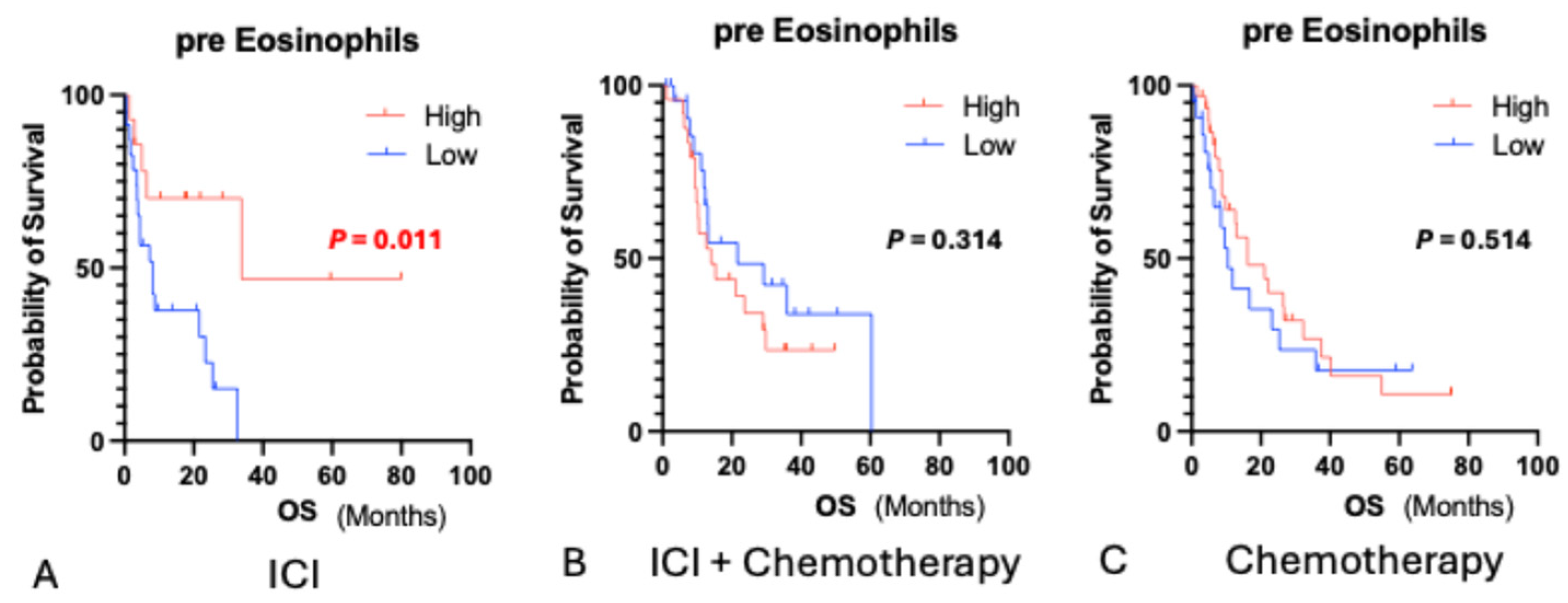
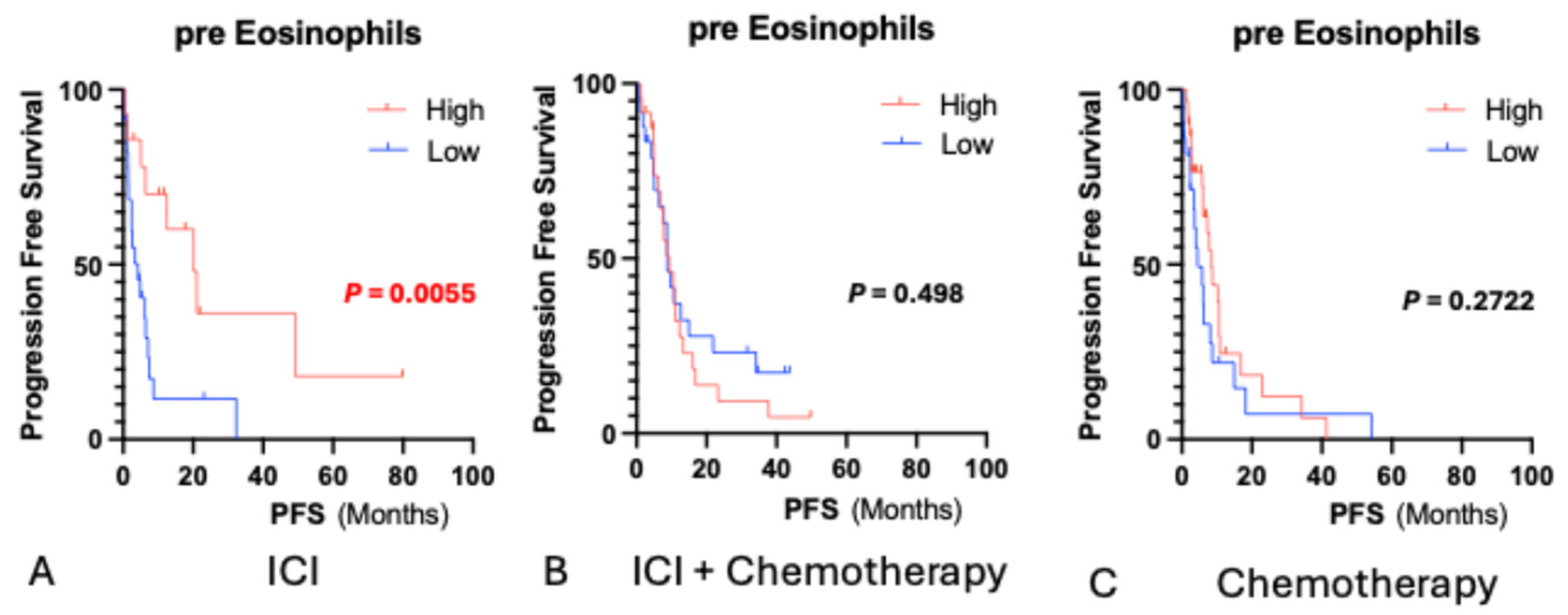
In the ICI monotherapy group, the median baseline eosinophil count was 92.3/µL. Patients with counts above this cutoff had significantly longer OS (HR 0.26, 95% CI 0.09–0.79, p = 0.007) (Figure 1) and PFS (HR 0.30, 95% CI 0.12–0.73, p = 0.005) (Figure 2). No significant associations were observed between the ICI plus chemotherapy and chemotherapy-alone groups.
Figure 1.
Overall survival according to baseline eosinophil count in patients. Kaplan–Meier survival curves for overall survival (OS) stratified by baseline eosinophil count (cutoff: 92.3/μL) in the ICI monotherapy, ICI plus chemotherapy, and chemotherapy alone groups. A significant survival benefit was observed only in the ICI monotherapy group for patients with higher eosinophil counts (HR: 0.33, 95%CI: 0.14–0.77, p = 0.01). No significant differences were detected between the combination and chemotherapy-only groups. Red font—statistically significant.
Figure 2.
Progression-free survival according to baseline eosinophil count in patients. Kaplan–Meier survival curves for progression-free survival (PFS) stratified by baseline eosinophil count (cutoff: 92.3/μL) in the ICI monotherapy, ICI plus chemotherapy, and chemotherapy alone groups. Patients with higher eosinophil counts showed significantly longer PFS in the ICI monotherapy group (HR: 0.32, 95%CI: 0.15–0.72, p = 0.001), while no association was found in the other two groups. Red font—statistically significant.
In the ICI monotherapy group, 23 patients were treated with anti-PD-1 therapy and 14 patients were treated with anti-PD-1 and anti-CTLA-4 combination therapy. Among patients treated with anti-PD-1 monotherapy, both OS and PFS were significantly longer in the high-baseline-eosinophil group (OS: p = 0.01; PFS: p = 0.01). In the anti-PD-1 + anti-CTLA-4 subgroup, statistical significance was not reached; however, a similar trend toward better outcomes in patients with higher baseline eosinophil counts was observed. No patients in our cohort received anti-PD-L1 monotherapy. In the ICI + chemotherapy group, 38 patients were treated with Anti-PD-1 combined with chemotherapy, 10 patients were treated with Anti-PD-L1 combined with chemotherapy, In the ICI plus chemotherapy group, 38 patients received anti-PD-1 and 10 patients received anti-PD-L1. For both anti-PD-1 and anti-PD-L1 combined with chemotherapy, neither OS nor PFS showed significant associations with baseline eosinophil counts (anti-PD-1: OS p = 0.15, PFS p = 0.19; anti-PD-L1: OS p = 0.66, PFS p = 0.26), which is consistent with the findings observed for the overall combination-therapy cohort.
In the ICI monotherapy group, the cancer-type distribution was as follows: lung cancer (n = 16), esophageal cancer (n = 14), melanoma (n = 6), and gastric cancer (n = 1). Because only a single gastric cancer case was included, subtype-specific analyses were not feasible and therefore were not reported. We further examined the association between baseline absolute eosinophil count and survival within each cancer subtype. The p-values for OS and PFS were as follows: esophageal cancer (OS p = 0.28, PFS p = 0.30), lung cancer (OS p = 0.05, PFS p = 0.02), and melanoma (OS p = 0.19, PFS p = 0.19). Although statistical significance was observed only in lung cancer subgroup, all subtypes demonstrated a consistent trend in which higher baseline eosinophil counts were associated with more favorable clinical outcomes.
3.2. Post-Treatment Eosinophil Changes
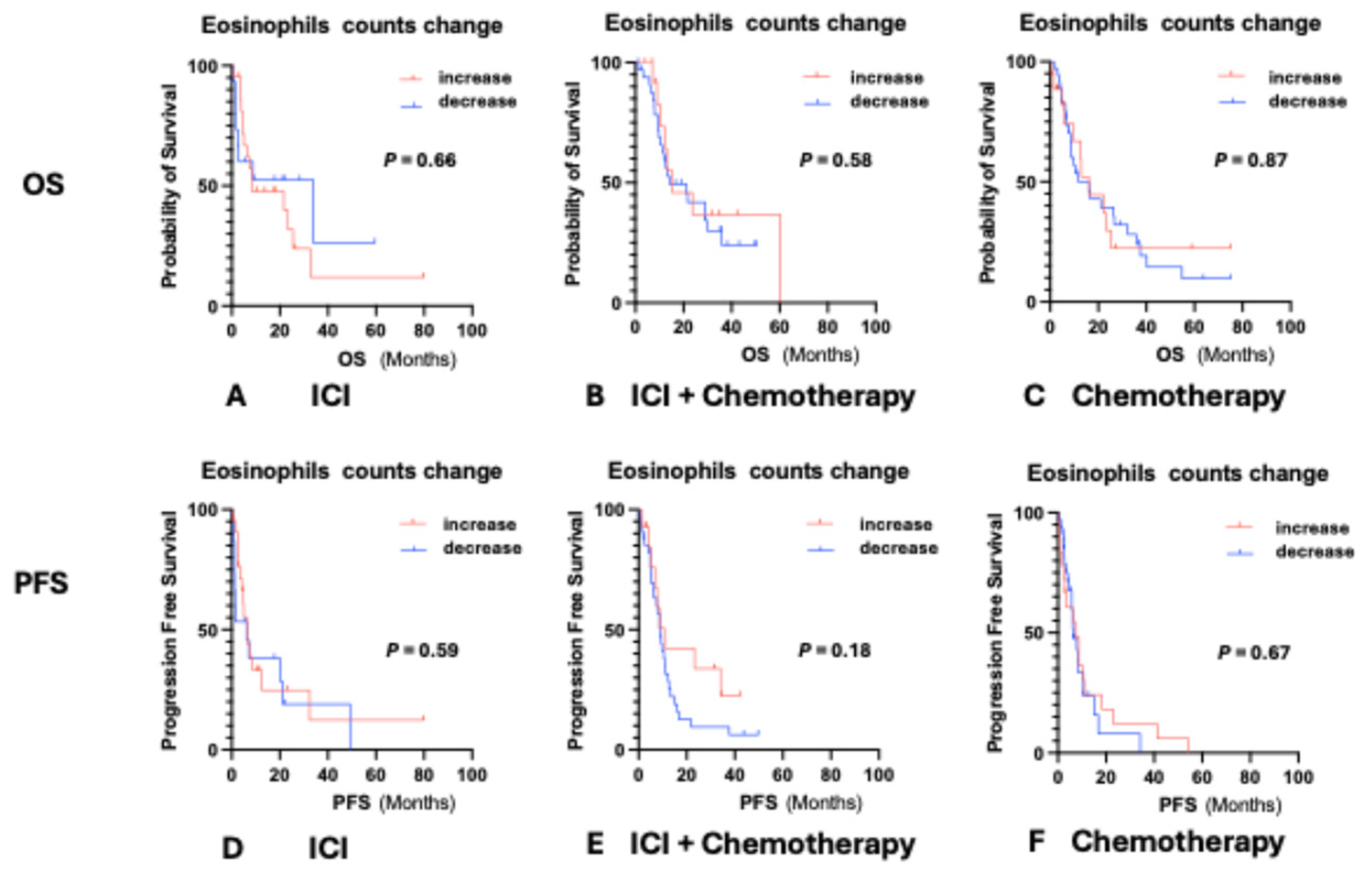
To evaluate whether changes in eosinophil counts after treatment were associated with clinical outcomes, we compared eosinophil levels before treatment initiation and after two cycles. In the ICI monotherapy group, 22 patients (59.5%) showed an increase in eosinophil count, whereas 15 patients (40.5%) showed a decrease. In the ICI plus chemotherapy group, eosinophil counts increased in 14 patients (29.2%) and decreased in 34 patients (70.8%). In the chemotherapy-alone group, 18 patients (34.0%) exhibited an increase and 35 patients (66.0%) showed a decrease. Notably, these post-treatment eosinophil changes were not significantly associated with OS or PFS in any treatment cohort (Figure 3).
Figure 3.
Changes in eosinophil counts between baseline and after two cycles in relation to OS and PFS across treatment groups. Changes in eosinophil counts between baseline and after two cycles were not significantly associated with OS (A–C) or PFS (D–F) in any treatment group. This finding suggests that dynamic eosinophil variations during early treatment do not reflect long-term outcomes, in contrast to the prognostic impact of baseline eosinophil levels.
3.3. Univariable Analysis
Higher baseline eosinophil counts were significantly associated with improved OS (HR 0.26, 95% CI 0.087–0.788, p = 0.01) and PFS (HR 0.30, 95% CI 0.123–0.733, p = 0.01). A Low NLR was also associated with better OS (HR 3.31, 95% CI 1.399–7.832, p = 0.01) and PFS (HR 1.40, 95% CI 1.402–7.205, p = 0.01). Albumin levels showed a trend toward significance for OS (p = 0.06) and PFS (p = 0.10), although the differences were not significant. Other variables, including PS, sex, age, and irAEs, were not significantly associated with survival rates (Table 2).
Table 2.
Univariable analysis of factors associated with overall survival (OS) and progression-free survival (PFS).
3.4. Multivariate Analysis
Variables with p < 0.10 in the univariable analysis (baseline eosinophil count, albumin, and NLR) were entered into the multivariable Cox model, together with clinically relevant covariates (age, sex, and PS). Higher baseline eosinophil counts were independently associated with longer OS (HR 0.31, 95% CI 0.097–0.981, p = 0.03) and PFS (HR 0.32, 95% CI 0.119–0.838, p = 0.01). Although the NLR was not statistically significant (OS: HR 3.09, 95% CI 0.939–10.148, p = 0.06; PFS: HR 2.65, 95% CI 0.910–7.704, p = 0.07), the observed trends suggest that NLR is an important prognostic factor in patients treated with ICIs. Serum albumin levels were not significant in the multivariate analysis. Other factors, including age, sex, and PS, were not significantly associated with survival rates (Table 3).
Table 3.
Multivariate Analysis of Prognostic Factors for OS and PFS in ICI Monotherapy.
4. Discussion
This study demonstrated that higher baseline eosinophil counts were associated with prolonged OS and PFS in patients treated with ICI monotherapy, consistent with previous reports [7,8,9,10]. The cutoff value identified in our cohort was comparable to that described in previous studies. In contrast, no such association was observed in patients receiving ICIs in combination with chemotherapy or chemotherapy alone, suggesting that eosinophils are directly associated with the immune-mediated effects of ICIs. This observation suggests that eosinophils may function as immune effector cells involved in antigen presentation, T-cell priming, and recruitment of other immune subsets. Their presence before therapy may indicate a pre-activated immune microenvironment capable of mounting effective responses upon checkpoint blockade.
Although chemotherapy-induced bone marrow suppression may reduce eosinophil counts after treatment, it should not affect baseline eosinophil levels. Most combination regimens in this study included platinum-based agents. Platinum compounds have been reported to enhance CD8+ T-cell infiltration and increase the ratio of PD-L1+ immune cells, while simultaneously inducing immunosuppressive effects via TGF-β signaling [13,14]. Moreover, the immunologic interplay between cytotoxic agents and immune cells is complex. Certain chemotherapies can induce immunogenic cell death and enhance antigen presentation, whereas others suppress bone marrow progenitors. Disentangling these bidirectional effects remains a key research priority. The early crossing of the Kaplan–Meier curves between the combination and monotherapy groups may reflect the reduced early progression in the combination group. Although chemotherapy may attenuate the intrinsic efficacy of ICIs, its ability to suppress early progression may counterbalance this effect and contribute to improved overall outcomes. The careful selection of cytotoxic agents with synergistic immunomodulatory activities is important for optimizing future treatment strategies.
Although NLR did not reach statistical significance in our multivariate analysis, the observed trends suggest that it continues to contribute to survival outcomes. These findings are consistent with previous reports demonstrating that a lower NLR is associated with improved prognosis in patients receiving ICIs across multiple cancer types. The NLR reflects systemic inflammation and immune balance, and an elevated NLR has been linked to an immunosuppressive tumor microenvironment (TME). Therefore, although NLR did not emerge as an independent prognostic factor in our cohort, our results support its potential role as a clinically relevant biomarker, consistent with prior evidence [1,2,3,4,5,6]. Combining eosinophil counts with NLR or albumin could provide a multifactorial immune index integrating inflammation, nutrition, and baseline immunity. Such indices may help stratify patients for ICI monotherapy versus combination regimens and optimize timing for treatment initiation.
In addition to their potential as biomarkers, eosinophils play diverse immunological roles in the TME. Recent studies have shown that eosinophils can infiltrate tumors and release granule proteins, such as eosinophil cationic protein and eosinophil peroxidase, as well as cytokines, including TNF-α, IL-4, and IL-13, which can induce direct tumor cell cytotoxicity and promote CD8+ T-cell and dendritic cell activation [15,16,17]. Moreover, eosinophils may remodel the extracellular matrix to facilitate lymphocyte infiltration and enhance the response to immune checkpoint blockade [18,19]. Conversely, eosinophils may exert pro-tumorigenic effects by secreting angiogenic and tissue-remodeling factors, depending on the cytokine milieu (e.g., IL-5, IL-33, and GM-CSF) within the TME [19,20].
In the context of ICI therapy, several studies have demonstrated that increased peripheral eosinophil counts following treatment correlate with activated antitumor immunity and, in some cases, with immune-related adverse events (irAEs) [21,22,23]. Thus, eosinophil dynamics may reflect the systemic immune activation triggered by ICIs. These findings support the hypothesis that eosinophils act as functional modulators of immune responses during checkpoint inhibition, in addition to serving as peripheral biomarkers.
Collectively, our findings and previous evidence suggest that the baseline eosinophil count represents an integrated indicator of host immune readiness. Beyond the prognostic perspective, our findings raise important implications for clinical practice and trial design. Integrating eosinophil assessment into pretreatment evaluation could help identify patients most likely to benefit from ICI monotherapy, thereby avoiding unnecessary exposure to cytotoxic chemotherapy. Furthermore, dynamic monitoring of eosinophil counts during treatment might serve as an early marker of immune activation, preceding radiographic changes. Evaluating eosinophil dynamics, along with other immune parameters such as NLR and albumin, may improve the prediction of ICI efficacy and provide insight into the complex immunological mechanisms governing antitumor responses.
Limitations
This study has a few limitations. First, although multiple cancer types were included in the analysis, the number of patients in each subtype—particularly melanoma and gastric cancer—was small, which limited the statistical power of the subtype-specific survival analyses. In the ICI monotherapy cohort, gastric cancer consisted of only one case and therefore could not be evaluated separately. Second, PS was assessed by both physicians and nurses, potentially introducing interobserver variability; most patients had a PS of 1, limiting stratification by this variable. Finally, the analysis was restricted to peripheral blood data, and eosinophil infiltration was not examined in tumor tissues. Another limitation of this study is its retrospective design, which may have introduced selection bias and unmeasured confounding factors. In addition, we did not evaluate other immune cell subsets, such as regulatory T cells or myeloid-derived suppressor cells, which may interact with eosinophils to shape the tumor immune microenvironment. Future prospective multicenter studies are needed to validate and expand upon our findings. Future studies should integrate tumor-local eosinophil analyses to clarify their role in ICI responses.
5. Conclusions
The findings of this study showed a significant association between baseline eosinophil count and OS and PFS in patients who received ICI monotherapy. In clinical practice, baseline eosinophil count could be easily adopted as part of routine pretreatment evaluations. In contrast, no such association was observed in patients treated with ICIs combined with chemotherapy or chemotherapy alone, suggesting that eosinophils are explicitly associated with the immune-mediated effects of ICIs.
Author Contributions
R.S., R.O. and S.W. analyzed and interpreted the patient data and were the major contributors to writing the manuscript. M.W., E.M., T.T. (Toshiaki Tsurui), N.I., T.I., Y.H., G.I., M.S., H.A., Y.K. (Yutaro Kubota), K.Y. and Y.K. (Yuji Kiuchi) contributed to data acquisition and analysis. S.K., T.T. (Takuya Tsunoda), A.H., M.T., Y.K. (Yuji Kiuchi) and T.O. contributed to the conceptualization and critically revised the manuscript. All authors have read and agreed to the published version of the manuscript.
Funding
This research received no external funding.
Institutional Review Board Statement
The study was conducted according to the guidelines of the Declaration of Helsinki and approved by the Ethics Committee of Showa University School of Medicine, Tokyo, Japan (approval numbers: M2165 (approved on 26 December 2018), M2253 (approved on 26 December 2018), M2776 (approved on 28 October 2019), and G285 (approved on 14 October 2021).
Informed Consent Statement
Informed consent was obtained from all subjects involved in the study.
Data Availability Statement
The datasets generated and/or analyzed during the current study are not publicly available due to patient privacy and institutional regulations but are available from the corresponding author on reasonable request.
Conflicts of Interest
The authors declare no conflicts of interest.
Abbreviations
The following abbreviations are used in this manuscript.
| ALB | Albumin |
| CD8+ | Cluster of differentiation 8 positive (cytotoxic T lymphocyte) |
| CI | Confidence interval |
| CTCAE | Common Terminology Criteria for Adverse Events |
| GM-CSF | Granulocyte–macrophage colony-stimulating factor |
| HR | Hazard ratio |
| ICI | Immune checkpoint inhibitor |
| IL | Interleukin |
| IL-4 | Interleukin 4 |
| IL-5 | Interleukin 5 |
| IL-13 | Interleukin 13 |
| IL-33 | Interleukin 33 |
| irAE | Immune-related adverse event |
| NLR | Neutrophil-to-lymphocyte ratio |
| OS | Overall survival |
| PD-L1 | Programmed death ligand 1 |
| PFS | Progression-free survival |
| PS | Performance status |
| TGF-β | Transforming growth factor beta |
| TME | Tumor microenvironment |
| TNF-α | Tumor necrosis factor alpha |
References
- Hirasawa, Y.; Kubota, Y.; Mura, E.; Suzuki, R.; Tsurui, T.; Iriguchi, N.; Ishiguro, T.; Ohkuma, R.; Shimokawa, M.; Ariizumi, H.; et al. Maximum efficacy of immune checkpoint inhibitors is in esophageal cancer patients with low neutrophil-to-lymphocyte ratio and good performance status prior to treatment. Anticancer Res. 2024, 44, 3397–3407. [Google Scholar] [CrossRef] [Scilit] [PubMed]
- Zheng, Y. Serum albumin: A pharmacokinetic marker for optimizing treatment outcome of immune checkpoint blockade. J. Immunother. Cancer 2022, 10, e005670. [Google Scholar] [CrossRef] [Scilit]
- Kuang, Y.; Miao, J.; Zhang, X. Serum albumin and derived neutrophil-to-lymphocyte ratio are potential predictive biomarkers for immune checkpoint inhibitors in small cell lung cancer. Front. Immunol. 2024, 7, 1327449. [Google Scholar] [CrossRef] [Scilit]
- Man, Q.; Li, P.; Fan, J.; Yang, S.; Xing, C.; Bai, Y.; Hu, M.; Wang, B.; Zhang, K. The prognostic role of pre-treatment neutrophil. to lymphocyte ratio and platelet to lymphocyte ratio in esophageal squamous cell carcinoma treated with concurrent chemoradiotherapy. BMC Cancer 2024, 24, 464. [Google Scholar] [CrossRef] [Scilit]
- Gao, Y.; Zhang, Z.; Li, Y.; Chen, S.; Lu, J.; Wu, L.; Ma, Z.; Hu, Y.; Zhang, G. Pretreatment neutrophil-to-lymphocyte ratio as a prognostic biomarker in unresectable or metastatic esophageal cancer patients with anti-PD-1 therapy. Front. Oncol. 2022, 12, 834564. [Google Scholar] [CrossRef] [Scilit]
- Ruan, D.Y.; Chen, Y.X.; Wei, X.L.; Wang, Y.N.; Wang, Z.X.; Wu, H.X.; Xu, R.H.; Yuan, S.Q.; Wang, F.H. Elevated peripheral blood. neutrophil-to-lymphocyte ratio is associated with an immunosuppressive tumour microenvironment and decreased benefit of PD-1 antibody in advanced gastric cancer. Gastroenterol. Rep. 2021, 9, 560–570. [Google Scholar] [CrossRef] [Scilit]
- Mota, J.M.; Teo, M.Y.; Whiting, K.; Li, H.A.; Regazzi, A.M.; Lee, C.H.; Funt, S.A.; Bajorin, D.; Ostrovnaya, I.; Iyer, G.; et al. Pretreatment eosinophil counts in patients with advanced or metastatic urothelial carcinoma treated with anti–PD-1/PD-L1 checkpoint inhibitors. J. Immunother. 2021, 44, 248–253. [Google Scholar] [CrossRef] [Scilit]
- Hwang, M.; Canzoniero, J.V.; Rosner, S.; Zhang, G.; White, J.R.; Belcaid, Z.; Cherry, C.; Balan, A.; Pereira, G.; Curry, A.; et al. Peripheral blood immune cell dynamics reflect antitumor immune responses and predict clinical response to immunotherapy. J. Immunother. Cancer 2022, 10, e005279. [Google Scholar] [CrossRef] [Scilit]
- Giommoni, E.; Giorgione, R.; Paderi, A.; Pellegrini, E.; Gambale, E.; Marini, A.; Antonuzzo, A.; Marconcini, R.; Roviello, G.; Matucci-Cerinic, M.; et al. Eosinophil Count as Predictive Biomarker of Immune-Related Adverse Events (irAEs) in Immune Checkpoint Inhibitors (ICIs) Therapies in Oncological Patients. Immuno 2021, 1, 253–263. [Google Scholar] [CrossRef] [Scilit]
- Caliman, E.; Fancelli, S.; Ottanelli, C.; Mazzoni, F.; Paglialunga, L.; Lavacchi, D.; Gatta Michelet, M.R.; Giommoni, E.; Napolitano, B.; Scolari, F.; et al. Absolute eosinophil count predicts clinical outcomes and toxicity in non-small cell lung cancer patients treated with immunotherapy. Cancer Treat. Res. Commun. 2022, 32, 100603. [Google Scholar] [CrossRef] [Scilit] [PubMed]
- Zhou, J.; Du, Z.; Fu, J.; Yi, X. Blood cell counts can predict adverse events of immune checkpoint inhibitors: A systematic review and meta-analysis. Front. Immunol. 2023, 14, 1230987. [Google Scholar] [CrossRef] [Scilit]
- Ohkuma, R.; Kubota, Y.; Horiike, A.; Ishiguro, T.; Hirasawa, Y.; Ariizumi, H.; Watanabe, M.; Onoue, R.; Ando, K.; Tsurutani, J.; et al. The prognostic impact of eosinophils and the eosinophil-to-lymphocyte ratio on survival outcomes in stage II resectable pancreatic cancer. Pancreas 2021, 50, 167–175. [Google Scholar] [CrossRef] [Scilit]
- Li, G.; Che, X.; Wang, S.; Liu, D.; Xie, D.; Jiang, B.; Zheng, Z.; Zheng, X.; Wu, G. The role of cisplatin in modulating the tumor immune microenvironment and its combination therapy strategies: A new approach to enhance anti-tumor efficacy. Cancer Cell Int. 2023, 23, 2447403. [Google Scholar] [CrossRef] [Scilit]
- Kalfeist, L.; Ledys, F.; Petit, S.; Poirrier, C.; Mohammed, S.K.; Galland, L.; Derangère, V.; Ilie, A.; Rageot, D.; Aucagne, R.; et al. Co-targeting TGF-β and PD-L1 sensitizes triple-negative breast cancer to experimental immunogenic cisplatin-eribulin chemotherapy doublet. J. Clin. Investig. 2025, 135, e184422. [Google Scholar] [CrossRef] [Scilit]
- Reichman, H.; Karo-Atar, D.; Munitz, A. Eosinophils: Multifunctional and distinctive cells in tumor immunity. Trends Cancer 2022, 8, 1006–1019. [Google Scholar] [CrossRef] [Scilit]
- Arnold, I.C.; Artola-Boran, M.; Gurtner, A.; Bertram, K.; Bauer, M.; Frangez, Z.; Becher, B.; Kopf, M.; Yousefi, S.; Simon, H.-U.; et al. The GM-CSF–IRF5 signaling axis in eosinophils promotes antitumor immunity through activation of type 1 T cell responses. J. Exp. Med. 2020, 217, e20190706. [Google Scholar] [CrossRef] [Scilit] [PubMed]
- Carretero, R.; Sektioglu, I.M.; Garbi, N.; Salgado, O.C.; Beckhove, P.; Hämmerling, G.J. Eosinophils orchestrate cancer rejection by normalizing tumor vessels and enhancing infiltration of CD8+ T cells. Nat. Immunol. 2015, 16, 609–617. [Google Scholar] [CrossRef] [Scilit] [PubMed]
- Grisaru-Tal, S.; Rothenberg, M.E.; Munitz, A. Eosinophil–lymphocyte interactions in the tumor microenvironment and cancer immunotherapy. Nat. Immunol. 2022, 23, 1309–1316. [Google Scholar] [CrossRef] [Scilit]
- Ghaffari, S.; Rezaei, N. Eosinophils in the tumor microenvironment: Implications for cancer immunotherapy. J. Transl. Med. 2023, 21, 551. [Google Scholar] [CrossRef] [Scilit] [PubMed]
- Lucarini, V.; Ziccheddu, G.; Macchia, I.; La Sorsa, V.; Peschiaroli, F.; Buccione, C.; Sistigu, A.; Sanchez, M.; Andreone, S.; D’Urso, M.T.; et al. IL-33 restricts tumor growth and inhibits pulmonary metastasis in melanoma-bearing mice through eosinophils. Oncoimmunology 2017, 6, e1317420. [Google Scholar] [CrossRef] [Scilit]
- Tasaki, Y.; Hamamoto, S.; Yamashita, S.; Furukawa, J.; Fujita, K.; Tomida, R.; Miyake, M.; Ito, N.; Iwamoto, H.; Mimura, Y.; et al. Eosinophil is a predictor of severe immune-related adverse events induced by ipilimumab plus nivolumab therapy in patients with renal cell carcinoma: A retrospective multicenter cohort study. Front. Immunol. 2025, 15, 1483956. [Google Scholar] [CrossRef] [Scilit] [PubMed]
- Takayasu, S.; Mizushiri, S.; Watanuki, Y.; Yamagata, S.; Usutani, M.; Nakada, Y.; Asari, Y.; Murasawa, S.; Kageyama, K.; Daimon, M. Eosinophil counts can be a predictive marker of immune checkpoint inhibitor-induced secondary adrenal insufficiency: A retrospective cohort study. Sci. Rep. 2022, 12, 1294. [Google Scholar] [CrossRef] [Scilit] [PubMed]
- Takeuchi, E.; Kondo, K.; Okano, Y.; Ichihara, S.; Kunishige, M.; Kadota, N.; Machida, H.; Hatakeyama, N.; Naruse, K.; Ogino, H.; et al. Pretreatment eosinophil counts as a predictive biomarker in non-small cell lung cancer patients treated with immune checkpoint inhibitors. Thorac. Cancer 2023, 14, 2877–2885. [Google Scholar] [CrossRef] [Scilit] [PubMed]




Disclaimer/Publisher’s Note: The statements, opinions and data contained in all publications are solely those of the individual author(s) and contributor(s) and not of MDPI and/or the editor(s). MDPI and/or the editor(s) disclaim responsibility for any injury to people or property resulting from any ideas, methods, instructions or products referred to in the content. |
© 2025 by the authors. Licensee MDPI, Basel, Switzerland. This article is an open access article distributed under the terms and conditions of the Creative Commons Attribution (CC BY) license (https://creativecommons.org/licenses/by/4.0/).