


Abstract
Background: Fabry disease (FD) is an X-linked lysosomal storage disorder caused by GLA mutations, leading to deficient α-galactosidase A (α-Gal A) activity and progressive glycosphingolipid accumulation. While α-Gal A activity is the diagnostic gold standard, its sensitivity is reduced in late-onset or heterozygous patients. Conventional biomarkers such as lyso-Gb3 provide only limited insight into disease progression and therapeutic response. Exosomes, as stable carriers of disease-specific proteins, may offer complementary biomarkers for early detection and longitudinal monitoring. Methods: Twenty-one pediatric FD patients with confirmed GLA mutations were enrolled. Clinical, enzymatic, renal, and cardiac parameters were assessed. Plasma-derived exosomes were characterized by transmission electron microscopy and proteomic profiling. Differentially expressed proteins were identified using mass spectrometry, analyzed using GO/KEGG enrichment, and validated using RT-PCR, ELISA, and immunofluorescence in patient samples and Gla−/− mice. Results: Male patients showed markedly reduced α-Gal A activity and elevated lyso-Gb3 compared with females. Although overt renal and cardiac dysfunction was uncommon, several patients exhibited early abnormalities such as proteinuria, an elevated LVMI, or increased cTnI levels. Proteomic analysis identified 2553 proteins, of which 188 were differentially expressed. Fibrosis- and inflammation-related proteins, including THBS1 and CFHR5, were upregulated, while protective factors such as APM1, SERPINA10, and CAB39 were downregulated. IGFBP3 was also elevated and closely linked to tissue remodeling. Enriched pathways were involved in PPAR/AMPK signaling, lipid metabolism, and complement activation. Conclusions: Exosomal proteomic profiling revealed early molecular signatures of cardiorenal involvement in pediatric FD. Key proteins such as THBS1, CFHR5, IGFBP3, APM1, and CAB39 show strong potential as biomarkers for risk stratification, disease monitoring, and therapeutic evaluation.
1. Introduction
Fabry disease (FD, OMIM 301500) is an inherited X-linked lysosomal storage disorder caused by pathogenic variants in the GLA gene, leading to deficient activity of the lysosomal enzyme α-galactosidase A (α-Gal A). This enzymatic defect results in systemic accumulation of globotriaosylceramide (Gb3) and related glycosphingolipids across multiple tissues. Pediatric patients manifest as a progressive multiorgan involvement that primarily affects the kidneys, heart, and nervous system, with these organ complications accounting for most of the disease burden, morbidity, and mortality [1,2].
The estimated incidence in males ranges from 1:40,000 to 1:117,000. However, newborn screening studies have revealed a greater prevalence of late-onset variants, suggesting that FD remains substantially underdiagnosed in the general population. Early symptoms, such as acroparesthesias, angiokeratomas, hypohidrosis, and corneal verticillata, often arise during childhood but are nonspecific, frequently delaying accurate diagnosis [2].
With the availability of enzyme replacement therapy (ERT) and pharmacological chaperones, early identification and timely intervention have become critical to prevent irreversible organ damage [3,4]. Accordingly, the identification of sensitive and dynamic biomarkers is essential to improve screening accuracy, diagnosis, and disease monitoring in FD [5]. Plasma globotriaosylsphingosine (Lyso-Gb3) is recognized as a robust biomarker, yet its ability to fully reflect disease heterogeneity and therapeutic response remains limited. Biomarkers play a crucial role in the screening and diagnosis of FD [6].
Extracellular vesicles, particularly exosomes, have recently emerged as promising sources of disease biomarkers. Exosomes are nanosized vesicles (30–150 nm) secreted by nearly all cell types, encapsulated by a lipid bilayer, and enriched in proteins, lipids, and nucleic acids that are actively involved in intercellular communication [7]. Compared with soluble plasma biomarkers, exosomal cargos are less affected by abundant serum proteins and exhibit enhanced stability, thereby offering unique advantages for clinical applications [8]. Proteomic analyses of exosomes have already provided valuable insights into several metabolic and lysosomal storage disorders [9]. However, to date, no systematic studies have investigated the proteomic profile of plasma exosomes in Fabry disease [10]. This knowledge gap highlights an important and unexplored opportunity for discovering novel, clinically relevant biomarkers that may improve disease stratification and monitoring [11].
Therefore, this study aimed to perform a comprehensive proteomic characterization of plasma-derived exosomes from patients with FD. By systematically profiling the protein cargo of exosomes, we sought to identify novel biomarker candidates that may complement or surpass existing markers such as Lyso-Gb3. Given the rarity of pediatric FD and the limited availability of treatment-naïve samples, we designed this as a pilot exploratory study to generate preliminary molecular insights into exosome-based biomarkers.
2. Materials and Methods
2.1. Patient and Specimen Information
Clinical data of 21 children with FD diagnosed at the Children’s Hospital Affiliated with Zhejiang University School of Medicine between July 2014 and August 2023 were collected. Inclusion criteria: Children with confirmed diagnosis of FD. The diagnosis was made by qualified clinicians at the Children’s Hospital Affiliated to Zhejiang University School of Medicine. Diagnostic criteria were based on the Expert Consensus on Diagnosis and Treatment of FD in China (2021 Edition): male children with clinical compliance, reduced α-Gal A enzyme activity, and carrying pathogenic mutations of the GLA gene; or female children carrying pathogenic mutations of the GLA gene. To ensure that the exosomal proteomic findings reflected the untreated disease state, only patients who had not received ERT or any other specific treatment before blood sample collection were enrolled in this study.
Data collection: (1) Age: Age of onset and age at diagnosis. (2) Gender. (3) Symptoms and signs: Presence of pre-existing symptoms such as paresthesia, pain, cutaneous angiosarcoma, hypohidrosis or anhidrosis, gastrointestinal discomfort, visual/hearing disturbances, proteinuria, and blood pressure. (4) GLA gene mutation site and family history of the disorder.
For the exosomal protein analysis, we included three age- and sex-matched male FD patients and three healthy male controls. Plasma samples (1 mL) were collected from both the FD children and the age- and sex-matched healthy controls, followed by centrifugation at 1000× g for 10 min. The supernatant was carefully collected and aliquoted into sterile EP tubes, with each aliquot containing 500 μL, and stored at −80 °C for subsequent analysis.
2.2. Exosome Extraction and Detection
Exosomes were extracted from plasma using the Hieff® Quick Exosome Isolation Kit (Yeasen, Shanghai, China). First, 1 mL of plasma was thawed on ice and centrifuged at 4 °C to remove debris. Four times the plasma volume of sterile phosphate-buffered saline (PBS) was added and mixed thoroughly. The recommended amount of exosome isolation reagent was then added, and the mixture was incubated overnight at 4 °C. Following incubation, the mixture was centrifuged at 10,000× g for 60 min at 4 °C to precipitate exosomes, which were subsequently resuspended in PBS for further analysis.
We used TSG101 (Proteintech, Wuhan, China; 28283-1-AP 1:7500) as a positive exosomal marker and Calnexin (Proteintech, Wuhan, China; 10427-2-AP 1:20,000) as a negative control marker by Western blot.
To visualize the exosomes, the resuspended samples were fixed in 4% paraformaldehyde (PFA) and imaged using a JEM-1230 transmission electron microscope (TEM) (JEOL, Tokyo, Japan), with images captured by an Olympus EM208S TEM (Hitachi, Tokyo, Japan).
2.3. Exosomal Protein Analysis via Mass Spectrometry
Two mobile phases were prepared for mass spectrometry analysis: Phase A consisted of 100% water with 0.1% formic acid, and Phase B comprised 100% acetonitrile with 0.1% formic acid. Samples were reconstituted in 10 μL of Phase A and centrifuged at 14,000× g for 20 min at 4 °C. The supernatant was collected for liquid chromatography–mass spectrometry (LC-MS) analysis.
The analysis utilized a nanoElute ultra-high-performance liquid chromatography (UHPLC) system coupled with a timsTOF Pro2 mass spectrometer (Agilent Technologies Inc., Santa Clara, CA, USA). The mass spectrometry parameters included an ion spray voltage of 1.5 kV and a mass-to-charge (m/z) scan range of 100–1700. The PASEF mode was employed for ten MS/MS scans, with a total cycle time of 1.17 s.
Mass spectrometry data were exported to Excel, and peptide spectrum matching (PSM) was used to assess protein expression. PSM values were normalized and multiplied by 100 to obtain PSM%. Statistical analysis, using a two-tailed independent t-test, identified significantly differentially expressed proteins between the FD and control (CON) groups (p < 0.05).
2.4. Cell Culture
The Gla−/− HEK293 cell line was constructed using a Cas9 and sgRNA (TTGGAAATAAAACCTGCGC) expression vector. Target cells were infected via transient transfection, enabling genomic editing, followed by clonal selection, expansion, and Sanger sequencing validation (Figure S2).
For cell culture, DMEM was chosen as the growth medium, supplemented with fetal bovine serum and appropriate antibiotics, such as penicillin and streptomycin, to prevent contamination. Cells were incubated in a 37 °C humidified incubator with a 5% CO2 atmosphere. Upon reaching confluency, cells were passaged, and the medium was replaced every 2–3 days.
2.5. Immunofluorescence (IF)
Immunofluorescence staining was performed on renal tissues from Gla−/− mice (B6;129-Glatm1Kul/J, Stock No. 003535, the Jackson Laboratory, Bar Harbor, ME, USA). Paraffin-embedded sections were deparaffinized, rehydrated, and subjected to heat-induced antigen retrieval. After circumscribing to prevent evaporation, sections were blocked with 5% bovine serum albumin (BSA) and incubated overnight at 4 °C with primary antibodies against CAB39 (1:200, ab51132, Abcam, Cambridge, UK), thrombospondin-1 (THBS1, 1:200, ab267388, Abcam, UK), and insulin-like growth factor binding protein-3 (IGFBP3, 1:200, ab220429, Abcam, UK). Following PBS washes, sections were incubated with species-appropriate fluorophore-conjugated secondary antibodies, and nuclei were counterstained with DAPI. Images were acquired using a confocal laser scanning microscope (FV3000, Olympus, Tokyo, Japan). For each experiment, five mice (three males and two females) were used, and fluorescence intensity was quantified in three randomly selected fields per mouse.
2.6. Enzyme-Linked Immunosorbent Assay (ELISA)
For the ELISA, the levels of THBS1, IGFBP3, and APM1 in the plasma of FD patients and healthy children were measured using kits from Xiamen Lun Chang Shuo Biotechnology Co., Ltd. (Wuhan, China), following the manufacturer’s instructions. Briefly, samples and HRP-conjugated detection antibodies were added to the wells, followed by incubation and washing. The substrate, 3,3′,5,5′-tetramethylbenzidine (TMB), was then added and incubated. The absorbance at 450 nm was measured using a microplate reader (Thermo Multiskan FC, Waltham, MA, USA).
2.7. Quantitative Reverse Transcription PCR (qPCR)
Total RNA was extracted using the SteadyPure RNA Extraction Kit (Accurate Biotechnology, Changsha, Hunan, China) and reverse-transcribed into cDNA with the Evo M-MLV RT Mix Kit (Accurate Biotechnology, Changsha, Hunan, China). Real-time quantitative PCR was conducted using the SYBR Green Pro Taq HS qPCR Kit (Accurate Biotechnology, Changsha, Hunan, China) to assess the relative mRNA levels of Β-ACTIN and apolipoprotein genes (APOA2, APOC1, APOC2, APOL1), FGA, SERPIND1, SERPINF2, SERPINA10, THBS1, IGFBP3, A1BG, AGT, CFHR5, and AMBP. The thermal cycling conditions were as follows: 95 °C for 30 s, followed by 40 cycles at 95 °C for 5 s and 60 °C for 30 s. The primers used are listed in Supplementary Table S1.
2.8. Bioinformatics Analysis
Gene Ontology (GO) and Kyoto Encyclopedia of Genes and Genomes (KEGG) enrichment analyses were performed using the clusterProfiler package (v4.6.2) in R. GO annotations were obtained via InterProScan (5.52-86.0), incorporating Pfam, PRINTS, ProDom, SMART, ProSite, and PANTHER databases. Enrichment was based on a hypergeometric test with Benjamini–Hochberg FDR correction. Pathways with FDR < 0.05 and gene count ≥3 were considered significant, using all identified proteins as the background.
Differentially expressed proteins (DEPs) were defined by fold change ≥1.5 and FDR < 0.05. Results were visualized with volcano plots and hierarchical clustering heatmaps. Protein–protein interaction (PPI) networks were predicted using STRING (v11.5) with a confidence score ≥0.7 and visualized via Cytoscape (v3.9.1).
2.9. Statistical Analysis
All experiment were conducted independently at least three times. Data are presented as means ± standard deviation (SD). Statistical analyses were performed using SPSS 22.0. Levene’s test was used to assess homogeneity of variance, and when variance was homogeneous, independent samples t-tests were employed. A p-value of <0.05 was considered statistically significant.
3. Results
3.1. Patient Information
This study enrolled 21 pediatric patients with FD; the median age at diagnosis was 10 years (ranging from 6 to 17 years) and the majority were male (n = 16), consistent with the X-linked inheritance pattern. In total, 12 patients (57.1%) were diagnosed via family screening following identification of a proband, whereas 9 patients (42.9%) were detected using high-risk screening prompted by symptoms such as neuropathic pain or hypohidrosis. The diagnostic delay was considerable, with the interval from symptom onset to confirmed diagnosis ranging from 8 months to 7 years (mean: 2.4 ± 2.1 years).
All patients carried pathogenic or likely pathogenic variants in the GLA gene, with recurrent mutations including R112H (c.335G>A), N34H (c.100A>G), and G261V (c.782G>T). Most variants were maternally inherited, with one de novo case identified. Enzyme assays demonstrated markedly reduced α-Gal A activity in all male patients, with values as low as 0.26 μmol/L/h in plasma. Female patients exhibited variable levels of residual enzyme activity, ranging from near-normal to significantly reduced activity, consistent with lyonization effects. Lyso-GL-3 levels, a sensitive biomarker of disease activity, were elevated in nearly all patients (range: 0.51–115.63 ng/mL). Several male patients showed extremely high levels (>70 ng/mL), reflecting significant glycosphingolipid accumulation.
Clinically, most symptomatic patients exhibited classic early-onset manifestations of FD, especially males. Acroparesthesia and hypohidrosis or anhidrosis were the most frequently reported symptoms, while some patients also had gastrointestinal complaints or angiokeratomas. In contrast, many female patients were either asymptomatic or displayed milder manifestations, reflecting the variable penetrance and expression in heterozygous individuals. These findings underscore the phenotypic diversity of FD in pediatric patients and highlight the importance of combining enzymatic, genetic, and clinical screening approaches to enable timely diagnosis and intervention (Table 1).
Table 1.
Demographic, genetic, biochemical, and clinical characteristics of pediatric FD patients.
3.2. Renal and Cardiac Function in Fabry Patients
Renal and cardiac assessments were performed in all 21 patients to evaluate organ involvement. Serum creatinine levels ranged from 30 to 85 μmol/L, generally within age-appropriate reference ranges. The estimated glomerular filtration rate (eGFR) showed wider variability (74.7–176.4 mL/min/1.73 m2), with the lowest value observed in patient 1, suggesting early renal impairment. Microalbuminuria, assessed by the urine albumin-to-creatinine ratio, ranged from 2.2 to 30.3 mg/g·Cr. The highest level occurred in patient 10, consistent with glomerular involvement. Microscopic hematuria was present in 13 patients, though most had low red blood cell counts (<6 cells/HPF), except for 1 patient with markedly elevated levels (>200 cells/HPF). Twenty-four-hour urinary protein excretion levels ranged from 36.2 to 209 mg, with mild elevations in several cases, indicating early glomerular dysfunction despite preserved eGFR.
Cardiac troponin I (cTnI) levels were within normal limits in most patients (0.01–0.19 ng/mL). Elevated levels were noted in patients 11, 18, and 21, potentially reflecting subclinical myocardial involvement. The left-ventricular mass index (LVMI) ranged from 23.6 to 52.3 g/m2.7. While values were largely within normal limits, several patients—including patients 10 and 17—exhibited an increased LVMI, suggestive of early cardiac remodeling.
Overall, overt kidney or cardiac disease was uncommon in this pediatric cohort, but early signs of organ involvement were detectable in a significant subset, highlighting the importance of routine monitoring from a young age (Table 2).
Table 2.
Renal and cardiac function in pediatric patients with FD.
3.3. Correlation Analysis of Clinical Indicators
Significant sex-related differences were observed in renal and cardiac parameters. Male patients exhibited markedly lower α-GalA activity compared with females (0.36 ± 0.03 vs. 1.76 ± 0.98 μmol/L/h; t = −3.82; p = 0.01), while Lyso-GL-3 levels were substantially elevated in males (73.06 ± 11.40 vs. 3.68 ± 3.96 ng/mL; t = 12.71; p < 0.001). The LVMI was significantly higher in males (40.83 ± 6.52 vs. 29.57 ± 7.15 g/m2.7; t = 3.30; p = 0.02). By contrast, no significant sex differences were detected for cTnI (0.05 ± 0.03 vs. 0.05 ± 0.05 ng/mL; p = 0.91) or eGFR (134.91 ± 36.25 vs. 122.64 ± 28.61 mL/min/1.73 m2; p = 0.32) (Table 3).
Table 3.
Sex-based differences in biochemical and clinical parameters among pediatric FD patients.
Correlation analysis revealed a strong negative association between α-GalA activity and Lyso-GL-3 levels (r = −0.70; p < 0.001). In contrast, no significant correlations were observed between α-GalA and cardiac or renal parameters, including cTnI (r = −0.20; p = 0.38), eGFR (r = −0.08; p = 0.75), or LVMI (r = −0.42; p = 0.06). However, Lyso-GL-3 showed a significant positive correlation with LVMI (r = 0.44; p = 0.04), suggesting that higher Lyso-GL-3 concentrations may be associated with increased left-ventricular mass (Table 4).
Table 4.
Correlation analysis between α-Gal A activity, Lyso-GL-3, and organ function parameters in pediatric FD patients.
3.4. Exosome Characterization
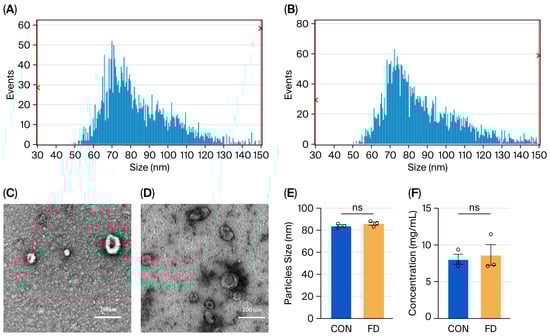
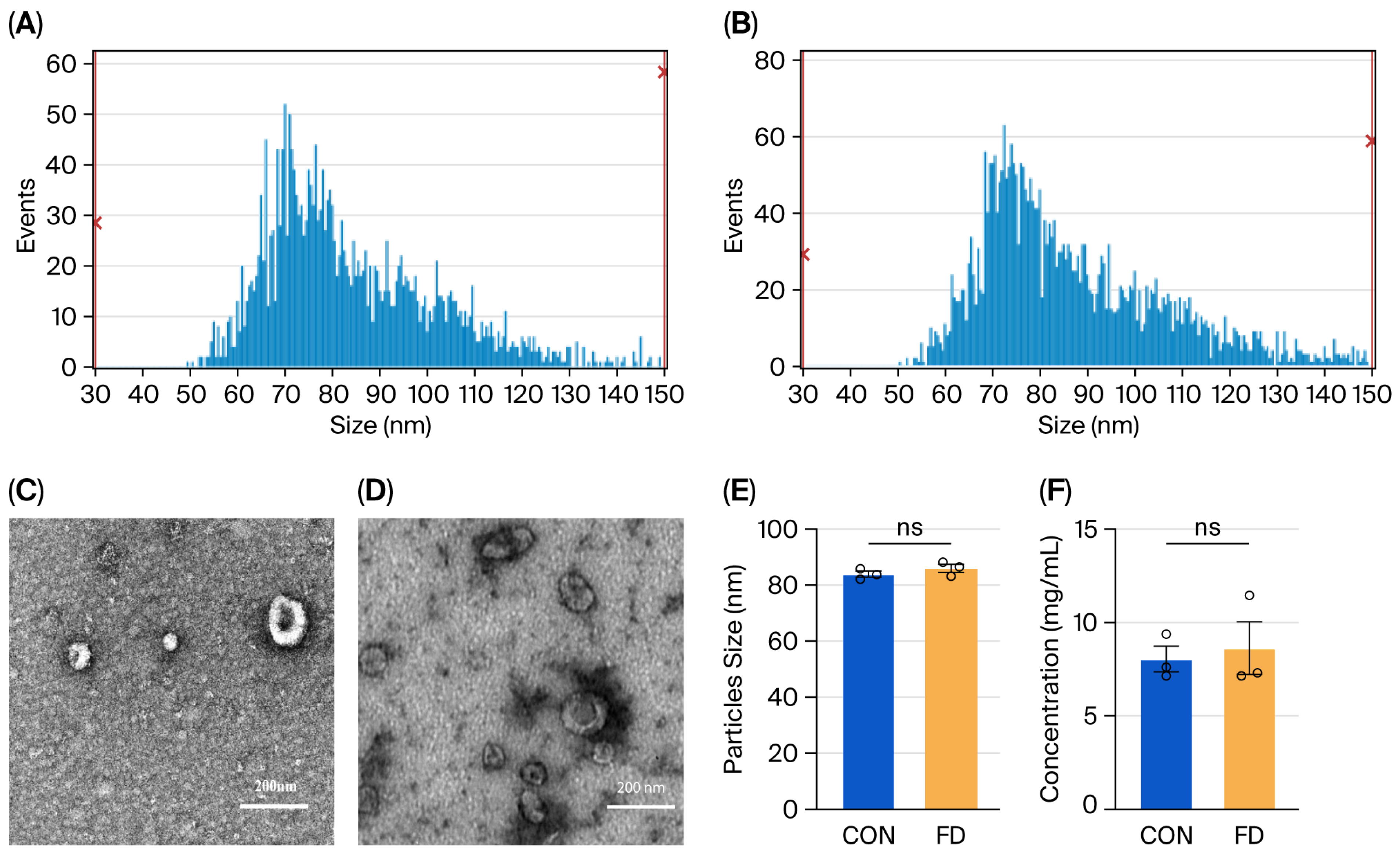
Exosomal morphology was assessed using TEM. Plasma-derived exosomes exhibited a uniform spherical or oval shape surrounded by a single lipid bilayer (Figure 1C). Particle diameters ranged from 30 to 150 nm, consistent with reported exosomal dimensions. The mean diameters were 83.80 nm in healthy controls (CON) and 86.56 nm in FD patients, with no significant difference in size distribution between groups (Figure 1A,B,E). Exosomes were further validated by Western blot using TSG101 as a positive marker and calnexin as a negative control (Figure S1).
Figure 1.
Characterization of plasma-derived exosomes in control and FD groups (A,B). Size distribution of exosomes from CON and FD plasma. (C,D) TEM images showing spherical or oval vesicles (30–150 nm) enclosed by a lipid bilayer. Scale bar = 200 nm. (E,F) Quantitative analysis of exosome size and particle concentration in CON and FD groups. No significant (ns) differences were detected (p > 0.05).
3.5. Protein Analysis of Exosomes from FD and Control Groups
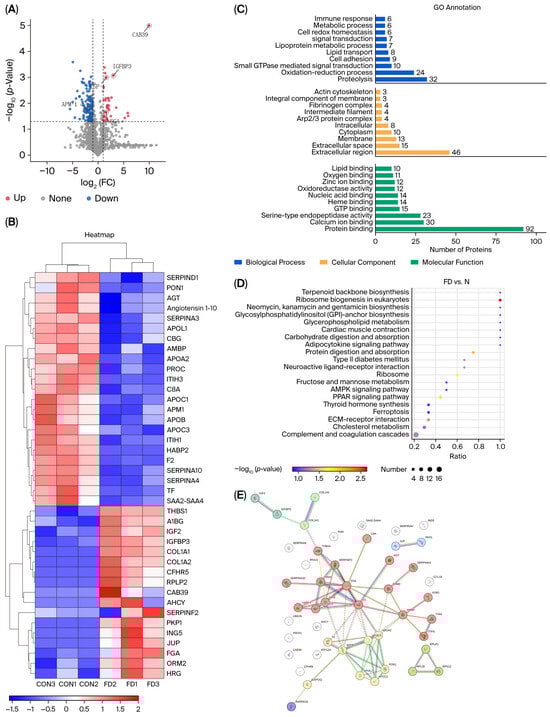
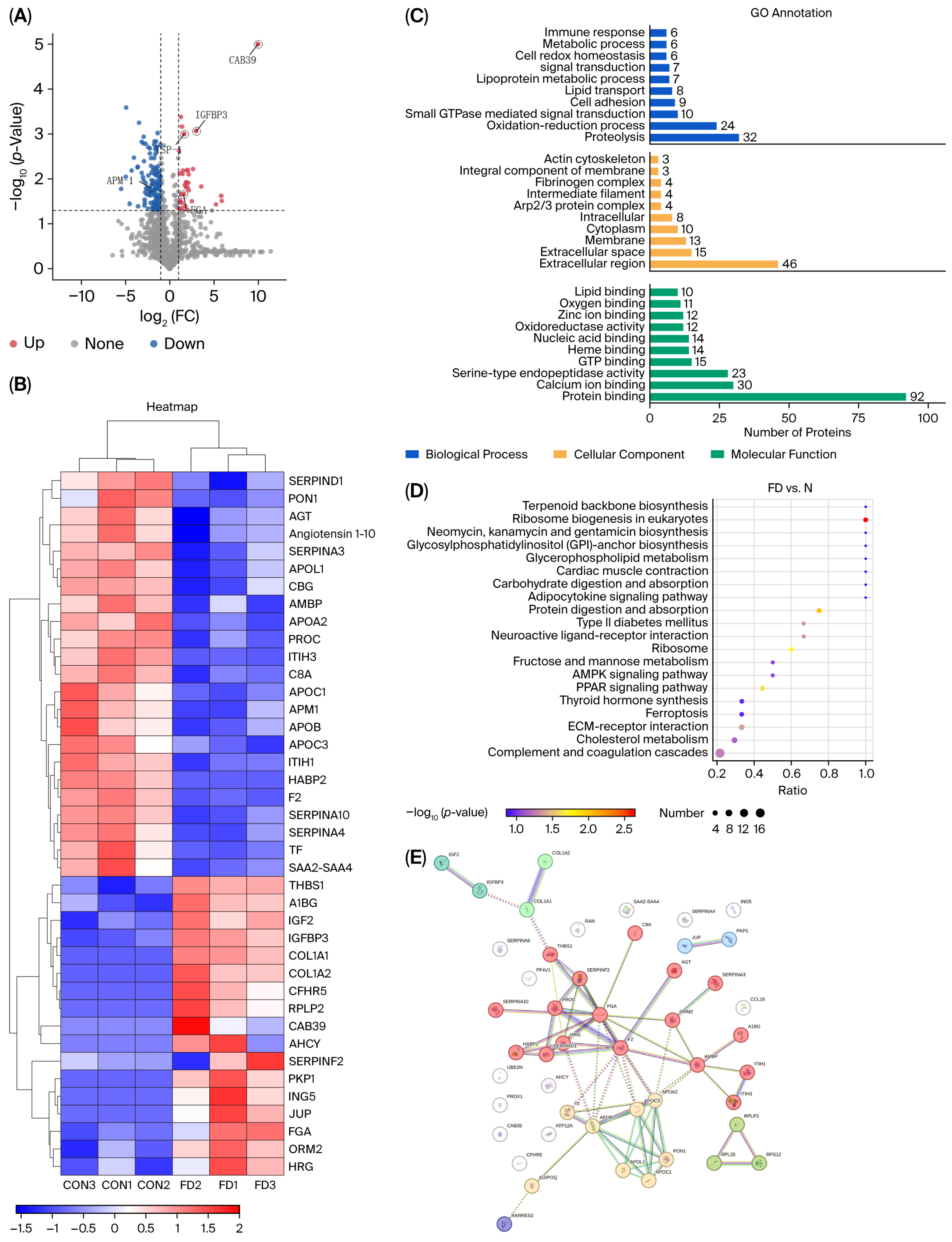
A total of 2553 proteins were identified by searching against a comprehensive protein database. Differential expression between group FD and group CON was evaluated using t-tests based on relative quantification values. Proteins with a fold change ≥1.5 and p < 0.05 were classified as significantly upregulated (n = 44), while those with a fold change ≤0.67 and p < 0.05 were considered downregulated (n = 144). The full dataset with adjusted p-values is provided in Supplementary Table S2.
Exosomal proteomic analysis revealed significant alterations in proteins related to renal pathology. THBS1, implicated in tubulointerstitial remodeling and inflammation, and CFHR5, associated with renal disease progression, were significantly upregulated in the FD group. Conversely, several proteins with renoprotective or disease-related functions were downregulated, including SERPINA10 (a renoprotective protein), A1BG, angiotensin 1–10 (involved in blood pressure regulation via ACE), APOL1 (associated with glomerulosclerosis and nephrotic syndrome), and AMBP (protective against oxidative stress). Proteins associated with lipid metabolism and cardiovascular health were also reduced, including ADIPOQ (also known as APM1, associated with cardiovascular disease) and IGFBP3 (a marker reflective of renal impairment). Other downregulated proteins consisted of APOF, APOA2, APOC1, APOC3, APOB, SAA2-SAA4 (plasma amyloid proteins), and PON1 (Figure 2B). Cluster analysis revealed clear segregation of FD and CON samples, underscoring a disease-specific exosomal proteomic profile and highlighting molecular signatures related to renal injury, inflammation, and metabolic dysregulation.
Figure 2.
Proteomic profiling of plasma-derived exosomes in FD and CON groups. (A) Volcano plot of differentially expressed proteins. (B) Heatmap showing sample clustering. (C) GO enrichment analysis. (D) KEGG pathway enrichment analysis. (E) PPI network generated using STRING, the lines in the figure follow the default settings of the STRING database: a greater number of lines indicates higher confidence in the protein–protein interaction.
Gene Ontology (GO) analysis revealed that differentially expressed proteins were associated with extracellular matrix structural constituents, metallopeptidase activity, serine-type peptidase inhibitor activity, zinc-ion binding, and transition-metal-ion binding. Biological processes included organic substance metabolism, nitrogen compound catabolism, and macromolecule metabolism, with localization enriched in the nucleus, ribonucleoprotein complexes, extracellular regions, and processing bodies (Figure 2C).
KEGG pathway analysis revealed significant enrichment in ribosome biogenesis, protein digestion and absorption, PPAR and AMPK signaling, extracellular matrix–receptor interactions, type II diabetes mellitus, lipid metabolism, complement and coagulation cascades, and cardiac muscle contraction (Figure 2D).
Protein–protein interaction (PPI) analysis using the STRING database (http://string-db.org/, accessed on 7 September 2025) led to the construction of an interaction network. Prominent functional modules included apolipoproteins (e.g., APOA2, APOC3, APOB, APOL1, APOC1, PON1, TF, and APM1) and proteins associated with the complement and coagulation systems (such as THBS1, SERPINF2, FGA, F2, AMBP, HRG, C8A, ORM2, and PROC) (Figure 2E).
3.6. Validation of Differential Proteins
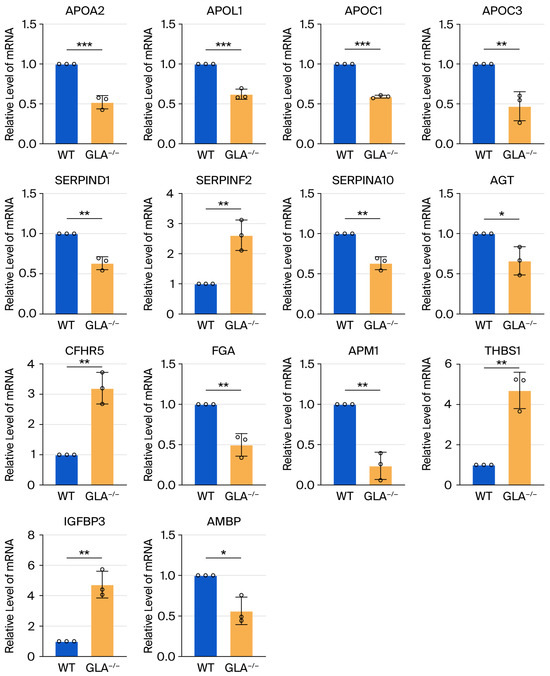
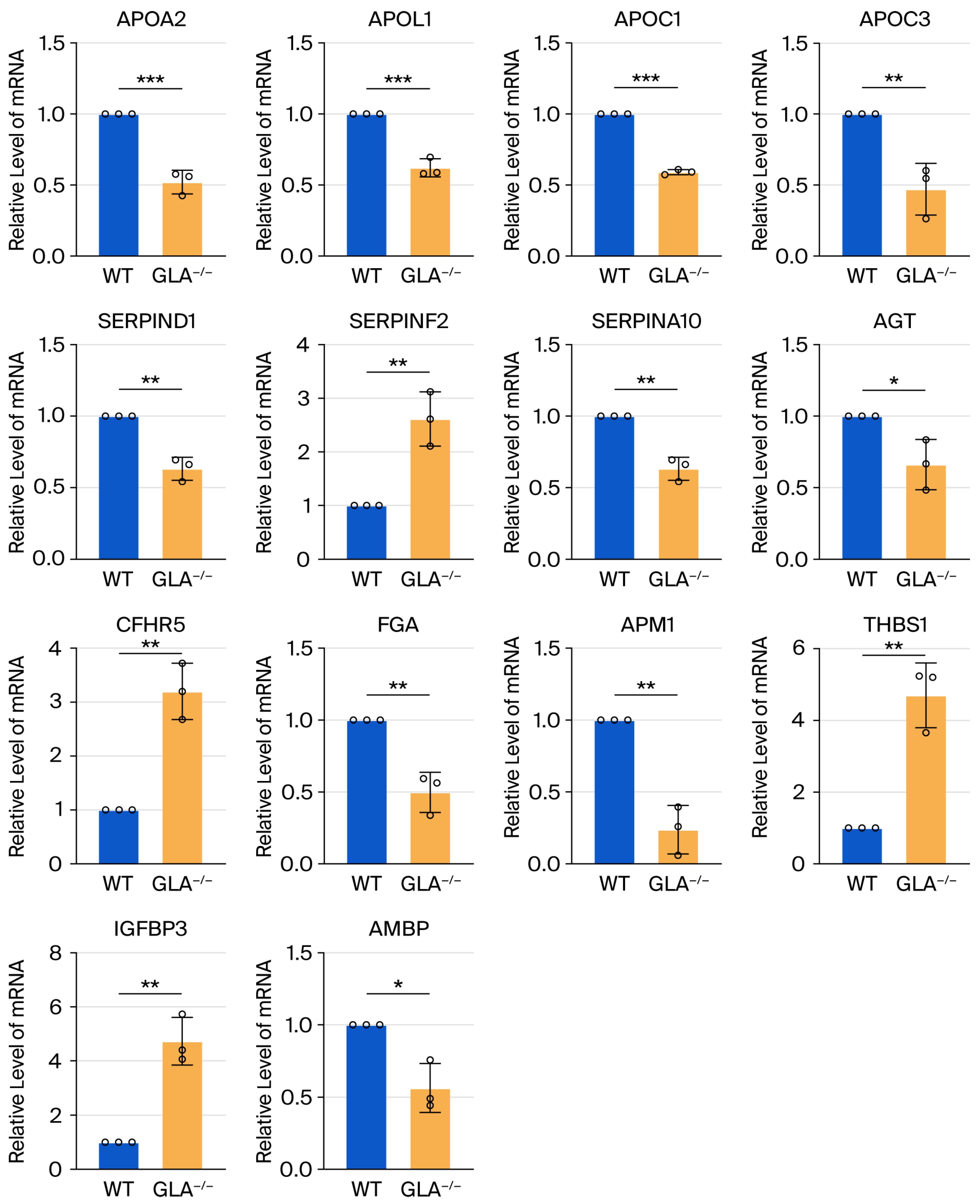
RT-PCR was performed in HEK 293 cells to validate exosomal proteomic findings (n = 4). qPCR targets were derived from exosomal proteomic findings and represent proteins linked to kidney and heart pathology, including upregulation of THBS1 (4.704 ± 0.934 fold vs. WT; p < 0.01), IGFBP3 (4.732 ± 0.880; p < 0.001), CFHR5 (3.199 ± 0.521; p < 0.01), and SRRPINF2 (2.615 ±0.506; p < 0.01), and downregulation of APM1 (ADIPOQ 0.238 ± 0.169; p < 0.01), APOA2 (0.521 ± 0.083; p < 0.001), APOL1 (0.621 ± 0.064; p < 0.001), APOC1 (0.591 ± 0.018; p < 0.001), APOC3 (0.471 ± 0.182; p < 0.01), AMBP (0.5564 ± 0.169; p < 0.05), SERPIND1 (0.633 ± 0.081; p < 0.01), SERPINA10 (0.632 ± 0.078; p < 0.01), AGT (0.661 ± 0.176; p < 0.05), and FGA (0.498 ± 0.139; p < 0.01) (Figure 3).
Figure 3.
Validation of exosomal proteomic findings in HEK293 cells. Relative mRNA expression of selected genes (APOA2, APOL1, APOC1, APOC3, SERPIND1, SERPINF2, SERPINA10, AGT, CFHR5, FGA, APM1, THBS1, and AMBP) in Gla−/− HEK 293, quantified by RT-PCR. *, p < 0.05; **, p < 0.01; ***, p < 0.001.
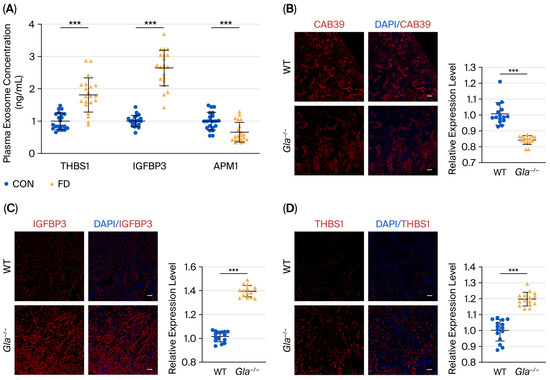
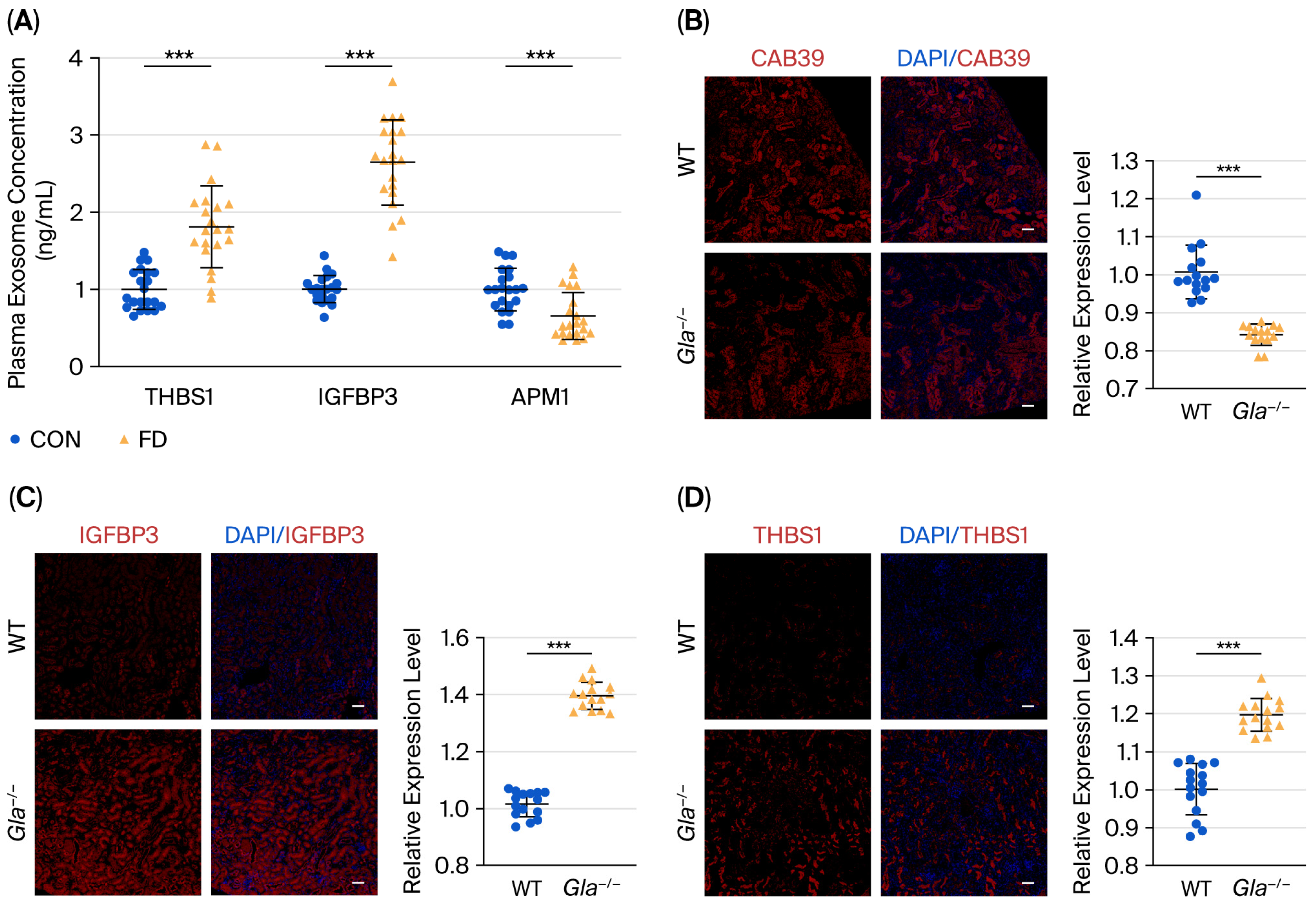
Further validation in patient-derived plasma exosomes (n = 21) using ELISA revealed significantly increased levels of THBS1 and IGFBP3, whereas APM1 levels were markedly reduced in FD patients compared with controls (Figure 4A). Consistently, immunofluorescence staining of kidney tissues from Gla−/− mice demonstrated decreased CAB39 (0.842 ± 0.028; p < 0.001) expression along with elevated IGFBP3 (1.396 ± 0.048; p < 0.001) and THBS1 (1.197 ± 0.043, p < 0.001) expression in renal tubules, supporting the relevance of these exosomal signatures to tissue-level changes in Fabry nephropathy (Figure 4B–D).
Figure 4.
Validation of exosomal protein alterations in plasma and kidney tissues. (A) ELISA quantification of plasma exosomes from 21 FD patients showing increased THBS1 and IGFBP3 levels and decreased APM1 levels. (B–D) Immunofluorescence staining of kidney tissues from Gla−/− mice (B6;129-Glatm1Kul/J; stock no. 003535, Jackson Laboratory), demonstrating reduced CAB39 expression and elevated IGFBP3 and THBS1 expression. Fluorescence intensity of the target protein was quantified in renal tubule regions per group using image analysis software (n = 5; three fields of vision were counted per mouse). ***, p < 0.001.
4. Discussion
Delayed diagnosis remains a major challenge in FD, often resulting in missed opportunities for early intervention and irreversible organ injury. In our cohort, the diagnostic latency ranged from 8 months to 7 years; such delays may reduce the effectiveness of enzyme--replacement therapy (ERT) and worsen clinical outcomes [4,12]. The efficacy of ERT is highly time-dependent; once structural lesions such as glomerulosclerosis, interstitial fibrosis, or myocardial hypertrophy are established, ERT typically slows progression but rarely restores renal function or reverses cardiac remodeling [13].
Analysis of 21 pediatric FD patients revealed that most maintained normal or supranormal glomerular filtration, yet several already showed early evidence of organ involvement, including proteinuria, microalbuminuria, hematuria, an elevated LVMI, or increased cTnI levels. These subclinical changes indicate that conventional markers such as creatinine and eGFR lack sensitivity for detecting early functional decline in children [11,14]. Proteins derived from plasma exosomes can report molecular changes not captured by routine assays and, therefore, constitute promising candidates for early diagnostic biomarkers [15,16].
Neither Lyso-GL-3 nor α-Gal A levels showed a clear correlation with age in our cohort. This finding is consistent with previous studies highlighting genotype, sex, and treatment status as primary determinants. Given this well-established pattern and the limited sample size, we did not perform additional age-based correlation analyses, focusing instead on phenotype- and organ-specific interpretations of the exosomal profiles [17,18].
Exosomal proteomics in this study identified over 2500 proteins. Pathways showing significant perturbation included PPAR and AMPK signaling, lipid metabolism, and complement and coagulation cascades, all of which are central to renal and cardiovascular homeostasis [19] and provide molecular evidence of early renal involvement. In pediatric plasma exosomes, THBS1 and CFHR5 were markedly upregulated [20]. THBS1, enriched in the tubulointerstitial compartment, activates latent TGF-β1 and promotes interstitial fibrosis, supporting its role as a sensitive marker of subclinical renal fibrogenesis [21,22]. CFHR5, a regulator of the alternative complement pathway implicated in complement-mediated nephropathies, suggests complement-related glomerular injury in FD [23,24].
In contrast, several cytoprotective proteins, including SERPINA10, A1BG, and AMBP, were downregulated and exosomal angiotensin I-10 was reduced, indicating impaired antioxidant/anti-inflammatory defenses and dysregulation of the renin–angiotensin system; these changes are consistent with the observation of proteinuria and microalbuminuria despite preserved serum creatinine [25]. In the cardiovascular domain, concurrent upregulation of THBS1 and downregulation of adiponectin (APM1) reflect an imbalance between profibrotic and protective signaling. THBS1 facilitates myocardial fibrosis via TGF-β activation and MMP/myofibroblast pathways, whereas adiponectin signals through AMPK/PPAR-α to exert anti-inflammatory, antifibrotic, and metabolic protective effects. Reduced adiponectin levels correlated with an increased LVMI and subclinical myocardial involvement [22,26,27,28,29].
Collectively, reciprocal changes in exosomal THBS1 and adiponectin, together with complement activation and loss of cytoprotective factors, indicate that profibrotic and inflammatory drivers outweigh protective pathways in early FD. These observations provide mechanistic insights and nominate exosomal THBS1, CFHR5, and adiponectin as candidate biomarkers for risk stratification and therapeutic monitoring; targeted mechanistic validation, including molecular docking and in vitro/in vivo functional studies, is required.
GO enrichment linked differentially expressed exosomal proteins in pediatric FD to extracellular matrix organization, metalloproteinase activity, serine protease inhibition, and metal-ion binding, functions integral to matrix remodeling, enzyme regulation, and metabolic homeostasis, and closely relevant to renal pathology. KEGG analysis highlighted ribosome biogenesis, protein digestion and absorption, PPAR and AMPK signaling, ECM–receptor interactions, type 2 diabetes mellitus, lipid metabolism, complement–coagulation cascades, and cardiac contraction pathways. PPAR and AMPK pathways regulate fatty acid oxidation, energy metabolism, and anti-inflammatory responses. Enrichment of these pathway components in exosomes, together with decreased adiponectin, is compatible with impairment of protective metabolic signaling and a shift toward metabolic stress and profibrotic states [19,30,31]. Interpretation of certain enriched terms (e.g., “type 2 diabetes” and “cardiac contraction”) requires caution, since such annotations may reflect broad enrichment of metabolic proteins rather than disease-specific mechanisms. Pathological inferences drawn from these terms demand targeted experimental validation.
The PPI network analysis identified an apolipoprotein-centered lipid transport module and a coagulation/complement module (FGA, F2, etc.), while THBS1 and IGFBP3 emerged as central nodes linking fibrotic and growth-factor regulatory processes, indicating that FD exosomes capture interrelated mechanisms of fibrosis, inflammation, and vascular dysfunction [32,33,34].
In summary, functional enrichment and network analyses suggest that exosomal proteins reflect systemic disease mechanisms in FD, bridging renal fibrosis, metabolic dysregulation, and cardiovascular remodeling. These molecular signatures not only mirror early clinical manifestations such as proteinuria, reduced eGFR, and left-ventricular hypertrophy, but also hold promise as biomarkers for disease progression and therapeutic monitoring. Future longitudinal studies integrating exosomal proteomics with imaging and genetic screening will be essential to establish their role in the precise diagnosis and personalized treatment of FD. A key limitation is that all samples were from symptomatic, untreated patients; pre-symptomatic cases were not included. As Lyso-Gb3 levels are known to rise before symptom onset, further studies are needed to assess whether exosomal markers exhibit similar early trends. Overall, these findings are exploratory and hypothesis-generating, and prospective validation is required to assess their clinical utility.
5. Conclusions
In conclusion, exosomal proteomic analysis in pediatric FD revealed key molecular alterations linked to renal and cardiovascular injury. Among the differentially expressed proteins, THBS1 and CFHR5 emerged as potential markers of renal fibrosis and complement-mediated glomerular injury, while IGFBP3 reflected growth factor dysregulation associated with both renal and cardiac remodeling. In contrast, the downregulation of APM1 highlighted loss of metabolic and cardioprotective signaling, and reduced CAB39 suggested impaired AMPK-mediated stress resistance. Together, these proteins delineate a pathophysiological imbalance between profibrotic drivers and protective mechanisms in FD. From a clinical perspective, such exosomal biomarkers hold promise for improving early diagnosis, monitoring subclinical organ involvement, and guiding therapeutic timing, particularly for interventions such as ERT. Their integration into clinical practice may enable earlier risk stratification, closer surveillance of renal and cardiac complications, and more personalized management strategies to optimize long-term outcomes in FD.
Supplementary Materials
The following supporting information can be downloaded at: https://www.mdpi.com/article/10.3390/biomedicines13112598/s1, Table S1. The primers used in the study; Table S2. Full dataset with adjusted p-values; Figure S1. Western blot analysis of exosomal marker in human plasma-derived exosomes; Figure S2. Validation of CRISPR-Cas9–mediated gene editing in HEK293 cells.
Author Contributions
Data curation, Z.L.; Formal analysis, Y.X.; Funding acquisition, P.J. and J.M.; Investigation, B.W.; Writing—original draft, Z.L. and Y.X.; Writing—review and editing, P.J. and J.M. All authors have read and agreed to the published version of the manuscript.
Funding
This research was funded by Zhejiang Provincial Natural Science Foundation of China (LMS25H050001).
Institutional Review Board Statement
The study was conducted in accordance with the Declaration of Helsinki, and approved by the Institutional Review Board of The Children’s Hospital, Zhejiang University School of Medicine (2021-IRB-187-A1, approved on 20 August 2021 and 2021-BC-001, approved on 20 January 2022).
Informed Consent Statement
Informed consent was obtained from the legal guardians of all the participants.
Data Availability Statement
Raw proteomics data have been deposited in PRIDE (accession number: [PXD069403]).
Conflicts of Interest
The authors declare that they have no competing interests.
Abbreviations
The following abbreviations are used in this manuscript:
| FD | Fabry disease |
| α-Gal A | α-galactosidase A |
| GL-3 | globotriaosylceramide |
| Lyso-GL-3 | glycosphingolipids |
References
- Toyooka, K. Fabry disease. Curr. Opin. Neurol. 2011, 24, 463–468. [Google Scholar] [CrossRef] [Scilit]
- Soloway, S.; Lister, D. Fabry’s Disease. N. Engl. J. Med. 2024, 391, 1038. [Google Scholar] [CrossRef] [Scilit] [PubMed]
- Borisch, C.; Thum, T.; Bär, C.; Hoepfner, J. Human in vitro models for Fabry disease: New paths for unravelling disease mechanisms and therapies. J. Transl. Med. 2024, 22, 965. [Google Scholar] [CrossRef] [Scilit] [PubMed]
- Lenders, M.; Brand, E. Precision medicine in Fabry disease. Nephrol. Dial. Transplant. 2021, 36, 14–23. [Google Scholar] [CrossRef] [Scilit]
- Ponleitner, M.; Gatterer, C.; Bsteh, G.; Rath, J.; Altmann, P.; Berger, T.; Graf, S.; Sunder-Plassmann, G.; Rommer, P.S. Investigation of serum neurofilament light chain as a biomarker in Fabry disease. Sci. Rep. 2024, 14, 23033. [Google Scholar] [CrossRef] [Scilit]
- Fuertes Kenneally, L.; García-Álvarez, M.I.; Feliu Rey, E.; García Barrios, A.; Climent-Payá, V. Fabry Disease Cardiomyopathy: A Review of the Role of Cardiac Imaging from Diagnosis to Treatment. Rev. Cardiovasc. Med. 2022, 23, 192. [Google Scholar] [CrossRef] [Scilit]
- Puspita, R.; Jusuf, A.A. Systematic review of exosomes derived from various stem cell sources: Function and therapeutic potential in disease modulation. Mol. Biol. Rep. 2025, 52, 842. [Google Scholar] [CrossRef] [Scilit]
- Zhao, B.; Wang, W.; Li, N.; Garcia-Lezana, T.; Che, C.; Wang, X.; Losic, B.; Villanueva, A.; Cunningham, B.T. Digital-resolution and highly sensitive detection of multiple exosomal small RNAs by DNA toehold probe-based photonic resonator absorption microscopy. Talanta 2022, 241, 123256. [Google Scholar] [CrossRef] [Scilit]
- Lai, J.J.; Chau, Z.L.; Chen, S.Y.; Hill, J.J.; Korpany, K.V.; Liang, N.W.; Lin, L.H.; Lin, Y.H.; Liu, J.K.; Liu, Y.C.; et al. Exosome Processing and Characterization Approaches for Research and Technology Development. Adv. Sci. Weinh. 2022, 9, e2103222. [Google Scholar] [CrossRef] [Scilit]
- Simonetta, I.; Tuttolomondo, A.; Daidone, M.; Pinto, A. Biomarkers in Anderson-Fabry Disease. Int. J. Mol. Sci. 2020, 21, 8080. [Google Scholar] [CrossRef] [Scilit]
- Pieroni, M.; Namdar, M.; Olivotto, I.; Desnick, R.J. Anderson-Fabry disease management: Role of the cardiologist. Eur. Heart J. 2024, 45, 1395–1409. [Google Scholar] [CrossRef] [Scilit]
- Hopkin, R.J.; Laney, D.; Kazemi, S.; Walter, A. Fabry disease in females: Organ involvement and clinical outcomes compared with the general population (103/150 characters). Orphanet. J. Rare Dis. 2025, 20, 433. [Google Scholar] [CrossRef] [Scilit] [PubMed]
- Riccio, E.; Pisani, A. Real-World Migalastat Use in Fabry Disease: Comparative Insights from the Pisani and Hughes Studies. J. Inherit. Metab. Dis. 2025, 48, e70080. [Google Scholar] [CrossRef] [Scilit] [PubMed]
- Weissman, D.; Dudek, J.; Sequeira, V.; Maack, C. Fabry Disease: Cardiac Implications and Molecular Mechanisms. Curr. Heart Fail Rep. 2024, 21, 81–100. [Google Scholar] [CrossRef] [Scilit]
- Burlina, A.; Brand, E.; Hughes, D.; Kantola, I.; Krämer, J.; Nowak, A.; Tøndel, C.; Wanner, C.; Spada, M. An expert consensus on the recommendations for the use of biomarkers in Fabry disease. Mol. Genet. Metab. 2023, 139, 107585. [Google Scholar] [CrossRef] [Scilit]
- Orsborne, C.; Black, N.; Naish, J.H.; Woolfson, P.; Reid, A.B.; Schmitt, M.; Jovanovic, A.; Miller, C.A. Disease-specific therapy for the treatment of the cardiovascular manifestations of Fabry disease: A systematic review. Heart 2023, 110, 19–26. [Google Scholar] [CrossRef] [Scilit]
- Ellaway, C. Paediatric Fabry disease. Transl. Pediatr. 2016, 5, 37–42. [Google Scholar] [CrossRef] [Scilit]
- Maruyama, H.; Miyata, K.; Mikame, M.; Taguchi, A.; Guili, C.; Shimura, M.; Murayama, K.; Inoue, T.; Yamamoto, S.; Sugimura, K.; et al. Effectiveness of plasma lyso-Gb3 as a biomarker for selecting high-risk patients with Fabry disease from multispecialty clinics for genetic analysis. Genet. Med. 2019, 21, 44–52. [Google Scholar] [CrossRef] [Scilit]
- Deng, Y.H.; Wang, X.F.; Wu, X.; Yan, P.; Liu, Q.; Wu, T.; Duan, S.B. Differential renal proteomics analysis in a novel rat model of iodinated contrast-induced acute kidney injury. Ren. Fail. 2023, 45, 2178821. [Google Scholar] [CrossRef] [Scilit]
- Fujimaru, T.; Mori, T.; Chiga, M.; Mandai, S.; Kikuchi, H.; Ando, F.; Mori, Y.; Susa, K.; Nakano, Y.; Shoji, T.; et al. Genetic Diagnosis of Adult Hemodialysis Patients with Unknown Etiology. Kidney Int. Rep. 2024, 9, 994–1004. [Google Scholar] [CrossRef] [Scilit]
- Yao, M.; Lian, D.; Wu, M.; Zhou, Y.; Fang, Y.; Zhang, S.; Zhang, W.; Yang, Y.; Li, R.; Chen, H.; et al. Isoliensinine Attenuates Renal Fibrosis and Inhibits TGF-β1/Smad2/3 Signaling Pathway in Spontaneously Hypertensive Rats. Drug Des. Dev. Ther. 2023, 17, 2749–2762. [Google Scholar] [CrossRef] [Scilit]
- Julovi, S.M.; Trinh, K.; Robertson, H.; Xu, C.; Minhas, N.; Viswanathan, S.; Patrick, E.; Horowitz, J.D.; Meijles, D.N.; Rogers, N.M. Thrombospondin-1 Drives Cardiac Remodeling in Chronic Kidney Disease. JACC Basic Transl. Sci. 2024, 9, 607–627. [Google Scholar] [CrossRef] [Scilit]
- Malik, T.H.; Gitterman, D.P.; Lavin, D.P.; Lomax-Browne, H.J.; Hiemeyer, E.C.; Moran, L.B.; Boroviak, K.; Cook, H.T.; Gilmore, A.C.; Mandwie, M.; et al. Gain-of-function factor H-related 5 protein impairs glomerular complement regulation resulting in kidney damage. Proc. Natl. Acad. Sci. USA 2021, 118, e2022722118. [Google Scholar] [CrossRef] [Scilit] [PubMed]
- Biddeci, G.; Spinelli, G.; Colomba, P.; Duro, G.; Giacalone, I.; Di Blasi, F. Fabry Disease Beyond Storage: The Role of Inflammation in Disease Progression. Int. J. Mol. Sci. 2025, 26, 7054. [Google Scholar] [CrossRef] [Scilit] [PubMed]
- Gaipov, A.; Makhammajanov, Z.; Dauyey, Z.; Markhametova, Z.; Mussina, K.; Nogaibayeva, A.; Kozina, L.; Auganova, D.; Tarlykov, P.; Bukasov, R.; et al. Urinary Protein Profiling for Potential Biomarkers of Chronic Kidney Disease: A Pilot Study. Diagnostics 2022, 12, 2583. [Google Scholar] [CrossRef] [Scilit] [PubMed]
- Hassan, H.M.; Liang, X.; Xin, J.; Lu, Y.; Cai, Q.; Shi, D.; Ren, K.; Li, J.; Chen, Q.; Li, J.; et al. Thrombospondin 1 enhances systemic inflammation and disease severity in acute-on-chronic liver failure. BMC Med. 2024, 22, 95. [Google Scholar] [CrossRef] [Scilit]
- Lee, S.; Kwak, H.B. Role of adiponectin in metabolic and cardiovascular disease. J. Exerc. Rehabil. 2014, 10, 54–59. [Google Scholar] [CrossRef] [Scilit]
- Clarke, R.; Von Ende, A.; Schmidt, L.E.; Yin, X.; Hill, M.; Hughes, A.D.; Pechlaner, R.; Willeit, J.; Kiechl, S.; Watkins, H.; et al. Apolipoprotein Proteomics for Residual Lipid-Related Risk in Coronary Heart Disease. Circ. Res. 2023, 132, 452–464. [Google Scholar] [CrossRef] [Scilit]
- Jønck, S.; Adamsen, M.L.; Rasmussen, I.E.; Lytzen, A.A.; Løk, M.; Vonsild Lund, M.A.; Dreyer, L.; Jørgensen, P.G.; Vejlstrup, N.; Køber, L.; et al. IL-6 Inhibitors and TNF Inhibitors: Impact on Exercise-induced Cardiac Adaptations in Patients with Rheumatoid Arthritis. JACC Basic Transl. Sci. 2025, 10, 551–563. [Google Scholar] [CrossRef] [Scilit]
- Fujita, K.; Maeda, N.; Sonoda, M.; Ohashi, K.; Hibuse, T.; Nishizawa, H.; Nishida, M.; Hiuge, A.; Kurata, A.; Kihara, S.; et al. Adiponectin protects against angiotensin II-induced cardiac fibrosis through activation of PPAR-α. Arterioscler. Thromb. Vasc. Biol. 2008, 28, 863–870. [Google Scholar] [CrossRef] [Scilit]
- Liu, H.; Li, W.; Zhu, M.; Wen, X.; Jin, J.; Wang, H.; Lv, D.; Zhao, S.; Wu, X.; Jiao, J. Myokines and Biomarkers of Frailty in Older Inpatients with Undernutrition: A Prospective Study. J. Frailty Aging 2024, 13, 82–90. [Google Scholar] [CrossRef] [Scilit]
- Mecatti, G.C.; Messias, M.C.F.; de Oliveira Carvalho, P. Lipidomic profile and candidate biomarkers in septic patients. Lipids Health Dis. 2020, 19, 68. [Google Scholar] [CrossRef] [Scilit]
- Lee, C.J.; Choi, S.; Cheon, D.H.; Kim, K.Y.; Cheon, E.J.; Ann, S.J.; Noh, H.M.; Park, S.; Kang, S.M.; Choi, D.; et al. Effect of two lipid-lowering strategies on high-density lipoprotein function and some HDL-related proteins: A randomized clinical trial. Lipids Health Dis. 2017, 16, 49. [Google Scholar] [CrossRef] [Scilit]
- Botoseneanu, A.; Markwardt, S.; Quiñones, A.R. Multimorbidity and Functional Disability among Older Adults: The Role of Inflammation and Glycemic Status—An Observational Longitudinal Study. Gerontology 2023, 69, 826–838. [Google Scholar] [CrossRef] [Scilit]

Disclaimer/Publisher’s Note: The statements, opinions and data contained in all publications are solely those of the individual author(s) and contributor(s) and not of MDPI and/or the editor(s). MDPI and/or the editor(s) disclaim responsibility for any injury to people or property resulting from any ideas, methods, instructions or products referred to in the content. |
© 2025 by the authors. Licensee MDPI, Basel, Switzerland. This article is an open access article distributed under the terms and conditions of the Creative Commons Attribution (CC BY) license (https://creativecommons.org/licenses/by/4.0/).