Mesenchymal Stromal Cell-Derived Extracellular Vesicles for Reversing Hepatic Fibrosis in 3D Liver Spheroids

 , , , and
 Abstract
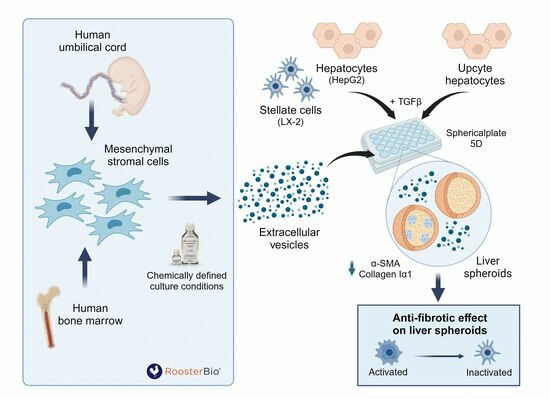
Share and Cite
Chiabotto, G.; Semnani, A.; Ceccotti, E.; Guenza, M.; Camussi, G.; Bruno, S. Mesenchymal Stromal Cell-Derived Extracellular Vesicles for Reversing Hepatic Fibrosis in 3D Liver Spheroids. Biomedicines 2024, 12, 1849. https://doi.org/10.3390/biomedicines12081849
Chiabotto G, Semnani A, Ceccotti E, Guenza M, Camussi G, Bruno S. Mesenchymal Stromal Cell-Derived Extracellular Vesicles for Reversing Hepatic Fibrosis in 3D Liver Spheroids. Biomedicines. 2024; 12(8):1849. https://doi.org/10.3390/biomedicines12081849
Chicago/Turabian StyleChiabotto, Giulia, Armina Semnani, Elena Ceccotti, Marco Guenza, Giovanni Camussi, and Stefania Bruno. 2024. "Mesenchymal Stromal Cell-Derived Extracellular Vesicles for Reversing Hepatic Fibrosis in 3D Liver Spheroids" Biomedicines 12, no. 8: 1849. https://doi.org/10.3390/biomedicines12081849
APA StyleChiabotto, G., Semnani, A., Ceccotti, E., Guenza, M., Camussi, G., & Bruno, S. (2024). Mesenchymal Stromal Cell-Derived Extracellular Vesicles for Reversing Hepatic Fibrosis in 3D Liver Spheroids. Biomedicines, 12(8), 1849. https://doi.org/10.3390/biomedicines12081849