Article

Generation of Alzheimer’s Disease Model Derived from Induced Pluripotent Stem Cells with APP Gene Mutation

1
Division of Intractable Disease Research, Department of Chronic Disease Convergence Research, Korea National Institute of Health, Cheongju 28160, Republic of Korea
2
Korea National Stem Cell Bank, Korea National Institute of Health, Cheongju 28160, Republic of Korea
3
Department of Neurology, Yonsei University College of Medicine, Seoul 03722, Republic of Korea
*
Author to whom correspondence should be addressed.
Biomedicines 2024, 12(6), 1193; https://doi.org/10.3390/biomedicines12061193

Submission received: 1 May 2024 / Revised: 23 May 2024 / Accepted: 24 May 2024 / Published: 27 May 2024
(This article belongs to the Special Issue The Promise and Challenge of Induced Pluripotent Stem Cells (iPSCs))

Abstract

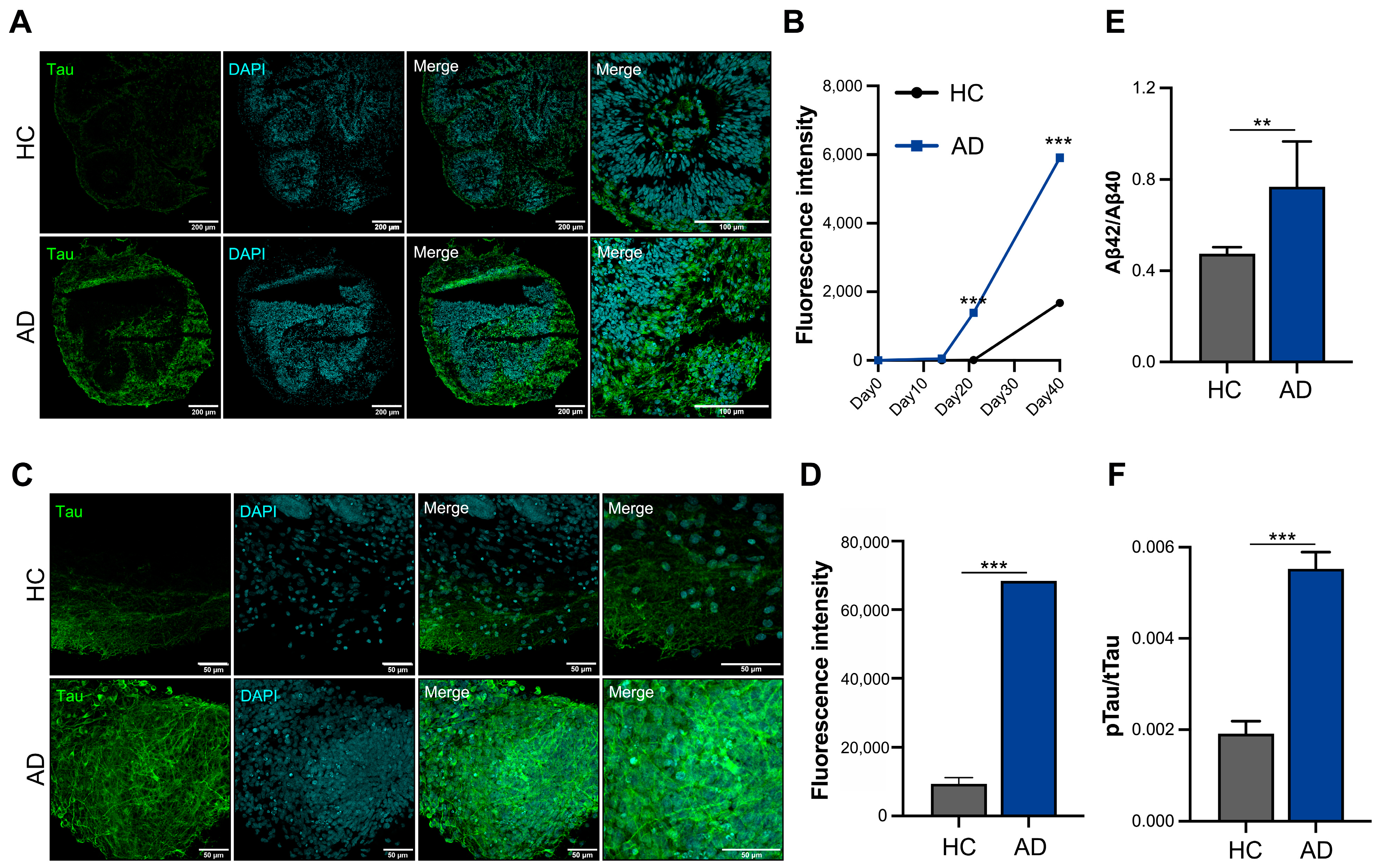
Alzheimer’s disease (AD), the most common cause of dementia, is characterized by disruptions in memory, cognition, and personality, significantly impacting morbidity and mortality rates among older adults. However, the exact pathophysiological mechanism of AD remains unknown, and effective treatment options for AD are still lacking. Human induced pluripotent stem cells (iPSC) are emerging as promising platforms for disease research, offering the ability to model the genetic mutations associated with various conditions. Patient-derived iPSCs are useful for modeling neurodegenerative and neurodevelopmental disorders. In this study, we generated AD iPSCs from peripheral blood mononuclear cells obtained from a 65-year-old patient with AD carrying the E682K mutation in the gene encoding the amyloid precursor protein. Cerebral organoids derived from AD iPSCs recapitulated the AD phenotype, exhibiting significantly increased levels of tau protein. Our analysis revealed that an iPSC disease model of AD is a valuable assessment tool for pathophysiological research and drug screening.
Keywords: Alzheimer’s disease; amyloid precursor protein; cerebral organoid; disease modeling; drug screening; induced pluripotent stem cells; organoids; tau pathology Alzheimer’s disease; amyloid precursor protein; cerebral organoid; disease modeling; drug screening; induced pluripotent stem cells; organoids; tau pathology