Article

State-of-the-Art Features for Early-Stage Detection of Diabetic Foot Ulcers Based on Thermograms

by
Natalia Arteaga-Marrero
1,*,
Abián Hernández-Guedes
2,3,
Jordan Ortega-Rodríguez
1 and
Juan Ruiz-Alzola
1,2,4
1
Grupo Tecnología Médica IACTEC, Instituto de Astrofísica de Canarias (IAC), 38205 San Cristóbal de La Laguna, Spain
2
Instituto Universitario de Investigaciones Biomédicas y Sanitarias (IUIBS), Universidad de Las Palmas de Gran Canaria, 35016 Las Palmas de Gran Canaria, Spain
3
Instituto Universitario de Microelectrónica Aplicada (IUMA), Universidad de Las Palmas de Gran Canaria, 35017 Las Palmas de Gran Canaria, Spain
4
Departamento de Señales y Comunicaciones, Universidad de Las Palmas de Gran Canaria, 35016 Las Palmas de Gran Canaria, Spain
*
Author to whom correspondence should be addressed.
Biomedicines 2023, 11(12), 3209; https://doi.org/10.3390/biomedicines11123209

Submission received: 31 October 2023 / Revised: 26 November 2023 / Accepted: 28 November 2023 / Published: 2 December 2023

Abstract

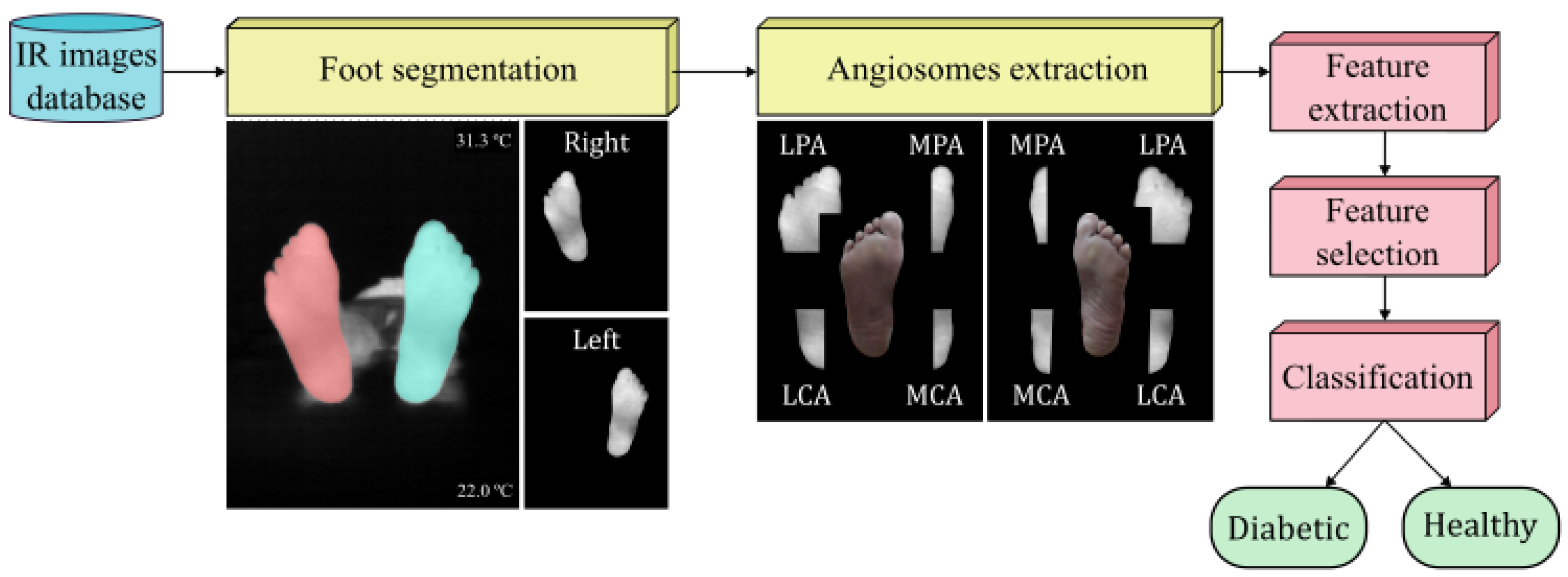
Diabetic foot ulcers represent the most frequently recognized and highest risk factor among patients affected by diabetes mellitus. The associated recurrent rate is high, and amputation of the foot or lower limb is often required due to infection. Analysis of infrared thermograms covering the entire plantar aspect of both feet is considered an emerging area of research focused on identifying at an early stage the underlying conditions that sustain skin and tissue damage prior to the onset of superficial wounds. The identification of foot disorders at an early stage using thermography requires establishing a subset of relevant features to reduce decision variability and data misinterpretation and provide a better overall cost–performance for classification. The lack of standardization among thermograms as well as the unbalanced datasets towards diabetic cases hinder the establishment of this suitable subset of features. To date, most studies published are mainly based on the exploitation of the publicly available INAOE dataset, which is composed of thermogram images of healthy and diabetic subjects. However, a recently released dataset, STANDUP, provided data for extending the current state of the art. In this work, an extended and more generalized dataset was employed. A comparison was performed between the more relevant and robust features, previously extracted from the INAOE dataset, with the features extracted from the extended dataset. These features were obtained through state-of-the-art methodologies, including two classical approaches, lasso and random forest, and two variational deep learning-based methods. The extracted features were used as an input to a support vector machine classifier to distinguish between diabetic and healthy subjects. The performance metrics employed confirmed the effectiveness of both the methodology and the state-of-the-art features subsequently extracted. Most importantly, their performance was also demonstrated when considering the generalization achieved through the integration of input datasets. Notably, features associated with the MCA and LPA angiosomes seemed the most relevant.
Keywords: thermography; infrared; deep learning; feature extraction; diabetic foot thermography; infrared; deep learning; feature extraction; diabetic foot