Psychological Distress among Undergraduate Dental Students in Saudi Arabia and Its Coping Strategies—A Systematic Review

 ,
, 
 , , , ,
  ,
,  and
and 
Abstract
1. Introduction
2. Materials and Methods
2.1. Search Strategy
2.2. Eligibility Criteria
2.2.1. Inclusion Criteria
2.2.2. Exclusion Criteria
2.3. Study Selection
3. Results
3.1. Search Results
3.2. Data Extraction and Qualitative Synthesis
3.3. Quality Assessment of the Cross-Sectional Studies Included in This Systematic Review
4. Discussion
4.1. Coping/Management Strategies for Dental Students
4.1.1. Identify the Individuals Affected
- −
- Students suffering from stress and depression must be identified.
- −
- Standardized assessment tools must be used for identifying individuals.
- −
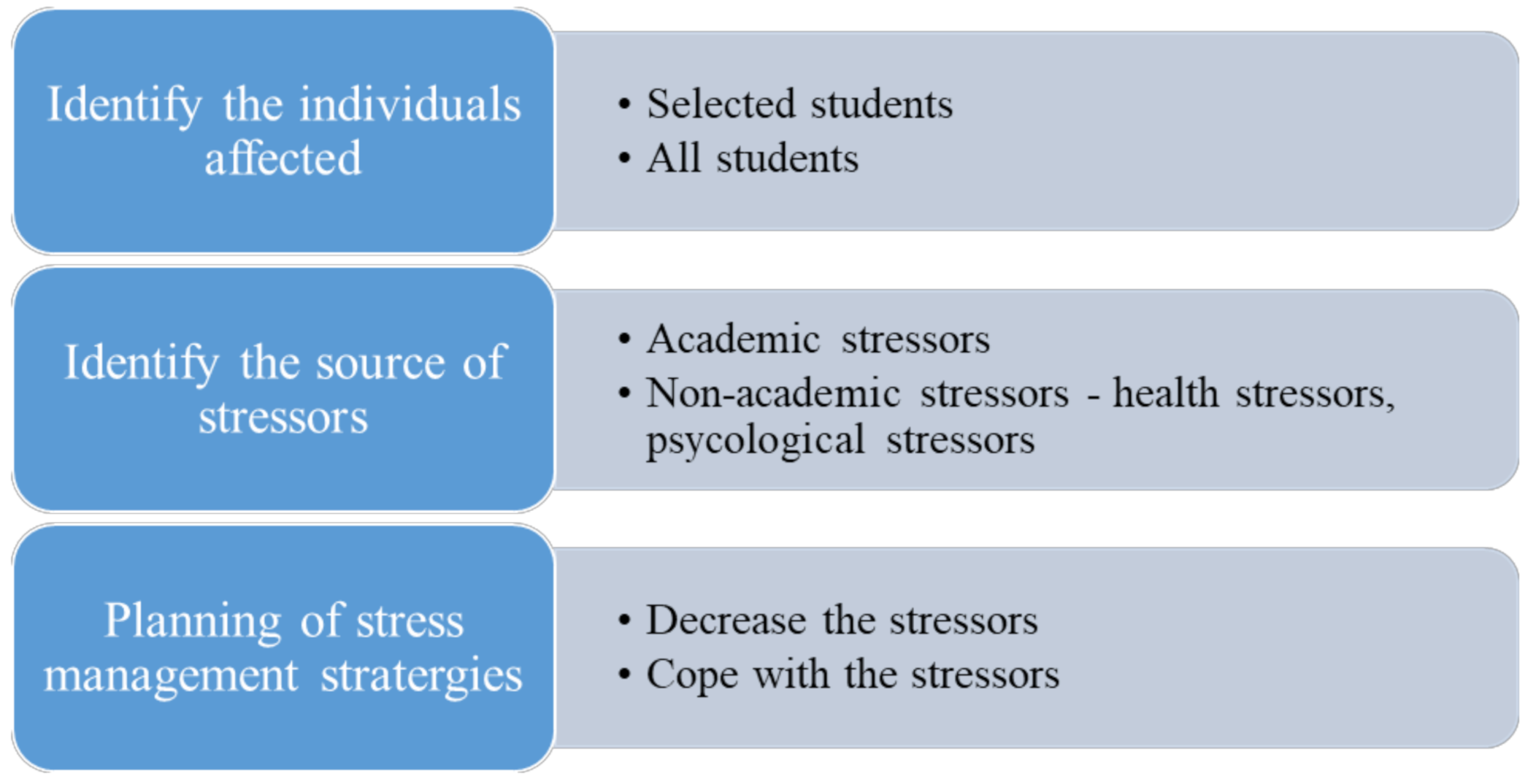
- Standardized tools like the DASS-21, DES, PSS, SWLS and GSE must be used. Visual Analog Scale (VAS) that has good validity and reliability [46]. Spielberger State-Trait Anxiety Inventory (STAI) which is a 40-item Likert-type questionnaire designed to assess individual differences in experiencing anxiety and also demonstrating strong validity and reliability [47] and COPE which is a 60-item Likert-type questionnaire that evaluates an individual’s general coping methods in response to stressors 46 must be used for assessing the mental status of the individuals (Figure 2).
4.1.2. Identify the Source of Stressors
- −
- A stressor is anything that initiates or activates a reaction to stress. They are broadly categorized as academic and non-academic stressors [48].
- −
- Academic stressors include stress related to excessive workload, attendance, assessments, curriculum, competition with the grades, academic performance, clinical requirements, fear of failure and limited time for relaxation.
- −
- Non-academic stressors include trust issues, lack of self-confidence, financial stressors, unhealthy eating habits and fear of insufficient job opportunities in the future.
4.1.3. Planning of Stress Management Strategies
- −
- Strategies must be developed to reduce the fear of failure among the students along with reducing the workload pressure.
- −
- Reducing the dental curricula would be unrealistic but the curriculum development committees should consider all things that increase stress when planning the curriculum [49].
- −
- The clinical requirements should be lowered and must not be a prerequisite for passing [50].
- −
- Faculty members should schedule regular information sessions.
- −
- −
- Faculty members should provide feedback to their students regularly and should work along with them for figuring out beneficial methods that could improve the student’s performance.
- −
- Faculty members should encourage and appreciate the students on their performance.
- −
- Students should be engaged in social activities which can help them develop good team spirit.
- −
- Stress management and wellness courses should be implemented in the curricula.
- −
- Study skills and time management should be emphasized and addressed regularly.
- −
- −
- Students should be encouraged to identify their goals, set achievable goals and prioritize them.
- −
- Students should be encouraged to work on one task at a time. They must be always encouraged to acknowledge their stress rather than ignoring it. Students should also be trained with various efficient and practical ways of dealing with stress.
- −
- Students should be encouraged to avoid stress building/negative thoughts. Instead, they should be taught to replace them with positive thoughts or stress-buster activities.
- −
- Students should be encouraged to reach out to their family and friends frequently to develop a strong support system.
5. Conclusions
Author Contributions
Funding
Data Availability Statement
Conflicts of Interest
References
- Osborne, D.; Croucher, R. Levels of burnout in general dental practitioners in the south-east of England. Br. Dent. J. 1994, 177, 372–377. [Google Scholar] [CrossRef] [PubMed]
- Humphris, G. A review of burnout in dentists. Dent. Updat. 1998, 25, 392–396. [Google Scholar]
- Abbasi, S.; Mubeen, N.; Ayub, T.; Khan, M.; Abbasi, Z.; Baig, N. Comparison of stress levels among medical and dental students in the clinical years of training and their coping strategies. J. Pak. Med. Assoc. 2020, 70, 1. [Google Scholar] [CrossRef] [PubMed]
- Murphy, R.J.; Gray, S.A.; Sterling, G.; Reeves, K.; DuCette, J. A comparative study of professional student stress. J. Dent. Educ. 2009, 73, 328–337. [Google Scholar] [CrossRef]
- Hermanson, P.C. Dentistry: A hazardous profession. Dent. Stud. 1972, 50, 60–61. [Google Scholar]
- Uraz, A.; Tocak, Y.S.; Yozgatligil, C.; Cetiner, S.; Bal, B. Psychological well-being, health, and stress sources in Turkish dental students. J. Dent. Educ. 2013, 77, 1345–1355. [Google Scholar] [CrossRef]
- Bergdahl, J.; Bergdahl, M. Perceived stress in adults: Prevalence and association of depression, anxiety and medication in a Swedish population. Stress Health 2002, 18, 235–241. [Google Scholar] [CrossRef]
- Bhat, S.B.; Basson, W.J. Perceived stress of dental students. J. Psychol. Afr. 2013, 23, 647–649. [Google Scholar] [CrossRef]
- Acharya, S. Factors Affecting Stress among Indian Dental Students; Wiley: Hoboken, NJ, USA, 2003; Volume 67. [Google Scholar]
- Rajab, L. Perceived sources of stress among dental students at the University of Jordan. J. Dent. Educ. 2001, 65, 232–241. [Google Scholar] [CrossRef]
- Sanders, A.; Lushington, K. Sources of stress for Australian dental students. J. Dent. Educ. 1999, 63, 688–697. [Google Scholar] [CrossRef]
- Alzahem, A.M.; Van Der Molen, H.T.; Alaujan, A.H.; Schmidt, H.G.; Zamakhshary, M.H. Stress amongst dental students: A systematic review. Eur. J. Dent. Educ. 2011, 15, 8–18. [Google Scholar] [CrossRef]
- Whatmore, L. Stress in health professionals. Stress Med. 2000, 16, 327–329. [Google Scholar] [CrossRef]
- Pöhlmann, K.; Jonas, I.; Ruf, S.; Harzer, W. Stress, burnout and health in the clinical period of dental education. Eur. J. Dent. Educ. 2005, 8, 78–84. [Google Scholar] [CrossRef]
- Pau, A.K.H.; Croucher, R. Emotional Intelligence and Perceived Stress in Dental Undergraduates. J. Dent. Educ. 2003, 67, 1023–1028. [Google Scholar] [CrossRef]
- Radcliffe, C.; Lester, H. Perceived stress during undergraduate medical training: A qualitative study. Med. Educ. 2003, 37, 32–38. [Google Scholar] [CrossRef]
- Pani, S.C.; Al Askar, A.M.; Al Mohrij, S.I.; Al Ohali, T.A. Evaluation of stress in final-year Saudi dental students using salivary cortisol as a biomarker. J. Dent. Educ. 2011, 75, 377–384. [Google Scholar] [CrossRef]
- Humphris, G.; Blinkhorn, A.; Freeman, R.; Gorter, R.; Hoad-Reddick, G.; Murtomaa, H.; O’Sullivan, R.; Splieth, C. Psychological stress in undergraduate dental students: Baseline results from seven European dental schools. Eur. J. Dent. Educ. 2002, 6, 22–29. [Google Scholar] [CrossRef]
- McGrath, T.A.; Alabousi, M.; Skidmore, B.; Korevaar, D.A.; Bossuyt, P.M.M.; Moher, D.; Thombs, B.; McInnes, M.D.F. Recommendations for reporting of systematic reviews and meta-analyses of diagnostic test accuracy: A systematic review. Syst. Rev. 2017, 6, 194. [Google Scholar] [CrossRef]
- Vandenbroucke, J.P.; von Elm, E.; Altman, D.G.; Gøtzsche, P.C.; Mulrow, C.D.; Pocock, S.J.; Poole, C.; Schlesselman, J.J.; Egger, M. Strengthening the Reporting of Observational Studies in Epidemiology (STROBE): Explanation and Elaboration. PLoS Med. 2007, 4, e297. [Google Scholar] [CrossRef]
- Al-Sowygh, Z.H.; Alfadley, A.A.; Al-Saif, M.I.; Al-Wadei, S.H. Perceived causes of stress among Saudi dental students. King Saud Univ. J. Dent. Sci. 2013, 4, 7–15. [Google Scholar] [CrossRef]
- Al-Sowygh, Z.H. Academic distress, perceived stress and coping strategies among dental students in Saudi Arabia. Saudi Dent. J. 2013, 25, 97–105. [Google Scholar] [CrossRef] [PubMed]
- Basudan, S.; Binanzan, N.; Alhassan, A. Depression, anxiety and stress in dental students. Int. J. Med. Educ. 2017, 8, 179–186. [Google Scholar] [CrossRef] [PubMed]
- Aboalshamat, K. Psychological Health of Medical and Dental Students in Saudi Arabia: A Longitudinal Study. Community Med. Public Health Care 2014, 1, 1–5. [Google Scholar] [CrossRef]
- Aboalshamat, K.; Hou, X.Y.; Strodl, E. Psychological well-being status among medical and dental students in Makkah, Saudi Arabia: A cross-sectional study. Med. Teach. 2015, 37, S75–S81. [Google Scholar] [CrossRef]
- Aseeri, N.A.; Alasmari, F.S.; Alqahtani, M.A.; Alqahtani, S.A.; Togoo, R.A. Stress Among Dental Students: A Cross-sectional Study in Saudi Arabia. Int. J. Sci. Study 2018. [Google Scholar] [CrossRef]
- Von Elm, E.; Altman, D.G.; Egger, M.; Pocock, S.J.; Gøtzsche, P.C.; Vandenbrouckef, J.P. The Strengthening the Reporting of Observational Studies in Epidemiology (STROBE) Statement: Guidelines for reporting observational studies. Bull. World Health Organ. 2007, 85, 867–872. [Google Scholar] [CrossRef]
- Polychronopoulou, A.; Divaris, K. Perceived Sources of Stress Among Greek Dental Students. J. Dent. Educ. 2005, 69, 687–692. [Google Scholar] [CrossRef]
- Tyssen, R.; Vaglum, P. Mental health problems among young doctors: An updated review of prospective studies. Harv. Rev. Psychiatry 2002, 10, 154–165. [Google Scholar] [CrossRef]
- Elani, H.W.; Allison, P.J.; Kumar, R.A.; Mancini, L.; Lambrou, A.; Bedos, C. A systematic review of stress in dental students. J. Dent. Educ. 2014, 78, 226–242. [Google Scholar] [CrossRef]
- Kelvin, L.Y.S.; Othman, Z.; Othman, A.; Yasin, M.A.M. Neurotic Personality Traits and Depression among First Year Medical and Dental Students in Universiti Sains Malaysia. Malays. J. Psychiatry 2013, 22, 51–60. [Google Scholar] [CrossRef]
- Divaris, K.; Mafla, A.C.; Villa-Torres, L.; Sánchez-Molina, M.; Gallego-Gómez, C.L.; Vélez-Jaramillo, L.F.; Tamayo-Cardona, J.A.; Pérez-Cepeda, D.; Vergara-Mercado, M.L.; Simancas-Pallares, M.Á.; et al. Psychological distress and its correlates among dental students: A survey of 17 Colombian dental schools. BMC Med. Educ. 2013, 13, 91. [Google Scholar] [CrossRef]
- Prinz, P.; Hertrich, K.; Hirschfelder, U.; de Zwaan, M. Burnout, depression and depersonalisation—Psychological factors and coping strategies in dental and medical students. GMS Z. Med. Ausbild. 2012, 29, 10. [Google Scholar] [CrossRef]
- Abu-Ghazaleh, S.B.; Rajab, L.D.; Sonbol, H.N. Psychological stress among dental students at the University of Jordan. J. Dent. Educ. 2011, 75, 1107–1114. [Google Scholar] [CrossRef]
- Ahmad, M.S.; Md Yusoff, M.M.; Abdul Razak, I. Stress and its relief among undergraduate dental students in Malaysia. Southeast Asian J. Trop. Med. Public Health 2011, 42, 996–1004. [Google Scholar]
- Sravani, A.; Doshi, D.; Kulkarni, S.; Reddy, P.; Reddy, S. Depression, anxiety, and stress among undergraduate dental students in Hyderabad City, Telangana, India: A cross-sectional study. J. Indian Assoc. Public Health Dent. 2018, 16, 26. [Google Scholar] [CrossRef]
- Naz, N.; Iqbal, S.; Mahmood, A. Stress, Anxiety and Depression among the Dental Students of University College of Medicine and Dentistry Lahore; Pakistan. Pak. J. Med. Health Sci. 2017, 11, 1277–1281. [Google Scholar]
- Takayama, Y.; Miura, E.; Miura, K.; Ono, S.; Ohkubo, C. Condition of depressive symptoms among Japanese dental students. Odontology 2011, 99, 179–187. [Google Scholar] [CrossRef]
- Peretz, B.; Rosenblum, A.; Zadik, D. Stress levels and related variables among dental students in Jerusalem, Israel. Eur. J. Dent. Educ. 1997, 1, 162–166. [Google Scholar]
- Naidu, R.S.; Adams, J.S.; Simeon, D.; Persad, S. Sources of stress and psychological disturbance among dental students in the West Indies. J. Dent. Educ. 2002, 66, 1021–1030. [Google Scholar] [CrossRef]
- Al-Tamimi, D.M. Saudi women in academic medicine. Are they succeeding? Saudi Med. J. 2004, 25, 1564–1567. [Google Scholar]
- El-Gilany, A.; Al-Wehady, A. Job satisfaction of female Saudi nurses. EMHJ East. Mediterr. Health J. 2001, 7, 31–37. [Google Scholar]
- Reda, G.; Hamdan, A. Gender, Language, and Society: Saudi Female University Students’ Perception of the Category of Professions. Multidiscip. J. Gend. Stud. 2015, 4, 666. [Google Scholar] [CrossRef]
- Schmitter, M.; Liedl, M.; Beck, J.; Rammelsberg, P. Chronic stress in medical and dental education. Med. Teach. 2008, 30, 97–99. [Google Scholar] [CrossRef]
- Radeef, A.S.; Faisal, G.G. Stressors and Their Association with Symptoms of Depression, Anxiety and Stress in Dental Students. Makara J. Health Res. 2018, 22, 58–62. [Google Scholar] [CrossRef]
- Piazza-Waggoner, C.A.; Cohen, L.L.; Kohli, K.; Taylor, B.K. Stress Management for Dental Students Performing Their First Pediatric Restorative Procedure. J. Dent. Educ. 2003, 67, 542–548. [Google Scholar] [CrossRef]
- Metzger, R.L. A reliability and validity study of the state-trait anxiety inventory. J. Clin. Psychol. 1976, 32, 276–278. [Google Scholar] [CrossRef]
- Amponsah, K.D.; Adasi, G.S.; Mohammed, S.M.; Ampadu, E.; Okrah, A.K. Stressors and coping strategies: The case of teacher education students at University of Ghana. Cogent Educ. 2020, 7, 1727666. [Google Scholar] [CrossRef]
- Kiessling, C.; Schubert, B.; Scheffner, D.; Burger, W. First year medical students’ perceptions of stress and support: A comparison between reformed and traditional track curricula. Med. Educ. 2004, 38, 504–509. [Google Scholar] [CrossRef]
- Dodge, W.W.; Dale, R.A.; Hendricson, W.D. A preliminary study of the effect of eliminating requirements on clinical performance. J. Dent. Educ. 1993, 57, 667–672. [Google Scholar] [CrossRef]
- Cardall, W.R.; Rowan, R.C.; Bay, C. Dental Education from the Students’ Perspective: Curriculum and Climate. J. Dent. Educ. 2008, 72, 600–609. [Google Scholar] [CrossRef]
- Sanders, A.E.; Lushington, K. Effect of perceived stress on student performance in dental school. J. Dent. Educ. 2002, 66, 75–81. [Google Scholar] [CrossRef] [PubMed]
- Malathi, A.; Damodaran, A. Stress due to exams in medical students-role of yoga. Indian J. Physiol. Pharmacol. 1999, 43, 218–224. [Google Scholar] [PubMed]
- Dunn, L.B.; Iglewicz, A.; Moutier, C. A conceptual model of medical student well-being: Promoting resilience and preventing burnout. Acad. Psychiatry 2008, 32, 44–53. [Google Scholar] [CrossRef] [PubMed]


| Sl.No | Author Name and Year | Region | Study Design | Participants | Gender | Comparison if Any | Assessment Tool | Mental Health Variables | Results | Conclusions or Suggestions | STROBE |
|---|---|---|---|---|---|---|---|---|---|---|---|
| 1 | Al-Sowygh.et al. 2013 [21] | Riyadh | Cross sectional study | 425 Dental students | Maleߞ293 Femaleߞ132 | No comparison | Questionnaire-Survey | Modified Dental Environmental Stress (DES) scale | Female students perceived significantly more stress than males | High quality | |
| 2 | Al-Sowygh et al. 2013 [22] | Riyadh | Cross sectional study | 425 Dental students | Maleߞ293 Femaleߞ132 | No comparison | Questionnaire-Survey | Dental Environmental Stress (DES) survey, Perceived Stress Scale (PSS) and Brief Coping Scale (BCS). | Scores-Mean (SD) DES scores- Malesߞ97.2(20.7), Femalesߞ104.8(22.2) PSS-Malesߞ22.02 (3.74) Femalesߞ24.59 (3.99) | High occurrence of stress scores was seen in dental students Female, advanced and married, compared with male, junior and single students reported more stress | High quality |
| 3 | Basudan et al. 2017 [23] | Riyadh | Cross sectional study | 227 Dental students | Maleߞ134 Femaleߞ113 | No comparison | Questionnaire-Survey | DASS-21 scale | Depressionߞ55.9%, Anxietyߞ66.8% Stressߞ54.7% Extremely severe scores for depressionߞ20.2%, anxietyߞ34.0%, and stressߞ20.2% | High occurrence of depression, anxiety and stress among dental students Females displayed higher stress and anxiety scores | High quality |
| 4 | Aboalshamat et al. 2014 [24] | Makkah | Cross sectional study | 58 Dental students 259-Medical students | Not mentioned | No comparison | Questionnaire-Survey | DASS-21 scale, Satisfaction with Life Scale (SWLS), General Self-Efficacy scale (GSE) | Scores-Mean (SD) Depression-Term 1ߞ15.93 (9.23) Depression-Term 2ߞ13.1 (8.85) Anxiety-Term 1ߞ12.03 (8.23) Anxiety-Term 2ߞ10.66 (8.62) Stress-Term 1ߞ20.41 (8.66) Stress-Term 2ߞ18.41 (8.3) SWLS-Term 1ߞ24.16 (5.46) SWLS-Term 2ߞ25.52 (5.25) GSE-Term 1ߞ27.12 (4.53) GSE-Term 2ߞ27.41 (3.99) | Compared to the middle of the 1semester (T1), Depression, anxiety, and stress measured at the beginning of 2nd semester (T2) were found significantly lower, while Satisfaction with life was significantly higher. | High quality |
| 5 | Aboalshamat et al. 2015 [25] | Makkah | Cross sectional study | 72 Dental students 350- Medical students | Not mentioned | Medical students | Questionnaire-Survey | DASS-21 scale, Satisfaction with Life Scale (SWLS), General Self-Efficacy scale (GSE) | Depressionߞ(69.9%), Anxietyߞ(66.4%), Stressߞ(70.9)% Scores-Mean (SD) Depressionߞ15.05 (SD¼9.12), Anxietyߞ11.98 Stressߞ(SD¼8.82), SWLSߞ23.60 (SD¼6.37) GSEߞ27.22 (SD¼4.85) | High levels of psychological distress were found. Male dental students had higher distress than female. Dental students were more depressed in the third year, but more stressed in the second year. | High quality |
| 6 | Aseeri et al. 2018 [26] | Abha | Cross sectional study | 301 Dental students | Maleߞ151 Femaleߞ150 | No comparison | Questionnaire-Survey | Dental Environmental Stress (DES) survey | Male and female students exhibited similar mean DES scores | High quality |
Publisher’s Note: MDPI stays neutral with regard to jurisdictional claims in published maps and institutional affiliations. |
© 2021 by the authors. Licensee MDPI, Basel, Switzerland. This article is an open access article distributed under the terms and conditions of the Creative Commons Attribution (CC BY) license (https://creativecommons.org/licenses/by/4.0/).
Share and Cite
Khanagar, S.B.; Al-Ehaideb, A.; Jamleh, A.; Ababneh, K.; Maganur, P.C.; Vishwanathaiah, S.; Awawdeh, M.A.; Naik, S.; Al-Kheraif, A.A.; Bhandi, S.; et al. Psychological Distress among Undergraduate Dental Students in Saudi Arabia and Its Coping Strategies—A Systematic Review. Healthcare 2021, 9, 429. https://doi.org/10.3390/healthcare9040429
Khanagar SB, Al-Ehaideb A, Jamleh A, Ababneh K, Maganur PC, Vishwanathaiah S, Awawdeh MA, Naik S, Al-Kheraif AA, Bhandi S, et al. Psychological Distress among Undergraduate Dental Students in Saudi Arabia and Its Coping Strategies—A Systematic Review. Healthcare. 2021; 9(4):429. https://doi.org/10.3390/healthcare9040429
Chicago/Turabian StyleKhanagar, Sanjeev B., Ali Al-Ehaideb, Ahmed Jamleh, Khansa Ababneh, Prabhadevi C. Maganur, Satish Vishwanathaiah, Mohammed Adel Awawdeh, Sachin Naik, Abdulaziz A. Al-Kheraif, Shilpa Bhandi, and et al. 2021. "Psychological Distress among Undergraduate Dental Students in Saudi Arabia and Its Coping Strategies—A Systematic Review" Healthcare 9, no. 4: 429. https://doi.org/10.3390/healthcare9040429
APA StyleKhanagar, S. B., Al-Ehaideb, A., Jamleh, A., Ababneh, K., Maganur, P. C., Vishwanathaiah, S., Awawdeh, M. A., Naik, S., Al-Kheraif, A. A., Bhandi, S., Zanza, A., Testarelli, L., & Patil, S. (2021). Psychological Distress among Undergraduate Dental Students in Saudi Arabia and Its Coping Strategies—A Systematic Review. Healthcare, 9(4), 429. https://doi.org/10.3390/healthcare9040429