Online Psychosocial Intervention for Nursing Students Who Experienced Intimate Partner Abuse in Türkiye

Abstract
1. Introduction
2. Materials and Methods
2.1. Design
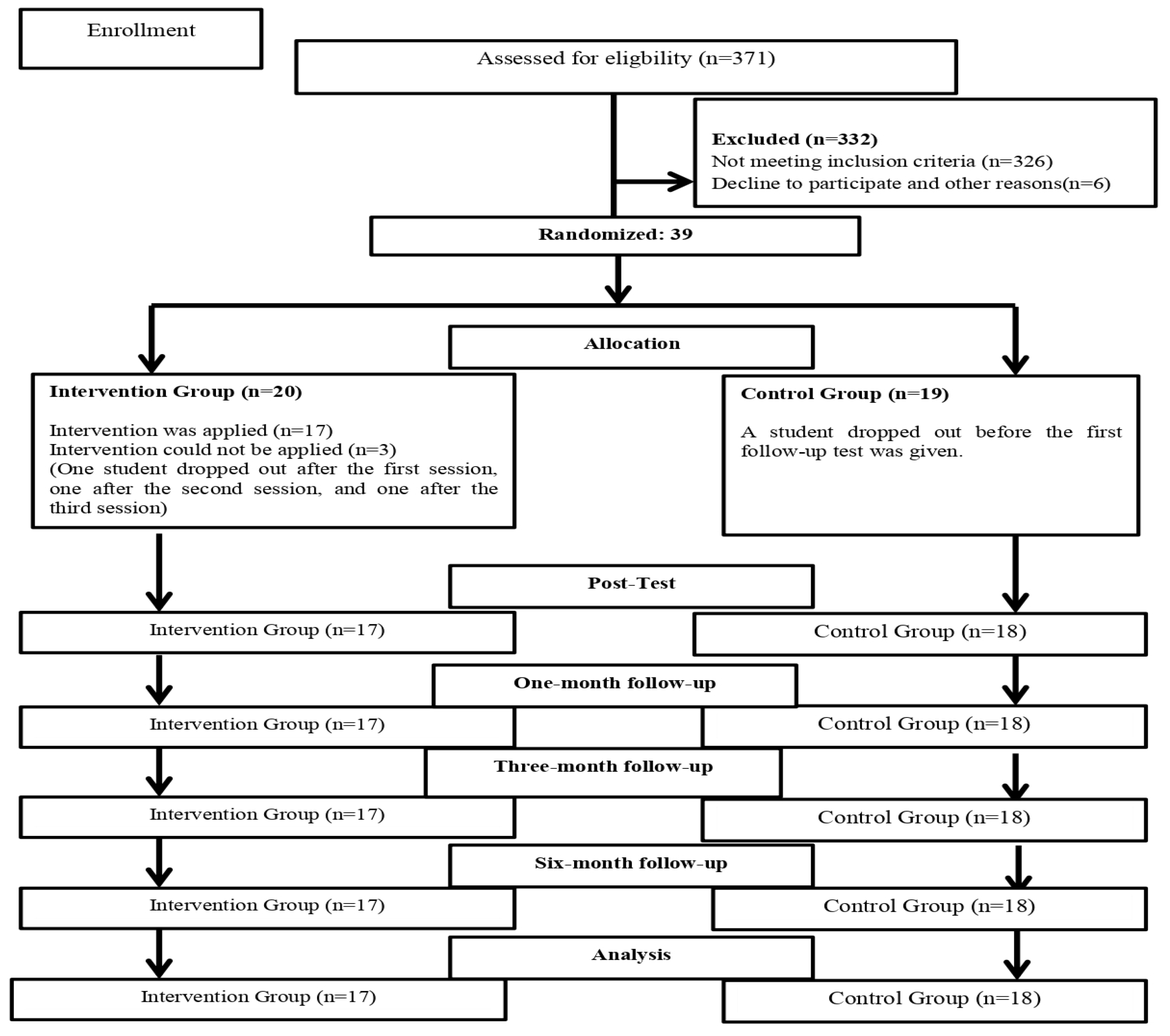
2.2. Participants and Sampling
2.3. Measures
2.3.1. Initial Measurements
Introductory Information Form (IIF)
Suicide Probability Scale (SPS)
Brief Symptom Inventory (BSI)
Somatoform Dissociation Questionnaire (SDQ)
Impact of Event Scale–Revised (IES-R)
2.3.2. Outcome Measurements
Posttraumatic Growth Inventory (PTGI)
2.4. The Online Psychosocial Intervention
2.5. Data Analysis
3. Results
3.1. Data on the Sociodemographic and IPA-Related Characteristics of the Nursing Students
3.2. Data on Posttraumatic Stress Symptom Scores and Their Effect Sizes
3.3. Data on Posttraumatic Growth (PTG) Scores and Their Effect Sizes
4. Discussion
5. Conclusions
Author Contributions
Funding
Institutional Review Board Statement
Informed Consent Statement
Data Availability Statement
Acknowledgments
Conflicts of Interest
References
- Treiber, K. Intimate partner abuse and homicide during the COVID-19 pandemic: A situational action theory analysis. J. Contemp. Crim. Justice 2024, 40, 290–323. [Google Scholar] [CrossRef]
- Brewer, N.Q.; Thomas, K.A. Intimate partner violence and academic performance: The role of physical, mental, behavioral, and financial health. Soc. Work Health Care 2019, 58, 854–869. [Google Scholar] [CrossRef] [PubMed]
- Ozturk, R.; Mete, D.; Altıntas, M.; Pekmez, M.A. Sağlık Bilimleri Öğrencilerinin Flört Şiddeti Tutumlarının Şiddete Karşı Profesyonel Rolleri ile İlişkisi. Turk. J. Fam. Med. Prim. Care 2021, 15, 142–153. [Google Scholar] [CrossRef]
- Barroso-Corroto, E.; Cobo-Cuenca, A.I.; Laredo-Aguilera, J.A.; Santacruz-Salas, E.; Pozuelo-Carrascosa, D.P.; Rodríguez-Cañamero, S.; Martín-Espinosa, N.M.; Carmona-Torres, J.M. Dating violence, violence in social networks, anxiety and depression in nursing degree students: A cross-sectional study. J. Adv. Nurs. 2023, 79, 1451–1463. [Google Scholar] [CrossRef]
- Andersson, G.; Olsson, E.; Ringsgård, E.; Sandgren, T.; Viklund, I.; Andersson, C.; Hesselman, Y.; Johansson, R.; Nordgren, L.B.; Bohman, B. Individually tailored internet-delivered cognitive-behavioral therapy for survivors of intimate partner violence: A randomized controlled pilot trial. Internet Interv. 2021, 26, 100453. [Google Scholar] [CrossRef]
- American Psychiatric Association. Diagnostic and Statistical Manual of Mental Disorders, 5th ed.; American Psychiatric Association: Arlington, VA, USA, 2013. [Google Scholar]
- Roland, N.; Delmas, N.; El Khoury, F.; Bardou, A.; Yacini, L.; Feldmann, L.; Hatem, G.; Mahdjoub, S.; Bardou, M. Post-traumatic stress disorders in women victims-survivors of intimate partner violence: A mixed-methods pilot study in a French coordinated structure. BMJ Open 2024, 14, e075552. [Google Scholar] [CrossRef]
- Tedeschi, R.G.; Calhoun, L.G. Target Article: “Posttraumatic growth: Conceptual foundations and empirical evidence”. Psychol. Inq. 2004, 15, 1–18. [Google Scholar] [CrossRef]
- Bryngeirsdottir, H.S.; Halldorsdottir, S. “I’m a winner, not a victim”: The facilitating factors of posttraumatic growth among women who have suffered intimate partner violence. Int. J. Environ. Res. Public Health 2022, 19, 1342. [Google Scholar] [CrossRef]
- Dell’Osso, L.; Lorenzi, P.; Nardi, B.; Carmassi, C.; Carpita, B. Post traumatic growth (PTG) in the frame of traumatic experiences. Clin. Neuropsychiatry 2022, 19, 390–393. [Google Scholar] [CrossRef]
- Hassija, C.M.; Turchik, J.A. An examination of disclosure, mental health treatment use, and posttraumatic growth among college women who experienced sexual victimization. J. Loss Trauma 2016, 21, 124–136. [Google Scholar] [CrossRef]
- Machinga-Asaolu, R.O. Posttraumatic growth promoting and inhibiting factors among intimate partner violence survivors: A systematic review. Trauma Violence Abuse 2025, 26, 789–803. [Google Scholar] [CrossRef] [PubMed]
- Lewis, C.; Roberts, N.P.; Simon, N.; Bethell, A.; Bisson, J.I. Internet-delivered cognitive behavioral therapy for posttraumatic stress disorder: Systematic review and meta-analysis. Acta Psychiatr. Scand. 2019, 140, 508–521. [Google Scholar] [CrossRef] [PubMed]
- Roepke, A.M. Psychosocial interventions and posttraumatic growth: A meta-analysis. J. Consult. Clin. Psychol. 2015, 83, 129–142. [Google Scholar] [CrossRef] [PubMed]
- Liu, A.N.; Wang, L.L.; Li, H.P.; Gong, J.; Liu, X.H. Correlation between posttraumatic growth and posttraumatic stress disorder symptoms based on Pearson correlation coefficient: A meta-analysis. J. Nerv. Ment. Dis. 2017, 205, 380–389. [Google Scholar] [CrossRef]
- Wagner, B.; Knaevelsrud, C.; Maercker, A. Posttraumatic growth and optimism as outcomes of an internet-based intervention for complicated grief. Cogn. Behav. Ther. 2007, 36, 156–161. [Google Scholar] [CrossRef]
- Cieslak, R.; Benight, C.C.; Rogala, A.; Smoktunowicz, E.; Kowalska, M.; Zukowska, K.; Yeager, C.; Luszczynska, A. Effects of internet-based self-efficacy intervention on secondary traumatic stress and secondary posttraumatic growth among health and human services professionals exposed to indirect trauma. Front. Psychol. 2016, 7, 1009. [Google Scholar] [CrossRef]
- Draughon Moret, J.; Todd, A.; Rose, L.; Pollitt, E.; Anderson, J. Mobile phone apps for intimate partner and sexual violence prevention and response: Systematic search on app stores. JMIR Form. Res. 2022, 6, e28959. [Google Scholar] [CrossRef]
- Bandura, A. Social Learning Theory; Prentice-Hall: Englewood Cliffs, NJ, USA, 1977. [Google Scholar]
- Powers, R.A.; Cochran, J.K.; Maskaly, J.; Sellers, C.S. Social learning theory, gender, and intimate partner violent victimization: A structural equations approach. J. Interpers. Violence 2020, 35, 3554–3580. [Google Scholar] [CrossRef]
- Flood, M. Engaging Men and Boys in Violence Prevention; Palgrave Macmillan: New York, NY, USA, 2019. [Google Scholar]
- Liu, L.; Thorp, S.R.; Moreno, L.; Wells, S.Y.; Glassman, L.H.; Busch, A.C.; Zamora, T.; Rodgers, C.S.; Allard, C.B.; Morland, L.A.; et al. Videoconferencing psychotherapy for veterans with PTSD: Results from a randomized controlled non-inferiority trial. J. Telemed. Telecare 2020, 26, 507–519. [Google Scholar] [CrossRef]
- Eysenbach, G.; CONSORT-EHEALTH Group. CONSORT-EHEALTH: Improving and standardizing evaluation reports of Web-based and mobile health interventions. J. Med. Internet Res. 2011, 13, e126. [Google Scholar] [CrossRef]
- Corapcioglu, A.; Yargic, I.; Geyran, P.; Kocabasoglu, N. “Olayların Etkisi Ölçeği” (IES-R) Türkçe versiyonunun geçerlilik ve Güvenilirliği. New Symp. 2006, 44, 14–22. [Google Scholar]
- Kersting, A.; Dölemeyer, R.; Steinig, J.; Walter, F.; Kroker, K.; Baust, K.; Wagner, B. Brief internet-based intervention reduces posttraumatic stress and prolonged grief in parents after the loss of a child during pregnancy: A randomized controlled trial. Psychother. Psychosom. 2013, 82, 372–381. [Google Scholar] [CrossRef] [PubMed]
- Ivarsson, D.; Blom, M.; Hesser, H.; Carlbring, P.; Enderby, P.; Nordberg, R.; Andersson, G. Guided internet-delivered cognitive behavior therapy for posttraumatic stress disorder: A randomized controlled trial. Internet Interv. 2014, 1, 33–40. [Google Scholar] [CrossRef]
- Allen, A.R.; Newby, J.M.; Smith, J.; Andrews, G. Internet-based cognitive behavioral therapy (iCBT) for posttraumatic stress disorder versus waitlist control: Study protocol for a randomized controlled trial. Trials 2015, 16, 544. [Google Scholar] [CrossRef] [PubMed]
- Follette, V.M.; Ruzek, J.I. Cognitive-Behavioral Therapies for Trauma; Guilford Press: New York, NY, USA, 2006. [Google Scholar]
- True Random Number Service. Available online: https://www.random.org/ (accessed on 18 June 2020).
- Sijbrandij, M.; Kunovski, I.; Cuijpers, P. Effectiveness of internet-delivered cognitive behavioral therapy for posttraumatic stress disorder: A systematic review and meta-analysis. Depress. Anxiety 2016, 33, 783–791. [Google Scholar] [CrossRef]
- Cull, J.G.; Gill, W.S. Suicide Probability Scale; Western Psychological Services: Los Angeles, CA, USA, 1990. [Google Scholar]
- Atlı, Z.; Eskin, M.; Dereboy, C. İntihar Olasılığı Ölçeğinin (IOÖ) klinik örneklemde geçerlik ve güvenirliği. Turk. J. Clin. Psychiatry 2009, 12, 111–124. [Google Scholar]
- Derogatis, L.R. SCL-90-R: Administration, Scoring, and Procedures Manual-II, 2nd ed.; Clinical Psychometric Research: Towson, MD, USA, 1992. [Google Scholar]
- Sahin, N.H.; Durak, A. Kısa Semptom Envanteri: Türk gençleri için uyarlanmasi. Turk. Psikoloji Derg. 1994, 9, 44–56. [Google Scholar]
- Nijenhuis, E.R.S.; Spinhoven, P.; Van Dyck, R.; Van der Hart, O.; Vanderlinden, J. The development and psychometric characteristics of the Somatoform Dissociation Questionnaire (SDQ-20). J. Nerv. Ment. Dis. 1996, 184, 688–694. [Google Scholar] [CrossRef]
- Sar, V.; Kundakci, T.; Kiziltan, E.; Bakim, B.; Bozkurt, O. Differentiating dissociative disorders from other diagnostic groups through somatoform dissociation in Turkey. J. Trauma Dissociation 2000, 1, 67–80. [Google Scholar] [CrossRef]
- Horowitz, M.; Wilner, N.; Alvarez, W. Impact of Event Scale: A measure of subjective stress. Psychosom. Med. 1979, 41, 209–218. [Google Scholar] [CrossRef]
- Weiss, D.S.; Marmar, C.R. The Impact of Event Scale–Revised. In Assessing Psychological Trauma and PTSD; Wilson, J.P., Keane, T.M., Eds.; Guilford Press: New York, NY, USA, 1997; pp. 399–411. [Google Scholar]
- McCabe, D. The Impact of Event Scale–Revised (IES-R). In Try This: Best Practices in Nursing Care to Older Adults; New York University Rory Meyers College of Nursing: New York, NY, USA, 2019. [Google Scholar]
- Tedeschi, R.G.; Calhoun, L.G. The Posttraumatic Growth Inventory: Measuring the positive legacy of trauma. J. Trauma. Stress 1996, 9, 455–471. [Google Scholar] [CrossRef]
- Kagan, M.; Gulec, M.; Boysan, M.; Cavus, H. Travma Sonrası Büyüme Envanteri’nin Türkçe versiyonunun normal toplumda hiyerarşik faktör yapısı. TAF Prev. Med. Bull. 2012, 11, 617–624. [Google Scholar] [CrossRef]
- Husson, O.; Zebrack, B.; Block, R.; Embry, L.; Aguilar, C.; Hayes-Lattin, B.; Cole, S. Posttraumatic growth and well-being among adolescents and young adults (AYAs) with cancer: A longitudinal study. Support Care Cancer 2017, 25, 2881–2890. [Google Scholar] [CrossRef] [PubMed]
- Rodríguez-Rey, R.; Alonso-Tapia, J. Relation between parental psychopathology and posttraumatic growth after a child’s admission to intensive care: Two faces of the same coin? Intensive Crit. Care Nurs. 2017, 43, 156–161. [Google Scholar] [CrossRef] [PubMed]
- Bandura, A. Health promotion by social cognitive means. Health Educ. Behav. 2004, 31, 143–164. [Google Scholar] [CrossRef] [PubMed]
- Cohen, J. Statistical Power Analysis for the Behavioral Sciences; Routledge Academic: New York, NY, USA, 1988. [Google Scholar]
- Scott-Storey, K.; O’Donnell, S.; Ford-Gilboe, M.; Varcoe, C.; Wathen, N.; Malcolm, J.; Vincent, C. What about the men? A critical review of men’s experiences of intimate partner violence. Trauma Violence Abuse 2023, 24, 858–872. [Google Scholar] [CrossRef]
- Lundgren, E. The hand that strikes and comforts: Gender construction and the tension between body and symbol. In Rethinking Violence Against Women; Dobash, R.E., Dobash, R.P., Eds.; Sage: Thousand Oaks, CA, USA, 1998; pp. 169–200. [Google Scholar]
- Garner, A.K.; Sheridan, D.J. Influence of intimate partner violence and depression on undergraduate nursing students: A literature review. J. Nurs. Educ. 2017, 56, 397–403. [Google Scholar] [CrossRef]
- Joshi, R.K.; Arora, M.; Mukherjee, R. Prevalence and determinants of emotional violence faced by married women in Delhi, India: A cross-sectional study. J. Family Med. Prim. Care 2023, 12, 332–337. [Google Scholar] [CrossRef]
- Knaevelsrud, C.; Maercker, A. Internet-based treatment for PTSD reduces distress and facilitates the development of a strong therapeutic alliance: A randomized controlled clinical trial. BMC Psychiatry 2007, 7, 13. [Google Scholar] [CrossRef]
- Calhoun, L.G.; Cann, A.; Tedeschi, R.G.; McMillan, J. A correlational test of the relationship between posttraumatic growth, religion, and cognitive processing. J. Trauma Stress 2000, 13, 521–527. [Google Scholar] [CrossRef]


| Sessions | Content |
|---|---|
| First Session |
|
| Second Session |
|
| Third Session |
|
| Fourth Session |
|
| Fifth Session |
|
| Sixth Session |
|
| Seventh Session |
|
| Eighth Session |
|
| Characteristics | Intervention Group | Control Group | χ2 p | |||
|---|---|---|---|---|---|---|
| n | % | n | % | |||
| Gender | Female | 13 | 76.5 | 13 | 72.2 | 0.083, 0.540 |
| Male | 4 | 23.5 | 5 | 27.8 | ||
| Adequate social support | Yes | 8 | 47.1 | 8 | 44.4 | 0.024, 0.573 |
| No | 9 | 52.9 | 10 | 55.6 | ||
| Physical abuse victimization | Yes | 11 | 64.7 | 12 | 66.7 | 0.015, 0.592 |
| No | 6 | 35.3 | 6 | 33.3 | ||
| Emotional abuse victimization | Yes | 17 | 100.0 | 18 | 100.0 | - |
| No | 0 | 0.0 | 0 | 0.0 | ||
| Sexual Abuse victimization | Yes | 3 | 17.6 | 4 | 22.2 | 0.114, 0.534 |
| No | 14 | 82.4 | 14 | 77.8 | ||
| Economic abuse victimization | Yes | 6 | 35.3 | 8 | 44.4 | 0.305, 0.418 |
| No | 11 | 64.7 | 10 | 55.6 | ||
| Measures | Pre-Test | Post-Test | 1st-Month Follow-Up | 3rd-Month Follow-Up | 6th-Month Follow-Up | ||||||
|---|---|---|---|---|---|---|---|---|---|---|---|
| Group | M | SD | M | SD | M | SD | M | SD | M | SD | |
| IES-R | |||||||||||
| Intrusion | IG | 16.47 | 7.50 | 4.17 | 3.02 | 4.11 | 2.84 | 3.35 | 2.23 | 3.17 | 1.62 |
| CG | 20.05 | 6.24 | 17.55 | 4.91 | 14.94 | 4.47 | 8.44 | 5.89 | 8.22 | 5.42 | |
| Avoidance | IG | 17.17 | 4.65 | 10.41 | 5.43 | 7.76 | 4.75 | 9.23 | 4.58 | 9.17 | 5.05 |
| CG | 17.83 | 4.01 | 17.44 | 2.52 | 17.16 | 3.05 | 11.72 | 4.36 | 10.5 | 5.89 | |
| Hyperarousal | IG | 12.29 | 5.14 | 3.11 | 3.37 | 2.58 | 1.93 | 2.11 | 1.99 | 1.88 | 1.90 |
| CG | 13.72 | 4.38 | 12.00 | 3.08 | 10.72 | 2.86 | 6.00 | 4.74 | 4.83 | 3.91 | |
| Total | IG | 45.94 | 14.41 | 17.7 | 9.53 | 14.47 | 6.50 | 14.7 | 6.14 | 14.23 | 6.66 |
| CG | 51.61 | 10.97 | 47.00 | 8.68 | 42.83 | 7.97 | 26.16 | 13.20 | 23.55 | 13.47 | |
| PTGI | Group | M | SD | M | SD | M | SD | M | SD | M | SD |
| Change in self-perception | IG | 15.00 | 3.92 | 45.11 | 3.78 | 42.41 | 4.33 | 42.64 | 4.18 | 41.35 | 5.23 |
| CG | 14.94 | 3.60 | 14.44 | 3.82 | 15.66 | 5.41 | 9.33 | 4.08 | 12.05 | 3.38 | |
| Change in life philosophy | IG | 11.76 | 2.48 | 27.64 | 2.49 | 24.05 | 5.52 | 25.35 | 4.22 | 24.88 | 3.40 |
| CG | 8.16 | 2.89 | 7.05 | 3.03 | 8.94 | 3.60 | 7.55 | 3.01 | 6.66 | 2.37 | |
| Change in relationships | IG | 6.29 | 1.82 | 20.76 | 2.92 | 19.17 | 3.32 | 18.82 | 3.28 | 19.47 | 3.67 |
| CG | 6.33 | 2.80 | 4.83 | 2.50 | 5.05 | 3.20 | 4.11 | 2.67 | 5.00 | 1.78 | |
| Total | IG | 33.05 | 5.35 | 93.52 | 4.61 | 85.64 | 11.23 | 86.82 | 10.54 | 85.70 | 11.40 |
| CG | 29.44 | 6.84 | 26.33 | 7.49 | 29.66 | 8.85 | 21.00 | 8.87 | 23.72 | 5.72 | |
| Measures | F_Time | F_Group | F_Group × Time | p_Time | p_Group | p_Group × Time | ηp2 |
|---|---|---|---|---|---|---|---|
| IES-R–Intrusion | 54.297 | 52.453 | 9.445 | <0.001 | <0.001 | <0.001 | 0.622 |
| IES-R–Avoidance | 22.175 | 17.751 | 8.660 | <0.001 | <0.001 | <0.001 | 0.402 |
| IES-R–Hyper-arousal | 57.547 | 41.562 | 10.611 | <0.001 | <0.001 | <0.001 | 0.636 |
| IES-R–Total | 68.742 | 53.725 | 14.901 | <0.001 | <0.001 | <0.001 | 0.676 |
| PTGI–Change in self-perception | 105.900 | 603.085 | 136.877 | <0.001 | <0.001 | <0.001 | 0.762 |
| PTGI–Change in life philosophy | 35.078 | 431.625 | 44.170 | <0.001 | <0.001 | <0.001 | 0.515 |
| PTGI–Change in relationships | 50.531 | 287.525 | 79.879 | <0.001 | <0.001 | <0.001 | 0.605 |
| PTGI–Total | 112.361 | 607.320 | 150.801 | <0.001 | <0.001 | <0.001 | 0.773 |
Disclaimer/Publisher’s Note: The statements, opinions and data contained in all publications are solely those of the individual author(s) and contributor(s) and not of MDPI and/or the editor(s). MDPI and/or the editor(s) disclaim responsibility for any injury to people or property resulting from any ideas, methods, instructions or products referred to in the content. |
© 2026 by the authors. Licensee MDPI, Basel, Switzerland. This article is an open access article distributed under the terms and conditions of the Creative Commons Attribution (CC BY) license.
Share and Cite
Demirkol, H.; Dülgerler, Ş. Online Psychosocial Intervention for Nursing Students Who Experienced Intimate Partner Abuse in Türkiye. Healthcare 2026, 14, 992. https://doi.org/10.3390/healthcare14080992
Demirkol H, Dülgerler Ş. Online Psychosocial Intervention for Nursing Students Who Experienced Intimate Partner Abuse in Türkiye. Healthcare. 2026; 14(8):992. https://doi.org/10.3390/healthcare14080992
Chicago/Turabian StyleDemirkol, Hacer, and Şeyda Dülgerler. 2026. "Online Psychosocial Intervention for Nursing Students Who Experienced Intimate Partner Abuse in Türkiye" Healthcare 14, no. 8: 992. https://doi.org/10.3390/healthcare14080992
APA StyleDemirkol, H., & Dülgerler, Ş. (2026). Online Psychosocial Intervention for Nursing Students Who Experienced Intimate Partner Abuse in Türkiye. Healthcare, 14(8), 992. https://doi.org/10.3390/healthcare14080992