1. Introduction
Injury is a major global health problem that causes substantial mortality and disability worldwide, including both unintentional injuries and intentional injuries such as violence and self-harm [
1]. Injuries disproportionately affect adolescents and young adults and contribute to a large social and economic burden through premature death and long-term disability [
1]. In clinical practice, a large proportion of injured patients enter the healthcare system through the emergency department, where early severity assessment, prioritization of care, and disposition decisions such as admission or interhospital transfer are made [
2]. Therefore, improving risk stratification and disposition decision-making in the emergency department is essential to improve outcomes and optimize resource use [
2].
In South Korea, the National Emergency Department Information System is a nationwide emergency care database that enables population-level analyses of emergency department utilization patterns, resource use, and outcomes [
2].
Because it captures national-scale emergency department encounters, it provides a practical foundation to evaluate injury epidemiology and emergency care processes at the system level [
2].
Recent Korean data also suggest that emergency department presentations related to self-harm and suicide attempts have shown meaningful changes over time, reinforcing the need to incorporate injury intent into injury research and emergency care planning [
3,
4].
Clinical trajectories and resource utilization among injured patients can vary substantially by injury mechanism and by intent [
3,
4]. In this study, injury intent refers to the underlying purpose or circumstance of the injury event, categorized as unintentional, self-harm/suicide attempt, assault/violence, or undetermined. For example, injuries categorized under similar mechanisms can have very different patterns of severity, comorbidity, clinical management needs, consultation requirements, and care pathways when the underlying intent differs [
3]. Mechanism and intent may influence outcomes not only independently but also jointly through their combined effect, meaning that certain mechanism–intent combinations can be associated with particularly high risk [
3,
4].
Analyses that focus on only one of these factors may overlook clinically important interaction patterns and potentially understate or overstate risk in specific subgroups [
3,
4]. Standardized severity measurement is critical for interpreting findings and translating evidence into practice and policy [
5]. The International Classification of Diseases–based Injury Severity Score is a diagnosis-code–based approach that estimates patient-level injury severity using survival risk ratios derived from large datasets, which makes it suitable for large administrative or registry-linked analyses [
5]. ICISS differs from traditional severity scoring systems such as the Injury Severity Score (ISS) and Trauma and Injury Severity Score (TRISS), as it is derived from diagnosis-specific survival risk ratios and is particularly suitable for large administrative datasets.
In Korea, injury severity classification using ICD-based approaches has been actively discussed and updated to align with contemporary coding and outcomes, supporting their applicability in nationwide emergency department datasets [
6,
7]. Prior research has generally accumulated in two main directions [
2,
5]. First, nationwide emergency department database studies have described injury-related patterns and trends in emergency department visits and outcomes across population subgroups and time periods [
2]. Second, methodological studies have evaluated and refined ICD-based injury severity metrics, including ICISS, to support large-scale severity adjustment and prediction [
5,
6]. These contributions have improved system-level understanding of emergency care and strengthened the evidence base for injury surveillance and quality improvement [
2,
5].
However, several gaps remain [
3,
4]. Many studies have examined either injury mechanism or intent separately, while fewer have explicitly tested whether the interaction between mechanism and intent influences severity and disposition outcomes [
3,
4]. In addition, descriptive approaches or coarse categorization of severity may lead to information loss and limit inference about the circumstances under which admission or transfer decisions are more likely [
2,
5]. As a result, evidence remains limited on which specific mechanism–intent combinations are associated with higher severity and higher likelihood of admission or transfer in nationwide emergency department data [
3,
4]. This study addresses these gaps using a retrospective observational design based on nationwide emergency department raw data [
2]. We simultaneously consider injury mechanism and intent and explicitly model their interaction to quantify associations with injury severity and emergency department disposition outcomes, including admission and transfer [
2,
5]. By leveraging diagnosis-code-based severity scoring and a nationwide dataset, this study aims to identify high-risk combinations that are directly relevant to triage refinement, pathway design, and transfer system optimization [
5,
7].
The primary objective of this study was to evaluate whether the interaction between injury mechanism and intent is associated with emergency department disposition and ICISS-based injury severity.
3. Results
3.1. General Characteristics of Injury-Related Emergency Department Visits
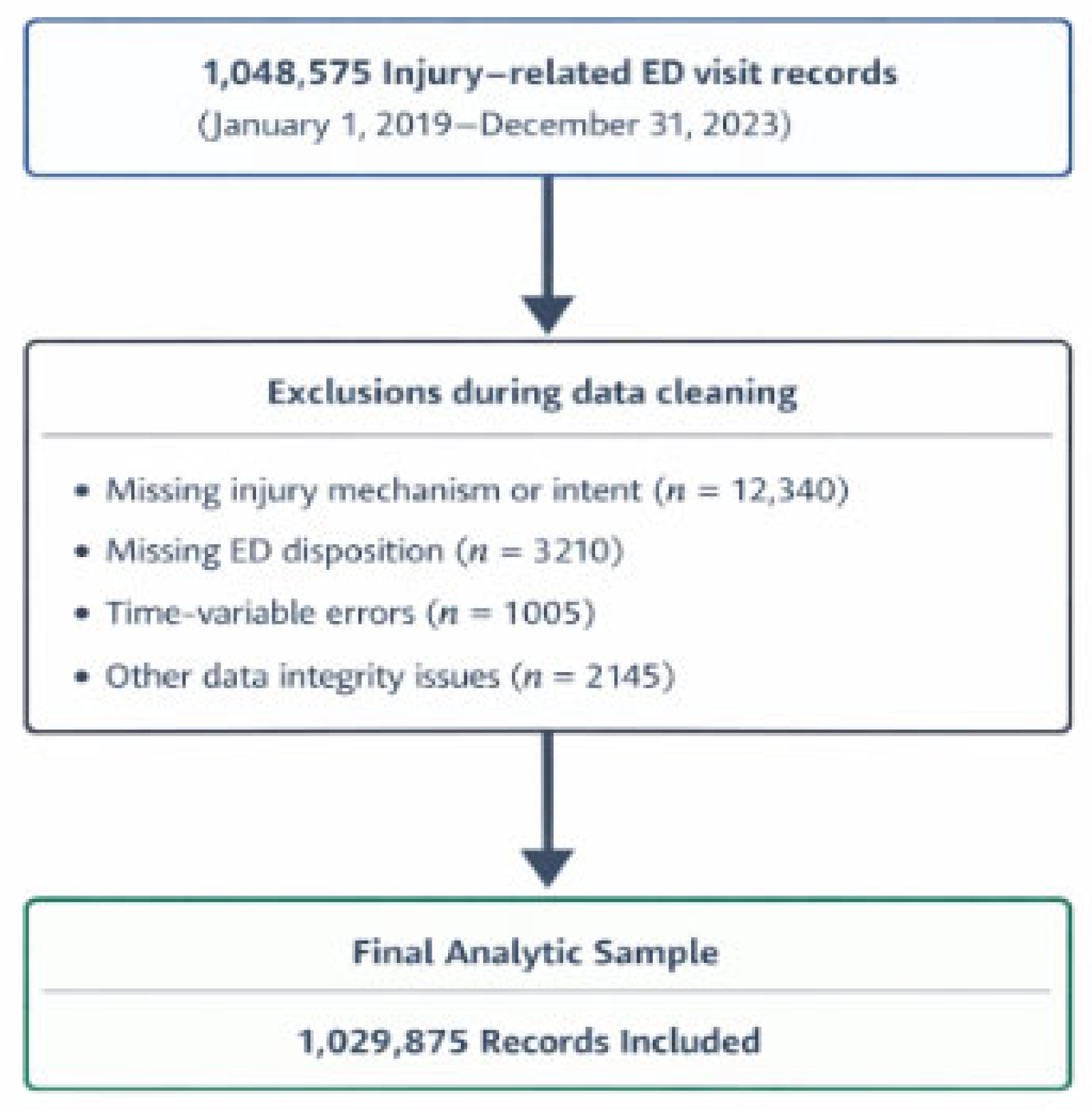
A total of 1,029,875 injury-related emergency department (ED) visits were included in the analysis. The cohort comprised 519,875 males (50.5%) and 510,000 females (49.5%). The mean age was 47.8 ± 21.6 years; the most common age groups were 20–39 years (31.1%) and 40–59 years (30.1%), followed by 60–79 years (21.4%), ≥80 years (9.2%), and 0–19 years (8.3%).
Regarding arrival characteristics, 380,000 patients (36.9%) arrived by ambulance and 649,875 (63.1%) arrived as walk-ins/other modes. Transferred-in visits accounted for 120,000 cases (11.7%). ED arrival time was most frequently during the daytime (08:00–15:59; 54.4%), followed by evening (16:00–21:59; 27.2%) and night-time (22:00–07:59; 18.4%). Most patients were alert on arrival (89.3%), while 10.7% were categorized as non-alert.
Initial vital signs were as follows: systolic blood pressure 125.0 ± 22.0 mmHg, diastolic blood pressure 76.0 ± 14.0 mmHg, heart rate 88.0 ± 18.0 bpm, respiratory rate 18.0 ± 4.0 breaths/min, body temperature 36.7 ± 0.7 °C, and oxygen saturation 97.0 ± 3.0%.
The leading injury mechanisms were traffic accidents (25.2%) and falls/slips (23.3%), followed by blunt injuries (non-traffic) (14.6%), other/unspecified (15.5%), poisoning/intoxication (8.7%), and penetrating/cut/stab injuries (7.8%). Most injuries were unintentional (81.6%), whereas self-harm/suicide attempts (8.7%) and assault/violence (7.8%) constituted smaller proportions; 1.9% were undetermined. For ED disposition, 69.9% were discharged, 24.3% were admitted, and 5.8% were transferred. Injury severity, assessed using ICISS, was 0.972 ± 0.045 (ICISS15) and 0.968 ± 0.052 (ICISS20) (
Table 1).
3.2. Association of Injury Mechanism, Intent, and Their Interaction with ED Disposition
In the multinomial logistic regression model, injury mechanism and intent were significantly associated with ED disposition. For admission vs. discharge, higher risks were observed for fall/slip (RRR = 1.18, 95% CI = 1.16–1.20), penetrating injury (RRR = 1.34, 95% CI = 1.30–1.38), thermal injury (RRR = 1.12, 95% CI = 1.07–1.18), poisoning/intoxication (RRR = 1.61, 95% CI = 1.56–1.66), suffocation/hanging/asphyxia (RRR = 2.45, 95% CI = 2.29–2.63), drowning/submersion (RRR = 2.10, 95% CI = 1.85–2.39), and other/unspecified (RRR = 1.05, 95% CI = 1.03–1.07) (all p < 0.001), whereas blunt (non-traffic) was associated with a lower risk (RRR = 0.96, 95% CI = 0.94–0.98; p < 0.001).
For transfer vs. discharge (reference mechanism: traffic accident), increased risks were found for fall/slip (RRR = 0.92, 95% CI = 0.89–0.95; p < 0.001) and blunt (non-traffic) (RRR = 0.88, 95% CI = 0.85–0.92; p < 0.001), indicating lower transfer risk, while penetrating injury (RRR = 1.22, 95% CI = 1.16–1.28; p < 0.001), poisoning/intoxication (RRR = 1.08, 95% CI = 1.01–1.16; p = 0.03), suffocation/hanging/asphyxia (RRR = 1.31, 95% CI = 1.14–1.51; p < 0.001), drowning/submersion (RRR = 1.52, 95% CI = 1.20–1.91; p < 0.001), and other/unspecified (RRR = 1.10, 95% CI = 1.06–1.14; p < 0.001) were associated with higher transfer risk; thermal injury was not significant (RRR = 0.97, 95% CI = 0.89–1.06; p = 0.48).
Compared with unintentional injuries, self-harm/suicide attempt was associated with higher risks of admission (RRR = 1.72, 95% CI = 1.67–1.77; p < 0.001) and transfer (RRR = 1.14, 95% CI = 1.06–1.22; p < 0.001). Assault/violence was also associated with admission (RRR = 1.09, 95% CI = 1.06–1.12; p < 0.001) and transfer (RRR = 1.28, 95% CI = 1.22–1.35; p < 0.001), and undetermined/unknown intent showed similar patterns (admission: RRR = 1.21, 95% CI = 1.15–1.27; p < 0.001; transfer: RRR = 1.34, 95% CI = 1.22–1.47; p < 0.001).
Several mechanism × intent interactions were significant: poisoning × self-harm (admission: RRR = 2.60, 95% CI = 2.45–2.75;
p < 0.001; transfer: RRR = 1.22, 95% CI = 1.09–1.36;
p < 0.001), fall/slip × self-harm (admission: RRR = 1.28, 95% CI = 1.20–1.37;
p < 0.001; transfer: RRR = 0.95, 95% CI = 0.84–1.07;
p = 0.40), penetrating × assault (admission: RRR = 1.52, 95% CI = 1.40–1.65;
p < 0.001; transfer: RRR = 1.48, 95% CI = 1.32–1.66;
p < 0.001), and suffocation × self-harm (admission: RRR = 1.90, 95% CI = 1.60–2.25;
p < 0.001; transfer: RRR = 1.35, 95% CI = 1.05–1.75;
p = 0.02). All models were adjusted for prespecified covariates (
Table 2).
3.3. Association of Injury Mechanism, Intent, and Their Interaction with Injury Severity
Across the three models, injury mechanism and intent were associated with the outcome. In the fully adjusted model (Model 3; reference mechanism: traffic accident), fall/slip was positively associated with the outcome (β = 0.0012, 95% CI = 0.0006–0.0018; p < 0.001). Penetrating/cut/stab injuries showed a negative association (β = −0.0031, 95% CI = −0.0040–−0.0022; p < 0.001), as did poisoning/intoxication (β = −0.0048, 95% CI = −0.0057–−0.0039; p < 0.001), suffocation/hanging/asphyxia (β = −0.0065, 95% CI = −0.0084–−0.0046; p < 0.001), and drowning/submersion (β = −0.0042, 95% CI = −0.0070–−0.0014; p = 0.003). Other/unspecified mechanisms showed a small positive association (β = 0.0004, 95% CI = 0.0000–0.0009; p = 0.048). Blunt (non-traffic) (β = 0.0006, 95% CI = −0.0001–0.0013; p = 0.090) and burn/thermal injury (β = −0.0009, 95% CI = −0.0021–0.0003; p = 0.140) were not statistically significant in Model 3.
Regarding injury intent (reference: unintentional), self-harm/suicide attempt was consistently negatively associated with the outcome (Model 3: β = −0.0046, 95% CI = −0.0055–−0.0037; p < 0.001). Assault/violence also remained significant, although attenuated after adjustment (Model 3: β = −0.0010, 95% CI = −0.0018–−0.0002; p = 0.014), whereas undetermined/unknown intent was not significant in Model 3 (β = −0.0014, 95% CI = −0.0030–0.0002; p = 0.083).
In Model 3, selected mechanism-by-intent interaction terms were additionally examined. Poisoning × self-harm was significantly associated with a further decrease in the outcome (β = −0.0068, 95% CI = −0.0085–0.0051;
p < 0.001). Suffocation × self-harm was also significant (β = −0.0040, 95% CI = −0.0069–0.0011;
p = 0.007). In contrast, fall/slip × self-harm (β = −0.0016, 95% CI = −0.0033–0.0001;
p = 0.064) and penetrating × assault (β = −0.0018, 95% CI = −0.0040–0.0004;
p = 0.111) were not statistically significant. Model 1 was unadjusted, while Models 2–3 were adjusted for prespecified covariates (
Table 3). These predicted probabilities should be interpreted in the context of baseline risks and overall case mix and do not independently account for all clinical severity factors.
3.4. Predicted Probabilities of ED Disposition by Injury Mechanism × Intent Combination
Predicted probabilities of ED disposition varied substantially by injury mechanism and intent. For unintentional traffic accidents, the predicted probabilities were discharge 70.0%, admission 25.0%, and transfer 5.0%. When intent was self-harm in traffic accidents, discharge decreased to 60.0% and admission increased to 34.0% (transfer 6.0%). For assault-related traffic accidents, transfer increased to 7.0% (discharge 67.0% and admission 26.0%).
Among falls/slips, unintentional injuries showed discharge 68.0%, admission 29.0%, and transfer 3.0%, whereas falls/slips with self-harm intent showed lower discharge (58.0%) and higher admission (39.0%) with transfer remaining at 3.0%. Blunt (non-traffic) unintentional injuries had a relatively high predicted discharge (73.0%) and lower admission (23.0%) and transfer (4.0%). Penetrating/cut/stab injuries were associated with higher transfer probabilities, particularly when intent was assault/violence (discharge 55.0%, admission 32.0%, and transfer 13.0%) compared with unintentional penetrating injuries (discharge 66.0%, admission 27.0%, and transfer 7.0%).
For poisoning/intoxication, unintentional cases showed discharge 63.0%, admission 33.0%, and transfer 4.0%, while poisoning with self-harm intent demonstrated the highest predicted admission (54.0%) and markedly reduced discharge (42.0%) (transfer 4.0%). The most severe pattern was observed for suffocation/hanging/asphyxia with self-harm intent, with discharge 30.0%, admission 62.0%, and transfer 8.0%. Drowning/submersion (unintentional) also showed a distinct disposition profile with elevated transfer (15.0%) alongside discharge (45.0%) and admission (40.0%). For other/unspecified injuries, unintentional cases showed the highest predicted discharge (75.0%) (admission 20.0% and transfer 5.0%), while undetermined/unknown intent was associated with higher transfer (8.0%) (discharge 70.0% and admission 22.0%) (
Table 4).
4. Discussion
The purpose of this study was to examine, using nationwide injury-related emergency department visit data from 1 January 2019 to 31 December 2023, how injury mechanism and injury intent are associated with injury severity and emergency department disposition outcomes, with a particular focus on whether the interaction between injury mechanism and intent modifies these associations. These findings are consistent with previous studies reporting that injury mechanism and intent independently influence clinical outcomes; however, this study extends prior work by explicitly demonstrating interaction effects between these factors. Injuries impose a substantial global burden of mortality and disability, and diverse causes such as road traffic crashes, falls, drowning, burns, poisoning, self-harm, and violence frequently lead to emergency department visits and subsequent hospitalization; therefore, risk stratification at the emergency department stage is critical for both clinical care and policy [
8,
9]. In this study, injury mechanism and injury intent were each independently associated with injury severity and emergency department outcomes, and models incorporating the injury mechanism by intent interaction indicated that risk increased for specific mechanism–intent combinations. Although several associations were statistically significant, the magnitude of effect varied, and small relative risk ratios may have limited clinical significance despite statistical significance.
In addition, by classifying emergency department disposition into three categories, discharge, admission, and interhospital transfer, we were able to interpret admission and transfer as distinct outcomes. We also presented combination-specific predicted probabilities, providing clinically interpretable absolute risk information. Injury severity was assessed primarily using ICISS15, and robustness was evaluated through sensitivity analyses using ICISS20 and alternative modeling approaches under different distributional assumptions. ICISS is widely used for severity adjustment in large administrative datasets, as it derives patient-level severity from diagnosis-specific survival risk ratios, making it well suited for nationwide analyses such as the present study [
10,
11].
Although prior studies have accumulated important evidence describing the epidemiologic characteristics and clinical outcomes of injured emergency department patients, the scope of inference has often been limited by study design and analytic focus. Many studies have compared outcomes such as admission rate, transfer rate, mortality, or emergency department length of stay across injury mechanisms, or have explored risk factors focusing on specific mechanisms. While useful for demonstrating mechanism-specific differences, this approach may not adequately capture the fact that clinical trajectories and disposition decisions can differ by intent even within the same mechanism category. Research on self-harm or suicide attempts and violence-related injuries has also expanded, but these studies have frequently centered on characteristics of intent-defined groups or on selected outcomes, making it difficult to address combination-based questions such as which mechanisms are particularly high risk in specific intent contexts. Moreover, even in nationwide emergency department database studies, outcomes have often been simplified or disposition categories including transfer have been combined, limiting evidence that evaluates interhospital transfer as a distinct outcome. Although nationwide studies using NEDIS have demonstrated the utility of capturing national trends in emergency department utilization and disposition indicators such as admission and transfer, interaction-based analyses that integrate injury mechanism and intent in the injury field remain relatively limited [
12,
13]. Finally, although ICD-based severity measures such as ICISS have been used in prior work, analyses often remained at the level of describing differences by mechanism or intent, or did not explicitly model interactions, limiting systematic identification of high-risk combinations [
10,
11].
In this context, the present study is meaningful in that it addresses several limitations of the prior literature. First, by including injury mechanism and injury intent within the same model and explicitly specifying the injury mechanism by intent interaction term, we statistically tested combination effects. This approach helps identify risk amplification patterns that may be overlooked when focusing on mechanism or intent alone, and demonstrates that emergency department outcomes and injury severity can differ by intent even within the same injury mechanism. Second, by reconstructing disposition into three categories, discharge, admission, and transfer, and evaluating admission and transfer separately, this study provides evidence that is directly relevant to improving the emergency care delivery system. Because transfer is not merely a proxy for severity but reflects a combination of system factors including regional resources, hospital capability, and patient transport feasibility, analyzing transfer separately has important implications for system optimization. In addition, the nationwide scale of the dataset provided a sufficient sample size to improve the stability of estimates even for relatively uncommon combinations, and the presentation of combination-specific predicted probabilities offers absolute risk information that is readily interpretable in clinical settings. Finally, in severity analyses, we used ICISS15 as the primary metric while also applying ICISS20 and alternative regression approaches to demonstrate that findings were not unduly driven by a single metric or modeling choice, supporting the robustness of the results [
10,
11].
These findings have practical implications for emergency department triage, suggesting that specific mechanism–intent combinations should be considered as high-risk signals in clinical decision-making. Importantly, while mechanism–intent combinations provide useful risk signals, clinical decision-making remains primarily driven by patient-level severity and physiological status. Therefore, these combinations should be interpreted as complementary risk indicators rather than replacements for clinical judgment. For example, a low-severity traffic accident may not require intensive care, whereas a seemingly minor domestic injury may result in life-threatening conditions depending on bleeding or physiological compromise. First, in emergency department triage and standardized care pathway design, it is more reasonable to incorporate specific mechanism–intent combinations as high-risk signals rather than treating mechanism and intent as independent checklist items, and this supports the development of standardized operational guidance and practical checklists that define combination-based risk groups [
8,
9]. Second, to improve the reliability of data-driven policy, it is necessary to enhance the accuracy of injury mechanism and intent recording in the national emergency department database through standardized definitions and training, and to introduce quality indicators that monitor the proportion of unknown or unspecified entries at the institutional level. Third, from a transfer-system perspective, demonstrating differences in transfer probability by mechanism–intent combinations provides a basis for assessing regional imbalances in capabilities for severe trauma, poisoning, and critical care, and for optimizing transfer criteria and acceptance coordination; in regions where high-risk combinations concentrate, policy support is needed to strengthen transfer coordination functions that share real-time information on available beds and specialist resources. Fourth, absolute risk measures such as combination-specific predicted probabilities can be used not only to compare disposition patterns across hospitals or regions but also to develop performance monitoring and quality improvement metrics that account for differences in case mix; in the mid to long term, it may be reasonable to consider a phased application of combination-based risk-adjusted indicators in emergency care evaluation and quality improvement programs. Fifth, the identification of interaction patterns in severity analyses indicates that severity prediction is a multidimensional process shaped not only by ICD-based classification but also by intent, initial clinical status, and system-level factors; thus, future prediction modeling and clinical decision support tool design should incorporate interaction effects. In particular, for self-harm and violence-related injuries, there is a need to connect policy and clinical operations by institutionalizing continuity-of-care systems that link mental health services and community resources to reduce revisits and repeat events after disposition [
8,
9]. Incorporating these interaction-based risk patterns into triage protocols and interhospital transfer systems may improve resource allocation and patient outcomes.
This study has several limitations. First, as an administrative data-based study, misclassification of injury mechanism and intent is possible, and the presence of unknown or unspecified categories may introduce residual error. In addition, selection bias may have been introduced through the exclusion of records with missing or implausible data. Second, because the unit of analysis was an emergency department visit, repeated visits by the same patient may have been included, and patient-level correlation structures may not have been fully accounted for. Furthermore, clustering at the hospital level could not be explicitly modeled, which may have influenced variance estimation. Third, disposition outcomes and transfer decisions are strongly influenced by system-level factors such as bed availability, regional transfer networks, and institutional capability. Residual confounding may therefore remain due to unavailable variables, including comorbidities, insurance status, and trauma center level. Fourth, the multinomial logistic regression model assumes independence of irrelevant alternatives (IIA), which may not fully hold in the context of emergency department disposition, where admission and transfer decisions are interrelated. Finally, while ICISS is suitable for large-scale severity adjustment, it does not directly incorporate detailed clinical information such as physiologic severity, imaging findings, or surgical interventions, and severity estimates may vary according to coding accuracy and coding practices. Future studies should further stratify transfer outcomes according to underlying reasons and regional variations in healthcare resources.
5. Conclusions
Injury mechanism and intent were each independently associated with injury severity and emergency department disposition outcomes, and interaction patterns were identified in which risk was further amplified for specific combinations of mechanism and intent, suggesting that single-factor risk assessment may underestimate or overestimate risk in certain subgroups. In addition, by analyzing disposition outcomes as three categories, discharge, admission, and interhospital transfer, and presenting combination-specific predicted probabilities, this study provided clinically interpretable absolute risk information. These findings support the need for a combination-based risk assessment framework that integrates high-risk mechanism–intent combinations as distinct signals in emergency department triage and standardized care pathway design, rather than considering mechanism and intent only as independent checklist items. Furthermore, differences in transfer probability across combinations can be used to assess regional imbalances in capacity for severe trauma, poisoning, and critical care, and to optimize transfer criteria and acceptance coordination; combination-based prediction metrics may also contribute to the development of quality improvement monitoring and performance indicators that account for differences in case mix. Future research should externally validate prediction models based on mechanism–intent combinations and expand policy relevant evidence through multilevel analyses that incorporate hospital and regional level resource indicators to inform improvements in the emergency medical care delivery system. In particular, in South Korea, it would be reasonable to consider policy actions that strengthen standardization and quality assurance for recording injury mechanism and intent in the national emergency department database, progressively incorporate triage and transfer criteria reflecting high-risk mechanism–intent combinations into operational guidance for regional emergency medical centers and the severe trauma system, and enhance transfer coordination functions by linking real-time information on available regional resources with interhospital transfer decision making.



 ,
,