_Rachiotis.png)
Exploring Healthcare Staff Perceptions and Satisfaction with the Physical Work Environment: A Qualitative Study

 , , , , , and
Abstract
1. Introduction
1.1. Conceptual Framework
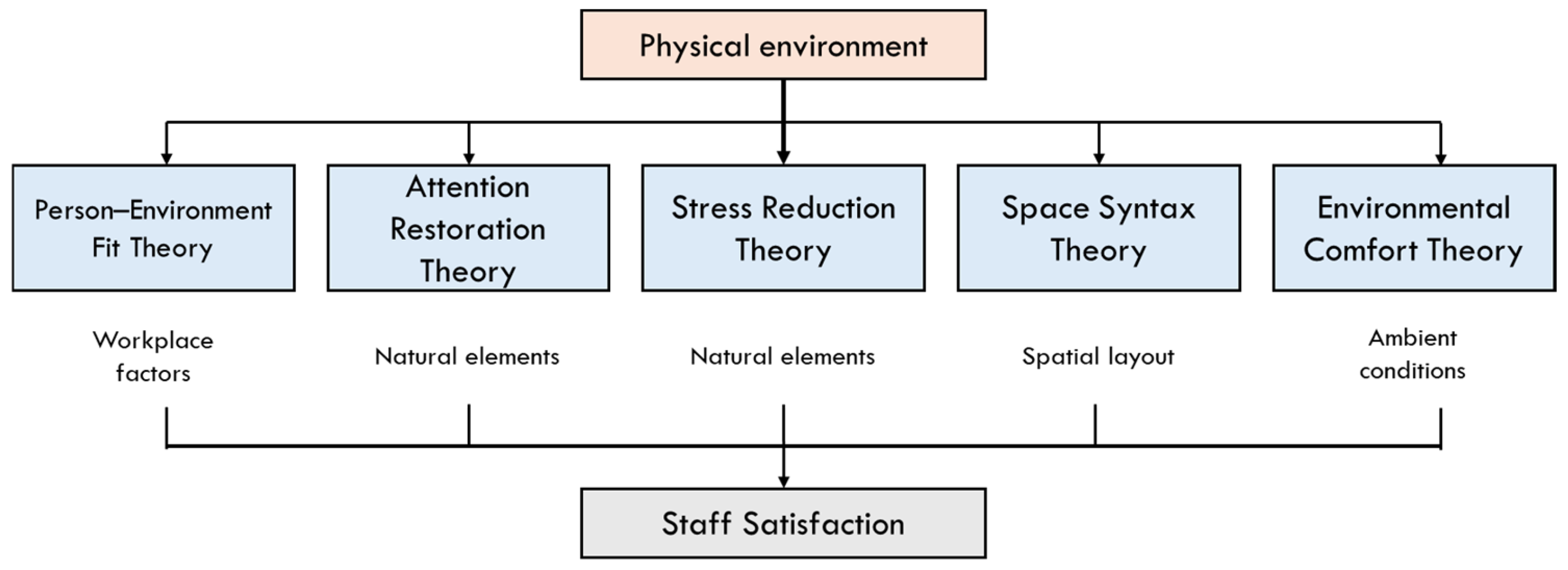
1.2. Theoretical Framework
2. Methods
2.1. Study Design
2.2. Participant Selection
2.3. Ethical Considerations
2.4. Interview Process
2.5. Data Analysis
3. Results
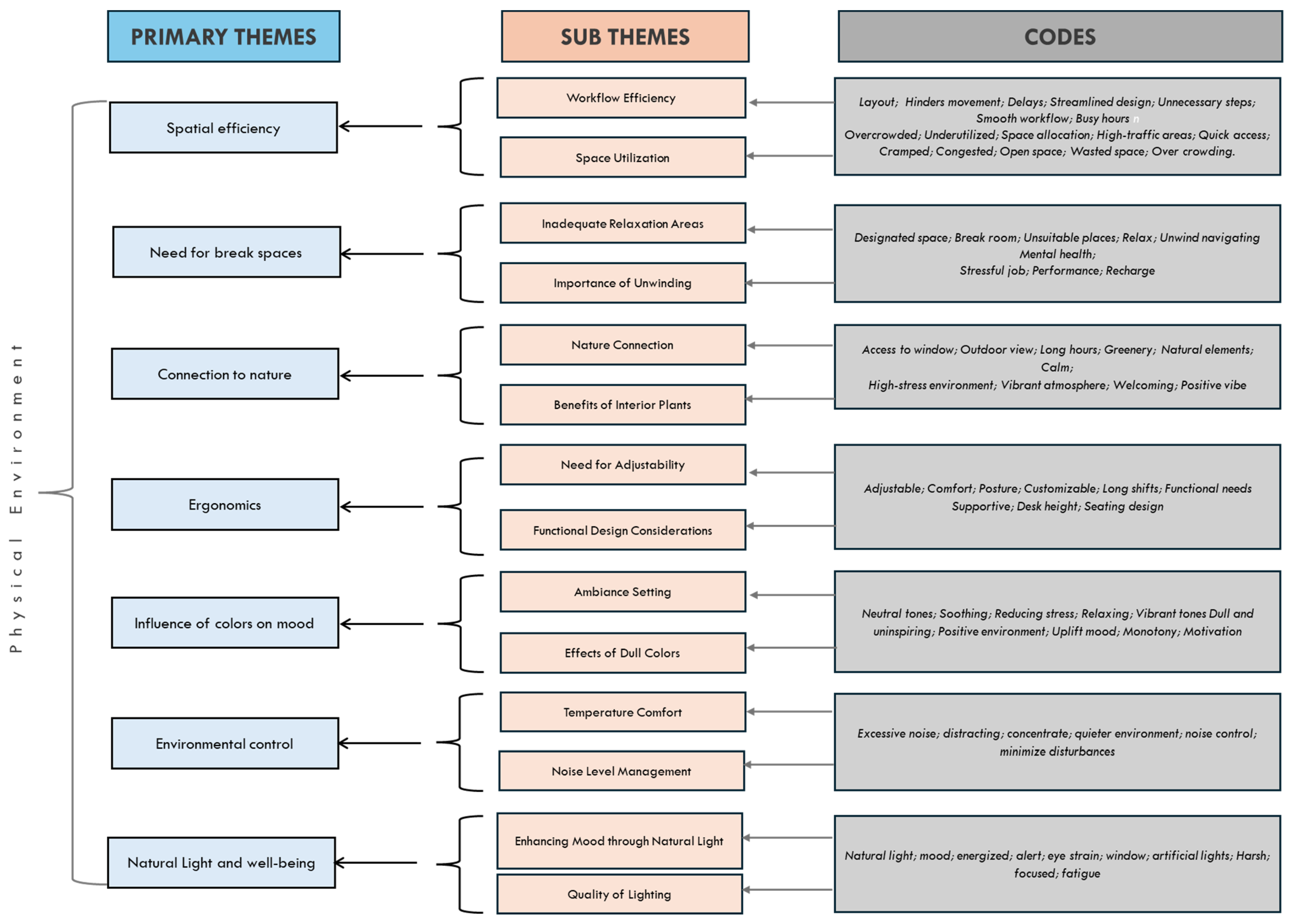
3.1. Theme 1: Spatial Efficiency
3.1.1. Subtheme 1.1: Workflow Efficiency
“The current layout hinders our movement between patient stations, leading to delays in providing care. We need a more efficient design to reduce unnecessary steps…. feels like we’re wasting time navigating the workspace than focusing on patient needs.”(N 1)
3.1.2. Subtheme 1.2: Space Utilization
“Some areas are overcrowded while some are underutilized…. the space allocation can be better designed, need to utilize space better, especially in frequently used areas such as supplies”(LA 1)
3.2. Theme 2: Need for Break Spaces
3.2.1. Subtheme 2.1: Inadequate Relaxation Areas
“There’s no space for a quick break. We end up resting in unsuitable places such as corridors or corner spaces. When we take short breaks, we find it difficult to find a comfortable space to relax…”(N 2)
3.2.2. Subtheme 2.2: Importance of Unwinding
“After attending patients back-to-back, a proper space to unwind becomes essential. Taking short breaks between hectic schedules is important, but without a peaceful space, I don’t feel refreshed.”(MD 1)
3.3. Theme 3: Connection to Nature
3.3.1. Subtheme 3.1: Nature Connection
“Having access to a window with an outdoor view would truly help during long hours of work… Seeing greenery around brings a sense of calmness, especially in a high-stress environment.”(AS 1)
3.3.2. Subtheme 3.2: Psychological Benefits of Interior Plants
“Plants brighten the room, making it feel more alive and less clinical. I feel more at ease working in a space with greenery; it creates a positive vibe.”(MD 2)
3.4. Theme 4: Ergonomics
3.4.1. Subtheme 4.1: Need for Adjustability
“The chairs and desks aren’t adjustable, which makes it uncomfortable during long shifts. The chair height can’t be adjusted, making it hard to maintain good posture during work… It would help if the desks were adjustable to fit different tasks, whether we’re sitting or standing.”(AS 2)
3.4.2. Subtheme 4.2: Functional Design Considerations
“We spend hours at the desk, but the seating isn’t designed for long-term comfort, and the current furniture design just isn’t supportive enough.”(P 1)
3.5. Theme 5: Influence of Colors on Mood
3.5.1. Subtheme 5.1: Ambiance Setting
“Soft colors make the environment more relaxing and calming, which helps focus during procedures… which is helpful in reducing stress during high-pressure moments.”(N 3)
3.5.2. Subtheme 5.2: Effects of Dull Color
“The lack of color variation makes the workspace feel dull and uninspiring… the workspace colors feel bland… A more active color could help uplift the mood and break the monotony.”(N 4)
3.6. Theme 6: Ambient Features and Environmental Control
3.6.1. Subtheme 6.1: Temperature Comfort
“The temperature fluctuates a lot, and it’s hard to maintain a consistent comfort level throughout the day… temperature control could be better and sometimes it gets too cold, affecting our comfort.”(AS 3)
3.6.2. Subtheme 6.2: Noise-Level Management
“The noise from the equipment can be distracting, especially when trying to concentrate… noise from patients and families makes it hard to concentrate and focus. A quieter environment would help improve focus.”(LA 2)
3.7. Theme 7: Natural Light and Well-Being
3.7.1. Subtheme 7.1: Enhancing Mood Through Natural Light
“Natural light truly helps during long shifts when I’m feeling tired… having access to sunlight makes a huge difference in how energized I feel during the day. it reduces eye strain also.”(MD 3)
3.7.2. Subtheme 7.2: Lighting Quality
“They can think of using better lighting in some areas. The artificial lights are too harsh, especially during long hours.”(Receptionist)
4. Discussion
5. Conclusions
Supplementary Materials
Author Contributions
Funding
Institutional Review Board Statement
Informed Consent Statement
Data Availability Statement
Conflicts of Interest
References
- Clark, P.A.; Wolosin, R.J.; Gavran, G. Customer Convergence: Patients, Physicians, and Employees Share in the Experience and Evaluation of Healthcare Quality. Health Mark. Q. 2007, 23, 79–99. [Google Scholar] [CrossRef]
- Raharjo, H.; Guglielmetti Mugion, R.; Di Pietro, L.; Toni, M. Do Satisfied Employees Lead to Satisfied Patients? An Empirical Study in an Italian Hospital. Total Qual. Manag. Bus. Excell. 2016, 27, 853–874. [Google Scholar] [CrossRef]
- Baker, D.P.; Salas, E.; Battles, J.B.; King, H.B. The Relation between Teamwork and Patient Safety. In Handbook of Human Factors and Ergonomics in Health Care and Patient Safety, 2nd ed.; CRC Press: Boca Raton, FL, USA, 2016; pp. 185–198. [Google Scholar]
- Uccella, L.; Mascherona, I.; Semini, S.; Uccella, S. Exploring Resilience among Hospital Workers: A Bayesian Approach. Front. Public Health 2024, 12, 1403721. [Google Scholar] [CrossRef] [PubMed]
- Shetty, R.; Prabhu, S.G.; Kamath, G.B.; Shetty, S.R.; Devi, N.R.; Rodrigues, L.R. Assessing the Influence of Ambient Features on Staff Satisfaction in the Healthcare Environment. J. Des. Built Environ. 2024, 24, 18–41. [Google Scholar] [CrossRef]
- Campos-Andrade, C.; Hernándezfernaud, E.; Lima, M.L. A Better Physical Environment in the Workplace Means Higher Well-Being A Study with Healthcare Professionals. Psyecology 2013, 4, 89–110. [Google Scholar] [CrossRef]
- Zhang, S.; Zhang, M.; Ban, Q. Study on the Synthetic Action of Environmental Factors on the Work Stress of Medical Staff. In Towards a Carbon Neutral Future; Lecture Notes in Civil Engineering; Springer Science and Business Media Deutschland GmbH: Singapore, 2024; Volume 393, pp. 131–139. [Google Scholar]
- Bosch, S.J.; Valipoor, S.; Alakshendra, A.; De Portu, G.; Mohammadigorji, S.; Rittenbacher, D.; Black, K.; Calienes, E. Coping and Caregiving: Leveraging Environmental Design to Moderate Stress Among Healthcare Workers in the Emergency Department Setting. Health Environ. Res. Des. J. 2023, 16, 261–277. [Google Scholar] [CrossRef]
- Chaudhury, H.; Mahmood, A.; Valente, M. The Effect of Environmental Design on Reducing Nursing Errors and Increasing Efficiency in Acute Care Settings: A Review and Analysis of the Literature. Environ. Behav. 2009, 41, 755–786. [Google Scholar] [CrossRef]
- Mohase, N.; Khumalo, J. Job Satisfaction in the Healthcare Services in South Africa: Case of MPH. Mediterr. J. Soc. Sci. 2014, 5, 94–102. [Google Scholar] [CrossRef]
- Вежнoвець, Т.А.; Парій, В.Д.; Вишнивецький, І.І.; Мoскаленкo, М.В. Factors Associated with Job Satisfaction of Human Resources in Healthcare. Wiad. Lek. 2017, 70, 443–448. [Google Scholar]
- Aiken, L.H.; Lasater, K.B.; Sloane, D.M.; Pogue, C.A.; Fitzpatrick Rosenbaum, K.E.; Muir, K.J.; McHugh, M.D. Physician and Nurse Well-Being and Preferred Interventions to Address Burnout in Hospital Practice: Factors Associated with Turnover, Outcomes, and Patient Safety. JAMA Health Forum 2023, 4, E231809. [Google Scholar] [CrossRef]
- Liu, K.; You, L.M.; Chen, S.X.; Hao, Y.T.; Zhu, X.W.; Zhang, L.F.; Aiken, L.H. The Relationship between Hospital Work Environment and Nurse Outcomes in Guangdong, China: A Nurse Questionnaire Survey. J. Clin. Nurs. 2012, 21, 1476–1485. [Google Scholar] [CrossRef] [PubMed]
- Ibrahim, M.; Kassawneh, F.Y. An investigation on the lighting in jordanian hospitals, focusing on daylight and the preferences of the staff. Malays. J. Public Health Med. 2024, 24, 75–85. [Google Scholar]
- Kotzer, A.M.; Zacharakis, S.K.; Raynolds, M.; Buenning, F. Evaluation of the Built Environment: Staff and Family Satisfaction Pre- and Post-Occupancy of the Children’s Hospital. Health Environ. Res. Des. J. 2011, 4, 60–78. [Google Scholar] [CrossRef] [PubMed]
- Weerakkody, S.; Teji, J.U.; Barrett, E.; Kousteni, M.; Flores-Villa, L.; Jenkins, E.; Montgomery, H. Improved Intensive Care Lighting and Staff Wellbeing: A Pilot Feasibility Service Evaluation. J. Intensive Care Soc. 2025, 26, 183–192. [Google Scholar] [CrossRef]
- Joseph, A. The Role of the Physical and Social Environment in Promoting Health, Safety, and Effectiveness in the Healthcare Workplace; Center for Health Design: Concord, CA, USA, 2006. [Google Scholar]
- Bayraktar Sari, A.O.; Jabi, W. Architectural Spatial Layout Design for Hospitals: A Review. J. Build. Eng. 2024, 97, 110835. [Google Scholar] [CrossRef]
- Benitez, G.B.; Da Silveira, G.J.C.; Fogliatto, F.S. Layout Planning in Healthcare Facilities: A Systematic Review. Health Environ. Res. Des. J. 2019, 12, 31–44. [Google Scholar] [CrossRef]
- Ley-Chavez, A.; Hmar-Lagroun, T.; Douglas-Ntagha, P.; Cumbo, C.L. Layout Improvement Study to Reduce Staff Walking Distance In a Large Health Care Facility: How to Not Walk an Extra 4740 Miles. Qual. Manag. Health Care 2016, 25, 134–140. [Google Scholar] [CrossRef]
- Zamani, Z.; Joy, T.; Worley, J. Optimizing Nurse Workflow Efficiency: An Examination of Nurse Walking Behavior and Space Accessibility in Medical Surgical Units. Health Environ. Res. Des. J. 2024, 17, 269–289. [Google Scholar] [CrossRef]
- Djukic, M.; Kovner, C.T.; Brewer, C.S.; Fatehi, F.; Greene, W.H. Exploring Direct and Indirect Influences of Physical Work Environment on Job Satisfaction for Early-Career Registered Nurses Employed in Hospitals. Res. Nurs. Health 2014, 37, 312–325. [Google Scholar] [CrossRef]
- Obeidat, B.; Bani, M.; Al-shlool, E. Heliyon Investigations into the Impact of Nursing Unit Layout on Critical Care Nurses. Heliyon 2022, 8, e08929. [Google Scholar] [CrossRef]
- Zhu, X. Assessing preferences and perceived restorative qualities of break spaces for nurses in China. Health Environ. Res. Des. J. 2022, 15, 126–142. [Google Scholar] [CrossRef]
- Lin, B.Y.-J.; Lin, Y.-K.; Wen Juan, C.; Lee, S.; Lin, C.-C. Moderating Role of Interior Amenities on Hospital Medical Directors’ Patient-Related Work Stresses. Health Environ. Res. Des. J. 2013, 6, 77–92. [Google Scholar] [CrossRef] [PubMed]
- Quan, X.; Joseph, A.; Ensign, J.C. Impact of Imaging Room Environment: Staff Job Stress and Satisfaction, Patient Satisfaction, and Willingness to Recommend. Health Environ. Res. Des. J. 2012, 5, 61–79. [Google Scholar] [CrossRef] [PubMed]
- Primavera, E.; Fiorini, J.; Della Bella, V.; Trebbi, E.; Tognaccini, L.; Zaghini, F.; Sili, A. Serenity Room as a Healing Space for Nurses: A Mixed-Method Systematic Review. J. Holist. Nurs. 2025, 8980101251395787. [Google Scholar] [CrossRef] [PubMed]
- Booker, J.; Cleak, V. Undervalued and Overlooked: The Importance of Private Space in Liaison Psychiatry. BJPsych Adv. 2023, 29, 393–395. [Google Scholar] [CrossRef]
- McCunn, L.J.; Safranek, S.; Wilkerson, A.; Davis, R.G. Lighting Control in Patient Rooms: Understanding Nurses’ Perceptions of Hospital Lighting Using Qualitative Methods. Health Environ. Res. Des. J. 2021, 14, 204–218. [Google Scholar] [CrossRef]
- Braun, V.; Clarke, V. Using Thematic Analysis in Psychology. Qual. Res. Psychol. 2006, 3, 77–101. [Google Scholar] [CrossRef]
- Zamani, Z. Effects of Emergency Department Physical Design Elements on Security, Wayfinding, Visibility, Privacy, and Efficiency and Its Implications on Staff Satisfaction and Performance. Health Environ. Res. Des. J. 2019, 12, 72–88. [Google Scholar] [CrossRef]
- Kim, S.K.; Hwang, Y.; Lee, Y.S.; Corser, W. Occupant Comfort and Satisfaction in Green Healthcare Environments: A Survey Study Focusing on Healthcare Staff. J. Sustain. Dev. 2015, 8, 156–173. [Google Scholar] [CrossRef]
- Arahanthabailu, P.; Praharaj, S.K.; Purohith, A.N.; Yesodharan, R.; Rege, S.; Appaji, R. Exploring Barriers to Seek Mental Health Services among Patients with Severe Mental Illness and Their Caregivers in a Modified Assertive Community Treatment Program: A Qualitative Thematic Analysis. Indian J. Psychiatry 2024, 66, 621–629. [Google Scholar] [CrossRef]
- Zakkar, M.A.; Janes, C.; Meyer, S. Barriers and Reliability of Patient Experience Evaluation in Ontario: Perspectives of Healthcare Providers, Managers, and Policymakers. Int. J. Health Gov. 2022, 27, 268–281. [Google Scholar] [CrossRef]
- Shetty, R.S.; Kamath, G.B.; Rodrigues, L.L.R.; Nandineni, R.D.; Shetty, S.R. The Impact of the Physical Environment on Staff in Healthcare Facilities: A Systematic Literature Review. Buildings 2024, 14, 2773. [Google Scholar] [CrossRef]
- Shetty, R.S.; Kamath, G.B.; Rodrigues, L.L.R.; Devi, N.R.; Shetty, S.R. Impact of the Physical Environment on Employee Satisfaction in Private Hospitals. Buildings 2025, 15, 1848. [Google Scholar] [CrossRef]
- Kaplan, R.; Kaplan, S.; Brown, T. Environmental Preference: A Comparison of Four Domains of Predictors. Environ. Behav. 1989, 21, 509–530. [Google Scholar] [CrossRef]
- Ulrich, R.S.; Simons, R.F.; Losito, B.D.; Fiorito, E.; Miles, M.A.; Zelson, M. Stress Recovery during Exposure to Natural and Urban Environments. J. Environ. Psychol. 1991, 11, 201–230. [Google Scholar] [CrossRef]
- Vischer, J.C. Towards an Environmental Psychology of Workspace: How People Are Affected by Environments for Work. Archit. Sci. Rev. 2008, 51, 97–108. [Google Scholar] [CrossRef]
- Kristof, A.L. Person-Organization Fit: An Integrative Review of Its Conceptualizations, Measurement, and Implications. Pers. Psychol. 1996, 49, 1–49. [Google Scholar] [CrossRef]
- Kaplan, R.; Kaplan, S. The Experience of Nature: A Psychological Perspective; Cambridge University Press: Cambridge, UK, 1989. [Google Scholar]
- Hillier, B.; Hanson, J. The Social Logic of Space; Cambridge University Press: Cambridge, UK, 1984. [Google Scholar] [CrossRef]
- Tong, A.; Sainsbury, P.; Craig, J. Consolidated Criteria for Reporting Qualitative Research (COREQ): A 32-Item Checklist for Interviews and Focus Groups. Int. J. Qual. Health Care 2007, 19, 349–357. [Google Scholar] [CrossRef]
- Palinkas, L.A.; Horwitz, S.M.; Green, C.A.; Wisdom, J.P.; Duan, N.; Hoagwood, K. Purposeful Sampling for Qualitative Data Collection and Analysis in Mixed Method Implementation Research. Adm. Policy Ment. Health Ment. Health Serv. Res. 2015, 42, 533–544. [Google Scholar] [CrossRef]
- Ulrich, R.S. View through a Window May Influence Recovery from Surgery. Science 1984, 224, 420–421. [Google Scholar] [CrossRef]
- Nowell, L.S.; Norris, J.M.; White, D.E.; Moules, N.J. Thematic Analysis: Striving to Meet the Trustworthiness Criteria. Int. J. Qual. Methods 2017, 16, 1609406917733847. [Google Scholar] [CrossRef]
- Guest, G.; Bunce, A.; Johnson, L. How Many Interviews Are Enough?: An Experiment with Data Saturation and Variability. Field Methods 2006, 18, 59–82. [Google Scholar] [CrossRef]
- Fusch, P.I.; Ness, L.R. Are We There yet? Data Saturation in Qualitative Research. Qual. Rep. 2015, 20, 1408–1416. [Google Scholar] [CrossRef]
- Choudhary, R.; Bafna, S.; Heo, Y.; Hendrich, A.; Chow, M. A Predictive Model for Computing the Influence of Space Layouts on Nurses’ Movement in Hospital Units. J. Build. Perform. Simul. 2010, 3, 171–184. [Google Scholar] [CrossRef]
- Trzpuc, S.J.; Martin, C.S. Application of Space Syntax Theory in the Study of Medical-Surgical Nursing Units in Urban Hospitals. Health Environ. Res. Des. J. 2011, 4, 34–55. [Google Scholar] [CrossRef]
- Çelebi, Ç.; Dündar, M. Investigation of Circulation Areas Depending on Spatial Planning Criteria in Healthcare Facilities. In Scientific Researches in Health Sciences II; Peter Lang: Frankfurt, Germany, 2021. [Google Scholar] [CrossRef]
- Nejati, A.; Shepley, M.; Rodiek, S. A Review of Design and Policy Interventions to Promote Nurses’ Restorative Breaks in Health Care Workplaces. Workplace Health Saf. 2016, 64, 70–77. [Google Scholar] [CrossRef]
- Nejati, A.; Shepley, M.; Rodiek, S.; Lee, C.; Varni, J. Restorative Design Features for Hospital Staff Break Areas: A Multi-Method Study. Health Environ. Res. Des. J. 2016, 9, 16–35. [Google Scholar] [CrossRef]
- Berto, R. The Role of Nature in Coping with Psycho-Physiological Stress: A Literature Review on Restorativeness. Behav. Sci. 2014, 4, 394–409. [Google Scholar] [CrossRef]
- Shin, W.; Park, M. Ergonomic Interventions for Prevention of Work-Related Musculoskeletal Disorders in a Small Manufacturing Assembly Line. Int. J. Occup. Saf. Ergon. 2019, 25, 110–122. [Google Scholar] [CrossRef]
- Vargas, A.R.; Maldonado-Macías, A.A.; García-Alcaraz, J.L. Postural and Fatigue Analyses for Ergonomic Workstations Design as an Integrated Approach to Sustainable Workplaces. In New Perspectives on Applied Industrial Ergonomics; Springer International Publishing: Cham, Switzerland, 2021; pp. 291–313. [Google Scholar]
- Sroykham, W.; Wongsathikun, J.; Wongsawat, Y. The Effects of Perceiving Color in Living Environment on QEEG, Oxygen Saturation, Pulse Rate, and Emotion Regulation in Humans. In Proceedings of the 2014 36th Annual International Conference of the IEEE Engineering in Medicine and Biology Society, EMBC 2014; Institute of Electrical and Electronics Engineers Inc.: New York, NY, USA, 2014; pp. 6226–6229. [Google Scholar]
- Ma, S.; Deng, W.; Lu, J.; Zhou, T.; Liu, B. Investigation of Thermal Comfort and Preferred Temperatures for Healthcare Staff in Hospitals in Ningbo, China. J. Build. Eng. 2023, 80, 108029. [Google Scholar] [CrossRef]
- Cantor-Cutiva, L.C.; Carrillo-Gonzalez, A. Relationship between Noise Perception, Vocal Fatigue, and Work-Related Stress among Health Workers in a Hospital in Bogotá, Colombia. J. Acoust. Soc. Am. 2022, 151, A216. [Google Scholar] [CrossRef]
- Raghuwanshi, N.K.; Yadav, S.K.; Jayaswal, P.; Parey, A. Noise Effects, Analysis and Control in Hospitals—A Review. Noise Vib. Worldw. 2024, 55, 123–134. [Google Scholar] [CrossRef]
- Oleksy, A.J.; Schlesinger, J.J. What’s All That Noise—Improving the Hospital Soundscape. J. Clin. Monit. Comput. 2019, 33, 557–562. [Google Scholar] [CrossRef]
- Lo Verso, V.R.M.; Caffaro, F.; Aghemo, C. Luminous Environment in Healthcare Buildings for User Satisfaction and Comfort: An Objective and Subjective Field Study. Indoor Built Environ. 2016, 25, 809–825. [Google Scholar] [CrossRef]
- Schledermann, K.M.; Bjørner, T.; West, A.S.; Hansen, T.S. Evaluation of Staff’s Perception of a Circadian Lighting System Implemented in a Hospital. Build. Environ. 2023, 242, 110488. [Google Scholar] [CrossRef]


Disclaimer/Publisher’s Note: The statements, opinions and data contained in all publications are solely those of the individual author(s) and contributor(s) and not of MDPI and/or the editor(s). MDPI and/or the editor(s) disclaim responsibility for any injury to people or property resulting from any ideas, methods, instructions or products referred to in the content. |
© 2026 by the authors. Licensee MDPI, Basel, Switzerland. This article is an open access article distributed under the terms and conditions of the Creative Commons Attribution (CC BY) license.
Share and Cite
Shetty, R.S.; Kamath, G.B.; Shetty, S.R.; KV, S.; Rao, A.; Prabhu, V.; Nayak, S. Exploring Healthcare Staff Perceptions and Satisfaction with the Physical Work Environment: A Qualitative Study. Healthcare 2026, 14, 642. https://doi.org/10.3390/healthcare14050642
Shetty RS, Kamath GB, Shetty SR, KV S, Rao A, Prabhu V, Nayak S. Exploring Healthcare Staff Perceptions and Satisfaction with the Physical Work Environment: A Qualitative Study. Healthcare. 2026; 14(5):642. https://doi.org/10.3390/healthcare14050642
Chicago/Turabian StyleShetty, Roshan S., Giridhar B. Kamath, Sham Ranjan Shetty, Sriram KV, Akshatha Rao, Vibha Prabhu, and Smitha Nayak. 2026. "Exploring Healthcare Staff Perceptions and Satisfaction with the Physical Work Environment: A Qualitative Study" Healthcare 14, no. 5: 642. https://doi.org/10.3390/healthcare14050642
APA StyleShetty, R. S., Kamath, G. B., Shetty, S. R., KV, S., Rao, A., Prabhu, V., & Nayak, S. (2026). Exploring Healthcare Staff Perceptions and Satisfaction with the Physical Work Environment: A Qualitative Study. Healthcare, 14(5), 642. https://doi.org/10.3390/healthcare14050642