Axial Length as a Key Risk Factor for Lattice Degeneration: A Large-Sample Retrospective Analysis

 , , ,
, , ,
Abstract
1. Introduction
2. Methods
2.1. Study Design and Participants
2.2. Ophthalmic Examinations
2.3. Standardization and Quality Control
2.4. Data Analysis
2.5. Definitions of Key Variables
3. Results
3.1. Participant Demographics and Ocular Characteristics
3.2. Comparison of Prevalence Rates Between Different Groups
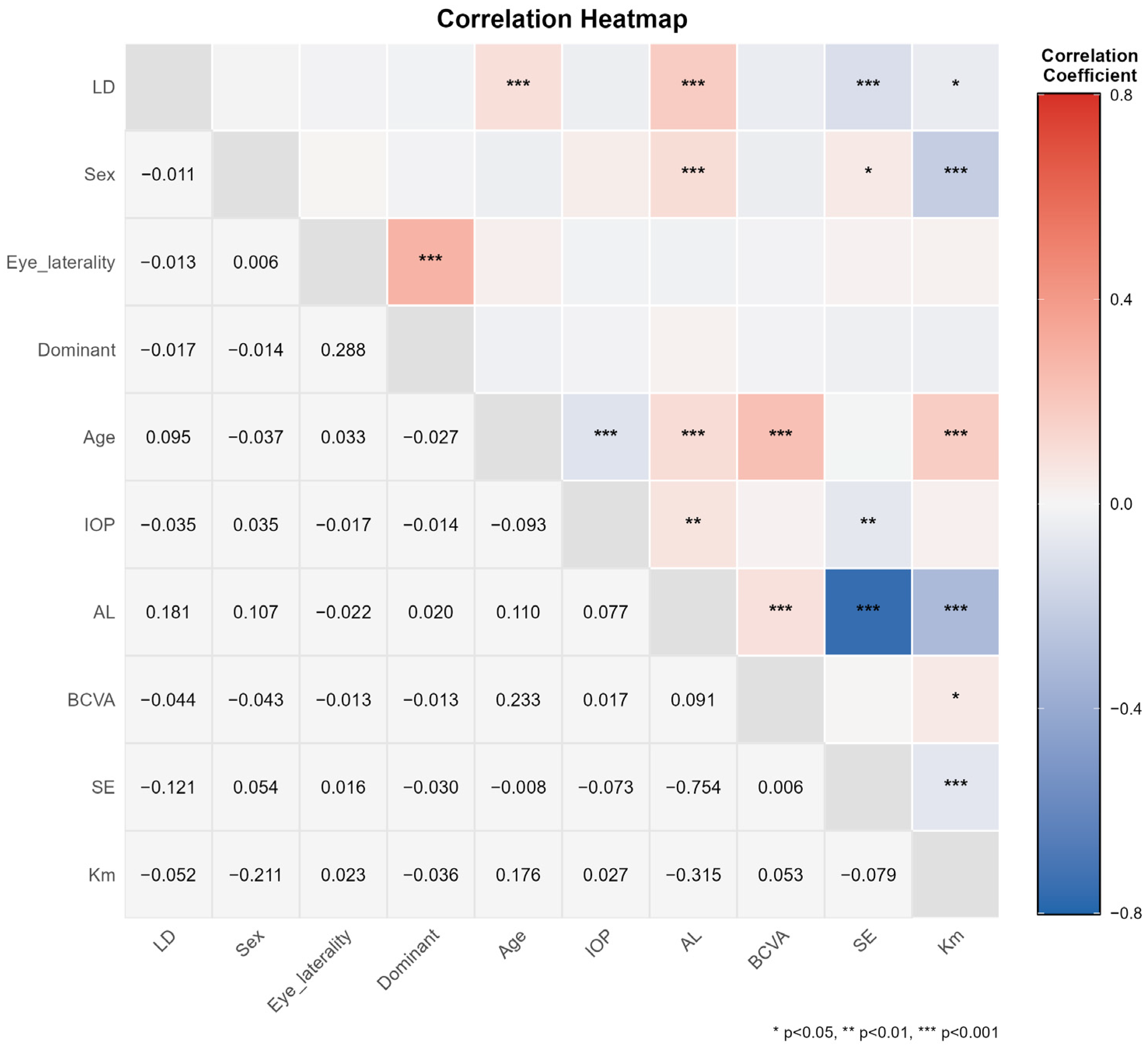
3.3. Correlation Analysis of SE, AL, AL/CR, and Age with LD
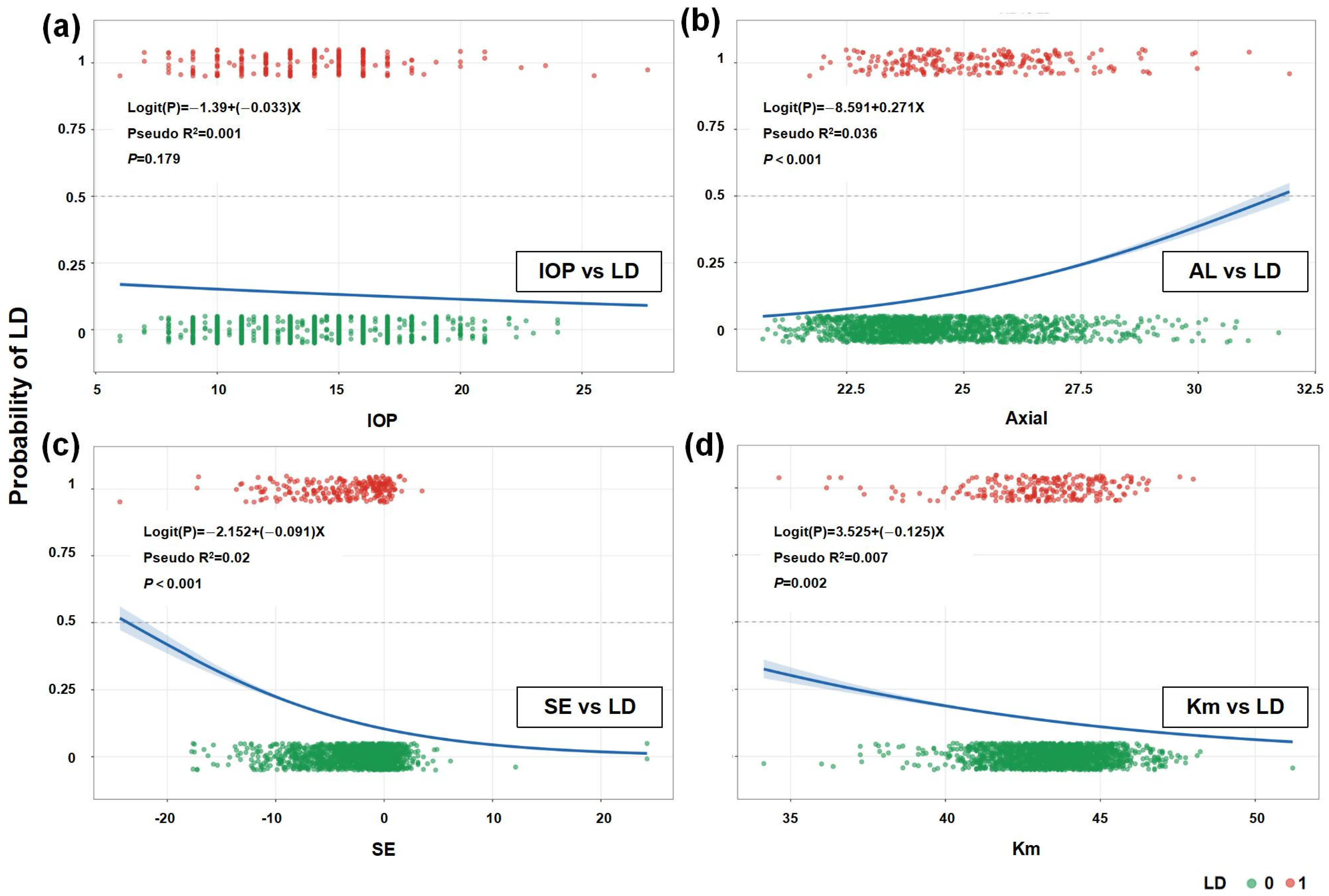
3.4. Univariate Logistic Regression Analysis
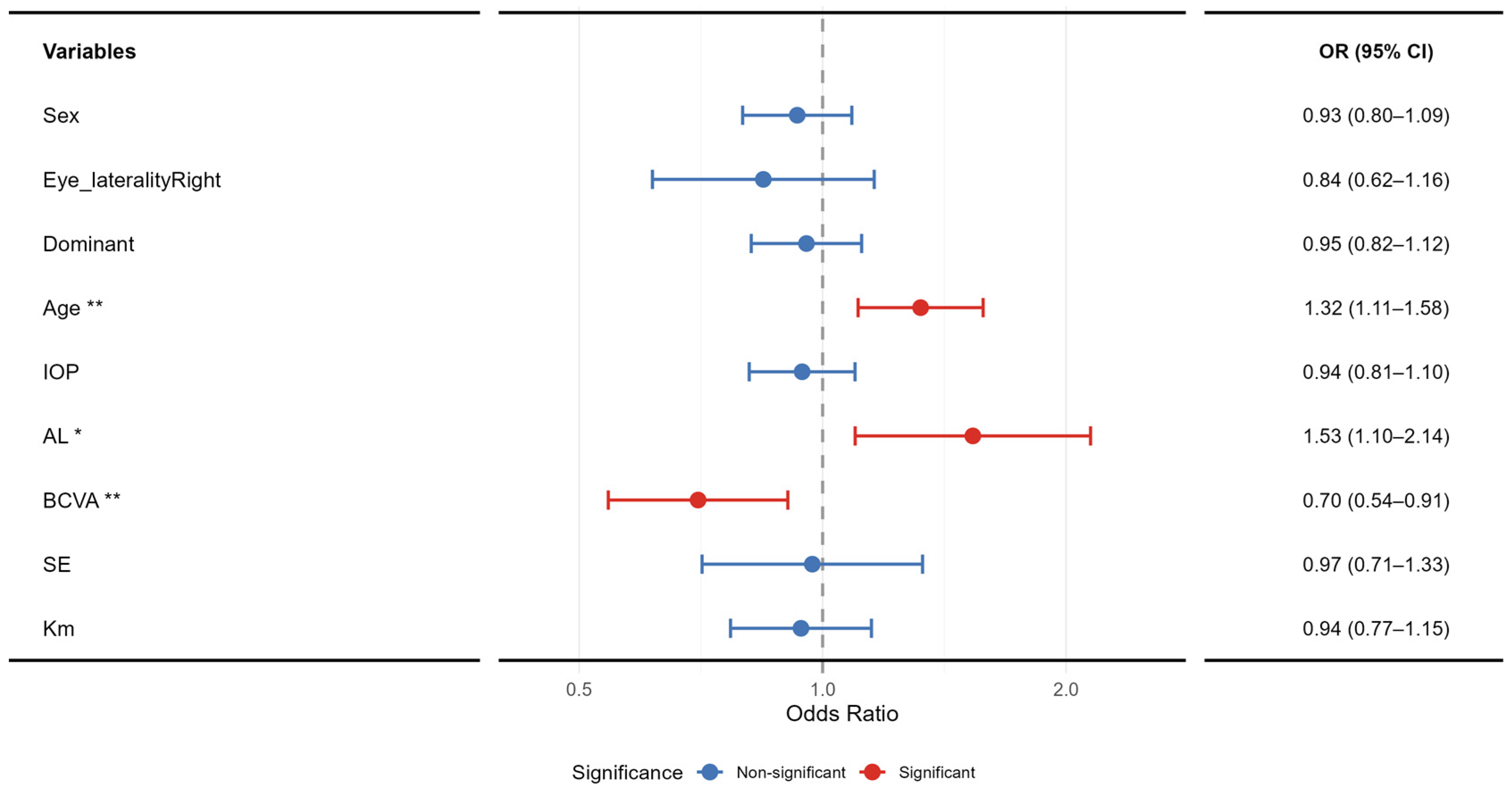
3.5. Multivariate Logistic Regression Analysis
4. Discussion
5. Conclusions
Author Contributions
Funding
Institutional Review Board Statement
Informed Consent Statement
Data Availability Statement
Acknowledgments
Conflicts of Interest
Abbreviations
| LD | Lattice Degeneration |
| SE | Spherical Equivalent |
| AL | Axial Length |
| AL/CR | Axial Length/Corneal Radius Ratio |
| BCVA | Best-Corrected Visual Acuity |
| OCT | Optical Coherence Tomography |
| RD | Retinal Detachment |
| Km | Mean Keratometry |
| IOP | Intraocular Pressure |
| AIC | Akaike’s Information Criterion |
| BIC | Bayesian Information Criterion |
| OR | Odds Ratio |
| CI | Confidence Interval |
| logMAR | logarithmic Minimum Angle of Resolution |
References
- Flaxel, C.J.; Adelman, R.A.; Bailey, S.T.; Fawzi, A.; Lim, J.I.; Vemulakonda, G.A.; Ying, G.-S. Posterior vitreous detachment, retinal breaks, and lattice degeneration preferred practice pattern®. Ophthalmology 2020, 127, P146–P181. [Google Scholar] [CrossRef] [Scilit] [PubMed]
- Wilkinson, C.P. Interventions for asymptomatic retinal breaks and lattice degeneration for preventing retinal detachment. Cochrane Database Syst. Rev. 2014, 14, CD003170. [Google Scholar] [CrossRef] [Scilit] [PubMed]
- Wilkinson, C. Evidence-based analysis of prophylactic treatment of asymptomatic retinal breaks and lattice degeneration. Ophthalmology 2000, 107, 12–15. [Google Scholar] [CrossRef] [Scilit] [PubMed]
- Sasaki, K.; Ideta, H.; Yonemoto, J.; Tanaka, S.; Hirose, A.; Oka, C. Risk of retinal detachment in patients with lattice degeneration. Jpn. J. Ophthalmol. 1998, 42, 308–313. [Google Scholar] [CrossRef] [Scilit]
- Straatsma, B.R.; Zeegen, P.D.; Foos, R.Y.; Feman, S.S.; Shabo, A.L. Lattice degeneration of the retina: XXX Edward Jackson Memorial Lecture. Am. J. Ophthalmol. 1974, 77, 619–649. [Google Scholar] [CrossRef] [Scilit]
- Byer, N.E. Lattice degeneration of the retina. Surv. Ophthalmol. 1979, 23, 213–248. [Google Scholar] [CrossRef] [Scilit]
- Okazaki, S.; Meguro, A.; Ideta, R.; Takeuchi, M.; Yonemoto, J.; Teshigawara, T.; Yamane, T.; Okada, E.; Ideta, H.; Mizuki, N. Common variants in the COL2A1 gene are associated with lattice degeneration of the retina in a Japanese population. Mol. Vis. 2019, 25, 843. [Google Scholar]
- Kumar, G.B.; Divya, M. Retinal Changes and Complications in Progressive Pathological Myopia: Insights from a Cross-sectional Observational Study. Telangana J. Ophthalmol. 2025, 1, 1–6. [Google Scholar]
- Jiang, Y.; Xiao, X.; Sun, W.; Wang, Y.; Li, S.; Jia, X.; Wang, P.; Hejtmancik, J.F.; Zhang, Q. Clinical and genetic risk factors underlying severe consequence iden-tified in 75 families with unilateral high myopia. J. Transl. Med. 2024, 22, 75. [Google Scholar] [CrossRef] [Scilit]
- Hyams, S. Prevalence of lattice degeneration and its relation to axial length in severe myopia. Am. J. Ophthalmol. 1991, 112, 356–357. [Google Scholar] [CrossRef] [Scilit]
- Chen, D.Z.; Koh, V.; Tan, M.; Tan, C.S.; Nah, G.; Shen, L.; Bhargava, M.; Cheng, C.Y.; Zhao, P.; Wong, T.Y.; et al. Peripheral retinal changes in highly myopic young Asian eyes. Acta Ophthalmol. 2018, 96, e846–e851. [Google Scholar] [CrossRef] [Scilit] [PubMed]
- Holden, B.A.; Fricke, T.R.; Wilson, D.A.; Jong, M.; Naidoo, K.S.; Sankaridurg, P.; Wong, T.Y.; Naduvilath, T.J.; Resnikoff, S. Global prevalence of myopia and high myopia and temporal trends from 2000 through 2050. Ophthalmology 2016, 123, 1036–1042. [Google Scholar] [CrossRef] [Scilit] [PubMed]
- Chen, S. Overall myopia rate of 52.7% among children and youth in China by 2020. Chin. Women’s Newsp. 2021, 2. [Google Scholar] [CrossRef]
- Zhang, W.; Yang, F.; Chen, S.; Shi, T. Peripheral and posterior pole retinal changes in highly myopic Chinese children and adolescents: Retinal changes in Chinese children and adolescents. BMC Ophthalmol. 2024, 24, 65. [Google Scholar] [CrossRef] [Scilit]
- Haarman, A.E.; Enthoven, C.A.; Tideman, J.W.L.; Tedja, M.S.; Verhoeven, V.J.; Klaver, C.C. The complications of myopia: A review and meta-analysis. Investig. Ophthalmol. Vis. Sci. 2020, 61, 49. [Google Scholar] [CrossRef] [Scilit]
- Saw, S.M.; Gazzard, G.; Shih-Yen, E.C.; Chua, W.H. Myopia and associated pathological complications. Ophthalmic Physiol. Opt. 2005, 25, 381–391. [Google Scholar] [CrossRef] [Scilit]
- Jonas, J.B.; Nangia, V.; Gupta, R.; Bhojwani, K.; Nangia, P.; Panda-Jonas, S. Prevalence of myopic retinopathy in rural Central India. Acta Ophthalmol. 2017, 95, e399–e404. [Google Scholar] [CrossRef] [Scilit]
- McCarty, C.A.; Taylor, H.R. Myopia and vision 2020. Am. J. Ophthalmol. 2000, 129, 525–527. [Google Scholar] [CrossRef] [Scilit]
- Quinn, N.; Csincsik, L.; Flynn, E.; Curcio, C.A.; Kiss, S.; Sadda, S.R.; Hogg, R.; Peto, T.; Lengyel, I. The clinical relevance of visualising the peripheral retina. Prog. Retin. Eye Res. 2019, 68, 83–109. [Google Scholar] [CrossRef] [Scilit]
- Horie, S.; Kukimoto, N.; Kamoi, K.; Igarashi-Yokoi, T.; Yoshida, T.; Ohno-Matsui, K. Blue widefield images of scanning laser ophthalmoscope can detect retinal ischemic areas in eyes with diabetic retinopathy. Asia-Pac. J. Ophthalmol. 2021, 10, 478–485. [Google Scholar] [CrossRef] [Scilit]
- Nagel, I.D.; Heinke, A.; Agnihotri, A.P.; Yassin, S.; Cheng, L.; Camp, A.S.; Scott, N.L.; Kalaw, F.G.P.; Borooah, S.; Bartsch, D.-U.G. Comparison of a novel ultra-widefield three-color scanning laser ophthalmoscope to other retinal imaging modalities in chorioretinal lesion imaging. Transl. Vis. Sci. Technol. 2025, 14, 11. [Google Scholar] [CrossRef] [Scilit]
- He, X.; Sankaridurg, P.; Naduvilath, T.; Wang, J.; Xiong, S.; Weng, R.; Du, L.; Chen, J.; Zou, H.; Xu, X. Normative data and percentile curves for axial length and axial length/corneal curvature in Chinese children and adolescents aged 4–18 years. Br. J. Ophthalmol. 2023, 107, 167–175. [Google Scholar] [CrossRef] [Scilit] [PubMed]
- Huang, J.; Wen, D.; Wang, Q.; McAlinden, C.; Flitcroft, I.; Chen, H.; Saw, S.M.; Chen, H.; Bao, F.; Zhao, Y. Efficacy comparison of 16 interventions for myopia control in children: A network meta-analysis. Ophthalmology 2016, 123, 697–708. [Google Scholar] [CrossRef] [Scilit] [PubMed]
- Olowe, K.J.; Edoh, N.L.; Zouo, S.J.C.; Olamijuwon, J. Comprehensive review of logistic regression techniques in predicting health outcomes and trends. World J. Adv. Pharm. Life Sci. 2024, 7, 16–26. [Google Scholar] [CrossRef] [Scilit]
- Semes, L.P.; Holland, W.; Likens, E.G. Prevalence and laterality of lattice retinal degeneration within a primary eye care population. Optometry 2001, 72, 247–250. [Google Scholar]
- Zhang, T.; Wei, Y.-T.; Huang, W.-B.; Liu, R.-J.; Zuo, Y.-J.; He, L.-W.; Zhong, L.-T.; Zhang, S.-C. Prevalence and characteristics of peripheral myopic retinopathy in Guangzhou office workers. Int. J. Ophthalmol. 2018, 11, 1390. [Google Scholar] [CrossRef] [Scilit]
- Liu, L.; Li, Y.; Wang, H.; Yang, Z.; Wang, K.; Luo, J.; Liu, Y. The correlation between molecular structure and superlubricity in homojunctions of 2D materials. Mater. Sci. Eng. R Rep. 2024, 161, 100868. [Google Scholar] [CrossRef] [Scilit]
- Cheng, S.C.; Lam, C.S.; Yap, M.K. Prevalence of myopia-related retinal changes among 12–18 year old Hong Kong Chinese high myopes. Ophthalmic Physiol. Opt. 2013, 33, 652–660. [Google Scholar] [CrossRef] [Scilit]
- Syal, A.D.; Satapathy, J.; Panigrahi, P.K. Characteristics of myopic retinopathy and its awareness in adults: A hospital-based comparative study. BMC Ophthalmol. 2025, 25, 339. [Google Scholar] [CrossRef] [Scilit]
- Lam, D.S.; Fan, D.S.; Chan, W.-M.; Tam, B.S.; Kwok, A.K.; Leung, A.T.; Parsons, H. Prevalence and characteristics of peripheral retinal degeneration in Chinese adults with high myopia: A cross-sectional prevalence survey. Optom. Vis. Sci. 2005, 82, 235–238. [Google Scholar] [CrossRef] [Scilit]
- Song, D.; Zhang, P.; Meng, T.; Yao, J.; Sheng, M. Axial length/corneal radius ratio for the diagnosis of myopia in children and adolescents: A meta-analysis. Clin. Exp. Optom. 2025, 1–11. [Google Scholar] [CrossRef] [Scilit]
- Tsai, C.-Y.; Hung, K.-C.; Wang, S.-W.; Chen, M.-S.; Ho, T.-C. Spectral-domain optical coherence tomography of peripheral lattice degeneration of myopic eyes before and after laser photocoagulation. J. Formos. Med. Assoc. 2019, 118, 679–685. [Google Scholar] [CrossRef] [Scilit]



| Parameters | Overall Distribution | Non-LD | LD | t/χ2 | p |
|---|---|---|---|---|---|
| Age, years | 33.23 ± 21.12 | 32.58 ± 21.64 | 37.39 ± 16.88 | −3.9136 | 0.0001 * |
| Sex (n%) | 0.1395 | 0.7088 | |||
| Male | 773 (43.5) | 673 (43.6) | 100 (42.2) | ||
| Female | 1003 (56.5) | 866 (56.4) | 137 (57.8) |
| Parameters | Overall Distribution | Non-LD (n = 1539) | LD (n = 237) | t/χ2/U | p |
|---|---|---|---|---|---|
| Eye Lateral (R/L) | 862/914 | 751/788 | 111/126 | 0.2430 | 0.6221 |
| IOP (mmHg) | 13.81 ± 2.9 | 13.85 ± 2.85 | 13.55 ± 3.16 | −1.2469 | 0.2134 |
| AL (mm) | 24.51 ± 1.71 | 24.39 ± 1.68 | 25.27 ± 1.74 | 7.2989 | <0.001 * |
| SE (d) # | −1.5 [−4.38, −0.12] | −1.38 [−4.12, 0] | −2.88 [−6.50, −0.5] | 144,863.0 | <0.001 * |
| Km (d) | 43.42 ± 1.67 | 43.46 ± 1.6 | 43.10 ± 2.03 | −2.6311 | 0.009 * |
| Comparison Group | Number of Disease Cases | Total (N) | Prevalence (%) | p | Test Statistic (χ2) |
|---|---|---|---|---|---|
| Monocular vs. Binocular | 166/71 | 1776 | 9.3/4.0 | <0.001 * | 38.08 |
| Dominant Eye vs. Non-dominant Eye | 97/109 | 1656 | 11.9/13.0 | 0.538 | 0.38 |
| Myopic vs. non-myopic | 162/74 | 1776 | 15.5/10.5 | 0.004 * | 8.47 |
| Male vs. Female | 100/137 | 1776 | 13.0/13.7 | 0.709 | 0.14 |
| Parameters | β | OR | 95% CI of OR | p | AIC | |
|---|---|---|---|---|---|---|
| Lower | Upper | |||||
| SE | 0.08 | 1.08 | 1.05 | 1.12 | <0.001 * | 1379.8 |
| AL | 0.27 | 1.31 | 1.22 | 1.41 | <0.001 * | 1349.3 |
| AL/CR | 1.65 | 5.22 | 2.91 | 9.34 | <0.001 * | 1369.7 |
| Parameters | OR | 95% Cl | p Value |
|---|---|---|---|
| Sex | 0.93 | 0.80–1.09 | 0.362 |
| Eye (Right) | 0.85 | 0.62–1.16 | 0.295 |
| Dominant Eye | 0.96 | 0.82–1.12 | 0.565 |
| Age | 1.32 | 1.11–1.58 | 0.002 * |
| IOP | 0.94 | 0.81–1.10 | 0.448 |
| AL | 1.53 | 1.10–2.14 | 0.012 * |
| BCVA | 0.70 | 0.54–0.91 | 0.007 * |
| SE | 0.97 | 0.71–1.33 | 0.854 |
| Km | 0.94 | 0.77–1.15 | 0.547 |
Disclaimer/Publisher’s Note: The statements, opinions and data contained in all publications are solely those of the individual author(s) and contributor(s) and not of MDPI and/or the editor(s). MDPI and/or the editor(s) disclaim responsibility for any injury to people or property resulting from any ideas, methods, instructions or products referred to in the content. |
© 2026 by the authors. Licensee MDPI, Basel, Switzerland. This article is an open access article distributed under the terms and conditions of the Creative Commons Attribution (CC BY) license.
Share and Cite
Mi, Q.; Zhang, Y.; Nie, Y.; Wu, X.; Fan, H.; Zhang, M.; Duan, J. Axial Length as a Key Risk Factor for Lattice Degeneration: A Large-Sample Retrospective Analysis. Healthcare 2026, 14, 561. https://doi.org/10.3390/healthcare14050561
Mi Q, Zhang Y, Nie Y, Wu X, Fan H, Zhang M, Duan J. Axial Length as a Key Risk Factor for Lattice Degeneration: A Large-Sample Retrospective Analysis. Healthcare. 2026; 14(5):561. https://doi.org/10.3390/healthcare14050561
Chicago/Turabian StyleMi, Qiulin, Youruo Zhang, Yingying Nie, Xiaoxiao Wu, Haobo Fan, Mingxu Zhang, and Junguo Duan. 2026. "Axial Length as a Key Risk Factor for Lattice Degeneration: A Large-Sample Retrospective Analysis" Healthcare 14, no. 5: 561. https://doi.org/10.3390/healthcare14050561
APA StyleMi, Q., Zhang, Y., Nie, Y., Wu, X., Fan, H., Zhang, M., & Duan, J. (2026). Axial Length as a Key Risk Factor for Lattice Degeneration: A Large-Sample Retrospective Analysis. Healthcare, 14(5), 561. https://doi.org/10.3390/healthcare14050561