Mechanical Efficiency and Injury Risk in Leg Kicks Across Combat Sports: A Narrative Review of Stance, Hip Rotation, and Striking Surface Effects
 ,
,  , , , , , , ,
  and
and
Highlights
- Pivot optimizes hip rotation and power but increases rotational stress on the knee and ankle of the supporting leg (risk of ACL and sprains).
- Contact with the tibia (shin) maximizes momentum but is associated with a high risk of tibial contusions and stress fractures (typical of Muay Thai/MMA).
- Contact with the instep promotes speed and scoring but exposes the foot and ankle to sprains and fractures.
- The same technical choices that maximize performance (impact force and speed) create specific vulnerabilities to injury.
- Results highlight a performance-safety continuum.
Abstract
1. Introduction
2. Materials and Methods
2.1. Eligibility
2.2. Information Sources and Search Strategy
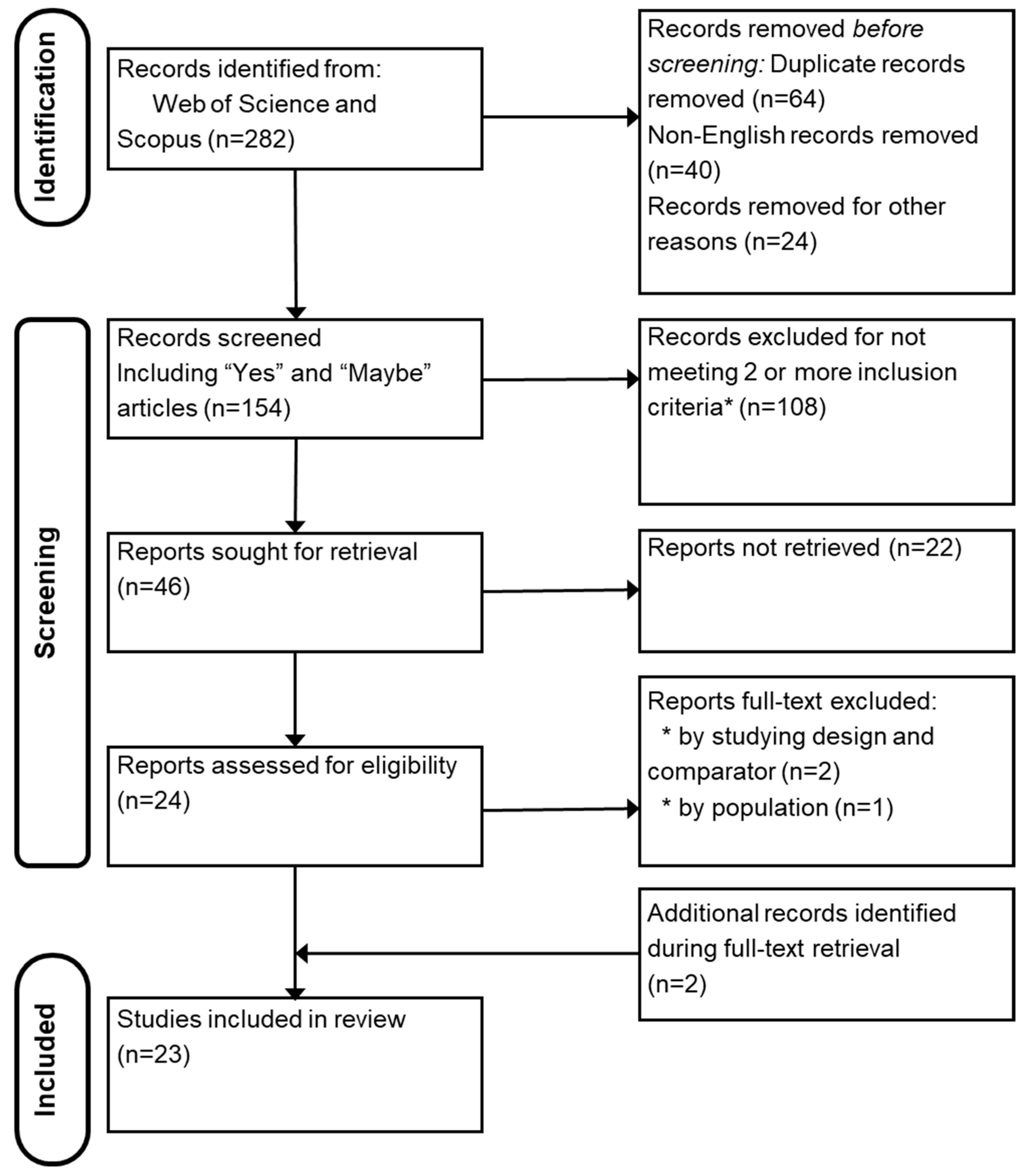
2.3. Study Selection and Data Extraction
- (1)
- Title and Abstract Screening: Records clearly unrelated to combat sports, leg kicks, or biomechanics/injury outcomes (e.g., studies on Wrestling, Judo, or upper limb strikes) were excluded.
- (2)
- Screening Groups: Each remaining record was categorized as “Included”, “Excluded”, or “Maybe”. Studies in the “Maybe” category were not clearly irrelevant but required full-text review to determine eligibility.
- (3)
- Full-Text Screening: Full texts were retrieved for all “Included” and “Maybe” articles. Studies that did not meet the eligibility criteria or were unavailable in full text were excluded.
2.4. Assessment of Methodological Quality
2.5. Data Synthesis
3. Results
3.1. Characteristics of the Studies
3.2. Sample Characteristics
3.3. Mechanical Efficiency
3.4. Injury Outcomes
3.4.1. Anatomical Distribution
3.4.2. Incidence and Time-Loss Injuries
3.4.3. Mechanisms of Injury
3.4.4. Risk Factors
3.5. Methodological Quality of Included Studies
4. Discussion
4.1. Biomechanical Paradox
4.1.1. Stance Mechanics and the Pivot “Penalty”
4.1.2. Hip Rotation and Force–Risk Trade-Offs
4.2. Contact Mechanics and Striking Surface
Force-Speed Trade-Off
4.3. Modifiers: Anthropometry, Fatigue, and Psychology
4.3.1. Anthropometry
4.3.2. Fatigue
4.3.3. Perceived Versus Actual Risk
4.3.4. Gender Dimorphism
4.4. Practical Implications
4.4.1. For Coaches and Technical Staff
4.4.2. For Athletes
4.4.3. For Clinicians and Sports Medicine Practitioners
4.5. Future Directions
4.6. Strengths and Limitations
5. Conclusions
Supplementary Materials
Author Contributions
Funding
Institutional Review Board Statement
Informed Consent Statement
Data Availability Statement
Conflicts of Interest
Abbreviations
| CS | Combat Sports |
| ACL | Anterior Cruciate Ligament |
| MMA | Mixed Martial Arts |
| DOI | Digital Object Identifier |
| WKF | World Karate Federation |
| UFC | Ultimate Fighting Championship |
| TKD | Taekwondo |
References
- Miarka, B.; Brito, C.J.; Moreira, D.G.; Amtmann, J. Differences by Ending Rounds and Other Rounds in Time-Motion Analysis of Mixed Martial Arts: Implications for Assessment and Training. J. Strength Cond. Res. 2018, 32, 534–544. [Google Scholar] [CrossRef]
- Górski, M.; Kubacki, R.; Buśko, K. Comparison of Muscle Strength Profiles in Taekwondo and Judo Elite Athletes. Acta Bioeng. Biomech. 2025, 26, 79–88. [Google Scholar] [CrossRef]
- Zetaruk, M.N.; Violan, M.A.; Zurakowski, D.; Micheli, L.J. Karate Injuries in Children and Adolescents. Accid. Anal. Prev. 2000, 32, 421–425. [Google Scholar] [CrossRef]
- Fares, M.Y.; Fares, J.; Fares, Y.; Abboud, J.A. Musculoskeletal and Head Injuries in the Ultimate Fighting Championship (UFC). Physician Sportsmed. 2019, 47, 205–211. [Google Scholar] [CrossRef]
- Casolino, E.; Lupo, C.; Cortis, C.; Chiodo, S.; Minganti, C.; Capranica, L.; Tessitore, A. Technical and Tactical Analysis of Youth Taekwondo Performance. J. Strength Cond. Res. 2012, 26, 1489–1495. [Google Scholar] [CrossRef] [PubMed]
- Jandačka, D.; Estevan, I.; Janura, M.; Falco, C. The Impact of the Initial Stance Position on Lower Limb Joint Kinetics in the Taekwondo Roundhouse Kick. Acta Gymnica 2013, 43, 15–22. [Google Scholar] [CrossRef]
- Hsieh, A.; Huang, C.-F.; Huang, C.C. The Biomechanical Analysis of Roundhouse Kick in Taekwondo. In Proceedings of the ISBS-Conference Proceedings Archive; International Society of Biomechanics in Sports (ISBS): Melbourne, Australia, 2012. [Google Scholar]
- Falco, C.; Alvarez, O.; Castillo, I.; Estevan, I.; Martos, J.; Mugarra, F.; Iradi, A. Influence of the Distance in a Roundhouse Kick’s Execution Time and Impact Force in Taekwondo. J. Biomech. 2009, 42, 242–248. [Google Scholar] [CrossRef]
- Hagler, S. Patterns of Selection of Human Movements IV: Energy Efficiency, Mechanical Advantage, and Asynchronous Arm-Cranking. arXiv 2017, arXiv:1702.03271. [Google Scholar]
- Romagnoli, C.; Caprioli, L.; Cariati, I.; Campoli, F.; Edriss, S.; Frontuto, C.; Galvan, A.; Giugliano, M.; Martinez, E.R.; Padua, E.; et al. Use of an IMU Device to Assess the Performance in Swimming and Match Positions of Impaired Water Polo Athletes: A Pilot Study. Appl. Sci. 2025, 15, 8826. [Google Scholar] [CrossRef]
- Vagner, M.; Cleather, D.J.; Olah, V.; Vacek, J.; Stastny, P. A Systematic Review of Dynamic Forces and Kinematic Indicators of Front and Roundhouse Kicks across Varied Conditions and Participant Experience. Sports 2023, 11, 141. [Google Scholar] [CrossRef]
- Verrelli, C.M.; Caprioli, L.; Iosa, M. Hidden Time-Patterns in Cyclic Human Movements: A Matter of Temporal Fibonacci Sequence Generation and Harmonization. Front. Hum. Neurosci. 2025, 19, 1525403. [Google Scholar] [CrossRef] [PubMed]
- Diniz, R.; Del Vecchio, F.B.; Schaun, G.Z.; Oliveira, H.B.; Portella, E.G.; Da Silva, E.S.; Formalioni, A.; Campelo, P.C.; Peyré-Tartaruga, L.A.; Pinto, S.S. Kinematic Comparison of the Roundhouse Kick between Taekwondo, Karate, and Muaythai. J. Strength Cond. Res. 2021, 35, 198–204. [Google Scholar] [CrossRef] [PubMed]
- Gavagan, C.J.; Sayers, M.G. A Biomechanical Analysis of the Roundhouse Kicking Technique of Expert Practitioners: A Comparison between the Martial Arts Disciplines of Muay Thai, Karate, and Taekwondo. PLoS ONE 2017, 12, e0182645. [Google Scholar] [CrossRef]
- Zhao, R.T.; Medina, G.; Chen, E.T.; Oh, L.S. Acute Injuries in American Collegiate Taekwondo Competitions: A Prospective Study Spanning Four Competitive Seasons. J. Sports Med. Phys. Fit. 2022, 62, 517–524. [Google Scholar] [CrossRef]
- Kim, K.; Davaasambuu, B.; Wei, R.; Kim, Y.H. Biomechanical Investigation of Anterior Cruciate Ligament Injury Risk in Pivoting Leg during Taekwondo Kicks Using Motion Analysis System. J. Mech. Sci. Technol. 2022, 36, 1051–1056. [Google Scholar] [CrossRef]
- Lee, J.; Lim, J.; Kim, S.; Song, I.; Lim, S.; Yoon, J.; Park, J. Injury Incidences Related to Acute-to-Chronic Workload Ratios in Taekwondo: A Prospective Study with a 3-Year Follow-Up. J. Athl. Train. 2025, 60, 569–576. [Google Scholar] [CrossRef]
- Strotmeyer, S., Jr.; Lystad, R.P. Perception of Injury Risk among Amateur Muay Thai Fighters. Inj. Epidemiol. 2017, 4, 2. [Google Scholar] [CrossRef]
- Park, S.; Kim, Y.; Woo, S.; Lee, O. A Survey Study on Sports Injury by Age for Male Athletes in Combat Sports. J. Men’s Health 2021, 17, 120–126. [Google Scholar]
- Robbiani, A.I.; Filippi, A. From Fitness to Fight: Associations between Training Motivation and Injury Prevalence in Muay Thai, K-1 and Kickboxing: Results of a Nationwide Swiss Survey. SWISS Dent. J. SSO–Sci. Clin. Top. 2025, 135, 62–71. [Google Scholar] [CrossRef]
- Augustovičová, D.; Lystad, R.P.; Arriaza, R. Time-Loss Injuries in Karate: A Prospective Cohort Study of 4 Consecutive World Karate Championships. Orthop. J. Sports Med. 2019, 7, 2325967119865866. [Google Scholar] [CrossRef] [PubMed]
- Lefebvre, C.; Glanville, J.; Briscoe, S.; Littlewood, A.; Marshall, C.; Metzendorf, M.-I.; Noel-Storr, A.; Rader, T.; Shokraneh, F.; Thomas, J.; et al. Searching for and Selecting Studies. In Cochrane Handbook for Systematic Reviews of Interventions; John Wiley & Sons: Hoboken, NJ, USA, 2019; pp. 67–107. [Google Scholar]
- Falagas, M.E.; Pitsouni, E.I.; Malietzis, G.A.; Pappas, G. Comparison of PubMed, Scopus, Web of Science, and Google Scholar: Strengths and Weaknesses. FASEB J. 2008, 22, 338–342. [Google Scholar] [CrossRef]
- Chadegani, A.A.; Salehi, H.; Yunus, M.M.; Farhadi, H.; Fooladi, M.; Farhadi, M.; Ebrahim, N.A. A Comparison between Two Main Academic Literature Collections: Web of Science and Scopus Databases. arXiv 2013, arXiv:1305.0377. [Google Scholar] [CrossRef]
- Dong, M.; Kim, B.; Lee, J.; Choi, Y.; Shi, P.; Zhang, G. Isokinetic Muscle Function, Dynamic Balance, and Injury Risk in Dominant and Non-Dominant Lower Extremities of Adolescent Taekwondo Athletes. Front. Sports Act. Living 2025, 7, 1599516. [Google Scholar] [CrossRef] [PubMed]
- Ramakrishnan, K.R.; Wang, H.; Shankar, K.; Fien, A. A New Method for the Measurement and Analysis of Biomechanical Energy Delivered by Kicking. Sports Eng. 2018, 21, 53–62. [Google Scholar] [CrossRef]
- Górski, M.; Orysiak, J. Differences between Anthropometric Indicators and the Impact Force of Taekwondo Kicks Performed with the Dominant and Non-Dominant Limb. Biomed. Hum. Kinet. 2019, 11, 193–197. [Google Scholar] [CrossRef]
- Negahban, H.; Aryan, N.; Mazaheri, M.; Norasteh, A.A.; Sanjari, M.A. Effect of Expertise in Shooting and Taekwondo on Bipedal and Unipedal Postural Control Isolated or Concurrent with a Reaction-Time Task. Gait Posture 2013, 38, 226–230. [Google Scholar] [CrossRef]
- Junior, A.B.D.A.; De Andrade, E.M.; Vigário, P.D.S.; Luchesa, C.A.; Vieira, J.E.D.A.; De Jesus, I.R.; Lopes, A.J. Relationships Between Performance in the Frequency Speed Kick Test, Heart Rate Variability, and Body Composition in Amateur Muay Thai Fighters. Int. J. Exerc. Sci. 2025, 18, 428. [Google Scholar] [CrossRef]
- Podrigalo, L.; Volodchenko, A.; Rovnaya, O.; Stankiewicz, B. Analysis of Martial Arts Athletes’ Goniometric Indicators. Phys. Educ. Stud. 2017, 21, 182–188. [Google Scholar] [CrossRef]
- Daniel, T.M.; Răzvan-Liviu, P. Correlation between Plantar Pressure and Striking Speed in Karate-Do. Procedia-Soc. Behav. Sci. 2014, 117, 357–360. [Google Scholar] [CrossRef]
- Everard, S.; Chang, M.; Landeo, R. Enhancing Taekwondo Performance: The Role of Pre-Kicking Techniques and Stimulus Triggers in Elite Athletes. J. Sports Sci. 2025, 43, 1036–1043. [Google Scholar] [CrossRef] [PubMed]
- Hallaçeli, H.; Davut, S.; Özbek, A.; Aydın, E. Epidemiological Analysis of Athlete Injuries in Muay Thai In-Ring Matches. Inj. Epidemiol. 2025, 12, 28. [Google Scholar] [CrossRef]
- Doherty, C.S.; Barley, O.R.; Fortington, L.V. Incidence of Health Problems in Australian Mixed Martial Arts and Muay Thai Competitors: A 14-Month Study of 26 Combat Sports Events. Sports Med.-Open 2025, 11, 60. [Google Scholar] [CrossRef]
- Bae, M. Biopsychosocial Approach to Sports Injury: A Systematic Review and Exploration of Knowledge Structure. BMC Sports Sci. Med. Rehabil. 2024, 16, 242. [Google Scholar] [CrossRef]
- Ivarsson, A.; Johnson, U.; Andersen, M.B.; Tranaeus, U.; Stenling, A.; Lindwall, M. Psychosocial Factors and Sport Injuries: Meta-Analyses for Prediction and Prevention. Sports Med. 2017, 47, 353–365. [Google Scholar] [CrossRef]
- Gant, H.; Ghimire, N.; Min, K.; Musa, I.; Ashraf, M.; Lawan, A. Impact of the Quadriceps Angle on Health and Injury Risk in Female Athletes. Int. J. Environ. Res. Public Health 2024, 21, 1547. [Google Scholar] [CrossRef] [PubMed]
- Gianakos, A.L.; Hartman, H.; Kerkhoffs, G.M.; Calder, J.; Kennedy, J.G. Sex Differences in Biomechanical Properties of the Achilles Tendon May Predispose Men to Higher Risk of Injury: A Systematic Review. J. ISAKOS 2024, 9, 184–191. [Google Scholar] [CrossRef] [PubMed]
- Hewett, T.E.; Myer, G.D.; Ford, K.R. Anterior Cruciate Ligament Injuries in Female Athletes: Part 1, Mechanisms and Risk Factors. Am. J. Sports Med. 2006, 34, 299–311. [Google Scholar] [CrossRef]
- Shultz, S.J.; Fegley, J.A. The Effect of Sex Hormones on Ligament Structure, Joint Stability and ACL Injury Risk. In Sex Hormones, Exercise and Women: Scientific and Clinical Aspects; Springer: Berlin/Heidelberg, Germany, 2023; pp. 167–195. [Google Scholar]
- Gilmer, G.; Crasta, N.; Tanaka, M.J. The Effect of Sex Hormones on Joint Ligament Properties: A Systematic Review and Meta-Analysis. Am. J. Sports Med. 2025, 53, 2738–2748. [Google Scholar] [CrossRef]
- Mackey, E.R.; Riemann, B.L. Biomechanical Differences between the Bulgarian Split-Squat and Back Squat. Int. J. Exerc. Sci. 2021, 14, 533. [Google Scholar] [CrossRef] [PubMed]
- McAllister, M.J.; Hammond, K.G.; Schilling, B.K.; Ferreria, L.C.; Reed, J.P.; Weiss, L.W. Muscle Activation during Various Hamstring Exercises. J. Strength Cond. Res. 2014, 28, 1573–1580. [Google Scholar] [CrossRef]
- Van Dyk, N.; Pecci, J. May the (Horizontal) Force Be with You: The Role of Ankle Function and Horizontal Force Production on Hamstring Injury Risk and Rehabilitation. Br. J. Sports Med. 2025, 59, 1332–1334. [Google Scholar] [CrossRef]
- Pezenka, L.; Wirth, K. Reliability of a Low-Cost Inertial Measurement Unit (IMU) to Measure Punch and Kick Velocity. Sensors 2025, 25, 307. [Google Scholar] [CrossRef]
- Zanela, A.; Caprioli, L.; Frontuto, C.; Bonaiuto, V. Integrative Analysis of Movement: AI-Enhanced Video and Inertial Sensors in Athletic Contexts. In Proceedings of the International Workshop on Engineering Methodologies for Medicine and Sport; Springer: Berlin/Heidelberg, Germany, 2024; pp. 625–641. [Google Scholar]
- Cizmic, D.; Hoelbling, D.; Baranyi, R.; Breiteneder, R.; Grechenig, T. Smart Boxing Glove “RD α”: IMU Combined with Force Sensor for Highly Accurate Technique and Target Recognition Using Machine Learning. Appl. Sci. 2023, 13, 9073. [Google Scholar] [CrossRef]
- Edriss, S.; Romagnoli, C.; Caprioli, L.; Zanela, A.; Panichi, E.; Campoli, F.; Padua, E.; Annino, G.; Bonaiuto, V. The Role of Emergent Technologies in the Dynamic and Kinematic Assessment of Human Movement in Sport and Clinical Applications. Appl. Sci. 2024, 14, 1012. [Google Scholar] [CrossRef]
- Edriss, S.; Romagnoli, C.; Caprioli, L.; Bonaiuto, V.; Padua, E.; Annino, G. Commercial Vision Sensors and AI-Based Pose Estimation Frameworks for Markerless Motion Analysis in Sports and Exercises: A Mini Review. Front. Physiol. 2025, 16, 1649330. [Google Scholar] [CrossRef]
- Sant’Ana, J.; Kons, R.L.; Detanico, D.; Diefenthaeler, F. The Use of Mobile Solutions for Biomechanical Assessment in Combat Sports: A Narrative Review. Proc. Inst. Mech. Eng. Part P J. Sports Eng. Technol. 2023, 239, 813–829. [Google Scholar]
- Zhang, D.C.; Highhouse, S.; Nye, C.D. Development and Validation of the General Risk Propensity Scale (GRiPS). J. Behav. Decis. Mak. 2019, 32, 152–167. [Google Scholar] [CrossRef]
- Della Villa, F.; Massa, B.; Bortolami, A.; Nanni, G.; Olmo, J.; Buckthorpe, M. Injury Mechanisms and Situational Patterns of Severe Lower Limb Muscle Injuries in Male Professional Football (Soccer) Players: A Systematic Video Analysis Study on 103 Cases. Br. J. Sports Med. 2023, 57, 1550–1558. [Google Scholar] [CrossRef]
- Campoli, F.; Caprioli, L.; Cariati, I.; Edriss, S.; Romagnoli, C.; Bonaiuto, V.; Annino, G.; Padua, E. A Functional Recovery Program for Femoroacetabular Impingement in Two Professional Tennis Players: Outcomes at Two-Year Follow-Up. J. Funct. Morphol. Kinesiol. 2025, 10, 309. [Google Scholar] [CrossRef] [PubMed]
- Caprioli, L.; Campoli, F.; Romagnoli, C.; Cariati, I.; Edriss, S.; Padua, E.; Bonaiuto, V.; Annino, G. Three Reasons for Playing the Tennis Forehand in Square Stance. J. Funct. Morphol. Kinesiol. 2025, 10, 215. [Google Scholar] [CrossRef]
- Martin, C.; Sorel, A.; Touzard, P.; Bideau, B.; Gaborit, R.; DeGroot, H.; Kulpa, R. Influence of the Forehand Stance on Knee Biomechanics: Implications for Potential Injury Risks in Tennis Players. J. Sports Sci. 2021, 39, 992–1000. [Google Scholar] [CrossRef] [PubMed]
- Arboix-Alió, J.; Buscà, B.; Trabal, G.; Sarmento, H.; Vaz, V.; Moreno-Galcerán, D. Relationship between Upper Limb Muscle Power and Shooting Velocity in Elite Male Youth Rink Hockey Players. Appl. Sci. 2024, 14, 9368. [Google Scholar] [CrossRef]
- Jiang, X.; Song, Y.; Sun, D.; Rong, M.; Mao, L.; Fekete, G. Sports Related Injury Mechanism on Ice Hockey Skills: A System Review. J. Med. Imaging Health Inform. 2020, 10, 1149–1158. [Google Scholar] [CrossRef]


| Study | Country | Combat Sport | Study Design | Sample | Biomechanical Focus | Injury Outcomes | Tools Used | Key Findings |
| Ramakrishnan et al., 2018 [26] | USA | Taekwondo | Experimental | n = 10 not specified | Kinetic variable: Energy transfer measurement | None | Force sensors | New method based on the force–time relation to quantify kick energy. |
| Park et al., 2021 [19] | Korea | Mixed Combat sports | Cross-sectional | n = 160 (m) | None | Injury prevalence (age) | Questionnaire | Injury risk increased with age, especially for lower limb injuries. |
| Zhao et al., 2022 [15] | USA | Taekwondo | Prospective | n = 183 m: 132 f: 41 | None | Injury prevalence | Injury forms | In taekwondo, the lower limb is the most affected with high rates of ankle sprains and foot fractures. |
| Podrigalo et al., 2017 [30] | Ukraine | Martial Arts | Cross-sectional | n = 28 m: 20 f: 8 | Hip rotation: Joint goniometry | None | Goniometer | Hip flexibility asymmetries are linked to kick efficiency. |
| Hsieh et al., 2012 [7] | Taiwan | Taekwondo | Experimental | n = 10 not specified | Hip rotation in a roundhouse kick | None | Motion capture | High hip rotation increases impact force and speed. |
| Kim et al., 2022 [16] | Korea | Taekwondo | Experimental | n = 20 m: 10 f: 10 | Stance mechanics: ACL risk during pivot | Injury mechanism: risk modeling | Motion analysis | The pivoting leg shows high ACL stress in the supporting leg. |
| Daniel & Razvan, 2014 [31] | Romania | Karate | Experimental | n = 12 m: 10 f: 2 | Stance mechanics: Plantar pressure vs. striking | None | Pressure plates | Higher plantar pressure correlated with stronger strikes. |
| Gorski & Orysiak, 2019 [27] | Poland | Taekwondo | Experimental | n = 16 (m) | Stance mechanics: Limb dominance in kicks | None | Force plates | Dominant leg kicking produced greater impact force. |
| Negahban et al., 2013 [28] | Iran | Taekwondo | Cross-sectional | n = 28 (m) | Stance mechanics: Postural control | None | Force plate | Taekwondo experts had better balance compared to shooting. |
| Everard et al., 2025 [32] | UK | Taekwondo | Prospective | n = 20 not specified | Stance mechanics | None | Motion capture | Stimulus cues improved performance, increasing speed and accuracy. |
| Robbiani & Filippi, 2025 [20] | Switzerland | Muay Thai, K-1, Kickboxing | Cross-sectional | n = 325 m: 244 f: 81 | None | Injury prevalence | Surveys | High motivation is linked with a higher injury rate. |
| Falco et al., 2009 [8] | Spain | Taekwondo | Experimental | n = 16 m: 12 f: 4 | Kinetic: Kick distance | None | Force plates | A longer distance increased the force but slowed execution. |
| Lee et al., 2025 [17] | Korea | Taekwondo | Prospective | n = 98 m: 72 f: 26 | None | Injury type | Monitoring logs | A high workload ratio increases injury incidence |
| Dong et al., 2025 [25] | Korea | Taekwondo | Cross-sectional | n = 40 m: 25 f: 15 | kinetic | Injury prevalence | Isokinetic dynamometer and surveys | Muscle imbalance is linked to higher injury risk. |
| Zetaruk et al., 2000 [3] | USA | Karate | Retrospective | n = 263 m: 169 f: 94 | None | Injury prevalence | Surveys | Most injuries were located in the lower limb, sprains being the most common. |
| Fares et al., 2019 [4] | USA | UFC (MMA) | Retrospective | n = 285 m: 249 f: 36 | None | Injury prevalence and mechanisms | Medical records | Head injuries are the most common type of injury, followed by upper limb and lower limb injuries. |
| Strotmeyer & Lystad, 2017 [18] | Australia | Muay Thai | Cross-sectional | n = 136 m: 96 f: 40 | None | Perceived risk | Surveys | Muay Thai fighters underestimate the risk of injury relative to other contact sports based on their own ability to negotiate risk. |
| Junior et al., 2025 [29] | Brazil | Muay Thai | Cross-sectional | n = 21 (m) | Kinetic | None | Heart rate variability monitor, Frequency speed of kick test | Heart rate variability, as an injury risk indicator, can be used by coaches to prevent injuries. |
| Casolino et al., 2012 [5] | Italy | Taekwondo (Youth) | Cross-sectional | n = 24 not specified | Kinematic | None | Video analysis | Young athletes tend to use simpler techniques in competition, suggesting that coaches should emphasize coordination exercises to enhance performance. |
| Jandačka et al., 2013 [6] | Czechia | Taekwondo | Cross-sectional | n = 12 m: 6 f: 6 | Stance mechanics | None | Force plates, movement capture analysis | The stance has little effect on kicking speed but a strong effect on hip power, which should be taken into account during training. |
| Augustovicova et al., 2019 [21] | International | Karate | Prospective | n = 778 m: 558 f: 220 | None | Injury prevalence | World Karate Federation surveillance system | Only 10% injuries caused time loss, mainly due to upper-extremity fractures. |
| Doherty et al., 2025 [34] | Australia | MMA/Muay Thai | Prospective | n = 238 m: 180 f: 58 | None | Injury prevalence | Questionnaire | High incidence of illness and injury during and after competition, with effects mainly limited to the 17 days post-competition. |
| Hallaçeli et al., 2025 [33] | Turkey | Muay Thai | Prospective | n = 663 m: 445 f: 218 | None | Injury prevalence: Epidemiological analysis of athlete injuries | Direct Clinical Observation | Injury rates in official Muay Thai competition were low, likely due to medical supervision, protective equipment, and timely Referee Stop Contest (RSC) decisions, which help limit injury severity. |
Disclaimer/Publisher’s Note: The statements, opinions and data contained in all publications are solely those of the individual author(s) and contributor(s) and not of MDPI and/or the editor(s). MDPI and/or the editor(s) disclaim responsibility for any injury to people or property resulting from any ideas, methods, instructions or products referred to in the content. |
© 2026 by the authors. Licensee MDPI, Basel, Switzerland. This article is an open access article distributed under the terms and conditions of the Creative Commons Attribution (CC BY) license.
Share and Cite
Razm, S.S.; Márquez-Flórez, K.; Caprioli, L.; Romagnoli, C.; Edriss, S.; Cariati, I.; Bonanni, R.; Campoli, F.; Tancredi, V.; Padua, E.; et al. Mechanical Efficiency and Injury Risk in Leg Kicks Across Combat Sports: A Narrative Review of Stance, Hip Rotation, and Striking Surface Effects. Healthcare 2026, 14, 430. https://doi.org/10.3390/healthcare14040430
Razm SS, Márquez-Flórez K, Caprioli L, Romagnoli C, Edriss S, Cariati I, Bonanni R, Campoli F, Tancredi V, Padua E, et al. Mechanical Efficiency and Injury Risk in Leg Kicks Across Combat Sports: A Narrative Review of Stance, Hip Rotation, and Striking Surface Effects. Healthcare. 2026; 14(4):430. https://doi.org/10.3390/healthcare14040430
Chicago/Turabian StyleRazm, Soheil Sabri, Kalenia Márquez-Flórez, Lucio Caprioli, Cristian Romagnoli, Saeid Edriss, Ida Cariati, Roberto Bonanni, Francesca Campoli, Virginia Tancredi, Elvira Padua, and et al. 2026. "Mechanical Efficiency and Injury Risk in Leg Kicks Across Combat Sports: A Narrative Review of Stance, Hip Rotation, and Striking Surface Effects" Healthcare 14, no. 4: 430. https://doi.org/10.3390/healthcare14040430
APA StyleRazm, S. S., Márquez-Flórez, K., Caprioli, L., Romagnoli, C., Edriss, S., Cariati, I., Bonanni, R., Campoli, F., Tancredi, V., Padua, E., & Annino, G. (2026). Mechanical Efficiency and Injury Risk in Leg Kicks Across Combat Sports: A Narrative Review of Stance, Hip Rotation, and Striking Surface Effects. Healthcare, 14(4), 430. https://doi.org/10.3390/healthcare14040430