Emergency and Non-Referral Admissions as Predictors of Hospital Mortality Among Adults with Congenital Heart Diseases: A Nationwide Claim-Based Registry Study in Japan

 , ,
, ,  , and
, and
Abstract
1. Introduction
2. Methods
2.1. Study Design and Data Source
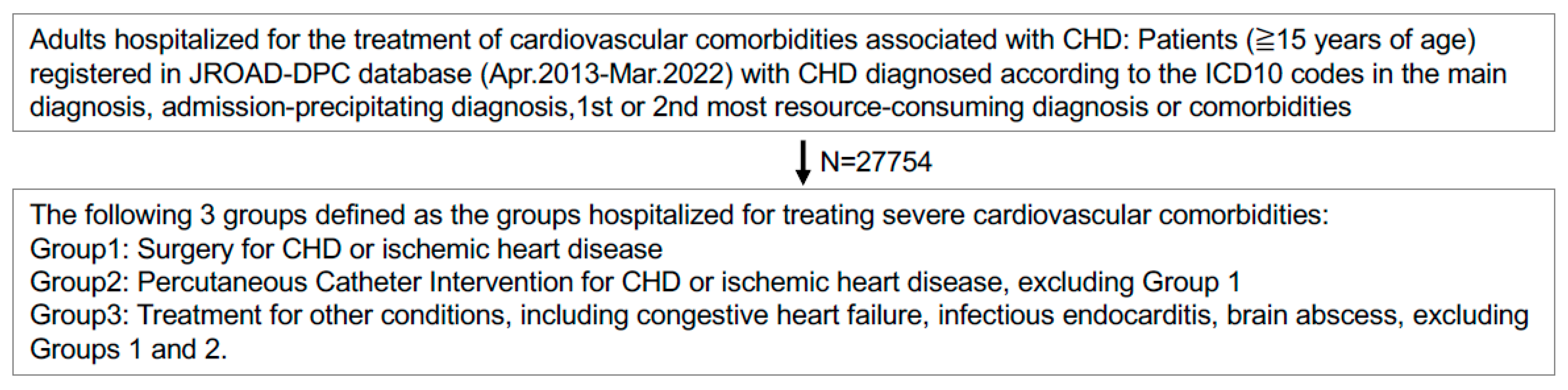
2.2. Study Population
2.3. Classification of Treatment Groups
2.4. The Outcome and Admission Types (Emergency and Non-Referral Admissions)
2.5. Statistical Analysis
2.6. Ethics Approval
3. Results
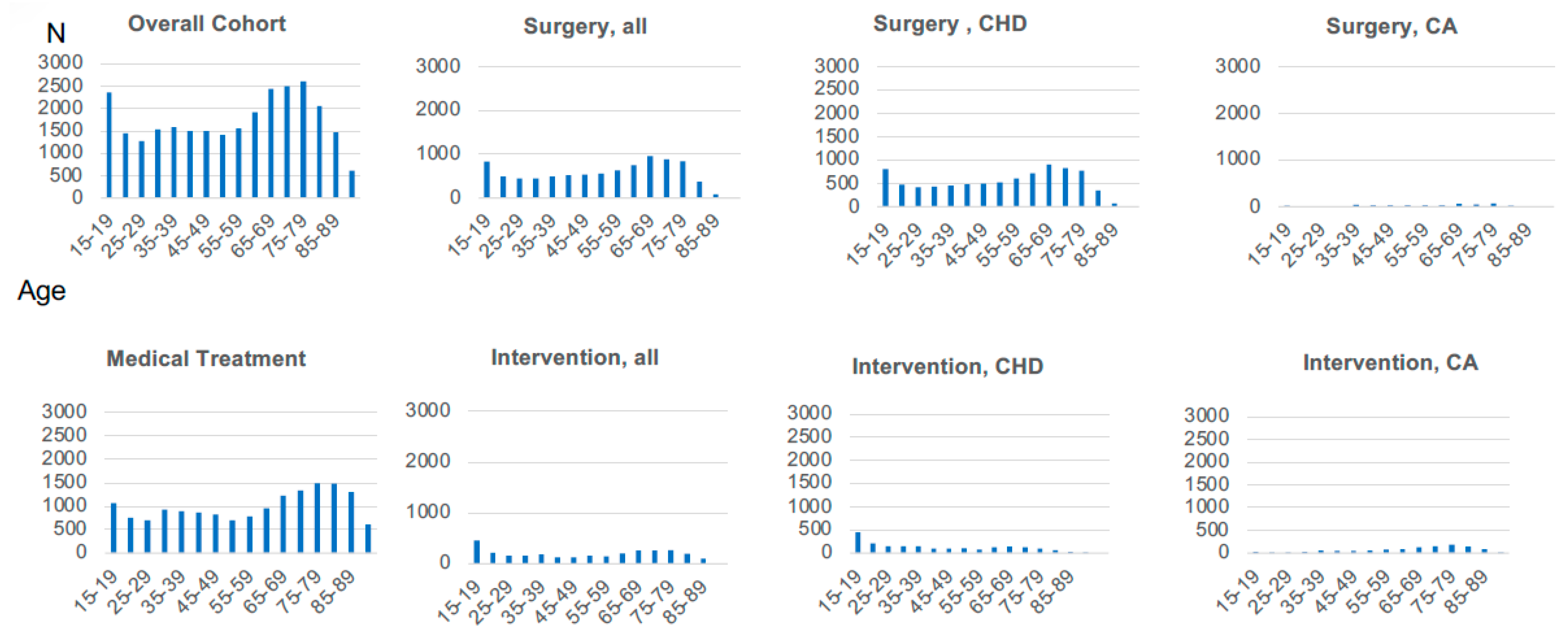
3.1. Patient Characteristics
3.2. Predictors of Mortality and Emergency and Non-Referral Admissions
4. Discussion
4.1. Emergency and Non-Referral Admission as the Risk for In-Hospital Mortality
4.2. Aging ACHD Population and Generational Shift
5. Limitations
6. Implications
7. Conclusions
Supplementary Materials
Author Contributions
Funding
Institutional Review Board Statement
Informed Consent Statement
Data Availability Statement
Acknowledgments
Conflicts of Interest
Correction Statement
Abbreviations
| ACHD | adult congenital heart disease |
| CHD | congenital heart disease |
| JROAD-DPC | Japanese Registry of All Cardiac and Vascular Diseases–Diagnosis Procedure Combination |
| BMI | body mass index |
| DPC | Diagnosis Procedure Combination |
| ICD | International Statistical Classification of Diseases and Related Health Problems |
| ACC | American College of Cardiology |
| AHA | American Heart Association |
| JCS | Japanese Circulation Society |
| JSACHD | Japanese Society for Adult Congenital Heart Disease |
| CABG | coronary artery bypass grafting |
References
- Gurvitz, M.; Krieger, E.V.; Fuller, S.; Davis, L.L.; Kittleson, M.M.; Aboulhosn, J.A.; Bradley, E.A.; Buber, J.; Daniels, C.J.; Dimopoulos, K.; et al. 2025 ACC/AHA/HRS/ISACHD/SCAI Guideline for the Management of Adults with Congenital Heart Disease: A Report of the American College of Cardiology/American Heart Association Joint Committee on Clinical Practice Guidelines. J. Am. Coll. Cardiol. 2025. [Google Scholar] [CrossRef] [PubMed]
- Baumgartner, H.; De Backer, J.; Babu-Narayan, S.V.; Budts, W.; Chessa, M.; Diller, G.P.; Kluin, J.; Lang, I.M.; Meijboom, F.; Moons, P.; et al. 2020 ESC Guidelines for the management of adult congenital heart disease. Eur. Heart J. 2021, 42, 563–645. [Google Scholar] [CrossRef] [PubMed]
- Egidy Assenza, G.; Krieger, E.V.; Baumgartner, H.; Cupido, B.; Dimopoulos, K.; Louis, C.; Lubert, A.M.; Stout, K.K.; Valente, A.M.; Zeppenfeld, K.; et al. AHA/ACC vs ESC Guidelines for Management of Adults With Congenital Heart Disease: JACC Guideline Comparison. J. Am. Coll. Cardiol. 2021, 78, 1904–1918. [Google Scholar] [PubMed]
- Gilboa, S.M.; Devine, O.J.; Kucik, J.E.; Oster, M.E.; Riehle-Colarusso, T.; Nembhard, W.N.; Xu, P.; Correa, A.; Jenkins, K.; Marelli, A.J. Congenital Heart Defects in the United States: Estimating the Magnitude of the Affected Population in 2010. Circulation 2016, 134, 101–109. [Google Scholar] [CrossRef]
- Gurvitz, M.; Dunn, J.E.; Bhatt, A.; Book, W.M.; Glidewell, J.; Hogue, C.; Lin, A.E.; Lui, G.; McGarry, C.; Raskind-Hood, C.; et al. Characteristics of Adults With Congenital Heart Defects in the United States. J. Am. Coll. Cardiol. 2020, 76, 175–182. [Google Scholar] [CrossRef]
- John, A.S.; Jackson, J.L.; Moons, P.; Uzark, K.; Mackie, A.S.; Timmins, S.; Lopez, K.N.; Kovacs, A.H.; Gurvitz, M. Advances in Managing Transition to Adulthood for Adolescents With Congenital Heart Disease: A Practical Approach to Transition Program Design: A Scientific Statement From the American Heart Association. J. Am. Heart Assoc. 2022, 11, e025278. [Google Scholar] [CrossRef]
- Moons, P.; Bratt, E.L.; De Backer, J.; Goossens, E.; Hornung, T.; Tutarel, O.; Zühlke, L.; Araujo, J.J.; Callus, E.; Gabriel, H.; et al. Transition to adulthood and transfer to adult care of adolescents with congenital heart disease: A global consensus statement of the ESC Association of Cardiovascular Nursing and Allied Professions (ACNAP), the ESC Working Group on Adult Congenital Heart Disease (WG ACHD), the Association for European Paediatric and Congenital Cardiology (AEPC), the Pan-African Society of Cardiology (PASCAR), the Asia-Pacific Pediatric Cardiac Society (APPCS), the Inter-American Society of Cardiology (IASC), the Cardiac Society of Australia and New Zealand (CSANZ), the International Society for Adult Congenital Heart Disease (ISACHD), the World Heart Federation (WHF), the European Congenital Heart Disease Organisation (ECHDO), and the Global Alliance for Rheumatic and Congenital Hearts (Global ARCH). Eur. Heart J. 2021, 42, 4213–4223. [Google Scholar]
- Rosenthal, E.; Qureshi, S.A. Adult Congenital Heart Disease: A Specialty With Ever-Expanding Challenges. Circulation 2023, 147, 939–941. [Google Scholar] [CrossRef]
- Warnes, C.A.; Williams, R.G.; Bashore, T.M.; Child, J.S.; Connolly, H.M.; Dearani, J.A.; Del Nido, P.; Fasules, J.W.; Graham, T.P., Jr.; Hijazi, Z.M.; et al. ACC/AHA 2008 Guidelines for the Management of Adults with Congenital Heart Disease: A report of the American College of Cardiology/American Heart Association Task Force on Practice Guidelines (writing committee to develop guidelines on the management of adults with congenital heart disease). Circulation 2008, 118, e714–e833. [Google Scholar]
- Marelli, A.J.; Ionescu-Ittu, R.; Mackie, A.S.; Guo, L.; Dendukuri, N.; Kaouache, M. Lifetime prevalence of congenital heart disease in the general population from 2000 to 2010. Circulation 2014, 130, 749–756. [Google Scholar] [CrossRef]
- Agarwal, A.; Thombley, R.; Broberg, C.S.; Harris, I.S.; Foster, E.; Mahadevan, V.S.; John, A.; Vittinghoff, E.; Marcus, G.M.; Dudley, R.A. Age- and Lesion-Related Comorbidity Burden Among US Adults With Congenital Heart Disease: A Population-Based Study. J. Am. Heart Assoc. 2019, 8, e013450. [Google Scholar] [CrossRef] [PubMed]
- Agasthi, P.; Van Houten, H.K.; Yao, X.; Jain, C.C.; Egbe, A.; Warnes, C.A.; Miranda, W.R.; Dunlay, S.M.; Stephens, E.H.; Johnson, J.N.; et al. Mortality and Morbidity of Heart Failure Hospitalization in Adult Patients With Congenital Heart Disease. J. Am. Heart Assoc. 2023, 12, e030649. [Google Scholar] [CrossRef] [PubMed]
- Su, Z.; Zou, Z.; Hay, S.I.; Liu, Y.; Li, S.; Chen, H.; Naghavi, M.; Zimmerman, M.S.; Martin, G.R.; Wilner, L.B.; et al. Global, regional, and national time trends in mortality for congenital heart disease, 1990-2019: An age-period-cohort analysis for the Global Burden of Disease 2019 study. eClinicalMedicine 2022, 43, 101249. [Google Scholar] [CrossRef] [PubMed]
- Tutarel, O.; Kempny, A.; Alonso-Gonzalez, R.; Jabbour, R.; Li, W.; Uebing, A.; Dimopoulos, K.; Swan, L.; Gatzoulis, M.A.; Diller, G.-P. Congenital heart disease beyond the age of 60: Emergence of a new population with high resource utilization, high morbidity, and high mortality. Eur. Heart J. 2014, 35, 725–732. [Google Scholar] [CrossRef]
- Mandalenakis, Z.; Giang, K.W.; Eriksson, P.; Liden, H.; Synnergren, M.; Wahlander, H.; Fedchenko, M.; Rosengren, A.; Dellborg, M. Survival in Children With Congenital Heart Disease: Have We Reached a Peak at 97%? J. Am. Heart Assoc. 2020, 9, e017704. [Google Scholar] [CrossRef]
- Lopez, K.N.; Morris, S.A.; Sexson Tejtel, S.K.; Espaillat, A.; Salemi, J.L. US Mortality Attributable to Congenital Heart Disease Across the Lifespan From 1999 Through 2017 Exposes Persistent Racial/Ethnic Disparities. Circulation 2020, 142, 1132–1147. [Google Scholar] [CrossRef]
- Cabrera Fernandez, D.L.; Lopez, K.N.; Bravo-Jaimes, K.; Mackie, A.S. The Impact of Social Determinants of Health on Transition From Pediatric to Adult Cardiology Care. Can. J. Cardiol. 2024, 40, 1043–1055. [Google Scholar] [CrossRef]
- Ko, J.M.; Yanek, L.R.; Cedars, A.M. Factors associated with a lower chance of having gaps in care in adult congenital heart disease. Cardiol. Young 2021, 31, 1576–1581. [Google Scholar]
- Diller, G.P.; Orwat, S.; Lammers, A.E.; Radke, R.M.; De-Torres-Alba, F.; Schmidt, R.; Marschall, U.; Bauer, U.M.; Enders, D.; Bronstein, L.; et al. Lack of specialist care is associated with increased morbidity and mortality in adult congenital heart disease: A population-based study. Eur. Heart J. 2021, 42, 4241–4248. [Google Scholar] [CrossRef]
- Ludomirsky, A.B.; Bucholz, E.M.; Newburger, J.W. Association of Financial Hardship Because of Medical Bills With Adverse Outcomes Among Families of Children With Congenital Heart Disease. JAMA Cardiol. 2021, 6, 713–717. [Google Scholar] [CrossRef]
- Bassareo, P.P.; Chessa, M.; Di Salvo, G.; Walsh, K.P.; McMahon, C.J. Strategies to Aid Successful Transition of Adolescents with Congenital Heart Disease: A Systematic Review. Children 2023, 10, 423. [Google Scholar] [CrossRef]
- Greenwell, A.A.; Deng, M.X.; Ross, S.; Weixler, V.; Vervoort, D. Socioeconomic Status and Access to Care for Pediatric and Adult Congenital Heart Disease in Universal Health Coverage Models. J. Cardiovasc. Dev. Dis. 2024, 11, 250. [Google Scholar] [CrossRef] [PubMed]
- Ikegami, N.; Yoo, B.K.; Hashimoto, H.; Matsumoto, M.; Ogata, H.; Babazono, A.; Watanabe, R.; Shibuya, K.; Yang, B.-M.; Reich, M.R.; et al. Japanese universal health coverage: Evolution, achievements, and challenges. Lancet 2011, 378, 1106–1115. [Google Scholar] [CrossRef] [PubMed]
- Disease JSfACH. ACHD Teaching Centers. 2025. Available online: https://www.jsachd.org/specialist/list-facility/ (accessed on 14 January 2026).
- Yasuda, S.; Miyamoto, Y.; Ogawa, H. Current Status of Cardiovascular Medicine in the Aging Society of Japan. Circulation 2018, 138, 965–967. [Google Scholar] [CrossRef] [PubMed]
- Shiina, Y.; Toyoda, T.; Kawasoe, Y.; Tateno, S.; Shirai, T.; Wakisaka, Y.; Matsuo, K.; Mizuno, Y.; Terai, M.; Hamada, H.; et al. Prevalence of adult patients with congenital heart disease in Japan. Int. J. Cardiol. 2011, 146, 13–16. [Google Scholar] [CrossRef]
- Japanese Circulation Society. Guideline for Adult Congenital Heart Disease. 2018. Available online: https://plaza.umin.ac.jp/~jscvs/wordpress/wp-content/uploads/2020/06/JCS2017_ichida_h.pdf (accessed on 23 March 2018).
- Mizuno, A.; Niwa, K.; Ochiai, R.; Shiraishi, I.; Sumita, Y.; Daida, H.; Fukuda, T.; Miyamoto, Y.; Nishimura, K.; Ogawa, H.; et al. Impact of facilities accredited by both adult and pediatric cardiology societies on the outcome of patients with adult congenital heart disease. J. Cardiol. 2020, 75, 105–109. [Google Scholar] [CrossRef]
- Kuraoka, A.; Ishizu, T.; Nakai, M.; Sumita, Y.; Kawamatsu, N.; Machino-Ohtsuka, T.; Masuda, K.; Ieda, M. Trends in Unplanned Admissions of Patients With Adult Congenital Heart Disease Based on the Japanese Registry of All Cardiac and Vascular Diseases-Diagnosis Procedure Combination Study. Circ. J. 2023, 88, 83–89. [Google Scholar] [CrossRef]
- Akiyama, N.; Ochiai, R.; Nitta, M.; Shimizu, S.; Kaneko, M.; Kuraoka, A.; Nakai, M.; Sumita, Y.; Ishizu, T. In-Hospital Death and End-of-Life Status Among Patients With Adult Congenital Heart Disease—A Retrospective Study Using the JROAD-DPC Database in Japan. Circ. J. 2024, 88, 631–639. [Google Scholar]
- Warnes, C.A.; Liberthson, R.; Danielson, G.K.; Dore, A.; Harris, L.; Hoffman, J.I.; Somerville, J.; Williams, R.G.; Webb, G.D. Task force 1: The changing profile of congenital heart disease in adult life. J. Am. Coll. Cardiol. 2001, 37, 1170–1175. [Google Scholar] [CrossRef]
- Konishi, T.; Yoshimoto, T.; Fujiogi, M.; Yamana, H.; Tanabe, M.; Seto, Y.; Yasunaga, H. Validity of operative information in Japanese administrative data: A chart review-based analysis of 1221 cases at a single institution. Surg. Today 2022, 52, 1484–1490. [Google Scholar] [CrossRef]
- Yamana, H.; Moriwaki, M.; Horiguchi, H.; Kodan, M.; Fushimi, K.; Yasunaga, H. Validity of diagnoses, procedures, and laboratory data in Japanese administrative data. J. Epidemiol. 2017, 27, 476–482. [Google Scholar] [CrossRef]
- Nakai, M.; Iwanaga, Y.; Sumita, Y.; Kanaoka, K.; Kawakami, R.; Ishii, M.; Uchida, K.; Nagano, N.; Nakayama, T.; Nishimura, K.; et al. Validation of Acute Myocardial Infarction and Heart Failure Diagnoses in Hospitalized Patients with the Nationwide Claim-Based JROAD-DPC Database. Circ. Rep. 2021, 3, 131–136. [Google Scholar] [CrossRef] [PubMed]
- Tyagi, A.; Sontakke, T. The Transition of Children Living With Congenital Heart Disease to Adult Care. Cureus 2023, 15, e50179. [Google Scholar] [CrossRef] [PubMed]
- Lee, B.R.; Koo, H.Y.; Lee, S. Effects of transition programmes to adulthood for adolescents and young adults with CHD: A systematic review with meta-analysis. Cardiol. Young 2024, 34, 945–958. [Google Scholar] [CrossRef] [PubMed]
- Gurvitz, M.; Burns, K.M.; Brindis, R.; Broberg, C.S.; Daniels, C.J.; Fuller, S.M.; Honein, M.A.; Khairy, P.; Kuehl, K.S.; Landzberg, M.J.; et al. Emerging Research Directions in Adult Congenital Heart Disease: A Report From an NHLBI/ACHA Working Group. J. Am. Coll. Cardiol. 2016, 67, 1956–1964. [Google Scholar] [CrossRef]
- El-Amin, A.; Koehlmoos, T.; Yue, D.; Chen, J.; Benharash, P.; Franzini, L. Does universal insurance influence disparities in high-quality hospital use for inpatient pediatric congenital heart defect care within the first year of diagnosis? BMC Health Serv. Res. 2023, 23, 702. [Google Scholar] [CrossRef]
- Agarwal, S.; Sud, K.; Menon, V. Nationwide Hospitalization Trends in Adult Congenital Heart Disease Across 2003–2012. J. Am. Heart Assoc. 2016, 5, e002330. [Google Scholar] [CrossRef]
- Dellborg, M.; Giang, K.W.; Eriksson, P.; Liden, H.; Fedchenko, M.; Ahnfelt, A.; Rosengren, A.; Mandalenakis, Z. Adults With Congenital Heart Disease: Trends in Event-Free Survival Past Middle Age. Circulation 2023, 147, 930–938. [Google Scholar] [CrossRef]
- Engelfriet, P.; Boersma, E.; Oechslin, E.; Tijssen, J.; Gatzoulis, M.A.; Thilen, U.; Kaemmerer, H.; Moons, P.; Meijboom, F.; Popelová, J.; et al. The spectrum of adult congenital heart disease in Europe: Morbidity and mortality in a 5 year follow-up period: The Euro Heart Survey on adult congenital heart disease. Eur. Heart J. 2005, 26, 2325–2333. [Google Scholar] [CrossRef]
- Moons, P.; Skogby, S.; Bratt, E.L.; Zuhlke, L.; Marelli, A.; Goossens, E. Discontinuity of Cardiac Follow-Up in Young People With Congenital Heart Disease Transitioning to Adulthood: A Systematic Review and Meta-Analysis. J. Am. Heart Assoc. 2021, 10, e019552. [Google Scholar] [CrossRef]
- Tsang, W.; Silversides, C.K.; Rashid, M.; Roche, S.L.; Alonso-Gonzalez, R.; Austin, P.C.; Lee, D.S. Outcomes and healthcare resource utilization in adult congenital heart disease patients with heart failure. ESC Heart Fail. 2021, 8, 4139–4151. [Google Scholar] [CrossRef]
- Nitta, M.; Ochiai, R.; Nakano, S.; Nakashima, R.; Matsumoto, K.; Sugano, T.; Ishigami, T.; Ishikawa, T.; Tamura, K.; Nakano, Y.; et al. Characteristics of patients with adult congenital heart disease treated by non-specialized doctors: The potential loss of follow-up. J. Cardiol. 2021, 77, 17–22. [Google Scholar] [CrossRef]
- Spector, L.G.; Menk, J.S.; Knight, J.H.; McCracken, C.; Thomas, A.S.; Vinocur, J.M.; Oster, M.E.; Louis, J.D.S.; Moller, J.H.; Kochilas, L. Trends in Long-Term Mortality After Congenital Heart Surgery. J. Am. Coll. Cardiol. 2018, 71, 2434–2446. [Google Scholar] [CrossRef]
- Fabbri, M.; Sahu, A. Challenges and opportunities in patients with adult congenital heart disease, a narrative review. Front. Cardiovasc. Med. 2024, 11, 1366572. [Google Scholar] [CrossRef]
- Khan, A.D.; Valente, A.M. Don’t be alarmed: The need for enhanced partnerships between medical communities to improve outcomes for adults living with congenital heart disease. Eur. Heart J. 2021, 42, 4249–4251. [Google Scholar] [CrossRef]
- Khalilipalandi, S.; Lemieux, A.; Lauzon-Schnittka, J.; Perreault, L.; Dubois, M.; Tousignant, A.; Watelle, L.; Pratte, G.; Dallaire, F. Systematic Review and Meta-analysis of Prenatal Risk Factors for Congenital Heart Disease: Part 1, Maternal Chronic Diseases and Parental Exposures. Can. J. Cardiol. 2024, 40, 2476–2495. [Google Scholar] [CrossRef]



| Groups | Overall | Surgery | Surgery | Surgery | Intervention | Intervention | Intervention | Medical Treatment |
|---|---|---|---|---|---|---|---|---|
| All | :CHD | :Coronary | All | :CHD | :Coronary | |||
| N | 27,754 | 8800 | 8343 | 457 | 3060 | 1998 | 1062 | 15,894 |
| Age (median, year) | 59 | 56 | 55 | 60 | 53 | 37 | 70 | 62 |
| (IQR) | 36.0, 74.0 | 34.0, 69.0 | 34.9, 69.0 | 42.0, 72.0 | 27.0, 71.0 | 21.0, 62.0 | 56.0, 78.0 | 38.0, 78.0 |
| Male (%) | 13,635 (49.1) | 4443 (50.5) | 4117 (49.3) | 7326 (1.3) | 1503 (49.1) | 785 (39.3) | 718 (67.6) | 7689 (48.4) |
| Body mass index (median) | 21.6 | 21.9 | 21.8 | 23.5 | 21.8 | 21 | 23.3 | 21.5 |
| (IQR) | 19.2, 24.4 | 19.6, 24.4 | 19.5, 24.3 | 21.4, 26.0 | 19.4, 24.6 | 18.8, 23.8 | 21.0, 25.7 | 18.9, 24.3 |
| Smoking (%) | 6118 (22.0) | 2245 (25.5) | 2975 (24.9) | 170 (37.2) | 630 (20.6) | 213 (10.7) | 417 (39.3) | 4243 (20.4) |
| Treatment | ||||||||
| HF or ARR (%) | 25,569 (92.1) | 8772 (99.7) | 8316 (99.7) | 456 (99.8) | 1275 (41.7) | 555 (27.8) | 720 (67.8) | 15,522 (97.7) |
| Heart Failure (%) | 24,988 (90.0) | 8736 (99.3) | 8282 (99.3) | 454 (99.3) | 835 (27.9) | 293 (14.7) | 560 (52.7) | 15,399 (96.9) |
| Arrhythmia (%) | 17,342 (62.5) | 7922 (90.0) | 7478 (89.6) | 444 (97.2) | 829 (27.1) | 360 (18.0) | 469 (44.2) | 8591 (54.1) |
| PH therapy(%) | 2428 (8.7) | 324 (3.7) | 321 (3.8) | 3 (0.7) | 528 (17.3) | 514 (25.7) | 14 (1.3) | 1576 (9.9) |
| OHCA(%) | 236 (0.9) | 4 (<0.1) | 2 (<1.0) | 2 (0.4) | 12 (0.4) | 0 (0) | 12 (1.1) | 220 (1.4) |
| Infectious endocarditis(%) | 802 (2.9) | 234 (2.7) | 234 (2.8) | 0 (0) | 1 (<0.1) | 1 (0.1) | 0 (0) | 567 (3.6) |
| Brain abscess(%) | 20 (0.1) | 1 (<0.001) | 1 (<1.0) | 0 (0) | 0 (0) | 0(0) | 0 (0) | 19 (0.1) |
| Oral medication at discharge | ||||||||
| Anti-hypertension | 17,290 (62.3) | 7032 (79.9) | 6672 (80.0) | 360 (78.8) | 1242 (40.6) | 696 (34.8) | 546 (51.4) | 9016 (56.7) |
| Anti-diabetes | 1651 (5.9) | 622 (7.1) | 562 (6.7) | 60 (13.1) | 134 (4.4) | 29 (1.5) | 105 (9.9) | 895 (5.6) |
| Anticoagulant | 11,916 (43.0) | 5616 (63.8) | 5373 (65.1) | 187 (40.9) | 703 (23.0) | 510 (25.6) | 193 (18.2) | 5598 (35.2) |
| Warfarin | 8716 (31.4) | 5120 (58.2) | 4970 (59.6) | 150 (32.8) | 387 (12.6) | 302 (15.1) | 85 (8.0) | 3209 (20.2) |
| DOAC/NOAC | 3203 (11.5) | 496 (5.6) | 459 (5.5) | 37 (8.1) | 317 (10.4) | 209 (10.5) | 108 (10.2) | 2390 (15.0) |
| Anti-platelet | 13,079 (47.1) | 5083 (57.8) | 4692 (56.2) | 391 (85.6) | 1732 (56.6) | 859 (43.0) | 873 (82.2) | 6264 (39.4) |
| Aspirin | 7092 (25.6) | 3402 (38.7) | 3040 (36.4) | 362 (79.2) | 1099 (35.9) | 418 (20.9) | 681 (64.1) | 2591 (16.3) |
| Other anti-platelet | 8795 (31.7) | 2763 (31.4) | 2603 (31.2) | 160 (35.0) | 1441 (47.1) | 621 (31.1) | 820 (77.2) | 4591 (28.9) |
| DAPT | 2808 (10.1) | 1082 (12.3) | 951 (11.4) | 131 (28.7) | 808 (26.4) | 180 (9.0) | 628 (59.1) | 918 (5.8) |
| Statin | 3303 (11.9) | 1196 (13.6) | 977 (11.7) | 219 (47.9) | 642 (21.0) | 133 (6.7) | 509 (47.9) | 1465 (9.2) |
| Socioeconomic parameters | ||||||||
| Hospital stay (median days) | 21 | 21 | 21 | 5 | 5 | 5 | 13 | |
| (IQR days) | 7.0, 25.0 | 16.0, 29.0 | 16.0, 29.0 | 16.0, 30.0 | 4.0, 9.0 | 4.0, 7.0 | 3.0, 13.0 | 6.0, 24.0 |
| Hospital charge (USD) | 12,041.30 | 28,360.00 | 28,536.70 | 25,250.70 | 6735.30 | 6082.70 | 8636.70 | 6434.00 |
| Hospital parameters | ||||||||
| CVIT Center (%) | 24,620 (88.7) | 8324 (94.6) | 7891 (94.6) | 433 (94.7) | 2768 (90.5) | 1854 (92.8) | 914 (86.1) | 13,528 (85.1) |
| ACHD Center (%) | 12,168 (43.8) | 4399 (50.0) | 4231 (50.7) | 168 (36.8) | 1592 (52.0) | 1352 (67.7) | 240 (22.6) | 6177 (38.9) |
| Beds (N) | 612 | 642 | 644 | 608 | 612 | 663 | 455 | 581 |
| Mode of hospitalization | ||||||||
| Emergency (%) | 9759 (35.2) | 779 (8.9) | 693 (8.3) | 86 (18.8) | 438 (14.3) | 47 (2.3) | 391 (39.4) | 8542 (53.7) |
| No Referral (%) | 2750 (9.9) | 495 (5.6) | 439 (5.3) | 56 (12.3) | 274 (9.0) | 81 (4.1) | 193 (18.2) | 1981 (12.5) |
| Outcome parameters | ||||||||
| ICU care (%) | 11,213 (40.4) | 7920 (90.0) | 7510 (90.0) | 410 (89.7) | 364 (11.9) | 214 (10.7) | 150 (14.2) | 2929 (18.4) |
| Hospital mortality (%) | 1392 (5.0) | 144 (1.6) | 129 (1.5) | 15 (3.3) | 34 (1.1) | 6 (0.3) | 28 (2.6) | 1214 (7.6) |
| Overall admissions | |||||||||
|---|---|---|---|---|---|---|---|---|---|
| Variables | Univariate | Multivariable model 1 | Multivariable model 2 | ||||||
| OR | 95% CI | p | OR | 95% CI | p | OR | 95% CI | p | |
| Age | 1.024 | 1.021–1.027 | <0.001 | 1.02 | 1.017–1.024 | <0.001 | 1.014 | 1.011–1.017 | <0.001 |
| Male Gender | 0.95 | 0.849–1.063 | 0.371 | 1.086 | 0.969–1.217 | 0.2156 | 1.108 | 0.987–1.243 | 0.083 |
| ACHD center | 0.35 | 0.28–0.438 | <0.001 | 0.54 | 0.439–0.665 | <0.001 | 0.752 | 0.633–0.893 | 0.001 |
| Emergency | 10.31 | 8.863–11.993 | <0.001 | 8.64 | 7.406–10.057 | <0.001 | |||
| B or C | 1.884 | 1.676–2.118 | <0.001 | 1.775 | 1.580–1.994 | <0.001 | 1.488 | 1.324–1.671 | <0.001 |
| No referral | 2.755 | 2.385–3.183 | <0.001 | 2.354 | 2.040–2.717 | <0.001 | |||
| The medical treatment group | |||||||||
| Variables | Univariate | Multivariable model 1 | Multivariable model 2 | ||||||
| OR | 95% CI | p | OR | 95% CI | p | OR | 95% CI | p | |
| Age | 1.023 | 1.020–1.026 | <0.001 | 1.02 | 1.017–1.023 | <0.001 | 1.014 | 1.011–1.017 | <0.001 |
| Male Gender | 0.95 | 0.850–1.063 | 0.374 | 1.09 | 0.973–1.222 | 0.138 | 1.115 | 0.993–1.252 | 0.065 |
| ACHD center | 0.374 | 0.300–0.466 | <0.001 | 0.564 | 0.461–0.691 | <0.001 | 0.755 | 0.636–0.897 | 0.001 |
| Emergency | 9.248 | 7.950–10.755 | <0.001 | 7.685 | 6.595–8.955 | <0.001 | |||
| B or C | 1.983 | 1.764–2.229 | <0.001 | 1.869 | 1.664–2.100 | <0.001 | 1.526 | 1.358–1.715 | <0.001 |
| No referral | 2.689 | 2.329–3.106 | <0.001 | 2.281 | 1.977–2.632 | <0.001 | |||
| Overall admissions | ||||||
|---|---|---|---|---|---|---|
| No referral admission | ||||||
| Variables | Univariate | Multivariable | ||||
| OR | 95% CI | p | OR | 95% CI | p | |
| Age | 1.007 | 1.005–1.009 | <0.001 | 1.006 | 1.004–1.008 | <0.001 |
| Male gender | 0.981 | 0.899–1.071 | 0.671 | 1.022 | 0.936–1.117 | 0.628 |
| ACHD center | 0.252 | 0.181–0.351 | <0.001 | 0.28 | 0.201–0.389 | <0.001 |
| B or C | 1.408 | 1.281–1.547 | <0.001 | 1.411 | 1.284–1.550 | <0.001 |
| Emergency admission | ||||||
| Variables | Univariate | Multivariable | ||||
| OR | 95% CI | p | OR | 95% CI | p | |
| Age | 1.015 | 1.013–1.016 | <0.001 | 1.015 | 1.013–1.017 | <0.001 |
| Male gender | 0.952 | 0.901–1.007 | 0.087 | 1.018 | 0.962–1.078 | 0.53 |
| ACHD center | 0.216 | 0.168–0.277 | <0.001 | 0.279 | 0.220–0.353 | <0.001 |
| B or C | 1.791 | 1.684–1.905 | <0.001 | 1.87 | 1.757–1.990 | <0.001 |
| The medical treatment group | ||||||
| No referral admission | ||||||
| Variables | Univariate | Multivariable | ||||
| OR | 95% CI | p | OR | 95% CI | p | |
| Age | 1.007 | 1.005–1.010 | <0.001 | 1.006 | 1.004–1.009 | <0.001 |
| Male gender | 0.954 | 0.872–1.04 | 0.03 | 0.999 | 0.912–1.094 | 0.98 |
| ACHD center | 0.261 | 0.188–0.362 | <0.001 | 0.29 | 0.209–0.402 | <0.001 |
| B or C | 1.469 | 0.998–0.999 | <0.001 | 1.87 | 1.757–1.990 | <0.001 |
| Emergency admission | ||||||
| Variables | Univariate | Multivariable | ||||
| OR | 95% CI | p | OR | 95% CI | p | |
| Age | 1.015 | 1.013–1.016 | <0.001 | 1.015 | 1.013–1.016 | <0.001 |
| Male gender | 0.935 | 0.883–0.990 | 0.021 | 0.999 | 0.943–1.060 | 0.998 |
| ACHD center | 0.225 | 0.175–0.289 | <0.001 | 0.288 | 0.227–0.365 | <0.001 |
| B or C | 1.963 | 1.884–2.092 | <0.001 | 2.051 | 1.924–2.188 | <0.001 |
Disclaimer/Publisher’s Note: The statements, opinions and data contained in all publications are solely those of the individual author(s) and contributor(s) and not of MDPI and/or the editor(s). MDPI and/or the editor(s) disclaim responsibility for any injury to people or property resulting from any ideas, methods, instructions or products referred to in the content. |
© 2026 by the authors. Licensee MDPI, Basel, Switzerland. This article is an open access article distributed under the terms and conditions of the Creative Commons Attribution (CC BY) license.
Share and Cite
Mitani, Y.; Nakai, M.; Shiraishi, I.; Ohashi, H.; Sawada, H.; Ohuchi, H. Emergency and Non-Referral Admissions as Predictors of Hospital Mortality Among Adults with Congenital Heart Diseases: A Nationwide Claim-Based Registry Study in Japan. Healthcare 2026, 14, 315. https://doi.org/10.3390/healthcare14030315
Mitani Y, Nakai M, Shiraishi I, Ohashi H, Sawada H, Ohuchi H. Emergency and Non-Referral Admissions as Predictors of Hospital Mortality Among Adults with Congenital Heart Diseases: A Nationwide Claim-Based Registry Study in Japan. Healthcare. 2026; 14(3):315. https://doi.org/10.3390/healthcare14030315
Chicago/Turabian StyleMitani, Yoshihide, Michikazu Nakai, Isao Shiraishi, Hiroyuki Ohashi, Hirofumi Sawada, and Hideo Ohuchi. 2026. "Emergency and Non-Referral Admissions as Predictors of Hospital Mortality Among Adults with Congenital Heart Diseases: A Nationwide Claim-Based Registry Study in Japan" Healthcare 14, no. 3: 315. https://doi.org/10.3390/healthcare14030315
APA StyleMitani, Y., Nakai, M., Shiraishi, I., Ohashi, H., Sawada, H., & Ohuchi, H. (2026). Emergency and Non-Referral Admissions as Predictors of Hospital Mortality Among Adults with Congenital Heart Diseases: A Nationwide Claim-Based Registry Study in Japan. Healthcare, 14(3), 315. https://doi.org/10.3390/healthcare14030315