
Manual Dexterity Training and Cognitive Function in Adults with Stroke: A Scoping Review
 , , , , and
Abstract
1. Introduction
2. Materials and Methods
2.1. Search Strategy
2.2. Eligibility Criteria
- Studies published in English or Spanish.
- Studies with full text available.
- Experimental study designs, including randomized controlled trials, non-randomized controlled trials, pilot and exploratory experimental studies.
- Studies involving adults aged 18 years or older with any type of ABI.
- Studies aimed at improving UL motor skills or MD.
- Studies addressing cognitive processes, either directly or indirectly.
- Studies published in other languages.
- Studies whose intervention was not focused on MD.
- Studies with the following designs: abstracts, editorials, letters to the editor, opinions, reviews, brief reports, conference papers, books, book chapters, scale validation studies, qualitative studies, case reports, animal studies, case series studies, observational studies, and protocols.
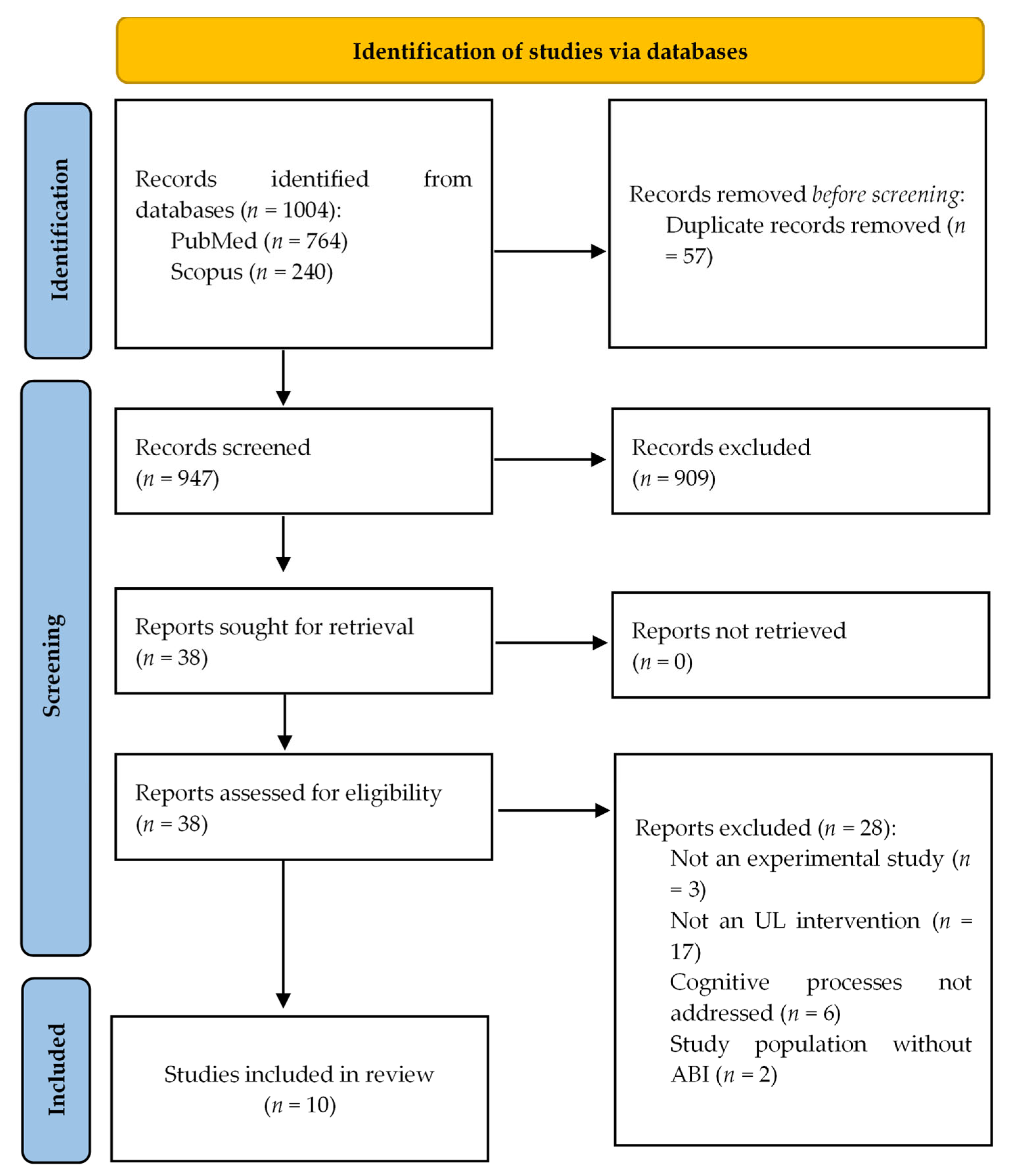
2.3. Study Selection
2.4. Data Extraction and Synthesis
2.5. Quality Assessment
3. Results
3.1. Main Characteristics of the Included Studies
3.2. Study Population in the Included Studies
3.3. Main Intervention Characteristics of the Included Studies
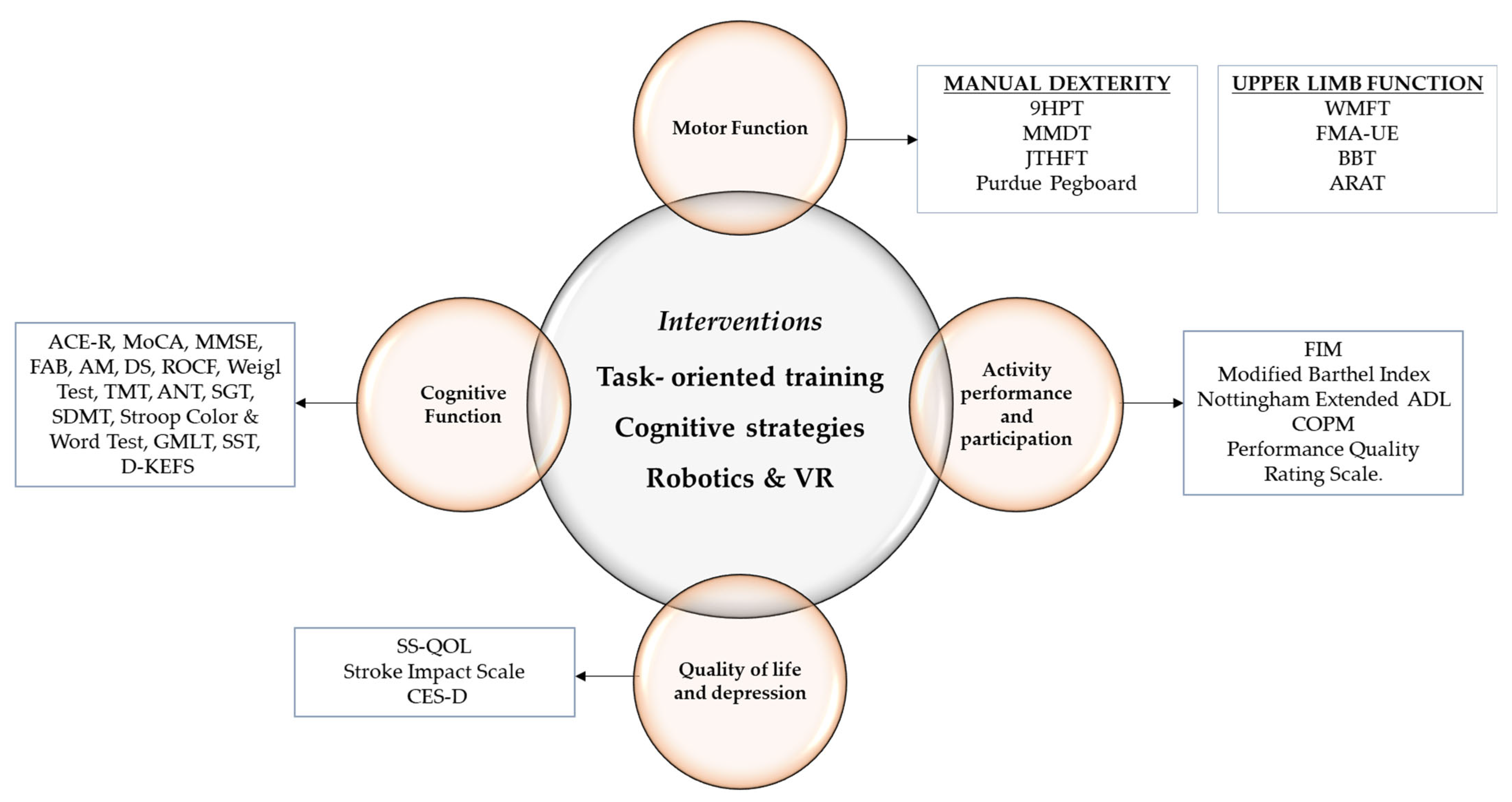
3.4. Variables of Study and Measurement Instruments
3.4.1. Motor and Sensorimotor Function
3.4.2. Cognitive Function
3.4.3. Functional Performance and Daily Living
3.4.4. Quality of Life and Psychological Variables
3.5. Occupational Therapy Interventions
3.5.1. Boxing
3.5.2. Motor Imagery Training with Brain–Computer Interface (MI-BCI)
3.5.3. Dual-Task Training
3.5.4. Cognitive Orientation to Daily Occupational Performance (CO-OP)
3.5.5. Robotics and VR
4. Discussion
4.1. Clinical Implications for Occupational Therapy
4.2. Limitations
5. Conclusions
Supplementary Materials
Author Contributions
Funding
Institutional Review Board Statement
Informed Consent Statement
Data Availability Statement
Conflicts of Interest
References
- Fernández-Sánchez, M.; Aza-Hernández, A.; Verdugo-Alonso, M.A. Models of public care for the population with acquired brain injury in Spain: A study of the situation by Spanish autonomous communities. Rev. Neurol. 2022, 74, 245–257. [Google Scholar] [CrossRef]
- Ríos-Lago, M. Daño cerebral adquirido: La necesidad de un trabajo multidisciplinar. Acción Psicol. 2012, 4, 5–7. Available online: https://revistas.uned.es/index.php/accionpsicologica/article/view/468 (accessed on 11 June 2025). [CrossRef]
- Cortés, A.S.; Muñoz Marrón, E.; Noreña Martínez, D. Neuropsicología Del Daño Cerebral Adquirido: Traumatismos Craneoencefálicos, Accidentes Cerebrovasculares y Tumores Del Sistema Nervioso Central; Editorial UC: Barcelona, Spain, 2017. [Google Scholar]
- Pérez-Cruzado, D.; Merchán-Baeza, J.A.; González-Sánchez, M.; Cuesta-Vargas, A.I. Systematic review of mirror therapy compared with conventional rehabilitation in upper extremity function in stroke survivors. Aust. Occup. Ther. J. 2017, 64, 91–112. [Google Scholar] [CrossRef]
- Zhang, L.; Lu, H.; Yang, C. Global, regional, and national burden of stroke from 1990 to 2019: A temporal trend analysis based on the Global Burden of Disease Study 2019. Int. J. Stroke 2024, 19, 686–694. [Google Scholar] [CrossRef]
- Instituto Nacional de Estadística. Enfermedades Crónicas Diagnosticadas Por Sexo y Edad. Población De 6 y Más Años Con Discapacidad [Internet]; INE: Madrid, Spain; Available online: https://www.ine.es/jaxi/Tabla.htm?tpx=51641 (accessed on 13 April 2025).
- Neuron Rehabilitación. Ictus: Síntomas y Tratamientos [Internet]. Available online: https://neuronrehab.es/que-tratamos/dano-cerebral-adquirido/ictus-tratamiento/ (accessed on 13 April 2025).
- Plummer, P.; Eskes, G.; Wallace, S.; Giuffrida, C.; Fraas, M.; Campbell, G.; Clifton, K.-L.; Skidmore, E.R. Cognitive-motor interference during functional mobility after stroke: State of the science and implications for future research. Arch. Phys. Med. Rehabil. 2013, 94, 2565–2574.e6. [Google Scholar] [CrossRef]
- Lindberg, P.G.; AmirShemiraniha, N.; Krewer, C.; Maier, M.A.; Hermsdörfer, J. Increased dual-task interference during upper limb movements in stroke exceeding that found in aging: A systematic review and meta-analysis. Front. Neurol. 2024, 15, 1375152. [Google Scholar] [CrossRef] [PubMed]
- Kwakkel, G.; Kollen, B.J.; van der Grond, J.; Prevo, A.J. Probability of regaining dexterity in the flaccid upper limb: Impact of severity of paresis and time since onset in acute stroke. Stroke 2003, 34, 2181–2186. [Google Scholar] [CrossRef] [PubMed]
- Langhorne, P.; Bernhardt, J.; Kwakkel, G. Stroke rehabilitation. Lancet 2011, 377, 1693–1702. [Google Scholar] [CrossRef]
- Pennati, G.V.; Plantin, J.; Carment, L.; Roca, P.; Baron, J.C.; Pavlova, E.; Borg, J.; Lindberg, P.G. Recovery and prediction of dynamic precision grip force control after stroke. Stroke 2020, 51, 944–951. [Google Scholar] [CrossRef]
- Santisteban, L.; Térémetz, M.; Bleton, J.P.; Baron, J.C.; Maier, M.A.; Lindberg, P.G. Upper limb outcome measures used in stroke rehabilitation studies: A systematic literature review. PLoS ONE 2016, 11, e0154792. [Google Scholar] [CrossRef] [PubMed]
- Constantinovici, M.I.; Poenaru, D.; Nartea, R.; Cinteza, D. Low-tech and high-tech assistive tools for occupational therapy and hand rehabilitation in patients with upper-extremity sensorimotor impairment and disability. J. Altern. Complement. Integr. Med. 2025, 11, 543. [Google Scholar]
- Flint Rehab. Occupational Therapy and Brain Injury: Goals and Benefits. Available online: https://www.flintrehab.com/occupational-therapy-and-brain-injury/ (accessed on 13 April 2025).
- de Paz Orozco, W.A. Neurociencias: La conectividad cerebral. Rev. Acad. Soc. Conoc. Cunzac. 2022, 2, 167–175. [Google Scholar] [CrossRef]
- Sierra Benítez, E.M.; León Pérez, M.Q. Brain plasticity: A neuronal reality. Rev. Cienc. Méd. Pinar Río 2019, 23, 599–609. [Google Scholar]
- Shapiro, L.; Spaulding, S. Embodied cognition. In The Stanford Encyclopedia of Philosophy [Internet], Summer 2025 ed.; Zalta, E.N., Nodelman, U., Eds.; Available online: https://plato.stanford.edu/archives/sum2025/entries/embodied-cognition/ (accessed on 16 June 2025).
- Mou, C.; Jiang, Y. Effect of dual task-based training on motor and cognitive function in stroke patients: A systematic review and meta-analysis of randomized controlled trials. BMC Neurol. 2025, 25, 290. [Google Scholar] [CrossRef]
- Seavey, C.V.; Walters, B.H. Motor dual-task deficits and their associations with executive function in older adults with cognitive impairments. J. Mot. Behav. 2025, 57, 502–518. [Google Scholar] [CrossRef] [PubMed]
- Silva, M.B.B.D.; Silva, E.C.F.D.; Bispo, M.E.F.D.S.; Nogueira, T.S.; Leal, J.C.; Mendes, F.A.D.S. Association between cognitive performance and manual dexterity in patients with Parkinson’s disease. Physiother. Res. Int. 2024, 29, e2126. [Google Scholar] [CrossRef] [PubMed]
- Vasylenko, O.; Gorecka, M.M.; Rodríguez-Aranda, C. Manual dexterity in young and healthy older adults: Association with cognitive abilities. Dev. Psychobiol. 2018, 60, 428–439. [Google Scholar] [CrossRef]
- Higgins, J.P.T.; Thomas, J.; Chandler, J.; Cumpston, M.; Li, T.; Page, M.J.; Welch, V.A. (Eds.) Cochrane Handbook for Systematic Reviews of Interventions, Version 6.4; Cochrane: London, UK, 2023. [Google Scholar]
- Tricco, A.C.; Lillie, E.; Zarin, W.; O’Brien, K.K.; Colquhoun, H.; Levac, D.; Moher, D.; Peters, M.D.J.; Horsley, T.; Weeks, L.; et al. PRISMA extension for scoping reviews (PRISMA-ScR): Checklist and explanation. Ann. Intern. Med. 2018, 169, 467–473. [Google Scholar] [CrossRef]
- Gough, D.; Thomas, J.; Oliver, S. Clarifying differences between review designs and methods. Syst. Rev. 2012, 1, 28. [Google Scholar] [CrossRef]
- Munn, Z.; Peters, M.D.J.; Stern, C.; Tufanaru, C.; McArthur, A.; Aromataris, E. Systematic review or scoping review? Guidance for authors when choosing between a systematic or scoping review approach. BMC Med. Res. Methodol. 2018, 18, 143. [Google Scholar] [CrossRef]
- Arksey, H.; O’Malley, L. Scoping studies: Towards a methodological framework. Int. J. Soc. Res. Methodol. 2005, 8, 19–32. [Google Scholar] [CrossRef]
- Peters, M.D.J.; Marnie, C.; Tricco, A.C.; Pollock, D.; Munn, Z.; Alexander, L.; McInerney, P.; Godfrey, C.M.; Khalil, H. Updated methodological guidance for the conduct of scoping reviews. JBI Evid. Synth. 2020, 18, 2119–2126. [Google Scholar] [CrossRef]
- Levac, D.; Colquhoun, H.; O’Brien, K.K. Scoping studies: Advancing the methodology. Implement. Sci. 2010, 5, 69. [Google Scholar] [CrossRef] [PubMed]
- Santini, A. The importance of referencing. J. Crit. Care Med. 2018, 4, 3–4. [Google Scholar] [CrossRef]
- Rogers, J.M.; Duckworth, J.; Middleton, S.; Steenbergen, B.; Wilson, P.H. Elements virtual rehabilitation improves motor, cognitive, and functional outcomes in adult stroke: A randomized controlled pilot study. J. Neuroeng. Rehabil. 2019, 16, 56. [Google Scholar] [CrossRef] [PubMed]
- Ersoy, C.; Iyigun, G. Boxing training in patients with stroke: Improvement of upper extremity, balance, and cognitive functions. Top. Stroke Rehabil. 2021, 28, 112–126. [Google Scholar] [CrossRef]
- Oh, Y.B.; Kim, G.W.; Han, K.S.; Won, Y.H.; Park, S.H.; Seo, J.H.; Ko, M.-H. Efficacy of virtual reality combined with real instrument training for patients with stroke: A randomized controlled trial. Arch. Phys. Med. Rehabil. 2019, 100, 1400–1408. [Google Scholar]
- Taravati, S.; Capaci, K.; Uzumcugil, H.; Tanigor, G. Evaluation of an upper limb robotic rehabilitation program on motor functions, quality of life, cognition, and emotional status in patients with stroke. Neurol. Sci. 2022, 43, 1177–1188. [Google Scholar] [CrossRef] [PubMed]
- Lee, H.S.; Lim, J.H.; Jeon, B.H.; Song, C.S. Non-immersive virtual reality rehabilitation applied to a task-oriented approach for stroke patients. Restor. Neurol. Neurosci. 2020, 38, 165–172. [Google Scholar]
- Liu, X.; Zhang, W.; Li, W.; Zhang, S.; Lv, P.; Yin, Y. Effects of motor imagery-based brain-computer interface on upper limb function and attention in stroke patients with hemiplegia. BMC Neurol. 2023, 23, 136. [Google Scholar]
- Wilson, P.H.; Rogers, J.M.; Vogel, K.; Steenbergen, B.; McGuckian, T.B.; Duckworth, J. Home-based virtual rehabilitation improves motor and cognitive function for stroke patients. J. Neuroeng. Rehabil. 2021, 18, 165. [Google Scholar]
- Torrisi, M.; Maggio, M.G.; De Cola, M.C.; Zichittella, C.; Porcari, B.; la Rosa, G.; De Luca, R.; Naro, A.; Calabrò, R.S. Beyond motor recovery after stroke: Role of hand robotic rehabilitation plus virtual reality in improving cognitive function. J. Clin. Neurosci. 2021, 92, 11–16. [Google Scholar] [CrossRef] [PubMed]
- Wolf, T.J.; Polatajko, H.; Baum, C.; Rios, J.; Cirone, D.; Doherty, M.; McEwen, S. Combined cognitive-strategy and task-specific training affects cognition and upper-extremity function in subacute stroke. Am. J. Occup. Ther. 2016, 70, 7002290010p1–7002290010p10. [Google Scholar]
- Park, M.O.; Lee, S.H. Effect of a dual-task program with different cognitive tasks applied to stroke patients. NeuroRehabilitation 2019, 44, 239–249. [Google Scholar] [CrossRef]
- Gómez González, J.R. Efectos del entrenamiento de destreza manual en procesos cognitivos mediante realidad virtual en trastornos del desarrollo de la coordinación. Rev. Neurorrehabil. 2023, 15, 45–60. [Google Scholar]
- Bernate, J.; Rojas, L.; Mendoza, J. Influence of basic physical skills on the cognitive process: A systematic review. Retos 2024, 54, 84–93. [Google Scholar] [CrossRef]
- Chen, X.; Liu, F.; Lin, S.; Yu, L.; Lin, R. Effects of virtual reality rehabilitation training on cognitive function and activities of daily living of patients with poststroke cognitive impairment. Arch. Phys. Med. Rehabil. 2022, 103, 1422–1435. [Google Scholar] [CrossRef]
- Landim, S.F.; López, R.; Caris, A.; Castro, C.; Castillo, R.D.; Avello, D.; Branco, B.H.M.; Valdés-Badilla, P.; Carmine, F.; Sandoval, C.; et al. Effectiveness of virtual reality in occupational therapy for post-stroke adults. J. Clin. Med. 2024, 13, 4615. [Google Scholar] [CrossRef]
- Villa-Berges, E.; Laborda Soriano, A.A.; Lucha-López, O.; Tricas-Moreno, J.M.; Hernández-Secorún, M.; Hidalgo-García, C. Motor imagery and mental practice in upper limb rehabilitation after stroke. Occup. Ther. Int. 2023, 2023, 3752889. [Google Scholar] [CrossRef]
- Gargon, E.; Williamson, P.R.; Clarke, M. Collating the knowledge base for core outcome set development. BMC Med. Res. Methodol. 2015, 15, 26. [Google Scholar] [CrossRef]
- Colamarino, E.; Morone, G.; Toppi, J.; Riccio, A.; Cincotti, F.; Mattia, D.; Pichiorri, F. Technology-based approaches for upper limb motor rehabilitation after stroke. J. Clin. Med. 2024, 13, 5414. [Google Scholar] [CrossRef] [PubMed]



| Database | Search Strategy | Results |
|---|---|---|
| PubMed | ||
| #1 (P) | “stroke” [Title/Abstract] OR “brain injury” [Title/Abstract] | 452,060 |
| #2 (I) | “upper limb” [Title/Abstract] OR “manual training” [Title/Abstract] OR “hand function” [Title/Abstract] OR “manual dexterity” [Title/Abstract] OR “fine motor skills” [Title/Abstract] OR “rehabilitation” [Title/Abstract] | 285,929 |
| #3 (C) | NA | |
| #4 (O) | “cognitive function” [Title/Abstract] OR “executive function” [Title/Abstract] OR “cognition” [Title/Abstract] OR “cognitive” [Title/Abstract] OR “memory” [Title/Abstract] | 885,155 |
| #1 AND #2 AND #4 | 7159 | |
| #1 AND #2 AND #4 filters: in the last 10 years, Clinical Study | 764 | |
| Scopus | ||
| #1 (P) | TITLE (stroke OR “brain injury”) | 799,568 |
| #2 (I) | TITLE (“upper limb” OR “manual training” OR “hand function” OR “manual dexterity” OR “fine motor skills” OR rehabilitation) | 577,844 |
| #3 (C) | NA | |
| #4 (O) | TITLE (“cognitive function” OR “executive function” OR “cognition” OR “cognitive” OR “memory”) | 2,496,911 |
| #1 AND #2 AND #4 | 738 | |
| #1 AND #2 AND #4 Filters: in the last 10 years, article and subject area | 240 |
| Autor, Year | Design | Sample (n), Country | Intervention/ Comparator | Duration Intervention | Study Outcomes |
|---|---|---|---|---|---|
| Wolf et al., 2016 [39] | Exploratory RCT | 26, EEUU | CO-OP + task-oriented practice/Task-oriented practice alone | 10 sessions | The CO-OP + task group showed greater improvements in cognitive function and UL performance. |
| Oh et al., 2019 [33] | RCT | 31, Republic of Korea | Training with real instruments and VR/Conventional OT | 30 min/day, 3 days/week, for 6 weeks | EG: showed greater improvements in MMT (shoulder extension), MAS (wrist extension), BBT, 9HPT, and increased pinch strength. EG and CG: showed improvements in MMT (finger extension), FMA-UE, MoCA, and MMSE. Results were maintained for at least 4 weeks after training. |
| Park et al., 2019 [40] | RCT | 30, Republic of Korea | Dual-task training/Conventional OT | 6 weeks, 3 sessions/week, total 18 sessions (30 min each per participant) | The dual-task program had a more positive effect than conventional OT on auditory attention, working memory, executive function, and balance. |
| Rogers et al., 2019 [31] | Pilot | 21, Australian | Elements VR system/Conventional OT | 4 weeks, 3 sessions/week, 30–40 min per session | Both groups showed improvements in cognitive, functional, and motor outcomes; however, the effects were more pronounced in the EG, particularly in hand motor function (BBT) and cognitive performance. These improvements were maintained at least until the one-month follow-up assessment. |
| Hye-Sun et al., 2020 [35] | RCT | 36, Republic of Korea | Non-immersive VR training with the RAPAEL glove/recreational activity plus conventional OT | 30 min/session, 3 days/week, for 8 weeks | Training with a smart glove + non-immersive VR has reasonable and beneficial effects on UL function and cognitive function in chronic stroke survivors. |
| Ersoy et al., 2021 [32] | RCT | 40, Turkey | Real Boxing/Virtual Boxing | 24 sessions/3 per week for 8 weeks | Improvements in UL function, balance, and cognitive performance; no significant differences between virtual and real environments. EG: improvement in memory and verbal fluency. CG: improvement in verbal fluency, language, and visuospatial skills. |
| Torrisi et al., 2021 [38] | RCT | 48, Italy | Robotic hand training (Amadeo™) + VR/UL/hand-focused OT without the robotic device + VR | 40 sessions/1 h each | EG > greater improvements than CG on the ROCF, MoCA, AM, FAB, and FMA-UE scales. Improvements in working memory, abstract reasoning, and UL motor aspects. |
| Wilson et al., 2021 [37] | RCT | 17, Australian | Virtual home rehabilitation (EDNA 22) plus Conventional rehabilitation/Graded Repetitive Arm Supplementary Program (GRASP) arm training | 8 weeks, 30 min per session, 3–4 sessions per week | The EDNA-22 virtual home rehabilitation system demonstrated greater improvements in affected-hand function and moderate improvements in the unaffected hand (BBT/9HPT), as well as moderate gains in cognition (MoCA) and participation/daily living function (SIS/NFI). Improvements were maintained at the 3-month follow-up. |
| Taravati et al., 2022 [34] | RCT | 37, Turkey | Robotic rehabilitation/Conventional OT | 30–45-min sessions, 5 days per week, for 4 weeks | Both groups improved in motor function, spasticity reduction, functional independence, quality of life, ADLs, and cognition after 4 weeks. A statistically significant difference between the robotic group and the control group was observed only on the CES-D scale (emotional status/depression) (p < 0.05), with the robotic rehabilitation group showing better outcomes. |
| Liu et al., 2023 [36] | RCT | 60, China | MI-BCI training plus conventional rehabilitation/conventional Rehabilitation | 3-week intervention, 5 sessions per week, 20 min per MI-BCI session | MI-BCI intervention combined with conventional rehabilitation significantly improved both UL function and attention. |
Disclaimer/Publisher’s Note: The statements, opinions and data contained in all publications are solely those of the individual author(s) and contributor(s) and not of MDPI and/or the editor(s). MDPI and/or the editor(s) disclaim responsibility for any injury to people or property resulting from any ideas, methods, instructions or products referred to in the content. |
© 2026 by the authors. Licensee MDPI, Basel, Switzerland. This article is an open access article distributed under the terms and conditions of the Creative Commons Attribution (CC BY) license.
Share and Cite
Moreno-Morente, G.; Company-Devesa, V.; Espinosa-Sempere, C.; Peral-Gómez, P.; Carrión-Téllez, V.; Compañ-Gabucio, L.-M. Manual Dexterity Training and Cognitive Function in Adults with Stroke: A Scoping Review. Healthcare 2026, 14, 234. https://doi.org/10.3390/healthcare14020234
Moreno-Morente G, Company-Devesa V, Espinosa-Sempere C, Peral-Gómez P, Carrión-Téllez V, Compañ-Gabucio L-M. Manual Dexterity Training and Cognitive Function in Adults with Stroke: A Scoping Review. Healthcare. 2026; 14(2):234. https://doi.org/10.3390/healthcare14020234
Chicago/Turabian StyleMoreno-Morente, Gema, Verónica Company-Devesa, Cristina Espinosa-Sempere, Paula Peral-Gómez, Vanesa Carrión-Téllez, and Laura-María Compañ-Gabucio. 2026. "Manual Dexterity Training and Cognitive Function in Adults with Stroke: A Scoping Review" Healthcare 14, no. 2: 234. https://doi.org/10.3390/healthcare14020234
APA StyleMoreno-Morente, G., Company-Devesa, V., Espinosa-Sempere, C., Peral-Gómez, P., Carrión-Téllez, V., & Compañ-Gabucio, L.-M. (2026). Manual Dexterity Training and Cognitive Function in Adults with Stroke: A Scoping Review. Healthcare, 14(2), 234. https://doi.org/10.3390/healthcare14020234