
Perceptions of Individuals/Patients with Temporomandibular Disorders About Their Diagnosis, Information Seeking and Treatment Expectations: A Comparative Qualitative Study of Brazilian and Spanish Individuals

 , , , , , , , ,
  and
and 
Abstract
1. Introduction
2. Materials and Methods
2.1. Design
2.2. Ethics
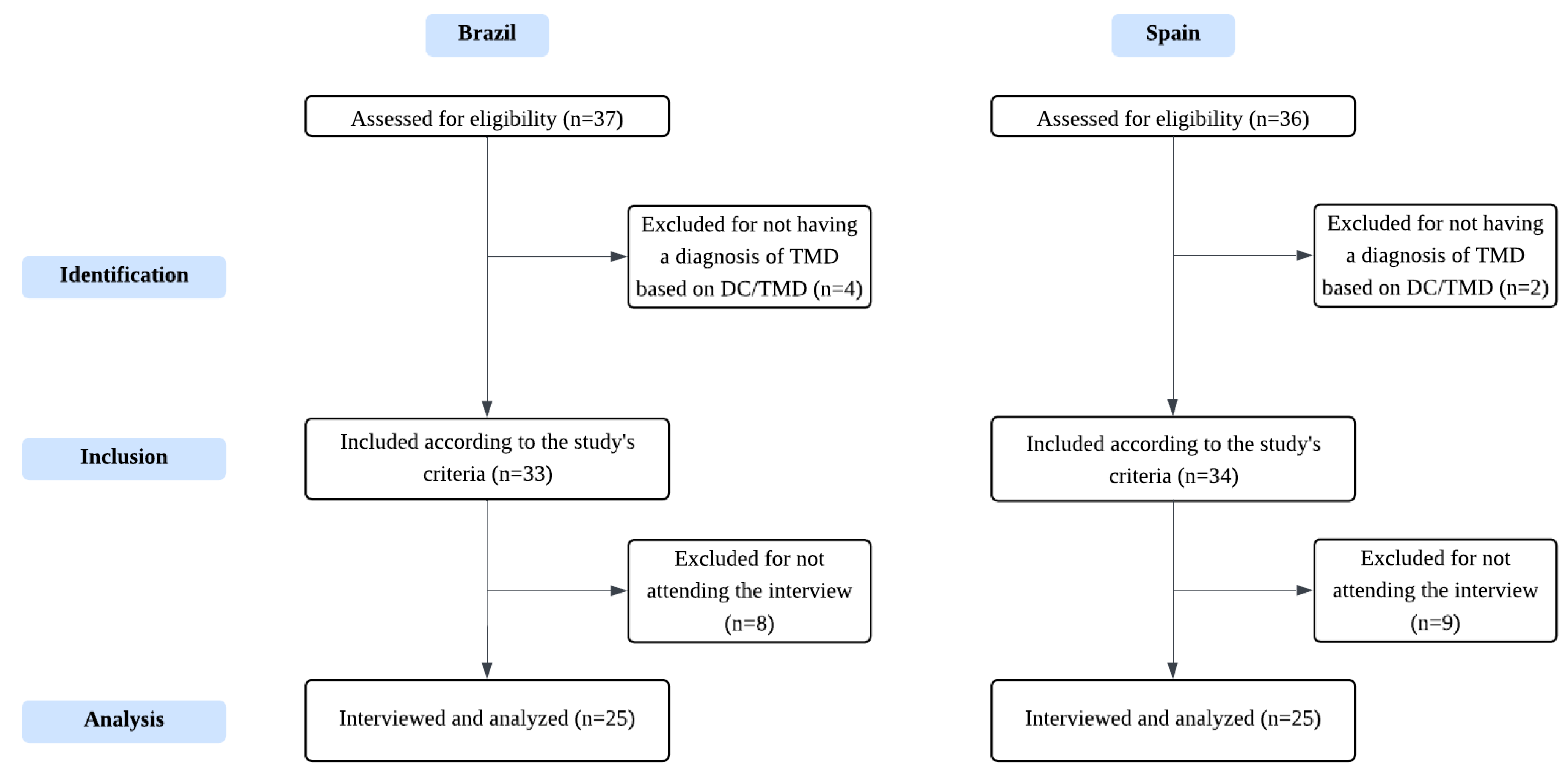
2.3. Participants
2.4. Researcher’s Backgrounds
2.5. Data Collection
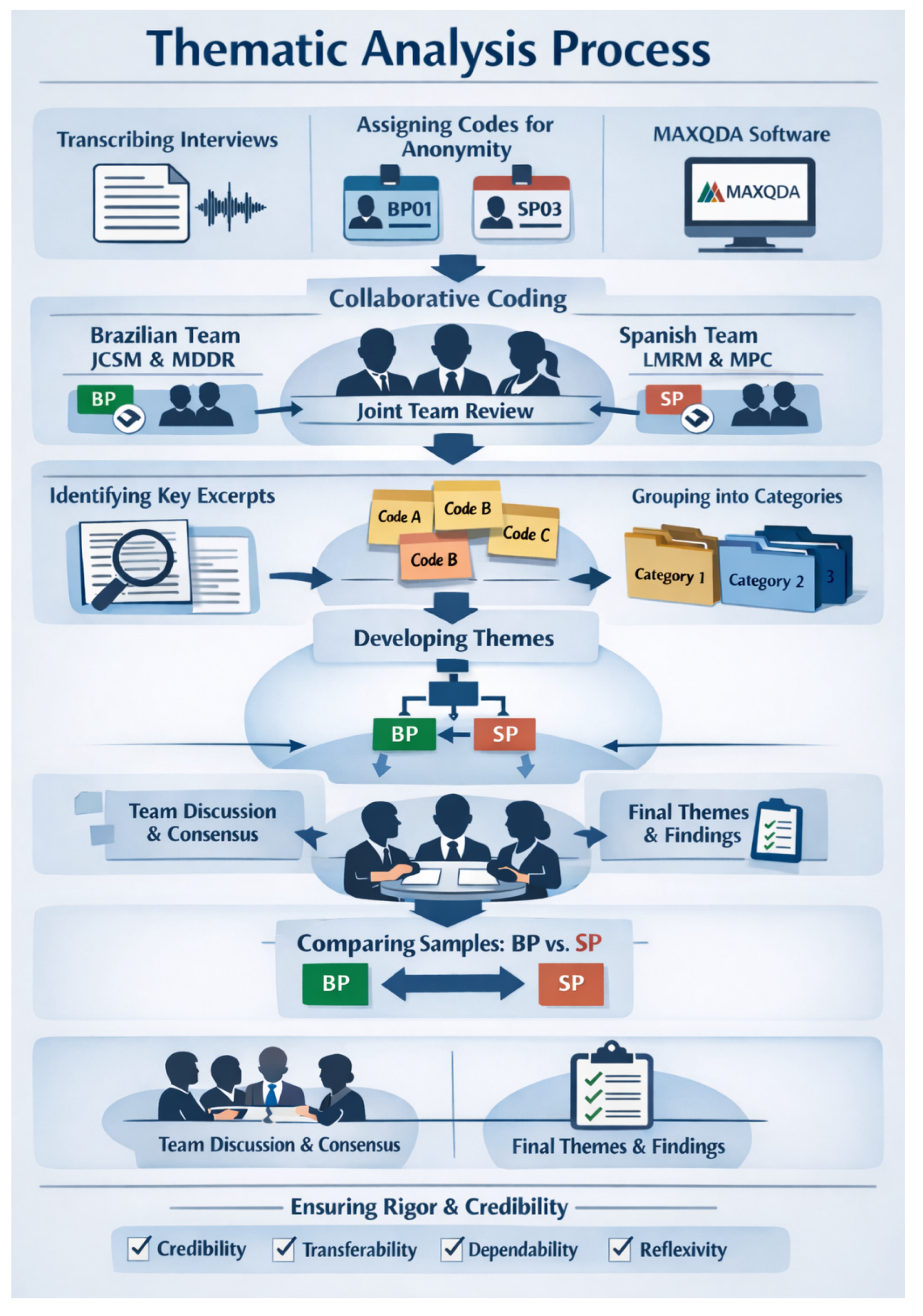
2.6. Data Analysis
3. Results
3.1. The Search for Diagnosis and Specialized Care
“I went to see a friend of mine who is a dentist, and she told me that I was losing teeth, right? And that it could be bruxism.” BP05
“So I went to the doctor, the general practitioner, and he told me that what I had was bruxism.” SP36
“I don’t remember exactly why I went to look for it, but I remember that I was in a lot of pain and that I felt more cracking at that moment.” BP02
“Because it’s true that it was really uncomfortable for me, so I went to the doctor.” SP08
“And maybe I wouldn’t have this bruxism that I have now. If I had been diagnosed correctly from the beginning.” SP23
“I would be glad to have it (the diagnosis) so that I can take action as soon as possible.” SP19
“I don’t know if I should go to the doctor, I don’t know if I should… I don’t know exactly which professional to go to. Whether it’s the doctor, the dentist, the physical therapist, I don’t know.” BP04
“I’ve had it very easy because my primary care physician is actually a very diligent person.” SP31
“At first, I went to the physical therapist because the pain was, well, although it was uncomfortable, it was tolerable.” SP28
3.2. Sources of Information About the Disease
“It was the times I sought help, like dentists, doctors, and then I read about (uhum) I read about and… I think that by talking like this, you discover that many people have discomfort.” BP09
“Well, it has always been through doctors or dentists.” SP35
“There are so many things on the internet that you must take with a grain of salt. So, well, you read a lot of things. Some you believe, others you don’t. Well… Useful… Well, just information, no, you can’t believe it 100%.” SP29
“I looked online, but above all, I looked for people who could help me. That means physical therapists and even speech therapists.” SP32
3.3. Perceptions and Beliefs About the Causes of TMD and the Influence of Emotions on Symptoms
“There is a very important factor in my life that was very significant, and that is my concern about leaving elementary school, where I didn’t have so many responsibilities and so much…” BP15
“It started when I began my master’s degree.” SP28
“When the clenching is more intense, it intensifies the headache and intensifies the pain in the face itself, and the clenching is like this every day.” BP21
“It must be that he had been clenching his jaw or whatever for years.” SP18
“About 22 years ago, more or less, we were at the amusement park, and I wanted to eat that, and that’s when I got dislocated.” SP02
“And the truth is that since then (orthodontic treatment), I have been in much more pain, and my quality of life has worsened.” SP23
“When I’m overwhelmed with college too, when I have a lot of assignments to hand in and a lot of things to do, I also feel a lot more pain, both in my face and in my head.” BP28
“So, if I’m more stressed or angry, will I clench my teeth more, and will that aggravate the joint even more?” SP20
3.4. Previous Experiences and Expectations of Good Treatment
“I was in my hometown and couldn’t find a physical therapist. I wanted to see one, but there was no one available, and I couldn’t find anyone to contact. So, in reality, I never received treatment, no, I never did.” BP19
“Good treatment… I think the professional should sit down and explain what is happening, why I am doing that.” BP01
“For me, a good diagnosis that identifies the exact cause of why.” SP33
“Then whoever listens to you, whoever notices that we’ve already done this, that you’re doing this, that you’re doing that… Then whoever pays attention to you.” SP02
“And that there should also be a protocol in place so that we can act relatively quickly, that is, define what is happening, take action, and refer cases as needed, without it taking too long.” SP32
3.5. Physical Therapy Treatment
“I know that physical therapy… physical therapy includes TMD. I know people who work in that field, who are physical therapists specializing in that, so I see those people quite often.” BP08
“But it is certainly the most effective. For me, it has been the most beneficial so far. Without a doubt, it is the one I would choose for treatment.” SP14
“Get well, be able to eat, have no more headaches after treatment, sleep better, of course.” BP06
“I’m going to the physical therapist to relieve the entire area.” SP16
“Or I imagine that if you go there now and you’re not muscular and you’re articular, I don’t think it will help much.” SP19
“The problem with physical therapy and these types of therapies, as well as dentists and things like that, is that they are very expensive.” SP14
3.6. Strategies for Dealing with TMD
“Massage: at bath time, giving a little relaxing massage helps a lot.” PB33
“Well, sometimes I apply heat myself or give myself a mini massage here.” SP16
“I’ve tried to change some things in my routine, catch up on my exercise, but honestly, I’m not doing as well as I should.” BP02
“I clench my teeth, and I have a habit of chewing gum because it helps me improve.” BP27
“I use an orofacial screen. I started doing this recently because it was also recommended to me to work on my muscles.” SP32
“I sleep with the occlusal splint, right? Every day. If I don’t use the occlusal splint, I have a headache, pain… here (points to the right TMJ) all day long, like this.” BP24
“And an occlusal splint… It’s true that I don’t tolerate it very well because I still clench my teeth even when I’m wearing the occlusal splint.” SP16
4. Discussion
5. Conclusions
Author Contributions
Funding
Institutional Review Board Statement
Informed Consent Statement
Data Availability Statement
Conflicts of Interest
Abbreviations
| TMD | Temporomandibular disorders |
| DC/TMD | Diagnostic Criteria for TMD |
| CF-PDI | Craniofacial Pain and Disability Inventory |
References
- Okeson, J.P. The American Academy of Orofacial Pain Orofacial Pain: Guidelines for Assessment, Diagnosis, and Management, 6th ed.; Leeuw, R., de Klasser, G.D., Eds.; Quintessence Publishing Co, Inc.: Hanover Park, IL, USA, 2018; ISBN 9780867157680. [Google Scholar]
- Valesan, L.F.; Da-Cas, C.D.; Réus, J.C.; Denardin, A.C.S.; Garanhani, R.R.; Bonotto, D.; Januzzi, E.; de Souza, B.D.M. Prevalence of temporomandibular joint disorders: A systematic review and meta-analysis. Clin. Oral Investig. 2021, 25, 441–453. [Google Scholar] [CrossRef]
- Zieliński, G. Quo Vadis Temporomandibular Disorders? By 2050, the Global Prevalence of TMD May Approach 44. J. Clin. Med. 2025, 14, 4414. [Google Scholar] [CrossRef]
- de Gonçalves, D.A.G.; Dal Fabbro, A.L.; Campos, J.A.D.B.; Bigal, M.E.; Speciali, J.G. Symptoms of temporomandibular disorders in the population: An epidemiological study. J. Orofac. Pain 2010, 24, 270–278. [Google Scholar]
- Zieliński, G.; Pająk-Zielińska, B.; Ginszt, M. A Meta-Analysis of the Global Prevalence of Temporomandibular Disorders. J. Clin. Med. 2024, 13, 1365. [Google Scholar] [CrossRef]
- Montero, J.; Llodra, J.C.; Bravo, M. Prevalence of the Signs and Symptoms of Temporomandibular Disorders Among Spanish Adults and Seniors According to Five National Surveys Performed Between 1993 and 2015. J. Oral Facial Pain Headache 2018, 32, 349–357. [Google Scholar] [CrossRef] [PubMed]
- Barbosa, S.P.; Martinez-Riera, J.R.; Barroso, T.M.M.D.A.; Hernadez-Caravaca, I.; Oliveira, A.C.; González, C.I.A.; Racis, M.; Silva, M.A.M.D.; Pinto, D.L.; Campos, Á.L.F.; et al. Sistemas nacionais de saúde, legislação e seus determinantes sociais: Um estudo comparativo entre Brasil, Espanha, Portugal e Itália [National health systems, legislation, and social determinants: A comparative study of Brazil, Spain, Portugal, and Italy]. Cad Saude Publica. 2024, 40, e00169423. (In Portuguese) [Google Scholar] [CrossRef] [PubMed]
- Türp, J.C.; Schindler, H. The dental occlusion as a suspected cause for TMDs: Epidemiological and etiological considerations. J. Oral Rehabil. 2012, 39, 502–512. [Google Scholar] [CrossRef] [PubMed]
- Al-Harthy, M.; Ohrbach, R.; Michelotti, A.; List, T. The effect of culture on pain sensitivity. J. Oral Rehabil. 2016, 43, 81–88. [Google Scholar] [CrossRef]
- Gil-Martínez, A.; Grande-Alonso, M.; López-de-Uralde-Villanueva, I.; López-López, A.; Fernández-Carnero, J.; La Touche, R. Chronic Temporomandibular Disorders: Disability, pain intensity and fear of movement. J. Headache Pain. 2016, 17, 103. [Google Scholar] [CrossRef]
- Almoznino, G.; Zini, A.; Zakuto, A.; Sharav, Y.; Haviv, Y.; Avraham, H.; Chweidan, H.; Noam, Y.; Benoliel, R. Oral Health-Related Quality of Life in Patients with Temporomandibular Disorders. J. Oral Facial Pain Headache 2015, 29, 231–241. [Google Scholar] [CrossRef]
- Delgado de la Serna, P.; Plaza-Manzano, G.; Cleland, J.; Fernández-de-las-Peñas, C.; Martín-Casas, P.; Díaz-Arribas, M.J. Effects of Cervico-Mandibular Manual Therapy in Patients with Temporomandibular Pain Disorders and Associated Somatic Tinnitus: A Randomized Clinical Trial. Pain Med. 2019, 21, 613–624. [Google Scholar] [CrossRef]
- Aguiar Ad, S.; Moseley, G.L.; Bataglion, C.; Azevedo, B.; Chaves, T.C. Education-Enhanced Conventional Care versus Conventional Care Alone for Temporomandibular Disorders: A Randomized Controlled Trial. J. Pain 2023, 24, 251–263. [Google Scholar] [CrossRef]
- Taimeh, D.; Leeson, R.; Fedele, S.; Ni Riordain, R. A Meta-Synthesis of Qualitative Data Exploring the Experience of Living with Temporomandibular Disorders: The Patients’ Voice. Oral Surg. 2023, 16, 152–168. [Google Scholar] [CrossRef]
- Crummey, S.; Rae, A.; Jacob, O.; Rogers, S.N.; Fan, K. Systematic Review of Patients’ Experience with Temporomandibular Disorders. Br. J. Oral Maxillofac. Surg. 2025, 63, 76–82. [Google Scholar] [CrossRef] [PubMed]
- Taimeh, D.; Leeson, R.; Fedele, S.; Ni Riordain, R. A Meta-Synthesis of the Experience of Chronic Temporomandibular Disorder Patients Within Health Care Services. J. Oral Facial Pain Headache 2023, 37, 55–73. [Google Scholar] [CrossRef] [PubMed]
- Rota, A.C.; Biato, E.C.L.; Macedo, S.B.; Moraes, A.C.R. Nas Trincheiras Da Disfunção Temporomandibular: Estudo de Vivências. Ciência Saúde Coletiva 2021, 26, 4173–4182. [Google Scholar] [CrossRef]
- Marçal, J.C.S.; Mendes, L.M.R.; Rosa, M.D.D.; Florencio, L.L.; Palacios-Ceña, D.; Bevilaqua-Grossi, D. Perceptions of Individuals With Temporomandibular Disorders About Associated Symptoms and Pain Management Strategies: A Qualitative Study. J. Oral Rehabil. 2025, 53, 8–20. [Google Scholar] [CrossRef]
- Rodrigues-De-Souza, D.P.; Palacios-Ceña, D.; Moro-Gutiérrez, L.; Camargo, P.R.; Salvini, T.F.; Alburquerque-Sendín, F. Socio-Cultural Factors and Experience of Chronic Low Back Pain: A Spanish and Brazilian Patients’ Perspective. A Qualitative Study. PLoS ONE 2016, 11, e0159554. [Google Scholar] [CrossRef]
- Creswell, J.W. A Concise Introduction to Mixed Methods Research, 2nd ed.; Sage Publications: Thousand Oaks, CA, USA, 2022. [Google Scholar]
- Bradshaw, C.; Atkinson, S.; Doody, O. Employing a Qualitative Description Approach in Health Care Research. Glob. Qual. Nurs. Res. 2017, 4, 2333393617742282. [Google Scholar] [CrossRef]
- Sandelowski, M. What’s in a Name? Qualitative Description Revisited. Res. Nurs. Health 2010, 33, 77–84. [Google Scholar] [CrossRef]
- Jack, S.M.; Phoenix, M. Qualitative Health Research in the Fields of Developmental Medicine and Child Neurology. Dev. Med. Child. Neurol. 2022, 64, 830–839. [Google Scholar] [CrossRef]
- Dos Santos Souza, V.R.; Marziale, M.H.P.; Silva, G.T.R.; Nascimento, P.L. Tradução e Validação Para a Língua Portuguesa e Avaliação Do Guia COREQ. Acta Paul. Enferm. 2021, 34, eAPE02631. [Google Scholar] [CrossRef]
- O’Brien, B.C.; Harris, I.B.; Beckman, T.J.; Reed, D.A.; Cook, D.A. Standards for Reporting Qualitative Research: A Synthesis of Recommendations. Acad. Med. 2014, 89, 1245–1251. [Google Scholar] [CrossRef] [PubMed]
- Moser, A.; Korstjens, I. Series: Practical Guidance to Qualitative Research. Part 3: Sampling, Data Collection and Analysis. Eur. J. Gen. Pract. 2018, 24, 9–18. [Google Scholar] [CrossRef] [PubMed]
- Schiffman, E.; Ohrbach, R.; Truelove, E.; Look, J.; Anderson, G.; Goulet, J.-P.; List, T.; Svensson, P.; Gonzalez, Y.; Lobbezoo, F.; et al. Diagnostic Criteria for Temporomandibular Disorders (DC/TMD) for Clinical and Research Applications: Recommendations of the International RDC/TMD Consortium Network* and Orofacial Pain Special Interest Group†. J. Oral Facial Pain Headache 2014, 28, 6–27. [Google Scholar] [CrossRef] [PubMed]
- Creswell, J.W.; Creswell, J.D. Research Design, Quantitative, and Mixed Methods Approaches, 6th ed.; SAGE Publications: Thousand Oaks, CA, USA, 2022. [Google Scholar]
- Vasileiou, K.; Barnett, J.; Thorpe, S.; Young, T. Characterising and Justifying Sample Size Sufficiency in Interview-Based Studies: Systematic Analysis of Qualitative Health Research over a 15-Year Period. BMC Med. Res. Methodol. 2018, 18, 148. [Google Scholar] [CrossRef]
- Hennink, M.; Kaiser, B.N. Sample Sizes for Saturation in Qualitative Research: A Systematic Review of Empirical Tests. Soc. Sci. Med. 2022, 292, 114523. [Google Scholar] [CrossRef]
- Aguiar, A.D.S.; Nogueira Carrer, H.C.; de Lira, M.R.; Martins Silva, G.Z.; Chaves, T.C. Patient-Reported Outcome Measurements in Temporomandibular Disorders and Headaches: Summary of Measurement Properties and Applicability. J. Clin. Med. 2021, 10, 3823. [Google Scholar] [CrossRef]
- Jordan, J.; Clarke, S.O.; Coates, W.C. A Practical Guide for Conducting Qualitative Research in Medical Education: Part 1-How to Interview. AEM Educ. Train. 2021, 5, e10646. [Google Scholar] [CrossRef]
- Braun, V.; Clarke, V. Using Thematic Analysis in Psychology. Qual. Res. Psychol. 2006, 3, 77–101. [Google Scholar] [CrossRef]
- Braun, V.; Clarke, V. Conceptual and Design Thinking for Thematic Analysis. Qual. Psychol. 2021, 9, 3–26. [Google Scholar] [CrossRef]
- Braun, V.; Clarke, V. To Saturate or Not to Saturate? Questioning Data Saturation as a Useful Concept for Thematic Analysis and Sample-Size Rationales. Qual. Res. Sport. Exerc. Health 2021, 13, 201–216. [Google Scholar] [CrossRef]
- Miles, M.B.; Huberman, A.M.; Saldaña, J. Qualitative Data Analysis: A Methods Sourcebook, 3rd ed.; Sage Publications: Thousand Oaks, CA, USA, 2014. [Google Scholar]
- Halpin, S.N. Inter-Coder Agreement in Qualitative Coding: Considerations for Its Use. Am. J. Qual. Res. 2024, 8, 23–43. [Google Scholar] [CrossRef]
- Given, L.M. The SAGE Encyclopedia of Qualitative Research Methods; SAGE Publishing: Thousand Oaks, CA, USA, 2008. [Google Scholar] [CrossRef]
- Korstjens, I.; Moser, A. Series: Practical Guidance to Qualitative Research. Part 4: Trustworthiness and Publishing. Eur. J. Gen. Pract. 2018, 24, 120–124. [Google Scholar] [CrossRef] [PubMed]
- Nilsson, I.-M.; Willman, A. Treatment Seeking and Self-Constructed Explanations of Pain and Pain Management Strategies Among Adolescents with Temporomandibular Disorder Pain. J. Oral Facial Pain Headache 2016, 30, 127–133. [Google Scholar] [CrossRef] [PubMed]
- Dinsdale, A.; Forbes, R.; Thomas, L.; Treleaven, J. The Management Experiences, Needs and Preferences of Individuals Seeking Care for Persistent Intra-Articular Temporomandibular Disorders: A Qualitative Study. J. Oral Rehabil. 2022, 49, 10–21. [Google Scholar] [CrossRef] [PubMed]
- Dinsdale, A.; Levine, J.; O’Leary, S.; Delaney, J.; Read, J.; Vuvan, S.; Dimitroulis, G.; Scanlan, R.; Forbes, R. What Factors Influence the Community’s Use of Physiotherapy Services as First-Line Management for Temporomandibular Disorders? A Qualitative Study Using the COM-B Framework. Musculoskelet. Sci. Pract. 2025, 77, 103315. [Google Scholar] [CrossRef]
- Durham, J.; Steele, J.G.; Wassell, R.W.; Exley, C. Living with Uncertainty: Temporomandibular Disorders. J. Dent. Res. 2010, 89, 827–830. [Google Scholar] [CrossRef]
- Durham, J.; Steele, J.; Moufti, M.A.; Wassell, R.; Robinson, P.; Exley, C. Temporomandibular Disorder Patients’ Journey through Care. Community Dent. Oral Epidemiol. 2011, 39, 532–541. [Google Scholar] [CrossRef]
- Manfredini, D. The Evolution of a Field: A Challenge and an Opportunity. Cranio 2024, 42, 251–252. [Google Scholar] [CrossRef]
- Thomas, D.C.; Manfredini, D.; Colonna, A.; Sangalli, L. Bruxism: Implications in Clinical Dentistry as Related to the Specialties in Dentistry. Dent. Clin. North Am. 2026, 70, 63–74. [Google Scholar] [CrossRef] [PubMed]
- Bonathan, C.J.; Zakrzewska, J.M.; Love, J.; Williams, A. Beliefs and Distress about Orofacial Pain: Patient Journey through a Specialist Pain Consultation. J. Oral Facial Pain Headache 2014, 28, 223–232. [Google Scholar] [CrossRef] [PubMed]
- Au, T.S.Y.; Wong, M.C.M.; McMillan, A.S.; Bridges, S.; McGrath, C. Treatment Seeking Behaviour in Southern Chinese Elders with Chronic Orofacial Pain: A Qualitative Study. BMC Oral. Health 2014, 14, 8. [Google Scholar] [CrossRef] [PubMed][Green Version]
- Michelotti, A.; Rongo, R.; D’Antò, V.; Bucci, R. Occlusion, Orthodontics, and Temporomandibular Disorders: Cutting Edge of the Current Evidence. J. World Fed. Orthod. 2020, 9, S15–S18. [Google Scholar] [CrossRef]
- Peters, S.; Goldthorpe, J.; McElroy, C.; King, E.; Javidi, H.; Tickle, M.; Aggarwal, V.R. Managing chronic orofacial pain: A qualitative study of patients’, doctors’, and dentists’ experiences. Br. J. Health Psychol. 2015, 20, 777–791. [Google Scholar] [CrossRef]
- Chahrour, M.; Reda, B. Assessment of Using Occlusal Splints Without Other Adjunctive Treatment Modules in the Management of Temporomandibular Disorders: A Systematic Review of Literature. Cureus 2025, 17, 89955. [Google Scholar] [CrossRef]
- Qin, H.; Liu, Y.; Miao, H.; Wang, T.; Chen, X.; Lu, L.; Zhang, M.; Zhang, H.; Zhang, J.; Guo, S.; et al. Comparative Efficacy of Digital 3D-Printed and Conventional Stable Occlusal Splints in the Treatment of Temporomandibular Disorders. J. Oral. Rehabil. 2025, 52, 1699–1706. [Google Scholar] [CrossRef]
- Kapos, F.P.; Exposto, F.G.; Oyarzo, J.F.; Durham, J. Temporomandibular disorders: A review of current concepts in aetiology, diagnosis and management. Oral Surg. 2020, 13, 321–334. [Google Scholar] [CrossRef]
- Moser, A.; Korstjens, I. Series: Practical Guidance to Qualitative Research. Part 1: Introduction. Eur. J. Gen. Pract. 2017, 23, 271–273. [Google Scholar] [CrossRef]
- Hagaman, A.K.; Wutich, A. How Many Interviews Are Enough to Identify Metathemes in Multisited and Cross-cultural Research? Another Perspective on Guest, Bunce, and Johnson’s (2006) Landmark Study. Field Methods 2016, 29, 23–41. [Google Scholar] [CrossRef]



| Variables | Brazil (N = 25) | Spain (N = 25) |
|---|---|---|
| Age (years) | 29.00 (6.45) a | 33.64 (8.47) a |
| BMI (Kg/cm2) | 23.89 (4.24) a | 24.68 (3.82) a |
| Duration of TMD symptoms (years) | 6.50 (6.25) b | 4.00 (6.00) b |
| Mouth opening (without pain) (mm) | 43.05 (7.93) a | 39.14 (10.77) a |
| Mouth opening (with pain) (mm) | 51.91 (6.48) a | 50.04 (7.54) a |
| Number of tender points (right) | 5.92 (2.74) a | 7.48 (3.42) a |
| Number of tender points (left) | 4.88 (3.22) a | 6.96 (3.74) a |
| CF-PDI score | 19.00 (14.00) b | 20.00 (16.00) b |
| Sex | ||
| Female | 22 (88.00%) | 20 (80.00%) |
| Male | 3 (12.00%) | 5 (20.00%) |
| TMD diagnosis | ||
| Pain-related | 10 (40.00%) | 5 (20.00%) |
| Intra-articular | 1 (4.00%) | 0 (0%) |
| Mixed | 14 (56.00%) | 20 (80.00%) |
| Marital status | ||
| Single | 14 (56.00%) | 19 (76.00%) |
| Married | 11 (44.00%) | 5 (20.00%) |
| Divorced | 0 (0.00%) | 1 (4.00%) |
| Education | ||
| Basic Level | 0 (0%) | 0 (0%) |
| Secondary Level | 3 (12.00%) | 4 (16.00%) |
| Professional Level | 0 (0%) | 2 (8.00%) |
| Incomplete Graduate Level | 7 (28.00%) | 1 (4.00%) |
| Complete Graduate Level | 5 (20.00%) | 15 (60.00%) |
| Postgraduate Level | 10 (40.00%) | 3 (12.00%) |
| Occupation | ||
| Employed | 19 (76.00%) | 24 (96.00%) |
| Unemployed | 0 (0%) | 0 (0%) |
| Student | 6 (24.00%) | 1 (4.00%) |
| Jaw Joint noise | ||
| Yes | 25 (100.00%) | 22 (88.00%) |
| No | 0 (0%) | 3 (12.00%) |
| Headache | ||
| Yes | 22 (88.00%) | 24 (96.00%) |
| No | 3 (12.00%) | 1 (4.00%) |
| Neck Pain | ||
| Yes | 20 (80.00%) | 19 (76.00%) |
| No | 5 (20.00%) | 6 (24.00%) |
| Tinnitus | ||
| Yes | 13 (52.00%) | 12 (48.00%) |
| No | 12 (48.00%) | 13 (52.00%) |
Disclaimer/Publisher’s Note: The statements, opinions and data contained in all publications are solely those of the individual author(s) and contributor(s) and not of MDPI and/or the editor(s). MDPI and/or the editor(s) disclaim responsibility for any injury to people or property resulting from any ideas, methods, instructions or products referred to in the content. |
© 2026 by the authors. Licensee MDPI, Basel, Switzerland. This article is an open access article distributed under the terms and conditions of the Creative Commons Attribution (CC BY) license.
Share and Cite
Mendes, L.M.R.; Palacios-Ceña, M.; Palacios-Ceña, D.; Cuadrado, M.-L.; Falahat, F.; Alonso-Juarranz, M.; Marçal, J.C.S.; Rosa, M.D.D.; Bevilaqua-Grossi, D.; Florencio, L.L. Perceptions of Individuals/Patients with Temporomandibular Disorders About Their Diagnosis, Information Seeking and Treatment Expectations: A Comparative Qualitative Study of Brazilian and Spanish Individuals. Healthcare 2026, 14, 227. https://doi.org/10.3390/healthcare14020227
Mendes LMR, Palacios-Ceña M, Palacios-Ceña D, Cuadrado M-L, Falahat F, Alonso-Juarranz M, Marçal JCS, Rosa MDD, Bevilaqua-Grossi D, Florencio LL. Perceptions of Individuals/Patients with Temporomandibular Disorders About Their Diagnosis, Information Seeking and Treatment Expectations: A Comparative Qualitative Study of Brazilian and Spanish Individuals. Healthcare. 2026; 14(2):227. https://doi.org/10.3390/healthcare14020227
Chicago/Turabian StyleMendes, Luana Maria Ramos, María Palacios-Ceña, Domingo Palacios-Ceña, María-Luz Cuadrado, Farzin Falahat, Miguel Alonso-Juarranz, Jene Carolina Silva Marçal, Milena Dietrich Deitos Rosa, Débora Bevilaqua-Grossi, and Lidiane Lima Florencio. 2026. "Perceptions of Individuals/Patients with Temporomandibular Disorders About Their Diagnosis, Information Seeking and Treatment Expectations: A Comparative Qualitative Study of Brazilian and Spanish Individuals" Healthcare 14, no. 2: 227. https://doi.org/10.3390/healthcare14020227
APA StyleMendes, L. M. R., Palacios-Ceña, M., Palacios-Ceña, D., Cuadrado, M.-L., Falahat, F., Alonso-Juarranz, M., Marçal, J. C. S., Rosa, M. D. D., Bevilaqua-Grossi, D., & Florencio, L. L. (2026). Perceptions of Individuals/Patients with Temporomandibular Disorders About Their Diagnosis, Information Seeking and Treatment Expectations: A Comparative Qualitative Study of Brazilian and Spanish Individuals. Healthcare, 14(2), 227. https://doi.org/10.3390/healthcare14020227