Exploring Parental Perceptions and Barriers to Early Orthodontic Treatment in Children: A Mixed-Methods Study

Abstract
1. Introduction
2. Materials and Methods
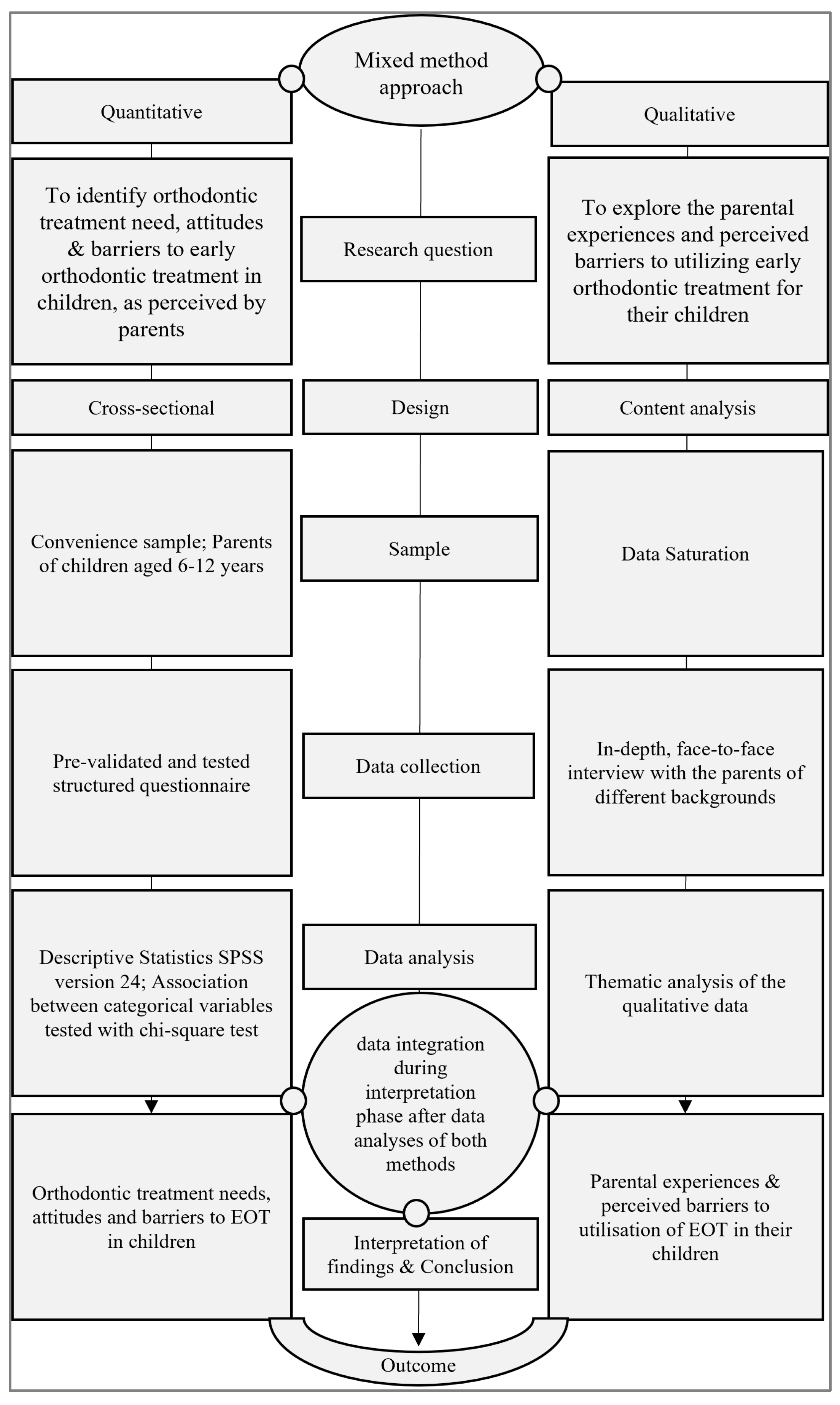
2.1. Study Design
2.1.1. Quantitative Phase
2.1.2. Qualitative Phase
2.1.3. Statistical Analysis
3. Results
3.1. Quantitative Results
3.2. Qualitative Results
“Most basic dental treatments are provided to us free of cost at primary healthcare centres, but orthodontic care is so expensive that it’s difficult for us to afford it.”(P2)
“Orthodontic treatments at private clinics are very expensive. As a parent I want to ensure my child receives best care possible without the burden of financial stress. To manage the costs, we request the dentist to reduce the fee sometimes or allow the option to pay in instalments.”(P4)
“There is no insurance coverage provided for my child’s orthodontic treatment through our medical insurance. Without coverage, we’re left with a heavy financial burden which really affects our family expenses. It’s hard to understand why something so important for their health is not covered.”(P7)
“Orthodontic care in primary health care centres comes with long appointment wait times. We had to wait months just to get an appointment. When I requested to make an appointment for my child, they told me the next available slot was eight months away, and so we….”(P3)
“I didn’t know my child needed orthodontic care at such a young age. To be honest, I thought braces or other orthodontic appliances were something only teenagers or adults required, not children.”(P9)
“My child’s teeth doesn’t need orthodontic treatment with braces at this young age. Those baby teeth will fall off anyway and another new set of teeth will come”.(P18)
“My dentist never mentioned that my child might need to see an orthodontist. So, i assumed everything was fine with her teeth. How was I supposed to know that these issues could go unnoticed until they become more serious”?(P5)
“When we took our child to the dentist for a check-up, the dentist advised us to wait on orthodontic treatment until all the baby teeth fall out and the permanent ones come in. He said it was better to wait and see how the permanent teeth adjust before starting any treatment with braces. While that advice made sense at the time, now when we look at the cost and the need for treatment, it’s becoming a concern for both my child’s health and our family’s finances.”(P11)
“My child is already scared of the dentist. The thought of taking him to an orthodontist for even more appointments makes both of us feel anxious.”(P14)
“I’m not concerned about the cost of the treatment, but I do worry that some types of orthodontic appliances might interfere with my child’s school activities and daily routine.”(P10)
4. Discussion
4.1. Parental Perceptions and Demographic Correlates
4.2. Qualitative Findings: Barriers to Early Orthodontic Care
4.3. Implications for Practice and Policy
4.4. Strengths and Limitations
5. Conclusions
Supplementary Materials
Funding
Institutional Review Board Statement
Informed Consent Statement
Data Availability Statement
Acknowledgments
Conflicts of Interest
References
- Madiraju, G.S.; Almugla, Y.M.; Mohan, R.; Alnasser, B.M. An epidemiological study on early orthodontic treatment need among eastern Saudi Arabian children in the mixed dentition stage. Sci. Rep. 2024, 14, 4084. [Google Scholar] [CrossRef]
- Alshammari, A.K.; Alanazi, A.; Al-Swedani, H.; Khan, M.; Ahmad, S.; Haque, S.; Khan, S. Knowledge and perception of orthodontic treatment among general and non-orthodontic dental specialists: A comparative study. Healthcare 2023, 11, 340. [Google Scholar] [CrossRef]
- Nobre, R.; Pozza, D.H. Parental influence in orthodontic treatment: A systematic review. Med. Pharm. Rep. 2023, 96, 28–34. [Google Scholar] [CrossRef]
- Brumini, M.; Slaj, M.; Katic, V.; Pavlic, A.; Trinajstic Zrinski, M.; Spalj, S. Parental influence is the most important predictor of child’s orthodontic treatment demand in a preadolescent age. Odontology 2020, 108, 109–116. [Google Scholar] [CrossRef]
- Tuncer, C.; Canigur Bavbek, N.; Balos Tuncer, B.; Ayhan Bani, A.; Çelik, B. How Do Patients and Parents Decide for Orthodontic Treatment-Effects of Malocclusion, Personal Expectations, Education and Media. J. Clin. Pediatr. Dent. 2015, 39, 392–399. [Google Scholar] [CrossRef]
- Aldweesh, A.H.; Ben Gassem, A.A.; AlShehri, B.M.; AlTowaijri, A.A.; Albarakati, S.F. Parents’ Awareness of Early Orthodontic Consultation: A Cross-Sectional Study. Int. J. Environ. Res. Public Health 2022, 19, 1800. [Google Scholar] [CrossRef] [PubMed]
- Moshkelgosha, V.; Kazemi, M.; Pakshir, H.; Safari, R. Parental Knowledge and Attitude towards Early Orthodontic Treatment for Their Primary School Children. Iran. J. Orthod. 2016, 12, e7377. [Google Scholar] [CrossRef]
- Mani, Z.A.; Goniewicz, K. Transforming Healthcare in Saudi Arabia: A Comprehensive Evaluation of Vision 2030′s Impact. Sustainability 2024, 16, 3277. [Google Scholar] [CrossRef]
- Creswell, J.W.; Clark, V.L.P. Designing and Conducting Mixed Methods Research, 3rd ed.; SAGE Publications: Thousand Oaks, CA, USA, 2018. [Google Scholar]
- Hassan, F.; Shafiq, U.; Mahmood, A. Parental Motivation for Orthodontic Consultation during Their Child’s Mixed Dentition Phase: A Questionnaire Study. Pak. Orthod. J. 2016, 7, 51–55. [Google Scholar]
- Di Spirito, F.; Cannatà, D.; Schettino, V.; Galdi, M.; Bucci, R.; Martina, S. Perceived Orthodontic Needs and Attitudes towards Early Evaluation and Interventions: A Survey-Based Study among parents of Italian School-Aged Children. Clin. Pract. 2024, 14, 1159–1170. [Google Scholar] [CrossRef]
- Tong, A.; Sainsbury, P.; Craig, J. Consolidated criteria for reporting qualitative research (COREQ): A 32-item checklist for interviews and focus groups. Int. J. Qual. Health Care 2007, 19, 349–357. [Google Scholar] [CrossRef] [PubMed]
- Eshky, R.T.; Althagafi, N.M.; Alsaati, B.H.; Alharbi, R.A.; Kassim, S.A.; Alsharif, A.T. Self-Perception Of Malocclusion And Barriers To Orthodontic Care: A Cross-Sectional Study In Al-Madinah, Saudi Arabia. Patient Prefer. Adherence 2019, 13, 1723–1732. [Google Scholar] [CrossRef] [PubMed]
- Assery, M.K.A. Knowledge, attitude, and practice regarding prosthodontic rehabilitation and factors affecting the patients visiting private clinics in Riyadh, Saudi Arabia: A crosssectional study. J. Fam. Med. Prim. Care 2020, 9, 2591–2592. [Google Scholar] [CrossRef] [PubMed]
- García, E.; Santos, L.; Borrell, C.; Aura, J.I.; Marqués, L. Parental Perceptions of Early Interceptive Orthodontic Intervention in Children and Adolescents: A Cross-Sectional Study. Eur. J. Paediatr. Dent. 2025, 26, 218–223. [Google Scholar] [CrossRef]
- Paes da Silva, S.; Pitchika, V.; Baumert, U.; Wehrbein, H.; Schwestka-Polly, R.; Drescher, D.; Kühnisch, J.; Wichelhaus, A. Oral health-related quality of life in orthodontics: A cross-sectional multicentre study on patients in orthodontic treatment. Eur. J. Orthod. 2020, 42, 270–280. [Google Scholar] [CrossRef]
- Zulkiffili, A.M.; Roslan, L.H.; Azrin, N.H.I.; Azmi, N.N.; Manivannan, P.C.; Yap, Y.H. Assessment of self-perceived malocclusion and barriers to orthodontic treatment: A cross-sectional study. J. Orthod. Sci. 2023, 12, 77. [Google Scholar] [CrossRef]
- Felemban, O.M.; Alharabi, N.T.; AAlamoudi, R.A.; Alturki, G.A.; Helal, N.M. Factors influencing the desire for orthodontic treatment among patients and parents in Saudi Arabia: A cross-sectional study. J. Orthod. Sci. 2022, 11, 25. [Google Scholar] [CrossRef]
- Carrillo, J.E.; Carrillo, V.A.; Perez, H.R.; Salas-Lopez, D.; Natale-Pereira, A.; Byron, A.T. Defining and targeting health care access barriers. J. Health Care Poor Underserved 2011, 22, 562–575. [Google Scholar] [CrossRef]
- George, S.; Daniels, K.; Fioratou, E. A qualitative study into the perceived barriers of accessing healthcare among a vulnerable population involved with a community centre in Romania. Int. J. Equity Health 2018, 17, 41. [Google Scholar] [CrossRef]
- Chambers, D.W.; Zitterkopf, J.G. How people make decisions about whether or not to seek orthodontic care: Upstream in the treatment chain. Am. J. Orthod. Dentofac. Orthop. 2019, 155, 826–831. [Google Scholar] [CrossRef]
- Allen, E.M.; Call, K.T.; Beebe, T.J.; McAlpine, D.D.; Johnson, P.J. Barriers to Care and Health Care Utilization Among the Publicly Insured. Med. Care 2017, 55, 207–214. [Google Scholar] [CrossRef] [PubMed]
- Mathew, R.; Sathasivam, H.P.; Mohamednor, L.; Yugaraj, P. Knowledge, attitude and practice of patients towards orthodontic treatment. BMC Oral Health 2023, 23, 132. [Google Scholar] [CrossRef]
- Almoammar, S.; Asiri, E.; Althogbi, S.I.; Saad, R.; Al Shahrani, A.; Hassan, N.; Alyami, B. Knowledge attitude of general population towards orthodontic treatment in Aseer region Kingdom of Saudi Arabia World. J. Dent. 2018, 8, 483–489. [Google Scholar] [CrossRef]
- Alharbi, R.; Taju, W. Factors Influencing the Decision Process within Seeking Orthodontic Care among the Saudi Population: A Cross-sectional Survey. Open Dent. J. 2024, 18, e18742106275295. [Google Scholar] [CrossRef]
- Madani, S.M.; Eslamipour, F.; Sadeghian, S.; Tahani, B. General dentists’ awareness of orthodontic treatment needs of patients and their referral practices. Dent. Res. J. 2023, 20, 93. [Google Scholar] [CrossRef]
- Alrejaye, N.S.; Alnasser, L.A.; Alsuliman, A.F.; Alomran, D.K.; Alshehri, H.H.; Almalki, M.M.; Alenazi, S.S.; Bushnak, I.A.; Abolfotouh, M.A. Physicians’ Examination and Referral Practices on Orthodontic Problems Among 6-12-Year-Old Children in Saudi Arabia. Clin. Cosmet. Investig. Dent. 2023, 15, 225–236. [Google Scholar] [CrossRef] [PubMed]
- Koufatzidou, M.; Koletsi, D.; Basdeki, E.I.; Pandis, N.; Polychronopoulou, A. Pediatricians’ awareness on orthodontic problems and related conditions-a national survey. Prog. Orthod. 2019, 20, 33. [Google Scholar] [CrossRef]
- Lin, F.; Ren, M.; Yao, L.; He, Y.; Guo, J.; Ye, Q. Psychosocial impact of dental esthetics regulates motivation to seek orthodontic treatment. Am. J. Orthod. Dentofac. Orthop. 2016, 150, 476–482. [Google Scholar] [CrossRef] [PubMed]


| Question | Answer Options | Response Count | Response % |
|---|---|---|---|
| Q1. Relation to the child (n = 470) | Mother | 251 | 53.4 |
| Father | 219 | 46.6 | |
| Q2. Parent Age (n = 470) | <30 | 250 | 53.2 |
| 30–40 | 151 | 32.1 | |
| >40 | 69 | 14.7 | |
| Q3. Education Level (n = 470) | Primary School or less | 51 | 10.9 |
| Secondary/High School | 253 | 53.8 | |
| College/University | 166 | 35.3 | |
| Q4. Monthly Income (n = 470) | <5000 | 68 | 14.5 |
| 5000–15,000 | 236 | 50.2 | |
| >15,000 | 166 | 35.3 | |
| Q5. No. of Children (n = 470) | 1 | 148 | 31.5 |
| 2 | 104 | 22.1 | |
| 3 or more | 218 | 46.4 | |
| Q6. Personal History of Orthodontic Treatment (n = 470) | Yes | 172 | 36.6 |
| No | 298 | 63.4 | |
| Q7. Do you think that your child’s teeth would ever have a significant impact on his/her personality? (n = 470) | Yes | 269 | 57.2 |
| No | 201 | 42.8 | |
| Q8. Do you think your child has any problems with the Teeth alignment/position or skeletal problems? (n = 470) | Yes | 320 | 68.1 |
| No | 150 | 31.9 | |
| Q9. If Yes, what problem is it? Choose one or more answers. (n = 320) | Spacing between teeth | 35 | 10.9 |
| Crowded anterior teeth | 58 | 18.1 | |
| Protruded upper teeth | 92 | 28.8 | |
| Extra teeth | 8 | 2.5 | |
| Missing teeth | 73 | 22.8 | |
| Incorrect teeth position | 25 | 7.8 | |
| Facial Asymmetry | 19 | 5.9 | |
| Protruding mandible | 18 | 5.6 | |
| Protruded upper Jaw | 27 | 8.4 | |
| Q10. Have you ever consulted a dentist or orthodontist seeking orthodontic evaluation for child? (n = 470) | Yes | 302 | 64.3 |
| No | 168 | 35.7 | |
| Q11. If Yes to Q10, did your child receive the required orthodontic treatment? (n = 302) | Yes | 120 | 39.7 |
| No | 182 | 60.3 | |
| Q12. Perceived barriers to orthodontic care in children. Choose one or more answers. | Dental fear/Anxiety | 34 | 7.2 |
| Treatment cost | 151 | 32.1 | |
| Lack of insurance coverage | 106 | 22.5 | |
| Lack of knowledge | 70 | 14.9 | |
| Age (too young) | 33 | 7.02 | |
| Unaesthetic appearance | 16 | 3.4 | |
| Long Treatment duration | 17 | 3.6 | |
| Long appointment wait list | 144 | 30.6 |
| Question | Response | Q7. Do You Think That Your Child’s Teeth Would Ever Have a Significant Impact on His/Her Personality? (n = 470) | Q8. Do You Think Your Child Has Any Problems with the Teeth Alignment/Position or Skeletal Problems? (n = 320) | ||||
|---|---|---|---|---|---|---|---|
| Yes | No | p-Value * | Yes | No | p-Value * | ||
| Q1. Relation to the child | Mother | 147 | 104 | 0.532 | 165 | 86 | 0.242 |
| Father | 122 | 97 | 155 | 64 | |||
| Q2. Parent Age | <30 | 168 | 82 | 0.000 | 218 | 32 | 0.000 |
| 30–40 | 99 | 52 | 100 | 51 | |||
| >40 | 02 | 67 | 02 | 67 | |||
| Q3. Education Level | Primary School | 17 | 34 | 0.000 | 17 | 34 | 0.000 |
| Secondary/High School | 118 | 135 | 185 | 68 | |||
| College/University | 134 | 32 | 118 | 48 | |||
| Q4. Monthly Income | <5000 | 51 | 17 | 0.000 | 68 | 00 | 0.000 |
| 5000–15,000 | 152 | 84 | 168 | 68 | |||
| >15,000 | 66 | 100 | 84 | 82 | |||
| Q5. No. of Children | 1 | 116 | 32 | 0.000 | 133 | 15 | 0.000 |
| 2 | 70 | 34 | 103 | 01 | |||
| 3 or more | 83 | 135 | 84 | 134 | |||
| Q6. Personal History of Orthodontic Treatment | Yes | 95 | 77 | 0.505 | 116 | 56 | 0.820 |
| No | 174 | 124 | 204 | 94 | |||
| Question | Response | Q10. Have You Ever Consulted a Dentist or Orthodontist Seeking Orthodontic Evaluation for Child (n = 470) | Q11. Did Your Child Receive the Required Orthodontic Treatment (n = 302) | ||||
|---|---|---|---|---|---|---|---|
| Yes | No | p-Value * | Yes | No | p-Value * | ||
| Q1. Relation to the child | Mother | 142 | 109 | 0.000 | 88 | 54 | 0.568 |
| Father | 160 | 59 | 94 | 66 | |||
| Q2. Parent Age | <30 | 182 | 68 | 0.000 | 148 | 34 | 0.000 |
| 30–40 | 117 | 34 | 33 | 84 | |||
| >40 | 03 | 66 | 01 | 02 | |||
| Q3. Education Level | Primary School | 17 | 34 | 0.000 | 00 | 17 | 0.000 |
| Secondary/High School | 151 | 102 | 51 | 100 | |||
| College/University | 134 | 32 | 131 | 03 | |||
| Q4. Monthly Income | <5000 | 0 | 68 | 0.000 | 00 | 00 | 0.000 |
| 5000–15,000 | 168 | 68 | 83 | 85 | |||
| >15,000 | 134 | 32 | 99 | 35 | |||
| Q5. No. of Children | 1 | 148 | 0 | 0.000 | 147 | 01 | 0.000 |
| 2 | 36 | 68 | 01 | 35 | |||
| 3 or more | 118 | 100 | 34 | 84 | |||
| Q6. Personal History of Orthodontic Treatment | Yes | 133 | 39 | 0.000 | 75 | 58 | 0.222 |
| No | 169 | 129 | 107 | 62 | |||
Disclaimer/Publisher’s Note: The statements, opinions and data contained in all publications are solely those of the individual author(s) and contributor(s) and not of MDPI and/or the editor(s). MDPI and/or the editor(s) disclaim responsibility for any injury to people or property resulting from any ideas, methods, instructions or products referred to in the content. |
© 2026 by the author. Licensee MDPI, Basel, Switzerland. This article is an open access article distributed under the terms and conditions of the Creative Commons Attribution (CC BY) license.
Share and Cite
Madiraju, G.S. Exploring Parental Perceptions and Barriers to Early Orthodontic Treatment in Children: A Mixed-Methods Study. Healthcare 2026, 14, 180. https://doi.org/10.3390/healthcare14020180
Madiraju GS. Exploring Parental Perceptions and Barriers to Early Orthodontic Treatment in Children: A Mixed-Methods Study. Healthcare. 2026; 14(2):180. https://doi.org/10.3390/healthcare14020180
Chicago/Turabian StyleMadiraju, Guna Shekhar. 2026. "Exploring Parental Perceptions and Barriers to Early Orthodontic Treatment in Children: A Mixed-Methods Study" Healthcare 14, no. 2: 180. https://doi.org/10.3390/healthcare14020180
APA StyleMadiraju, G. S. (2026). Exploring Parental Perceptions and Barriers to Early Orthodontic Treatment in Children: A Mixed-Methods Study. Healthcare, 14(2), 180. https://doi.org/10.3390/healthcare14020180