Mitigating Home Environmental Asthma Triggers in Subsidized Housing: Experiences of Caregivers and Healthcare Workers

 ,
,  , , ,
, , ,  ,
,
Abstract
1. Introduction
2. Literature Review
2.1. Environmental Factors Related to Pediatric Asthma
2.2. Home Environment and Pediatric Asthma
2.3. Policies and Programs Addressing Home Environmental Issues
2.4. Housing Codes
2.5. Gaps in the Literature and Study Purpose
2.6. Methodological Challenges
3. Methods
3.1. Community-Based Participatory Research Approach
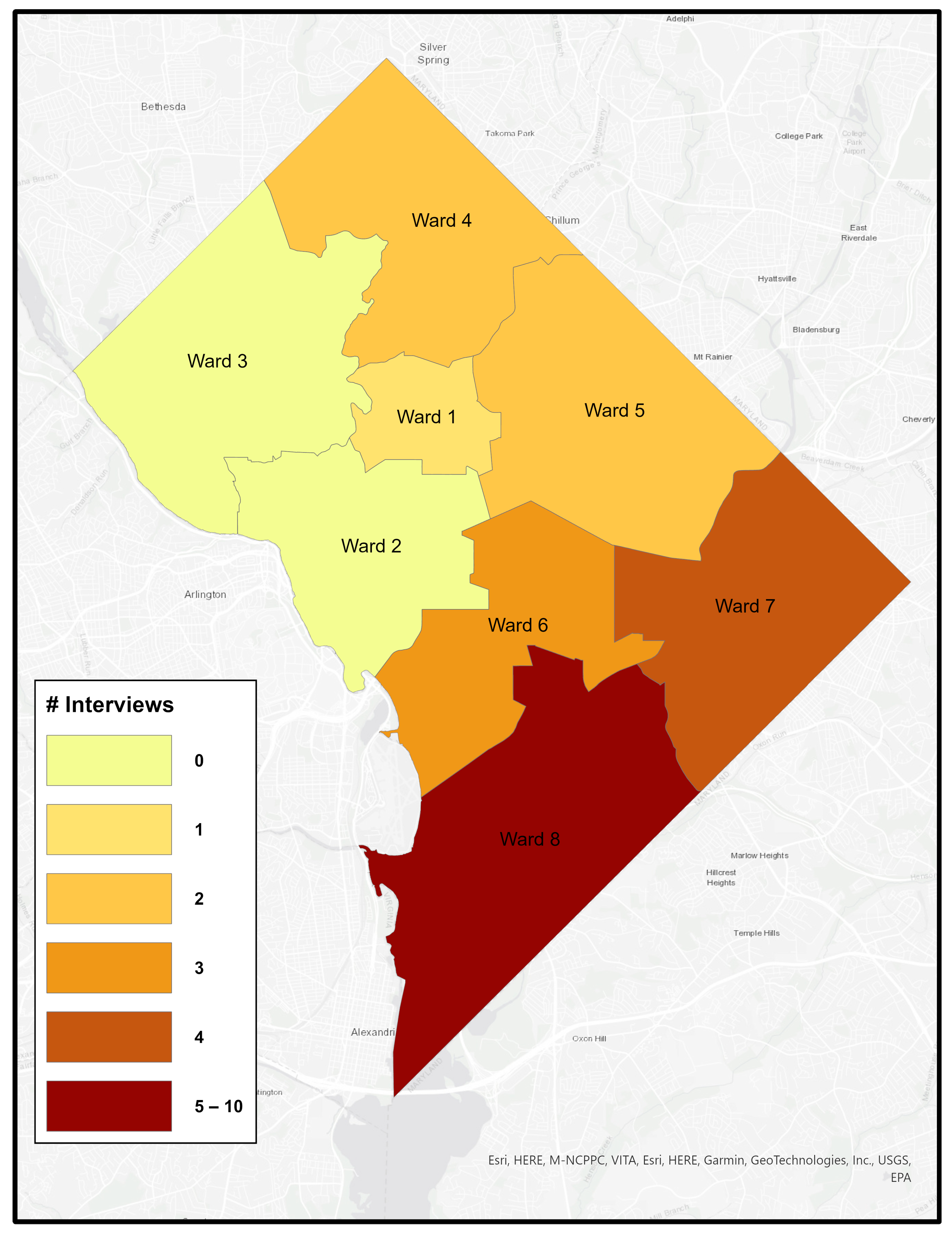
3.2. Participants
3.3. Semi-Structured Interviews
3.4. Data Collection
3.5. Data Analysis
3.6. Participants’ Characteristics
4. Results
4.1. Theme 1: Prevalence of Home Environmental Asthma Triggers
4.1.1. Caregivers’ Perspectives
4.1.2. Healthcare Workers’ Perspectives
4.2. Theme 2: Gaps in Implementation of Healthy Homes Services
4.2.1. Caregivers’ Perspectives
4.2.2. Healthcare Workers’ Perspectives
4.3. Theme 3: Ineffective Implementation of Healthy Homes Services
4.3.1. Caregivers’ Perspectives
4.3.2. Healthcare Workers’ Perspectives
4.4. Theme 4: Challenges in Implementing Healthy Homes Services
4.4.1. Caregivers’ Perspectives
4.4.2. Healthcare Workers’ Perspectives
4.5. Theme 5: The Multilevel Impact of Substandard Housing
4.5.1. Caregivers’ Perspectives
4.5.2. Healthcare Workers’ Perspectives
4.6. Theme 6. Suggestions for Healthy Homes Services
4.6.1. Caregivers’ Perspectives
4.6.2. Healthcare Workers’ Perspectives
5. Discussions
6. Implications for Policies on Mitigating Asthma Triggers in Subsidized Housing
6.1. Housing Code Enforcement and Landlord Accountability
6.2. An Integrated Model for Healthy Housing Policy Planning and Implementation
6.3. From Evidence to Practice: Scaling and Sustaining Healthy Homes Interventions
7. Limitations
8. Conclusions
Author Contributions
Funding
Institutional Review Board Statement
Informed Consent Statement
Data Availability Statement
Conflicts of Interest
References
- Centers for Disease Control and Prevention. Most Recent National Asthma Data. 2021. Available online: https://www.cdc.gov/asthma/most_recent_national_asthma_data.htm (accessed on 16 October 2025).
- O’Rourke, A.; Zimmerman, A.; Platt, H.; Pappalardo, A.A. Preventing asthma emergencies in schools. Pediatrics 2020, 145, e20200377. [Google Scholar] [CrossRef]
- Pate, C.A.; Zahran, H.S.; Qin, X.; Johnson, C.; Hummelman, E.; Malilay, J. Asthma Surveillance—United States, 2006–2018. Morb. Mortal. Wkly. Rep. Surveill. Summ. 2021, 70, 1–32. [Google Scholar] [CrossRef]
- Kim, B.; Mulready-Ward, C.; Thorpe, L.E.; Titus, A.R. Housing environments and asthma outcomes within population-based samples of adults and children in NYC. Prev. Med. 2022, 161, 107147. [Google Scholar] [CrossRef]
- Titus, A.R.; Terlizzi, K.; Conderino, S.; Ðoàn, L.N.; Kim, B.; Thorpe, L.E. Patterns and drivers of disparities in pediatric asthma outcomes among Medicaid-enrolled children living in subsidized housing in NYC. Prev. Med. 2024, 185, 108023. [Google Scholar] [CrossRef]
- Binney, S.; Flanders, W.D.; Sircar, K.; Idubor, O. Trends in US pediatric asthma hospitalizations, by race and ethnicity, 2012–2020. Prev. Chronic Dis. 2024, 21, E71. [Google Scholar] [CrossRef]
- Turcotte, D.; Chaves, E.; Gore, R.; Adejumo, K.; Woskie, S. The impact of housing type on low-income asthmatic children receiving multifaceted home interventions. Public Health 2018, 164, 107–114. [Google Scholar] [CrossRef] [PubMed]
- Urban Institute. Exposing and Addressing Child Asthma in HUD-Assisted Renter Households. 2017. Available online: https://www.urban.org/urban-wire/exposing-and-addressing-child-asthma-hud-assisted-renter-households (accessed on 16 October 2025).
- Bryant-Stephens, T.C.; Strane, D.; Robinson, E.K.; Bhambhani, S.; Kenyon, C.C. Housing and asthma disparities. J. Allergy Clin. Immunol. 2021, 148, 1121–1129. [Google Scholar] [CrossRef] [PubMed]
- Northridge, J.; Ramirez, O.F.; Stingone, J.A.; Claudio, L. The role of housing type and housing quality in urban children with asthma. J. Urban Health Bull. New York Acad. Med. 2010, 87, 211–224. [Google Scholar] [CrossRef]
- Lemire, E.; Samuels, E.A.; Wang, W.; Haber, A. Unequal housing conditions and code enforcement contribute to asthma disparities in Boston, Massachusetts. Health Aff. 2022, 41, 563–572. [Google Scholar] [CrossRef]
- Centers for Disease Control and Prevention. Behavioral Risk Factor Surveillance System 2011–2022. Analysis by the American Lung Association Epidemiology and Statistics Unit. 2025. Available online: https://www.lung.org/research/trends-in-lung-disease/asthma-trends-brief/current-demographics (accessed on 10 September 2025).
- District of Columbia Department of Health. Improving Pediatric Asthma Outcomes: Asthma RFA Final [Request for Applications]; District of Columbia Department of Health: Washington, DC, USA, 2024. [Google Scholar]
- Regional Educational Laboratory Mid-Atlantic. Examining Student Health Conditions: Insights from DC Public Schools [Infographic]. Institute of Education Sciences. Available online: https://ies.ed.gov/sites/default/files/migrated/rel/regions/midatlantic/app/Docs/Infographics/RELMA_DCPS_Health_Conditions_infographic_508C.pdf (accessed on 12 September 2025).
- Open Data DC. Economic Characteristics of Wards. Available online: https://opendata.dc.gov/apps/2f6f21d035984e9c9438ae494022aa2a/explore (accessed on 10 October 2025).
- Open Data DC. Census Tracts in 2020. Available online: https://opendata.dc.gov/datasets/95f1885eff9a4c089012a872c851c50a_8/explore (accessed on 10 October 2025).
- IMPACT DC. Healthy Housing Map. Available online: https://www.childrensnational.org/get-care/departments/impact-dc-asthma-clinic/provider-resources/healthy-housing-map (accessed on 1 November 2025).
- Hernandez-Pacheco, N.; Kere, M.; Melén, E. Gene-environment interactions in childhood asthma revisited; expanding the interaction concept. Pediatr. Allergy Immunol. 2022, 33, e13780. [Google Scholar] [CrossRef]
- Cook, L.; Argenio, K.; Lovinsky-Desir, S. The impact of environmental injustice and social determinants of health on the role of air pollution in asthma and allergic disease in the United States. J. Allergy Clin. Immunol. 2021, 148, 1089–1101.e5. [Google Scholar] [CrossRef]
- Currie, J.; Voorheis, J.; Walker, R. What caused racial disparities in particulate exposure to fall? New evidence from the Clean Air Act and satellite-based measures of air quality. Am. Econ. Rev. 2023, 113, 71–97. [Google Scholar] [CrossRef]
- Currie, J. Inequality at birth: Some causes and consequences. Am. Econ. Rev. 2011, 101, 1–22. [Google Scholar] [CrossRef]
- Landrigan, P.J.; Fuller, R.; Acosta, N.J.R.; Adeyi, O.; Arnold, R.; Basu, N.N.; Baldé, A.B.; Bertollini, R.; Bose-O′Reilly, S.; Boufford, J.I.; et al. The Lancet Commission on Pollution and Health. Lancet 2018, 391, 462–512. [Google Scholar] [CrossRef]
- Chatkin, J.; Correa, L.; Santos, U. External environmental pollution as a risk factor for asthma. Clin. Rev. Allergy Immunol. 2022, 62, 72–89. [Google Scholar] [CrossRef] [PubMed]
- Schraufnagel, D.E.; Balmes, J.R.; Cowl, C.T.; De Matteis, S.; Jung, S.H.; Mortimer, K.; Perez-Padilla, R.; Rice, M.B.; Riojas-Rodriguez, H.; Sood, A.; et al. Air pollution and noncommunicable diseases: A review by the Forum of International Respiratory Societies’ Environmental Committee, Part 2—Air pollution and organ systems. Chest 2019, 155, 417–426. [Google Scholar] [CrossRef] [PubMed]
- Kang, I.; McCreery, A.; Azimi, P.; Gramigna, A.; Baca, G.; Hayes, W.; Crowder, T.; Scheu, R.; Evens, A.; Stephens, B. Impacts of residential indoor air quality and environmental risk factors on adult asthma-related health outcomes in Chicago, IL. J. Expo. Sci. Environ. Epidemiol. 2022, 33, 358–367. [Google Scholar] [CrossRef]
- Grant, T.; Wood, R. The influence of urban exposures and residence on childhood asthma. Pediatr. Allergy Immunol. 2022, 33, e13784. [Google Scholar] [CrossRef]
- National Low Income Housing Coalition. Healthy Homes and Lead Hazard Control. 2014. Available online: https://nlihc.org/sites/default/files/2014AG-236.pdf (accessed on 16 August 2025).
- National Center for Healthy Housing. Surgeon General’s Call to Action. Available online: https://nchh.org/information-and-evidence/healthy-housing-policy/national/keystone-federal-policy/surgeon-generals-call-to-action/ (accessed on 7 August 2025).
- National Center for Healthy Housing. Tracking FY26 Federal Funding for Healthy Homes. Available online: https://nchh.org/2025/07/tracking-fy26-federal-funding-for-healthy-homes/ (accessed on 7 July 2025).
- US Department of Housing and Urban Development. Healthy Homes. HUD Exchange. Available online: https://www.hudexchange.info/programs/healthy-homes/ (accessed on 19 August 2025).
- Giese, J.K. Evidence-based pediatric asthma interventions and outcome measures in a healthy homes program: An integrative review. J. Asthma 2019, 56, 662–673. [Google Scholar] [CrossRef]
- Tilburg, W.C. Policy approaches to improving housing and health. J. Law Med. Ethics 2017, 45, 90–93. [Google Scholar] [CrossRef]
- District of Columbia Department of Buildings. DC Housing Code Standards. Available online: https://dob.dc.gov/service/dc-housing-code-standards (accessed on 19 August 2025).
- Hindman, D.; Pollack, C.; Gensheimer, S.; Wu, A.; Eisenberg, M. Examining health care access and health of children living in homes subsidized by the Low-Income Housing Tax Credit. Health Aff. 2022, 41, 883–892. [Google Scholar] [CrossRef]
- Liu, M.; Chung, J.E.; Robinson, B.; Taylor, L.; Andrewn, R.A.; Li, J. A home An Exploration of Challenges in visit program for low-income African American children with asthma: Caregivers’ perception of asthma triggers and a gap in action. J. Pediatr. Nurs. 2022, 67, e79–e84. [Google Scholar] [CrossRef]
- Carrillo, G.; Mendez-Dominguez, N.; Moreno-Rangel, A. The housing environment and its effect on Hispanic children with asthma. BMC Environ. Sci. 2024, 1, 11. [Google Scholar] [CrossRef]
- Bellin, M.H.; Land, C.; Newsome, A.; Kub, J.; Mudd, S.S.; Bollinger, M.E.; Butz, A.M. Caregiver perception of asthma management of children in the context of poverty. J. Asthma 2017, 54, 162–172. [Google Scholar] [CrossRef]
- Korfmacher, K.S.; Holt, K.D. The potential for proactive housing inspections to inform public health interventions. J. Public Health Manag. Pract. 2018, 24, 444–447. [Google Scholar] [CrossRef]
- Matiz, L.A.; Leong, S.; Peretz, P.J.; Kuhlmey, M.; Bernstein, S.A.; Oliver, M.A.; Medina, K.; Lalwani, A.K. Integrating community health workers into a community hearing health collaborative to understand the social determinants of health in children with hearing loss. Disabil. Health J. 2022, 15, 101181. [Google Scholar] [CrossRef] [PubMed]
- Hughes, C. A house but not a home: How surveillance in subsidized housing exacerbates poverty and reinforces marginalization. Soc. Forces 2020, 100, 293–315. [Google Scholar] [CrossRef]
- Heaton, B.; Muzzi, A.; Gebel, C.; Bernstein, J.; Garcia, R.I. Recruitment and Enrollment of Low-income, Minority Residents of Urban Public Housing into Research. J. Community Health 2023, 48, 741–751. [Google Scholar] [CrossRef] [PubMed]
- Mitchell, U.A.; Nishida, A.; Fletcher, F.E.; Molina, Y. The long arm of oppression: How structural stigma against marginalized communities perpetuates within-group health disparities. Health Educ. Behav. 2021, 48, 342–351. [Google Scholar] [CrossRef]
- Park, S.; Cho, J.; Chen, Y. Subsidized housing and geographic accessibility to neighborhood resources for low-income older people: A later-life social-exclusion perspective. Geoforum 2019, 106, 297–304. [Google Scholar] [CrossRef]
- Davis, L.F.; Ramírez-Andreotta, M.D. Participatory Research for Environmental Justice: A Critical Interpretive Synthesis. Environ. Health Perspect. 2021, 129, 26001. [Google Scholar] [CrossRef] [PubMed]
- Muhammad, M.; Wallerstein, N.; Sussman, A.L.; Avila, M.; Belone, L.; Duran, B. Reflections on Researcher Identity and Power: The Impact of Positionality on Community Based Participatory Research (CBPR) Processes and Outcomes. Crit. Sociol. 2015, 41, 1045–1063. [Google Scholar] [CrossRef]
- Suarez-Balcazar, Y. Meaningful Engagement in Research: Community Residents as Co-creators of Knowledge. Am. J. Community Psychol. 2020, 65, 261–271. [Google Scholar] [CrossRef] [PubMed]
- Lansing, A.E.; Romero, N.J.; Siantz, E.; Silva, V.; Center, K.; Casteel, D.; Gilmer, T. Building trust: Leadership reflections on community empowerment and engagement in a large urban initiative. BMC Public Health 2023, 23, 1252. [Google Scholar] [CrossRef]
- McGrath, C.; Palmgren, P.J.; Liljedahl, M. Twelve tips for conducting qualitative research interviews. Med. Teach. 2019, 41, 1002–1006. [Google Scholar] [CrossRef] [PubMed]
- Bradley, E.H.; Curry, L.A.; Devers, K.J. Qualitative data analysis for health services research: Developing taxonomy, themes, and theory. Health Serv. Res. 2007, 42, 1758–1772. [Google Scholar] [CrossRef]
- Trint. Trint [Computer Program]. Available online: https://trint.com/ (accessed on 10 July 2024).
- Braun, V.; Clarke, V. Using thematic analysis in psychology. Qual. Res. Psychol. 2006, 3, 77–101. [Google Scholar] [CrossRef]
- Padgett, D.K. Qualitative Methods in Social Work Research, 3rd ed.; Sage Publications: Thousand Oaks, CA, USA, 2016. [Google Scholar]
- Palinkas, L.; Cabassa, L.; Shin, M.; Garcia, S.; Springgate, B.; Crabtree, B.; Tsui, J. Methods for community-engaged data collection and analysis in implementation research. Implement. Sci. Commun. 2025, 6, 24. [Google Scholar] [CrossRef]
- Sankofa, N. Participatory thick descriptions: A collaborative and reflective approach. Qual. Res. Psychol. 2022, 20, 100–120. [Google Scholar] [CrossRef]
- Children’s National. DC Health Matters Collaborative. Available online: https://www.childrensnational.org/in-the-community/advocacy-and-outreach/community-initiatives-and-partnerships/dc-health-matters-collaborative (accessed on 20 August 2025).
- Louisias, M.; Matsui, E. Disentangling the Root Causes of Racial Disparities in Asthma: The Role of Structural Racism in a 5-Year-Old Black Boy with Uncontrolled Asthma. J. Allergy Clin. Immunol. Pract. 2020, 8, 1162–1164. [Google Scholar] [CrossRef]
- Sullivan, K.; Thakur, N. Structural and Social Determinants of Health in Asthma in Developed Economies: A Scoping Review of Literature Published Between 2014 and 2019. Curr. Allergy Asthma Rep. 2020, 20, 5. [Google Scholar] [CrossRef]
- Keet, C.A.; Matsui, E.C.; McCormack, M.C.; Peng, R.D. Urban residence, neighborhood poverty, race/ethnicity, and asthma morbidity among children on Medicaid. J. Allergy Clin. Immunol. 2017, 140, 822–827. [Google Scholar] [CrossRef]
- Klassen, A.C.; Lee, N.L.; Pankiewicz, A.; Ward, R.; Shuster, M.; Ogbenna, B.T.; Wade, A.; Boamah, M.; Osayameh, O.; Rule, A.M.; et al. Secondhand Smoke Exposure and Smoke-free Policy in Philadelphia Public Housing. Tob. Regul. Sci. 2017, 3, 192–203. [Google Scholar] [CrossRef] [PubMed]
- Plunk, A.D.; Rees, V.W.; Jeng, A.; Wray, J.A.; Grucza, R.A. Increases in secondhand smoke after going smoke-free: An assessment of the impact of a mandated smoke-free housing policy. Nicotine Tob. Res. 2020, 22, 2254–2256. [Google Scholar] [CrossRef]
- Thorpe, L.E.; Anastasiou, E.; Wyka, K.; Tovar, A.; Gill, E.; Rule, A.; Elbel, B.; Kaplan, S.A.; Jiang, N.; Gordon, T.; et al. Evaluation of Secondhand Smoke Exposure in New York City Public Housing After Implementation of the 2018 Federal Smoke-Free Housing Policy. JAMA Netw. Open 2020, 3, e2024385. [Google Scholar] [CrossRef] [PubMed]
- Boyack, A.J. Sustainable affordable housing strategies. Fordham Urban Law J. 2020, 47, 1107–1184. [Google Scholar]
- Hunt, D. Public Housing in Urban America. Oxford Research Encyclopedia of American History. Available online: https://oxfordre.com/americanhistory/view/10.1093/acrefore/9780199329175.001.0001/acrefore-9780199329175-e-61 (accessed on 20 December 2018).
- Schlinger, H. A proposed rule that inspires few tenants: The shortcomings of HUD’s public-housing inspection standards in addressing environmental hazards. Adm. Law Rev. Accord. 2022, 7, 135–159. [Google Scholar]
- Rosen, E.; Garboden, P.; DeLuca, S.; Edin, K. Taking stock: What drives landlord participation in the Housing Choice Voucher Program? Hous. Policy Debate 2018, 28, 979–1003. [Google Scholar] [CrossRef]
- Zuberi, A. “This voicemail box is full”: Landlord perceptions of communication issues as a key challenge to participating in the Housing Choice Voucher Program. Hous. Policy Debate 2025, 35, 402–421. [Google Scholar] [CrossRef]
- City of New York. Local Laws of the City of New York for the Year 2018, No. 55. 2018. Available online: https://www1.nyc.gov/assets/buildings/local_laws/ll55of2018.pdf (accessed on 27 August 2025).
- National League of Cities. Advancing City-Level Healthy Housing: Policies, Programs, and Practices in Asthma and Lead; National League of Cities: Washington, DC, USA, 2018. [Google Scholar]
- Sonik, R.A.; Herrera, A.L. Associations between inspections for unsafe housing conditions and evictions in New York City public housing buildings. J. Community Health 2022, 47, 849–852. [Google Scholar] [CrossRef]
- Beck, A.F.; Klein, M.D.; Schaffzin, J.K.; Tallent, V.; Gillam, M.; Kahn, R.S. Identifying and treating a substandard-housing cluster using a medical-legal partnership. Pediatrics 2012, 130, 831–838. [Google Scholar] [CrossRef] [PubMed]
- Gomez, M.; Reddy, A.; Dixon, S.; Wilson, J.; Jacobs, D. A cost-benefit analysis of a state-funded healthy homes program for residents with asthma: Findings from the New York State Healthy Neighborhoods Program. J. Public Health Manag. Pract. 2017, 23, 229–238. [Google Scholar] [CrossRef]
- Younas, A.; Fàbregues, S.; Durante, Á.; Escalante, E.; Inayat, S.; Ali, P. Proposing the “MIRACLE” narrative framework for providing thick description in qualitative research. Int. J. Qual. Methods 2023, 22, 1–13. [Google Scholar] [CrossRef]
- Oland, A.A.; Booster, G.D.; Bender, B.G. Psychological and lifestyle risk factors for asthma exacerbations and morbidity in children. World Allergy Organ. J. 2017, 10, 35. [Google Scholar] [CrossRef]
- Boudreaux, M.; Fenelon, A.; Slopen, N.; Newman, S.J. Association of childhood asthma with federal rental assistance. JAMA Pediatr. 2020, 174, 592–598. [Google Scholar] [CrossRef]



| Caregivers (N = 22) | N & % | Key Quotes | Healthcare Workers (N = 8) | N & % | Key Quotes |
|---|---|---|---|---|---|
| Theme 1. Prevalence of Home Environmental Asthma Triggers | |||||
| Rodents, roaches, other Pests | 13 (59.1%) | “The house was infested with mice, cockroaches, everything you could think of flying” (CG 104) | The prevalence of home environmental triggers | 8 (100.0%) | “Parents will often talk about pests. Cockroaches, mice, water damage, and mold are common triggers. Carpet removal is also a major one” (HCW 7) |
| Mold | 10 (45.5%) | “The bathroom? The mold was everywhere” (CG 108) | “Parents open certain cabinets or closets, and then some roaches like out” (HCW 6) “Old buildings hold dust and cause health problems” (HCW 3) | ||
| Carpeting, water leaks and poor ventilation | 15 (68.2%) | “The carpet triggered the boy’s allergies” (CG 120) | |||
| Aging building infrastructure | 13 (59.1%) | “The building has been up since the thirties” (CG 107) “We can’t barely breathe in it” (CG 106) | Impact on children’s asthma health | 6 (75.0%) | “Home environment plays a huge role in asthma outcomes and other health related outcomes” (HCW 4) |
| Building Infrastructural Issues | 13 (59.1%) | “it’s a plumbing issue inside my building… there’s nothing we could do about it unless they tear the crap down” (CG 112) | Clinical limitations amid environmental hazards | 7 (87.5%) | “it’s really hard to treat families and then send them home where they have a lot of exposure—like carpet or bad ventilation systems. It gets very challenging knowing that there’s only so much you can do to help out a family” (HCW 2) |
| Secondhand Smoking Exposure | 7 (31.8%) | “Having to walk the kids through the building full of smoke and stuff” (CG 120) | |||
| Impact on children’s asthma health outcome | 14 (63.6%) | “He (her son) was in ICU for asthma… the housing conditions have something to do with it” (CG 108) | |||
| Theme 2. Gaps in Implementation of Healthy Homes Services | |||||
| Awareness on Heathy Home services | 19 (86.4%) | “No, I’ve never heard of that” | Landlords’ lack responses | 8 (100.0%) | “They have unresponsive landlords” (HCW 9) “It is frustrating that families on vouchers tend to have the most issues and have to go back and forth with the landlord and then not trying to fix things” (HCW 4) |
| Landlords’ lack responses and lack of follow-ups to resident requests | 13 (59.1%) | “I’ve been telling him everything, sent him lists and he never came to do nothing” (CG 117) “They don’t follow up to ensure the things get done” (CG 101) | |||
| Inadequate inspection and pest control | 13 (59.1%) | “I haven’t had an inspection since 2019” (CG 118) “They have pest control on the list. But no, never have I heard about anything like that” (CG 112) | |||
| Unreplaced air filters | 11 (50.0%) | “They haven’t changed it (air filter) since I’ve lived here. About four years” | |||
| Theme 3. Ineffective Implementation of Healthy Home Services | |||||
| The ineffective implementation of pest control | 11 (50.0%) | “Your house is treated for pests and the one next door to you doesn’t. Because it’s so close together, you’re still going to have them regardless” (CG 101) | Ineffective implementation | 7 (87.5%) | “Instead of actually removing it (mold), they just cover it” (HCW 6) “Infestations keep coming back” (HCW 6) |
| Ineffective enforcement of “Smoking-Free” policies | 8 (36.4%) | “That’s a terrible law nobody abides by it. If you go to any specific property, you will still see smoke outside” (CG 102) | Gaps in access to funded HH Programs | 4 (50.0%) | “For D.C. families right now, we’re not offering referrals to any specific program” (HCW 7) |
| Theme 4. Challenges in Implementing Healthy Home Service | |||||
| Challenges faced by landlords | 6 (27.3%) | “They’re old. How can the DC government help them, help me” (CG 108) | Geographic inequalities of housing environment challenges | 4 (50.0%) | “Kids In ward 7/8 with housing issues- their asthma tends to be worse” (HCW 6) |
| Structural inequalities for marginalized neighborhoods | 15 (68.2%) | “Just apartments in general with black kids” (CG 122) “Being a Ward 8 resident. That’s the barrier” | |||
| Theme 5. The Multilevel Impact of Substandard Housing | |||||
| Feelings of powerlessness and vulnerability | 14 (63.6%) | “It’s just a big disregard” (CG 107). “If you ain’t got enough money. You’re not going to be seen or heard” (CG 112) | Caregivers’ powerlessness and vulnerability | 7 (87.5%) | “It’s emotional—for them and for me” (HCW 7) |
| Frustration and distrust | 14 (63.6%) | “They just take your money and don’t provide the services that’s required” (CG 107) | |||
| Legal actions | 8 (36.4%) | “I had to get a lawyer so that I could move.” (CG 120) | |||
| Theme 6. Suggestions for Healthy Home Services | |||||
| Strengthening accountability and oversight of landlords | 14 (63.6%) | “Stay on top of these landlords then you wouldn’t have these problems inside the household” (CG 118) | Listening to families’ voices | 7 (87.5%) | “Allows the parent to have a voice is very important” (HCW 2) |
| Ensuring sustainable funding | 5 (62.5%) | “The city should establish a budget so this can be done sustainably” (HCW 4) “Need more money—invest up-front to fix these houses rather than pay higher health-care costs later” (HCW 7) “they’re trying to get some grants so that program can start back up” (HCW 8) | |||
| Addressing the cycle of inequality | 7 (87.5%) | “Affordable units aren’t affordable, voucher holders still can’t move, the cycle continues” (HCW 6) “Data show asthma is rising due to poor housing, that evidence can drive better laws” (HCW 8) | |||
| Policies reinforcing landlord responsibilities | 8 (100.0%) | “They need to be stricter on the landlord—really enforcing the rules” (HCW 2) “We are moving past the point where community partners can shoulder this—the city needs to budget for it”, and “landlords feel more forced to act when it’s the city, not just a clinic, telling them” (HCW 4) “Research can help put in better laws for landlords to stay on top of their buildings” (HCW 8) | |||
| Supports for landlords/property managers | 5 (62.5%) | “City officials should collaborate with landlords—see what barriers they have and give support, not just another fine” (HCW 4) “Some landlords want to fix problems but lack the money—the city should help, not just fine them” (HCW 5) “Building relationships with housing resources can help landlords finds lower-cost fixes, benefiting families and owners” (HCW 8) | |||
| Innovative Approaches | 4 (50%) | “There could be smoke detector” (HCW 5) | |||
| Caregiver Advocacy | 5 (62.5%) | “Advocate for these families. Children are our future; we need to help them as much as we can” (HCW 9) | |||
Disclaimer/Publisher’s Note: The statements, opinions and data contained in all publications are solely those of the individual author(s) and contributor(s) and not of MDPI and/or the editor(s). MDPI and/or the editor(s) disclaim responsibility for any injury to people or property resulting from any ideas, methods, instructions or products referred to in the content. |
© 2026 by the authors. Licensee MDPI, Basel, Switzerland. This article is an open access article distributed under the terms and conditions of the Creative Commons Attribution (CC BY) license.
Share and Cite
Liu, M.; Chung, J.E.; Currie, J.; Park, I.; Bhavsar, D.; Carlis, S.A.; Cabassa-George, I.; Washington, K.; Lan, M. Mitigating Home Environmental Asthma Triggers in Subsidized Housing: Experiences of Caregivers and Healthcare Workers. Healthcare 2026, 14, 150. https://doi.org/10.3390/healthcare14020150
Liu M, Chung JE, Currie J, Park I, Bhavsar D, Carlis SA, Cabassa-George I, Washington K, Lan M. Mitigating Home Environmental Asthma Triggers in Subsidized Housing: Experiences of Caregivers and Healthcare Workers. Healthcare. 2026; 14(2):150. https://doi.org/10.3390/healthcare14020150
Chicago/Turabian StyleLiu, Meirong, Jae Eun Chung, Janet Currie, Irene Park, Dharmil Bhavsar, Sarah Ali Carlis, Imani Cabassa-George, Kyaus Washington, and Minxuan Lan. 2026. "Mitigating Home Environmental Asthma Triggers in Subsidized Housing: Experiences of Caregivers and Healthcare Workers" Healthcare 14, no. 2: 150. https://doi.org/10.3390/healthcare14020150
APA StyleLiu, M., Chung, J. E., Currie, J., Park, I., Bhavsar, D., Carlis, S. A., Cabassa-George, I., Washington, K., & Lan, M. (2026). Mitigating Home Environmental Asthma Triggers in Subsidized Housing: Experiences of Caregivers and Healthcare Workers. Healthcare, 14(2), 150. https://doi.org/10.3390/healthcare14020150