Effectiveness of a Mobile-Based Self-Regulation Training on Youths’ Affect
 , , , , ,
Abstract
1. Introduction
Aims of This Study
2. Method
2.1. Sample
2.2. Ethics, Consent and Data Sharing
2.3. Procedure
2.4. Self-Regulation Training
2.5. Measures
2.5.1. Positive and Negative Affect
2.5.2. Self-Control
2.5.3. Adaptive Emotion Regulation Strategies
2.6. Statistical Analyses
3. Results
3.1. Group Differences in Change in Positive and Negative Affect
3.2. Self-Control and Adaptive Emotion Regulation Strategies
3.3. Post Hoc Analyses
4. Discussion
5. Conclusions
Supplementary Materials
Author Contributions
Funding
Institutional Review Board Statement
Informed Consent Statement
Data Availability Statement
Conflicts of Interest
References
- McGorry, P.D.; Mei, C.; Dalal, N.; Alvarez-Jimenez, M.; Blakemore, S.-J.; Browne, V.; Dooley, B.; Hickie, I.B.; Jones, P.B.; McDaid, D.; et al. The Lancet Psychiatry Commission on Youth Mental Health. Lancet Psychiatry 2024, 11, 731–774. [Google Scholar] [CrossRef] [PubMed]
- McGrath, J.J.; Al-Hamzawi, A.; Alonso, J.; Altwaijri, Y.; Andrade, L.H.; Bromet, E.J.; Bruffaerts, R.; de Almeida, J.M.C.; Chardoul, S.; Chiu, W.T.; et al. Age of Onset and Cumulative Risk of Mental Disorders: A Cross-National Analysis of Population Surveys from 29 Countries. Lancet Psychiatry 2023, 10, 668–681. [Google Scholar] [CrossRef] [PubMed]
- Asselmann, E.; Wittchen, H.-U.; Lieb, R.; Beesdo-Baum, K. Sociodemographic, Clinical, and Functional Long-Term Outcomes in Adolescents and Young Adults with Mental Disorders. Acta Psychiatr. Scand. 2018, 137, 6–17. [Google Scholar] [CrossRef]
- Veldman, K.; Bültmann, U.; Stewart, R.E.; Ormel, J.; Verhulst, F.C.; Reijneveld, S.A. Mental Health Problems and Educational Attainment in Adolescence: 9-Year Follow-up of the TRAILS Study. PLoS ONE 2014, 9, e101751. [Google Scholar] [CrossRef] [PubMed]
- Uhlhaas, P.J.; Davey, C.G.; Mehta, U.M.; Shah, J.; Torous, J.; Allen, N.B.; Avenevoli, S.; Bella-Awusah, T.; Chanen, A.; Chen, E.Y.H.; et al. Towards a Youth Mental Health Paradigm: A Perspective and Roadmap. Mol. Psychiatry 2023, 28, 3171–3181. [Google Scholar] [CrossRef]
- Baird, S.; Choonara, S.; Azzopardi, P.S.; Banati, P.; Bessant, J.; Biermann, O.; Capon, A.; Claeson, M.; Collins, P.Y.; De Wet-Billings, N.; et al. A Call to Action: The Second Lancet Commission on Adolescent Health and Wellbeing. Lancet 2025, 405, 1945–2022. [Google Scholar] [CrossRef]
- Dodge, K.A.; Prinstein, M.J.; Evans, A.C.; Ahuvia, I.L.; Alvarez, K.; Beidas, R.S.; Brown, A.J.; Cuijpers, P.; Denton, E.-G.; Hoagwood, K.E.; et al. Population Mental Health Science: Guiding Principles and Initial Agenda. Am. Psychol. 2024, 79, 805–823. [Google Scholar] [CrossRef]
- Lonigan, C.J.; Phillips, B.M.; Hooe, E.S. Relations of Positive and Negative Affectivity to Anxiety and Depression in Children: Evidence from a Latent Variable Longitudinal Study. J. Consult. Clin. Psychol. 2003, 71, 465–481. [Google Scholar] [CrossRef]
- Peñate, W.; González-Loyola, M.; Oyanadel, C. The Predictive Role of Affectivity, Self-Esteem and Social Support in Depression and Anxiety in Children and Adolescents. Int. J. Environ. Res. Public Health 2020, 17, 6984. [Google Scholar] [CrossRef]
- Gross, J.J.; Uusberg, H.; Uusberg, A. Mental Illness and Well-Being: An Affect Regulation Perspective. World Psychiatry 2019, 18, 130–139. [Google Scholar] [CrossRef]
- Pandey, A.; Hale, D.; Das, S.; Goddings, A.-L.; Blakemore, S.-J.; Viner, R.M. Effectiveness of Universal Self-Regulation-Based Interventions in Children and Adolescents: A Systematic Review and Meta-Analysis. JAMA Pediatr. 2018, 172, 566–575. [Google Scholar] [CrossRef]
- Kanter, J.W.; Manos, R.C.; Bowe, W.M.; Baruch, D.E.; Busch, A.M.; Rusch, L.C. What Is Behavioral Activation? A Review of the Empirical Literature. Clin. Psychol. Rev. 2010, 30, 608–620. [Google Scholar] [CrossRef]
- Hooley, C.D. Scaling-Up Child and Youth Mental Health Services: Assessing Coverage of a County-Wide Initiative. Ph.D. Thesis, Washington University in St. Louis, St. Louis, MO, USA, 2019. [Google Scholar]
- Nigg, J.T. Annual Research Review: On the Relations among Self-Regulation, Self-Control, Executive Functioning, Effortful Control, Cognitive Control, Impulsivity, Risk-Taking, and Inhibition for Developmental Psychopathology. J. Child Psychol. Psychiatry 2017, 58, 361–383. [Google Scholar] [CrossRef]
- Wesarg-Menzel, C.; Ebbes, R.; Hensums, M.; Wagemaker, E.; Zaharieva, M.S.; Staaks, J.P.C.; van den Akker, A.L.; Visser, I.; Hoeve, M.; Brummelman, E.; et al. Development and Socialization of Self-Regulation from Infancy to Adolescence: A Meta-Review Differentiating between Self-Regulatory Abilities, Goals, and Motivation. Dev. Rev. 2023, 69, 101090. [Google Scholar] [CrossRef]
- Diamond, A. Executive Functions. Annu. Rev. Psychol. 2013, 64, 135–168. [Google Scholar] [CrossRef]
- Baumeister, R.F.; Heatherton, T.F. Self-Regulation Failure: An Overview. Psychol. Inq. 1996, 7, 1–15. [Google Scholar] [CrossRef]
- Posner, M.; Rothbart, M. Developing Mechanisms of Self-Regulation. Dev. Psychopathol. 2000, 12, 427–441. [Google Scholar] [CrossRef] [PubMed]
- Montroy, J.J.; Bowles, R.P.; Skibbe, L.E.; McClelland, M.M.; Morrison, F.J. The Development of Self-Regulation across Early Childhood. Dev. Psychol. 2016, 52, 1744–1762. [Google Scholar] [CrossRef] [PubMed]
- Howard, S.J.; Williams, K.E. Early Self-Regulation, Early Self-Regulatory Change, and Their Longitudinal Relations to Adolescents’ Academic, Health, and Mental Well-Being Outcomes. J. Dev. Behav. Pediatr. 2018, 39, 489–496. [Google Scholar] [CrossRef]
- Carver, C.S.; Scheier, M.F. On the Self-Regulation of Behavior; Cambridge University Press: Cambridge, UK, 1998. [Google Scholar]
- Lyons, K.E.; Zelazo, P.D. Monitoring, Metacognition, and Executive Function: Elucidating the Role of Self-Reflection in the Development of Self-Regulation. Adv. Child Dev. Behav. 2011, 40, 379–412. [Google Scholar] [PubMed]
- Orkibi, H.; Hamama, L.; Gavriel-Fried, B.; Ronen, T. Pathways to Adolescents’ Flourishing: Linking Self-Control Skills and Positivity Ratio through Social Support. Youth Soc. 2018, 50, 3–25. [Google Scholar] [CrossRef]
- Bandura, A.; Caprara, G.V.; Barbaranelli, C.; Gerbino, M.; Pastorelli, C. Role of Affective Self-Regulatory Efficacy in Diverse Spheres of Psychosocial Functioning. Child Dev. 2003, 74, 769–782. [Google Scholar] [CrossRef]
- van Genugten, L.; Dusseldorp, E.; Massey, E.K.; van Empelen, P. Effective Self-Regulation Change Techniques to Promote Mental Wellbeing among Adolescents: A Meta-Analysis. Health Psychol. Rev. 2017, 11, 53–71. [Google Scholar] [CrossRef] [PubMed]
- Murray, D.W.; Kurian, J.; Soliday Hong, S.L.; Andrade, F.C. Meta-Analysis of Early Adolescent Self-Regulation Interventions: Moderation by Intervention and Outcome Type. J. Adolesc. 2022, 94, 101–117. [Google Scholar] [CrossRef] [PubMed]
- Rosenbaum, M.E. Learned Resourcefulness: On Coping Skills, Self-Control, and Adaptive Behavior; Springer: New York, NY, USA, 1990. [Google Scholar]
- Forbes, C.N. New Directions in Behavioral Activation: Using Findings from Basic Science and Translational Neuroscience to Inform the Exploration of Potential Mechanisms of Change. Clin. Psychol. Rev. 2020, 79, 101860. [Google Scholar] [CrossRef] [PubMed]
- Rosenbaum, M.; Ronen, T. Emotional Well-Being and Self-Control Skills of Children and Adolescents: The Israeli Perspective. In Mental Well-Being; Springer: New York, NY, USA, 2013; pp. 209–229. ISBN 9789400751941. [Google Scholar]
- Singh, S.; Sharma, N.R. Self-Regulation as a Correlate of Psychological Well-Being. Indian J. Health Well-Being 2018, 9, 441–444. [Google Scholar]
- Orkibi, H.; Ronen, T.; Assoulin, N. The Subjective Well-Being of Israeli Adolescents Attending Specialized School Classes. J. Educ. Psychol. 2014, 106, 515–526. [Google Scholar] [CrossRef]
- Cuijpers, P.; Karyotaki, E.; Harrer, M.; Stikkelbroek, Y. Individual Behavioral Activation in the Treatment of Depression: A Meta Analysis. Psychother. Res. 2023, 33, 886–897. [Google Scholar] [CrossRef]
- Mazzucchelli, T.G.; Kane, R.T.; Rees, C.S. Behavioral Activation Interventions for Well-Being: A Meta-Analysis. J. Posit. Psychol. 2010, 5, 105–121. [Google Scholar] [CrossRef]
- Martin, F.; Oliver, T. Behavioral Activation for Children and Adolescents: A Systematic Review of Progress and Promise. Eur. Child Adolesc. Psychiatry 2019, 28, 427–441. [Google Scholar] [CrossRef]
- Tindall, L.; Kerrigan, P.; Li, J.; Hayward, E.; Gega, L. Is Behavioural Activation an Effective Treatment for Depression in Children and Adolescents? An Updated Systematic Review and Meta-Analysis. Eur. Child Adolesc. Psychiatry 2024, 33, 4133–4156. [Google Scholar] [CrossRef]
- Malik, K.; Ibrahim, M.; Bernstein, A.; Venkatesh, R.K.; Rai, T.; Chorpita, B.; Patel, V. Behavioral Activation as an “active Ingredient” of Interventions Addressing Depression and Anxiety among Young People: A Systematic Review and Evidence Synthesis. BMC Psychol. 2021, 9, 150. [Google Scholar] [CrossRef]
- Schleider, J.L.; Mullarkey, M.C.; Fox, K.R.; Dobias, M.L.; Shroff, A.; Hart, E.A.; Roulston, C.A. A Randomized Trial of Online Single-Session Interventions for Adolescent Depression during COVID-19. Nat. Hum. Behav. 2022, 6, 258–268. [Google Scholar] [CrossRef]
- Miller, A.L.; Lo, S.L.; Bauer, K.W.; Fredericks, E.M. Developmentally Informed Behaviour Change Techniques to Enhance Self-Regulation in a Health Promotion Context: A Conceptual Review. Health Psychol. Rev. 2020, 14, 116–131. [Google Scholar] [CrossRef]
- Murray, D.W.; Rosanbalm, K.; Christopoulos, C.; Meyer, A.L. An Applied Contextual Model for Promoting Self-Regulation Enactment across Development: Implications for Prevention, Public Health and Future Research. J. Prim. Prev. 2019, 40, 367–403. [Google Scholar] [CrossRef]
- Davidson, M.C.; Amso, D.; Anderson, L.C.; Diamond, A. Development of Cognitive Control and Executive Functions from 4 to 13 Years: Evidence from Manipulations of Memory, Inhibition, and Task Switching. Neuropsychologia 2006, 44, 2037–2078. [Google Scholar] [CrossRef] [PubMed]
- Inzlicht, M.; Werner, K.M.; Briskin, J.L.; Roberts, B.W. Integrating Models of Self-Regulation. Annu. Rev. Psychol. 2021, 72, 319–345. [Google Scholar] [CrossRef]
- Kelley, W.M.; Wagner, D.D.; Heatherton, T.F. In Search of a Human Self-Regulation System. Annu. Rev. Neurosci. 2015, 38, 389–411. [Google Scholar] [CrossRef] [PubMed]
- Muraven, M.; Baumeister, R. Self-Regulation and Depletion of Limited Resources: Does Self-Control Resemble a Muscle? Psychol. Bull. 2000, 126, 247–259. [Google Scholar] [CrossRef]
- Heatherton, T.F.; Wagner, D.D. Cognitive Neuroscience of Self-Regulation Failure. Trends Cogn. Sci. 2011, 15, 132–139. [Google Scholar] [CrossRef] [PubMed]
- Wenzel, M.; Rowland, Z.; Kubiak, T. Examining Five Pathways on How Self-Control Is Associated with Emotion Regulation and Affective Well-Being in Daily Life. J. Pers. 2021, 89, 451–467. [Google Scholar] [CrossRef] [PubMed]
- Hofmann, W.; Schmeichel, B.J.; Baddeley, A.D. Executive Functions and Self-Regulation. Trends Cogn. Sci. 2012, 16, 174–180. [Google Scholar] [CrossRef]
- Huguet, A.; Miller, A.; Kisely, S.; Rao, S.; Saadat, N.; McGrath, P.J. A Systematic Review and Meta-Analysis on the Efficacy of Internet-Delivered Behavioral Activation. J. Affect. Disord. 2018, 235, 27–38. [Google Scholar] [CrossRef]
- Iida, M.; Shrout, P.E.; Laurenceau, J.-P.; Bolger, N. Using Diary Methods in Psychological Research. In APA Handbook of Research Methods in Psychology; Cooper, H., Camic, P.M., Long, D.L., Panter, A.T., Rindskopf, D., Sher, K.J., Eds.; American Psychological Association: Washington, DC, USA, 2012; Foundations, Planning, Measures, and Psychometrics; Volume 1, pp. 277–305. [Google Scholar]
- Ridder, D.; Weiden, A.V.D.; Gillebaart, M.; Benjamins, J.; Ybema, J.F. Just Do It: Engaging in Self-Control on a Daily Basis Improves the Capacity for Self-Control. Motiv. Sci. 2020, 6, 309. [Google Scholar] [CrossRef]
- Laceulle, O.M.; Rienks, K.; Meijer, L.; de Moor, E.L.; Karreman, A. A Developmental Approach to Youth Maladaptive Personality Traits: Variable- versus Person-Centered Change in the Transition from Childhood to Adolescence. Eur. J. Pers. 2023, 37, 649–668. [Google Scholar] [CrossRef]
- Maas, C.J.M.; Hox, J.J. Sufficient Sample Sizes for Multilevel Modeling. Methodology 2005, 1, 86–92. [Google Scholar] [CrossRef]
- Crawford, J.R.; Henry, J.D. The Positive and Negative Affect Schedule (PANAS): Construct Validity, Measurement Properties and Normative Data in a Large Non-Clinical Sample. Br. J. Clin. Psychol. 2004, 43, 245–265. [Google Scholar] [CrossRef]
- Dietvorst, E.; Hiemstra, M.; Maciejewski, D.; van Roekel, E.; Bogt, T.T.; Hillegers, M.; Keijsers, L. Grumpy or Depressed? Disentangling Typically Developing Adolescent Mood from Prodromal Depression Using Experience Sampling Methods. J. Adolesc. 2021, 88, 25–35. [Google Scholar] [CrossRef] [PubMed]
- Tangney, J.P.; Baumeister, R.F.; Boone, A.L. High Self-Control Predicts Good Adjustment, Less Pathology, Better Grades, and Interpersonal Success. J. Pers. 2004, 72, 271–324. [Google Scholar] [CrossRef]
- Garnefski, N.; Kraaij, V. Cognitive Emotion Regulation Questionnaire—Development of a Short 18-Item Version (CERQ-Short). Pers. Individ. Dif. 2006, 41, 1045–1053. [Google Scholar] [CrossRef]
- Garnefski, N.; Kraaij, V.; Spinhoven, P. Negative Life Events, Cognitive Emotion Regulation and Emotional Problems. Pers. Individ. Dif. 2001, 30, 1311–1327. [Google Scholar] [CrossRef]
- R Core Team. R: A Language and Environment for Statistical Computing; R Core Team: Vienna, Austria, 2020. [Google Scholar]
- Bates, D.; Mächler, M.; Bolker, B.; Walker, S. Fitting Linear Mixed-Effects Models Using Lme4. J. Stat. Softw. 2015, 67, 1–48. [Google Scholar] [CrossRef]
- Lischetzke, T.; Reis, D.; Arndt, C. Data-analytic Strategies for Examining the Effectiveness of Daily Interventions. J. Occup. Organ. Psychol. 2015, 88, 587–622. [Google Scholar] [CrossRef]
- Mens, M.M.J.; Keijsers, L.; Dietvorst, E.; Koval, S.; Legerstee, J.S.; Hillegers, M.H.J. Promoting Daily Well-Being in Adolescents Using MHealth. J. Youth Adolesc. 2022, 51, 2173–2189. [Google Scholar] [CrossRef]
- Wiese, C.W.; Tay, L.; Duckworth, A.L.; D’Mello, S.; Kuykendall, L.; Hofmann, W.; Baumeister, R.F.; Vohs, K.D. Too Much of a Good Thing? Exploring the Inverted-U Relationship between Self-Control and Happiness. J. Pers. 2018, 86, 380–396. [Google Scholar] [CrossRef] [PubMed]
- Lim, L.; Bannert, M.; van der Graaf, J.; Singh, S.; Fan, Y.; Surendrannair, S.; Rakovic, M.; Molenaar, I.; Moore, J.; Gašević, D. Effects of Real-Time Analytics-Based Personalized Scaffolds on Students’ Self-Regulated Learning. Comput. Hum. Behav. 2023, 139, 107547. [Google Scholar] [CrossRef]
- Zielińska, A.; Lebuda, I.; Czerwonka, M.; Karwowski, M. Self-regulation Prompts Improve Creative Performance. J. Creat. Behav. 2024, 59, e674. [Google Scholar] [CrossRef]
- Muir, R.A.; Howard, S.J.; Kervin, L. Interventions and Approaches Targeting Early Self-Regulation or Executive Functioning in Preschools: A Systematic Review. Educ. Psychol. Rev. 2023, 35, 27. [Google Scholar] [CrossRef]
- O’Carroll, R.E. Self-Regulation Interventions—What Do We Know and Where Should We Go? Health Psychol. Rev. 2020, 14, 159–164. [Google Scholar] [CrossRef]
- Anvari, F.; Lakens, D. Using Anchor-Based Methods to Determine the Smallest Effect Size of Interest. J. Exp. Soc. Psychol. 2021, 96, 104159. [Google Scholar] [CrossRef]
- Weisz, J.R.; Sandler, I.N.; Durlak, J.A.; Anton, B.S. Promoting and Protecting Youth Mental Health through Evidence-Based Prevention and Treatment. Am. Psychol. 2005, 60, 628–648. [Google Scholar] [CrossRef] [PubMed]
- Havinga, P.J.; Maciejewski, D.F.; Hartman, C.A.; Hillegers, M.H.J.; Schoevers, R.A.; Penninx, B.W.J.H. Prevention Programmes for Children of Parents with a Mood/Anxiety Disorder: Systematic Review of Existing Programmes and Meta-Analysis of Their Efficacy. Br. J. Clin. Psychol. 2021, 60, 212–251. [Google Scholar] [CrossRef]
- van Doorn, M.; Nijhuis, L.A.; Egeler, M.D.; Daams, J.G.; Popma, A.; van Amelsvoort, T.; McEnery, C.; Gleeson, J.F.; Öry, F.G.; Avis, K.A.; et al. Online Indicated Preventive Mental Health Interventions for Youth: A Scoping Review. Front. Psychiatry 2021, 12, 580843. [Google Scholar] [CrossRef]
- Verduyn, P.; Van Mechelen, I.; Tuerlinckx, F. The Relation between Event Processing and the Duration of Emotional Experience. Emotion 2011, 11, 20–28. [Google Scholar] [CrossRef]
- Larson, R.W.; Moneta, G.; Richards, M.H.; Wilson, S. Continuity, Stability, and Change in Daily Emotional Experience across Adolescence. Child Dev. 2002, 73, 1151–1165. [Google Scholar] [CrossRef] [PubMed]


| Total Sample | Training Group | Control Group | |
|---|---|---|---|
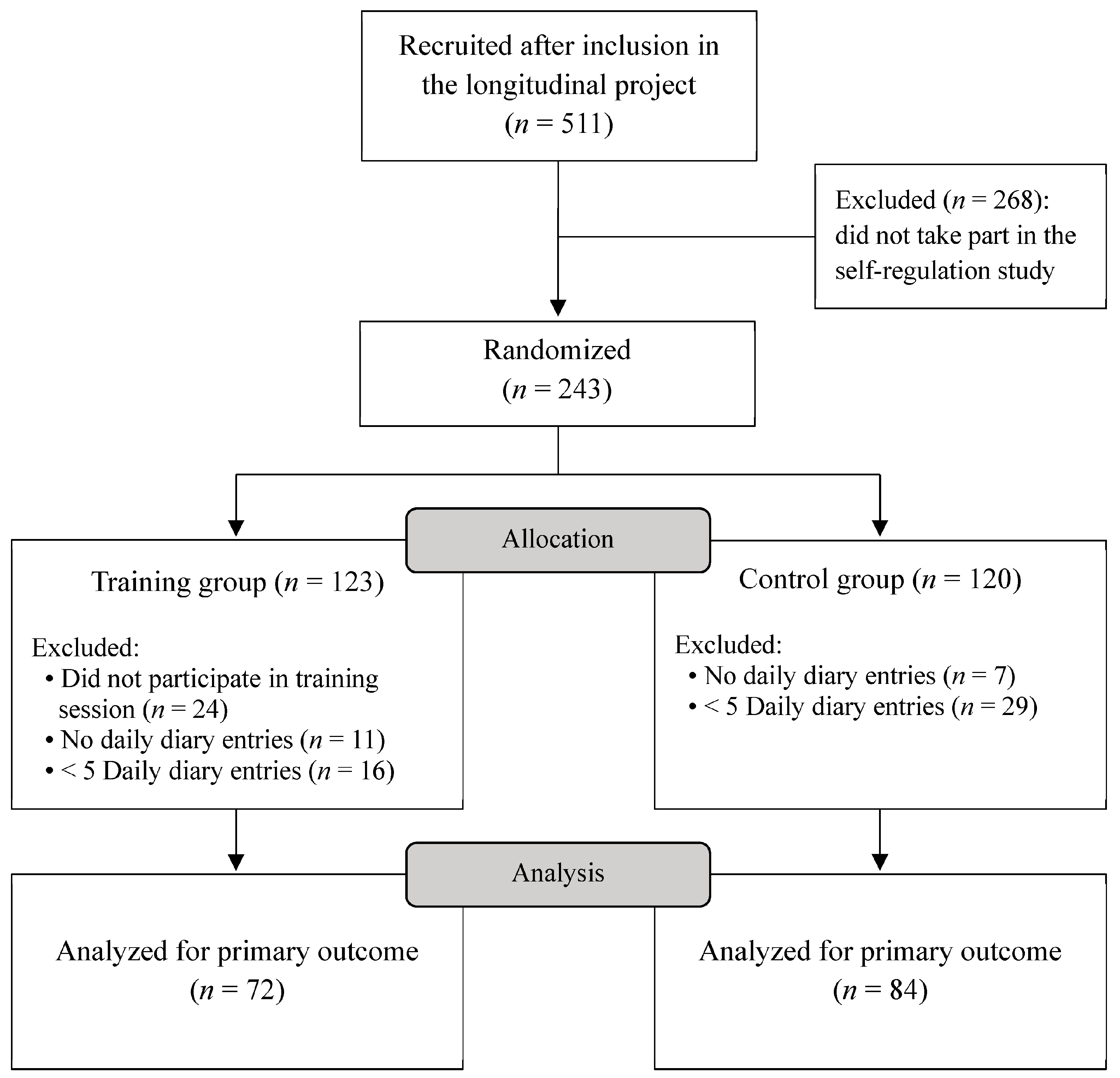
| N = 156 | n = 72 | n = 84 | |
| Age, M (SD) | 10.0 (0.4) a | 9.96 (0.4) b | 10.1 (0.4) c |
| Girl/Boy | 82/74 | 41/31 | 41/43 |
| Self-Control, M (SD) | 3.8 (0.7) d | 3.8 (0.7) e | 3.8 (0.7) f |
| Adaptive Emotion Regulation Strategies, M (SD) | 2.8 (0.7) g | 2.8 (0.6) h | 2.8 (0.7) i |
| Positive Affect at Day 1, M (SD) | 4.2 (0.6) | 4.2 (0.6) | 4.2 (0.5) |
| Positive Affect at Day 12, M (SD) | 4.3 (0.6) | 4.4 (0.6) | 4.2 (0.6) |
| Negative Affect at Day 1, M (SD) | 1.5 (0.5) | 1.5 (0.5) | 1.6 (0.5) |
| Negative Affect at Day 12, M (SD) | 1.5 (0.6) | 1.5 (0.7) | 1.5 (0.6) |
| B | SE | p-Value | 95% CI | ||
|---|---|---|---|---|---|
| Positive Affect | |||||
| Step 1 | Day | 0.01 | 0.01 | 0.083 | −0.00, 0.02 |
| Group | 0.01 | 0.09 | 0.904 | −0.16, 0.18 | |
| Day × Group | 0 | 0.01 | 0.865 | −0.02, 0.01 | |
| Step 2 | Day | 0.01 | 0.01 | 0.079 | −0.00, 0.02 |
| Group | 0.13 | 0.08 | 0.127 | −0.04, 0.29 | |
| Day × Group | −0.01 | 0.01 | 0.205 | −0.03, 0.01 | |
| Self-Control | 0.18 | 0.06 | 0.003 ** | 0.06, 0.30 | |
| Adaptive Emotion Regulation Strategies | 0.14 | 0.06 | 0.016 * | 0.03, 0.25 | |
| Step 3 | Day | 0.01 | 0.01 | 0.060 | −0.00, 0.02 |
| Group | 0.11 | 0.09 | 0.210 | −0.06, 0.28 | |
| Day × Group | −0.01 | 0.01 | 0.284 | −0.02, 0.01 | |
| Self-Control | 0.24 | 0.09 | 0.006 ** | 0.07, 0.42 | |
| Day × Self-Control | 0 | 0.01 | 0.623 | −0.02, 0.01 | |
| Group × Self-Control | −0.02 | 0.13 | 0.903 | −0.27, 0.24 | |
| Day × Group × Self-Control | 0.02 | 0.01 | 0.175 | −0.01, 0.04 | |
| Step 4 | Day | 0.01 | 0.01 | 0.106 | −0.00, 0.02 |
| Group | 0.05 | 0.08 | 0.569 | −0.12, 0.21 | |
| Day × Group | 0 | 0.01 | 0.707 | −0.02, 0.01 | |
| Adaptive Emotion Regulation Strategies | 0.26 | 0.10 | 0.009 ** | 0.07, 0.45 | |
| Day × Adaptive Emotion Regulation Strategies | 0 | 0.01 | 0.696 | −0.01, 0.02 | |
| Group × Adaptive Emotion Regulation Strategies | −0.1 | 0.12 | 0.431 | −0.34, 0.14 | |
| Day × Group × Adaptive Emotion Regulation Strategies | −0.01 | 0.01 | 0.60 | −0.03, 0.02 | |
| Negative Affect | |||||
| Step 1 | Day | 0 | 0.01 | 0.663 | −0.01, 0.01 |
| Group | 0.01 | 0.07 | 0.903 | −0.13, 0.15 | |
| Day × Group | 0 | 0.01 | 0.590 | −0.02, 0.01 | |
| Step 2 | Day | 0 | 0.01 | 0.381 | −0.02, 0.01 |
| Group | −0.06 | 0.08 | 0.407 | −0.21, 0.09 | |
| Day × Group | 0.01 | 0.01 | 0.407 | −0.01, 0.02 | |
| Self-Control | −0.09 | 0.05 | 0.069 | −0.20, 0.01 | |
| Adaptive Emotion Regulation Strategies | −0.03 | 0.05 | 0.533 | −0.13, 0.07 | |
| Step 3 | Day | 0 | 0.01 | 0.788 | −0.01, 0.01 |
| Group | −0.05 | 0.07 | 0.512 | −0.19, 0.10 | |
| Day × Group | 0 | 0.01 | 0.793 | −0.01, 0.02 | |
| Self-Control | −0.03 | 0.08 | 0.731 | −0.17, 0.12 | |
| Day × Self-Control | −0.01 | 0.01 | 0.177 | −0.03, 0.00 | |
| Group × Self-Control | −0.09 | 0.11 | 0.419 | −0.31, 0.13 | |
| Day × Group × Self-Control | 0 | 0.01 | 0.930 | −0.02, 0.02 | |
| Step 4 | Day | −0.01 | 0.01 | 0.344 | −0.02, 0.01 |
| Group | −0.01 | 0.07 | 0.890 | −0.15, 0.13 | |
| Day × Group | 0 | 0.01 | 0.958 | −0.01, 0.01 | |
| Adaptive Emotion Regulation Strategies | −0.15 | 0.09 | 0.081 | −0.32, 0.02 | |
| Day × Adaptive Emotion Regulation Strategies | 0 | 0.01 | 0.938 | −0.02, 0.02 | |
| Group × Adaptive Emotion Regulation Strategies | 0.18 | 0.11 | 0.093 | −0.03, 0.40 | |
| Day × Group × Adaptive Emotion Regulation Strategies | 0 | 0.01 | 0.979 | −0.02, 0.02 | |
Disclaimer/Publisher’s Note: The statements, opinions and data contained in all publications are solely those of the individual author(s) and contributor(s) and not of MDPI and/or the editor(s). MDPI and/or the editor(s) disclaim responsibility for any injury to people or property resulting from any ideas, methods, instructions or products referred to in the content. |
© 2026 by the authors. Licensee MDPI, Basel, Switzerland. This article is an open access article distributed under the terms and conditions of the Creative Commons Attribution (CC BY) license.
Share and Cite
Aleva, A.; Karreman, A.; Janssen, L.H.C.; Vroegindeweij, A.; Aken, M.A.G.v.; Hessels, C.J.; Laceulle, O.M. Effectiveness of a Mobile-Based Self-Regulation Training on Youths’ Affect. Healthcare 2026, 14, 133. https://doi.org/10.3390/healthcare14010133
Aleva A, Karreman A, Janssen LHC, Vroegindeweij A, Aken MAGv, Hessels CJ, Laceulle OM. Effectiveness of a Mobile-Based Self-Regulation Training on Youths’ Affect. Healthcare. 2026; 14(1):133. https://doi.org/10.3390/healthcare14010133
Chicago/Turabian StyleAleva, Anouk, Annemiek Karreman, Loes H. C. Janssen, Anouk Vroegindeweij, Marcel A. G. van Aken, Christel J. Hessels, and Odilia M. Laceulle. 2026. "Effectiveness of a Mobile-Based Self-Regulation Training on Youths’ Affect" Healthcare 14, no. 1: 133. https://doi.org/10.3390/healthcare14010133
APA StyleAleva, A., Karreman, A., Janssen, L. H. C., Vroegindeweij, A., Aken, M. A. G. v., Hessels, C. J., & Laceulle, O. M. (2026). Effectiveness of a Mobile-Based Self-Regulation Training on Youths’ Affect. Healthcare, 14(1), 133. https://doi.org/10.3390/healthcare14010133