


Dimensions of Hope as Mediators Between Negative Events and Recovery of Well-Being in Adults and Elderly



Highlights
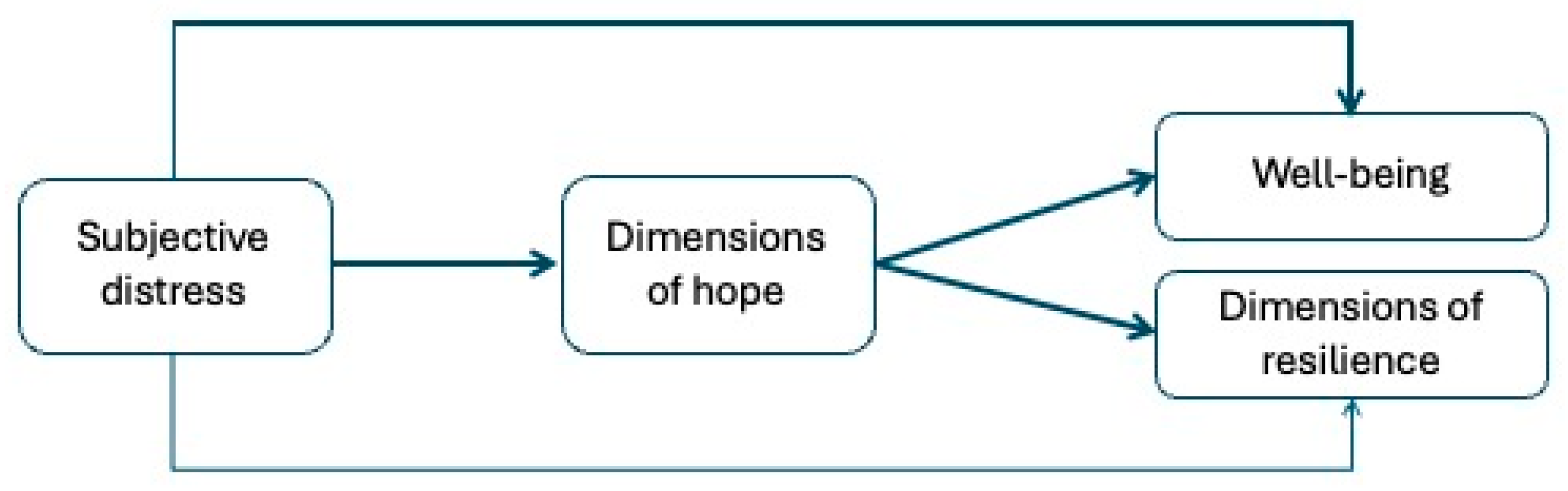
- Specific dimensions of hope mediate the relationship between stress resulting from negative life events and resilience and well-being.
- This mediation involves different hope components for adults and older adults, while spirituality appears to be non-significant in both groups.
- Hope can be increased, even in old age, through specific training to promote resil-ience and the recovery of well-being when dealing with stressful events.
- In training to enhance hope, specific aspects of the construct should be addressed to increase their effectiveness.
Abstract
1. Introduction
1.1. Hope in the Elderly
1.2. Hope and Spirituality
1.3. Hope Components as Possible Mediators of Well-Being
2. Aims of the Study
3. Materials and Methods
3.1. Participants and Procedure
3.2. Instruments
3.3. Data Analysis
4. Results
4.1. Differences by Gender, Age, Instruction and Living Conditions
4.2. Subjective Distress: Distribution and Differences in the Two Age Groups
4.3. Correlations
4.4. The Mediational Model
5. Discussion
6. Limitations
7. Conclusions
Author Contributions
Funding
Institutional Review Board Statement
Informed Consent Statement
Data Availability Statement
Conflicts of Interest
References
- Snyder, C.R. Handbook of Hope: Theory, Measures, and Applications; Academic Press: San Diego, CA, USA, 2000. [Google Scholar]
- Martin, A.M. Hopes and dreams. Philos. Phenom. Res. 2011, 83, 148–173. [Google Scholar] [CrossRef]
- Erikson, E.H. Identity and the Life Cycle; Selected Papers; International Universities Press: New York, NY, USA, 1959. [Google Scholar]
- Scioli, A.; Biller, H.B. Hope in the Age of Anxiety; Oxford University Press: New York, NY, USA, 2009. [Google Scholar]
- Bryant, F.B.; Cvengros, J.A. Distinguishing hope and optimism: Two sides of a coin, or two separate coins? J. Soc. Clin. Psychol. 2004, 23, 273–302. [Google Scholar] [CrossRef]
- Laranjeira, C.; Querido, A. Hope and optimism as an opportunity to improve the “Positive mental health” demand. Front. Psychol. 2022, 13, 827320. [Google Scholar] [CrossRef]
- Pleeging, E.; van Exel, J.; Burger, M. Characterizing hope: An interdisciplinary overview of the characteristics of hope. Appl. Res. Qual. Life 2021, 17, 1681–1723. [Google Scholar] [CrossRef]
- Bernardo, A.B. Extending hope theory: Internal and external locus of trait hope. Personal. Individ. Differ. 2010, 49, 944–949. [Google Scholar] [CrossRef]
- Seligman, M.E.P. Positive health. Appl. Psychol. 2008, 57, 3–18. [Google Scholar] [CrossRef]
- Kortte, K.B.; Stevenson, J.E.; Hosey, M.M.; Castillo, R.; Wegener, S.T. Hope predicts positive functional role outcomes in acute rehabilitation populations. Rehabil. Psychol. 2012, 57, 248–255. [Google Scholar] [CrossRef] [PubMed]
- Gottschalk, L.A. Hope and other deterrents to illness. Am. J. Psychother. 1985, 39, 515–524. [Google Scholar] [CrossRef]
- Breznitz, S. The effect of hope on coping with stress. In Dynamics of Stress: Physiological, Psychological, and Social Perspectives; Appley, M.H., Trumbull, R., Eds.; Plenum Press: New York, NY, USA, 1986; pp. 295–306. [Google Scholar]
- Scioli, A.; Samor, C.M.; Campbell, T.L.; Chamberlin, C.M.; Lapointe, A.B.; Macleod, A.R. A prospective study of hope, optimism and health. Psychol. Rep. 1997, 81, 723–733. [Google Scholar] [CrossRef]
- Liu, R.T.; Kleiman, E.M.; Nestor, B.A.; Cheek, S.M. The Hopelessness Theory of Depression: A Quarter Century in Review. Clin. Psychol. 2015, 22, 345–365. [Google Scholar] [CrossRef]
- Feldman, D.B.; Snyder, C.R. Hope and the meaningful life: Theoretical and empirical associations between goal–directed thinking and life meaning. J. Soc. Clin. Psychol. 2005, 24, 401–421. [Google Scholar] [CrossRef]
- Forbes, S.B. Hope: An essential human need in the elderly. J. Gerontol. Nurs. 1994, 20, 5–10. [Google Scholar] [CrossRef]
- Barnett, M.D. Future Orientation and Health Among Older Adults: The Importance of Hope. Educ. Gerontol. 2014, 40, 745–755. [Google Scholar] [CrossRef]
- Gupta, S.; Singh, A. The Study of Resilience and Hope among Elderly People. Indian J. Gerontol. 2020, 34, 343–352. [Google Scholar]
- Marques, S.; Gallagher, M.W. Age differences and short-term stability in hope: Results from a sample aged 15 to 80. J. Appl. Dev. Psychol. 2017, 53, 120–126. [Google Scholar] [CrossRef]
- Zhang, R.; Gao, Y.; Xie, P. The role of perceived social support for loneliness in the Chinese elderly: Hope and core self-evaluations as mediators. Curr. Psychol. 2023, 42, 29172–29178. [Google Scholar] [CrossRef]
- Moraitou, D.; Kolovou, C.; Papasozomenou, C.; Paschoula, C. Hope and adaptation to old age: Their relationship with individual-demographic factors. Soc. Indic. Res. 2006, 76, 71–93. [Google Scholar] [CrossRef]
- Oliver, A.; Tomás, J.M.; Montoro-Rodriguez, J. Dispositional hope and life satisfaction among older adults attending lifelong learning programs. Arch. Gerontol. Geriatr. 2017, 72, 80–85. [Google Scholar] [CrossRef]
- Schiavon, C.C.; Marchetti, E.; Gurgel, L.G.; Busnello, F.M.; Reppold, C.T. Optimism and hope in chronic disease: A systematic review. Front. Psychol. 2017, 7, 2022. [Google Scholar] [CrossRef]
- Duggleby, W.; Lee, H.; Nekolaichuk, C.; Fitzpatrick-Lewis, D. Systematic review of factors associated with hope in family carers of persons living with chronic illness. J. Adv. Nurs. 2021, 77, 3343–3360. [Google Scholar] [CrossRef]
- Long, K.N.; Kim, E.S.; Chen, Y.; Wilson, M.F.; Worthington, E.L., Jr.; VanderWeele, T.J. The role of hope in subsequent health and well-being for older adults: An outcome-wide longitudinal approach. Glob. Epidemiol. 2020, 2, 100018. [Google Scholar] [CrossRef]
- Fitzgerald Miller, J. Hope: A construct central to nursing. Nurs. Forum 2007, 42, 12–19. [Google Scholar] [CrossRef]
- Wills, M. Connection, action, and hope: An invitation to reclaim the “spiritual” in health care. J. Relig. Health 2007, 46, 423–436. [Google Scholar] [CrossRef]
- Scioli, A.; Ricci, M.; Nyugen, T.; Scioli, E.R. Hope: Its nature and measurement. Psychol. Relig. Spiritual. 2011, 3, 78–97. [Google Scholar] [CrossRef]
- Chen, Z.J.; Cowden, R.G.; Streib, H. More spiritual than religious: Concurrent and longitudinal relations with personality traits, mystical experiences, and other individual characteristics. Front. Psychol. 2023, 13, 1025938. [Google Scholar] [CrossRef]
- Davis, B. Mediators of the Relationship Between Hope and Well-Being in Older Adults. Clin. Nurs. Res. 2005, 14, 253–272. [Google Scholar] [CrossRef] [PubMed]
- Sharif, S.D.; Amiri, M.; Allen, K.A.; Nia, H.S.; Formani, F.K.; Matbue, Y.H.; Goudarzian, A.H.; Arefi, S.; Yaghoobzadeh, A.; Waheed, H. Attachment: The mediating role of hope, religiosity, and life satisfaction in older adults. Health Qual. Life Outcomes 2021, 19, 57. [Google Scholar] [CrossRef]
- Farran, C.J.; Herth, K.A.; Popovich, J.M. Hope and Hopelessness: Critical Clinical Constructs; Sage: Thousand Oaks, CA, USA, 1995. [Google Scholar]
- Unger, R.M. The Self Awakened: Pragmatism Unbound; Harvard University Press: Cambridge, MA, USA, 2007. [Google Scholar]
- Özdemir, A.A.; Buda, F.K.; Dural, G. The Relationship Between Spiritual Well-Being, Life Satisfaction and Hope in Elderly Individuals in Turkey. J. Relig. Health 2023, 63, 3123–3136. [Google Scholar] [CrossRef] [PubMed]
- Weingarten, K. Reasonable hope: Construct, clinical applications, and supports. Fam. Process 2010, 49, 5–25. [Google Scholar] [CrossRef] [PubMed]
- Ricoeur, P. Figuring the Sacred: Religion, Narrative, and Imagination; Augsburg Fortress: Minneapolis, MN, USA, 1995. [Google Scholar]
- Webb, D. Modes of Hoping. Hist. Hum. Sci. 2007, 20, 65–83. [Google Scholar] [CrossRef]
- Paykel, E.S.; Prusoff, B.A.; Uhlenhuth, E.H. Scaling of life events. Arch. Gen. Psychiatry 1971, 25, 340–347. [Google Scholar] [CrossRef]
- Horowitz, M.M.D.; Wilner, N.B.A.; Alvarez, W.M.A. Impact of Event Scale: A Measure of Subjective Stress. Psychosom. Med. 1979, 41, 209–218. [Google Scholar] [CrossRef]
- Magnano, P.; Di Nuovo, S.; Scioli, A.; Di Corrado, D. A study of the Comprehensive State Hope Scale in Italian culture. TPM Test. Psychom. Methodol. Appl. Psychol. 2019, 26, 287–304. [Google Scholar] [CrossRef]
- Friborg, O.; Martinussen, M.; Rosenvinge, J.H. Likert-based vs. semantic differential-based scorings of positive psychological constructs: A psychometric comparison of two versions of a scale measuring resilience. Personal. Individ. Differ. 2006, 40, 873–884. [Google Scholar] [CrossRef]
- Laudadio, A.; Mazzocchetti, L.; Fiz, F.J. Valutare la Resilienza. Teorie, Modelli e Strumenti; Carocci: Rome, Italy, 2011. [Google Scholar]
- Marsh, H.W.; Huppert, F.A.; Donald, J.N.; Horwood, M.S.; Sahdra, B.K. The well-being profile (WB-Pro): Creating a theoretically based multidimensional measure of well-being to advance theory, research, policy, and practice. Psychol. Assess. 2020, 32, 294–313. [Google Scholar] [CrossRef] [PubMed]
- Scalas, L.F.; Lodi, E.; Magnano, P.; Marsh, H.W. Towards a multidimensional measure of well-being: Cross-cultural support through the Italian validation of the Well-Being Profile. BMC Psychol. 2023, 11, 441. [Google Scholar] [CrossRef]
- Schafer, J.L.; Graham, J.W. Missing data: Our view of the state of the art. Psychol. Methods 2002, 7, 147–177. [Google Scholar] [CrossRef] [PubMed]
- Traub, R.E. Reliability for the Social Sciences: Theory and Applications; SAGE Publications: Thousand Oaks, CA, USA, 1994. [Google Scholar]
- Kline, P. The Handbook of Psychological Testing, 2nd ed.; Routledge: London, UK, 1999. [Google Scholar]
- IBM Corp. IBM SPSS Statistics for Windows, Version 25; IBM Corp: Armonk, NY, USA, 2017.
- The Jamovi Project. Jamovi, Version 2.5 [Computer Software]. 2024. Available online: https://www.jamovi.org (accessed on 1 October 2025).
- Preacher, K.J.; Hayes, A.F. SPSS and SAS procedures for estimating indirect effects in simple mediation models. Behav. Res. Methods Instrum. Comput. 2004, 36, 717–731. [Google Scholar] [CrossRef]
- Fritz, M.S.; MacKinnon, D.P. Required sample size to detect the mediated effect. Psychol. Sci. 2007, 18, 233–239. [Google Scholar] [CrossRef]
- Cohen, J. Statistical Power Analysis for the Behavioral Sciences; Routledge: New York, NY, USA, 2013. [Google Scholar]
- Thornstam, L. Gerotranscendence: A Developmental Theory of Positive Aging; Springer: New York, NY, USA, 2005. [Google Scholar]
- Jewell, A.J. Tornstam’s notion of gerotranscendence: Re-examining and questioning the theory. J. Aging Stud. 2014, 30, 112–120. [Google Scholar] [CrossRef]
- McCarty, V.L.; Bockweg, A. The role of transcendence in a holistic view of successful aging. A concept analysis and model of transcendence in maturation and aging. J. Holist. Nurs. 2012, 31, 84–92. [Google Scholar] [CrossRef]
- Huss, B. Spirituality: The emergence of a new cultural category and its challenge to the religious and the secular. J. Contemp. Relig. 2014, 29, 47–60. [Google Scholar] [CrossRef]
- Ammerman, N.T. Spiritual but not religious? Beyond binary choices in the study of religion. J. Sci. Stud. Relig. 2013, 52, 258–278. [Google Scholar] [CrossRef]
- Steensland, B.; Wang, X.; Schmidt, L.C. Spirituality: What does it mean and to whom? J. Sci. Stud. Relig. 2018, 57, 450–472. [Google Scholar] [CrossRef]
- Wixwat, M.; Saucier, G. Being spiritual but not religious. Curr. Opin. Psychol. 2021, 40, 121–125. [Google Scholar] [CrossRef]
- Wienand, I.; Rakic, M.; Eckstein, S.; Escher, M.; Pacurari, N.; Zwahlen, S.; Elger, B. The variety of hope: Findings in palliative care patients’ medical records. Spir. Care 2018, 7, 181–185. [Google Scholar] [CrossRef]
- Ciarrocchi, J.W.; Deneke, E. Hope, optimism, pessimism and spirituality as predictors of well-being controlling for personality. Res. Soc. Sci. Study Relig. 2006, 16, 161–183. [Google Scholar]
- Bergin, L.; Walsh, S. The role of hope in psychotherapy with older adults. Aging Ment. Health 2005, 9, 7–15. [Google Scholar] [CrossRef] [PubMed]
- Hernandez, S.C.; Overholser, J.C. A systematic review of interventions for hope/hopelessness in older adults. Clin. Gerontol. 2020, 44, 97–111. [Google Scholar] [CrossRef] [PubMed]
- Chochinov, H.M.; Cann, B.; Cullihall, K.; Kristjanson, L.; Harlos, M.; McClement, S.E.; Hack, T.F.; Hassard, T. Dignity therapy: A feasibility study of elders in long-term care. Palliat. Support. Care 2012, 10, 3–15. [Google Scholar] [CrossRef] [PubMed]
- Cheavens, J.S.; Whitted, M. Hope therapy. Curr. Opin. Psychol. 2023, 49, 101509. [Google Scholar] [CrossRef] [PubMed]
- Lopez, S.J.; Floyd, R.K.; Ulven, J.C.; Snyder, C.R. Hope Therapy: Helping Clients Build a House of Hope. In Handbook of Hope: Theory, Measures, and Applications; Snyder, C.R., Ed.; Academic Press: San Diego, CA, USA, 2000; pp. 123–150. [Google Scholar] [CrossRef]
- Sabzmeydani, F. Group Hope Therapy Effectiveness on Feeling of Loneliness in Elderly Women. J. Appl. Psychol. Behav. Sci. 2017, 2, 60–63. [Google Scholar]

| Adults (50–65 Years) N = 52 | Elderly (>66 Years) N = 48 | Mean Dif. | Cohen’s d | t | p | |||
|---|---|---|---|---|---|---|---|---|
| M | SD | M | SD | |||||
| 1. CHS Spirituality | 2.321 | 1.070 | 2.453 | 1.009 | −0.133 | −0.127 | −0.636 | 0.525 |
| 2. CHS Relation/social support | 3.191 | 0.804 | 3.144 | 0.716 | 0.047 | 0.061 | 0.305 | 0.761 |
| 3. CHS Trust | 3.962 | 0.684 | 3.677 | 0.877 | 0.284 | 0.364 | 1.817 | 0.072 |
| 4. CHS Self-realization | 3.160 | 0.757 | 2.889 | 0.696 | 0.271 | 0.372 | 1.861 | 0.066 |
| 5. WBP | 6.867 | 1.362 | 6.182 | 1.345 | 0.685 | 0.506 | 2.527 | 0.013 |
| 6. RSA Social support | 3.862 | 0.727 | 3.597 | 0.861 | −0.265 | −0.334 | −1.667 | 0.099 |
| 7. RSA Future perception | 3.712 | 0.813 | 3.193 | 0.961 | −0.519 | −0.585 | −2.923 | 0.004 |
| 8. RSA Family cohesion | 3.858 | 0.816 | 3.346 | 0.807 | −0.512 | −0.631 | −3.151 | 0.002 |
| 9. RSA Personal competence | 3.849 | 0.700 | 3.431 | 0.898 | −0.419 | −0.522 | −2.611 | 0.010 |
| 10. RSA Social competence | 3.685 | 0.784 | 3.396 | 0.870 | −0.289 | −0.350 | −1.747 | 0.084 |
| 11. RSA Personal structure | 2.244 | 0.968 | 2.271 | 0.841 | 0.027 | 0.030 | 0.150 | 0.881 |
| 12. Subjective distress | 0.211 | 0.120 | 0.210 | 0.111 | 0.001 | 0.007 | 0.037 | 0.971 |
| Lower School N = 24 | High School N = 33 | University Degree N = 43 | F | p | ||||
|---|---|---|---|---|---|---|---|---|
| M | SD | M | SD | M | SD | |||
| 1. CHS Spirituality | 2.531 | 0.708 | 2.394 | 1.161 | 2.295 | 1.104 | 0.398 | 0.673 |
| 2. CHS Relation/social support | 2.833 | 0.753 | 3.226 | 0.699 | 3.311 | 0.768 | 3.335 | 0.040 |
| 3. CHS Trust | 3.630 | 0.896 | 3.894 | 0.710 | 3.881 | 0.789 | 0.959 | 0.387 |
| 4. CHS Self-realization | 2.618 | 0.568 | 3.091 | 0.651 | 3.213 | 0.805 | 5.671 | 0.005 |
| 5. WBP | 5.691 | 1.461 | 6.827 | 1.420 | 6.789 | 1.144 | 6.525 | 0.002 |
| 6. RSA Social support | 2.535 | 0.921 | 2.162 | 0.857 | 2.194 | 0.659 | 1.835 | 0.165 |
| 7. RSA Future perception | 2.729 | 0.992 | 2.462 | 0.859 | 2488 | 0.931 | 0.689 | 0.505 |
| 8. RSA Family cohesion | 2.717 | 0.958 | 2.254 | 0.839 | 2.307 | 0.756 | 2.483 | 0.089 |
| 9. RSA Personal competence | 2.389 | 0.806 | 2.232 | 0.796 | 2.422 | 0.865 | 0.523 | 0.594 |
| 10. RSA Social competence | 2.742 | 0.851 | 2.364 | 0.887 | 2.3628 | 0.764 | 1.911 | 0.154 |
| 11. RSA Personal structure | 3.431 | 0.752 | 3.636 | 1.068 | 4.000 | 0.787 | 3.570 | 0.032 |
| 12. Subjective distress | 0.260 | 0.085 | 0.217 | 0.120 | 0.179 | 0.119 | 4.080 | 0.020 |
| 1 | 2 | 3 | 4 | 5 | 6 | 7 | 8 | 9 | 10 | 11 | 12 | 13 | |
|---|---|---|---|---|---|---|---|---|---|---|---|---|---|
| 1. CHS Spirituality | 1 | ||||||||||||
| 2. CHS Relation/social support | 0.157 | 1 | |||||||||||
| 3. CHS Trust | −0.198 * | 0.182 | 1 | ||||||||||
| 4. CHS Self-realization | 0.131 | 0.585 *** | 0.258 ** | 1 | |||||||||
| 5. WBP | 0.068 | 0.397 *** | 0.541 *** | 0.547 *** | 1 | ||||||||
| 6. RSA Social support | 0.014 | 0.643 *** | 0.394 *** | 0.306 ** | 0.491 *** | 1 | |||||||
| 7. RSA Future perception | 0.002 | 0.388 *** | 0.555 *** | 0.542 *** | 0.656 *** | 0.446 *** | 1 | ||||||
| 8. RSA Family cohesion | 0.046 | 0.522 *** | 0.468 *** | 0.385 *** | 0.566 *** | 0.687 *** | 0.487 *** | 1 | |||||
| 9. RSA Personal competence | −0.012 | 0.326 *** | 0.536 *** | 0.481 *** | 0.642 *** | 0.503 *** | 0.675 *** | 0.547 *** | 1 | ||||
| 10. RSA Social competence | 0.051 | 0.348 *** | 0.518 *** | 0.324 ** | 0.568 *** | 0.526 *** | 0.458 *** | 0.532 *** | 0.587 *** | 1 | |||
| 11. RSA Personal structure | 0.023 | −0.267 ** | −0.074 | −0.284 ** | −0.251 * | −0.313 ** | −0.233 * | −0.228 * | −0.200 * | −0.138 | 1 | ||
| 12. Subjective distress | 0.092 | −0.083 | −0.372 *** | −0.266 ** | −0.281 ** | 0.015 | −0.204 * | −0.124 | −0.111 | −0.195 | 0.136 | 1 | |
| 13. Age | 0.147 | −0.180 | −0.189 | −0.321 ** | −0.383 *** | −0.187 | −0.290 ** | −0.375 *** | −0.260 ** | −0.214 * | 0.063 | 0.124 | 1 |
| M | 2.384 | 3.168 | 3.825 | 3.030 | 6.538 | 2.265 | 2.538 | 2.388 | 2.352 | 2.454 | 3.743 | 0.211 | 66.08 |
| SD | 1.038 | 0.759 | 0.791 | 0.738 | 1.391 | 0.801 | 0.920 | 0.848 | 0.825 | 0.835 | 0.905 | 0.115 | 8.485 |
| Skewness | 0.318 | −0.260 | −0.474 | −0.060 | −0.700 | 0.357 | 0.478 | 0.195 | 0.539 | 0.085 | −0.369 | 0.041 | 0.496 |
| Kurtosis | −0.815 | 0.341 | −0.793 | −0.394 | −0.033 | −0.802 | −0.158 | −0.728 | 0.131 | −0.733 | −0.491 | −0.791 | −0.252 |
| Shapiro-Wilk W | 0.947 | 0.988 | 0.946 | 0.987 | 0.956 | 0.958 | 0.966 | 0.968 | 0.969 | 0.967 | 0.946 | 0.970 | 0.968 |
| Shapiro–Wilk p | <0.001 | 0.529 | <0.001 | 0.465 | 0.002 | 0.003 | 0.011 | 0.015 | 0.019 | 0.014 | <0.001 | 0.022 | 0.014 |
| Paths | Indirect Effect | C.I. (95%) | p |
|---|---|---|---|
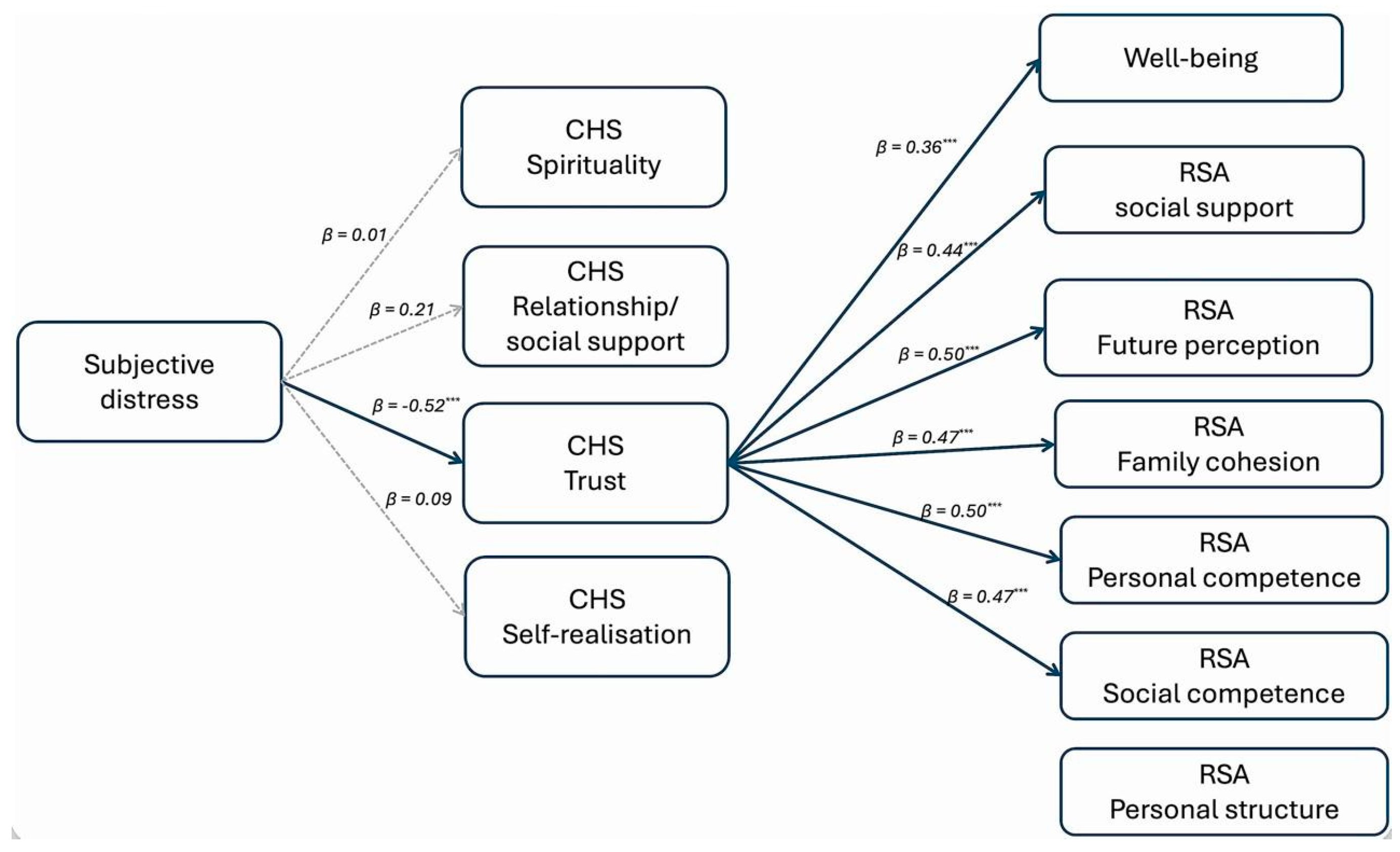
| Subjective distress–trust–well-being | −0.18 | −13.90; 0.11 | 0.023 |
| Subjective distress–trust–social support | 0.22 | 0.62; 2.99 | 0.004 |
| Subjective distress–trust–future perception | 0.26 | 0.63; 2.34 | 0.002 |
| Subjective distress–trust–family cohesion | 0.24 | 0.59; 3.07 | 0.006 |
| Subjective distress–trust–personal competence | 0.26 | 0.65; 3.51 | 0.005 |
| Subjective distress–trust–social competence | 0.24 | 0.30; 2.87 | 0.010 |
| Paths | Indirect Effect | C.I. (95%) | p |
|---|---|---|---|
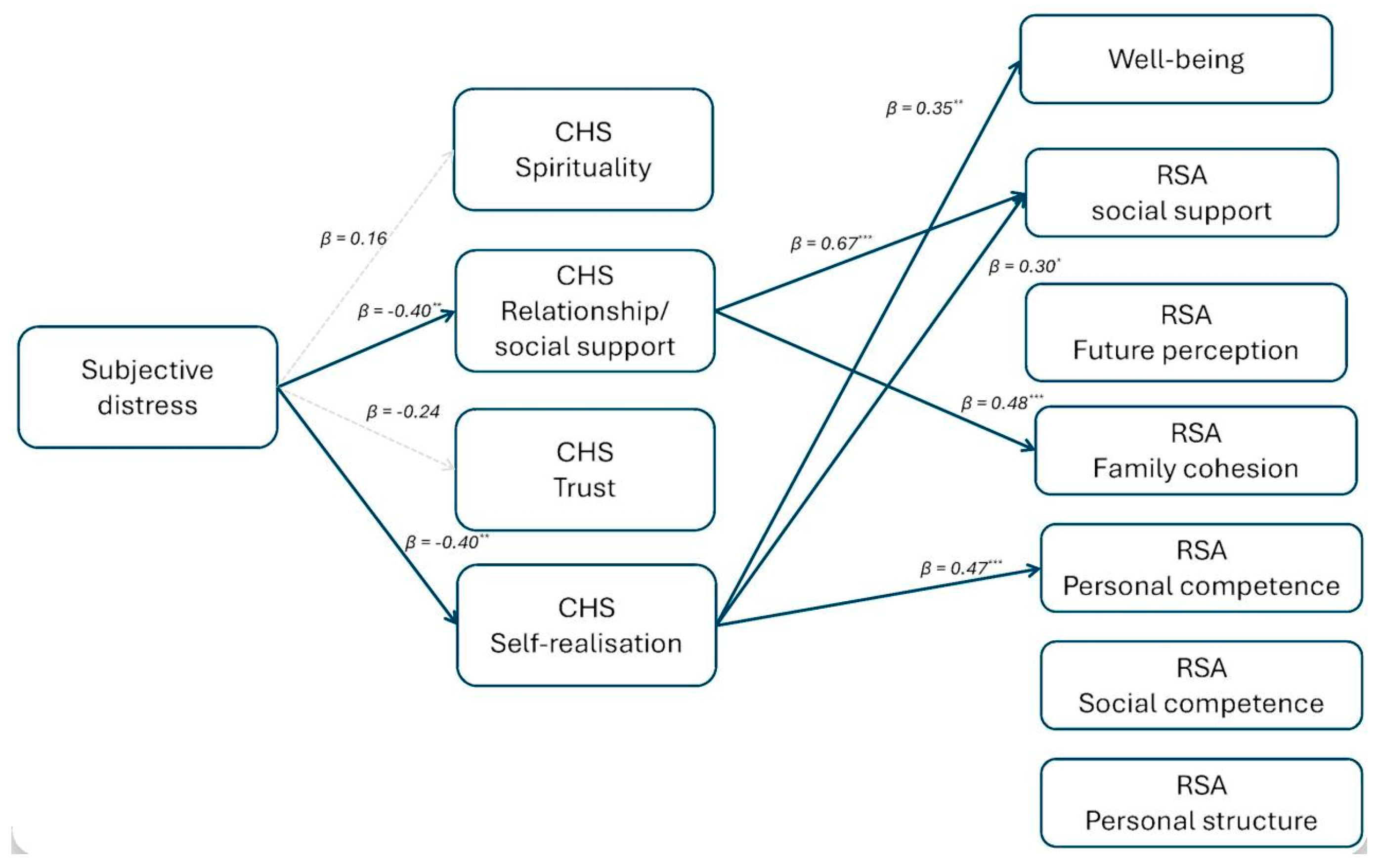
| Subjective distress–self-realisation–well-being | 0.14 | 10.13; 0.91 | 0.031 |
| Subjective distress–self-realisation–personal competence | 0.17 | 0.34; 3.45 | 0.029 |
| Subjective distress–relationship/social support–social support | 0.27 | 0.69; 4.85 | 0.007 |
| Subjective distress–relationship/social support–family cohesion | 0.19 | 0.28; 3.09 | 0.017 |
Disclaimer/Publisher’s Note: The statements, opinions and data contained in all publications are solely those of the individual author(s) and contributor(s) and not of MDPI and/or the editor(s). MDPI and/or the editor(s) disclaim responsibility for any injury to people or property resulting from any ideas, methods, instructions or products referred to in the content. |
© 2025 by the authors. Licensee MDPI, Basel, Switzerland. This article is an open access article distributed under the terms and conditions of the Creative Commons Attribution (CC BY) license (https://creativecommons.org/licenses/by/4.0/).
Share and Cite
Di Nuovo, S.; Ugolini, C.; Zarbo, R.; Magnano, P. Dimensions of Hope as Mediators Between Negative Events and Recovery of Well-Being in Adults and Elderly. Healthcare 2025, 13, 3259. https://doi.org/10.3390/healthcare13243259
Di Nuovo S, Ugolini C, Zarbo R, Magnano P. Dimensions of Hope as Mediators Between Negative Events and Recovery of Well-Being in Adults and Elderly. Healthcare. 2025; 13(24):3259. https://doi.org/10.3390/healthcare13243259
Chicago/Turabian StyleDi Nuovo, Santo, Caterina Ugolini, Rita Zarbo, and Paola Magnano. 2025. "Dimensions of Hope as Mediators Between Negative Events and Recovery of Well-Being in Adults and Elderly" Healthcare 13, no. 24: 3259. https://doi.org/10.3390/healthcare13243259
APA StyleDi Nuovo, S., Ugolini, C., Zarbo, R., & Magnano, P. (2025). Dimensions of Hope as Mediators Between Negative Events and Recovery of Well-Being in Adults and Elderly. Healthcare, 13(24), 3259. https://doi.org/10.3390/healthcare13243259

