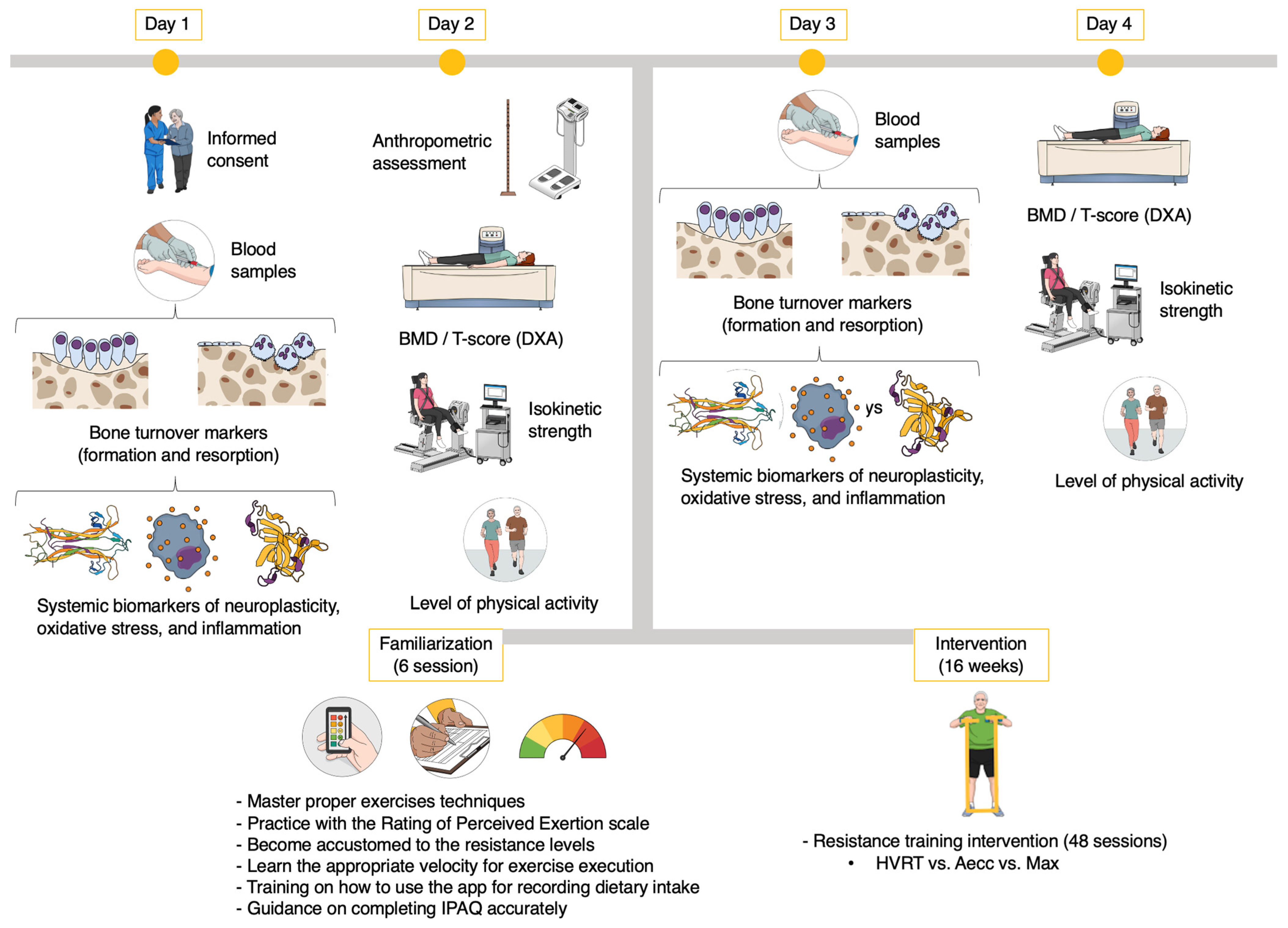
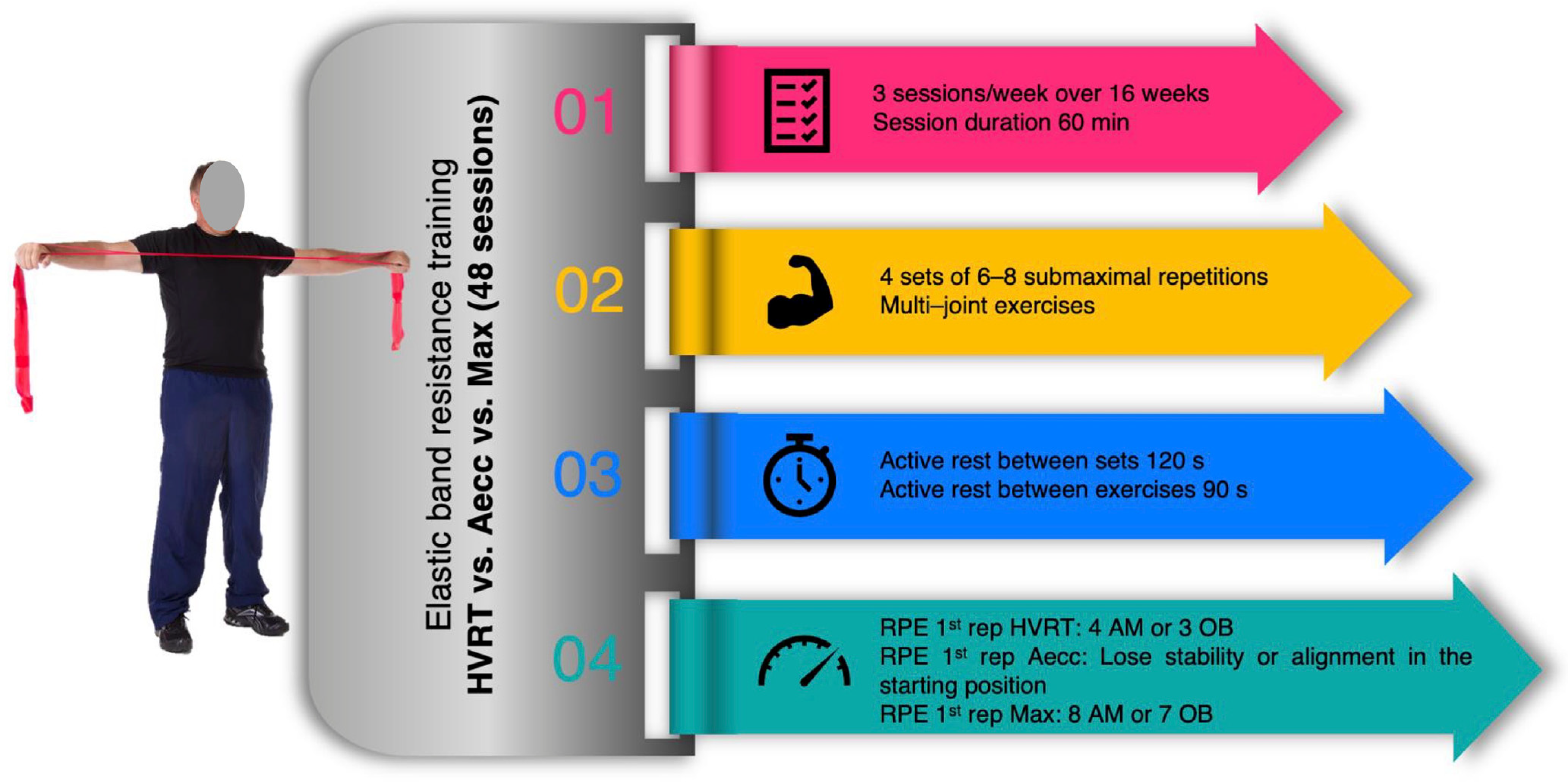
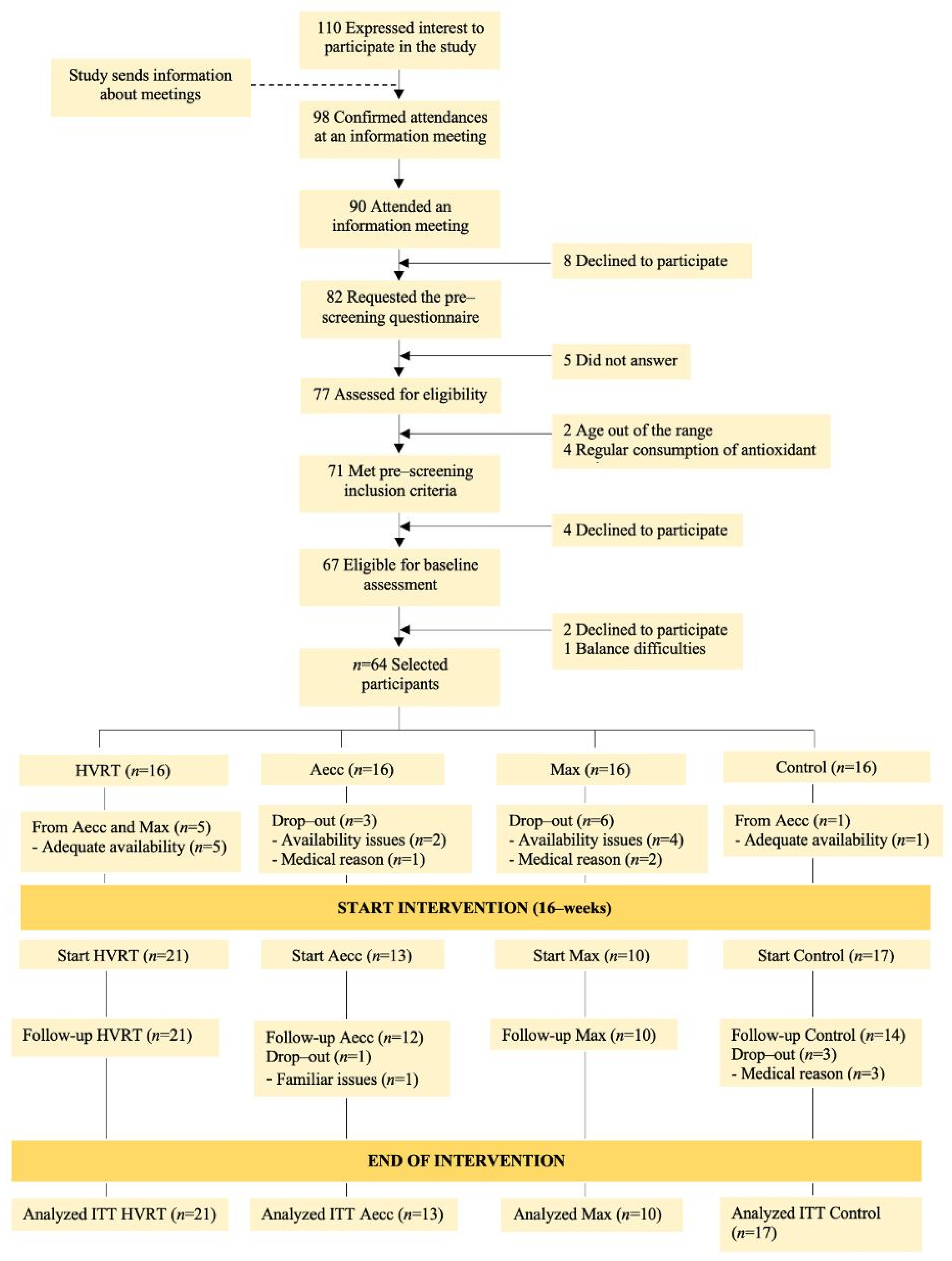
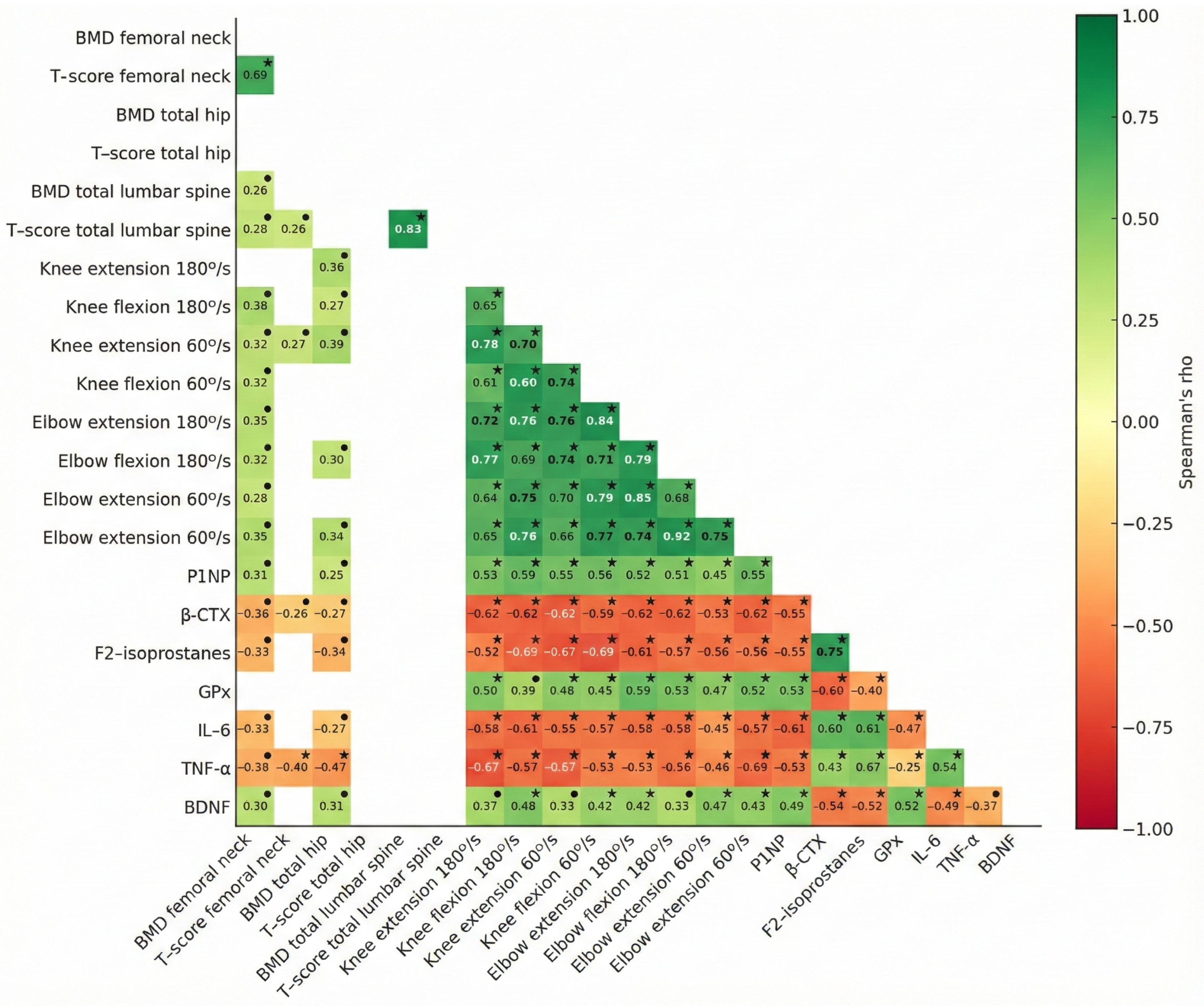
High-Velocity, Accentuated Eccentric, or Maximal Elastic Band Resistance Training? Effects of Resistance Training Modalities on Bone Health, Isokinetic Strength, and Systemic Biomarkers in Sedentary Older Adults: A Comparative Study

 ,
,  , ,
, ,  ,
,  , , , ,
  , , and
Abstract
1. Introduction
2. Materials and Methods
2.1. Study Design
2.2. Participants
2.3. Randomization and Blinding
2.4. Testing Procedures
2.4.1. General Testing Protocol
2.4.2. Bone Health
2.4.3. Neuromuscular Strength of Knee and Elbow
2.4.4. Collection and Processing of Blood Samples
2.4.5. Anthropometric Measurements
2.4.6. Dietary and Physical Activity Control (Potential Confounder Variables)
2.4.7. Compliance and Safety
2.5. Training Procedures
2.5.1. Familiarization
2.5.2. Training Programs
- A.
- High-velocity elastic band resistance training program (HVRT)
- B.
- Accentuated eccentric elastic band resistance training program (Aecc)
- C.
- Maximal strength elastic band resistance training program (Max)
- D.
- Control group
2.6. Statistical Analysis
2.7. Sample Size Determination
3. Results
3.1. Participant Flow and Baseline Characteristics
3.2. Program Feasibility and Safety: Compliance, and Adverse Events
3.3. Bone Health Outcomes
3.3.1. Bone Turnover Biomarkers
3.3.2. BMD and T-Score of Femoral Neck, Total Spine, and Total Lumbar Spine
3.4. Isokinetic Strength Outcomes
3.5. Systemic Biomarkers of Oxidative Stress, Inflammation, and Neuroplasticity Outcomes
3.5.1. Oxidative Stress
3.5.2. Inflammation
3.5.3. Neuroplasticity
3.6. Association Between Variables (Spearman ρ)
4. Discussion
4.1. Bone Remodeling Induced by HVRT, Aecc, and Max: A Comparative Analysis
4.2. Resistance Training Modalities and Their Differential Impact on Isokinetic Function
4.3. Redox Dose-Response: Which Strength Training Modality Provides Greater Cellular Protection?
4.4. BDNF in Older Adults: Adaptive Differences According to Resistance Training Modality
5. Conclusions
Supplementary Materials
Author Contributions
Funding
Institutional Review Board Statement
Informed Consent Statement
Data Availability Statement
Conflicts of Interest
Abbreviations
| EB-RT | Elastic band resistance training |
| HVRT | High-velocity resistance training |
| Aecc | Accentuated eccentric resistance training |
| Max | Maximal resistance training |
| OMNI-RES EB | OMNI-RES elastic band scale |
| 1RM | One-repetition maximum |
| RPE–1 | Rating of perceived exertion in the first repetition |
| BDNF | Brain-derived neurotrophic factor |
| GPx | Glutathione peroxidase |
| P1NP | Type I procollagen N-terminal propeptide |
| β-CTX | Beta C-terminal cross-linked telopeptide of type I collagen |
| RT | Resistance training |
| BMD | Bone mineral density |
| BTMs | Bone turnover markers |
| RFD | Rate of force development |
| TrkB | Tyrose receptor kinase B |
| RANKL | Receptor activator of nuclear factor kappa beta |
| IL-6 | Interleukin–6 |
| TNF-α | Tumor necrosis factor alpha |
| NSAIDs | Non-steroidal anti-inflammatory drugs |
| DXA | Fan-beam dual-energy X-ray absorptiometry |
| ELISA | Enzyme-linked immunosorbent assay |
| CLSI | Clinical and Laboratory Standards Institute |
| BMI | Body mass index |
| IPAQ | International Physical Activity Questionnaire |
| ACSM | American College of Sports Medicine |
| SD | Standard deviation |
| ANOVA | Analysis of variance |
| ANCOVA | Analysis of covariance |
| LSD | Least significant difference |
| ES | Effect size |
| AMPK | AMP-activated protein kinase |
| PGC–1α | Peroxisome proliferator-activated receptor gamma coactivator 1alpha |
| HR-pQCTD | High-resolution peripheral quantitative computed tomography |
| fMRI | Functional magnetic resonance imaging |
| EEG | Electroencephalogram |
References
- Inoue, T.; Maeda, K.; Satake, S.; Matsui, Y.; Arai, H. Osteosarcopenia, the Co-Existence of Osteoporosis and Sarcopenia, Is Associated with Social Frailty in Older Adults. Aging Clin. Exp. Res. 2022, 34, 535–543. [Google Scholar] [CrossRef]
- Massini, D.A.; Nedog, F.H.; de Oliveira, T.P.; Almeida, T.A.F.; Santana, C.A.A.; Neiva, C.M.; Macedo, A.G.; Castro, E.A.; Espada, M.C.; Santos, F.J.; et al. The Effect of Resistance Training on Bone Mineral Density in Older Adults: A Systematic Review and Meta-Analysis. Healthcare 2022, 10, 1129. [Google Scholar] [CrossRef]
- Saez-Berlanga, A.; Gargallo, P.; Gene-Morales, J.; Babiloni, C.; Colado, J.C.; Juesas, A. Multicomponent Elastic Training Improves Short-Term Body Composition and Balance in Older Women. Sci. J. Sport Perform. 2022, 1, 4–13. [Google Scholar] [CrossRef]
- Freitas, S.R.; Cruz-Montecinos, C.; Ratel, S.; Pinto, R.S. Powerpenia Should Be Considered a Biomarker of Healthy Aging. Sports Med. Open 2024, 10, 27. [Google Scholar] [CrossRef]
- Jiménez-Lupión, D.; Chirosa-Ríos, L.; Martínez-García, D.; Rodríguez-Pérez, M.; Jerez-Mayorga, D. Effects of Power Training on Functional Capacity Related to Fall Risk in Older Adults: A Systematic Review and Meta-Analysis. Arch. Phys. Med. Rehabil. 2023, 104, 1514–1525. [Google Scholar] [CrossRef]
- Haque, I.; Schlacht, T.Z.; Skelton, D.A. The Effects of High Velocity Resistance Training on Bone Mineral Density in Older Adults: A Systematic Review. Bone 2024, 179, 116986. [Google Scholar] [CrossRef] [PubMed]
- Rong, W.; Geok, S.K.; Samsudin, S.; Zhao, Y.; Ma, H.; Zhang, X. Effects of Strength Training on Neuromuscular Adaptations in the Development of Maximal Strength: A Systematic Review and Meta-Analysis. Sci. Rep. 2025, 15, 19315. [Google Scholar] [CrossRef] [PubMed]
- Cheng, Y.; Yi, Y.; Bo, S.; Mao, J.; Ma, J. Optimization of High-Intensity Resistance Exercise Protocols for Improving Bone Mineral Density in the Elderly without Chronic Diseases: A Systematic Review and Network Meta-Analysis. Front. Physiol. 2025, 16, 1589200. [Google Scholar] [CrossRef] [PubMed]
- Bloch-Ibenfeldt, M.; Theil Gates, A.; Karlog, K.; Demnitz, N.; Kjaer, M.; Boraxbekk, C.-J. Heavy Resistance Training at Retirement Age Induces 4-Year Lasting Beneficial Effects in Muscle Strength: A Long-Term Follow-up of an RCT. BMJ Open Sport Exerc. Med. 2024, 10, e001899. [Google Scholar] [CrossRef]
- Baxter, B.A.; Baross, A.W.; Ryan, D.J.; Tkadlec, S.; Kay, A.D. Effects of Once- versus Twice-Weekly Eccentric Resistance Training on Muscular Function and Structure in Older Adults: A Randomised Controlled Trial. Sci. Rep. 2024, 14, 9638. [Google Scholar] [CrossRef]
- Quinlan, J.I.; Narici, M.V.; Reeves, N.D.; Franchi, M.V. Tendon Adaptations to Eccentric Exercise and the Implications for Older Adults. J. Funct. Morphol. Kinesiol. 2019, 4, 60. [Google Scholar] [CrossRef]
- Singh, H.; Moore, B.A.; Rathore, R.; Reed, W.R.; Thompson, W.R.; Fisher, G.; Lein, D.H.; Hunter, G.R. Skeletal Effects of Eccentric Strengthening Exercise: A Scoping Review. BMC Musculoskelet. Disord. 2023, 24, 611, Erratum in BMC Musculoskelet. Disord. 2023, 24, 696. [Google Scholar] [CrossRef]
- Colard, J.; Betus, Y.; Tallio, T.; Bizet, B.; Nordez, A.; Jubeau, M.; Cattagni, T. Eccentric Training at Long Muscle Lengths Induces Greater Corticospinal and Spinal Reflex Plasticity than Eccentric Training at Short Muscle Lengths. Exp. Physiol. 2025, 110, 1990–2006. [Google Scholar] [CrossRef]
- Schini, M.; Vilaca, T.; Gossiel, F.; Salam, S.; Eastell, R. Bone Turnover Markers: Basic Biology to Clinical Applications. Endocr. Rev. 2023, 44, 417–473. [Google Scholar] [CrossRef] [PubMed]
- Radaelli, R.; Trajano, G.S.; Freitas, S.R.; Izquierdo, M.; Cadore, E.L.; Pinto, R.S. Power Training Prescription in Older Individuals: Is It Safe and Effective to Promote Neuromuscular Functional Improvements? Sports Med. 2023, 53, 569–576. [Google Scholar] [CrossRef] [PubMed]
- Alix-Fages, C.; Del Vecchio, A.; Baz-Valle, E.; Santos-Concejero, J.; Balsalobre-Fernández, C. The Role of the Neural Stimulus in Regulating Skeletal Muscle Hypertrophy. Eur. J. Appl. Physiol. 2022, 122, 1111–1128. [Google Scholar] [CrossRef]
- Cheng, X.; Yang, Z. Effect of Resistance Training on Inflammatory Markers in Middle-Aged and Older Adults: A Meta-Analysis. Arch. Gerontol. Geriatr. 2024, 126, 105536. [Google Scholar] [CrossRef]
- Li, D.; Zhao, Z.; Zhu, L.; Feng, H.; Song, J.; Fu, J.; Li, J.; Chen, Z.; Fu, H. 7,8-DHF Inhibits BMSC Oxidative Stress via the TRKB/PI3K/AKT/NRF2 Pathway to Improve Symptoms of Postmenopausal Osteoporosis. Free Radic. Biol. Med. 2024, 223, 413–429, Erratum in Free Radic. Biol. Med. 2025, 228, 405–406. [Google Scholar] [CrossRef]
- Cordeiro, L.D.S.; Linhares, D.G.; Castro, J.B.P.D.; Oliveira Barros Dos Santos, A.; Lima Dos Santos, L.; César Pereira Salustiano Mallen Da, G.; Gomes De Souza Vale, R. Impacts of Resistance Training on Endogenous Antioxidants in Older Individuals: A Systematic Review and Meta-Analysis of Randomized Controlled Trials. J. Phys. Act. Health 2025, 22, 407–417. [Google Scholar] [CrossRef] [PubMed]
- Kostka, M.; Morys, J.; Małecki, A.; Nowacka-Chmielewska, M. Muscle-Brain Crosstalk Mediated by Exercise-Induced Myokines—Insights from Experimental Studies. Front. Physiol. 2024, 15, 1488375. [Google Scholar] [CrossRef]
- Setayesh, S.; Mohammad Rahimi, G.R. The Impact of Resistance Training on Brain-Derived Neurotrophic Factor and Depression among Older Adults Aged 60 Years or Older: A Systematic Review and Meta-Analysis of Randomized Controlled Trials. Geriatr. Nurs. 2023, 54, 23–31. [Google Scholar] [CrossRef] [PubMed]
- Park, E.J.; Truong, V.-L.; Jeong, W.-S.; Min, W.-K. Brain-Derived Neurotrophic Factor (BDNF) Enhances Osteogenesis and May Improve Bone Microarchitecture in an Ovariectomized Rat Model. Cells 2024, 13, 518. [Google Scholar] [CrossRef]
- Xue, F.; Zhao, Z.; Gu, Y.; Han, J.; Ye, K.; Zhang, Y. 7,8-Dihydroxyflavone Modulates Bone Formation and Resorption and Ameliorates Ovariectomy-Induced Osteoporosis. eLife 2021, 10, e64872. [Google Scholar] [CrossRef]
- Palmisano, B.; Farinacci, G.; Campolo, F.; Tavanti, C.; Stefano, A.; Donsante, S.; Ippolito, E.; Giannicola, G.; Venneri, M.A.; Corsi, A.; et al. A Pathogenic Role for Brain-Derived Neurotrophic Factor (BDNF) in Fibrous Dysplasia of Bone. Bone 2024, 181, 117047. [Google Scholar] [CrossRef]
- Slart, R.H.J.A.; Punda, M.; Ali, D.S.; Bazzocchi, A.; Bock, O.; Camacho, P.; Carey, J.J.; Colquhoun, A.; Compston, J.; Engelke, K.; et al. Updated Practice Guideline for Dual-Energy X-Ray Absorptiometry (DXA). Eur. J. Nucl. Med. Mol. Imaging 2025, 52, 539–563. [Google Scholar] [CrossRef]
- Themeli, T.; Triantafyllopoulos, I.K. Choosing the Site to Estimate Bone Mineral Density with DXA Method. J. Res. Pract. Musculoskelet. Syst. 2021, 5, 79–87. [Google Scholar] [CrossRef]
- Steffl, M.; Stastny, P.; Bohannon, R. Isokinetic Testing of Muscle Strength of Older Individuals with Sarcopenia or Frailty: A Systematic Review. Isokinet. Exerc. Sci. 2020, 28, 291–301. [Google Scholar] [CrossRef]
- Evenepoel, C.; Clevers, E.; Deroover, L.; Van Loo, W.; Matthys, C.; Verbeke, K. Accuracy of Nutrient Calculations Using the Consumer-Focused Online App MyFitnessPal: Validation Study. J. Med. Internet Res. 2020, 22, e18237. [Google Scholar] [CrossRef]
- Craig, C.L.; Marshall, A.L.; Sjöström, M.; Bauman, A.E.; Booth, M.L.; Ainsworth, B.E.; Pratt, M.; Ekelund, U.; Yngve, A.; Sallis, J.F.; et al. International Physical Activity Questionnaire: 12-Country Reliability and Validity. Med. Sci. Sports Exerc. 2003, 35, 1381–1395. [Google Scholar] [CrossRef]
- Colado, J.C.; Pedrosa, F.M.; Juesas, A.; Gargallo, P.; Carrasco, J.J.; Flandez, J.; Chupel, M.U.; Teixeira, A.M.; Naclerio, F. Concurrent Validation of the OMNI-Resistance Exercise Scale of Perceived Exertion with Elastic Bands in the Elderly. Exp. Gerontol. 2018, 103, 11–16. [Google Scholar] [CrossRef] [PubMed]
- Garber, C.E.; Blissmer, B.; Deschenes, M.R.; Franklin, B.A.; Lamonte, M.J.; Lee, I.-M.; Nieman, D.C.; Swain, D.P. Quantity and Quality of Exercise for Developing and Maintaining Cardiorespiratory, Musculoskeletal, and Neuromotor Fitness in Apparently Healthy Adults: Guidance for Prescribing Exercise. Med. Sci. Sports Exerc. 2011, 43, 1334–1359. [Google Scholar] [CrossRef] [PubMed]
- Uchida, M.C.; Nishida, M.M.; Sampaio, R.A.C.; Moritani, T.; Arai, H. Thera-Band® Elastic Band Tension: Reference Values for Physical Activity. J. Phys. Ther. Sci. 2016, 28, 1266–1271. [Google Scholar] [CrossRef]
- Fernandez-Gamez, B.; Pulido-Muñoz, Á.; Olvera-Rojas, M.; Solis-Urra, P.; Corral-Pérez, J.; Morales, J.S.; Jiménez-Pavón, D.; Mora-Gonzalez, J.; Esteban-Cornejo, I. Examining Elastic Band Properties for Exercise Prescription: AGUEDA Equations. Physiother. Res. Int. 2025, 30, e70010. [Google Scholar] [CrossRef]
- Colado, J.C.; Gené-Morales, J.; Jiménez-Martínez, P.; Flandez, J.; Ferri-Caruana, A.M.; Babiloni-Lopez, C. Rating of Perceived Exertion in the First Repetition Is Related to the Total Repetitions Performed in Elastic Bands Training. Mot. Control 2023, 27, 830–843. [Google Scholar] [CrossRef]
- Colado, J.C.; Gene-Morales, J.; Jiménez-Martínez, P.; Hammami, R.; Juesas, A.; Babiloni-Lopez, C. Psychological and Physical Predictors of Perceived Effort in Elastic Band Training: A Velocity-Based Approach. Int. J. Sports Phys. Ther. 2025, 20, 1232–1242. [Google Scholar] [CrossRef]
- Vieira, E.R.; Palmer, R.C.; Chaves, P.H.M. Prevention of Falls in Older People Living in the Community. BMJ 2016, 353, i1419. [Google Scholar] [CrossRef]
- Stotz, A.; Maghames, E.; Mason, J.; Groll, A.; Zech, A. Maximum Isometric Torque at Individually-Adjusted Joint Angles Exceeds Eccentric and Concentric Torque in Lower Extremity Joint Actions. BMC Sports Sci. Med. Rehabil. 2022, 14, 13. [Google Scholar] [CrossRef]
- Morishita, S.; Tsubaki, A.; Nakamura, M.; Nashimoto, S.; Fu, J.B.; Onishi, H. Rating of Perceived Exertion on Resistance Training in Elderly Subjects. Expert Rev. Cardiovasc. Ther. 2019, 17, 135–142. [Google Scholar] [CrossRef] [PubMed]
- Row, B.S.; Knutzen, K.M.; Skogsberg, N.J. Regulating Explosive Resistance Training Intensity Using the Rating of Perceived Exertion. J. Strength Cond. Res. 2012, 26, 664–671. [Google Scholar] [CrossRef] [PubMed]
- Helms, E.R.; Storey, A.; Cross, M.R.; Brown, S.R.; Lenetsky, S.; Ramsay, H.; Dillen, C.; Zourdos, M.C. RPE and Velocity Relationships for the Back Squat, Bench Press, and Deadlift in Powerlifters. J. Strength Cond. Res. 2017, 31, 292–297. [Google Scholar] [CrossRef]
- Moher, D.; Schulz, K.F.; Altman, D.G. The CONSORT Statement: Revised Recommendations for Improving the Quality of Reports of Parallel-Group Randomised Trials. Lancet 2001, 357, 1191–1194. [Google Scholar] [CrossRef]
- Gupta, S.K. Intention-to-Treat Concept: A Review. Perspect Clin. Res. 2011, 2, 109–112. [Google Scholar] [CrossRef]
- Quade, D. Rank Analysis of Covariance. J. Am. Stat. Assoc. 1967, 62, 1187–1200. [Google Scholar] [CrossRef]
- Morris, S.B. Estimating Effect Sizes from Pretest-Posttest-Control Group Designs. Organ. Res. Methods 2008, 11, 364–386. [Google Scholar] [CrossRef]
- Cohen, J. Statistical Power Analysis for the Behavioral Sciences, 2nd ed.; Routledge: New York, NY, USA, 2013; ISBN 978-0-203-77158-7. [Google Scholar]
- Hauke, J.; Kossowski, T. Comparison of Values of Pearson’s and Spearman’s Correlation Coefficients on the Same Sets of Data. Quaest. Geogr. 2011, 30, 87–93. [Google Scholar] [CrossRef]
- Meng, Y.; Hu, Y.; Yang, W.; Xue, Y.; Yang, S. Effects of Elastic Band Resistance Training on Lower Limb Strength and Balance Function in Older Adults: A Systematic Review and Meta-Analysis. Front. Sports Act. Living 2025, 7, 1649305. [Google Scholar] [CrossRef] [PubMed]
- Wang, C.; Fu, R.; Yang, H. Toward a Clear Relationship between Mechanical Signals and Bone Adaptation. Mechanobiol. Med. 2025, 3, 100115. [Google Scholar] [CrossRef]
- Zhao, F.; Su, W.; Sun, Y.; Wang, J.; Lu, B.; Yun, H. Optimal Resistance Training Parameters for Improving Bone Mineral Density in Postmenopausal Women: A Systematic Review and Meta-Analysis. J. Orthop. Surg. Res. 2025, 20, 523. [Google Scholar] [CrossRef]
- Bloch-Ibenfeldt, M.; Gates, A.T.; Jørgensen, N.R.; Linneberg, A.; Aadahl, M.; Kjær, M.; Boraxbekk, C.-J. Heavy Resistance Training Provides Short-Term Benefits on Bone Formation in Well-Functioning Older Adults. Bone 2025, 193, 117393. [Google Scholar] [CrossRef]
- Muollo, V.; Hvid, L.G.; Shanbhogue, V.V.; Steinhauser, V.; Caporossi, D.; Dimauro, I.; Andersen, M.S.; Fantini, C.; Grazioli, E.; Strotmeyer, E.S.; et al. Effects of 12-Week Power Training on Bone in Mobility-Limited Older Adults: Randomised Controlled Trial. Arch. Osteoporos 2024, 20, 5. [Google Scholar] [CrossRef] [PubMed]
- Kulkarni, D.; Gregory, S.; Evans, M. Effectiveness of Eccentric-Biased Exercise Interventions in Reducing the Incidence of Falls and Improving Functional Performance in Older Adults: A Systematic Review. Eur. Geriatr. Med. 2022, 13, 367–380. [Google Scholar] [CrossRef]
- Kim, D.Y.; Oh, S.L.; Lim, J.-Y. Applications of Eccentric Exercise to Improve Muscle and Mobility Function in Older Adults. Ann. Geriatr. Med. Res. 2022, 26, 4–15. [Google Scholar] [CrossRef]
- Tøien, T.; Berg, O.K.; Modena, R.; Brobakken, M.F.; Wang, E. Heavy Strength Training in Older Adults: Implications for Health, Disease and Physical Performance. J. Cachexia Sarcopenia Muscle 2025, 16, e13804, Erratum in J. Cachexia Sarcopenia Muscle 2025, 16, e70014. [Google Scholar] [CrossRef] [PubMed]
- Maïmoun, L.; Sultan, C. Effects of Physical Activity on Bone Remodeling. Metabolism 2011, 60, 373–388. [Google Scholar] [CrossRef] [PubMed]
- Maurel, D.B.; Jähn, K.; Lara-Castillo, N. Muscle–Bone Crosstalk: Emerging Opportunities for Novel Therapeutic Approaches to Treat Musculoskeletal Pathologies. Biomedicines 2017, 5, 62. [Google Scholar] [CrossRef] [PubMed]
- Kay, A.D.; Blazevich, A.J.; Fraser, M.; Ashmore, L.; Hill, M.W. Isokinetic Eccentric Exercise Substantially Improves Mobility, Muscle Strength and Size, but Not Postural Sway Metrics in Older Adults, with Limited Regression Observed Following a Detraining Period. Eur. J. Appl. Physiol. 2020, 120, 2383–2395. [Google Scholar] [CrossRef]
- Fry, A.C. The Role of Resistance Exercise Intensity on Muscle Fibre Adaptations. Sports Med. 2004, 34, 663–679. [Google Scholar] [CrossRef]
- Tøien, T.; Malmo, T.; Espedal, L.; Wang, E. Maximal Intended Velocity Enhances Strength Training-Induced Neuromuscular Stimulation in Older Adults. Eur. J. Appl. Physiol. 2022, 122, 2627–2636. [Google Scholar] [CrossRef]
- Martins, A.D.; Fernandes, O.; Pereira, A.; Oliveira, R.; Alderete Goñi, F.D.; Leite, N.J.C.; Brito, J.P. The Effects of High-Speed Resistance Training on Health Outcomes in Independent Older Adults: A Systematic Review and Meta-Analysis. Int. J. Environ. Res. Public Health 2022, 19, 5390. [Google Scholar] [CrossRef]
- Schaun, G.Z.; Bamman, M.M.; Andrade, L.S.; David, G.B.; Krüger, V.L.; Marins, E.F.; Nunes, G.N.; Häfele, M.S.; Mendes, G.F.; Gomes, M.L.B.; et al. High-Velocity Resistance Training Mitigates Physiological and Functional Impairments in Middle-Aged and Older Adults with and without Mobility-Limitation. Geroscience 2022, 44, 1175–1197. [Google Scholar] [CrossRef]
- Merrigan, J.; Borth, J.; Taber, C.; Suchomel, T.; Jones, M. Application of Accentuated Eccentric Loading to Elicit Acute and Chronic Velocity and Power Improvements: A Narrative Review: Accentuated Eccentric Loading for Power. Int. J. Strength Cond. 2022, 2. [Google Scholar] [CrossRef]
- Wang, X.; Qu, Z.; Zhao, S.; Luo, L.; Yan, L. Wnt/β-Catenin Signaling Pathway: Proteins’ Roles in Osteoporosis and Cancer Diseases and the Regulatory Effects of Natural Compounds on Osteoporosis. Mol. Med. 2024, 30, 193. [Google Scholar] [CrossRef] [PubMed]
- Iantomasi, T.; Romagnoli, C.; Palmini, G.; Donati, S.; Falsetti, I.; Miglietta, F.; Aurilia, C.; Marini, F.; Giusti, F.; Brandi, M.L. Oxidative Stress and Inflammation in Osteoporosis: Molecular Mechanisms Involved and the Relationship with microRNAs. Int. J. Mol. Sci. 2023, 24, 3772. [Google Scholar] [CrossRef]
- Zhou, P.; Lu, K.; Li, C.; Xu, M.; Ye, Y.; Shan, H.; Yin, Y. Association between Systemic Inflammatory Response Index and Bone Turnover Markers in Chinese Patients with Osteoporotic Fractures: A Retrospective Cross-Sectional Study. Front. Med. 2024, 11, 1404152. [Google Scholar] [CrossRef]
- Magni, O.; Arnaoutis, G.; Panagiotakos, D. The Impact of Exercise on Chronic Systemic Inflammation: A Systematic Review and Meta–Meta-Analysis. Sport Sci. Health 2025, 21, 1405–1417. [Google Scholar] [CrossRef]
- Nejatian Hoseinpour, A.; Bassami, M.; Ahmadizad, S.; Donath, L.; Setayesh, S.; Mirzaei, M.; Mohammad Rahimi, G.R. The Influence of Resistance Training on Inflammatory Markers, Body Composition and Functional Capacity in Healthy Older Adults: A Systematic Review and Meta-Analysis. Arch. Gerontol. Geriatr. 2025, 130, 105731. [Google Scholar] [CrossRef] [PubMed]
- Meng, Q.; Su, C.-H. The Impact of Physical Exercise on Oxidative and Nitrosative Stress: Balancing the Benefits and Risks. Antioxidants 2024, 13, 573. [Google Scholar] [CrossRef]
- Powers, S.K.; Jackson, M.J. Exercise-Induced Oxidative Stress: Cellular Mechanisms and Impact on Muscle Force Production. Physiol. Rev. 2008, 88, 1243–1276. [Google Scholar] [CrossRef] [PubMed]
- de Castro, D.L.S.; da Cunha Nascimento, D.; Orsano, V.S.M.; de Sousa Neto, I.V.; Beal, F.L.R.; Stone, W.; Dos Santos Rosa, T.; Prestes, J. Effect of High-Velocity and Traditional Resistance Exercise on Serum Antioxidants and Inflammation Biomarkers in Older Women: A Randomized Crossover Trial. Exp. Gerontol. 2020, 139, 111026. [Google Scholar] [CrossRef]
- Walsh, J.J.; Tschakovsky, M.E. Exercise and Circulating BDNF: Mechanisms of Release and Implications for the Design of Exercise Interventions. Appl. Physiol. Nutr. Metab. 2018, 43, 1095–1104. [Google Scholar] [CrossRef]
- Nicolini, C.; Michalski, B.; Toepp, S.L.; Turco, C.V.; D’Hoine, T.; Harasym, D.; Gibala, M.J.; Fahnestock, M.; Nelson, A.J. A Single Bout of High-Intensity Interval Exercise Increases Corticospinal Excitability, Brain-Derived Neurotrophic Factor, and Uncarboxylated Osteolcalcin in Sedentary, Healthy Males. Neuroscience 2020, 437, 242–255. [Google Scholar] [CrossRef]
- Bandeira-Guimarães, M.; Blanco-Rambo, E.; Vieira, A.F.; Sáez de Asteasu, M.L.; Pinto, R.S.; Izquierdo, M.; Cadore, E.L. Chronic Effects of Different Intensities of Power Training on Neuromuscular Parameters in Older People: A Systematic Review with Meta-Analysis. Sports Med. Open 2023, 9, 98. [Google Scholar] [CrossRef] [PubMed]
- Castaño, L.A.A.; Castillo de Lima, V.; Barbieri, J.F.; de Lucena, E.G.P.; Gáspari, A.F.; Arai, H.; Teixeira, C.V.L.; Coelho-Júnior, H.J.; Uchida, M.C. Resistance Training Combined With Cognitive Training Increases Brain Derived Neurotrophic Factor and Improves Cognitive Function in Healthy Older Adults. Front. Psychol. 2022, 13, 870561. [Google Scholar] [CrossRef] [PubMed]
- Cefis, M.; Chaney, R.; Wirtz, J.; Méloux, A.; Quirié, A.; Leger, C.; Prigent-Tessier, A.; Garnier, P. Molecular Mechanisms Underlying Physical Exercise-Induced Brain BDNF Overproduction. Front. Mol. Neurosci. 2023, 16, 1275924. [Google Scholar] [CrossRef]
- Gholami, F.; Mesrabadi, J.; Iranpour, M.; Donyaei, A. Exercise Training Alters Resting Brain-Derived Neurotrophic Factor Concentration in Older Adults: A Systematic Review with Meta-Analysis of Randomized-Controlled Trials. Exp. Gerontol. 2025, 199, 112658. [Google Scholar] [CrossRef]
- Tomalka, A. Eccentric Muscle Contractions: From Single Muscle Fibre to Whole Muscle Mechanics. Pflug. Arch. Eur. J. Physiol. 2023, 475, 421–435. [Google Scholar] [CrossRef]
- Forti, L.N.; Van Roie, E.; Njemini, R.; Coudyzer, W.; Beyer, I.; Delecluse, C.; Bautmans, I. Dose-and Gender-Specific Effects of Resistance Training on Circulating Levels of Brain Derived Neurotrophic Factor (BDNF) in Community-Dwelling Older Adults. Exp. Gerontol. 2015, 70, 144–149. [Google Scholar] [CrossRef] [PubMed]
- Nuvagah Forti, L.; Van Roie, E.; Njemini, R.; Coudyzer, W.; Beyer, I.; Delecluse, C.; Bautmans, I. High Versus Low Load Resistance Training: The Effect of 24 Weeks Detraining on Serum Brain Derived-Neurotrophic Factor (BDNF) in Older Adults. J. Frailty Aging 2017, 6, 53–58. [Google Scholar] [CrossRef]
- McKay, B.R.; Nederveen, J.P.; Fortino, S.A.; Snijders, T.; Joanisse, S.; Kumbhare, D.A.; Parise, G. Brain-Derived Neurotrophic Factor Is Associated with Human Muscle Satellite Cell Differentiation in Response to Muscle-Damaging Exercise. Appl. Physiol. Nutr. Metab. 2020, 45, 581–590. [Google Scholar] [CrossRef]
- Zhang, Z.; Hu, P.; Wang, Z.; Qiu, X.; Chen, Y. BDNF Promoted Osteoblast Migration and Fracture Healing by Up-Regulating Integrin Β1 via TrkB-Mediated ERK1/2 and AKT Signalling. J. Cell Mol. Med. 2020, 24, 10792–10802. [Google Scholar] [CrossRef]
- Arazi, H.; Babaei, P.; Moghimi, M.; Asadi, A. Acute Effects of Strength and Endurance Exercise on Serum BDNF and IGF-1 Levels in Older Men. BMC Geriatr. 2021, 21, 50. [Google Scholar] [CrossRef] [PubMed]
- Krueger, D.; Tanner, S.B.; Szalat, A.; Malabanan, A.; Prout, T.; Lau, A.; Rosen, H.N.; Shuhart, C. DXA Reporting Updates: 2023 Official Positions of the International Society for Clinical Densitometry. J. Clin. Densitom. 2024, 27, 101437. [Google Scholar] [CrossRef] [PubMed]



| Variable | HVRT | Aecc | Max | Control |
|---|---|---|---|---|
| Age (years) | 69.10 ± 5.01 | 69.50 ± 4.00 | 69.50 ± 4.70 | 69.55 ± 4.73 |
| Weight (kg) | 69.51 ± 12.85 | 69.50 ± 12.00 | 71.10 ± 11.10 | 70.41 ± 10.86 |
| Height (cm) | 162.70 ± 7.52 | 163.20 ± 7.20 | 165.90 ± 7.00 | 166.51 ± 5.64 |
| Body mass index (kg/m2) | 26.26 ± 5.43 | 26.80 ± 2.90 | 25.70 ± 3.40 | 25.40 ± 4.28 |
| Body fat percentage (%) | 36.41 ± 6.36 | 34.40 ± 5.60 | 33.80 ± 5.80 | 35.15 ± 8.20 |
| Total calories (kcal) | 1672.18 ± 332.75 | 1774.95 ± 376.59 | 1593.70 ± 253.95 | 1750.03 ± 269.61 |
| Weekly physical activity (MET-min/week) | 705.00 ± 184.75 | 730.00 ± 209.98 | 805.01 ± 220.01 | 715.00 ± 185.25 |
| Variable | Group | Mean (SD) (Pre-Test) | Mean (SD) (Post-Test) | △% | p-Value (Time) | ES (Time) | Comparison (Group) | p-Value (Group) | ES (Group) |
|---|---|---|---|---|---|---|---|---|---|
| β-CTX (pg/mL) | (1) HVRT | 283.47 (53.62) | 224.67 (54.45) | −20.74 | <0.001 * | −1.09 | 1–4 | <0.001 | −3.30 |
| 2–4 | <0.001 | −5.54 | |||||||
| (2) Aecc | 252.51 (34.27) | 188.63 (35.94) | −25.29 | <0.001 * | −1.82 | 3–4 | <0.001 | −4.38 | |
| (3) Max | 264.33 (42.47) | 216.70 (42.73) | −18.01 | <0.001 * | −1.12 | ||||
| (4) Control | 163.58 (15.55) | 243.97 (26.33) | 49.14 | <0.001 * | 3.72 | ||||
| P1NP (µg/L) | (1) HVRT | 3.05 (0.83) | 3.69 (0.99) | 20.98 | <0.001 * | 0.70 | 1–4 | <0.001 | 1.84 |
| 2–4 | <0.001 | 2.35 | |||||||
| (2) Aecc | 2.46 (0.62) | 3.17 (0.55) | 28.86 | 0.001 * | 1.21 | 3–4 | <0.001 | 2.17 | |
| (3) Max | 2.86 (0.46) | 3.34 (0.43) | 16.78 | 0.005 * | 1.08 | ||||
| (4) Control | 3.56 (0.58) | 2.83 (0.81) | −20.51 | <0.001 * | −1.04 | ||||
| Variable | Group | Mean (SD) (Pre-Test) | Mean (SD) (Post-Test) | △% | p-Value (Time) | ES (Time) | Comparison (Group) | p-Value (Group) | ES (Group) |
|---|---|---|---|---|---|---|---|---|---|
| Femoral neck BMD (g/cm2) | (1) HVRT | 0.66 (0.08) | 0.67 (0.09) | 1.51 | 0.006 * | 0.12 | |||
| (2) Aecc | 0.73 (0.10) | 0.73 (0.09) | 0.00 | 0.743 | 0.00 | ||||
| (3) Max | 0.64 (0.09) | 0.65 (0.09) | 1.56 | 0.215 | 0.11 | ||||
| (4) Control | 0.71 (0.16) | 0.70 (0.16) | −1.41 | 0.045 * | −0.06 | ||||
| Femoral neck T-score (SD) | (1) HVRT | −1.83 (0.82) | −1.76 (0.69) | 3.83 | 0.407 | 0.09 | |||
| (2) Aecc | −1.34 (0.75) | −1.23 (0.70) | 8.21 | 0.260 | 0.15 | ||||
| (3) Max | −1.92 (0.90) | −1.78 (0.85) | 7.29 | 0.231 | 0.16 | ||||
| (4) Control | −1.44 (1.17) | −1.57 (1.16) | −9.03 | 0.692 | −0.11 | ||||
| Total hip BMD (g/cm2) | (1) HVRT | 0.80 (0.12) | 0.81 (0.13) | 1.25 | <0.001 * | 0.08 | 1–4 | 0.003 | 0.13 |
| (2) Aecc | 0.90 (0.13) | 0.91 (0.12) | 1.11 | 0.387 | 0.08 | ||||
| (3) Max | 0.82 (0.11) | 0.83 (0.12) | 1.22 | 0.344 | 0.09 | ||||
| (4) Control | 0.86 (0.19) | 0.85 (0.19) | −1.16 | 0.472 | −0.05 | ||||
| Total hip T-score (SD) | (1) HVRT | −1.14 (0.85) | −1.02 (0.96) | 10.53 | 0.008 * | 0.13 | |||
| (2) Aecc | −0.69 (0.84) | −0.61 (0.81) | 11.54 | 0.130 | 0.10 | ||||
| (3) Max | −1.11 (0.95) | −1.05 (0.94) | 5.04 | 0.344 | 0.06 | ||||
| (4) Control | −1.33 (0.70) | −1.40 (0.71) | −5.26 | 0.650 | −0.10 | ||||
| Total lumbar spine BMD (g/cm2) | (1) HVRT | 0.85 (0.13) | 0.86 (0.14) | 1.18 | 0.077 | 0.07 | |||
| (2) Aecc | 0.98 (0.14) | 0.98 (0.14) | 0.00 | 0.798 | 0.00 | ||||
| (3) Max | 0.88 (0.10) | 0.88 (0.09) | 0.00 | 0.632 | 0.00 | ||||
| (4) Control | 0.92 (0.17) | 0.92 (0.17) | 0.00 | 0.809 | 0.00 | ||||
| Total lumbar spine T–T-score (SD) | (1) HVRT | −1.90 (1.22) | −1.75 (1.32) | 7.89 | 0.002 * | 0.12 | 1–4 | 0.020 | 0.13 |
| (2) Aecc | −0.81 (1.15) | −0.73 (1.12) | 9.88 | 0.181 | 0.07 | ||||
| (3) Max | −1.61 (0.92) | −1.50 (0.82) | 6.83 | 0.110 | 0.13 | ||||
| (4) Control | −1.29 (1.41) | −1.31 (1.41) | −1.55 | 0.816 | −0.01 | ||||
| Variable | Group | Mean (SD) (Pre-Test) | Mean (SD) (Post-Test) | △% | p-Value (Time) | ES (Time) | Comparison (Group) | p-Value (Group) | ES (Group) |
|---|---|---|---|---|---|---|---|---|---|
| Knee flexion at 60°/s (N·m) | (1) HVRT | 47.28 (16.62) | 66.61 (16.70) | 40.88 | <0.001 * | 1.16 | 1–3 | <0.001 | −0.62 |
| 1–4 | <0.001 | 1.19 | |||||||
| (2) Aecc | 49.10 (14.84) | 72.33 (12.25) | 47.31 | <0.001 * | 1.65 | 2–3 | 0.015 | −0.42 | |
| 2–4 | <0.001 | 1.44 | |||||||
| (3) Max | 52.50 (24.32) | 84.16 (17.54) | 60.30 | <0.001 * | 1.43 | 3–4 | <0.001 | 1.57 | |
| (4) Control | 50.68 (18.36) | 48.84 (17.54) | −3.63 | 0.351 | −0.12 | ||||
| Knee extension at 60°/s (N·m) | (1) HVRT | 81.90 (28.64) | 114.03 (34.98) | 39.23 | <0.001 * | 1.01 | 1–4 | <0.001 | 0.99 |
| 2–4 | <0.001 | 1.11 | |||||||
| (2) Aecc | 93.06 (27.37) | 130.86 (27.41) | 40.62 | 0.001 * | 1.34 | 3–4 | <0.001 | 0.99 | |
| (3) Max | 90.86 (41.16) | 129.90 (42.51) | 42.97 | 0.005 * | 0.91 | ||||
| (4) Control | 91.08 (39.97) | 88.74 (39.06) | −2.57 | 0.338 | −0.08 | ||||
| Knee flexion at 180°/s (N·m) | (1) HVRT | 40.02 (15.82) | 58.68 (15.96) | 46.63 | <0.001 * | 1.56 | 1–2 | 0.018 | −0.46 |
| 1–3 | <0.001 | −0.82 | |||||||
| (2) Aecc | 37.76 (17.32) | 64.24 (15.43) | 70.13 | 0.001 * | 2.32 | 1–4 | <0.001 | 1.11 | |
| 2–4 | <0.001 | 1.47 | |||||||
| (3) Max | 43.30 (22.13) | 77.12 (22.03) | 78.11 | 0.005 * | 1.28 | 3–4 | <0.001 | 1.68 | |
| (4) Control | 47.14 (18.66) | 46.36 (18.75) | −1.65 | 0.351 | −0.05 | ||||
| Knee extension at 180°/s (N·m) | (1) HVRT | 49.50 (13.74) | 74.19 (17.65) | 49.88 | <0.001 * | 1.15 | 1–2 | 0.020 | −0.66 |
| 1–4 | <0.001 | 1.33 | |||||||
| (2) Aecc | 48.81 (12.43) | 82.43 (16.31) | 68.88 | <0.001 * | 1.56 | 2–4 | <0.001 | 1.71 | |
| 3–4 | <0.001 | 1.27 | |||||||
| (3) Max | 58.84 (21.90) | 88.08 (21.96) | 49.69 | <0.001 * | 1.47 | ||||
| (4) Control | 60.40 (23.46) | 59.65 (23.74) | −1.24 | 0.770 | −0.06 | ||||
| Elbow flexion at 60°/s (N·m) | (1) HVRT | 18.12 (9.70) | 34.78 (11.72) | 91.94 | <0.001 * | 1.52 | 1–3 | 0.005 | −0.53 |
| 1–4 | <0.001 | 1.38 | |||||||
| (2) Aecc | 23.15 (9.46) | 43.09 (9.72) | 86.13 | 0.001 * | 2.01 | 2–4 | <0.001 | 1.52 | |
| 3–4 | <0.001 | 1.44 | |||||||
| (3) Max | 21.91 (18.54) | 45.67 (18.59) | 108.44 | 0.005 * | 1.23 | ||||
| (4) Control | 23.74 (16.54) | 21.87 (14.96) | −7.88 | 0.196 | −0.14 | ||||
| Elbow flexion at 60°/s (N·m) | (1) HVRT | 33.50 (10.08) | 53.34 (14.57) | 50.25 | <0.001 * | 1.69 | 1–3 | <0.001 | −0.48 |
| 1–4 | <0.001 | 1.65 | |||||||
| (2) Aecc | 42.42 (10.08) | 62.20 (15.09) | 46.63 | 0.002 * | 1.49 | 2–3 | 0.019 | −0.45 | |
| 2–4 | <0.001 | 1.57 | |||||||
| (3) Max | 39.97 (17.36) | 66.08 (15.52) | 65.32 | 0.005 * | 1.52 | 3–4 | <0.001 | 1.68 | |
| (4) Control | 40.66 (13.89) | 40.41 (14.02) | −0.61 | 0.550 | −0.04 | ||||
| Elbow flexion at 180°/s (N·m) | (1) HVRT | 16.20 (8.93) | 33.77 (14.08) | 108.46 | <0.001 * | 1.46 | 1–2 | 0.025 | −0.73 |
| 1–4 | <0.001 | 1.59 | |||||||
| (2) Aecc | 19.62 (8.50) | 43.76 (10.84) | 123.04 | 0.001 * | 2.40 | 2–4 | <0.001 | 2.07 | |
| 3–4 | <0.001 | 1.37 | |||||||
| (3) Max | 20.20 (18.10) | 41.12 (20.27) | 103.56 | 0.005 * | 1.04 | ||||
| (4) Control | 21.70 (13.52) | 21.05 (12.53) | −2.99 | 0.393 | −0.07 | ||||
| Elbow flexion at 180°/s (N·m) | (1) HVRT | 31.90 (11.57) | 48.32 (12.32) | 51.47 | <0.001 * | 1.35 | 1–2 | 0.032 | −0.57 |
| 1–3 | 0.005 | −0.61 | |||||||
| (2) Aecc | 36.00 (10.28) | 58.92 (10.91) | 63.67 | 0.001 * | 2.09 | 1–4 | <0.001 | 1.34 | |
| 2–4 | <0.001 | 1.87 | |||||||
| (3) Max | 35.57 (15.34) | 59.99 (16.34) | 68.65 | 0.005 * | 1.48 | 3–4 | <0.001 | 1.71 | |
| (4) Control | 39.18 (13.63) | 38.47 (14.71) | −1.81 | 0.046 * | −0.07 | ||||
| Variable | Group | Mean (SD) (Pre-Test) | Mean (SD) (Post-Test) | △% | p-Value (Time) | ES (Time) | Comparison (Group) | p-Value (Group) | ES (Group) |
|---|---|---|---|---|---|---|---|---|---|
| F2-isoprostanes (pg/mL) | (1) HVRT | 4260.93 (1812.88) | 3268.01 (1336.53) | −23.30 | 0.002 * | −0.62 | 1–4 | <0.001 | −1.44 |
| 2–4 | <0.001 | −1.80 | |||||||
| (2) Aecc | 4496.52 (1646.88) | 3185.02 (1027.28) | −29.16 | 0.007 * | −0.94 | 3–4 | 0.006 | −1.71 | |
| (3) Max | 4693.97 (1947.32) | 3313.40 (2037.99) | −29.41 | 0.017 * | −0.68 | ||||
| (4) Control | 3788.55 (1283.65) | 5155.85 (1036.05) | 36.09 | <0.001 * | 1.15 | ||||
| GPx (µIU/mL) | (1) HVRT | 228.93 (54.50) | 245.94 (56.39) | 7.40 | <0.001 * | 0.31 | 1–4 | <0.001 | 0.74 |
| 2–4 | 0.009 | 0.88 | |||||||
| (2) Aecc | 202.13 (28.18) | 214.21 (30.67) | 5.98 | 0.020 * | 0.40 | ||||
| (3) Max | 233.11 (48.06) | 234.43 (49.94 | 0.57 | 0.721 | 0.03 | ||||
| (4) Control | 236.87 (38.28) | 217.79 (33.81) | −8.06 | <0.001 * | −0.52 | ||||
| IL-6 (pg/mL) | (1) HVRT | 12.85 (1.78) | 11.08 (1.60) | −13.77 | <0.001 * | −1.03 | 1–3 | 0.050 | 0.05 |
| 1–4 | <0.001 | −2.79 | |||||||
| (2) Aecc | 13.44 (3.81) | 10.77 (2.07) | −19.87 | 0.004 * | −0.85 | 2–3 | 0.015 | −0.25 | |
| 2–4 | <0.001 | −2.24 | |||||||
| (3) Max | 14.32 (1.94) | 12.45 (1.24) | −13.05 | 0.007 * | −1.13 | 3–4 | 0.001 | −2.52 | |
| (4) Control | 10.23 (3.08) | 15.43 (3.18) | 50.83 | <0.001 * | 1.63 | ||||
| TNF-α (pg/mL) | (1) HVRT | 3.42 (0.47) | 3.13 (0.42) | −8.52 | <0.001 * | −0.64 | 1–2 | 0.005 | −0.04 |
| 1–3 | 0.019 | −0.12 | |||||||
| (2) Aecc | 3.01 (0.46) | 2.74 (0.35) | −8.95 | <0.001 * | −0.64 | 1–4 | 0.012 | −0.79 | |
| 2–4 | <0.001 | −0.74 | |||||||
| (3) Max | 2.63 (0.29) | 2.39 (0.37) | −9.14 | 0.004 * | −0.70 | 3–4 | <0.001 | −0.74 | |
| (4) Control | 2.95 (0.53) | 3.06 (0.41) | 3.89 | 0.174 | 0.24 | ||||
| BDNF (pg/mL) | (1) HVRT | 40,495.48 (9351.05) | 44,543.64 (9907.90) | 10.00 | 0.019 * | 0.42 | 1–4 | <0.001 | 0.73 |
| 2–4 | 0.002 | 0.53 | |||||||
| (2) Aecc | 39,222.33 (8741.69) | 41,295.85 (8935.97) | 5.29 | 0.020 * | 0.25 | 3–4 | 0.010 | 0.41 | |
| (3) Max | 43,736.96 (9564.52) | 44,827.51 (8376.60) | 2.49 | 0.375 | 0.13 | ||||
| (4) Control | 46,015.66 (9587.65) | 43,052.07 (9103.29) | −6.44 | <0.001 * | −0.31 | ||||
Disclaimer/Publisher’s Note: The statements, opinions and data contained in all publications are solely those of the individual author(s) and contributor(s) and not of MDPI and/or the editor(s). MDPI and/or the editor(s) disclaim responsibility for any injury to people or property resulting from any ideas, methods, instructions or products referred to in the content. |
© 2025 by the authors. Licensee MDPI, Basel, Switzerland. This article is an open access article distributed under the terms and conditions of the Creative Commons Attribution (CC BY) license (https://creativecommons.org/licenses/by/4.0/).
Share and Cite
Saez-Berlanga, A.; Gene-Morales, J.; Teixeira, A.M.; Jiménez-Castuera, R.; Gené-Sampedro, A.; Juesas, A.; Gargallo, P.; Caballero, O.; Fernandez-Garrido, J.; Alix-Fages, C.; et al. High-Velocity, Accentuated Eccentric, or Maximal Elastic Band Resistance Training? Effects of Resistance Training Modalities on Bone Health, Isokinetic Strength, and Systemic Biomarkers in Sedentary Older Adults: A Comparative Study. Healthcare 2025, 13, 3129. https://doi.org/10.3390/healthcare13233129
Saez-Berlanga A, Gene-Morales J, Teixeira AM, Jiménez-Castuera R, Gené-Sampedro A, Juesas A, Gargallo P, Caballero O, Fernandez-Garrido J, Alix-Fages C, et al. High-Velocity, Accentuated Eccentric, or Maximal Elastic Band Resistance Training? Effects of Resistance Training Modalities on Bone Health, Isokinetic Strength, and Systemic Biomarkers in Sedentary Older Adults: A Comparative Study. Healthcare. 2025; 13(23):3129. https://doi.org/10.3390/healthcare13233129
Chicago/Turabian StyleSaez-Berlanga, Angel, Javier Gene-Morales, Ana María Teixeira, Ruth Jiménez-Castuera, Andrés Gené-Sampedro, Alvaro Juesas, Pedro Gargallo, Oscar Caballero, Julio Fernandez-Garrido, Carlos Alix-Fages, and et al. 2025. "High-Velocity, Accentuated Eccentric, or Maximal Elastic Band Resistance Training? Effects of Resistance Training Modalities on Bone Health, Isokinetic Strength, and Systemic Biomarkers in Sedentary Older Adults: A Comparative Study" Healthcare 13, no. 23: 3129. https://doi.org/10.3390/healthcare13233129
APA StyleSaez-Berlanga, A., Gene-Morales, J., Teixeira, A. M., Jiménez-Castuera, R., Gené-Sampedro, A., Juesas, A., Gargallo, P., Caballero, O., Fernandez-Garrido, J., Alix-Fages, C., Jiménez-Martínez, P., & Colado, J. C. (2025). High-Velocity, Accentuated Eccentric, or Maximal Elastic Band Resistance Training? Effects of Resistance Training Modalities on Bone Health, Isokinetic Strength, and Systemic Biomarkers in Sedentary Older Adults: A Comparative Study. Healthcare, 13(23), 3129. https://doi.org/10.3390/healthcare13233129