


Abstract
Let M be the Doob maximal operator on a filtered measure space and let v be an weight with . We try proving that where Although we do not find an approach which gives the constant we obtain that with
1. Introduction
Let M be the Doob maximal operator on a filtered measure space. For it is well known (see, e.g., [1]) that
where and is the best constant. Let v be an weight with Tanaka and Terasawa [2] proved that
where C is independent of
For a Euclidean space with a dyadic filtration, the dyadic maximal operator is the above Doob maximal operator. For the dyadic maximal operator, the constant is the optimal power on (see, e.g., [3,4]). It follows that the constant is also the optimal power on for the Doob maximal operator
In this note, we estimate the constant C in (2). Substituting into (2), we get (1). Thus, we conjecture that the constant C equals in (2). However, we do not find an approach which gives the constant Our results are as follows.
Theorem 1.
Let v be a weight and We have the inequality
if and only if . Moreover, if we denote the smallest constant in (3) by , we have
and
Remark 1.
- 1
- Motivated by the proof of [4] (Theorem B), we get
- 2
- Using the construction of principal sets [2] and the conditional sparsity [5], we have where are the constants in the construction of principal sets (Appendix A).
- 3
- Long [1] [Theorem 6.6.3] qualitatively evaluated . Modifying Long’s proof, we have which is the same as 1.
Approaches 1 and 3 both use the boundedness of the Doob maximal operator twice and give the same estimation Approach 2 depends on the conditional sparsity and the boundedness of the Doob maximal operator. Letting and we can rewrite (3) as
Cao and Xue [6] (see also the references therein) used the atomic decomposition to study weighted theory on the Euclidean space, but we do not know whether it is possible on the filtered measure space.
This paper is organized as follows. Section 2 consists of the preliminaries for this paper. In Section 3, we give the proof of Theorem 1, and in Section 4 we compare with . In order to keep track of the constants in our paper, we modify the construction of principal sets in Appendix A.
2. Preliminaries
The filtered measure space was discussed in [2,7], which is abstract and contains several kinds of spaces. For example, a doubling metric space with systems of dyadic cubes was introduced by Hytönen and Kairema [8]. In order to develop discrete martingale theory, a probability space endowed with a family of -algebra was considered by Long [1]. In addition, a Euclidean space with several adjacent systems of dyadic cubes was mentioned by Hytönen [9]. Because the filtered measure space is abstract, it is possible to study these spaces together ([10,11,12]). As is well known, Lacey, Petermichl and Reguera [13] studied the shift operators, which are related to the martingale theory on a filtered measure space. When Hytönen [9] solved the conjecture of those operators became very useful.
2.1. Filtered Measure Space
Let be a measure space and let . As for -finite, we mean that is a union of We only consider -finite measure space in this paper. Let be a sub-family of and let be measurable on . If for all , we have then we say that f is -integrable. The family of the above functions is denoted by
Let be a sub--algebra and let . Because of the -finiteness of and Radon–Nikodým’s theorem, there is a unique function denoted by or such that
Letting with a family of sub--algebras satisfying that is increasing, we say that has a filtration . Then, a quadruplet is said to be a filtered measure space. It is clear that with Let and then is a martingale, where means The reason is that
2.2. Stopping Times
Let be a -finite filtered measure space and let . If for any we have then is said to be a stopping time. We denote the family of all stopping times by For we denote
2.3. Operators and Weights
Let The Doob maximal operator is defined by
For we define the tailed Doob maximal operator by
For with we say that is a weight. The set of all weights is denoted by Let Then and are denoted by and respectively. Now we give the definition of weights.
Definition 1.
Let and let ω be a weight. We say that the weight ω is an weight, if there exists a positive constant C such that
where We denote the smallest constant C in (6) by .
3. Approaches of Theorem 1
Proof of Theorem 1.
Thus
which shows that
In order to prove (5), we provide the three approaches which we mentioned in Remark 1.
Approach 1. It is clear that
Then, we have
Using the boundedness of Doob maximal operators and we obtain
Approach 2. For and we denote
We claim that
where are the constants in the construction of principal sets (Appendix A). To see this, we denote For the above and we construct principal sets. Then, Lemma A1 shows that
To estimate For the sake of simplicity, we denote by without confusion. We now estimate as follows:
In the view of the definition of and the construction of we have
Noting that the conditional expectation satisfies Hölder’s inequality, we have
As is a subset of P and we obtain that
where we have used Then,
It follows from (8) and the boundedness of Doob maximal operator that
which implies (7). Furthermore,
Noting that is a -finite measure space, we obtain that
Because as then
Approach 3. For and we define stopping times
Then, we denote
and
It follows that . It is clear that is a family of disjoint sets and
Following from
we have
Applying the condition
we have
It follows that
Letting and
we have that is a measure on For and we denote
It follows that
For we obtain
In view of the boundedness of Doob maximal operator we get that
Therefore,
Using the boundedness of Doob maximal operator we conclude that
Taking limit as in (9), we have
□
4. Comparison of and
We compare with in this section, where and are the constants in the construction of principal sets (Appendix A). We split our comparison into two theorems, Theorems 2 and 3.
Theorem 2.
For let Then, we have
Proof
We deal with Then,
It is easy to check We have
It is clear that the unique solves equation and
Thus,
□
It follows from Theorem 2 that the minimum of is a function of Then, we denote the minimum and the constant by and respectively. Because of and we have Now we study limits of and in the following Theorem 3.
Theorem 3.
Let ϕ and ψ as above. Then,
and
Moreover,
Proof.
Because
and
we have and respectively.
Similarly, we get and
Finally, we obtain
□
Remark 2.
We give further properties of and
- 1
- We claim that the function is decreasing on Writing and we will show that and are both decreasing on Combining this with and we obtain that is decreasing on We now check that and are both decreasing.For with it is clear thatThus, is decreasing onFor with considerIt is clear thatUsing the mean value theorem, we havewhere It follows thatwhich implies Thus, is decreasing on
- 2
- We claim that the function is decreasing on It suffices to show that We haveIt is clear that if and only if Let with Because of on the function is strictly increasing on It follows from that on That is, with Thus, is decreasing on
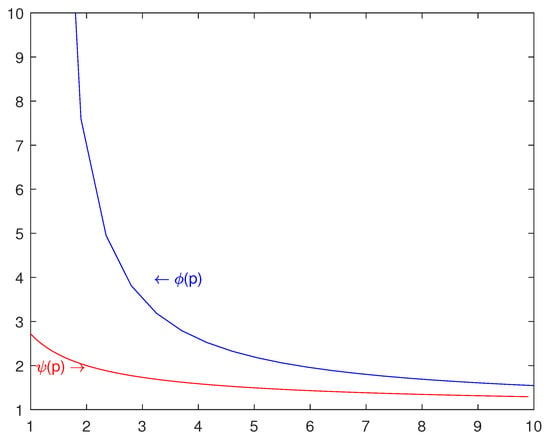
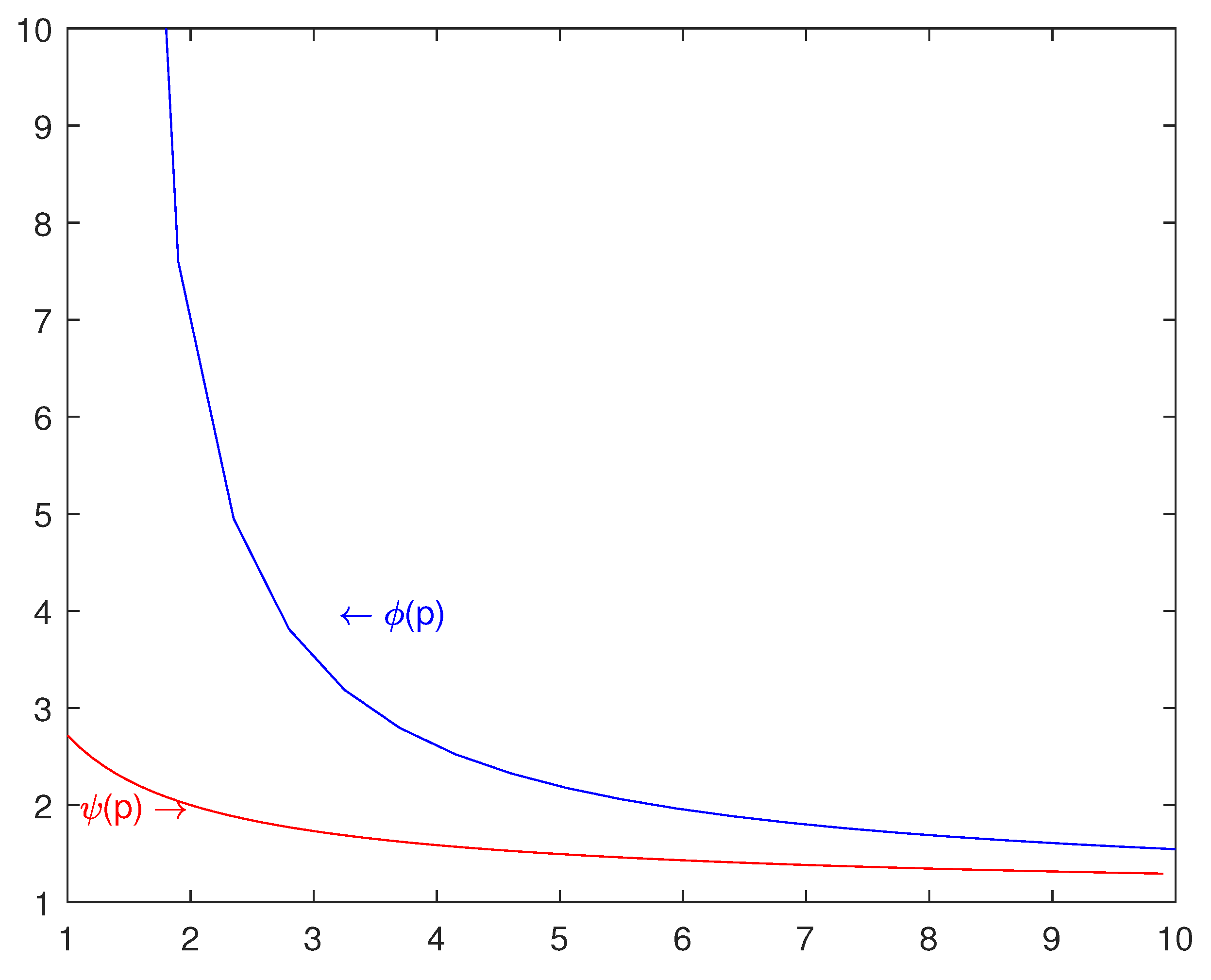
Figure 1.
Computer confirmation of and .
5. Conclusions and Future Work
Let M be the Doob maximal operator on a filtered measure space and let v be an weight with . In this note, we try proving that
where Although we do not find an approach which gives the constant in (10), we obtain that
with
As is well known, Cao and Xue [6] (see also the references therein) used the atomic decomposition to study weighted theory on the Euclidean space, and we will try the approach of atomic decomposition on the filtered measure space.
Furthermore, the multilinear analogue of Theorem 1 is interesting but difficult. One of the reasons is that there are no multilinear analogues of approaches 1 and 3.
Author Contributions
Writing—original draft preparation, W.C.; writing—review and editing, J.C. All authors have read and agreed to the published version of the manuscript.
Funding
The research of Wei Chen is supported by the National Natural Science Foundation of China (11971419, 11771379) and the School Foundation of Yangzhou University (2019CXJ001).
Institutional Review Board Statement
Not applicable.
Informed Consent Statement
Not applicable.
Acknowledgments
The authors thank the referees for many valuable comments and suggestions. These greatly improved the presentation of our results.
Conflicts of Interest
The authors declare no conflict of interest. The funders had no role in the design of the study; in the collection, analyses, or interpretation of data; in the writing of the manuscript, or in the decision to publish the results.
Appendix A. Construction of Principal Sets
The construction of principal sets first appeared in Tanaka and Terasawa [2], and Chen, Zhu, Zuo and Jiao [5,14] found the conditional sparsity of the construction, which is new and useful. We will use the construction of principal sets. Because we keep track of the constants of the conditional sparsity, we will give the modifications in the construction of principal sets in this Appendix A.
For and stopping times are defined by
Let
where then We denote and Then, we define which is the first generation . Now we show how to define the second one. Let
where Let P be a subset of with If there is and such that
we say that P is a principal set of We denote and Letting be the family of the above principal sets of we say that is the second generation.
Following [5] (p. 804), we have
where
Furthermore, we have which is called the conditional sparsity of principal sets with (see [5,14]).
Proceeding inductively, we obtain the next generalizations
Let
then the collection of principal sets satisfies the following properties:
- The sets where are disjoint and
- on
- on
where
Now, we represent the tailed Doob maximal operator by the principal sets, which is the following lemma.
Lemma A1.
Let and For and we let
If then
References
- Long, R.L. Martingale Spaces and Inequalities; Peking University Press: Beijing, China; Friedr. Vieweg & Sohn: Braunschweig, Germany, 1993; p. iv+346. [Google Scholar] [CrossRef] [Scilit]
- Tanaka, H.; Terasawa, Y. Positive operators and maximal operators in a filtered measure space. J. Funct. Anal. 2013, 264, 920–946. [Google Scholar] [CrossRef] [Scilit]
- Moen, K. Sharp one-weight and two-weight bounds for maximal operators. Stud. Math. 2009, 194, 163–180. [Google Scholar] [CrossRef] [Scilit]
- Lerner, A.K. An elementary approach to several results on the Hardy-Littlewood maximal operator. Proc. Am. Math. Soc. 2008, 136, 2829–2833. [Google Scholar] [CrossRef] [Scilit]
- Chen, W.; Zhu, C.; Zuo, Y.; Jiao, Y. Two-weighted estimates for positive operators and Doob maximal operators on filtered measure spaces. J. Math. Soc. Jpn. 2020, 72, 795–817. [Google Scholar] [CrossRef] [Scilit]
- Cao, M.; Xue, Q. Characterization of two-weighted inequalities for multilinear fractional maximal operator. Nonlinear Anal. 2016, 130, 214–228. [Google Scholar] [CrossRef] [Scilit]
- Hytönen, T.; van Neerven, J.; Veraar, M.; Weis, L. Analysis in Banach Spaces. Volume I. Martingales and Littlewood-Paley Theory; Ergebnisse der Mathematik und ihrer Grenzgebiete. 3. Folge; A Series of Modern Surveys in Mathematics [Results in Mathematics and Related Areas. 3rd Series; A Series of Modern Surveys in Mathematics]; Springer: Cham, Switzerland, 2016; Volume 63, p. xvi+614. [Google Scholar]
- Hytönen, T.; Kairema, A. Systems of dyadic cubes in a doubling metric space. Colloq. Math. 2012, 126, 1–33. [Google Scholar] [CrossRef] [Scilit]
- Hytönen, T.P. The sharp weighted bound for general Calderón-Zygmund operators. Ann. Math. 2012, 175, 1473–1506. [Google Scholar] [CrossRef] [Scilit]
- Hytönen, T.; Kemppainen, M. On the relation of Carleson’s embedding and the maximal theorem in the context of Banach space geometry. Math. Scand. 2011, 109, 269–284. [Google Scholar] [CrossRef] [Scilit]
- Schilling, R.L. Measures, Integrals and Martingales, 2nd ed.; Cambridge University Press: Cambridge, UK, 2017; p. xvii+476. [Google Scholar]
- Stroock, D.W. Probability Theory, an Analytic View; Cambridge University Press: Cambridge, UK, 1993; p. xvi+512. [Google Scholar]
- Lacey, M.T.; Petermichl, S.; Reguera, M.C. Sharp A2 inequality for Haar shift operators. Math. Ann. 2010, 348, 127–141. [Google Scholar] [CrossRef] [Scilit]
- Chen, W.; Jiao, Y. Weighted estimates for the bilinear maximal operator on filtered measure spaces. J. Geom. Anal. 2021, 31, 5309–5335. [Google Scholar] [CrossRef] [Scilit]
Publisher’s Note: MDPI stays neutral with regard to jurisdictional claims in published maps and institutional affiliations. |
© 2021 by the authors. Licensee MDPI, Basel, Switzerland. This article is an open access article distributed under the terms and conditions of the Creative Commons Attribution (CC BY) license (https://creativecommons.org/licenses/by/4.0/).