Abstract
In this paper, we study the qualitative behavior of solutions for a general class of difference equations. The criteria of local and global stability, boundedness and periodicity character (with period ) of the solution are established. Moreover, by applying our general results on a population model with two age classes, we establish the qualitative behavior of solutions of this model. To support our results, we introduce some numerical examples.
1. Introduction
The difference equations appear when modeling many natural phenomena in many branches of science. In fact, there are numerous applications for difference equations in queuing problems, statistical problems, combinatorial analysis, stochastic time series, number theory, geometry, electrical networks, probability theory, quanta in radiation, psychology, genetics in biology, sociology, economics, see References [1,2,3,4,5,6,7,8].
One interesting example for both facts is Riccati difference equations
where and are real numbers. The richness of the dynamics of Riccati equations is very well-known [9], and a specific case of these equations provides the classical Beverton-Holt model on the dynamics of exploited fish populations [10]. As an example of a map generated by a simple model for frequency dependent natural selection, May [11] introduced the difference equation
where . May studied the local stability of the positive equilibrium point . Moreover, Kocic et al. [12] investigated the oscillation and the global asymptotic stability of Equation (1).
Furthermore, in Reference [13], Franke studied the global attractively and convergence to a two-cycle of the population model with two age classes
where , and he proved that equilibrium point of system (2) is a global attractor if and . He also proved that every solution of system (2) is periodic with period two if and . In view of this, Kulenovic et al. [14] established the following conjecture:
Definition 1.
Assume that . Every positive solution of the population model
converges to a period-two solution.
For many results, applications and open problems on higher-order equations and difference systems, see References [1,2,3,4,5,6,7,8,9,10,11,12,13,14,15,16,17,18,19,20,21,22,23,24,25,26,27,28,29,30,31,32,33,34,35,36,37].
This paper is concerned with investigation of the asymptotic behavior of the solutions of a general class of difference equation
where a is positive real number, the function is continuous real function and homogenous with degree and the initial conditions are positive real numbers.
The main reason for studying this general Equation is that its solutions have a peculiar periodicity character (with period-even) and it also involves a population model with two age classes (3), as a special case. One purpose of this paper is to further complement the results of Reference [13] for periodic solutions of the population model (2). In Section 3, we state a new necessary and sufficient condition for locally asymptotically stable of the population model (2). Also, we will confirm that the population model (2) has periodic solutions of a prime period (this means that Definition 1 is not accurate).
Furthermore, we introduce general theorems in order to study the asymptotic behavior of Equation (4). Namely, we give a complete picture regarding the local stability of equilibrium point, and we study the global stability and boundedness nature of the solutions. Also, we study the existence of periodic solutions of a prime period . Moreover, we apply our results on the population model (2). Finally, we gave many numerical examples to support our results.
Consider the the difference equation
where is continuous real function and are positive real numbers. The linearized Equation associated with (5) about the equilibrium point
Theorem 1.
Assume that and are roots of the quadratic equation
We have one of the following cases for stability:
- (a)
- If and , then is locally asymptotically stable;
- (b)
- If either or , then is unstable;
- (c)
- The point is locally asymptotically stable and sink if and only if halds and ;
- (d)
- The point is a repeller, that is and , if and only if and ;
- (e)
- The point is a saddle point, that is only one of and is holds, if and only is and ;
- (f)
- The point is a nonhyperbolic point, that is either or , if and only if or and .
2. Dynamics of Equation (4)
2.1. Stability and Boundedness of Equation (4)
In the next, we state a necessary and sufficient condition for locally asymptotically stable of equilibrium point of Equation (4). For our next considerations, we define the function by
An equilibrium point of Equation (6) is a point such that . Then, the equilibrium point of Equation (4) is given by Hence
which means that
The linearized Equation of (4) of is
where . A linear Equation will be called stable, asymptotically stable, or unstable provided that the zero equilibrium has that property. From (6), we get
and
In the next theorems, we study the asymptotic stability for (4).
Theorem 2.
For local stability of the equilibrium point of Equation (4), we have the following cases:
- (1)
- If then is locally asymptotically stable and sink;
- (2)
- If then is unstable and repeller;
- (3)
- If then is nonhyperbolic point.
Proof.
Theorem 3.
For local stability of the equilibrium point of Equation (4), we have the following cases:
- (1)
- Equilibrium point is locally asymptotically stable and sink if and only if
- (2)
- Equilibrium point is unstable saddle point if and only if
- (3)
- Equilibrium point is unstable and repeller if and only if , or
- (4)
- Equilibrium point is nonhyperbolic point if and only if , orwhere and .
Proof.
Since f homogenous with degree , we have from Reference [19] that and homogenous with degree and hence
and
where . Thus, the characteristic Equation of (8) is
Also, from Euler’s homogeneous function theorem, we have , and hence (at ).
- For Case (1), we assume that (11) holds. ThenTherefore, by using Reference ([14], Theorem 1.1.1-(c)), we have that is a locally asymptotically stable and sink.
- From (12), we see also that . Hence which implies that
- For Case (3), we suppose that (13) holds. If , then and so, . Also, . This implies and . The case can be proved, similarly. Therefore, and from Reference ([14], Theorem 1.1.1-(d)), we have that is an unstable and repeller.
In the following theorems, we study the boundedness of the solutions of Equation (4).
Theorem 4.
Proof.
Since , we get . Thus, we can divide the sequence to two bounded above subsequence by the initial conditions as
Hence, we see that for all . The proof of the theorem is complete. □
Theorem 5.
Assume that there exists a constant such that . Then every solution of Equation (4) is bounded and
for all .
Proof.
Theorem 6.
Assume that there exists a constant such that , and . Then every positive solution of Equation (4) converges to .
Proof.
First, we consider the function defined as (6). From (9) and (10), if and , then we conclude that is non-decreasing in each of its arguments. Now, we will verify that the function satisfies the negative feedback condition
Let , then
and so,
Since homogenous with degree , we have and hence (23) becomes
2.2. The Existence of Periodic Solutions
Here, we investigate the periodicity character of the solution for Equation (4).
Lemma 1.
Assume that is a solution of Equation (4). Then,
Proof.
The proof of the lemma is complete. □
Theorem 7.
Assume that , is a solution of Equation (4) and there exists a couple of integers and such that
where
Then is an eventually periodic solution with period .
Proof.
Now, from Lemma 1, we get
Using (26), we obtain . Also, from Lemma 1, we see that
Since and from (27), we get
Similarly, we can prove that
Thus, the sequence converges to a prime period solutions. The proof of the theorem is complete. □
Corollary 1.
In the next theorem, we state a new necessary and sufficient condition for periodic solutions of a period two.
Theorem 8.
Equation (4) has a period two solution if and only if
Proof.
Let Equation (4) has a solution of period two . Hence, we have
Similarly, we can prove that . Hence, by Corollary 1, it is clear that converges to a prime period two solution. The proof of the theorem is complete. □
3. A Population Model
Difference equations have been widely used as mathematical models for describing real life situations in biology. In this section, we study the discrete model with two age classes, adults and juveniles (2) where . Expression represents reproduction rate and is a decreasing exponential which captures the over crowding phenomenon as the population grows. To apply our results, we set system (2) as the following
By compared with (4), we note that and . Thus, we have that . Equilibrium points of Equation (29) are and positive equilibrium . From Theorem 2, is an unstable and repeller where for .
For locally asymptotically stable of equilibrium point of Equation (29), we have the next theorem.
Corollary 2.
We have the following cases:
- 1.
- Equilibrium point is locally asymptotically stable and sink if and only if .
- 2.
- Equilibrium point is unstable saddle point if and only if .
- 3.
- Equilibrium point is unstable and repeller if and only if and .
- 4.
- Equilibrium point is nonhyperbolic point if and only if , or and .
Proof.
The proof is immediate (from Theorem 3) and hence is omitted. □
Corollary 3.
Every solution of Equation (2) is bounded and for all .
Proof.
Since for all , we have that, from Theorem 5, every solution of Equation (2) is bounded and , and hence the proof is complete. □
Now, we give the periodicity character of the solution for Equation (29).
Corollary 4.
Assume that is a solution of Equation (29) and . If there exists a positive integer number η such that
then converges to a prime period solution.
Remark 1.
Note that, from Corollary 4, if , then the solution of Equation (4) is a period-two solution.
Theorem 9.
4. Numerical Examples
In order to support our results, we are to consider some numerical examples which illustrate many types of solutions to the Equation (4) and the behavior of these solutions.
Example 1.
Consider the equation
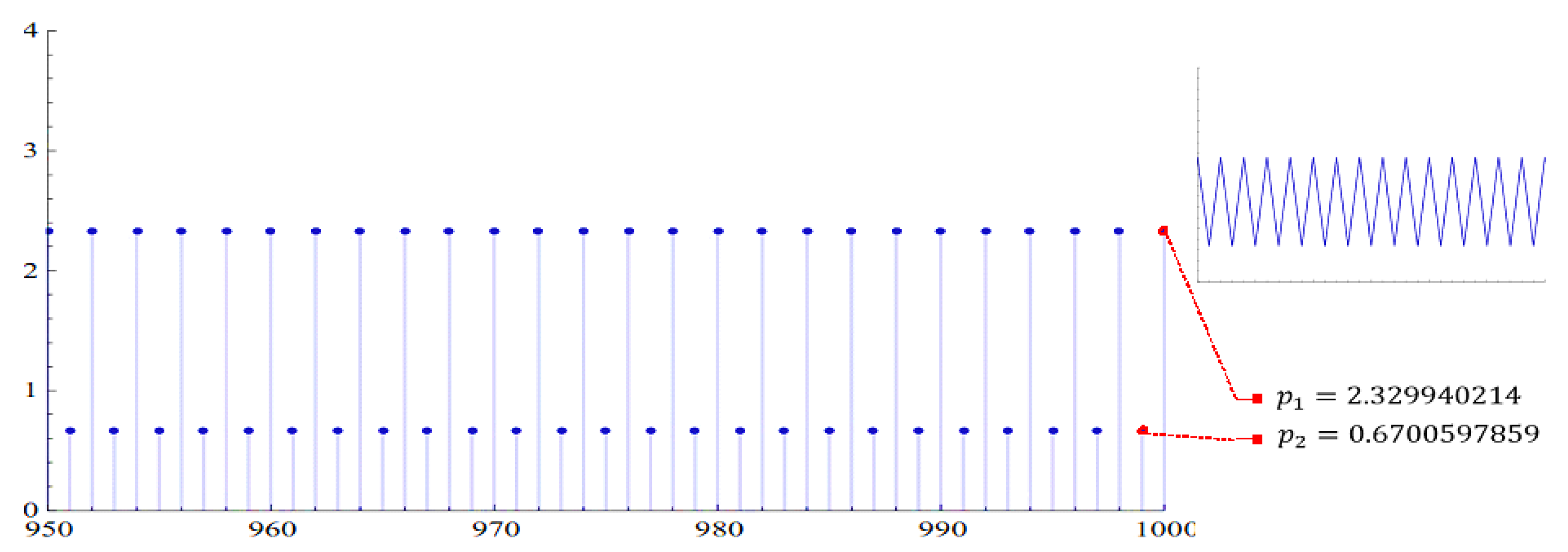
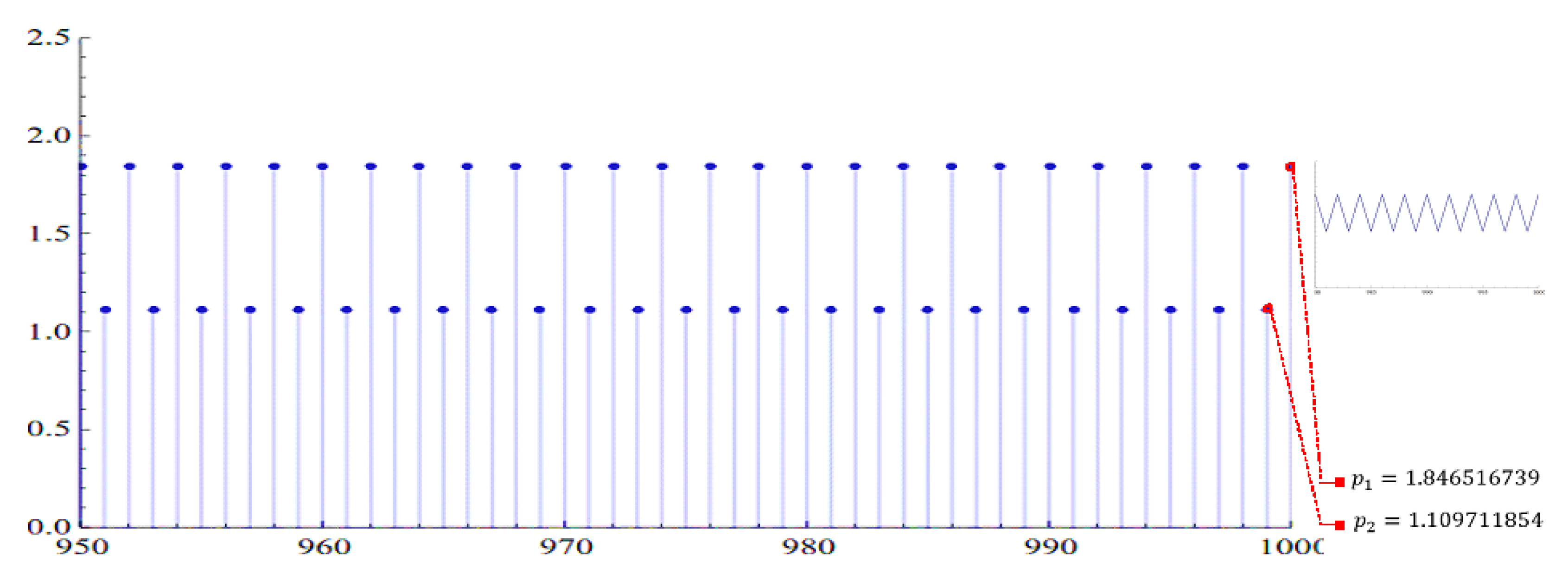
where . From Theorem 3, the positive equilibrium point , is a nonhyperbolic point. Also, Equation (37) has a prime period 2 solution when and see Figure 1, and prime period 4 solution when and , see Figure 2.
Figure 1.
Prime period 2 solution.
Figure 2.
Prime period 4 solution.
Example 2.
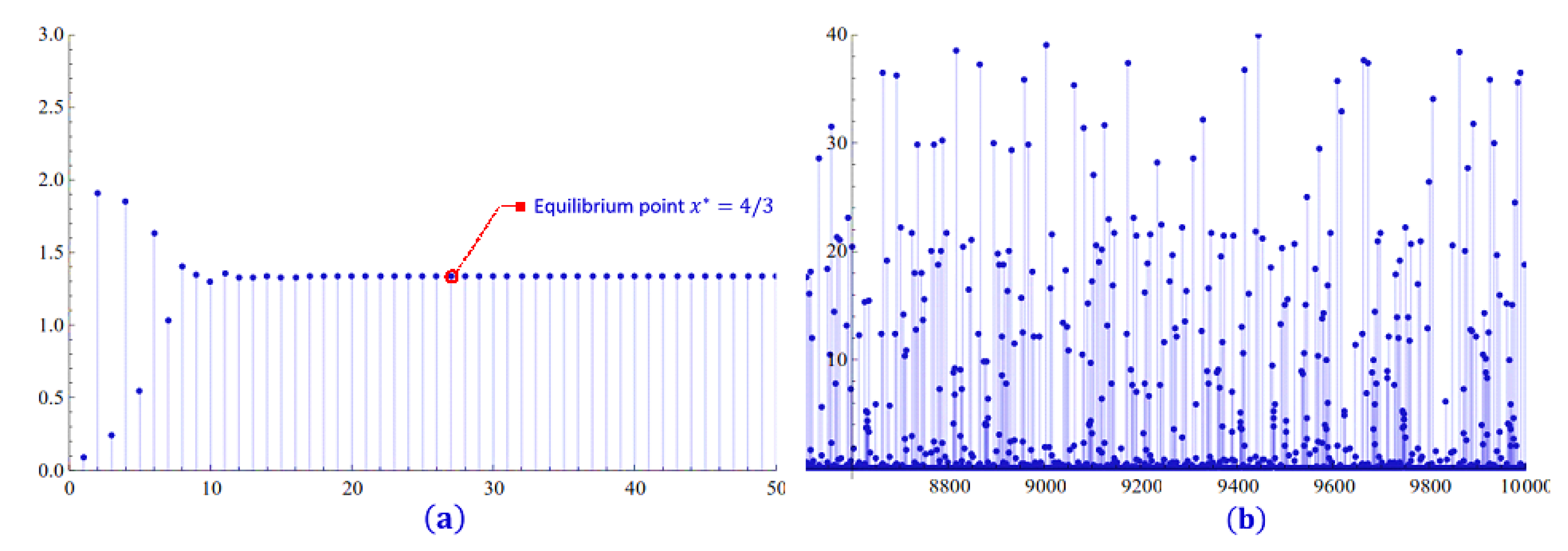
Consider the Equation (29), if and , then equilibrium point is a locally asymptotically stable, see Figure 3a. On the other hand, if and , then equilibrium point is an unstable saddle point, see Figure 3b.
Figure 3.
(a) Locally asymptotically stable, (b) unstable saddle point.
Example 3.
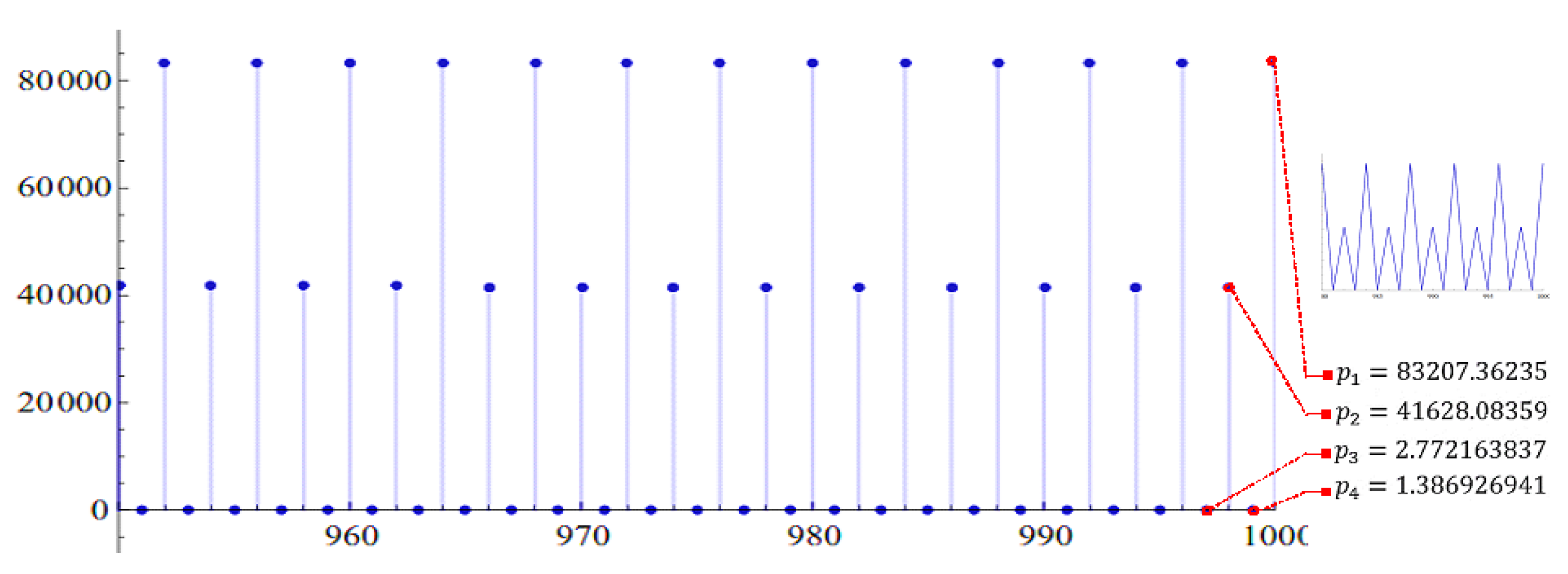
From Theorem 4, Equation (29) has a prime period solution. For example,
- (a)
Figure 4. Prime period 2 solution.- -
- and (according to Corollary 4).
- -
- (according to (31) in Theorem 9).
- (b)
- If and , then Equation (29) has a prime period 6 solution. Note that, and
- (c)
- If and , then Equation (29) has a prime period 8 solution.
- (d)
- If and , then Equation (29) has a prime period 12 solution.
5. Conclusions
Difference equations have been widely used as mathematical models for describing real life situations in biology. So, this paper is concerned with the qualitative behavior of the solution of the general class of the nonlinear difference equations which involves a population model with two age classes, as a special case. For general equation, we studied the stability (local and global), boundedness and periodicity character (with period ) of the solution. Moreover, by applying our general results on a population model with two age classes, adults and juveniles , where expression represents reproduction rate and is a decreasing exponential which captures the over crowding phenomenon as the population grows, we give a complete picture applying the local stability of equilibrium point of population model and we study the boundedness of soluations. Furthermore, we studied the existence of periodic solutions of a prime period-even of this model, as improved and complemented of results of Franke 1999 and conjecture of Kulenovic 2001. In order to support our results, we introduced some numerical examples. Further, we can try to get a necessary and sufficient condition for global stability as well as bifurcation behavior for (4) in the future work.
Author Contributions
O.M. and O.B.: Writing original draft, and writing review and editing. G.E.C. and D.C.: Formal analysis, writing review and editing, funding and supervision. All authors have read and agreed to the published version of the manuscript.
Funding
The authors received no direct funding for this work.
Acknowledgments
The authors thank the reviewers for their useful comments, which led to the improvement of the content of the paper.
Conflicts of Interest
The authors declare no conflict of interest.
References
- Ahmad, S. On the nonautonomous Volterra-Lotka competition equations. Proc. Am. Math. Soc. 1993, 117, 199–204. [Google Scholar] [CrossRef]
- Allman, E.S.; Rhodes, J.A. Mathematical Models in Biology: An Introduction; Cambridge University Press: Cambridge, UK, 2003. [Google Scholar]
- Din, Q.; Elsayed, E.M. Stability analysis of a discrete ecological model. Comput. Ecol. Softw. 2014, 4, 89–103. [Google Scholar]
- Elettreby, M.F.; El-Metwally, H. On a system of difference equations of an economic model. Discr. Dyn. Nat. Soc. 2013, 6, 405628. [Google Scholar] [CrossRef][Green Version]
- Haghighi, A.M.; Mishev, D.P. Difference and Differential Equations with Applications in Queueing Theory; John Wiley & Sons Inc.: Hoboken, NJ, USA, 2013. [Google Scholar]
- Kelley, W.G.; Peterson, A.C. Difference Equations: An Introduction with Applications, 2nd ed.; Harcour Academic: New York, NY, USA, 2001. [Google Scholar]
- Liu, X. A note on the existence of periodic solutions in discrete predator-prey models. Appl. Math. Model. 2010, 34, 2477–2483. [Google Scholar] [CrossRef]
- Zhou, Z.; Zou, X. Stable periodic solutions in a discrete periodic logistic equation. Appl. Math. Lett. 2003, 16, 165–171. [Google Scholar] [CrossRef]
- Cull, P.; Flahive, M.; Robson, R. Difference equations: From rabbits to chaos. In Undergraduate Texts in Mathematics; Springer: New York, NY, USA, 2005. [Google Scholar]
- Beverton, R.J.H.; Holt, S.J. On the Dynamics of Exploited Fish Populations; Fishery Investigations Series II; Blackburn Press: Caldwell, NJ, USA, 2004; Volume 19. [Google Scholar]
- May, R.M. Nonlinear problems in ecology and resource management. In Chaotic Behaviour of Deterministic Systems; Helleman, R.H.G., Iooss, G., Stora, R., Eds.; North-Holland Publ. Co.: Amsterdam, The Netherlands, 1983. [Google Scholar]
- Kocic, V.L.; Ladas, G. Global Behavior of Nonlinear Difference Equations of Higher Order with Applications; Kluwer Academic Publishers: Dordrecht, The Netherlands, 1993. [Google Scholar]
- Franke, J.E.; Hoag, J.T.; Ladas, G. Global attractivity and convergence to a two-cycle in a difference equation. J. Differ. Equ. Appl. 1999, 5, 203–209. [Google Scholar] [CrossRef]
- Kulenovic, M.R.S.; Ladas, G. Dynamics of Second Order Rational Difference Equations with Open Problems and Conjectures; Chapman & Hall/CRC Press: Boca Raton, FL, USA, 2001. [Google Scholar]
- Abu-Saris, R.M.; Devault, R. Global stability of yn+1 = A+yn/yn−k. Appl. Math. Lett. 2003, 16, 173–178. [Google Scholar] [CrossRef]
- Ahlbrandt, C.D.; Peterson, A.C. Discrete Hamiltonian Systems: Difference Equations, Continued Fractions, and Riccati Equations; Kluwer Academic Publishers: Dordrecht, The Netherlands, 1996; Volume 16. [Google Scholar]
- Amleh, A.; Grove, E.A.; Georgiou, D.A.; Ladas, G. On the recursive sequence Jn+1 = α+Jn−1/Jn. J. Math. Anal. Appl. 1999, 233, 790–798. [Google Scholar] [CrossRef]
- Berenhaut, K.S.; Foley, J.D.; Stevic, S. The global attractivity of the rational difference equation yn+1 = 1+yn−k/yn-m. Proc. Am. Math. Soc. 2007, 135, 1133–1140. [Google Scholar] [CrossRef]
- Border, K.C. Eulers Theorem for Homogeneous Functions; Caltech Division of the Humanities and Social Sciences: Pasadena, CA, USA, 2017. [Google Scholar]
- Cooke, K.L.; Calef, D.F.; Level, E.V. Stability or chaos in discrete epidemic models. In Nonlinear Systems and Applications; Lakshmikantham, V., Ed.; Academic Press: New York, NY, USA, 1977; pp. 73–93. [Google Scholar]
- Devault, R.; Kent, C.; Kosmala, W. On the recursive sequence Jn+1 = p+Jn−kJn. J. Differ. Equ. Appl. 2003, 9, 721–730. [Google Scholar] [CrossRef]
- Devault, R.; Schultz, S.W. On the dynamics of Jn+1 = (βJn+γJn−1)/(BJn+DJn−1). Commun. Appl. Nonlinear Anal. 2005, 12, 35–40. [Google Scholar]
- Din, Q. A novel chaos control strategy for discrete-time Brusselator models. J. Math. Chem. 2018, 56, 3045–3075. [Google Scholar] [CrossRef]
- Din, Q. Bifurcation analysis and chaos control in discrete-time glycolysis models. J. Math. Chem. 2018, 56, 904–931. [Google Scholar] [CrossRef]
- Din, Q.; Elsadany, A.A.; Ibrahim, S. Bifurcation analysis and chaos control in a second-order rational difference equation. Int. J. Nonlinear Sci. Numer. Simul. 2018, 19, 53–68. [Google Scholar] [CrossRef]
- Elabbasy, E.M.; El-Metwally, H.; Elsayed, E.M. On the difference Equation Jn+1 = (αJn−l+βJn−k)/(AJn−l+BJn−k). Acta Math. Vietnam. 2008, 33, 85–94. [Google Scholar]
- El-Owaidy, H.M.; Ahmed, A.M.; Mousa, M.S. On asymptotic behaviour of the differens Equation Jn+1 = α+Jn−1δ/Jnδ. J. Appl. Math. Comput. 2003, 12, 31–37. [Google Scholar] [CrossRef]
- Elsayed, E.M. Dynamics and behavior of a higher order rational difference equation. Nonlinear Sci. Appl. 2015, 9, 1463–1474. [Google Scholar] [CrossRef]
- Elsayed, E.M. New method to obtain periodic solutions of period two and three of a rational difference equation. Nonlinear Dyn. 2015, 79, 241–250. [Google Scholar] [CrossRef]
- Hamza, A.E. On the recursive sequence Jn+1 = α+Jn−1Jn. J. Math. Anal. Appl. 2006, 322, 668–674. [Google Scholar] [CrossRef]
- Kalabusic, S.; Kulenovic, M.R.S. On the recursive sequnence Jn+1 = (γJn−1+δJn−2)/(CJn−1+DJn−2). J. Differ. Equ. Appl. 2003, 9, 701–720. [Google Scholar]
- Khuong, V.V. On the positive nonoscillatory solution of the difference equations Jn+1=α+(Jn−k/Jn−m)p. Appl. Math. J. Chin. Univ. 2008, 24, 45–48. [Google Scholar]
- Kuang, Y.K.; Cushing, J.M. Global stability in a nonlinear difference-delay Equation model of flour beetle population growth. J. Differ. Equ. Appl. 1996, 2, 31–37. [Google Scholar] [CrossRef]
- Kulenovic, M.R.S.; Ladas, G.; Sizer, W.S. On the dynamics of Jn+1=(αJn+βJn−1)/(γJn+δJn−1). Math. Sci. Res. Hot-Line 1998, 2, 1–16. [Google Scholar]
- Moaaz, O.; Chalishajar, C.; Bazighifan, O. Some qualitative behavior of solutions of general class difference equations. Mathematics 2019, 7, 585. [Google Scholar] [CrossRef]
- Moaaz, O. Comment on new method to obtain periodic solutions of period two and three of a rational difference Equation [Nonlinear Dyn 79:241250]. Nonlinear Dyn. 2017, 88, 1043–1049. [Google Scholar] [CrossRef]
- Pielou, E.C. An Introduction to Mathematical Ecology; John Wiley & Sons: New York, NY, USA, 1965. [Google Scholar]
© 2020 by the authors. Licensee MDPI, Basel, Switzerland. This article is an open access article distributed under the terms and conditions of the Creative Commons Attribution (CC BY) license (http://creativecommons.org/licenses/by/4.0/).