1. Introduction–Preliminaries
Let C be a nonempty closed convex subset of a real Hilbert space H. Recall that a mapping is said to be nonexpansive if for all . We denote the set of fixed points of a mapping T by . For any , denotes the metric projection of H onto C, such that .
The main purpose of this paper is to consider the following fixed point problem: find
, such that
, where
is nonexpansive with
. In recent years, there has been tremendous interest in developing approximation of fixed point problems with nonexpansive mappings. The fixed point problem, serves as a powerful mathematical model, which generalize important concepts in optimization problems, such as, monotone variational inequalities, convex optimization problems, signal processing and image restoration problems; see, e.g., [
1,
2,
3,
4,
5] and the references therein. In general, the Picard iteration
may perform poorly, where
is starting point, this means that the Picard method may not converge even in weak topology. Mann iteration algorithm is one of the effective ways to overcome this difficulty, which generates iterative sequence
through the following convex combination:
The Mann iteration algorithm is extremely useful for finding the fixed point problem of nonexpansive mappings, and provides a unified framework for different algorithms. However, it should be pointed out that even in a Hilbert space, the iterative sequence
defined by (
1) has only weak convergence under certain conditions.
In the past two decades, there has been extensive study and application of the modified Mann iteration algorithm to obtain strong convergence, see [
6,
7,
8,
9,
10] and the references therein. In 2003, Nakajo and Takahashi [
6] established strong convergence of the Mann iteration by means of projection methods, and proposed the following algorithm in a Hilbert space
H:
where
T is a nonexpansive mapping on
C,
is the metric projection from
C onto
, and
. Iteration scheme (
2) is now referred to simply as the CQ algorithm. For further research, we refer to [
9,
11,
12] for more details. These methods require us to calculate the metric projection in each iteration. However, in complex practical applications, it is difficult to know the numerical expression of the metric projection operator. Note that this is computationally very expensive, and thus projection algorithms are extremely inconvenient in many cases. Recently, Kim and Xu [
7] got rid of the projection algorithm. Indeed, they proposed the following modified Mann iteration algorithm based on the Halpern iterative algorithm [
13] and the Mann iteration algorithm (
1):
where
is a nonexpansive mapping with
, for some fixed point
, sequences
and
in
. Then the iterative sequence
defined by (
3) converges to a fixed point of
T in norm by satisfying the following conditions:
- (C1)
and ;
- (C2)
and .
Inspired by the result of Kim and Xu [
7], Yao, Chen and Yao [
8] introduced a new modified Mann iteration algorithm by combines the viscosity approximation algorithm [
14] and the modified Mann iteration algorithm [
7]. They established strong convergence result under fewer restrictions. It is important to note that there is no additional projection involved in [
7,
8]. Recently, the above results have been extended to more general operators and wider Banach spaces, such as strict pseudo-contractions, quasi-nonexpansive mappings, asymptotically quasi-nonexpansive mappings, see, e.g., [
12,
15,
16,
17] and the references therein.
On the other hand, the inertial type technique, which was first proposed by Polyak [
18], have attracted considerable attention in the research of fast convergence of algorithms. It is a heavy-ball method based on a second-order time dynamic system. The inertial method involves two iterative steps, and the second iterative step is obtained by means of the previous two iterates. In recent years, a great deal of mathematical effort in fast iterative algorithms has been devoted to the study of inertial extrapolation techniques. Researchers have improved some algorithms with the help of inertial techniques. They have shown the superiority of those results in theory and numerical experiments, and applied them to the fields of signal processing and image restoration. For instance, inertial forward-backward splitting algorithms [
19,
20], inertial projection algorithms [
21,
22], inertial extragradient algorithms [
23,
24,
25] and fast iterative shrinkage-thresholding algorithm (FISTA) [
26]. In 2008, by unifying the inertial extrapolation and the Mann algorithm (
1), Mainge [
27] introduced the following inertial Mann algorithm:
It should be noted that the iterative sequence
defined by (
4) converges weakly to a fixed point of
T under some mild assumptions.
Inspired and motivated by the works of Kim and Xu [
7], Yao et al. [
8] and Mainge [
27], we propose a modified inertial Mann Halpern algorithm and a modified inertial Mann viscosity algorithm. Strong convergence results are obtained under some mild conditions. Finally, some numerical examples to support our results are provided. These demonstrate the superiority of our proposed algorithm by comparison with some algorithms in [
6,
7,
8,
27,
28].
Throughout this paper, we use the symbol “→” for strong convergence and “⇀” for weak convergence. For each , we have the following facts.
- (1)
;
- (2)
;
- (3)
.
We need some lemmas to use in our proof. The first one is called the demiclosed principle.
Lemma 1 ([
29])
. Assume that C is a nonempty closed convex subset of a real Hilbert space H and is a nonexpansive mapping. Let be a sequence in C and such that and as . Then . Lemma 2 ([
30])
. Suppose that is a sequence of nonnegative real numbers such thatwhere is a sequence in , is a sequence of nonnegative real numbers, and are real sequences such that (i) ; (ii) ; (iii) implies for any subsequence of . Then . 2. Modified Inertial Mann Halpern and Viscosity Algorithms
In this section, combining the idea of inertial technique with the Halpern algorithm and viscosity algorithm, respectively, we introduce two modified inertial Mann algorithms and analyze their convergence.
Theorem 1. Assume that C is a nonempty closed convex subset of a real Hilbert space H and is a nonexpansive mapping with . Given a point and given two sequences and in , the following conditions are satisfied:
- (D1)
and ;
- (D2)
.
Let be arbitrarily. Define a sequence by the following algorithm: Then the iterative sequence defined by (5) converges strongly to . Proof. First we show that
is bounded. Indeed, taking
, due to the nonexpansivity of
T, we have
Let
. Then (
6) reducing to the following:
Combining condition (D2) and (
7), we obtain that
is bounded. So
and
are also bounded. By the definition of
in (
5), we know that
Therefore, according to the definition of
and (
8), we get
For the sake of simplicity, for each
, let
As a result, inequality (
9) reduces to the following:
From the conditions (D1) and (D2), we see that
and
. In order to complete the proof, using Lemma 2, it remains to show that
implies
for any subsequence
of
. Let
be a subsequence of
such that
, since
and
in
, which implies that
. Using the condition (D2), we have
Since
is bounded, there exists a subsequence
of
such that
as
and
. It follows from (
10) that
as
. We get
by means of Lemma 1. Combining the projection property and
, it follows that
By (
5), we obtain
as
. This together with (
10) imply that
as
. Further, on account of condition (D1), we obtain
Combining (
11) and (
12), we infer that
, which together with condition (D2) indicate that
. Consequently, we observe that
from Lemma 2, and hence
as
. The proof is complete. ☐
We emphasize that if
is a contractive mapping and we replace
u by
in (
5), we can obtain the following viscosity iteration algorithm, for more details, see [
31].
Theorem 2. Assume that C is a nonempty closed convex subset of a real Hilbert space H and is a nonexpansive mapping with . Let be a ρ-contraction with , that is . Given two sequences and in , the following conditions are satisfied:
- (K1)
and ;
- (K2)
.
Let be arbitrarily. Define a sequence by the following algorithm: Then the iterative sequence defined by (13) converges strongly to . Remark 1. - (1)
For special choice, the parameter in the Algorithm (5) and the Algorithm (13) can be chosen as follows. for some and is a positive sequence such that . This idea derives from the recent inertial extrapolated step introduced in [26,32]. - (2)
If for all , in the Algorithm (5) and the Algorithm (13), then we obtained the results proposed by Kim and Xu [7] and Yao et al. [8], respectively. - (3)
It is worth to mention that our proposed algorithms can get rid of the condition (C1) and obtain strong convergence results.
3. Numerical Experiments
In this section, we perform some numerical experiments to illustrate the convergence behavior of our proposed algorithms, and show the computational performance of our algorithms by comparison with some existing ones. For convenience, the modified inertial Mann Halpern algorithm (
5) and modified inertial Mann viscosity algorithm (
13) are abbreviated as MIMHA and MIMVA, respectively. All the programs are performed in MATLAB2018a on a PC Desktop Intel(R) Core(TM) i5-8250U CPU @ 1.60GHz 1.800 GHz, RAM 8.00 GB.
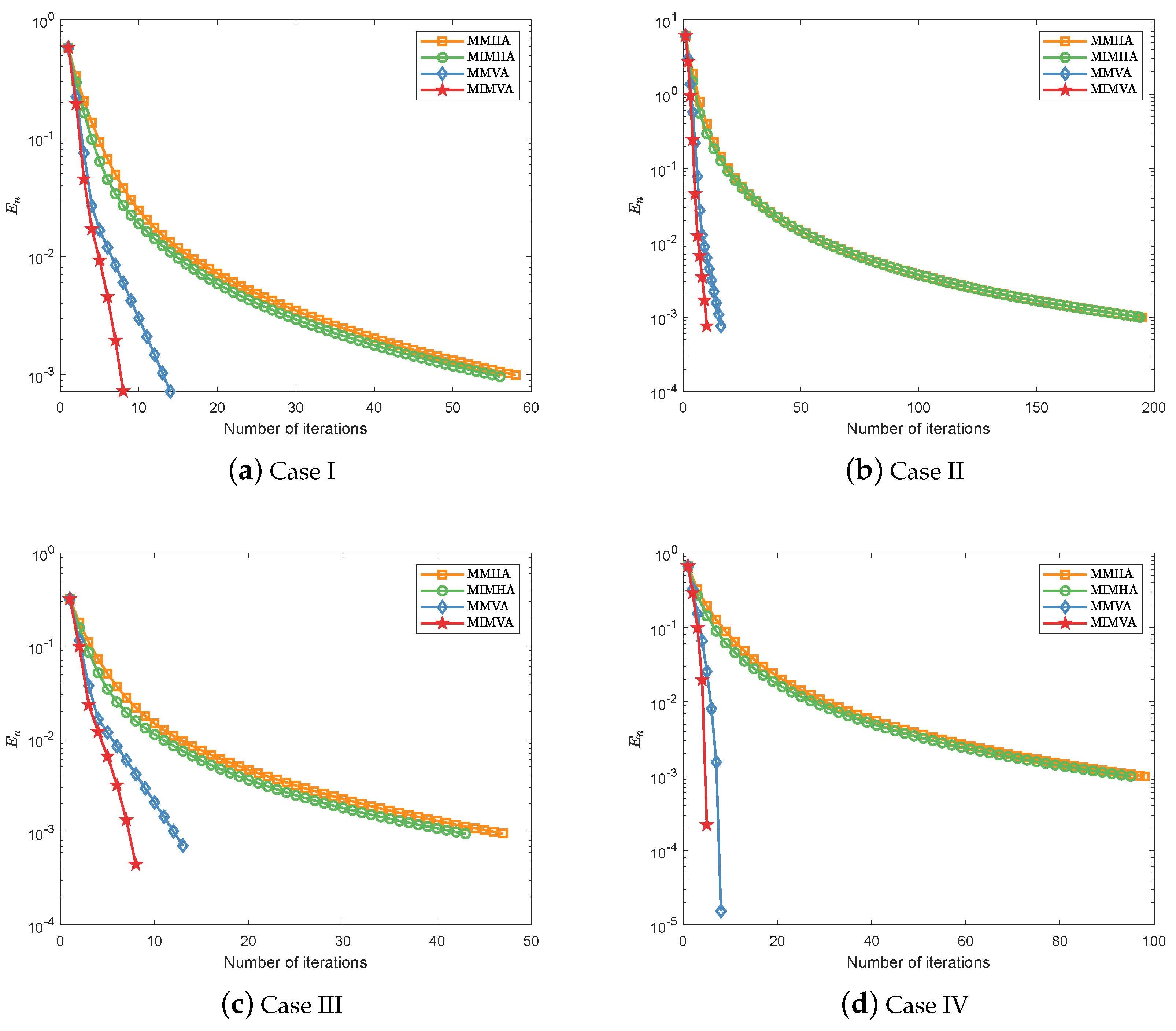
Example 1. To begin with, we consider an example in infinite dimensional Hilbert space. Suppose that C and Q is nonempty closed and convex subsets of real Hilbert spaces and , respectively. Let be a bounded linear operator. We consider the following split feasibility problem (in short, SFP): For any , we consider with inner product and induced norm . Consider the following two half space: The sets C and Q are nonempty, closed and convex subsets of Hilbert space . Assume that is a bounded linear operator defined by . Let denote the adjoint of T. Then and . Therefore, (15) is actually a convex feasibility problem: . Moreover, observe that the solution set of (15) is nonempty since is a solution. For solving the (15), Byrne [33] proposed the following algorithm:where with Lipschitz constant . For the purpose of our numerical computation, we use the following formula for the projections onto C and Q, respectively, see [29].where and . We consider different initial points in the experiment and use the stopping criterion We use the modified Mann Halpern algorithm (MMHA, i.e., MIMHA with ) [7], the modified inertial Mann Halpern algorithm (5) (MIMHA), the modified Mann viscosity algorithm (MMVA, i.e., MIMVA with ) [8] and the modified inertial Mann viscosity algorithm (13) (MIMVA) to solve Example 1. In all algorithms, set , , , . In MIMHA algorithm and MIMVA algorithm, update inertial parameter by (14) with and . Set in the MIMHA algorithm and in the MIMVA algorithm, respectively. Results of these calculations are given in Table 1 and Figure 1. In Table 1, “Iter." and “Time(s)" denote the number of iterations and the cpu time in seconds, respectively. Example 2. The second example we consider the convex feasibility problem, for any nonempty closed convex set (), find , where one suppose that . Define a mapping by , where represents the metric projection onto . Owing to is nonexpansive, and thus the mapping T is also nonexpansive. Furthermore, it is easy to see that . In this example, we set as a closed ball with center and radius . Therefore, can be calculated as follows: Choose , , , and . are randomly chosen. According to the choice of and , it follows that . Iteration error of the algorithm represented by .
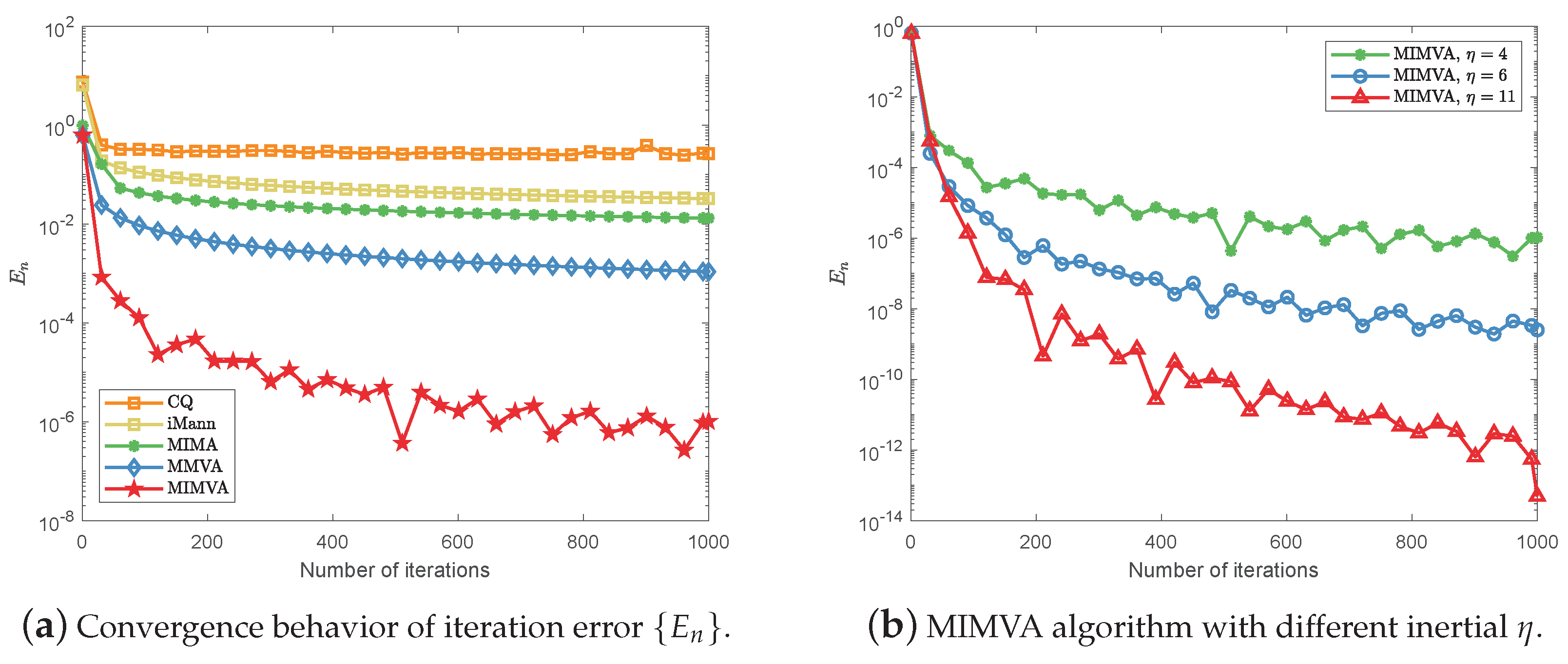
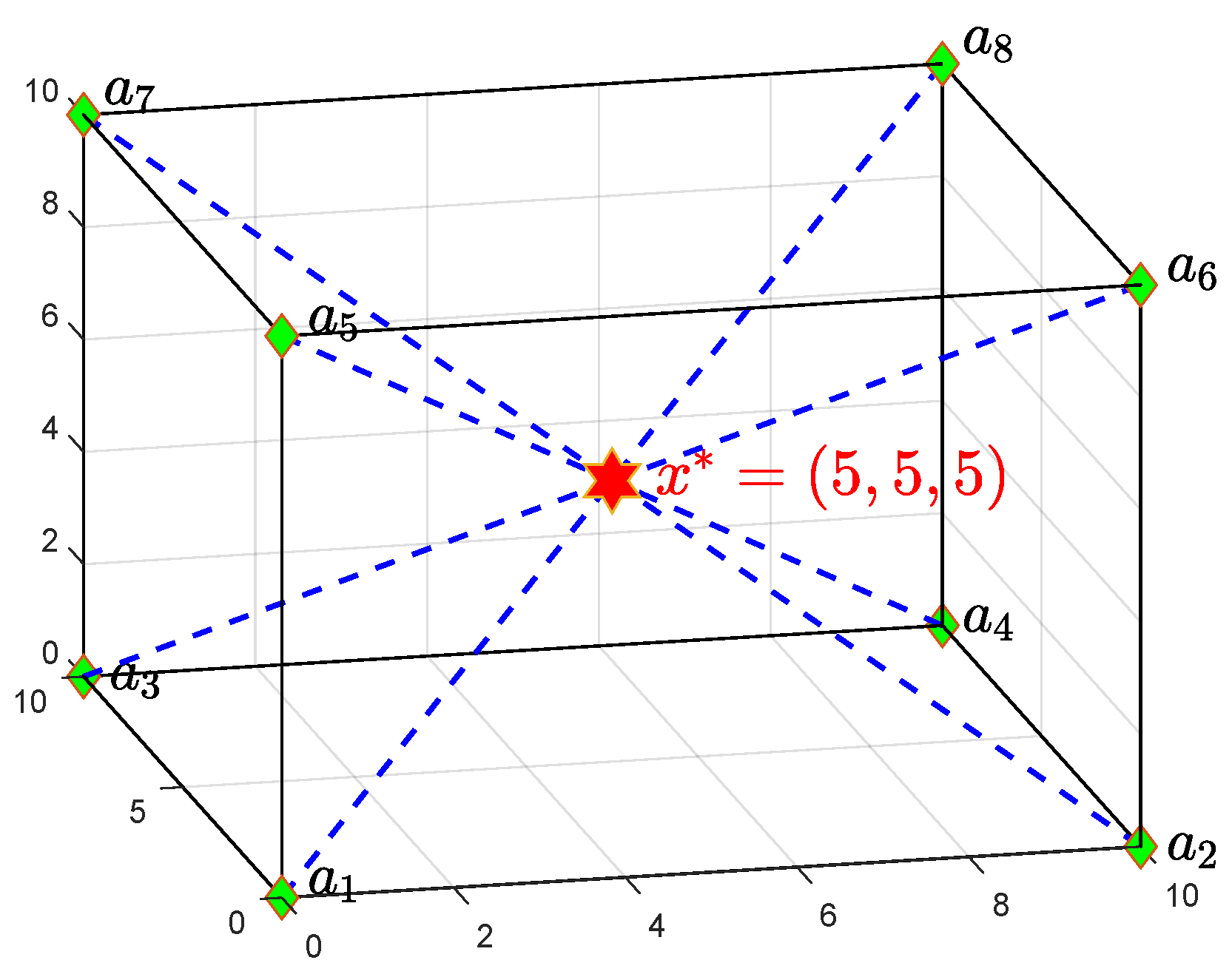
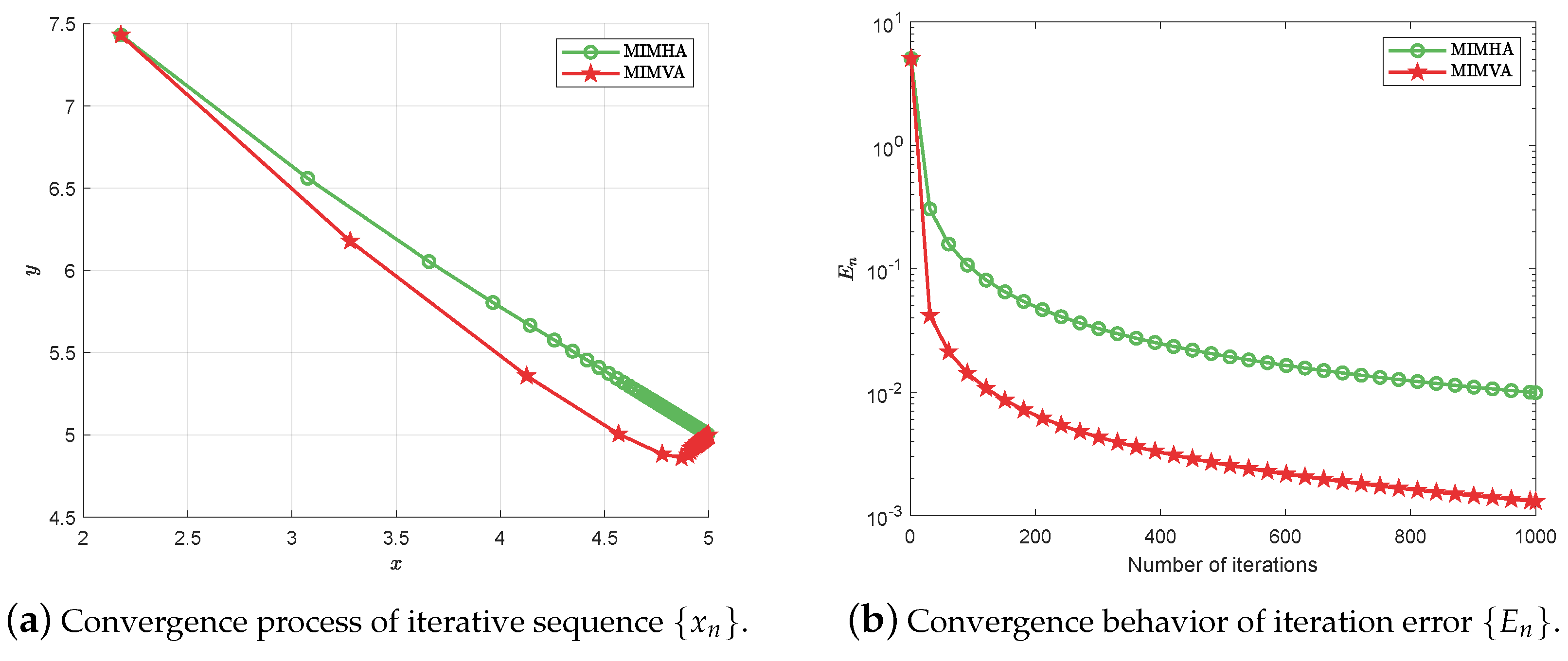
We use the CQ algorithm (2) (CQ) [6], the inertial Mann algorithm (4) (iMann) [27], the modified inertial Mann algorithm (MIMA) [28], the modified Mann viscosity algorithm (MMVA) [8] and the modified inertial Mann viscosity algorithm (13) (MIMVA) to solve Example 2. In all algorithms, set . Set in the CQ algorithm and , in the iMann algorithm, respectively. Set , , , and in the MIMA algorithm and , , , and in the MIMVA algorithm, respectively. Take maximum iteration of 1000 as a common stopping criterion. The initial values are randomly generated by the MATLAB function 10rand(N,1). Computational results are shown in Figure 2. Example 3. As a final example, we consider the Fermat-Weber (FW) problem, which is a well-known model in location theory. FW is expressed mathematically as follows: find that solveswhere are anchor points and are given non-negative weights. It should be pointed out that f is non-differentiable at the anchor points. The Weiszfeld algorithm is the most famous method for solving the problem (16), see [34] for more details. He constructed the following fixed-point iterative algorithm: . The mapping is defined bywhere . We consider a three dimensional example with anchor points,and for all i. In view of the special selection of anchor points , it follows that the optimal value of (16) is . Figure 3 shows a schematic diagram of the anchor points and the optimal solution. We use the modified inertial Mann Halpern algorithm (5) (MIMHA) and the modified inertial Mann viscosity algorithm (13) (MIMVA) to solve Example 3. In MIMHA algorithm and MIMVA algorithm, set , , , . Set in the MIMHA algorithm and in the MIMVA algorithm, respectively. Let be the iteration error of these algorithms, and maximum number of iterations 1000 as a common stopping criterion. The initial values are randomly generated by the MATLAB function 10rand(3,1). Numerical results are reported in Figure 4. Remark 2. - (1)
From Examples 1–3, we observe that Algorithm (13) is efficient, easy to implement, and most importantly very fast. In addition, the inertial parameter (14) can significantly improve the convergence speed of our proposed algorithms, see Figure 2b. - (2)
The Algorithm (13) proposed in this paper can improve some known results in the field, see Figure 2a. It should be noted that the choice of initial values does not affect the calculation performance of our algorithms, see Table 1.