


Abstract
Let be the sequence of the Fibonacci numbers. The order (or rank) of appearance of a positive integer n is defined as the smallest positive integer m such that n divides . In 1975, Sallé proved that , for all positive integers n. In this paper, we shall solve the Diophantine equation for positive integers n and k.
Keywords:
diophantine equation; asymptotic; Fibonacci numbers; order (rank) of appearance; p-adic valuation MSC:
primary 11Dxx; 11B39; secondary 11A41; 11Y70
1. Introduction
Undoubtedly one of the most famous sequences of integer numbers is the sequence of the Fibonacci numbers given for by , with and . The Fibonacci numbers have many amazing properties (see [1,2,3,4] together with their very extensive annotated bibliography for further references). Many prominent mathematicians have dealt with divisibility properties of the Fibonacci numbers but many questions remain unanswered, e.g., it is an open problem if there exist infinitely many primes in the Fibonacci sequence (we recommend [5,6]). Further, we note that the p-adic order (the exponent of the highest power of a prime number p which divides n is called the p-adic order of n and it is denoted by ) of Fibonacci numbers has been completely characterized by Halton [7] and Lengyel [8] (see some generalizations and applications in [9,10,11,12,13,14]). The order (or rank) of appearance of a positive integer n in the Fibonacci sequence, denoted by , is defined as the smallest natural number m, such that (sometimes it is called order of apparition, or Fibonacci entry point), see Table 1.
Table 1.
Values of for .
The function can be implemented in Mathematica [15] as
z[n_]:=Catch[Do[i;If[Mod[Fibonacci[i],n]==0,Throw[i]],{i,2*n}]].
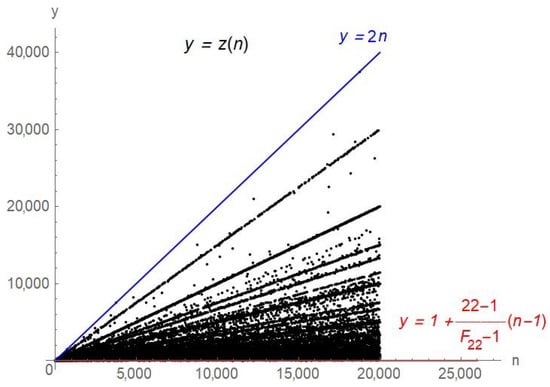
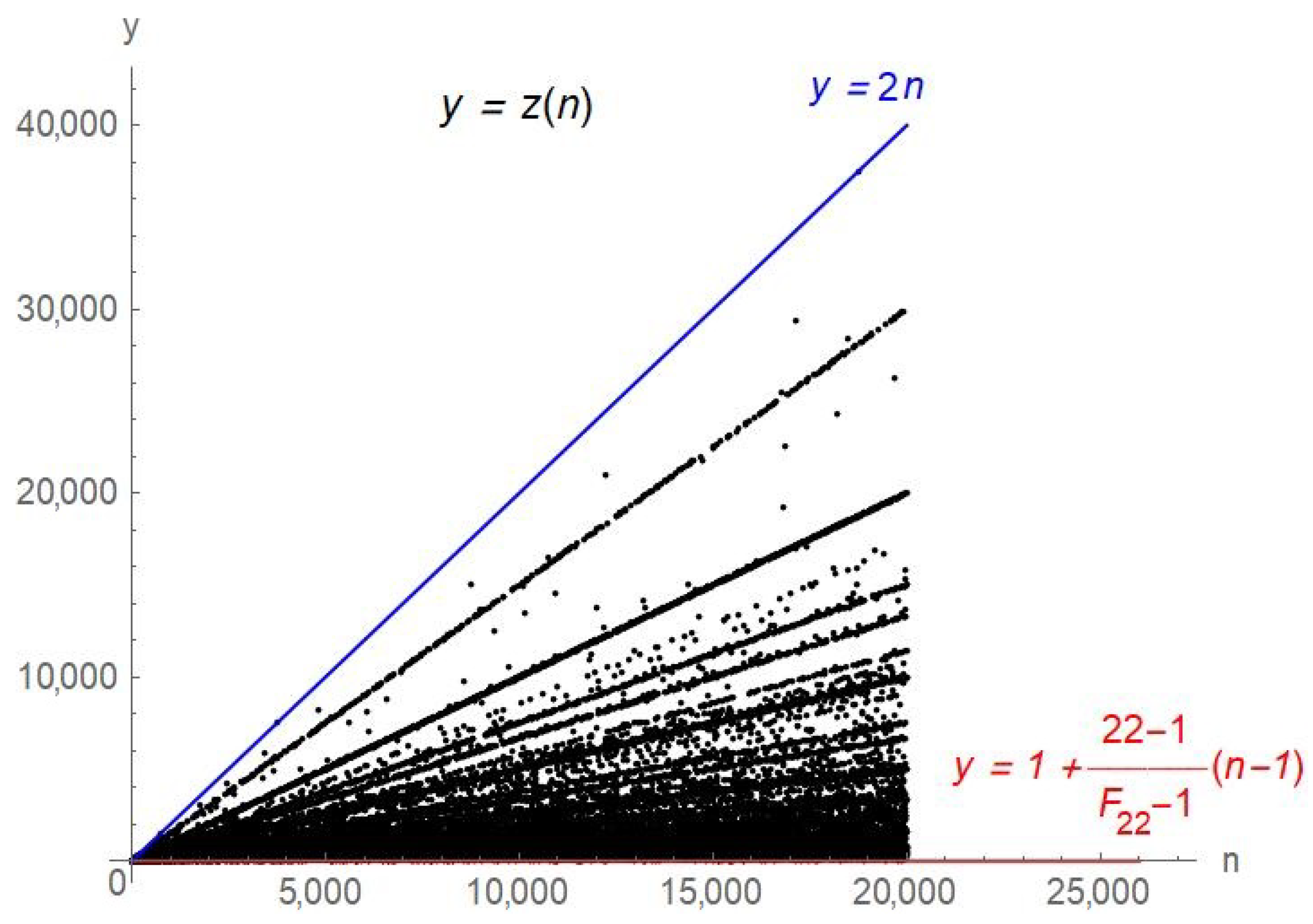
Using Mathematica we can easily get Figure 1, from which it can be seen that the values of have the upper bounds on the line and the lower bounds on the line , with respect to an elementary fact, that , for and the well-known fact, that
Figure 1.
The graph of for [1, 20,000], with the upper bounds on the blue line and the lower bounds on the red line .
There are many results about in the literature. Some advanced properties of can be found e.g., in [16,17,18,19]. Marques [20,21] and Luca and Pomerance [22] investigated a local behavior of the order of appearance in the Fibonacci sequence. Subsequently, considerable efforts were made to find the values of , where is a certain expression containing operations of addition, subtraction, multiplication, as well as powers of Fibonacci and Lucas numbers. Marques [23], Marques and Trojovský [24], and Khaochim and Pongsriiam [25] studied for some values of k. Similarly, was found by Marques [26] and Khaochim and Pongsriiam [27] and the values of and were derived by Marques [28] and Khaochim and Pongsriiam [29]. Trojovský [30,31] found for distinct positive integers m, the values of and , when and , respectively. We will also mention a few results regarding the upper bounds for . In 1878, Lucas showed, as an immediate consequence of the Théorème Fondamental of Section XXVI in ([32], p. 300), that for all . We remark that there is not a closed formula for the , and therefore, Diophantine equations related to play an important role in its best comprehension. This function gained great interest in 1992, when Sun and Sun [33] proved that to show that all solutions of the Diophantine equation are composite numbers, implies Fermat’s last theorem. However, it is still known that there are no prime solutions when (PrimeGrid Project, May 2017). Recently, deep interest has been shown in investigating some Diophantine equations containing . Independently, Somer and Křížek [34] and Marques [35] showed that all solutions of the Diophantine equation (thus, all fixed points of the function ), have the form or , for any integer . Lehmer [36] (see Theorem 5.1) proved that all solutions of the equations and are primes. A generalization of these results was studied by Trojovsk y [37], as he considered the Diophantine equation , with . For instance, it was proved that for , the only solution is , and for no solution exists.
Concerning upper bounds for , one can apply the Dirichlet’s box principle to the sequence (sequence of ordered pairs modulo n, so it has at most distinct terms), to obtain that n must divide , for some , in particular, (see [2], Theorem, p. 52). For a prime p there is a better upper bound for , as .
In 1975, Sallé [38] proved that , for all natural numbers n. The value is the sharpest upper bound for , since, e.g., (Savin [39] showed that holds for prime numbers , hence ). Actually, proceeding along the same lines as the proof of Theorem 1.1 of [35], one obtains that
Thus, the Diophantine equation is completely solved. Now, we can think about the related version of this equation, i.e., . Since tends to 2 as , the following question arises: What other possible solutions could appear?
In this paper, we shall answer completely this question by proving Theorem 1.
Theorem 1.
The only solutions of the Diophantine equation
in positive integers n and k are
for all positive integers a.
It is important to remark that the appearance of the power of 5, in the solutions of Equations (1) and (2), is not a coincidence. Indeed, it comes from the strong relation between the Fibonacci numbers and the number 5. This can be seen in Binet’s formula (where and ) which reflects in the powerful fact that the 5-adic valuation of and n are the same (in fact, the prime 5 is the only one with this property, see [8]).
2. Auxiliary Results
As mentioned before, in 1975, Sallé provided the sharpest upper bound for , namely, , where the equality holds if and only if , for all integers . However, apart from these cases this upper bound is very weak. For instance, , thus the smallest upper bound of is approximately only 4% of that upper bound . In fact, Marques [40] gave sharper upper bounds for for all positive integers n which are not in the form , where k is any positive integer.
Marques’ theorems from [40] will be essential ingredients in our proof. Therefore, we shall present his results as lemmas (in what follows, we denote by and the number of distinct prime factors of n and the 2-adic valuation of n, respectively).
Lemma 1.
(Theorem 1.1 of [40]) We have
- (i)
- (for , (for and (for .
- (ii)
- If is a prime, thenwhere, as usual, denotes the Legendre symbol of a with respect to a prime .
For the cases when , Marques [40] proved that
Lemma 2.
(Theorem 1.2 of [40]) Let n be an odd integer with , then
where
Lemma 3.
(Theorem 1.3 of [40]) Let n be an even integer with , we have that
- (i)
- If , then
- (ii)
- If , then
- (iii)
- If , then
Our last tool is a relation between and for all prime powers dividing n. A proof of this fact can be found in [41].
Lemma 4.
(Theorem 3.3 of [41]) Let have the prime factorization . Then
where denotes the least common multiple.
As usual, from now on we use the well-known notation , for integers .
Now we are ready to deal with the proof of our main result.
3. The Proof of the Theorem
For , all the solutions are of the form or (see [35]). So, we may assume that , hence in the rest of the proof. Therefore, in our case, we have that . Now, we shall split the proof according to the value of .
3.1. The Case
In this case, we have that , for a prime p. For the primes , and 5, respectively, we obtain, by Lemma 1 (i), that
Clearly, these three inequalities do not hold for any positive integer a. Thus, we suppose that . By Lemma 1 (ii), we get which arrives in the contradiction that . So, we have no solution for a power of all primes.
3.2. The Case in Which n Is Odd and
This case does not provide any solution, since, by Lemma 2, we have
3.3. The Case in Which n Is Even and
Here, we shall split the proof according to the value of .
3.3.1. The Case
For this case, we do not have solution, since, by Lemma 3 (i), we obtain
3.3.2. The Case and
In this case, we have that which is a solution for . In fact, we can use Lemma 4 to obtain (we remark that we shall use this result many times in this work. So, in order to avoid unnecessary repetition, we shall omit its citation),
Thus, and so .
3.3.3. The Case and
In this case, we have that , for a prime or 5. So, we have
If , then and then
where we supposed that (the case implies that but as we do not have a solution). Hence . Now, we assume that . Observe that is either or at most . So, is either or at least . In the second case, we use the Lemma 3 to arrive at
and so which is a contradiction. In the case in which , after a straightforward computation, we obtain that
This implies that divides . Note that all positive divisors of are or , for any . Since , we have
thus must divide and then divides . However, in the proof of the item (ii) of Lemma 1, it was proved the stronger fact that divides (see [40], p. 235). Hence, we have that which yields that p divides and so which contradicts our assumption of . So, we do not have solution in this case.
3.3.4. The Case and
For this, we have
which does not hold.
3.3.5. The Case and
This case is exactly as the previous one, since all that matters is that .
3.3.6. The Case and
We have , where is a prime. Thus
where we used that . Since is either or at most , the proof of the non-existence of solutions for this case follows exactly along the same lines than in Section 3.3.3.
3.3.7. The Case
For this case, by Lemma 3 (iii), we do not have solution when (since ). Clearly, the same holds when and . So, it remains to study the case in which and . Then , where . Thus
where we used that . Now, observe that implies in for . This holds only for and so we obtain the family of solutions of the form .
This completes the proof of the main theorem. □
4. Conclusions
In this paper, we dealt with the function , which is known as the order (or rank) of appearance of n in the Fibonacci sequence. This function encodes many properties of Fibonacci numbers and it is related to famous problems in mathematics (such as an elementary proof of the Fermat’s last theorem). Here, we used sharper upper bounds for in order to understand its behavior near the extremal case (i.e., near ). More precisely, we solved completely the Diophantine equation in positive integers k and n, by expliciting its four (and unique) families of solutions.
Funding
The author was supported by the Project of Specific Research PrF UHK no. 2116/2019, University of Hradec Králové, Czech Republic.
Conflicts of Interest
The author declares no conflict of interest.
References
- Koshy, T. Fibonacci and Lucas Numbers with Applications; Wiley: New York, NY, USA, 2001. [Google Scholar]
- Vorobiev, N.N. Fibonacci Numbers; Dover Publications: New York, NY, USA, 2013. [Google Scholar]
- Knott, R. Fibonacci Numbers and the Golden Section. The Mathematics Department of the University of Surrey, UK. Available online: Http://www.maths.surrey.ac.uk/hosted-sites/R.Knott/Fibonacci/fib.html (accessed on 2 January 2020).
- The Fibonacci Association. Official Website. Available online: Https://www.mathstat.dal.ca/fibonacci/ (accessed on 2 January 2020).
- Brillhart, J.; Montgomery, P.L.; Silverman, R.D. Tables of Fibonacci and Lucas Factorizations. Math. Comput. 1988, 50, 251–260. [Google Scholar] [CrossRef]
- Dubner, H.; Keller, W. New Fibonacci and Lucas Primes. Math. Comput. 1999, 68, 417–427. [Google Scholar] [CrossRef] [Scilit]
- Halton, J.H. On the divisibility properties of Fibonacci numbers. Fibonacci Q. 1966, 4, 217–240. [Google Scholar]
- Lengyel, T. The order of the Fibonacci and Lucas numbers. Fibonacci Q. 1995, 33, 234–239. [Google Scholar]
- Kreutz, A.; Lelis, J.; Marques, D.; Silva, E.; Trojovský, P. The p-adic order of the k-Fibonacci and k-Lucas numbers. p-Adic Numbers Ultrametric Anal. Appl. 2017, 9, 15–21. [Google Scholar] [CrossRef] [Scilit]
- Sanna, C. The p-adic valuation of Lucas sequences. Fibonacci Q. 2016, 54, 118–124. [Google Scholar]
- Marques, D.; Trojovský, P. The p-adic order of some Fibonomial Coefficients. J. Integer Seq. 2015, 18, 15.3.1. [Google Scholar]
- Trojovský, P. The p-adic order of some Fibonomial coefficients whose entries are powers of p. p-Adic Numbers Ultrametric Anal. Appl. 2017, 9, 228–235. [Google Scholar] [CrossRef] [Scilit]
- Phunphayap, P.; Pongsriiam, P. Explicit Formulas for the p-adic Valuations of Fibonomial Coefficients. J. Integer Seq. 2018, 21, 18.3.1. [Google Scholar]
- Pongsriiam, P. The order of appearance of factorials in the Fibonacci sequence and certain Diophantine equations. Period. Math. Hungar. 2019, 79, 141–156. [Google Scholar] [CrossRef] [Scilit]
- Wolfram, S. The Mathematica Book, 4th ed.; Wolfram Media/Cambridge University Press: Cambridge, UK, 1999. [Google Scholar]
- Cubre, P.; Rouse, J. Divisibility properties of the Fibonacci entry point. Proc. Am. Math. Soc. 2014, 142, 3771–3785. [Google Scholar] [CrossRef] [Scilit]
- Chung, C.L. Some Polynomial Sequence Relations. Mathematics 2019, 7, 750. [Google Scholar] [CrossRef] [Scilit]
- Kim, S. The density of the terms in an elliptic divisibility sequence having a fixed G.C.D. with their indices. J. Number Theory 2020, 207, 22–41. [Google Scholar] [CrossRef] [Scilit]
- Leonetti, P.; Sanna, C. On the greatest common divisor of n and the nth Fibonacci number. Rocky Mt. J. Math. 2018, 48, 1191–1199. [Google Scholar] [CrossRef] [Scilit]
- Marques, D. On integer numbers with locally smallest order of appearance in the Fibonacci sequence. Int. J. Math. Math. Sci. 2011, 2011, 407643. [Google Scholar] [CrossRef] [Scilit]
- Marques, D. The order of appearance of integers at most one away from Fibonacci numbers. Fibonacci Q. 2012, 50, 36–43. [Google Scholar]
- Luca, F.; Pomerance, C. On the local behavior of the order of appearance in the Fibonacci sequence. Int. J. Number Theory 2014, 10, 915–933. [Google Scholar] [CrossRef] [Scilit]
- Marques, D. The order of appearance the product of consecutive Lucas numbers. Fibonacci Q. 2013, 51, 38–43. [Google Scholar] [CrossRef] [Scilit]
- Marques, D.; Trojovský, P. The order of appearance of the product of five consecutive Lucas numbers. Tatra Mt. Math. Publ. 2014, 59, 65–77. [Google Scholar] [CrossRef] [Scilit]
- Khaochim, N.; Pongsriiam, P. The general case on the order of appearance of the product of consecutive Lucas numbers. Acta Math. Univ. Comenian. 2018, 59, 277–289. [Google Scholar]
- Marques, D. The order of appearance of product of consecutive Fibonacci numbers. Fibonacci Q. 2012, 50, 132–139. [Google Scholar]
- Khaochim, N.; Pongsriiam, P. On the order of appearance of the product of Fibonacci numbers. Contrib. Discret. Math. 2018, 13, 45–62. [Google Scholar]
- Marques, D. The order of appearance of powers of Fibonacci and Lucas numbers. Fibonacci Q. 2012, 50, 239–245. [Google Scholar]
- Pongsriiam, P. A complete formula for the order of appearance of the powers of Lucas numbers. Commun. Korean Math. Soc. 2016, 31, 447–450. [Google Scholar] [CrossRef] [Scilit]
- Trojovský, P. The order of appearance of the sum and difference between two Fibonacci numbers. Asian-Eur. J. Math. 2019, 12, 1950046. [Google Scholar] [CrossRef] [Scilit]
- Trojovský, P. On the order of appearance of the difference of two Lucas numbers. Miskolc Math. Notes 2018, 19, 641–648. [Google Scholar] [CrossRef] [Scilit]
- Lucas, E. Théorie des fonctions numériques simplement périodiques. Am. J. Math. 1878, 1, 289–321. [Google Scholar] [CrossRef] [Scilit]
- Sun, Z.H.; Sun, Z.W. Fibonacci numbers and Fermat’s last theorem. Acta Arith. 1992, 60, 371–388. [Google Scholar] [CrossRef] [Scilit]
- Somer, L.; Křížek, M. Fixed points and upper bounds for the rank of appearance in Lucas sequences. Fibonacci Q. 2013, 51, 291–306. [Google Scholar]
- Marques, D. Fixed points of the order of appearance in the Fibonacci sequence. Fibonacci Q. 2012, 50, 346–352. [Google Scholar]
- Lehmer, D.H. An extended theory of Lucas’ functions. Ann. Math. 1930, 31, 419–448. [Google Scholar] [CrossRef] [Scilit]
- Trojovský, P. On Diophantine equations related to order of appearance in Fibonacci sequence. Mathematics 2019, 7, 1073. [Google Scholar] [CrossRef] [Scilit]
- Sallé, H.J.A. A Maximum value for the rank of apparition of integers in recursive sequences. Fibonacci Q. 1975, 13, 159–161. [Google Scholar]
- Savin, D. About Special Elements in Quaternion Algebras Over Finite Fields. Adv. Appl. Clifford Algebr. 2017, 27, 1801–1813. [Google Scholar] [CrossRef] [Scilit]
- Marques, D. Sharper upper bounds for the order of appearance in the Fibonacci sequence. Fibonacci Q. 2013, 51, 233–238. [Google Scholar]
- Renault, M. Properties of the Fibonacci Sequence Under Various Moduli. Master’s Thesis, Wake Forest University, Winston-Salem, NC, USA, 1996. Available online: http://webspace.ship.edu/msrenault/fibonacci/FibThesis.pdf (accessed on 2 January 2020).

© 2020 by the author. Licensee MDPI, Basel, Switzerland. This article is an open access article distributed under the terms and conditions of the Creative Commons Attribution (CC BY) license (http://creativecommons.org/licenses/by/4.0/).