1. Introduction
A network sometimes can be viewed as a graph. In this context, we just consider connected, simple and undirected graphs. It means the graphs without the multiple edges or loops. A given graph
can be presented by a set
of vertices and a set
of edges. For other terminology and notation not stated here, refer to Reference [
1,
2].
The
adjacency matrix of
G is a square matrix with order
n, which elements
are 1 or 0, depending on whether there is an edge or not between vertices
i and
j. Denoted by
, the degree diagonal matrix of
G, where
are the degree of vertices
. Combining the adjacency and degree matrix, we get the
Laplacian matrix, for which expressions can be written as
, respectively. One may deeply understand them with the help of Reference [
3,
4,
5,
6]. The
normalized Laplacian [
7] is given by:
Obviously,
As we know, the normalized Laplacian plays an important role in studying the structure properties of non-regular graphs. In fact, the spectral graph theory focuses on the interplay between the structure properties and the eigenvalues of a graph.
In mathematical chemistry, topological descriptors are always used to make a prediction for the physico-chemical, biological, and structural properties of some molecule graphs. For instance, one of the most studied topological indices the Harary index. The larger the Harary index, the larger the compactness of the molecule. Other topological indices were also used to study the structure properties of graphs. One well-known valency-based topological descriptor was the Wiener index [
8,
9], which is defined as:
where
is the distance between vertices
i and
j, that is, the length of the shortest path between vertices
i and
j.
As a weighted version of Wiener index, Gutman has introduced the
Gutman index in Reference [
10] as:
According to the theory of electrical networks
N, Klein and Randić proposed a new distance function, named resistance distance, in 1993 [
11]. He denoted
as the resistance distance for any pair of vertices between
i and
j of a graph, which means the effective resistance between the vertices
i and
j in
N with replacing each edge of a graph by a unit resistor. The Kirchhoff index [
12,
13] was defined as:
It is equal to the sum of resistance distances between all pairs of vertices of
G. For analog considerations to the Gutman index, Chen and Zhang [
14] defined the weighted version of the Kirchhoff index, which was called the degree-Kirchhoff index and given by:
Recently, more and more researchers have concentrated on the Kirchhoff index and degree-Kirchhoff index, due to its wide applications. Despite all that, it seems hard to deal with the Kirchhoff index and degree-Kirchhoff index of complex graphs. Thus, some researchers have tried to find some techniques to solve the problems about the Kirchhoff and degree-Kirchhoff index, such as general star-mesh transformation [
15], combinatorial formulas, and others (see Reference [
16] for details). In Reference [
17,
18], Klein and Lovász proved independently that:
Based on the definition of the Laplacian matrix, one finds the sum of each rows of the Laplacian matrix is zero. Futher, are the eigenvalues of .
In Reference [
14], Chen and Zhang also proposed a method to obtain the formula of degree-Kirchhoff index, which is associated with the eigenvalues of the normalized Laplacian, namely,
where
are the eigenvalues of
.
The number of spanning trees [
7] of a given graph
G, also known as the complexity of
G, is the number of subgraphs which contains all the vertices of
Further, all those subgraphs must be trees.
In 1985, Yang et al. [
19] proposed a general solution in theoretically treating linear viscoelasticity by using the knowledge in graph theory. On the basis of this solution, many problems in linear systems have been solved. For instance, based on the decomposition theorem of Laplacian matrix, Y. Yang et al. [
20] obtained the Kirchhoff index of linear hexagonal chains in 2007. Y. Pan et al. constructed a crossed hexagonal by adding two pairs of crossed edges in linear hexagonal chains, and they got the Kirchhoff and degree-Kirchhoff index [
21], respectively (see Reference [
5,
22,
23] for details.)
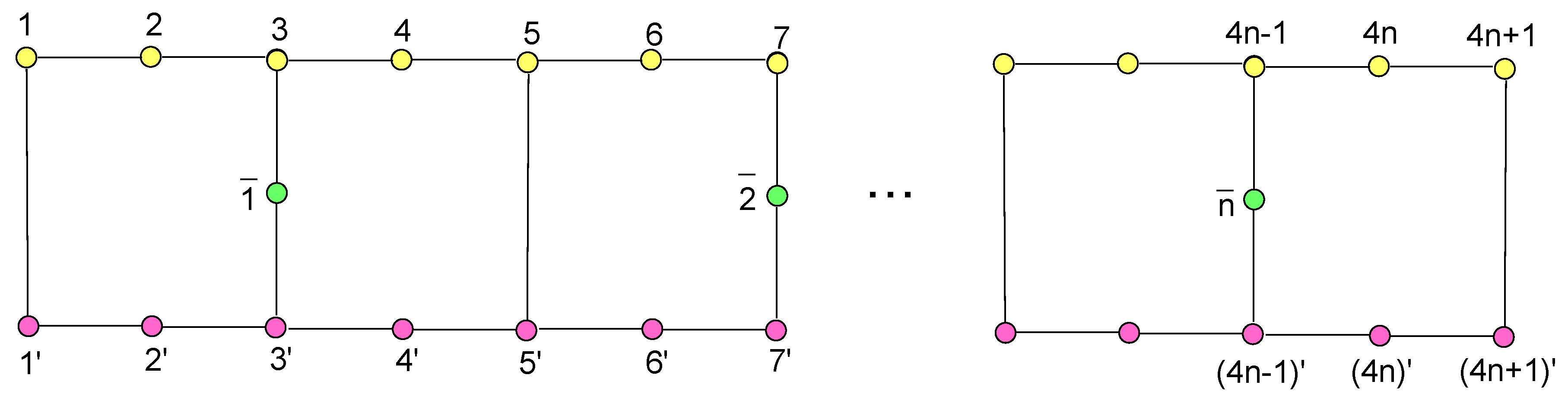
Let
be the heptagonal networks as illustrated in
Figure 1, of which two heptagons have two common edges. That is, two heptagons can be seen as adding two
and attaching them. Notice that there are some applications of the heptagons derived from different aspects, which are listed as follows. The 20p and 50p coins of the United Kingdom have two heptagons. Although there are less heptagonal floor plans, a remarkable example is the Mausoleum of Prince Ernst. Meanwhile, cacti are the most common plants with heptagons in natural structures.
For the exited results of linear networks [
20,
21,
22,
23], there were only two types of vertices considered in these paper. The structure of linear heptagonal networks is much more complex, of which have three types of vertices, shown in
Figure 1. It was challenging and meaningful for us to study the structural properties of linear heptagonal networks. On the other hand, the degree-Kirchhoff index and the number of spanning trees are the important parameters to predict the structure properties of graphs. Therefore, computing the degree-Kirchhoff index and the number of spanning trees of linear heptagonal networks are interesting works. In the rest of the context, we recall some necessary notations and methods used in the proofs of the main results in
Section 2. We aimed to first determine the normalized Laplacian spectrum of
by the decomposition theorem for the normalized Laplacian matrix of
. We then derived the explicit formulas for the degree-Kirchhoff index and the number of spanning trees of
through using the relationships between the roots and coefficients in
Section 3. The discussion of the previous results is given in
Section 4. A conclusion is summarized in
Section 5.
2. Materials and Methods
In this section, we first recall some basic notations and introduce a classical method, which laid the foundations for this paper. All equations that we introduce below can be found in Reference [
1,
19].
Fix a square matrix M with order n, denote the submatrix of M the , and yield by the deletion of the -th, …, -th rows and corresponding columns. Assume that is the characteristic polynomial of the matrix M.
Let
be the graph, as illustrated in
Figure 1, with
,
and
. It is straightforward to verify that
is an automorphism. Then the normalized laplacian matrix of
can be given as the following block matrices.
Notice that, and .
Given:
then
where
is the transposition of
T.
At this place, the matrices introduced above are given in the following. In view of Equation (
1) and
Figure 1, one has
.
where
and
, if
and otherwise, respectively.
On the other hand, one gets:
where
,
for
and 0 otherwise.
According to Equation (
5), one has:
where
,
for
and
,
for
. Also,
,
for
and
for
.
And:
where
,
for
and
,
for
. Also,
,
for
and
for
.
In what follows, the lemmas that we present will be used throughout the main results.
Lemma 1. Assume that are defined as mentioned above [1]. Then: According to the relation between the number of spanning trees and its normalized laplacian eigenvalues, one arrives the following lemma.
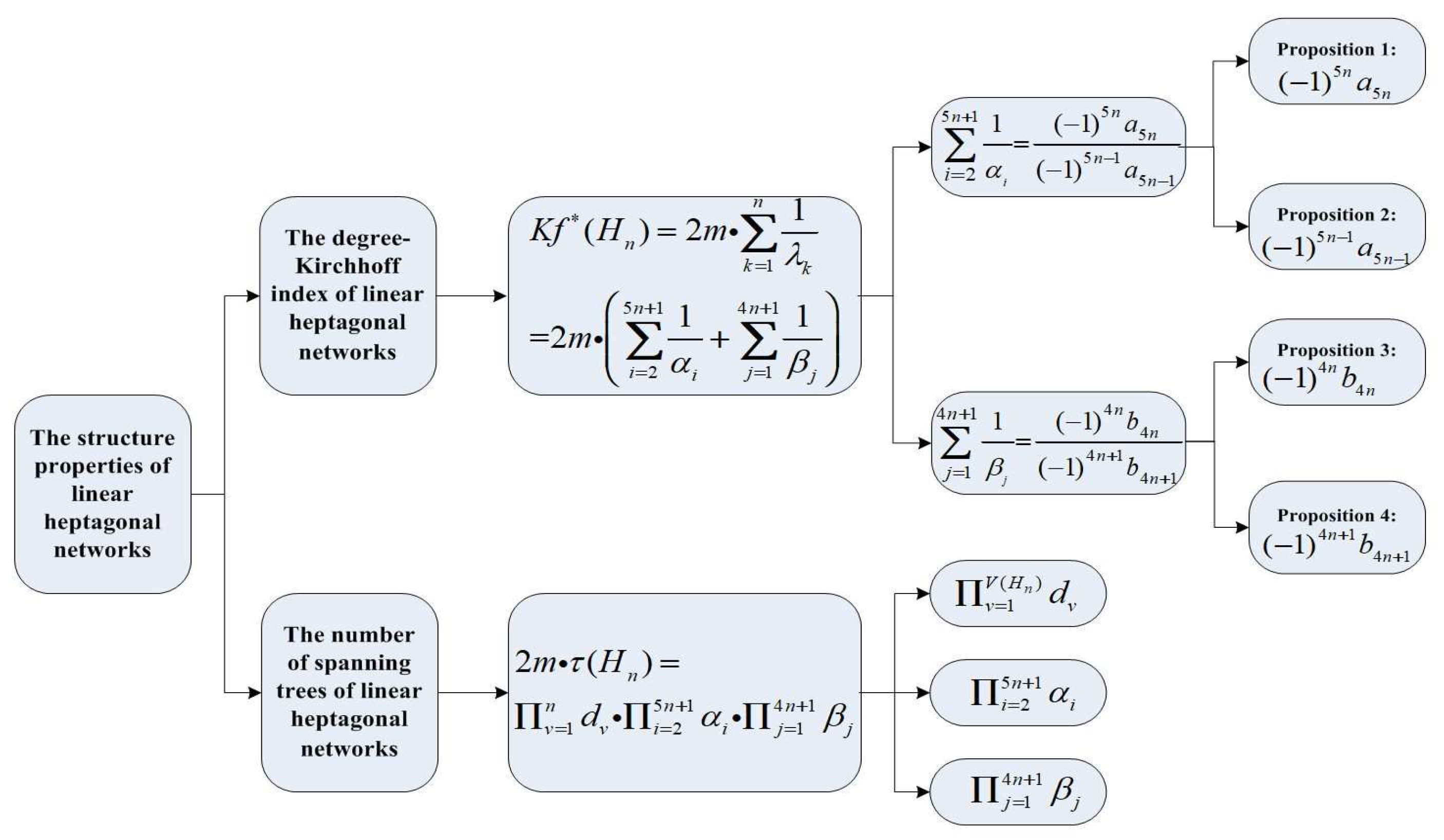
Lemma 2. Assume that G is a connected graph with order n and size m [7], thenwhere is the number of spanning trees of G. Lemma 3. Let and be the , , and matrices, respectively [24]. Then:where and are invertible, and and are called the Schur complements of and , respectively. In what follows, a flowchart (
Figure 2) is given on the basis of the steps we have processed, and it will facilitate the understanding of the proposed approach. The explanations of these notations that appear in the flowchart are presented in
Section 3.
3. Main Results
In this section, we first figure out the explicit formula for the degree-Kirchhoff index of
. The steps of computing the degree-Kirchhoff index follow the flowchart in
Figure 2. Combining the eigenvalues of
and
, it is easy to get the normalized Laplacian spectrum of
by Lemma 1. On the other hand, one can find that the number or spanning trees of
consists of the products of the degree of all vertices, the eigenvalues of
and
, respectively. Suppose
and
are the roots of
and
, respectively. By Equation (
3), one has:
Lemma 4. Suppose that are the linear heptagonal networks. Then: Evidently, one just needs to calculate the eigenvalues of the and . Hence, the formulas of and are given in the following lemmas.
Lemma 5. Suppose that are the eigenvalues of . One has: Proof. It is straightforward to verify that:
with
Then, one knows that
are the roots of the following equation:
According to the relationships between the roots and the coefficients and Vieta theorem, one arrives at:
□
Proposition 1.
Proof. Since the number
is the sum of all those principal minors of
which have
rows and columns, we get:
In view of Equation (
6), one may find that
i can be selected in the identity matrix
or
Thus, all these cases are listed as below.
Case 1. One first considers the case
That is to say,
is obtained by deleting the
i row of the identity matrix
and
, and also the corresponding column of the
and
Denoted by
and
are the resulting blocks, respectively. According to the Lemma 3, and applying elementary operations (see also in Reference [
25], P8), one knows:
where
of which
for
for
but
Also,
,
for
and
for
. With a explicit calculation, one gets:
Case 2. One now takes into account the case
Namely,
is obtained by deleting the
i row of the
and
, also the corresponding column of the
and
Denote by
and
the resulting blocks, respectively. According to Lemma 3 and applying elementary operations, we arrive at:
where
Set
with order
, of which
for
for
. Also,
,
for
and
for
. Evidently,
. With an explicit calculation, one gets:
Combining Equations (8)–(10), we have:
This completes the proof of the Proposition 1. □
In what follows, we will focus on the calculation of the .
Proposition 2.
Proof. Since the number
is the sum of all those principal minors of
which have
rows and columns, it is straightforward to obtain that:
Similar to consideration of Proposition 1, all these cases are listed as follows.
Case 1. One first considers the case
That is to say,
is obtained by deleting the
i and
j rows of the identity matrix
and
, also the corresponding columns of the
and
Denote by
and
the resulting blocks, respectively. According to Lemma 3 and applying elementary operations, one has:
where
of which
for
for
but
and
,
Also,
,
for
and
for
. With an explicit calculation, one gets:
Case 2. One now takes into account the case
Namely,
is obtained by deleting the
-th and
-th rows of the
and
, also the corresponding columns of the
and
Denote by
and
the resulting blocks, respectively. According to Lemma 3 and applying elementary operations, one arrives at:
where
. With an explicit calculation, one gets:
Case 3. One devotes to consideration of the case
,
. That is,
is obtained by deleting the
i rows of the identity matrix
and
,
-th rows of the
and
, respectively. In addition, the corresponding columns of the
,
,
and
Denote by
and
the resulting blocks, respectively. According to Lemma 3 and applying elementary operations, one has:
where
. By an explicit calculation, we get:
Together with Equations (11)–(14), one gets:
The proof of the Proposition 2 completed. □
By Propositions 1 and 2, we have the desired result of Lemma 5.
Lemma 6. Suppose that are the eigenvalues of . One has:where . Proof. It is straightforward to verify that:
with
Then, one knows that
are the roots of the following equation:
In the line with the relationships between the roots and the coefficients of
, one arrives at:
On the one hand, we first consider
l-th order principal submatrix,
, and yield by the first
l rows and columns of
. Set
. Then
and:
With a explicit calculation, we get:
□
Proof. By expanding
with regards to the last row, one gets:
This has completed the proof of the Proposition 3. □
On the other hand, we will take into account the
k-th order principal submatrix,
, and yield by the last
k rows and columns of
. Set
. Then
and:
Obviously, one finds that .
Proof. Denoted
the diagonal entries of
Since the number
is the sum of all those principal minors of
which have
rows and columns, one arrives at:
where
Let
and
, if
. In line with Equation (
18), one gets:
By a straightforward calculation, we can obtain the following expressions.
Substituting Equations (20)–(24) to (19), we can get the desired result. □
Together with the Propositions 3 and 4, one gets Lemma 6 immediately.
By Lemmas 5 and 6, we have the following theorem.
Proof. By Lemma 2, one has
Notice that:
This completes the proof of the theorem. □
4. Discussion
In recent decades, the resistance distance has attracted some attentions due to its practical applications. The spectral graph theory focuses on the interplay between the structure properties and eigenvalues of a graph. In Reference [
17,
18], Klein and Lovász independently found that the sum of resistance distance, namely, the Kirchhoff index, could be determined by the Laplacian eigenvalues of the graph. In later years, Chen and Zhang [
14] defined the degree-Kirchhoff index. Meanwhile, they proved that the degree-Kirchhoff index could be given by the normalized Laplacian eigenvalues of the graph. Since the relationships between Kirchhoff (and degree-Kirchhoff, respectively) index and the Laplacian (normalized Laplacian, respectively ) eigenvalues of the graph, the Kirchhoff and degree-Kirchhoff index are highly concerned. Y. Yang et al. [
20] determined the Laplacian spectrum and Kirchhoff index of linear hexagonal chains by the decomposition theorem of the Laplacian polynomial in 2007. More surprising, they found the Wiener index of linear hexagonal chains is almost twice that of its Kirchhoff index. Reference [
22] explored the normalized Laplacian spectrum and degree-Kirchhoff index of linear hexagonal chains by the decomposition theorem of normalized Laplacian polynomial. They also found the Gutman index of linear hexagonal chains is almost twice that of its degree-Kirchhoff index. Y. Pan et al. [
21] constructed a crossed hexagonal by adding two pairs of crossed edges in linear hexagonal chains, and the Kirchhoff and degree-Kirchhoff indices are derived, respectively. Besides, they presented the Wiener (Gutman, respectively) index of linear crossed hexagonal chains is almost four times that of its Kirchhoff (degree-Kirchhoff, respectively) index. Applying similar methods, X. Ma et al. [
26] determined the degree-Kirchhoff index and spanning trees of linear hexagonal M
bius graphs. For the results of linear phenylenes, see Reference [
5,
23]. Considering a more complex graph and different methods, the degree-Kirchhoff index and number of spanning trees of liner heptagonal networks were given in this paper.