1. Introduction
The present paper concerns the existence problem of the topologies on that are not homeomorphic to the typical n-dimensional Khalimsky topology. More precisely, after establishing many topologies on that are not homeomorphic to the Khalimsky line topology, we will extend this approach to the set , where , and is the set of natural numbers. Namely, how many topologies on are not homoeomorphic to the typical n-dimensional Khalimsky topological space? Since we will often use the term “Khalimsky” in this paper, hereafter, we will use the notation “-” for short instead of the “Khalimsky” if there is no danger of ambiguity. In this paper we will often use the notation “” to introduce new notions without proving the fact.
Several kinds of digital topologies [
1,
2,
3,
4,
5,
6], such as digital topology using digital adjacencies [
7],
K-topology [
8], Marcus–Wyse (
M-, for short) topology [
3], and generalized
M-topology [
9], have played important roles in pure and applied topologies. More precisely, digital images can be considered as subsets of
with some structures, such as a digital adjacency (or the digital connectivity in the Rosenfeld model), the Khalimsky, the Marcus–Wyse, the
H-topological, and the Alexandroff structures [
10,
11]. In particular, these structures play important roles in the fields of digital homotopy theory, fixed point theory, digital topological rough set theory, digital geometry, information theory, and so forth [
12,
13,
14,
15,
16]. Thus, an intensive development of new topologies on
, which are different from the well-known topologies on
, can facilitate the study of pure and applied sciences including computer science. Indeed, the present paper aims at developing new topologies that are different from the
K-product topology on
(or (
) and are not homeomorphic to
. Based on these kinds of new topologies on
, we can further establish several kinds of homotopies for various types of continuous maps on the newly-established topological spaces. In addition, we can introduce new types of homotopic thinnings using these homotopies on
.
The rest of the paper is organized as follows:
Section 2 refers to some notions relating to homeomorphism for Alexandroff spaces and comparisons among topological spaces.
Section 3 proposes countably many subbases
on
for establishing the corresponding topological spaces
, where
is the topology generated by
as a subbase. In addition, we prove that the topology
is not a Kolmogorov space and the topology
satisfies the
-separation axiom,
.
Section 4 proposes two kinds of topologies on
: a quasi-discrete (clopen) topology and a topology equipped with the
-separation axiom. In addition, they are proved to be Alexandroff spaces.
Section 5 corrects a certain inappropriate comment proposed by Boxer et al. in the paper [
17].
Section 6 concludes the paper.
2. Homeomorphisms for Alexandroff Spaces
In this section we refer to several concepts and definitions which are used in this paper.
Definition 1. [10,11] We say that a topological space is an Alexandroff (topological) space if every point has the smallest (or minimal) open neighborhood in . As an Alexandroff space, the Khalimsky
nD space was established and the study of its properties includes the papers [
8,
18,
19,
20,
21].
Let us now recall basic notions from the K-topology on .
Definition 2. The Khalimsky line topology on , denoted by , is induced by the set as a subbase [8], where for , . The product topology on induced by is called the Khalimsky product topology on (or the Khalimsky nD space), denoted by .
Hereafter, for a subset we will denote the subspace induced by with , , and we call it a K-topological space. As usual, we denote the cardinality of a denumerable set with . In particular, we denote a Khalimsky interval with (or for short, if there is no danger of ambiguity). In addition, we will often use the following notations in this paper: , , , and . Depending on the situation, we may use the intervals with the K-topology or without topology, i.e., just a set.
Let us now recall certain notions and basic structures of
. A point
is
pure open if all coordinates, say
, are odd,
pure closed if each of the coordinates is even, and the other points in
are called
mixed [
20]. In addition, these points are shown by using the following symbols, i.e., ■ and • mean a pure closed point and a pure open point, respectively. Motivated by these notations, in order to describe certain points in the newly-established topological spaces in this paper such as
,
, we will also use the symbols ■ and • for showing a closed point and a pure open point, respectively, in the topologies (see
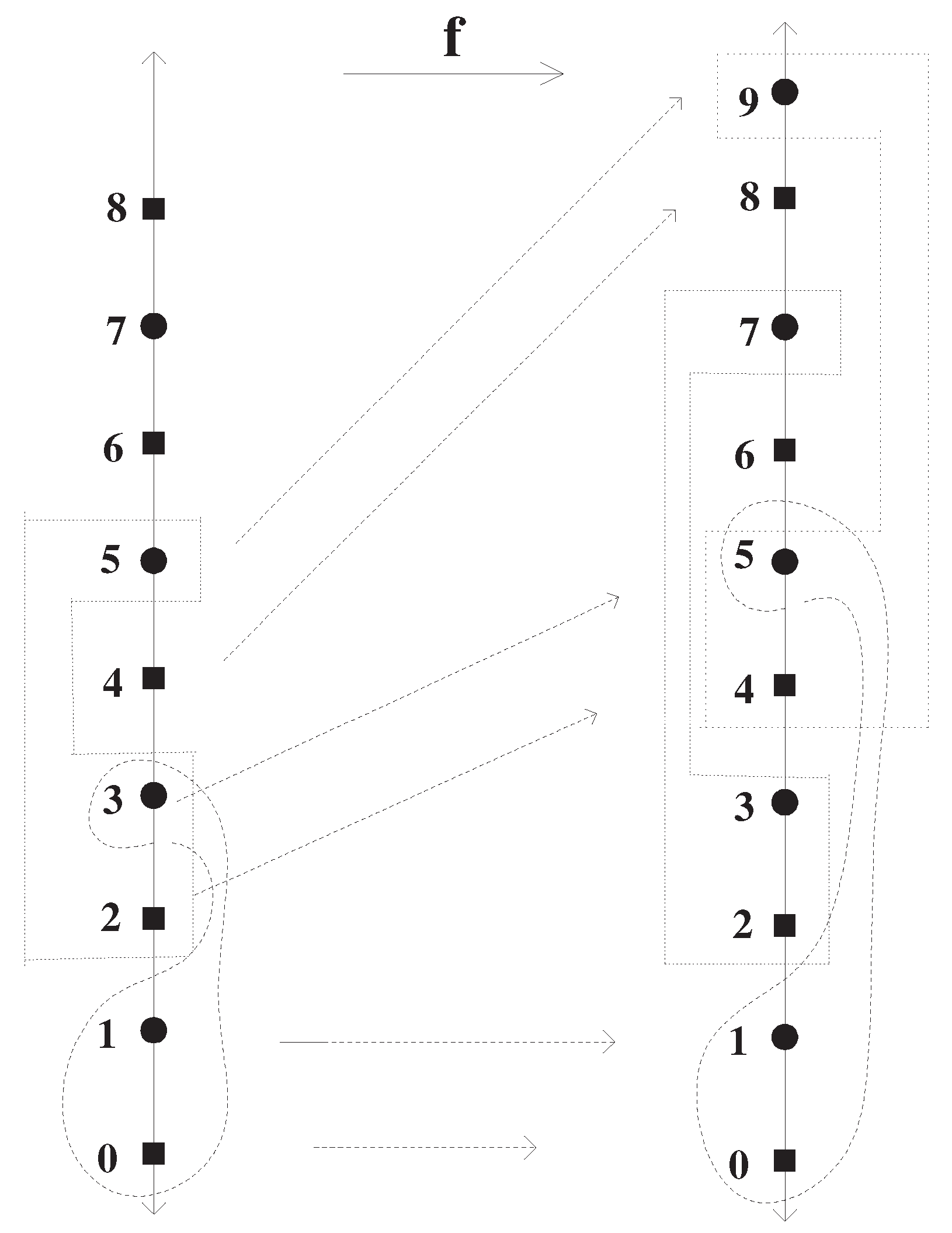
Figure 1 and
Figure 2). Regarding the further statement of a mixed point in
, for the points
(resp.
), we call the point
p closed-open (
resp. open-closed).
With this perspective, in
we clearly observe that for the point
of
the
smallest (open) neighborhood of the point, denoted by
, is the following [
10,
11,
18]:
Hereafter, in
, we denote the smallest open set containing a point
x with
for short or
[
22] if there is no danger of confusion.
Definition 3. A topology T is called a quasi-discrete topology [23] (or clopen or pseudo-discrete topology [24]) if every open set in T is closed. Remark 1. (1) In view of (1), any infinite set of is not compact in .
(2) Due to the connectedness of [20], is clearly connected. In the category of Alexandroff spaces, for two Alexandroff spaces and , it is clear that a map is continuous if, and only if, for each point , , where means the smallest open set containing the point x in the given Alexandroff space. In addition, for two Alexandroff spaces and , a map is called an Alexandroff homeomorphism if h is a continuous bijection, and further, is continuous.
For instance, in
, let us now recall the notion of
K-continuity of a map between two
K-topological spaces [
8] as follows: For two
K-topological spaces
and
, a function
is said to be
K-continuous at a point
if
f is continuous at the point
x from the viewpoint of
K-topology. Further, we say that a map
is
K-continuous if it is
K-continuous at every point
. Indeed, since
is an Alexandroff space (see (1)), the above
X and
Y are Alexandroff spaces. Thus we can represent the
K-continuity of
f at a point
[
18], as follows
Based on this approach, a map is called a K-homeomorphism if h is a K-continuous bijection and further, is K-continuous.
We say that a topological space satisfies the separation axiom
[
25,
26,
27] if every singleton of
is either an open or a closed set. Then, we call it a
-space.
For two topologies,
and
, on a set
X, in the case
is coarser (weaker) than
and
is finer (stronger) than
[
28], we use the notation
. If additionally
, then we say that
is strictly coarser than
and
is strictly finer than
[
28]. In this case we use the notation
. In examining the case
, we can equivalently take the following approach. Let
be bases for the topologies
. Then, it is clear that
3. Various Types of Topologies on Generated by Certain Subbases
In this section, many types of subbases, say , are introduced for establishing topologies of . Then, we intensively explore the topological features of , with respect to separation axioms and an Alexandroff space structure. As mentioned previously, each element of the subbase of the K-line topology consists of three consecutive elements. Indeed, the topology on generated by the set as a subbase is homeomorphic to . Thus, we now consider other types of elements which are not consecutive, such as for a given number , , and so forth.
Let us now investigate various properties of the topologies generated by certain subbases .
Lemma 1. Given a number , assume the set Consider a topology on generated by as a subbase, denoted by . Then, is an Alexandroff space.
Before proving this claim, as the set is totally determined by the number , hereafter, the topology of Lemma 1 will be denoted by for simplicity, i.e., .
Proof. Given a number
, a topology generated by the given subbase
is obtained in terms of the following process.
where
is the base induced by the subbase
and
is the topology generated by the set
as a base. Since
is an Alexandroff space. □
Example 1. (1) The topology is generated by the set as a subbase. Thus, for any , we obtainfrom which is proved to be an Alexandroff space. (2) The topology is generated by the set as a subbase. Thus, for any we obtainwhich implies that is an Alexandroff space. (3) The topology is generated by the set as a subbase. Thus, for any we obtainwhich means that is an Alexandroff space. Lemma 2. For distinct numbers , we obtain the following:
(1) .
(2) .
Proof. (1) (Case 1) Consider the case of which either of and is equal to 0. Without loss of generality, let us assume . Then, due to the subbase given in (4) (see also Example 1(2)), we observe that whereas each member of has cardinality 2, that of has cardinality 3, which clearly implies that .
(Case 2) In the case neither of
and
is equal to 0 and further,
, each member of
is different from any element of
because
which implies that
.
(2) The bases
, induced by the subbases
, are finally obtained, as follows:
According to the property (see the proof of (1) of Lemma 2), (6) supports the assertion. □
Theorem 1. For a number , we obtain
(1) is not a Kolmogorov space.
(2) is a -space, .
Proof. (1) Since , by Example 1(2), the proof is completed. To be precise, due to the smallest open sets and in (see Example 1(2)), is not a Kolmogorov space.
(2) Due to the bases on (6), we obtain
. Thus, in the topological space
, it is clear that every singleton consisting of an odd number is open. Let us now prove that every singleton consisting of an even number is closed. Namely, let us prove that for each element
, the singleton
is a closed set in
. For the sake of doing this work, let us take a hard look at the topological structure of
. Due to the topology
generated by the set
as a subbase, it is clear that for each
, the singleton
. Let us now consider the complement of
in
, denoted by
. For the set
for convenience, put
and
. Then, the set
can be represented in the following way, say
. Since the singleton
belongs to
and further,
, it is clear that the set
. Considering the topology
, let us now examine if each element of
is an interior point of
. Indeed,
is represented by
Based on the subbase of (4), whereas the subset is an open set in , there is no element containing the remaining element , where . Thus, . However, there is a member in . Thus, is an interior point of . Hence, although is not a subset of , it is a subset of . Finally, we conclude that is an open set in .
For instance, we can confirm that the singleton
of
Figure 1 is proved a closed set in
in the following way. The set
is represented by
and
. Although
is not an open set in
, we observe that
. Since each of the sets
,
, and
belongs to
(for
, see
Figure 1), we conclude that
is an open set in
.
Finally, according to (4) and using a method similar to the proof of being a -space of , we obtain that is also a -space, . Then this is true since every singleton consisting of an odd number is an open set in . □
Some further studies of the structures of
, will intensively be done in
Section 4 (see Theorem 2).
4. Countably Many Types of Topologies on Generated by the Subbases
In this section, we now intensively characterize the topological spaces . One important thing is that we can observe several types of topological features on depending on the given subbases , such as a quasi-discrete, the K-topological, and Alexandroff topological structures. Furthermore, for , , we find that and further, is not homeomorphic to either.
Theorem 2. For the topological spaces , we obtain the following properties, where .
(1) is a quasi-discrete (not discrete) topological space.
(2) is not connected.
(3) is the K-topological line.
(4) if , and .
(5) For distinct numbers , is not homeomorphic to .
Proof. (1) Since
, we have
. Hence, with the topology
(see (5)), the smallest open set containing an even number
or an odd number
is exactly the set
(see Example 1(2)). Thus, each open set in
, denoted by
, can be represented by
Therefore, the closure of is equal to itself, which completes the proof.
(2) Owing to Theorem 2 (1), the proof is completed. Namely, for any , is a separation of .
(3) Since the topology is generated by the set as a subbase, it is equal to the K-line topology on .
(4) (Case 1) For distinct numbers
, assume that either of
i and
j is equal to 0. Without loss of generality, we may take
and
. Since
, we obtain
. Meanwhile, for each
, the base
is induced by the subbase
. According to (3), we obtain that
is not comparable with
. Namely,
and
. To be precise, based on (3), consider an arbitrary member of
, say
, and take an element
. Then, there is no element
such that
, which implies that
.
Conversely, consider an arbitrary member of
, say
, and take an element
. For convenience, we may put
. Then, there is no element
such that
, which implies that
.
(Case 2) For and , let us compare two topologies and according to (3). Then, we prove that is not comparable with , i.e., and . Let us take any , e.g., and further, an element . Then, by Lemma 2, there is no member such that , which implies that is not finer than .
Meanwhile, using a method similar to the proof of this approach, we can also prove that is not finer than either, which completes the proof.
(5) (Case 1) Owing to Theorem 1, it is clear that is not homeomorphic to .
(Case 2) For two numbers , without loss of generality, we may assume . Then we prove that is not homeomorphic to . Before proving this assertion, we observe that for the topologies , in view of (3) and Theorem 1 (2), each singleton consisting of an odd (resp. an even) number is an open (resp. a closed) set in both and .
Using the reductio ad absurdum, suppose there is a homeomorphism
At this moment, we need to recall the following.
Namely, , where . In other words, any element should be an interior point of in . Put , where (resp. ) is the set of even (resp. odd) integers. Then, owing to (10), .
Based on this observation, we now proceed to the proof. Since
f is a continuous bijection, in view of (9), (10), and (11), in
we obtain
More precisely, owing to (9), (10), and (11), we obviously obtain that
Hence, using the smallest open sets in
and
(see (10) and (11)), for some
, we may assume
. Then, the other elements
and
in
should be mapped by the map
f as follows:
Indeed, regarding the maps in (13), we observe
according to the continuities of
f and
(see the continuity of
at
) because
Then, owing to (1) and (2) of (13), we have a contradiction with respect to the bijection of f because f is not a bijection at least what concerns the elements , and so on in . Thus it turns out that is not homeomorphic to .
For instance, without loss of generality, we may take
. Then consider the map
f of (8) with
, i.e.,
In practice, considering the topologies (resp. ) as (resp. ), we suffice to prove that and are not homeomorphic, as follows:
Following the reductio ad absurdum, recall the homeomorphism in (8)
Furthermore, without loss of generality, we may assume
according to (12) and (13). Then
, because
and
(see (4) and (5)) and further,
so that
. Suppose
instead of
. Then, since the smallest open set of 4 in
is
, and
should be also continuous at 4 in
. Thus
should contain the element 1 and further,
, where
means the cardinality of the given set. Hence we obtain
, which invokes a contradiction to being a map of
f at 0, i.e.,
and
(see this process in
Figure 2). Thus we must have
and further,
. Owing to the mapping
and
, we obtain
(see (9)). Then
(see (12)) so that we have
and
.
Owing to the mapping , we have , where . In addition, so that we have , i.e., and further, and .
Using this process, we conclude that there are no elements in mapping to the elements 2, 3, 6, 7 and so on, which invokes a contradiction to the bijection of f. □
Corollary 1. Each is connected if .
Proof. By Theorems 1 and 2 ((3), and (5)), the proof is completed. □
Up to now we have studied the structures of the topologies generated by the subbase in terms of the process of (5). As proven in Theorem 2, it turns out that there are countably many topologies , on which are not homeomorphic to the K-line topology .
Let us now replace the subbase of (4) by the set (see (9)), where
Then, what happens on the topology
using the process of (5) (see also (15) below)? Based on this query, we now investigate certain structures of
. Before proceeding to this work, we can recognize some similarities and differences between
of (4) and
, as follows:
Lemma 3. Given a number , consider the set of (14). Then, is a subbase for a topology on . The topology generated by as a subbase is denoted by . Thus, we have as an Alexandroff space.
Since the set
is totally determined by the number
, hereafter, the topology
of Lemma 3 will be denoted by
for simplicity. Thus, given a number
, with the process given in (5), consider the topology generated by the given subbase
of Lemma 3 in the following way.
where
is the base generated by the subbase
and
is the topology generated by the set
as a base. According to the process of (15), we observe that for
each singleton consisting of even (resp. odd) number is an open (resp. a closed) set.
Using a method similar to the proof of Theorem 2, we obtain the following:
Corollary 2. For the topological spaces , we obtain the following:
(1) is a quasi-discrete (not discrete) topological space.
(2) is not connected.
(3) Although is not the K-topological line, it is homoeomorphic to .
(4) if , and .
(5) For distinct numbers , is not homeomorphic to if .
Proof. (1) Due to the structure of and the process of (15), the smallest open set of or is the set .
(2) Due to (1) above, the proof is completed.
(3) Consider the map defined as . Then, it is a homeomorphism.
(4) Due to (15), for any distinct numbers
, using a method similar to the proof of Lemma 2, we obtain
Further, in terms of a method similar to the proof of Theorem 2 (3), the proof is completed.
(5) With the topology , using a method similar to the proof of Theorem 2 (5), we complete the proof. □
In view of Theorem 2 and Corollary 2, we obtain the following:
Remark 2. For each we obtain
(1) .
(2) .
(3) is not homeomorphic to if .
Let us now consider some topologies on generated by certain Cartesian products of the sets , as subbases. To be precise, using the process similar to that of (5), we may consider many types of the Cartesian products, such as , , and so forth. Then, we denote by and generated by the above Cartesian products as subbases. Based on Theorem 2 and Corollary 2, we obtain the following:
Corollary 3. There are countably many topologies , , and so on, which are not homeomorphic to the 2-dimensional K-topological plane, i.e., .
Using the method given in Corollary 3, for the set , we can also obtain countably many topologies generated by certain n-tuple Cartesian products of and . Further, each of these topologies need not be homeomorphic to the n-dimensional K-topological space, i.e., .