1. Introduction
In this paper, we are concerned only with simple, finite, connected and undirected graphs with vertex set and edge set . The order and the size of G is, respectively, the number of vertices and the number of edges of G. The degree of a vertex v, denoted by (or simply ) is the cardinality of the set of vertices adjacent to v in a graph G. The distance between two vertices , denoted by , represents the number of edges in a shortest path between these two end nodes in G. The diameter of G is the maximum distance between any pair of vertices of G. The distance matrix of a graph G is a square symmetric matrix defined as . The transmission of a vertex v, denoted by , is defined as the sum of the distances from v to all other vertices in G, in other words, . A graph G is referred to as k-transmission regular when the matrix has the constant row sum equal to k. The Wiener index (also called the transmission) of a graph G, denoted by , is the sum of distances between all unordered pairs of vertices in G. Apparently, . For any vertex , the transmission is also called the transmission degree, shortly denoted by , and the sequence is called the transmission degree sequence of the graph G.
Let
be the diagonal matrix of vertex transmissions of
G. Following Aouchiche and Hansen [
1,
2], the
distance Laplacian matrix and the
distance signless Laplacian matrix of a graph
G are defined, respectively, as
and
. Recently, the spectral properties of the distance Laplacian matrix, distance matrix, as well as distance signless Laplacian matrix have attracted attention of the many researchers and a large number of papers have been published regarding their spectral properties, like spectral radius, energy, Estrada index, second largest eigenvalue, smallest eigenvalue, etc. For some recent works, we refer to [
3,
4,
5] and the references cited therein.
Motivated by [
6], Cui et al. [
7] introduced the
generalized distance matrix as a convex combinations of
and
, defined as
, for
. Noting that
, and
, any result regarding the spectral properties of generalized distance matrix has its counterpart for each of these particular graph matrices, and these counterparts following immediately from a single proof. In fact, this matrix reduces to merging the distance Laplacian spectral, distance spectral, as well as distance signless Laplacian spectral theories. As the matrix
is real symmetric, all its eigenvalues are real. Therefore, we can arrange them as
. The largest eigenvalue
of the matrix
is called the
generalized distance spectral radius of
G (We will denote
by
).
Based upon some geometric characteristics of biomolecules, Ernesto Estrada [
8,
9] investigated an expression taking the form
where
represent all eigenvalues of the adjacency matrix of a molecular graph
G. Analytical studies on this quantity was performed later in [
10] and the name “Estrada index” was proposed in [
11]. The properties of the Estrada index have been intensively explored, see, for example [
11,
12,
13,
14]. There exists a vast literature related to Estrada index and its bounds and we refer the reader to the nice surveys [
15,
16].
This graph-spectrum-based invariant has also an important role in chemistry, biology, as well as network science. It has been applied for instance to gauge the extent of folding of long chain polymeric molecules, encompassing some proteins [
8,
17,
18]. It has found a number of applications in complex networks and characterizes the centrality [
9].
offers a unique metric to characterize the robustness of complex networks [
19]; namely, it is a monotonic measure with respect to the edge deletion and addition. For more applications of the Estrada index in network science, see the monograph in [
20] and papers [
19,
21].
The pioneering papers [
8,
9] further investigate varied versions of Estrada index with respect to other graph associated matrices. Because of the evident success of the graph Estrada index, this proposal has been put into effect, and Estrada index-based on the eigenvalues of more graph matrices have been introduced subsequently: Estrada index-based invariant with respect to distance matrix [
22], Estrada index-based invariant with respect to Laplacian matrix [
23,
24], Estrada index-based invariant with respect to signless Laplacian matrix [
25,
26], and Estrada index-based invariant with respect to distance signless Laplacian matrix [
27] have been introduced and studied. For some other interesting papers, we direct the reader to works [
28,
29,
30,
31].
The distance matrix graph has shown its importance in a wide range of areas across science and engineering. The distance matrix contains information on the number of walks and self-avoiding walks of chemical graphs, which adjacency matrix fails to show. Distance matrix has been used to calculate many topological indices, including the Wiener index, and thermodynamic properties involving temperature and pressure coefficients. In the design of communication infrastructure network, molecular stability, and graph embedding theory, distance matrix has played an important role. Distance eigenvalues of graphs have attracted huge attention for mathematicians for decades. For more information regarding distance spectrum, we refer to the survey [
1] and the references therein.
We observe that the distance matrix and its eigenvalues are of importance not only from a chemistry point of view, but also because they are very useful in other branches of science and social science. Clearly, the information one gets regarding the graph from the distance matrix is also visible from the distance Laplacian and the distance signless Laplacian matrices of a graph. As these matrices use more structural properties of a graph than the distance matrix, these matrices may contain a wealth of information about the graph. In addition to its formal analogy to the Estrada index, the distance and the distance signless Laplacian Estrada indices are arguably of prominent significance in physical chemistry. Distance turns out to be rooted deeply in the molecular graphs.
Therefore, here we define the
generalized distance Estrada index , based on the generalized distance matrix of the graph
G, as
where
are the eigenvalues of
(the generalized distance eigenvalues of a graph
G).
It follows from the definition that
and
, where
denotes the distance Estrada index of a graph
G and
denotes the distance signless Laplacian Estrada index of a graph
G. This shows that the concept of generalized distance Estrada index of a graph
G merges the theories of distance Estrada index and the distance signless Laplacian Estrada index of a graph
G. Let
Then, and Recalling the power series expansion of , we can write the generalized distance Estrada index as
The rest of the paper is structured as follows. In
Section 2, we mention some preliminary results which will be helpful throughout the paper. In
Section 3, we obtain some lower bounds for the generalized distance Estrada index
, in terms of various graph parameters associated with structure of the graph
G, and identify the extremal graphs attaining these bounds. In
Section 4, we obtain some upper bounds for the generalized distance Estrada index
and delineate the extremal graphs. In
Section 5, we derive some relations between the generalized distance Estrada index and the generalized distance energy of
G. Finally, in
Section 6, we obtain some results about generalized distance Estrada index of some elementary graphs and give an expression for
of a (transmission) regular graph
G, in terms of the distance eigenvalues as well as adjacency eigenvalues of
G, and describe the generalized distance Estrada index of some graphs obtained by operations.
2. Preliminary Results
In this section, we give some preliminary results which will be utilized in the subsequent sections. The following lemma can be found in [
7].
Lemma 1 ([
7]).
Suppose that G is a connected graph of order n. We havewhere the equality holds if and only if G is transmission regular. By a similar way as used in the proof of ([
32], Lemma 2), we can prove the following lemma.
Lemma 2. A connected graph G admits two distinct generalized distance eigenvalues if and only if G is a complete graph.
The proof of the following lemma is similar to that of ([
4], Theorem 2.2) and is omitted here.
Lemma 3. Let the transmission degree sequence of G be . Then,where the equality holds if and only if G is transmission regular. Given two nonincreasing real sequences
and
of length
n,
is said to be majorized by
or
majorizes
, denoted by
if
The relation means that and is not the rearrangement of .
The following observation can be found in [
23].
Lemma 4 ([
23]).
Let and be nonincreasing sequences of real numbers of length n. If , then for any convex function ψ, we have . Equality holds if and only if for all . In addition, when and ψ is strictly convex, holds. The majorization relation between the spectrum and diagonal elements of Hermitian matrices perfectly links the spectrum of a generalized distance matrix with majorization. The relation given below immediately follows.
Lemma 5. Assume that G is a connected graph of order n admitting generalized distance eigenvalues and transmission degrees . Then, Theorem 1. Assume that G is any connected graph of order with transmission degree sequence .
- (i)
If or , then ;
- (ii)
If , then .
Equality occurs in both parts, if and only if for .
Proof. (i) For
, it follows that the function
is a convex function if
or
. Let
and
. By Lemma 5, we have
. It then follows by Lemma 4 that
Therefore, by Lemma 4, equality occurs in the inequality (
3) if and only if
That is, if and only if
for all
.
(ii) For , it follows that the function is a convex function if . Therefore, proceeding similarly as in part (i), we arrive at part (ii). □
3. Lower Bounds for the Generalized Distance Estrada Index of Graphs
In this section, we obtain some lower bounds for the generalized distance Estrada index of a connected graph G. These bounds are characterized in terms of the order n, the Wiener index , the transmission degree and the parameter . We also investigate the extremal graph attaining these bounds.
Our first result gives a lower bound for the generalized distance Estrada index , in terms of the order n, the transmission degrees and the parameter .
Theorem 2. Suppose G is a connected graph of order n. Then,with equality if and only if . Proof. Starting with Equation (
1), we have
Thanks to the arithmetic–geometric mean inequality, we have
Using a power-series expansion, and as
,
and
, we get
We apply a multiplier
to arrive at
where we have used the fact that
for
since
,
for
and
for
when
.
Let
. By substituting (
6) and (
7) in (
5), and solving it for
, we get
The function
monotonically decreases for
. Consequently, the best lower bound for
is attained for
. This gives us the first part of the proof.
From the derivation of (
4), we observe readily that the equality holds if and only if
G has no non-zero
-eigenvalues. Recall that
G is connected. Therefore, this can only happen when
. The proof is then complete. □
The following result is an immediate consequence of Theorem 2.
Corollary 1. Assume that G is a connected graph of order n. We havewhere the equality holds if and only if . Proof. As
from the lower bound of Theorem 2, we obtain
Thus, the result, □
The next result gives a complementary lower bound for the generalized distance Estrada index . The bound is characterized by the order n of graph, its Wiener index as well as the parameter .
Theorem 3. Suppose that G is a connected graph of order n. Then,where the equality holds if and only if . Proof. Thanks to Equation (
1) and the well-known arithmetic–geometric mean inequality, we have
Consider the following function,
for
. We have
for
It is not difficult to see that
is increasing for
. Using Equation (10) and Lemma 1, we obtain
Moreover, from the derivation of (
8), it is clear that equality holds if and only if the equality holds in the inequality (
9). Also, equality holds in (
9) if and only if
. Therefore,
G has exactly two distinct generalized distance eigenvalues; then, by Lemma 2, we see that
G is the complete graph
.
Conversely, it is easy to see that the equality holds in (
8) for
. □
We will make use of the following lemma in our next results.
Lemma 6 ([
33]).
Let be non-negative numbers. Then, Let be the geometric mean of the transmission degrees sequence. Clearly, , and equality is attained if and only if (i.e., G is a transmission regular graph).
Our next result gives a lower bound for in terms of the order n, the Wiener index , the geometric mean of the transmission degrees sequence and the parameter . It also gives an upper bound for in terms of the order n, the diameter d and the parameter .
Theorem 4. Assume that G is a connected graph of order with diameter d. Then, The equality on the left-hand side of (
12)
holds if and only if . The equality on the right hand side of (
12)
holds if and only if . Proof. We will deal with the left part inequality first. Thanks to the arithmetic–geometric mean inequality, we arrive at
By Lemma 3,
. Setting
in Lemma 6, we get
Combining this with Lemma 3 yields
Clearly,
and so
Similar to Theorem 3, we obtain the desired result. If , we have , and Therefore, and the equality holds.
Conversely, assume that the equality holds true. In view of (
13), we have
Clearly,
if and only if
From (
14), it follows that
for
Thus,
G has exactly two distinct generalized distance eigenvalues, and so Lemma implies that
G is the complete graph
.
Next, we prove the right inequality. We have
As
for
and there are
pairs of vertices in
we have
, so that
Therefore, we arrive at the right-hand side of the inequality (
12).
In the above proof, it can be seen that the equality holds if and only if G has no non-zero -eigenvalues. Recall that G is connected. This can only happen when . The proof is complete. □
Remark 1. In view of the inequality we obtain Recall that the function defined in (
11)
is increasing. The given lower bound in (
12)
turns out to be sharper than the lower bound in (
8).
Given a k-transmission regular graph G, we have and . Therefore, the following result follows immediately from Theorem 4.
Corollary 2. Suppose that G is k-transmission regular. We havewhere the equality holds if and only if . The next result provides a lower bound for involving the order n and the Wiener index .
Theorem 5. Suppose that G is a connected graph of order n. We have Proof. Applying the Cauchy–Schwartz inequality we have
, therefore
It follows again by the Cauchy–Schwartz inequality that
Thus
and then, by (
15), we obtain
Corollary 3. Suppose that G is connected with order n. We have Proof. As
for
and there are
pairs of vertices in
by Theorem 5, we obtain
and the result follows. □
6. Examples
In this section, we obtain some results about the generalized distance Estrada index of some typical graphs. This would be instrumental in interpreting this measure further in the case of more complex graphs. We also give an expression for of a (transmission) regular graph G, in terms of the distance eigenvalues as well as adjacency eigenvalues of G, and describe the generalized distance Estrada index of some graphs obtained by operations.
As mentioned in introduction of the paper, for the generalized distance matrix is equivalent to the distance matrix and for , twice the generalized distance matrix is the same as the distance signless Laplacian matrix . Therefore, if in particular we put and in all the results obtained in this paper, we obtain the corresponding bounds for the distance Estrada index and the distance signless Laplacian Estrada index , respectively.
Theorem 11. Suppose that G is a k-transmission regular graph of order n having distance eigenvalues Then, Proof. Note that the generalized distance spectrum of the graph G consists of where is the distance spectrum of Also, it is easy to see that Then, □
Theorem 12. Let G be an r-regular graph of order n, size m and diameter at most 2. If are the eigenvalues of the adjacency matrix of then Proof. The transmission of each vertex
can be computed as
and the Wiener index
of
G becomes
Also,
where
J is the all ones matrix. Then,
□
We denote by the cartesian product of two graphs G and H. It is the graph with vertex set and two vertices and are adjacent if and only if and or and
Corollary 4. Let G be an r-regular graph of diameter at most 2 with an adjacency matrix A and . Then, the generalized distance Estrada index of is Proof. Let
,
. As
, we see that all vertices of
H have the same transmission and
. So
. Then
Note that
has distance spectrum (see in [
37])
for
The graph is obtained by joining each vertex of G to each vertex of a second copy of G.
Corollary 5. Let G be an r-regular graph with an adjacency matrix A and . Then, the generalized distance Estrada index of is Proof. For
it is easy to see that
Then,
is a transmission regular graph and
Note that the
has distance spectrum (see in [
37])
for
Then,
□
Next, we study the generalized distance Estrada index of the lexicographic product of two graphs G and H. The lexicographic product of G and H can be defined as follows.
Definition 1 ([
39]). Let
G and
H be two graphs on vertex sets
and
, respectively. Their
lexicographic product is a graph defined by
, the cartesian product of
, and
, where
is adjacent to
if and only if either
- (a)
is adjacent to in G, or
- (b)
and is adjacent to in G.
Theorem 13. Given a k-transmission regular graph G of order p. If H is an r-regular graph of order n with adjacency eigenvalues , thenwhere are the eigenvalues of the distance matrix . Proof. For
it is easy to see that
Then
is a transmission regular graph and
Note that
has distance spectrum (see [
40])
for
and
Then,
□
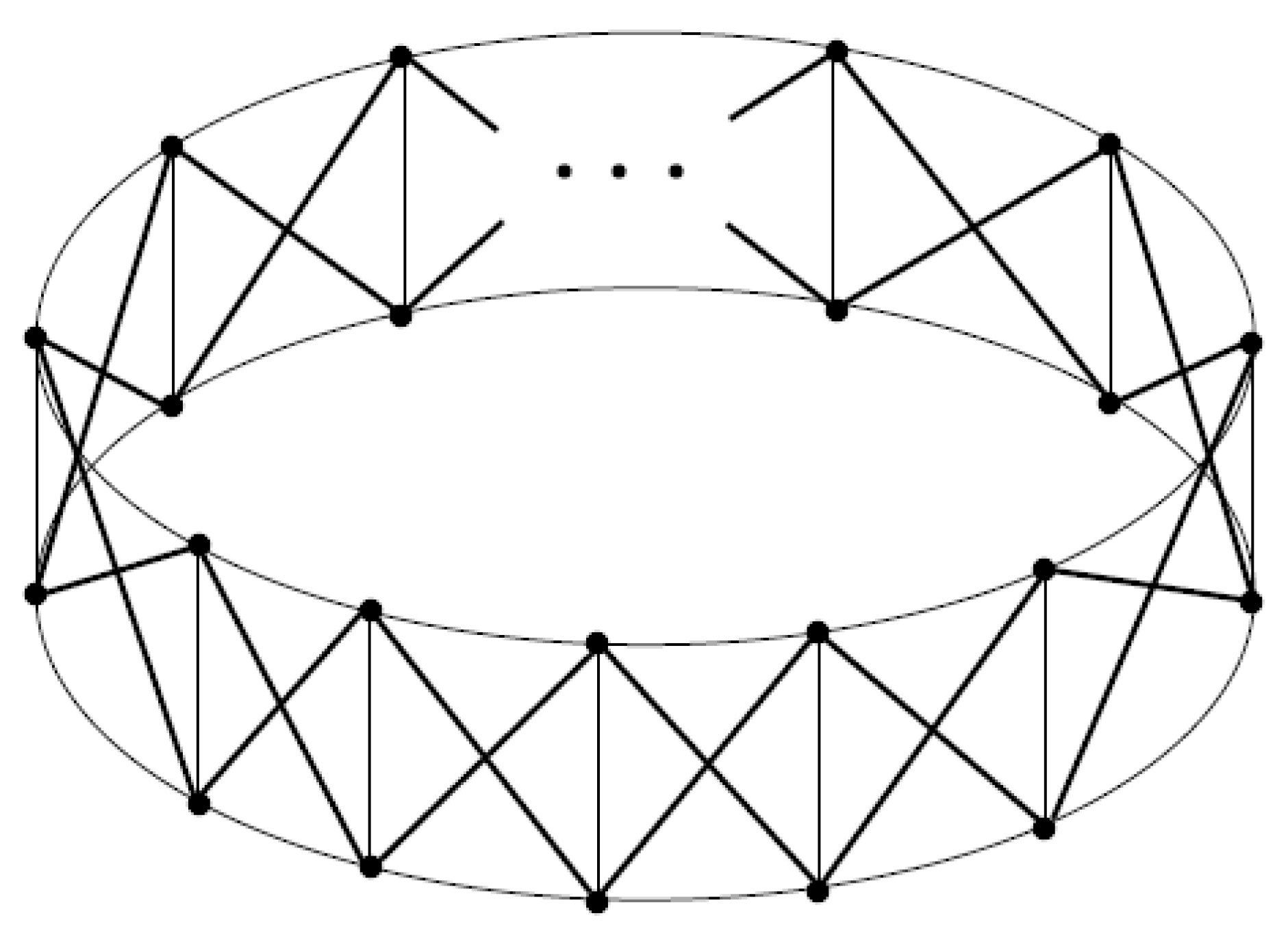
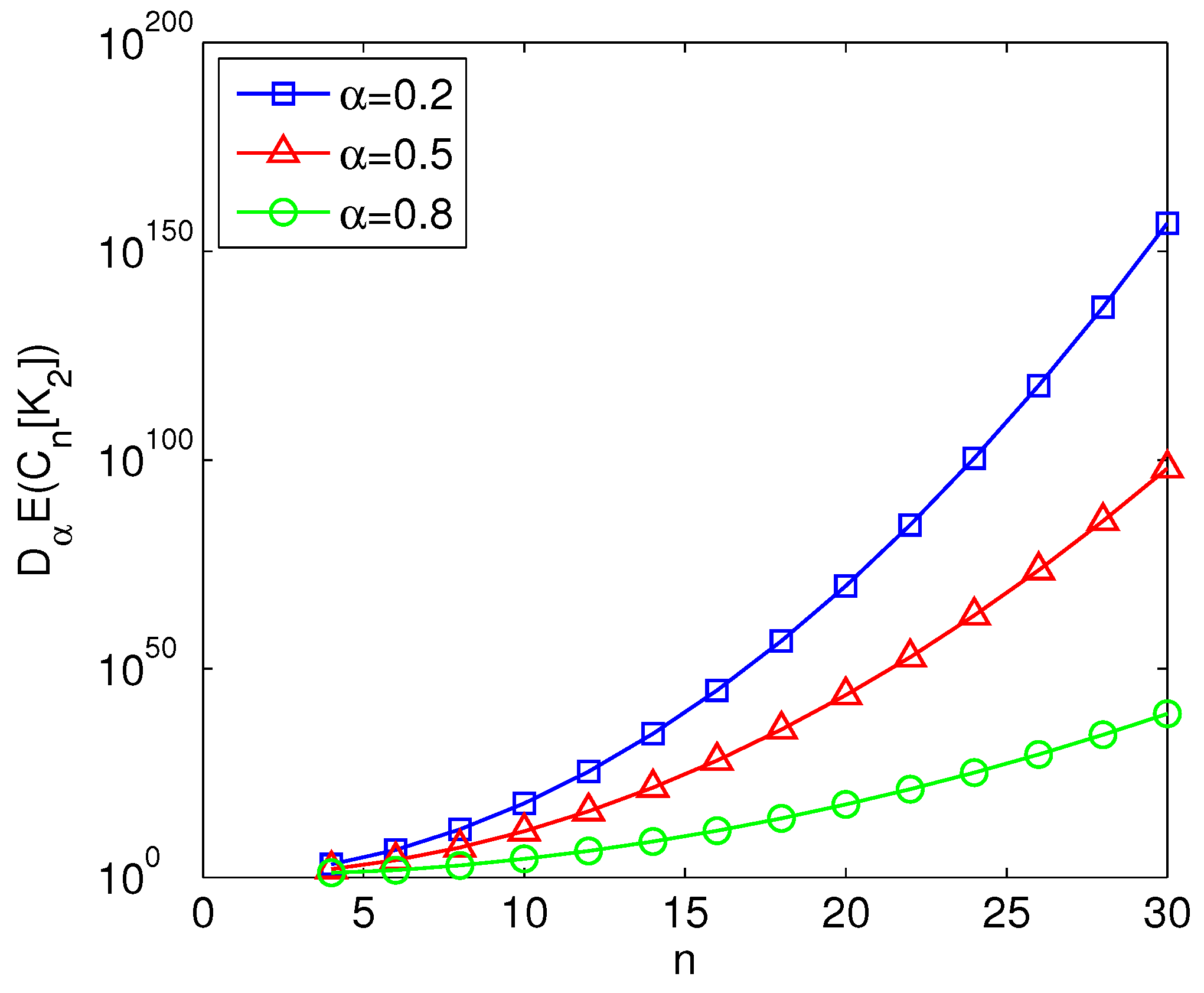
Example 1. Let be a cycle of order n and be the complete graph of order 2. Then, the closed fence graph is defined as , and depicted in Figure 1. Applying Theorem 13, we will be able to compute the generalized distance Estrada index of closed fence . It is well known ([41], Theorem 3) that is a k-transmission regular graph, with . It is also clear tht the adjacency spectrum of the graph is . Then, applying Theorem 13, the generalized distance Estrada index of closed fence , according to the parity of n, is as follows. If (i.e., n is even), then following [2] the distance spectrum of is Thus, applying Theorem 13 we have If (i.e., n is odd), then following [2] the distance spectrum of is Thus, applying Theorem 13 we haveFigure 2 shows versus n for different values of α.