


Abstract
For a graph G, the resistance distance is defined to be the effective resistance between vertices x and y, the multiplicative degree-Kirchhoff index , where is the degree of vertex x, and denotes the vertex set of G. L. Feng et al. obtained the element in with first-minimum multiplicative degree-Kirchhoff index. In this paper, we first give some transformations on , and then, by these transformations, the second-minimum multiplicative degree-Kirchhoff index and the corresponding extremal graph are determined, respectively.
1. Introduction
Throughout this paper, we consider finite, undirected simple graphs. Let be a graph with vertex set (or V) and edge set . For a graph G, the distance between vertices x and y, denoted by , is the length of a shortest path between them.
For distance, Harold Wiener in 1947 defined a famous index [1], named Wiener index, where . It is the earliest and one of the most thoroughly studied distance-based graph invariants. Later, Dobrynin and Kochetova [2] gave a modified version of the Wiener index . It is called degree distance and has attracted much attention (see [3,4,5,6]). For a graph G, the degree distance is the essential part of the molecular topological index introduced by Schultz [7], which is defined as , where is the well-known first Zagreb index [8]. Klein et al. [9] discovered the relation between degree distance and Wiener index for a tree G on n vertices:
The Gutman index of a connected graph G is defined as . It was introduced in [10] and has been studied extensively (see, e.g., [11,12]). For a tree G on n vertices, Gutman [10] showed that
In 1993, Klein and Randić [13] introduced a distance function named resistance distance on a graph. They viewed a graph G as an electrical network such that each edge of G is assumed to be a unit resistor, and the resistance distance between the vertices x and y of the graph G, denoted by , is then defined to be the effective resistance between the vertices x and y in G. The Kirchhoff index of G is defined as
The index has been widely studied in mathematical, physical and chemical aspects; for details on the Kirchhoff index, the readers are referred to [14,15,16,17,18]. In 1996, Gutman and Mohar [19] obtained the result by which a relationship is established between the Kirchhoff index and the Laplacian spectrum: , where are the eigenvalues of the Laplacian matrix of a connected graph G with n vertices.
Similarly, if the distance is replaced by resistance distance in the expression for the degree distance and Gutman index, respectively, then one arrives at the following indices
and are called the additive degree-Kirchhoff index and multiplicative degree- Kirchhoff index, respectively, and were introduced by Gutman et al. [20] and Chen et al. [21], respectively. The indices have been well studied in both mathematical and chemical literature. In [22] some properties of are determined and the extremal graph of cacti with minimum -value characterized. Bianchi et al. [23] studied some upper and lower bounds for whose expressions do not depend on the resistance distances. Feng et al. [24] characterized n-vertex unicyclic graphs having maximum, second maximum, minimum, and second minimum multiplicative degree-Kirchhoff index. Palacios [25] studied some interplay of the three Kirchhoff indices and found lower and upper bounds for the additive degree-Kirchhoff index. Yang and Klein [26] derived a formula for of subdivisions and triangulations of graphs. To simplify the calculation of , the present authors [27] also obtained a formula for with respect to the subgraph of G. For more work on the topological indices, we refer the reader to [13,21,22,28,29,30,31].
In this paper, we study the multiplicative degree-Kirchhoff index of cacti. To state our results, we introduce some notation and terminology. For graph-theoretical terms that are not defined here, we refer to Bollobás’ book [32]. Let and be the path, the cycle and the star on n vertices, respectively. We denote by if graph G is isomorphic to graph H. Let . Denote by the degree of the vertex x of G. If , we denote by the subgraph of G obtained by deleting the edges in . If is the subset of the edge set of the complement of G, denotes the graph obtained from G by adding the edges in Similarly, if , we denote by the subgraph of G obtained by deleting the vertices of W and the edges incident with them and the subgraph of G induced by W. If and , we write and instead of and , respectively.
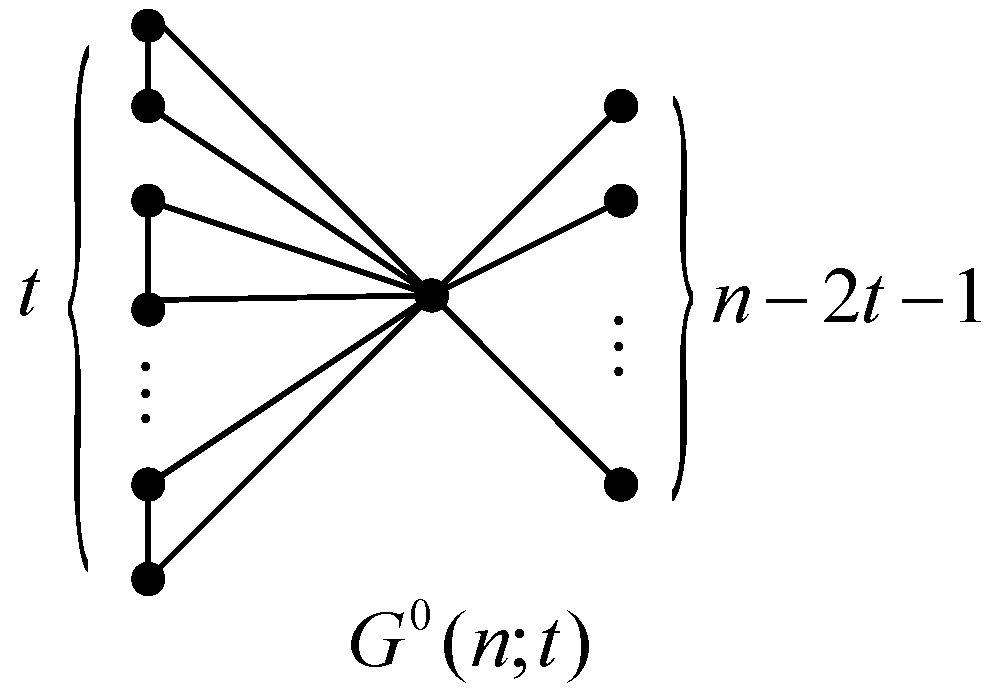
A graph G is called a cactus if each block of G is either an edge or a cycle. Denote by the set of cacti possessing n vertices and t cycles. Let , a cycle of G is said to be an end cycle if all vertices are of degree two, and the degree of vertex is greater than two. The vertex is called the anchor of C. Let be the graph shown in Figure 1. In this paper, we first give some transformations on , and then, by these transformations, we determine the first-minimum and second-minimum multiplicative degree-Kirchhoff index in and characterize the corresponding extremal graphs, respectively.
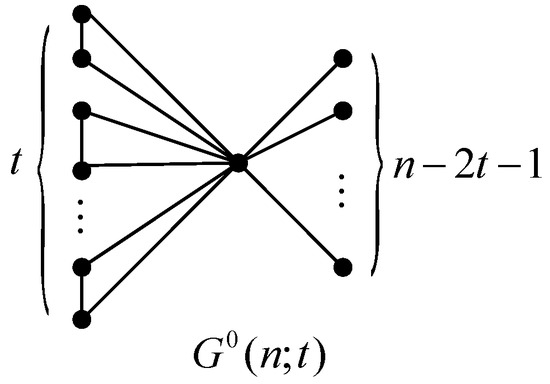
Figure 1.
The graph .
Now, we give some lemmas that are used in the proof of our main results.
Lemma 1.
Ref. [13] Let u be a cut vertex of a connected graph G and x and y be vertices occurring in different components which arise upon deletion of u, then
Lemma 2.
Ref. [27] Let and be connected graphs with disjoint vertex sets, with and edges, respectively. Let . Constructing the graph G by identifying the vertices and , and denote the so obtained vertex by u. Then,
For completeness, we also give the proof in this paper.
Proof.
Let , . Note that for , and . By the definition of and Lemma 1, we have
Because and for , for , we have
since for . □
Lemma 3.
Ref. [27] Let , then , where is the class of unicyclic graphs. The equality holds if and only if .
2. Transformations
In this section, we give some transformations that decrease .
Transformation 1.
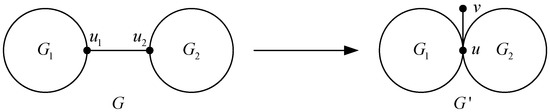
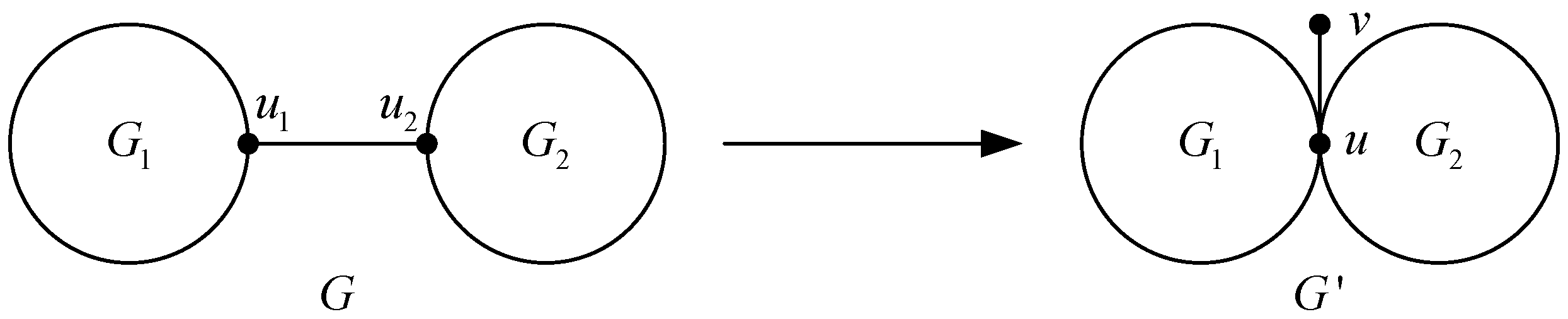
Let be a cut-edge of G, but not an pendent edge, be the connected components of , where . Constructing the graph from G by deleting and identifying the vertices , denote the so obtained vertex by u, adding an pendent edge (as shown in Figure 2).
Figure 2.
The graphs G and in Transformation 1.
Lemma 4.
Let be the graphs described in Transformation 1, then .
Proof.
Let and , where . Let H be the graph obtained by attaching to the vertex of the pendent vertex , then . By Lemma 2, we have
Note that , then
so . □
Let be the class of connected graphs on n vertices. By Transformation 1 and Lemma 4, we have the following result.
Corollary 1.
Let be a graph with the smallest multiplicative degree-Kirchhoff index in , then all cut-edges are pendent edges.
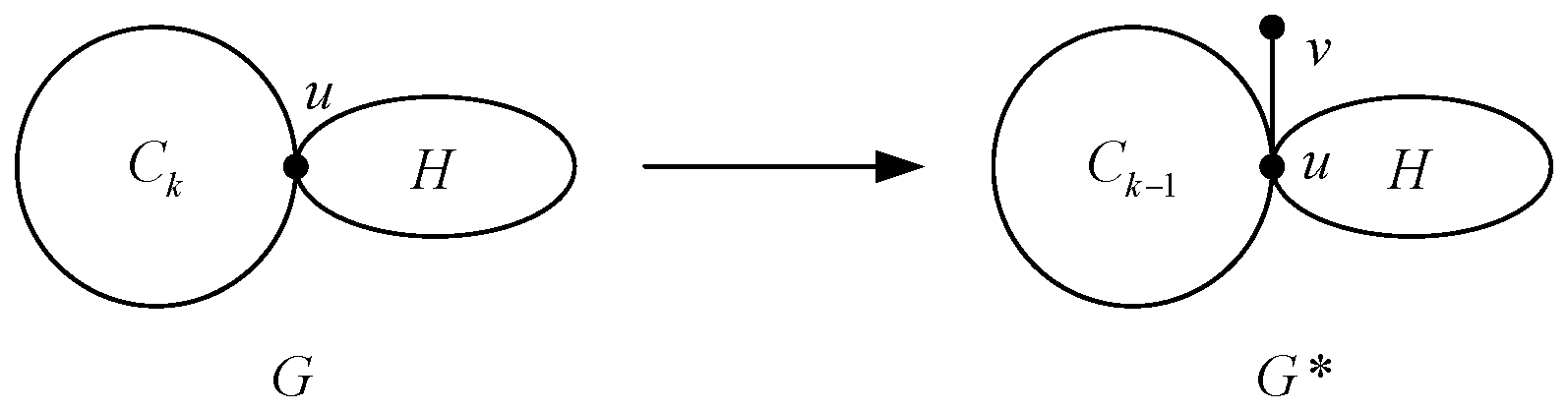
Transformation 2.
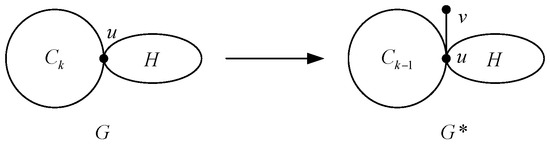
For , let be a cycle with vertices, contained in G. Let there be a unique vertex which is adjacent to a vertex in . Assuming that , construct a new graph (as shown in Figure 3).
Figure 3.
The graphs G and in Transformation 2.
For , by direct calculation, we have
Lemma 5.
Let be the graphs described in Transformation 2, then .
Proof.
Let S be the graph obtained by attaching to the vertex u of the pendent vertex v. By Lemma 1, we have
Further by Equations (1) and (2), then
since . □
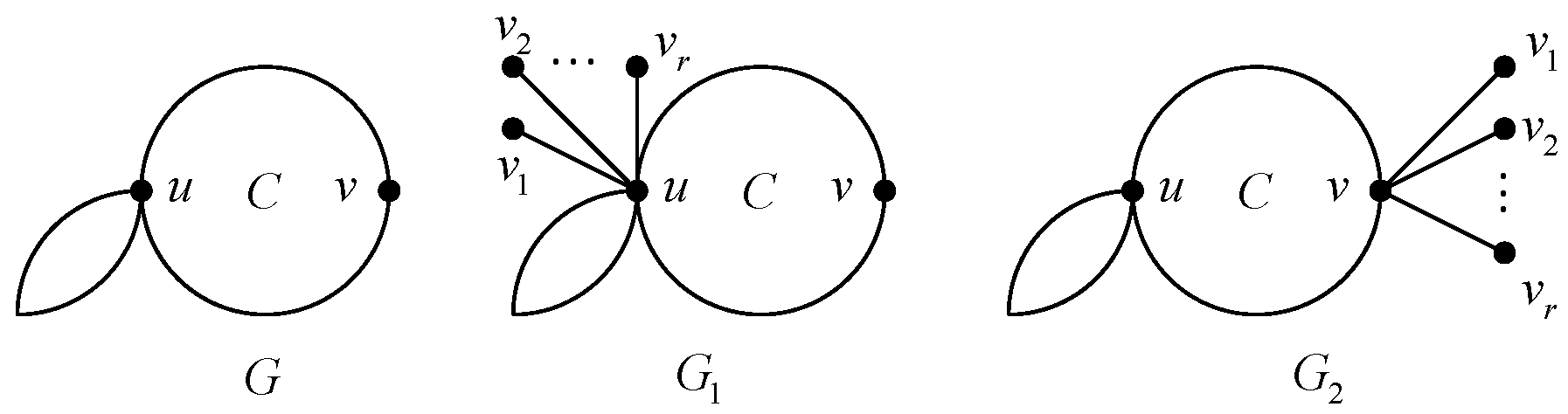
Transformation 3.
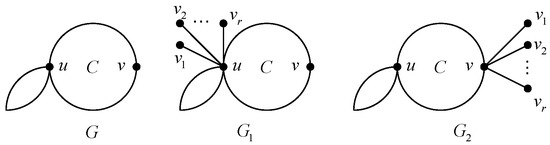
Let , be a cactus without cut edges. Let C be an end cycle of G and u be its anchor. Let v be a vertex of C different from u. The graphs and are constructed by adding r pendent edges to the vertices u and v of G respectively (as shown in Figure 4).
Figure 4.
The graphs G, and in Transformation 3.
Lemma 6.
Let be the graphs described in Transformation 3, then .
Proof.
Let and , then . By Lemma 2, we have
Note that , and for , then
Considering that and , we obtain
This completes the proof. □
Transformation 4.
Let be a cycle of the graph G, C is called a pendant triangle if and . Suppose that G is a cactus graph and are two vertices, such that and are pendant triangles with the anchor u and v, respectively. We form two new graphs A and B according to the following transformation.
Lemma 7.
Let be the graphs described in Transformation 4, then either or .
Proof.
Let , and . Because of , by Lemma 2, we have
and analogously
Note that for and for or or , then
Considering that for and , we get
and analogously,
Because for , then
Because for . After the transformation, the degree of the vertex v increases by , and for .
By Equations (3)–(13), we have
Similarly, we have
If then
Further, we have
This completes the proof. □
Transformation 5.
Let u be a vertex of G such that there are s pendent vertices attached to u, and v be another vertex of G such that there are t pendent vertices attached to v. Let
Similar to the proof of Lemma 7, we can prove the following result.
Lemma 8.
Let and be graphs as described in Transformation 5, then either or .
3. Main Results
In this section, we determine the elements in with first-minimum and second-minimum multiplicative degree-Kirchhoff index by the transformations that we have obtained. Note that the first-minimum multiplicative degree-Kirchhoff index has been obtained in [33]; for completeness, we also give the following proof.
Theorem 1.
Ref. [33] Let , then . The equality holds if and only if .
Proof.
Let be the unique graph having the minimum multiplicative degree-Kirchhoff index in .
Case 1. If , is the class of unicyclic graphs. By Lemma 3, we know the results hold.
Case 2. If , is the class of bicyclic graphs. By Lemma 4, we conclude that contains two cycles attached to a common vertex u, and all cut-edges are all pendent edges (if any). Further, by Lemmas 8 and 6, all pendent edges (if any) are also attached to u. Finally, by Lemma 5, the two cycles must be triangles, that is, . This obtains the desirable results.
Case 3. If , by Lemma 4, we conclude that all cut-edges are all pendent edges (if any) in . Further, by Lemmas 8 and 6, has at least two end cycles. Repeated by Lemmas 5–8, we arrive at the conclusion
By direct calculation, we have
This completes the proof. □
Theorem 2.
Let , then . The equality holds if and only if .
Proof.
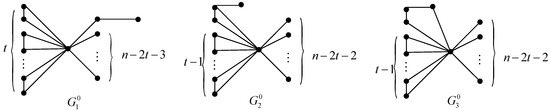
By Lemmas 4–8 and Theorem 1, one can conclude that G, which has the second-minimum multiplicative degree-Kirchhoff index in must be one of the graphs , as shown in Figure 5. By Lemma 2, we have
Figure 5.
The graphs .
Then,
This completes the proof. □
By Theorems 1 and 2, we have
Corollary 2.
Among all graphs in , and are the graphs with first-minimum and second-minimum multiplicative degree-Kirchhoff index.
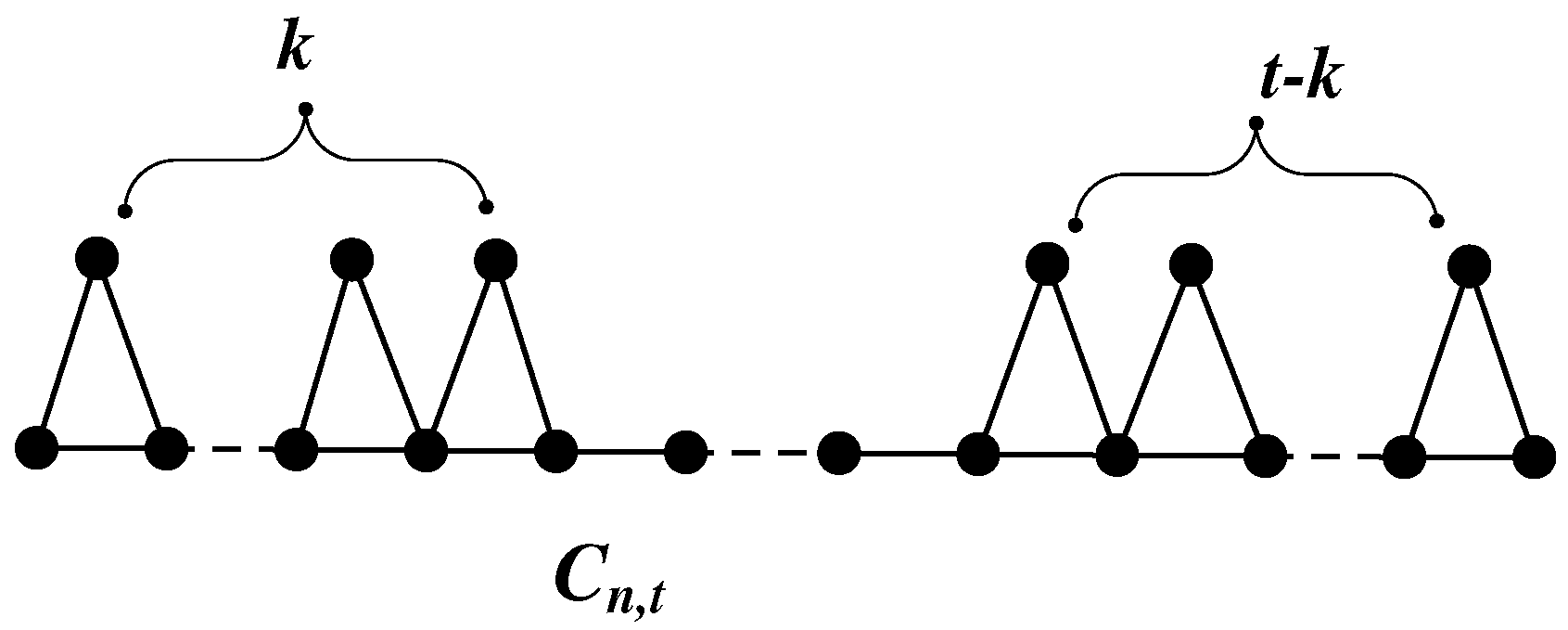
According to the above discussion, we find that the extremal cacti for the index are the same as the extremal cacti for the Kirchhoff index, the multiplicative degree-Kirchhoff index, the Wiener index and the other indices [22,29,34,35]. Based on the known results for these indices, we guess the element of with maximum multiplicative degree-Kirchhoff index is isomorphic to the graph (as shown in Figure 6).
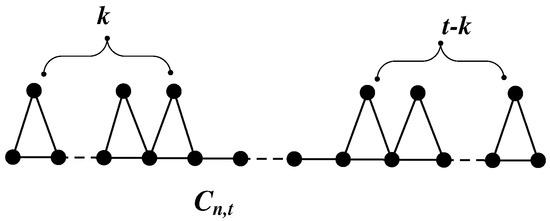
Figure 6.
The graphs .
Conjecture 1.
Let be the graph depicted in Figure 6, where . Then, is the unique element of having maximum multiplicative degree-Kirchhoff index.
In particular, for , if , and are the set of unicyclic graphs and trees, respectively. For , the graphs having maximum and minimum multiplicative degree-Kirchhoff index are given in [13], that is
where consists of a cycle of size 3 to which a path with vertices is attached. For , it is easy to get the result
4. Conclusions
In this paper, we give some transformations on the multiplicative degree-Kirchhoff index. As applications, the second-minimum multiplicative degree-Kirchhoff index on and the corresponding extremal graph are determined. We guess is the graph of with maximum value. For solving the problem, our approach would need to be modified; it would be interesting to continue studying the extremal graphs.
Author Contributions
Investigation, Z.Z.; Methodology, F.H.
Funding
This research received no external funding.
Conflicts of Interest
The authors declare no conflict of interest.
References
- Wiener, H. Structural determination of paraffin boiling points. J. Am. Chem. Soc. 1947, 69, 17–20. [Google Scholar] [CrossRef] [PubMed]
- Dobrynin, A.A.; Kochetova, A.A. Degree distance of a graph: A degree analogue of the Wiener index. J. Chem. Inf. Comput. Sci. 1994, 34, 1082–1086. [Google Scholar] [CrossRef]
- Ali, P.; Mukwembi, S.; Munyira, S. Degree distance and vertex–connectivity. Discret. Appl. Math. 2013, 161, 2802–2811. [Google Scholar] [CrossRef]
- Dankelmannn, P.; Gutman, I.; Mukwembi, S.; Swart, H.C. On the degree distance of a graph. Discret. Appl. Math. 2009, 157, 2773–2777. [Google Scholar] [CrossRef]
- Li, S.C.; Song, Y.B.; Zhang, H.H. On the degree distance of unicyclic graphs with given matching number. Graphs Comb. 2015, 31, 2261–2274. [Google Scholar] [CrossRef]
- Tomescu, I. Ordering connected graphs having small degree distances. Discret. Appl. Math. 2010, 158, 1714–1717. [Google Scholar] [CrossRef]
- Schultz, H.P. Topological organic chemistry. 1. Graph theory and topological indices of alkanes. J. Chem. Inf. Comput. Sci. 1989, 29, 227–228. [Google Scholar] [CrossRef]
- Gutman, I.; Das, K.C. The first Zagreb index 30 years after. MATCH Commun. Math. Comput. Chem. 2004, 50, 83–92. [Google Scholar]
- Klein, D.J.; Mihalić, Z.; Plavšić, D.; Trinajstić, N. Molecular topological index: A relation with the Wiener index. J. Chem. Inf. Comput. Sci. 1992, 32, 304–305. [Google Scholar] [CrossRef]
- Gutman, I. Selected properties of the Schultz molecular topological index. J. Chem. Inf. Comput. Sci. 1994, 34, 1087–1089. [Google Scholar] [CrossRef]
- Agnes, V.S. Degree distance and Gutman index of corona product of graphs. Trans. Comb. 2015, 4, 11–23. [Google Scholar]
- Knor, M.; Potočnik, P.; Škrekovski, R. Relationship between the edge Wiener index and the Gutman index of a graph. Discret. Appl. Math. 2014, 167, 197–201. [Google Scholar] [CrossRef]
- Klein, D.J.; Randić, M. Resistance distance. J. Math. Chem. 1993, 12, 81–95. [Google Scholar] [CrossRef]
- Arauz, C. The Kirchhoff indexes of some composite networks. Discret. Appl. Math. 2012, 160, 1429–1440. [Google Scholar] [CrossRef]
- Feng, L.; Yu, G.; Xu, K.; Jiang, Z. A note on the Kirchhoff index of bicyclic graphs. Ars Comb. 2014, 114, 33–40. [Google Scholar]
- Yang, Y.; Jiang, X. Unicyclic graphs with extremal Kirchhoff index. MATCH Commun. Math. Comput. Chem. 2008, 60, 107–120. [Google Scholar]
- Zhang, H.; Jiang, X.; Yang, Y. Bicyclic graphs with extremal Kirchhoff index. MATCH Commun. Math. Comput. Chem. 2009, 61, 697–712. [Google Scholar]
- Zhou, B.; Trinajstić, N. On resistance–distance and kirchhoff index. J. Math. Chem. 2009, 46, 283–289. [Google Scholar] [CrossRef]
- Gutman, I.; Mohar, B. The quasi—Wiener and the Kirchhoff indices coincide. J. Chem. Inf. Comput. Sci. 1996, 36, 982–985. [Google Scholar] [CrossRef]
- Gutman, I.; Feng, L.; Yu, G. Degree resistance distance of unicyclic graphs. Trans. Comb. 2012, 1, 27–40. [Google Scholar]
- Chen, H.; Zhang, F. Resistance distance and the normalized Laplacian spectrum. Discret. Appl. Math. 2007, 155, 654–661. [Google Scholar] [CrossRef]
- Du, J.; Su, G.; Tu, J.; Gutman, I. The degree resistance distance of cacti. Discret. Appl. Math. 2015, 188, 16–24. [Google Scholar] [CrossRef]
- Bianchi, M.; Cornaro, A.; Palacios, J.L.; Torriero, A. New upper and lower bounds for the additive degree-Kirchhoff index. Croat. Chem. Acta 2013, 86, 363–370. [Google Scholar] [CrossRef]
- Feng, L.H.; Gutman, I.; Yu, G.H. Degree Kirchhoff index of unicyclic graphs. MATCH Commun. Math. Comput. Chem. 2013, 69, 629–648. [Google Scholar]
- Palacios, J.L. Some interplay of the three Kirchhoffian indices. MATCH Commun. Math. Comput. Chem. 2016, 75, 199–206. [Google Scholar] [CrossRef]
- Yang, Y.; Klein, D.J. Resistance distance-based graph invariants of subdivisions and triangulations of graphs. Discret. Appl. Math. 2015, 181, 260–274. [Google Scholar] [CrossRef]
- Zhu, Z.; Hong, Y. Some transformations on multiplicative degree-Kirchhoff index of graphs and their applications. 2019; submitted. [Google Scholar]
- Bianchi, M.; Cornaro, A.; Palacios, J.L.; Renom, J.M.; Torriero, A. Revisiting Bounds for the Multiplicative Degree-Kirchhoff Index. MATCH Commun. Math. Comput. Chem. 2016, 75, 227–231. [Google Scholar]
- Liu, J.; Wanga, W.; Zhang, Y.; Pan, X. On degree resistance distance of cacti. Discret. Appl. Math. 2016, 203, 217–225. [Google Scholar] [CrossRef]
- Palacios, J.L.; Renom, J.M. Another look at the degree-Kirchhoff index. Int. J. Quantum Chem. 2011, 111, 3453–3455. [Google Scholar] [CrossRef]
- Shang, Y.L. Further Results on Distance Estrada Index of Random Graphs. Bull. Malaysian Math. Sci. Soc. 2018, 21, 537–544. [Google Scholar] [CrossRef]
- Bollobás, B. Modern Graph Theory; Springer: Berlin, Germany, 1998. [Google Scholar]
- Feng, L.; Liu, N.; Yu, G.; Li, S. The degree-Kirchhoff index of fully loaded unicyclic graphs and cacti. Util. Math. 2014, 95, 149–159. [Google Scholar]
- He, F.; Zhu, Z. Cacti with maximum eccentricity resistance-distance sum. Discret. Appl. Math. 2017, 219, 117–125. [Google Scholar] [CrossRef]
- Liu, H.Q.; Lu, M. A Unified Approach to Extremal Cacti for Different Indices. MATCH Commun. Math. Comput. Chem. 2007, 58, 183–194. [Google Scholar]

© 2019 by the authors. Licensee MDPI, Basel, Switzerland. This article is an open access article distributed under the terms and conditions of the Creative Commons Attribution (CC BY) license (http://creativecommons.org/licenses/by/4.0/).