Abstract
Pythagorean fuzzy sets (PFSs), an extension of intuitionistic fuzzy sets (IFSs), inherit the duality property of IFSs and have a more powerful ability than IFSs to model the obscurity in practical decision-making problems. In this research study, we compute the energy and Laplacian energy of Pythagorean fuzzy graphs (PFGs) and Pythagorean fuzzy digraphs (PFDGs). Moreover, we derive the lower and upper bounds for the energy and Laplacian energy of PFGs. Finally, we present numerical examples, including the design of a satellite communication system and the evaluation of the schemes of reservoir operation to illustrate the applications of our proposed concepts in decision making.
1. Introduction
Yager recently [1,2] introduced the concept of the Pythagorean fuzzy set (PFS) as a generalization of the intuitionistic fuzzy set (IFS) [3], to manage the complex impreciseness and uncertainty in practical decision-making problems. The prominent characteristic of the Pythagorean fuzzy model is to relax the condition that the sum of its membership degree and non-membership degree is no greater than one with the square sum of its membership degree and non-membership degree no greater than one. After the inception of PFS by Yager [2], Zhang and Xu [4] presented the mathematical form of the PFS and introduced the concept of the Pythagorean fuzzy number (PFN). Meanwhile, they presented a series of basic operational laws of PFNs and proposed the Pythagorean fuzzy aggregation operators. PFS, a novel class of the non-standard fuzzy set, has a wide range of applications in different fields, such as medical diagnosis [5], Internet stock investment [6], the service quality of domestic airlines [4] and the governor selection of the Asian Infrastructure Investment Bank [7].
Graph representations are generally used for dealing with structural information, in different domains such as operations research, networks, systems analysis, pattern recognition, economics and image interpretation. Gutman [8] introduced the notion of the energy of a graph in chemistry, because of its relevance to the total -electron energy of certain molecules and found upper and lower bounds for the energy of graphs [9]. In chemistry, the energy of a given molecular graph is interesting because of its relation to the total -electron energy of the molecule represented by that graph. A graph with all isolated vertices has zero energy, while the complete graph with n vertices has energy . Later, Gutman and Zhou [10] defined the Laplacian energy of a graph as the sum of the absolute values of the differences of the average vertex degree of G to the Laplacian eigenvalues of G. When there is obscureness in the description of the objects, or in their relations, or in both, the fuzzy graph model is put forward naturally. The concept of fuzzy graphs was initiated by Kaufmann [11], based on Zadeh’s fuzzy relations [12]. Rosenfeld [13] discussed the concept of the fuzzy graph and developed its structure. The energy of a fuzzy graph was investigated in [14] by Anjali and Mathew. The Laplacian energy of a fuzzy graph was defined by Sharbaf and Fayazi [15]. Parvathi and Karunambigai [16] generalized the concept of a fuzzy graph to an intuitionistic fuzzy graph (IFG). Later, IFGs were discussed by Akram and Davvaz [17]. Praba et al. [18] defined the energy of IFGs as an extension of [14]. Basha and Kartheek [19] generalized the concept of the Laplacian energy of a fuzzy graph to the Laplacian energy of an IFG. Akram et al. [20,21,22,23,24,25,26] put forward many new concepts concerning the extended structures of fuzzy graphs and provided their pertinent applications in decision-making. Recently, Naz et al. [27] proposed the concept of Pythagorean fuzzy graphs (PFGs), a generalization of the notion of Akram and Davvaz IFGs [17], along with its applications in decision-making. The Pythagorean fuzzy model is more flexible and practical than fuzzy and intuitionistic fuzzy models. Therefore, in this research study, we introduce certain novel concepts, including the energy and Laplacian energy of PFGs, as well as the energy and Laplacian energy of Pythagorean fuzzy digraphs (PFDGs). We illustrate these concepts with examples. We investigate some of their interesting properties. In particular, we solve decision-making problems concerning the design of a satellite communication system and the evaluation of the schemes of reservoir operation to illustrate the applicability and effectiveness of our proposed notions.
The paper is structured as follows: Section 2 proposes the concept of the energy of a PFG and investigates its properties. Section 3 puts forward the Laplacian energy of a PFG based on its Laplacian eigenvalues. Section 4 generalizes the concepts of energy and Laplacian energy to PFDGs. Section 5 is reserved for demonstrating the use of the proposed concepts of energy and Laplacian energy in decision-making, and finally, we draw conclusions in Section 6.
Throughout this paper, Z represents a crisp universe of generic elements, G stands for the crisp graph, is the PFG and is the PFDG.
Definition 1
([2,28]). Let Z be a fixed set. A PFS in Z is expressed as the following mathematical symbol:
characterized by a membership function and a non-membership function , where:
such that Moreover, for all is called a Pythagorean fuzzy index or degree of hesitancy of z in .
For computational convenience, is called a PFN [4], where and .
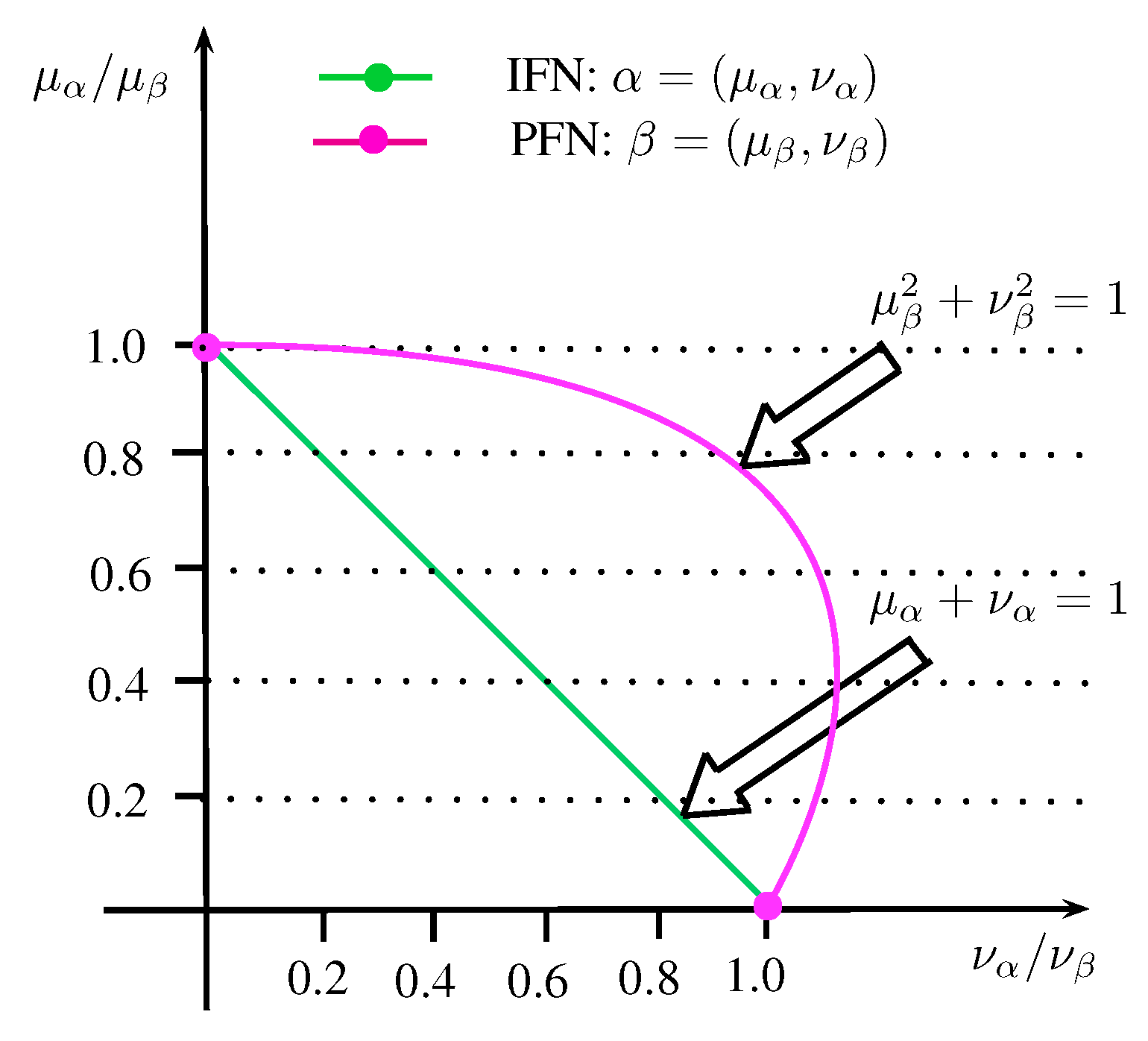
The key difference between the intuitionistic fuzzy number (IFN) [29] and PFN is their different constraint conditions, that is the constraint conditions of IFN and PFN are and , respectively. Since for any point , if , then , so the space of PFS’s membership degree is greater than the space of IFS’s membership degree, as shown in Figure 1.
Figure 1.
Comparison of spaces of the IFNs and the Pythagorean fuzzy numbers (PFNs).
For more definitions and terminologies, the readers are referred to [30,31,32,33,34,35,36,37,38,39,40,41].
2. Energy of Pythagorean Fuzzy Graphs
In this section, we define the energy of a graph under Pythagorean fuzzy circumstances and investigate its properties.
Definition 2
([27]). A PFG on a non-empty set Z is a pair , where is a PFS on Z and is a Pythagorean fuzzy relation on Z such that:
and for all We call and the Pythagorean fuzzy vertex set and the Pythagorean fuzzy edge set of , respectively. Here, is a symmetric Pythagorean fuzzy relation on . If is not symmetric on , then is called PFDG.
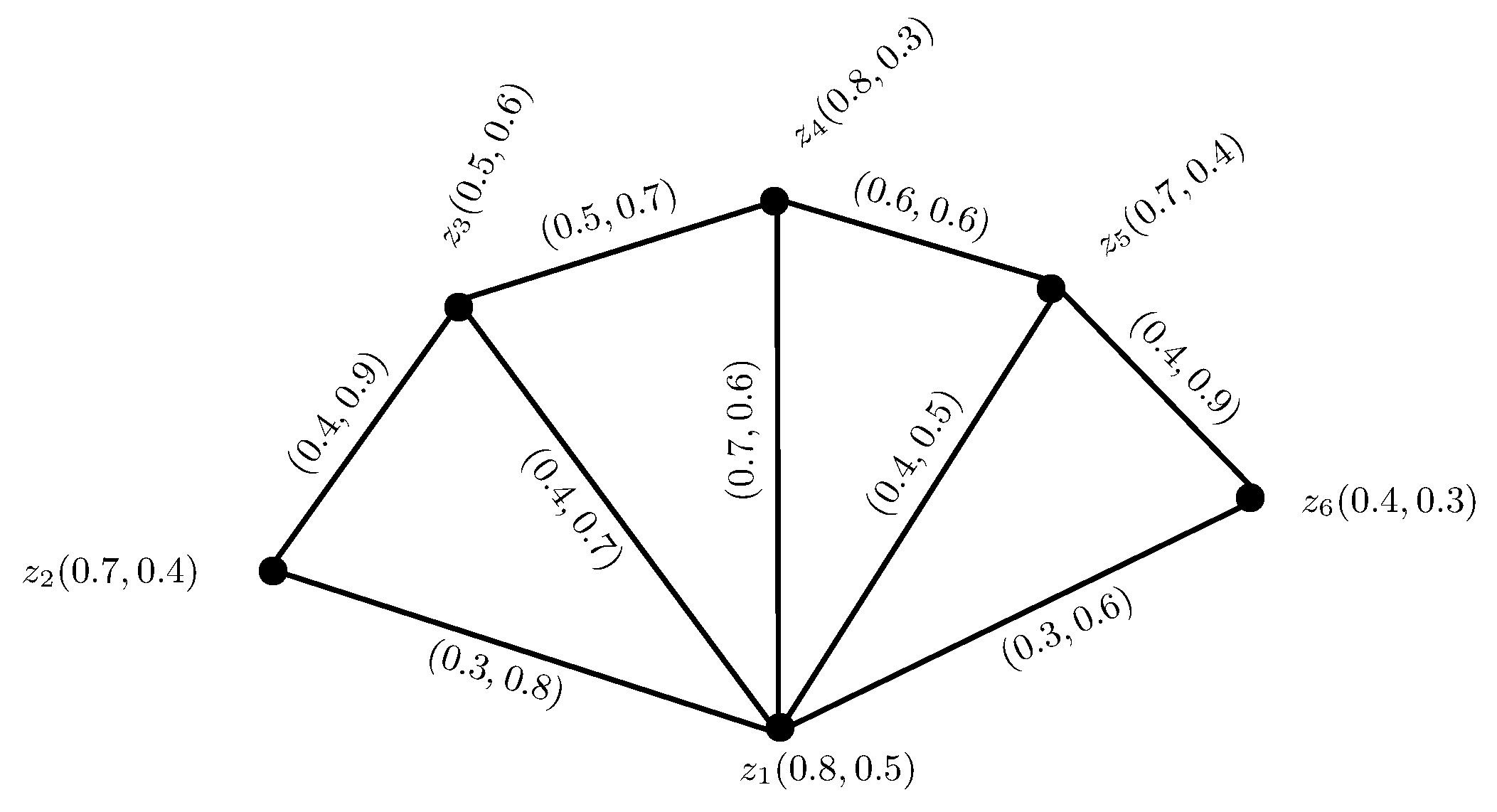
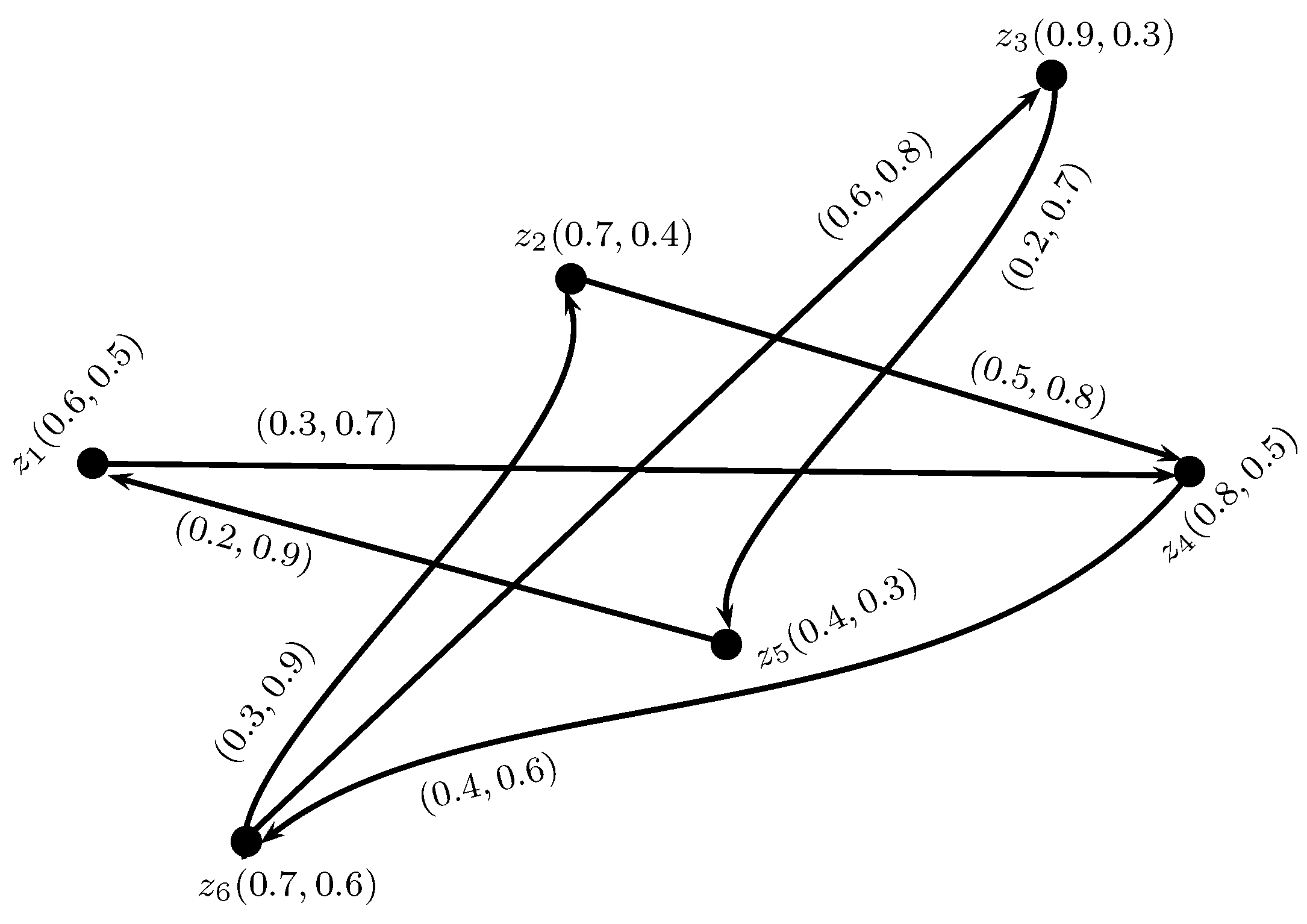
Example 1.
Consider a graph , where is the vertex set and is the edge set of G. Let be a PFG on V, as shown in Figure 2, defined by:
Figure 2.
Pythagorean fuzzy graph.
Definition 3.
The adjacency matrix of a PFG is defined as a square matrix , where and represent the strength of relationship and strength of non-relationship between and , respectively.
Definition 4.
The spectrum of adjacency matrix of a PFG is defined as , where S and T are the sets of eigenvalues of and , respectively.
Definition 5.
The energy of a PFG is defined as:
Example 2.
The adjacency matrix of a PFG given in Figure 2 is:
The spectrum and the energy of a PFG , given in Figure 2, are as follows:
Therefore,
Now, and .
Therefore, .
Theorem 1.
Let be a PFG and be its adjacency matrix. If and are the eigenvalues of and , respectively, then:
- (i)
- (ii)
- and .
Proof.
- (i)
- Since is a symmetric matrix with zero trace, its eigenvalues are real with the sum equal to zero.
- (ii)
- By the trace properties of a matrix, we have:where:
Hence:
Analogously, we can show that . ☐
Example 3.
Consider a PFG on , as shown in Figure 2. Then:
We now find upper and lower bounds of the energy of a PFG , in terms of the number of vertices and the sum of squares of membership and non-membership values of edges.
Theorem 2.
Let be a PFG on n vertices and be the adjacency matrix of . Then:
- (i)
- (ii)
Proof.
(i) Upper bound:
Applying the Cauchy–Schwarz inequality to the vectors and with n entries, we get:
By comparing the coefficients of in the characteristic polynomial:
we have:
Therefore,
Lower bound:
Since , ,
so,
also since:
so,
Thus,
Analogously, we can show that
☐
The following result gives us the upper bound of the energy of a PFG, with the conditions and .
Theorem 3.
Let be a PFG on n vertices and be the adjacency matrix of . If and , then:
- (i)
- (ii)
Proof.
If is a symmetric matrix with zero trace, then where, is the maximum eigenvalue of A. If is the adjacency matrix of a PFG then where . Moreover, since:
Applying the Cauchy–Schwarz inequality to the vectors and with entries, we get:
Now, since the function:
decreases on the interval:
also , Therefore,
Therefore, Equation (7) implies:
Analogously, we can show that:
☐
Theorem 4.
Let be a PFG on n vertices. Then,
Proof.
Suppose that is a PFG with n vertices. If , then by routine calculus, it is easy to show that is maximized when Substituting this value of y in place of in Theorem 3, we must have Similarly, it is easy to show that Hence, ☐
3. Laplacian Energy of Pythagorean Fuzzy Graphs
This section defines and investigates the Laplacian energy of a PFG and provides its properties in detail.
Definition 6.
Let be a PFG on n vertices. The degree matrix, of is a diagonal matrix defined as:
Definition 7.
The Laplacian matrix of a PFG is defined as , where is an adjacency matrix and is a degree matrix of a PFG .
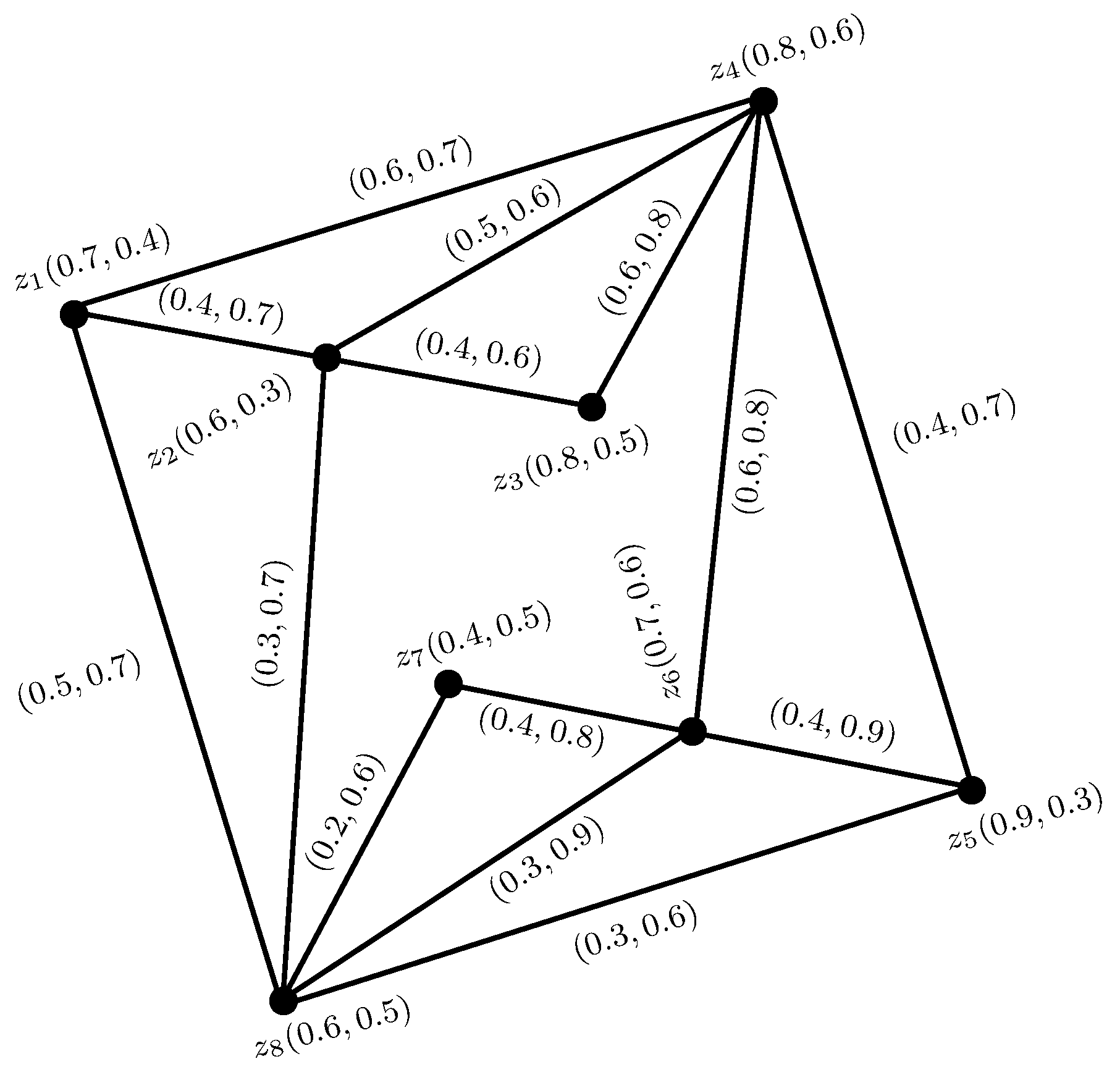
Example 4.
Consider a graph , where and . Let be a PFG on V, as shown in Figure 3.
Figure 3.
Pythagorean fuzzy graph.
The adjacency matrix, degree matrix and Laplacian matrix of the PFG shown in Figure 3 are as follows:
Definition 8.
The spectrum of Laplacian matrix of a PFG is defined as , where and are the sets of Laplacian eigenvalues of and , respectively.
Theorem 5.
Let be a PFG, and let be the Laplacian matrix of . If and are the eigenvalues of and , respectively, then:
- (i)
- (ii)
- , .
Proof.
- (i)
- Since is a symmetric matrix with non-negative Laplacian eigenvalues, such that:Therefore, .Similarly, it is easy to show that, .
- (ii)
- By the definition of Laplacian matrix, we have:
By the trace properties of a matrix, we have:
where:
Therefore,
Analogously, we can show that . ☐
Definition 9.
The Laplacian energy of a PFG is defined as:
where:
Theorem 6.
Let be a PFG, and let be the Laplacian matrix of . If and are the eigenvalues of and , respectively, and then:
where:
Example 5.
The Laplacian spectrum and the Laplacian energy of a PFG , given in Figure 3, are as follows:
Therefore, Laplacian Spec Now,
Therefore, .
Furthermore, we have:
Theorem 7.
Let be a PFG on n vertices, and let be the Laplacian matrix of . Then,
- (i)
- (ii)
Proof.
Applying the Cauchy–Schwarz inequality to the n numbers and , we have:
Since
therefore
Analogously, it is easy to show that
. ☐
Theorem 8.
Let be a PFG on n vertices, and let be the Laplacian matrix of . Then:
- (i)
- (ii)
Proof.
Since
therefore .
Similarly, it is easy to show that
. ☐
Theorem 9.
Let be a PFG on n vertices, and let be the Laplacian matrix of .
Then:
- (i)
- (ii)
Proof.
Using the Cauchy–Schwarz inequality, we get:
Since Therefore:
Similarly, we can show that . ☐
Theorem 10.
If the PFG is regular, then:
- (i)
- (ii)
4. Energy and Laplacian Energy of Pythagorean Fuzzy Digraphs
This section generalizes the concept of energy to PFDGs. The eigenvalues of a PFDG may be complex numbers, as its adjacency matrix is not necessarily symmetric.
Definition 10.
The spectrum of the adjacency matrix of a PFDG is defined as , where and are the sets of eigenvalues of and , respectively.
Definition 11.
Let be a PFDG on n vertices. The energy of is defined as:
where and represent the real part of eigenvalues and , respectively.
Theorem 11.
Let be a PFDG and be its adjacency matrix. If and are the eigenvalues of and , respectively, then:
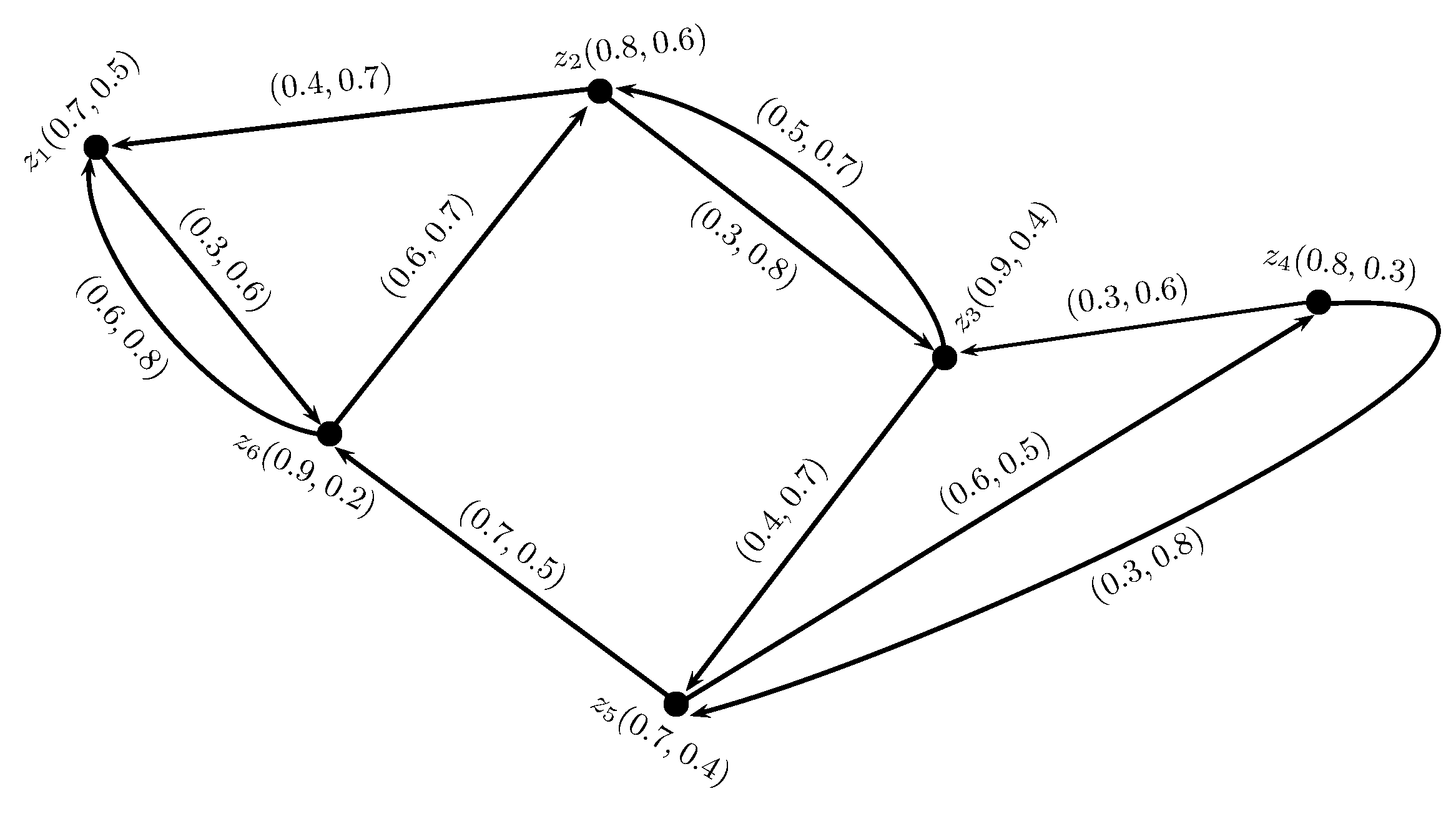
Example 6.
Consider a digraph , where and . Let be a PFDG on V, as shown in Figure 4.
Figure 4.
Pythagorean fuzzy digraph.
The adjacency matrix of a PFDG given in Figure 4 is:
The spectrum and the energy of a PFDG given in Figure 4 are:
Therefore,
Now, and .
Therefore, .
Furthermore,
We now discuss the Laplacian energy of Pythagorean fuzzy digraphs.
Definition 12.
Let be a PFDG on n vertices. The degree matrix, of is a diagonal matrix defined as:
Definition 13.
The Laplacian matrix of a PFDG is defined as , where is an adjacency matrix and is an out-degree matrix of a PFDG .
Definition 14.
The spectrum of the Laplacian matrix of a PFDG is defined as , where and are the sets of Laplacian eigenvalues of and , respectively.
Theorem 12.
Let be a PFDG, and let be the Laplacian matrix of . If and are the eigenvalues of and , respectively, then:
Definition 15.
The Laplacian energy of a PFDG is defined as:
where:
Theorem 13.
Let be a PFDG, and let be the Laplacian matrix of . If and are the eigenvalues of and , respectively, and then .
Example 7.
Consider a PFDG on , as shown in Figure 5.
Figure 5.
Pythagorean fuzzy digraph.
The adjacency matrix, out-degree matrix and Laplacian matrix of the PFDG shown in Figure 5 are as follows:
The Laplacian spectrum and the Laplacian energy of a PFDG , given in Figure 5, are as follows:
Therefore, Laplacian Spec
Now,
Therefore, .
Furthermore, we have:
5. Applications of the Energy of PFGs in Decision-Making
In this section, we use two practical examples of the satellite communication system design and the evaluation of the schemes of reservoir operation to illustrate our proposed concepts of the Pythagorean fuzzy graph theory in decision-making.
5.1. Designing of a Satellite Communication System
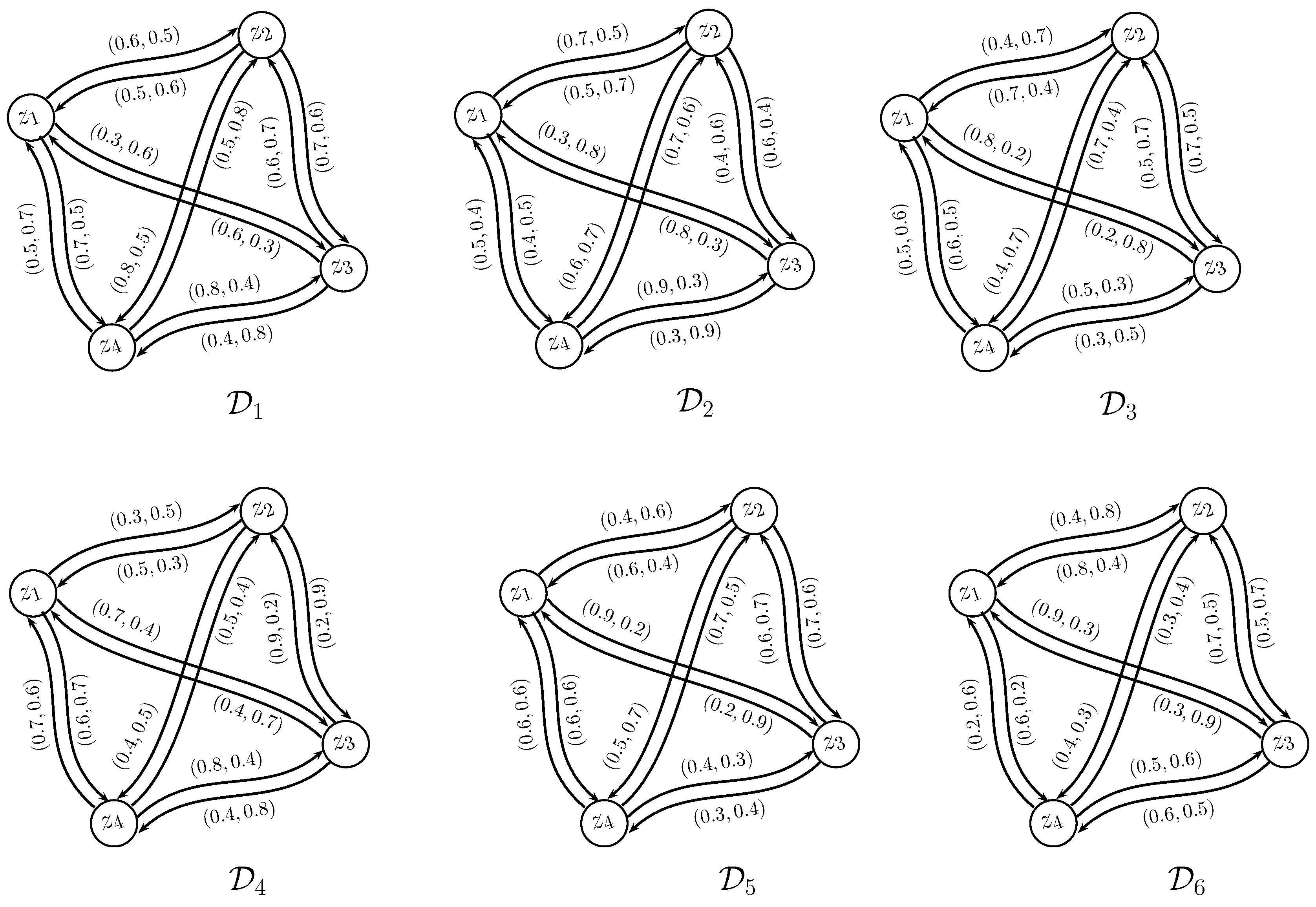
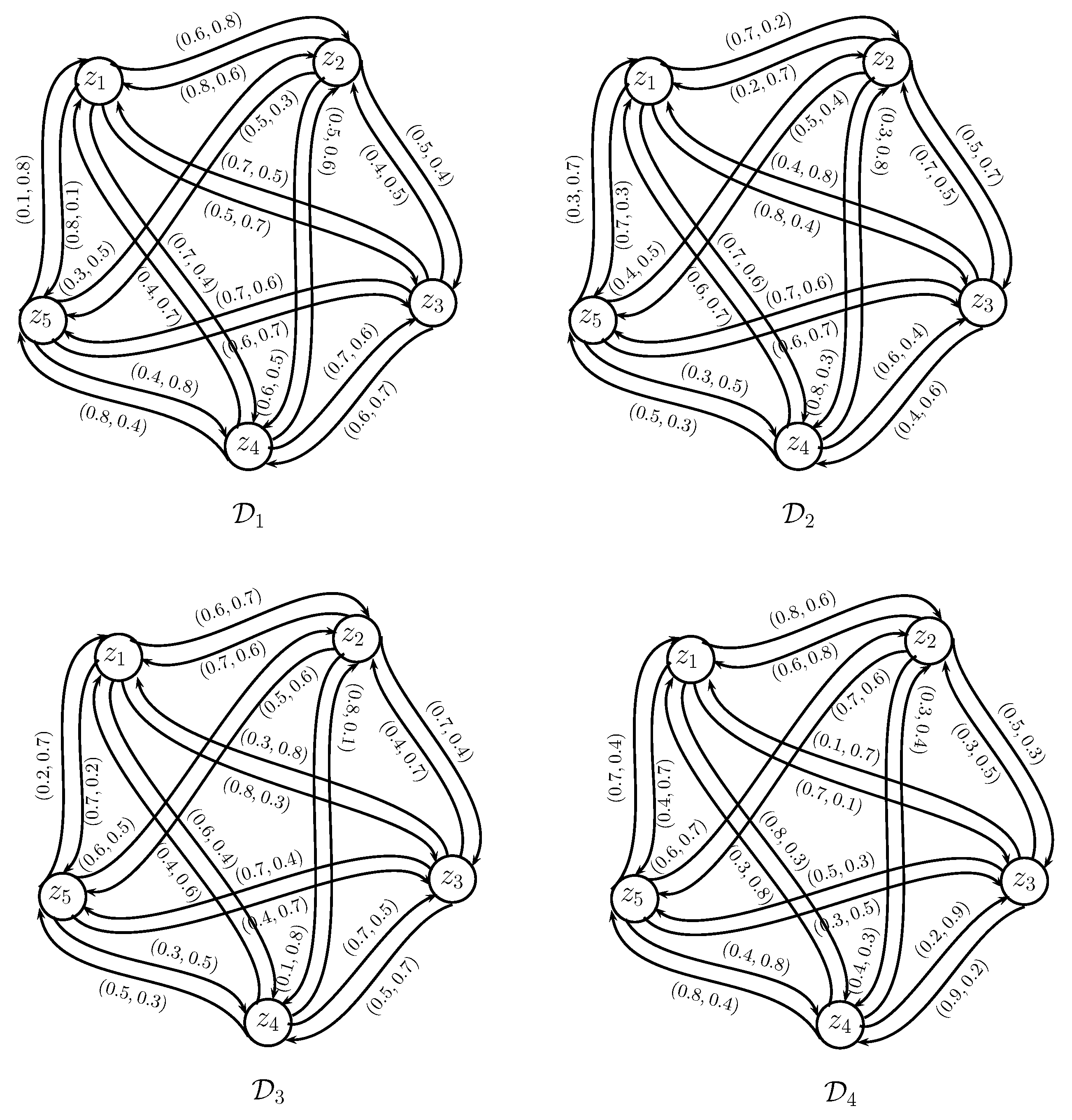
Communication is closely related to social development. In particular, satellite communication [42] has wide coverage area for communication, without geographical restrictions, and is less susceptible to the impact of land disasters. There is a unique advantage of satellite communication in many application areas, such as remote areas, islands, mountains, voyage aircraft and oceangoing vessels. Therefore, satellite communication not only effectively supplements the lack of other means of communication, but also has an irreplaceable role as the primary method of communication in mass media, especially the military. In modern warfare, it is very important to quantify the quality of the communication service. Suppose that a communication joint department in China plans to design a satellite communication system. Thus, a new test methodology for the synthetic communication system needs to be investigated, in order to provide evidence for building satellite Earth stations in the future. According to the expeditions, there are four possible testing venues to choose from (Xichang , Chengdu , Nanjing and Lhasa ). However, due to resources, funds, and other factors, only the most suitable of these would be selected. A decision-making group composed of six experts provides the judgments with six individual Pythagorean fuzzy preference relations (PFPRs) [27] as follows:
The PFDGs corresponding to PFPRs given in matrices are shown in Figure 6.
Figure 6.
Pythagorean fuzzy digraphs.
The energy of each PFDG is calculated as:
Then, the weight of each expert can be calculated as:
Therefore, the weight vector of six experts (k = 1, 2, …, 6) is:
Compute the averaged Pythagorean fuzzy element (PFE) of the testing venue over all the other testing venues for the experts by the Pythagorean fuzzy averaging (PFA) operator:
The aggregation results are listed in Table 1:
Table 1.
The aggregation results of the experts
Compute a collective PFE of the testing venue over all the other testing venues using the Pythagorean fuzzy weighted averaging (PFWA) operator [2].
Compute the score functions [4] of , and rank all the testing venues according to the values of .
Then, .
Thus, the best testing venue is
Now, the Laplacian matrices of the PFDGs shown in Figure 6 are:
The Laplacian energy of each PFDG is calculated as:
Then, the weight of each expert can be calculated as:
Based on this, we compute a collective PFE of the testing venue over all the other testing venues using the PFWA operator:
That is,
Compute the score functions of , and rank all the testing venues according to the values of .
Then, .
Thus, the testing venue is the best among the four given testing venues. We present our scheme for this application in the following Algorithm 1.
| Algorithm 1 The algorithm for the selection of the most important testing venue. |
| INPUT: A discrete set of testing venues (alternatives) , a set of experts and construction of PFPR for each expert. OUTPUT: The selection of the optimal testing venue.
|
5.2. Evaluation of the Schemes of Reservoir Operation
This section focuses on evaluating the schemes of reservoir operation. It is a water resource system led by Jiudianxia reservoir with a complex condition and multipurpose use along with the Tao River basin and cascaded power stations in the Tao River. The reservoir was designed for many purposes, such as power generation, irrigation, total water supply for agriculture, industry, residents and environment. Due to different requirements for the partition of the amount of water, five reservoir operation schemes , and are recommended.
- z1:
- Maximum plant output, enough supply of water used in the Tao River basin, lower and higher supply for society and the economy;
- z2:
- Maximum plant output, enough supply of water used in the Tao River basin, lower and higher supply for society and the economy, lower supply for the ecosystem;
- z3:
- Maximum plant output, enough supply of water used in the Tao River basin, lower and higher supply for society and the economy, total supply for the ecosystem and environment, 90% of which is passed down for flushing sands during low water periods;
- z4:
- Maximum plant output, enough supply of water used in the Tao River basin, lower and higher supply for society and the economy, total supply for the ecosystem and environment, 50% of which is passed down for flushing sands during low water periods;
- z5:
- Maximum plant output, enough supply of water used in the Tao River basin, lower and higher supply for society and the economy, total supply for the ecosystem and environment during level and flood periods.
To select the optimal scheme, the government invites four experts to evaluate the five schemes. Based on their experience, the experts compare each pair of schemes and give individual judgments using the following PFPRs [43]:
The PFDGs corresponding to PFPRs given in matrices are shown in Figure 7:
Figure 7.
Pythagorean fuzzy digraphs.
The energy of each PFDG is calculated as:
Then, the weight of each expert can be calculated as:
Utilize the aggregation operator to fuse all the individual PFPRs into the collective PFPR . Here, we apply the Pythagorean fuzzy weighted averaging (PFWA) operator [2] to fuse the individual PFPR. Thus, we have:
Calculate their scores using the score function :
The net flow of [44], i.e., the net degree of preference of over the other schemes is:
Therefore, the net flows of the five schemes are:
which gives the ranking of . Thus, the best scheme is
Now, the Laplacian matrices of the PFDGs shown in Figure 7 are:
The Laplacian energy of each PFDG is calculated as:
Then, the weights can be calculated as:
Based on this, we utilize the PFWA operator to fuse all the individual PFPRs into the collective PFPR :
Calculate their scores using the score function:
The net flows of the five alternatives are:
which gives the ranking of . Thus, the best scheme is We present our proposed method in the following Algorithm 2.
| Algorithm 2 The algorithm for the selection of the most important scheme of reservoir operation. |
| INPUT: A discrete set of schemes (alternatives) , a set of experts and construction of PFPR for each expert. OUTPUT: The selection of the optimal scheme.
|
6. Conclusions
A Pythagorean fuzzy set model is suitable for modeling problems with uncertainty, indeterminacy and inconsistent information in which human knowledge is necessary and human evaluation needed. Pythagorean fuzzy models give more precision, flexibility and compatibility to the system as compared to the classical, fuzzy and intuitionistic fuzzy models. A PFG can describe the uncertainty of all kinds of networks well. In this paper, we have introduced the concepts of energy and Laplacian energy of graphs in Pythagorean fuzzy circumstances and investigated their interesting properties. We have derived the lower and upper bounds for the energy and Laplacian energy of a PFG. We have also introduced the concept of the energy and Laplacian energy of a PFDG along with its applications in decision making problems. We are planing to extend our research work to: (1) interval-valued Pythagorean fuzzy graphs; (2) simplified interval-valued Pythagorean fuzzy graphs; and (3) hesitant Pythagorean fuzzy graphs.
Author Contributions
M.A. and S.N. conceived of the presented idea. S.N. developed the theory and performed the computations. M.A. verified the analytical methods.
Funding
This research received no external funding.
Conflicts of Interest
The authors declare no conflict of interest.
References
- Yager, R.R. Pythagorean fuzzy subsets. In Proceedings of the Joint IFSA World Congress and NAFIPS Annual Meeting, Edmonton, AB, Canada, 24–28 June 2013. [Google Scholar]
- Yager, R.R. Pythagorean membership grades in multi-criteria decision making. IEEE Trans. Fuzzy Syst. 2014, 22, 958–965. [Google Scholar] [CrossRef]
- Atanassov, K.T. Intuitionistic fuzzy sets. Fuzzy Sets Syst. 1986, 20, 87–96. [Google Scholar] [CrossRef]
- Zhang, X.; Xu, Z. Extension of TOPSIS to multiple-criteria decision making with Pythagorean fuzzy sets. Int. J. Intell. Syst. 2014, 29, 1061–1078. [Google Scholar] [CrossRef]
- Peng, X.; Yuan, H.; Yang, Y. Pythagorean fuzzy information measures and their applications. Int. J. Intell. Syst. 2017, 32, 991–1029. [Google Scholar] [CrossRef]
- Peng, X.; Yang, Y. Some results for Pythagorean fuzzy sets. Int. J. Intell. Syst. 2015, 30, 1133–1160. [Google Scholar] [CrossRef]
- Ren, P.; Xu, Z.; Gou, X. Pythagorean fuzzy TODIM approach to multi-criteria decision making. Appl. Soft Comput. 2016, 42, 246–259. [Google Scholar] [CrossRef]
- Gutman, I. The energy of a graph. Ber. Math. Statist. Sekt. Forsch-Ungszentram Graz. 1978, 103, 1–22. [Google Scholar]
- Gutman, I. The energy of a graph: Old and new results. In Algebraic Combinatorics and Applications; Springer: Berlin, Germany, 2001; pp. 196–211. [Google Scholar]
- Gutman, I.; Zhou, B. Laplacian energy of a graph, Linear Algebra and its Application. J. Linear Algebra Appl. 2006, 414, 29–37. [Google Scholar] [CrossRef]
- Kaufmann, A. Introduction a la Theorie des Sour-Ensembles Flous; Masson et Cie: Paris, France, 1973. [Google Scholar]
- Zadeh, L.A. Similarity relations and fuzzy orderings. Inf. Sci. 1971, 3, 177–200. [Google Scholar] [CrossRef]
- Rosenfeld, A. Fuzzy graphs, Fuzzy Sets and their Applications; Zadeh, L.A., Fu, K.S., Shimura, M., Eds.; Academic Press: New York, NY, USA, 1975; pp. 77–95. [Google Scholar]
- Anjali, N.; Mathew, S. Energy of a fuzzy graph. Ann. Fuzzy Math. Inf. 2013, 6, 455–465. [Google Scholar]
- Sharbaf, S.R.; Fayazi, F. Laplacian energy of a fuzzy graph. Iran. J. Math. Chem. 2014, 5, 1–10. [Google Scholar]
- Parvathi, R.; Karunambigai, M.G. Intuitionistic fuzzy graphs. In Computational Intelligence, Theory and Applications; Springer: Berlin, Germany, 2006; pp. 139–150. [Google Scholar]
- Akram, M.; Davvaz, B. Strong intuitionistic fuzzy graphs. Filomat 2012, 26, 177–196. [Google Scholar] [CrossRef]
- Praba Chandrasekaran, B.V.M.; Deepa, G. Energy of an intutionistic fuzzy graph. Italian J. Pure Appl. Math. 2014, 32, 431–444. [Google Scholar]
- Basha, S.S.; Kartheek, E. Laplacian energy of an intuitionistic fuzzy graph. J. Sci. Technol. 2015, 8, 1–7. [Google Scholar]
- Akram, M.; Ishfaq, N.; Sayed, S.; Smarandache, F. Decision-making approach based on neutrosophic rough information. Algorithms 2018, 11, 59. [Google Scholar] [CrossRef]
- Akram, M.; Zafar, F. Rough fuzzy digraphs with application. J. Appl. Math. Comput. 2018, 11, 1–37. [Google Scholar] [CrossRef]
- Akram, M.; Luqman, A. Certain networks models using single-valued neutrosophic directed hypergraphs. J. Intell. Fuzzy Syst. 2017, 33, 575–588. [Google Scholar] [CrossRef]
- Akram, M.; Shahzadi, S.; Smarandache, F. Multi-attribute decision-making method based on neutrosophic soft rough information. Axioms 2018, 7, 19. [Google Scholar] [CrossRef]
- Sarwar, M.; Akram, M. An algorithm for computing certain metrics in intuitionistic fuzzy graphs. J. Intell. Fuzzy Syst. 2016, 30, 2405–2416. [Google Scholar] [CrossRef]
- Shahzadi, S.; Akram, M. Graphs in an intuitionistic fuzzy soft environment. Axioms 2018, 7, 20. [Google Scholar] [CrossRef]
- Naz, S.; Akram, M.; Smarandache, F. Certain notions of energy in single-valued neutrosophic graphs. Axioms 2018, 7, 50. [Google Scholar] [CrossRef]
- Naz, S.; Ashraf, S.; Akram, M. A novel approach to decision-making with Pythagorean fuzzy information. Mathematics 2018, 6, 95. [Google Scholar] [CrossRef]
- Yager, R.R.; Abbasov, A.M. Pythagorean membership grades, complex numbers, and decision making. Int. J. Intell. Syst. 2013, 28, 436–452. [Google Scholar] [CrossRef]
- Xu, Z. Intuitionistic fuzzy aggregation operators. IEEE Trans. Fuzzy Syst. 2007, 15, 1179–1187. [Google Scholar]
- Ashraf, S.; Naz, S.; Rashmanlou, H.; Malik, M.A. Regularity of graphs in single-valued neutrosophic environment. J. Intell. Fuzzy Syst. 2017, 33, 529–542. [Google Scholar] [CrossRef]
- Naz, S.; Rashmanlou, H.; Malik, M.A. Operations on single-valued neutrosophic graphs with application. J. Intell. Fuzzy Syst. 2017, 32, 2137–2151. [Google Scholar] [CrossRef]
- Naz, S.; Malik, M.A.; Rashmanlou, H. Hypergraphs and transversals of hypergraphs in interval-valued intuitionistic fuzzy setting. J. Mult.-Valued Logic Soft Comput. 2018, 30, 399–417. [Google Scholar]
- Dey, A.; Pal, A. Vertex coloring of a fuzzy graph using alpa cut. Int. J. Manag. IT Eng. 2012, 2, 340–352. [Google Scholar]
- Dey, A.; Pradhan, R.; Pal, A.; Pal, T. In the fuzzy robust graph coloring problem. In Proceedings of the 3rd International Conference on Frontiers of Intelligent Computing: Theory and Applications (FICTA), Bhubaneswar, Odisha, India, November 2014; Springer International Publishing: Cham, Switzerland, 2014; pp. 805–813. [Google Scholar]
- Dey, A.; Pal, A.; Pal, T. Interval type 2 fuzzy set in fuzzy shortest path problem. Mathematics 2016, 4, 62. [Google Scholar] [CrossRef]
- Dey, A.; Broumi, S.; Bakali, A.; Talea, M.; Smarandache, F. A new algorithm for finding minimum spanning trees with undirected neutrosophic graphs. Granul. Comput. 2018, 3, 1–7. [Google Scholar] [CrossRef]
- Broumi, S.; Dey, A.; Bakali, A.; Talea, M.; Smarandache, F.; Son, L.H.; Koley, D. Uniform single valued neutrosophic graphs. Neutrosophic Sets Syst. 2017, 17, 42–49. [Google Scholar]
- Estrada, E.; Hameed, E.; Langer, M.; Puchalska, A. Path Laplacian operators and superdiffusive processes on graphs. II. Two-dimensional lattice. Linear Algebra Its Appl. 2018, 555, 373–397. [Google Scholar] [CrossRef]
- Mathew, S.; Mordeson, J.N. Connectivity concepts in fuzzy incidence graphs. Inf. Sci. 2017, 382, 326–333. [Google Scholar] [CrossRef]
- Malik, D.S.; Mathew, S.; Mordeson, J.N. Fuzzy Incidence Graphs: Applications to Human Trafficking. Inf. Sci. 2018, 447, 244–255. [Google Scholar] [CrossRef]
- Mathew, S.; Mordeson, J.N. Fuzzy incidence blocks and their applications in illegal migration problems. New Math. Nat. Comput. 2017, 13, 245–260. [Google Scholar] [CrossRef]
- Jiang, Y.; Xu, Z.; Shu, Y. Interval-valued intuitionistic multiplicative aggregation in group decision making. Granul. Comput. 2017, 2, 387–407. [Google Scholar] [CrossRef]
- Xu, K.; Zhou, J.; Gu, R.; Qin, H. Approach for aggregating interval-valued intuitionistic fuzzy information and its application to reservoir operation. Expert Syst. Appl. 2011, 38, 9032–9035. [Google Scholar] [CrossRef]
- Wang, Y.M.; Fan, Z.P. Fuzzy preference relations: Aggregation and weight determination. Comput. Ind. Eng. 2007, 53, 163–172. [Google Scholar] [CrossRef]
© 2018 by the authors. Licensee MDPI, Basel, Switzerland. This article is an open access article distributed under the terms and conditions of the Creative Commons Attribution (CC BY) license (http://creativecommons.org/licenses/by/4.0/).