Abstract
In this paper, we relate Poisson’s summation formula to Heisenberg’s uncertainty principle. They both express Fourier dualities within the space of tempered distributions and these dualities are also inverse of each other. While Poisson’s summation formula expresses a duality between discretization and periodization, Heisenberg’s uncertainty principle expresses a duality between regularization and localization. We define regularization and localization on generalized functions and show that the Fourier transform of regular functions are local functions and, vice versa, the Fourier transform of local functions are regular functions.
Keywords:
generalized functions; tempered distributions; regular functions; local functions; regularization–localization duality; regularity; Heisenberg’s uncertainty principle MSC:
42B05; 42B08; 42B10; 46F05; 46F10
1. Introduction
Regularization is a popular trick in applied mathematics; see [1] for example. It is the technique “to approximate functions by more differentiable ones” [2]. Moreover, its terminology coincides with the terminology used in generalized function spaces. They contain two kinds of functions: “regular functions” and “generalized functions”. While regular functions are functions in the ordinary functions sense which are smooth (infinitely differentiable) in the ordinary functions sense, all other functions become smooth (infinitely differentiable) in the “generalized functions sense” [3]. In this way, all functions are smooth. Localization, in contrast to that, is another popular technique. It allows, for example, to integrate functions which could not be integrated otherwise, if we think of “locally integrable” functions or if we think of the Short-Time Fourier Transform (STFT), capable of analyzing infinitely extended signals.
Although regularization (Figure 1) and localization (Figure 2) appear to be quite different, a connection between these operations is no surprise. It is rather ubiquitous in the literature. However, the theorem below (Figure 3) appears in a wider sense. It even holds within the space of tempered distributions and is directly related to Heisenberg’s uncertainty principle. It is moreover the inverse of an already known discretization–periodization duality (Poisson’s Summation Formula). While discretization and periodization map functions from smoothness towards discreteness in both time and frequency domain, the operations investigated in this study, regularization and localization, map functions from discreteness towards smoothness in both time and frequency domain (Figure 4 and Figure 5). In this way, we have a full range of tools (discretization, periodization, regularization, localization) in order to describe any transition from smoothness towards discreteness and also back from discreteness towards smoothness in a mathematically rigorous and formally correct way.
Figure 1.
A regularization of generalized function f yields regular function .
Figure 2.
A localization of generalized function f yields local function .
Figure 3.
The regularization–localization theorem.
Figure 4.
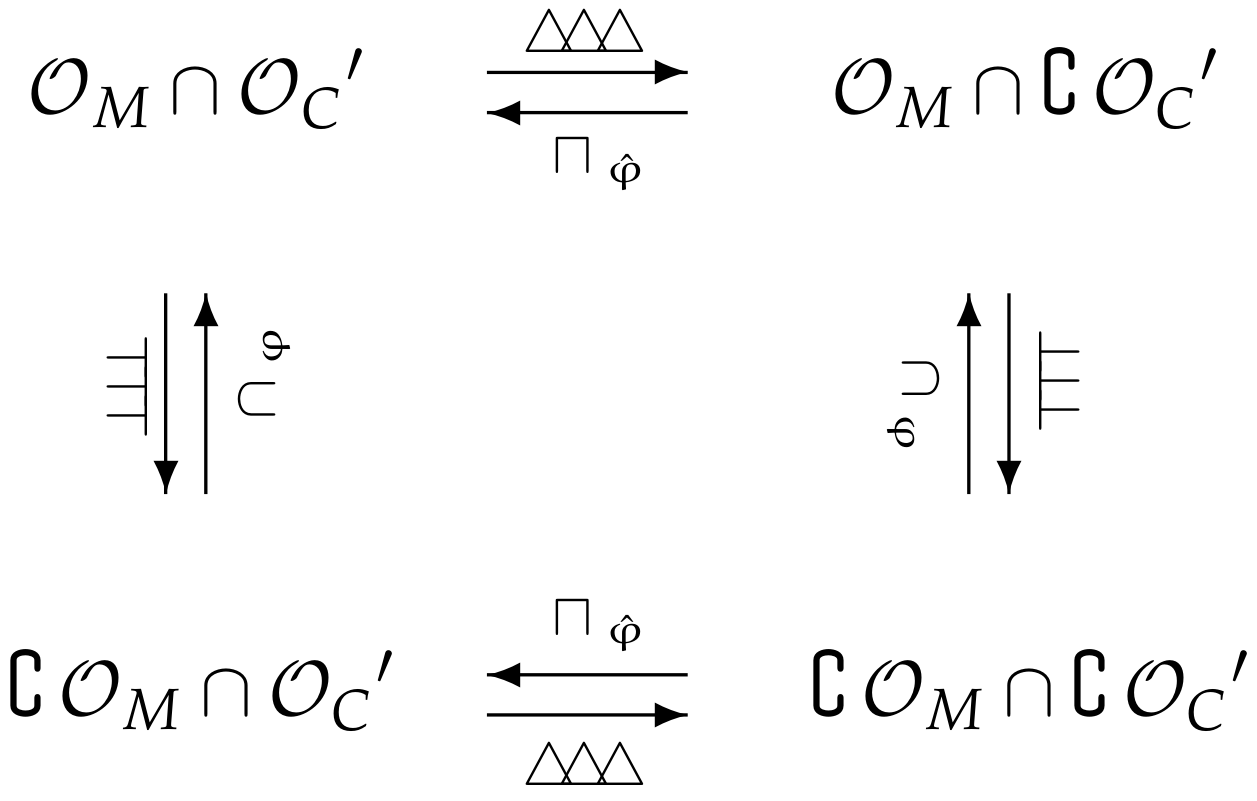
Four subspaces in , linked via operations .
Figure 5.
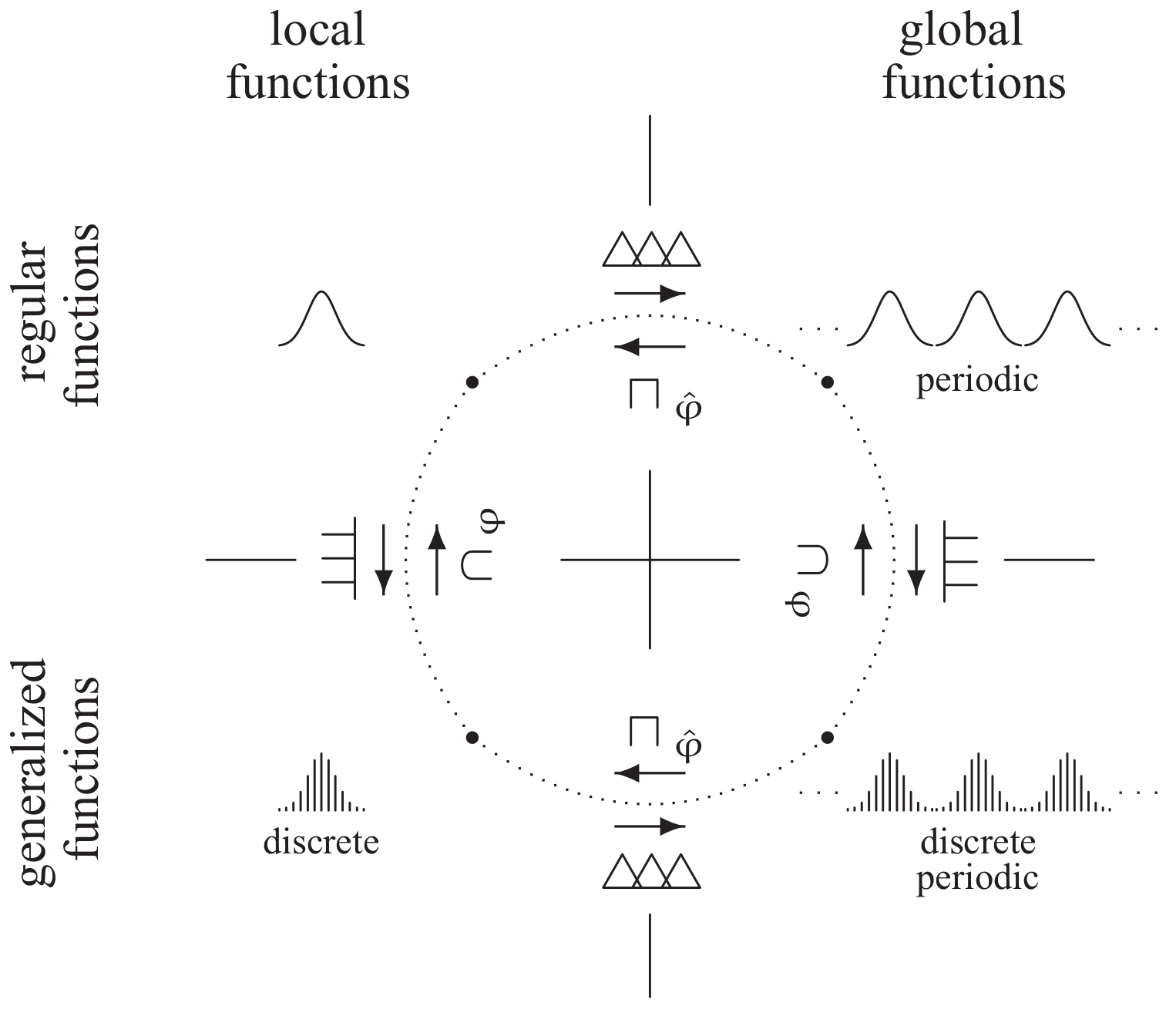
The same diagram as above, drawn in another fashion.
This paper is organized as follows. Section 2 describes the overall motivation for this study and Section 3 explains the rough proof idea. Section 4 provides an introduction to the notations used and previous results. Section 5 presents a justification for Section 6 where regularization and localization within the space of tempered distributions are defined. Section 7 provides symbolic calculation rules based on these definitions, needed to prove the theorem in Section 8. Section 9 connects these results to results in a previous study and Section 10, finally, concludes this study and provides an outlook.
2. Motivation
In contrast to more practical applications of regularizations and localizations, the actual intention of this study is to provide universally valid calculation rules for regularizations and localizations together with the scope of their validity within a preferably most general setting. In this way, regularizations can be expressed in terms of localizations and, vice versa, localizations can be expressed in terms of regularizations, i.e., poorly converging formulas can be replaced by better converging ones. Another important application of our rules is knowing the scope of their validity. Knowing not only a formula but also its validity scope is especially important in applied mathematics. It is simply not very reasonable to implement a formula that will never converge.
2.1. Generalized Functions
The setting of generalized functions, also called distributions, is today a most modern, very general setting in Fourier analysis [3,4,5,6,7,8,9,10,11]. It meets the requirements of Fourier analysis in both theory and practice. It allows, for example, to Fourier transform functions which are not even Lebesgue integrable, such as the Dirac impulse or even constants such as the function that is constantly 1.
In this study, we prove simple symbolic calculation rules within , the space of tempered distributions, for handling both, regularizations and localizations, and their interactions. The space of tempered distributions is known to be an ideal setting in Fourier analysis, mainly due to three facts. First, the Fourier transform is understood in a much wider sense than usually (on Lebesgue square-integrable functions); secondly, the Fourier transform is still an automorphism in (as on Lebesgue square-integrable functions), i.e., the Fourier transform of any element in is again an element in ; thirdly, all functions are smooth, i.e., all functions can be derived infinitely often. Smoothness is especially required to treat Fourier series (and the Fourier transform as their limit). They consist of complex exponentials which are functions that can be derived infinitely often. Furthermore, recall that Lebesgue square-integrable functions (and their Fourier transforms accordingly) must decrease to zero as their arguments increase, otherwise they would not be Lebesgue integrable. This very strong restriction has, in fact, never been accepted by those who are working with Fourier transforms practically. It actually led to the acceptance of as a standard space in Fourier analysis throughout many scientific communities; beside mathematics and engineering, also in physics, especially in quantum mechanics [12,13,14,15]. In , in contrast to traditional approaches, we may even allow functions to grow up to the order of polynomials as their arguments increase and they can still be sampled and/or Fourier transformed.
2.2. Symbolic Calculation
The overall goal in this and in our previous study [16] is to compile a number of rules including their validity scope and therewith to fill a toolbox that will enable us to symbolically calculate with operations of discretization (sampling), periodization (replicating), regularization (smoothing) and localization (windowing). Performing such calculations on a symbolic level has several advantages. We are now able to rigorously prove higher-level theorems in ; we may replace more complicated formulas by simpler ones (or by better converging ones) prior to implementing them in software and, lastly, we may even implement these rules in symbolic calculation environments such as in Wolfram Mathematica [17] or in Python SymPy [18] in order to exclude human errors in formula derivations.
Some applications of our rules [19] are, for example, extending the scope of validity of Poisson’s Summation Formula to a validity on tempered distributions [16], proving that four differently defined Fourier transforms (more precisely, the Integral Fourier Transform, Discrete-Time Fourier Transform (DTFT), Discrete Fourier Transform (DFT) and the Integral Fourier Transform for periodic functions) coincide in the distributional sense [20,21,22] or deriving a digital radar image from the continuous case (the landscape being imaged) via operations of localization (windowing), discretization (sampling), convolution (defocusing) and deconvolution (focusing) [23].
3. Idea
The proof technique in generalized function spaces may appear a bit unusual to those who are practically oriented. For any equality in generalized function spaces where , it must be shown that both, f and g, yield the same result if applied to arbitrarily chosen test functions taken from their test function space X. A very short introduction to this technique is given in the section Distribution Theory in our previous paper [16].
However, the argumentation in this paper is much simpler. We do not need to prove any results on test functions because it has already been done by other authors [24,25,26,27]. Instead, we simply argue with subspaces of . We implicitly use the fact that functions in subspaces in inherit all function properties from the spaces where they are embedded. This idea is one of the fundamental tricks in distribution theory. A full range of distribution space embeddings can be found in [24], p. 170. However, only a few of these spaces are needed here (see section Notation and Figure 4 in [16]). We need the space of slowly growing regular functions (where “regular” means smooth functions in the ordinary functions sense), the space of rapidly decreasing generalized functions (where “generalized” means that they are smooth but not necessarily “regular”) and the Schwartz space which is the space of regular, rapidly decreasing functions, i.e., functions in are “regular” and “local” (rapidly decreasing). They inherit “regular” from and “local” from . Another important fact is that contains the space which is the space of compactly supported smooth functions. So, in the special case of having some , the property of being “local” turns into being “finite”, i.e., is zero outside some given interval. Accordingly, for some will be zero outside the given interval. In this case, we talk about “finitization” as a special form of “localization”. A concatenation of discretization and finitization is of particular importance, especially for turning integrals into finite sums.
Moreover, we make intensive use of the following dualities of the Fourier transform: and hence as well as and . The first duality means that the Fourier transform maintains the function property of being “regular and local”, the second duality means that “tempered” functions (slowly growing functions, i.e., functions that do not grow faster than polynomials) are again “tempered” after Fourier transforming them and the latter duality (Theorem 3, p. 424 in [26]) means that the Fourier transform of slowly growing (“regular”) functions are rapidly decreasing (“local”) functions and, vice versa, the Fourier transform of rapidly decreasing (“local”) functions are slowly growing (“regular”) functions. This simple circumstance resulted in a validity statement for the Poisson Summation Formula in , see Theorem 1 in [16]—the widest comprehension of the Poisson Summation Formula today to the best of this author’s knowledge.
Another issue in generalized function spaces, hence also in , is the fact that arbitrary generalized functions cannot be multiplied with each other. Accordingly, arbitrary generalized functions cannot be convolved with each other. We evade this problem in by using Laurent Schwartz’ [24] subspace of multiplication operators and his space of convolution operators as introduced above. These spaces provide a secure footing for multiplications and convolutions in , see Theorem 3, p. 424 in [26]. Recall that stands for Opérateurs (operators), m for Multiplication, c for Convolution, an apostrophe as indicates spaces of “generalized” functions, no apostrophe as X indicates spaces of “regular” functions. Elements from can always be applied to elements of X.
4. Preliminaries
Let be the Dirac impulse shifted by units of , being component-wise multiplication, within the space of tempered distributions (generalized functions that do not grow faster than polynomials) and let
be the Dirac comb. Then, and for any are tempered distributions [8,24,25]. We shortly write instead of if . The Fourier transform in is defined as usual and such that and where 1 is the function being constantly one [3,4,5,6,7,9,11,24]. The Dirac comb is moreover known for its excellent discretization (sampling) and periodization (replicating) properties [4,9,11,28]. While multiplication in samples a function , the corresponding convolution product periodizes f in .
The following two lemmas summarize the demands that must be put on such that f can be sampled and/or periodized in . Recall that smoothness, i.e., infinite differentiability, is not a demand. It is a given fact for all functions in generalized function spaces. Also recall that is the space of multiplication operators in and is the space of convolution operators in according to Laurent Schwartz’ theory of distributions [14,16,24,25,26,27,29,30,31].
Lemma 1 (Discretization).
Generalized functions can be sampled in if .
Proof.
Any uniform discretization (sampling) in corresponds to forming the product
where is the Dirac comb. Furthermore, is not a regular function, i.e., . However, for any multiplication product in , it is required that at least one of the two factors is in . Otherwise, the existence of this product cannot be secured. Hence, or another reasonable definition of this multiplication product would be required. Vice versa, if then exists due to (Theorem 3, p. 424 in [26]). ☐
One may observe that even ”if and only if” holds in Lemma 1 if the operation · is not redefined (in the sense that at least one of the two factors converges in any sense). An equivalent statement is the following lemma.
Lemma 2 (Periodization).
Generalized functions can be periodized in if .
Proof.
Any periodization in corresponds to forming the convolution product
where is the Dirac comb. Furthermore, is of no rapid descent, i.e., . However, for any convolution product in , it is required that at least one of the two factors is in . Otherwise, the existence of this product cannot be secured. Hence, or another reasonable definition of this convolution product would be required. Vice versa, if , then exists due to (Theorem 3, p. 424 in [26]). ☐
In a previous study [16], we used these insights in order to define operations of discretization and periodization in . While discretization is an operation , periodization is an operation , respectively. Starting from these two definitions, we proved that
hold in , both being expressions of Poisson’s Summation Formula. We shortly write and instead of and if for all .
Moreover, recall that these rules are a consequence of the Fourier duality
for any , and which is, according to Laurent Schwartz’ theory of generalized functions, the widest possible comprehension of both multiplication and convolution within the space of tempered distributions [24,26,30]. It lies at the very heart of . Many calculation rules in , including Equations (1), (2), (7), (8), (11), (12) and Lemmas 1, 2, 3, 4 rely on it.
5. Feasibilities
The following two lemmas provide justifications for the way we will define regularizations and localizations in below. They will allow us to invert discretizations and periodizations in .
Lemma 3 (Regularization).
Let . Then, for any , can be sampled.
Proof.
This is a consequence of the fact that [7,24,26,30] and Lemma 1. ☐
An equivalent statement is the following lemma.
Lemma 4 (Localization).
Let . Then for any , can be periodized.
Proof.
It follows from the fact that [24,30], which is the Fourier dual of , and Lemma 2. ☐
It is interesting to observe that and stretch and compress , respectively. Moreover, this property is independent of the actual choice of . It can therefore be attributed to the operations of convolution and multiplication themselves.
6. Definitions
“One of the main applications of convolution is the regularization of a distribution” [26] or the regularization of ordinary functions which are not infinitely differentiable in the conventional functions sense. Its actual importance lies in the fact that it is the reversal of discretization.
Regularization (see Figure 1) is usually understood as the approximation of generalized functions via approximate identities [2,5,6,7,26,32,33,34]. In this paper, however, we extend this idea by allowing any and also any, i.e., even ordinary functions (either smooth or not smooth) can be regularized. This approach naturally includes the special case of choosing approximate identities without unnecessarily restricting our theorem below.
Lemmas 3 and 4 above justify the following two definitions.
Definition 1 (Regularization).
Let . Then, for any tempered distribution we define another tempered distribution by
which is a regular, slowly growing function in . The operation is called regularization, approximation, interpolation or smoothing of f by means of . It is a linear continuous operation . The result of is called regular function of f in .
Regular functions (according to this definition) are functions in the ordinary functions sense which are smooth (infinitely differentiable) in the ordinary functions sense, a function property that is of immense value in many branches of mathematics. Regular functions belong to because , see e.g., [7,24,30]. They maintain the ‘tempered’ property, i.e., they do not grow faster than polynomials, which is common to all tempered distributions but add the regularity of to f. It follows that regularized functions can always be sampled according to Lemma 1.
Regularizations of type (5), where f as a member in some distribution space is singular (i.e., there is no locally integrable function representing f) and as a member in its corresponding space of test functions X is used for its regularization, are usually called “singular convolution” [35,36] and with f replaced by a sequence converging towards f, they become so-called “discrete singular convolutions (DSCs)”, a standard technique today for the regularization of singular distributions.
Regularizations are treated in many mathematical textbooks [2,11,25,26,27,32] and scientific papers [1,35,36,37,38,39,40,41,42,43]. They are also known in terms of “smooth cutoff functions” [2,8], “regularizers” [1,35,36,38], “distributed approximating functionals (DAFs)” [39,40,41,42,43] and “mollifiers” [29,44,45,46,47,48], a term that goes back (see [29], p. 63) to K.O. Friedrichs [44]. Regularized rect functions (characteristic functions of an interval) are known as “mesa function”, “tapered box” [11] or “tapered characteristic function” and “taper function” [49] or as “ bell” or “smoothed top hat” function in [50]. Mostly, regularizations are required “to obtain regularized interpolating kernels” such as in [38], finally to speed up convergences (e.g. in [51]). They are closely linked to the “regularity theorem for tempered distributions” [13].
Away from the generalized functions literature, we also encounter regularizations in terms of “smoothings”, “interpolations”, “zero-paddings” or “approximations” because they are not only applied to generalized functions, they are also applied to ordinary functions, usually to obtain better “regularity” properties for functions, i.e., better differentiability. Regularity is also a topic discussed in [52], for example. It is closely related to localization (see Figure 2).
Definition 2 (Localization).
Let . Then, for any tempered distribution , we define another tempered distribution by
which is a generalized function of rapid descent in . The operation is called localization or restriction of f by means of . It is a linear continuous operation . If , it is also called finitization. The result of is called local function of f in .
Local functions (according to this definition) belong to because [24,26]. They add the ‘rapid descent’ property of Schwartz functions to . It follows that localized functions can always be periodized according to Lemma 2.
The term “local” and the treatment of localizations have a long history in mathematics. It culminated, however, in the term “localization operator”. It appears in 1988 for the first time (see [53], p. 133 in [54]) in Daubechies’ article [55] and later in Daubechies’ 1992 standard textbook [52]. Meanwhile, “localizations” occur in many publications [2,52,54,55,56,57,58,59,60,61,62,63], amongst others as “localized trigonometric functions” or “localized sine basis” [52,57,64], as “localized frames” [65], “local trigonometric bases”, as “local representations” [6] or simply in terms of “locally integrable” functions.
7. Calculation Rules
“One of the basic principles in classical Fourier analysis is the impossibility to find a function f that is arbitrarily well localized together with its Fourier transform ” [66]. This, in particular, can easily be seen if one tries to localize the function that is constantly 1.
Lemma 5 (Localization Balance).
Let and let . Then
In (8), we see that by localizing 1, we delocalize , i.e., 1 and its Fourier transform cannot be both arbitrarily well localized. This phenomenon is known as Heisenberg’s uncertainty principle [6,7,11,66,67,68]. Vice versa, in (7), we see that by regularizing we increasingly deregularize 1. The entity is also known as an “approximate identity” of , usually denoted as where is a parameter describing the proximity to (see e.g., [26] p. 316, p. 401 or [32] p. 5). Convolving any with , it creates an approximate identity of f which is a function in the ordinary sense being infinitely differentiable.
Proof.
According to (4), can be convolved with and, equivalently, can be multiplied with , hence
holds in . The second formula is shown in an analogous manner. ☐
It is also interesting to observe that in analogy to the Dirac comb identity [16]
the following identity, let’s say a “localization balance”
holds a balance in if is satisfied for , which obviously is the best achievable compromise in localizing 1 and thereby delocalizing . It is true for the Gaussian and herewith expresses Hardy’s uncertainty principle [69]. However, it is also true for the Hyperbolic secant , see e.g., [11], and for every fourth Hermite function H, i.e., all H satisfying . A connection between Gaussians and Hyperbolic Secants is that both belong to a class of “Pólya frequency functions” [70,71]. Gaussians, Hyperbolic Secants and Hermite functions are treated in [72,73] for example. Hermite polynomials are also known for their very important role in distribution theory [13,35,36,43]. Hyperbolic Secants may also replace Gaussians in Gabor systems; see e.g., Janssen and Strohmer [74]. A link between Gaussians and Hyperbolic Secants is also known in soliton physics where the “initial Gaussian beam reshapes to a squared hyperbolic secant profile” [75]. Studying fixpoints of the Fourier transform in is therefore a worthwhile goal.
Another calculation rule that we need to prove for the theorem below is the following. It holds in analogy to already shown properties of discretizations and periodizations [16].
Lemma 6.
Let , , and . Then, and exist in and
Proof.
We may allow that at most one of the operands in is not an element in . This is indeed true as , and f is an arbitrary element in . It follows that exists in and, hence, operands may be interchanged arbitrarily. Using twice and (5), we obtain
in . The other half of this equation results from the fact that the roles of f and g can be exchanged due to commutativity. The second formula is then shown in an analogous manner. ☐
8. A Regularization–Localization Duality
The interaction between regularizations and localizations is ubiquitous in the literature today, for example as “regularization” and multiplication with smooth “cutoff functions” in Hörmander [2], as “two components of the approximation procedure” in , see Strichartz [8], or as “approximation by cutting and regularizing” in Trèves [27], p. 302, or as “cutting out” one period of f and applying “(quasi-)interpolation” [63] or in terms of ”zero-padding in the time domain corresponds to interpolation in the frequency domain” [76]. Detailed studies of the interaction of both regularizations and localizations, can be found for example in [49,53,54,77] and in engineering literature, we encounter these interactions in terms of the interplay between “windowing” on one hand and “interpolation” on the other. An equivalent is the so-called “zero-padding” technique (e.g., in [76,78,79,80,81,82,83]) found in engineering textbooks as a way to implement interpolations. It corresponds to the regularization of a discrete function by embedding it into a higher-dimensional space where it is smooth. However, we may summarize this regularization–localization duality in the following way.
Theorem 1 (Regularization vs. Localization).
Let , and let . Then
So, this duality asserts that regularizing a function means to localize its Fourier transform and, vice versa, localizing a function means to regularize its Fourier transform. It is the one-to-one counterpart of a discretization–periodization duality in , given in (1) and (2).
Proof.
Formally, according to the calculation rules shown above, the following equalities hold
in . We start using where is the identity element with respect to convolution in . Then, we apply Equations (10), (4), (7) and (9), in this order. Finally, with , we use where is the identity element with respect to multiplication in . The second formula is now shown in an analogous manner. ☐
An immediate consequence of the theorem is that f and its Fourier transform cannot both be arbitrarily well localized, a fact that is known as Heisenberg’s uncertainty principle. Also note that , as shown in Figure 3, is the Short-Time Fourier Transform (STFT) with window function and it is the Gabor transform if is a Gaussian. Consequently, the result of Gabor transforms will be smooth, i.e., they cannot be discrete for example. In contrast, its Fourier dual, the Fourier transform of regular functions , as shown in Figure 3, corresponds first to regularizing functions before Fourier transforming them. Consequently, the result of such transforms will be local, i.e., they cannot be periodic for example.
Obviously, by looking at these interactions, one may think of discrete functions as the ‘opposite’ of regular functions and, equivalently, one may think of periodic functions as the ‘opposite’ of local functions. This is examined more closely in the next section.
9. Four Subspaces
Let be the complement of regular functions in . It is the space of all ordinary or generalized functions in which are not infinitely differentiable in the ordinary functions sense. Furthermore, let be the complement of local functions in . It consists of all ordinary or generalized functions in which either do not fade to zero as increases (periodic functions for example) or they fall to zero but too slowly (with polynomial decay rather than with exponential decay).
Then, the following diagram (Figure 4) holds in .
This diagram can also be expressed in a slightly more “human readable” form (Figure 5) by recalling that are “regular functions” and are “generalized functions” (in the sense that they are not “regular”) and are “local functions” and are “global functions” (in the sense that they are not “local”).
Apparently, the Schwartz space , the “smooth world”, in some sense, is the ‘opposite’ of , the “discrete world”. One may also note that no additional information is used yet beside pure operator definitions. There is also no statement yet on the reversibility of our operations and and and in . Such inversions will be treated from a more quantitative point of view in a follow-on study.
10. Conclusions and Outlook
It is shown that in analogy to a discretization–periodization duality in , there is also a regularization–localization duality in . Proving these dualities even follows the same pattern. In addition, the two dualities are inverse of each other in the sense that the first one maps towards discreteness and the latter one maps towards smoothness. In total, we derived several calculation rules that are suitable to symbolically calculate with operations of discretization, periodization, regularization and localization in order to describe transitions from smoothness towards discreteness, even finite discreteness, and back from discreteness towards smoothness in a mathematically rigorous and formally correct way. We may replace, for example, discretizations by periodizations or regularizations by localizations whenever it is advantageous to do so. Our rules can, for example, be used to derive higher-level theorems in . They can also be implemented in symbolic calculation environments such as Wolfram Mathematica or Python SymPy and thereby become a very useful toolbox for algorithm design.
Acknowledgments
This paper is primarily based on studies conducted in the years 1995–1997 at the Institute of Mathematics, Ludwig Maximilians University (LMU), Munich. The author is, in particular, very grateful to Professor Otto Forster. The author would also like to thank his colleagues at the Microwaves and Radar Institute, German Aerospace Center (DLR), for deep insights into practised signal processing and a great cooperation for many years.
Conflicts of Interest
The author declares no conflicts of interest.
References
- Wei, G.W.; Gu, Y. Conjugate filter approach for solving Burgers’ equation. J. Comput. Appl. Math. 2002, 149, 439–456. [Google Scholar] [CrossRef]
- Hörmander, L. The Analysis of Linear Partial Differential Operators I; Die Grundlehren der mathematischen Wissenschaften; Springer: Berlin/Heidelberg, Germany, 1983. [Google Scholar]
- Lighthill, M.J. An Introduction to Fourier Analysis and Generalised Functions; Cambridge University Press: Cambridge, NY, USA, 1958. [Google Scholar]
- Woodward, P.M. Probability and Information Theory, with Applications to Radar; Pergamon Press Ltd.: Oxford, UK, 1953. [Google Scholar]
- Benedetto, J.J. Harmonic Analysis and Applications; CRC Press Inc.: Boca Raton, FL, USA, 1996. [Google Scholar]
- Feichtinger, H.G.; Strohmer, T. Gabor Analysis and Algorithms: Theory and Applications; Birkhäuser: Boston, MA, USA, 1998. [Google Scholar]
- Gasquet, C.; Witomski, P. Fourier Analysis and Applications: Filtering, Numerical Computation, Wavelets; Springer: New York, NY, USA, 1999; Volume 30. [Google Scholar]
- Strichartz, R.S. A Guide to Distribution Theorie and Fourier Transforms; World Scientific Publishing Co. Pte Ltd.: Singapore, 2003. [Google Scholar]
- Brandwood, D. Fourier Transforms in Radar and Signal Processing; Artech House, Inc.: Norwood, MA, USA, 2003. [Google Scholar]
- Rahman, M. Applications of Fourier Transforms to Generalized Functions; WIT Press: Southampton, UK, 2011. [Google Scholar]
- Kammler, D.W. A first Course in Fourier Analysis; Cambridge University Press: New York, NY, USA, 2007. [Google Scholar]
- Messiah, A. Quantum Mechanics—Two Volumes Bound as One; Dover Publications, Inc.: Mineola, NY, USA, 1999. [Google Scholar]
- Simon, B. Distributions and their Hermite expansions. J. Math. Phys. 1971, 12, 140–148. [Google Scholar] [CrossRef]
- Gracia-Bondía, J.M.; Varilly, J.C. Algebras of Distributions Suitable for Phase-Space Quantum Mechanics. I. J. Math. Phys. 1988, 29, 869–879. [Google Scholar] [CrossRef]
- Becnel, J.; Sengupta, A. The Schwartz Space: Tools for Quantum Mechanics and Infinite Dimensional Analysis. Mathematics 2015, 3, 527–562. [Google Scholar] [CrossRef]
- Fischer, J.V. On the duality of discrete and periodic functions. Mathematics 2015, 3, 299–318. [Google Scholar] [CrossRef]
- Wolfram Mathematica. Available online: http://reference.wolfram.com/language/tutorial/SymbolicCalculations.html (accessed on 7 August 2017).
- Python SymPy. Available online: https://en.wikipedia.org/wiki/SymPy (accessed on 7 August 2017).
- Fischer, J. Calculation Rules for Discrete Functions, Periodic Functions and Discrete Periodic Functions. ResearchGate 2017. Available online: https://www.researchgate.net/publication/316582622_Calculation_Rules_for_Discrete_Functions_Periodic_Functions_and_Discrete_Periodic_Functions (accessed on 7 August 2017). [CrossRef]
- Fischer, J. There is only one Fourier Transform. ResearchGate 2017. Available online: https://www.researchgate.net/publication/316855293_There_is_only_one_Fourier_Transform (accessed on 7 August 2017). [CrossRef]
- Fischer, J. A Formula Connecting Fourier Series and Fourier Transform. ResearchGate 2017. Available online: https://www.researchgate.net/publication/316659619_A_Formula_Connecting_Fourier_Series_and_Fourier_Transform (accessed on 7 August 2017). [CrossRef]
- Fischer, J. Fourier Transforms and Fourier Series and Their Interrelations. ResearchGate 2017. Available online: https://www.researchgate.net/publication/316140184_Fourier_Transforms_and_Fourier_Series_and_Their_Interrelations (accessed on 7 August 2017). [CrossRef]
- Fischer, J.; Molkenthin, T.; Chandra, M. SAR Image Formation as Wavelet Transform. In Proceedings of the European Conference on Synthetic Aperture Radar (EUSAR), VDE Verlag GmbH, Berlin, Germany, 18–26 May 2006. [Google Scholar]
- Schwartz, L. Théorie des Distributions, Tome II; Hermann: Paris, France, 1959. [Google Scholar]
- Zemanian, A. Distribution Theory and Transform Analysis—An Introduction to Generalized Functions, with Applications; McGraw-Hill Inc.: New York, NY, USA, 1965. [Google Scholar]
- Horváth, J. Topological Vector Spaces and Distributions; Addison-Wesley Publishing Company: Reading, MA, USA, 1966. [Google Scholar]
- Trèves, F. Topological Vector Spaces, Distributions and Kernels: Pure and Applied Mathematics; Academic Press Inc.: Mineola, NY, USA, 1967. [Google Scholar]
- Bracewell, R.N. Fourier Transform and its Applications; McGraw-Hill Book Company: New York, NY, USA, 1965. [Google Scholar]
- Grubb, G. Distributions and Operators; Springer Science+Business Media: New York, NY, USA, 2009; Volume 252. [Google Scholar]
- Dubois-Violette, M.; Kriegl, A.; Maeda, Y.; Michor, P.W. Smooth*-Algebras. Prog. Theor. Phys. Supp. 2002, 144, 54–78. [Google Scholar] [CrossRef]
- Nguyen, H.Q.; Unser, M.; Ward, J.P. Generalized Poisson Summation Formulas for Continuous Functions of Polynomial Growth. J. Fourier Anal. Appl. 2017, 23, 442–461. [Google Scholar] [CrossRef]
- Walter, W. Einführung in die Theorie der Distributionen; BI-Wissenschaftsverlag, Bibliographisches Institut & FA Brockhaus: Mannheim, Germany, 1994. [Google Scholar]
- Hunter, J.K.; Nachtergaele, B. Applied Analysis; World Scientific Publishing Company: Singapore, 2001. [Google Scholar]
- Beals, R. Advanced Mathematical Analysis: Periodic Functions and Distributions, Complex Analysis, Laplace Transform and Applications; Springer: New York, NY, USA, 1973; Volume 12. [Google Scholar]
- Wei, G. Wavelets generated by using discrete singular convolution kernels. J. Phys. A Math. Gen. 2000, 33, 8577. [Google Scholar] [CrossRef]
- Wei, G. Discrete singular convolution for the solution of the Fokker–Planck equation. J. Chem. Phys. 1999, 110, 8930–8942. [Google Scholar] [CrossRef]
- Estrada, R.; Kanwal, R.P. Regularization, pseudofunction, and Hadamard finite part. J. Math. Anal. Appl. 1989, 141, 195–207. [Google Scholar] [CrossRef]
- Wei, G. Quasi wavelets and quasi interpolating wavelets. Chem. Phys. Lett. 1998, 296, 215–222. [Google Scholar] [CrossRef]
- Wei, G.; Wang, H.; Kouri, D.J.; Papadakis, M.; Kakadiaris, I.A.; Hoffman, D.K. On the mathematical properties of distributed approximating functionals. J. Math. Chem. 2001, 30, 83–107. [Google Scholar] [CrossRef]
- Hoffman, D.K.; Kouri, D.J. Distributed approximating function theory for an arbitrary number of particles in a coordinate system-independent formalism. J. Phys. Chem. 1993, 97, 4984–4988. [Google Scholar] [CrossRef]
- Hoffman, D.K.; Kouri, D.J. Distributed approximating functionals: A new approach to approximating functions and their derivatives. In Proceedings of the Third International Conference on Mathematical and Numerical Aspects of Wave Propagation (SIAM), edited by Gary Cohen, Mandelieu-La Napoule, France, 24–28 April 1995; pp. 56–83. [Google Scholar]
- Hoffman, D.; Wei, G.; Zhang, D.; Kouri, D. Shannon—Gabor wavelet distributed approximating functional. Chem. Phys. Lett. 1998, 287, 119–124. [Google Scholar] [CrossRef]
- Bodmann, B.G.; Hoffman, D.K.; Kouri, D.J.; Papadakis, M. Hermite distributed approximating functionals as almost-ideal low-pass filters. Sampl. Theory Signal Image Process. 2008, 7, 15. [Google Scholar]
- Friedrichs, K.O. On the differentiability of the solutions of linear elliptic differential equations. Commun. Pure Appl. Math. 1953, 6, 299–326. [Google Scholar] [CrossRef]
- Schechter, M. Modern Methods in Partial Differential Equations: An Introduction; McGraw-Hill Inc.: New York, NY, USA, 1977. [Google Scholar]
- Yosida, K. Functional Analysis, Reprint of the Sixth (1980) Edition; Springer-Verlag: Berlin, Germany, 1995; Volume 11. [Google Scholar]
- Gaffney, M.P. A special Stokes’s theorem for complete Riemannian manifolds. Ann. Math. 1954, 60, 140–145. [Google Scholar] [CrossRef]
- Ni, L.; Markenscoff, X. The self-force and effective mass of a generally accelerating dislocation I: Screw dislocation. J. Mech. Phys. Solids 2008, 56, 1348–1379. [Google Scholar] [CrossRef]
- Ashino, R.; Desjardins, J.S.; Heil, C.; Nagase, M.; Vaillancourt, R. Pseudo-differential operators, microlocal analysis and image restoration. In Advances in Pseudo-Differential Operators; Birkhäuser Verlag: Basel, Switzerland, 2004; pp. 187–202. [Google Scholar]
- Boyd, J.P. Asymptotic Fourier Coefficients for a C∞ Bell (Smoothed-Top-Hat) and the Fourier Extension Problem. J. Sci. Comput. 2006, 29, 1–24. [Google Scholar] [CrossRef]
- Termonia, P.; Voitus, F.; Degrauwe, D.; Caluwaerts, S.; Hamdi, R. Application of Boyds periodization and relaxation method in a spectral atmospheric limited-area model. Part I: Implementation and reproducibility tests. Mon. Weather Rev. 2012, 140, 3137–3148. [Google Scholar] [CrossRef]
- Daubechies, I. Ten Lectures on Wavelets; Society for Industrial and Applied Mathematics (SIAM): Philadelphia, PA, USA, 1992; Volume 61. [Google Scholar]
- Cordero, E.; Tabacco, A. Localization operators via time-frequency analysis. In Advances in Pseudo-Differential Operators; Birkhäuser Verlag: Basel, Switzerland, 2004; pp. 131–147. [Google Scholar]
- Ashino, R.; Boggiatto, P.; Wong, M.W. Advances in Pseudo-Differential Operators; Birkhäuser Verlag: Basel, Switzerland, 2004; Volume 155. [Google Scholar]
- Daubechies, I. Time-frequency localization operators: A geometric phase space approach. IEEE Trans. Inf. Theory 1988, 34, 605–612. [Google Scholar] [CrossRef]
- Oberguggenberger, M.B. Multiplication of Distributions and Applications to Partial Differential Equations; Longman Scientific & Technical: Harlow, Essex, UK, 1992; Volume 259. [Google Scholar]
- Coifman, R.R.; Wickerhauser, M.V. Entropy-based algorithms for best basis selection. IEEE Trans. Inf. Theory 1992, 38, 713–718. [Google Scholar] [CrossRef]
- Triebel, H. A localization property for Bspq and Fspq spaces. Stud. Math. 1994, 109, 183–195. [Google Scholar]
- Feichtinger, H.G.; Gröchenig, K. Gabor frames and time-frequency analysis of distributions. J. Funct. Anal. 1997, 146, 464–495. [Google Scholar] [CrossRef]
- Skrzypczak, L. Heat and Harmonic Extensions for Function Spaces of Hardy–Sobolev–Besov Type on Symmetric Spaces and Lie Groups. J. Approx. Theory 1999, 96, 149–170. [Google Scholar] [CrossRef]
- Feichtinger, H.G. Modulation spaces: Looking back and ahead. Sampl. Theory Signal Image Process. 2006, 5, 109. [Google Scholar]
- Nguyen, H.Q.; Unser, M. A sampling theory for non-decaying signals. Appl. Comput. Harmon. Anal. 2017. [Google Scholar] [CrossRef]
- Feichtinger, H.G. Thoughts on Numerical and Conceptual Harmonic Analysis. In New Trends in Applied Harmonic Analysis; Birkhäuser: Cham, Switzerland, 2016; pp. 301–329. [Google Scholar]
- Daubechies, I. The Wavelet Transform, Time-Frequency Localization and Signal Analysis. IEEE Trans. Inf. Theory 1990, 36, 961–1005. [Google Scholar] [CrossRef]
- Gröchenig, K. Localization of frames, Banach frames, and the invertibility of the frame operator. J. Fourier Anal. Appl. 2004, 10, 105–132. [Google Scholar] [CrossRef]
- Wilczok, E. New uncertainty principles for the continuous Gabor transform and the continuous wavelet transform. Doc. Math. 2000, 5, 201–226. [Google Scholar]
- Mallat, S. A Wavelet Tour of Signal Processing; Academic Press, Elsevier: Burlington, MA, USA, 1999. [Google Scholar]
- Higgins, J.R. Sampling Theory in Fourier and Signal Analysis: Foundations; Oxford University Press: New York, NY, USA, 1996. [Google Scholar]
- Gröchenig, K.; Zimmermann, G. Hardy’s theorem and the short-time Fourier transform of Schwartz functions. J. Lond. Math. Soc. 2001, 63, 205–214. [Google Scholar] [CrossRef]
- Schoenberg, I.J. On totally positive functions, Laplace integrals and entire functions of the Laguerre-Pólya-Schur type. Proc. Natl. Acad. Sci. USA 1947, 33, 11–17. [Google Scholar] [CrossRef] [PubMed]
- Schoenberg, I. On variation-diminishing integral operators of the convolution type. Proc. Natl. Acad. Sci. USA 1948, 34, 164–169. [Google Scholar] [CrossRef] [PubMed]
- Boyd, J.P. Asymptotic coefficients of Hermite function series. J. Comput. Phys. 1984, 54, 382–410. [Google Scholar] [CrossRef]
- Boyd, J.P. Chebyshev and Fourier Spectral Methods; Dover Publications: Mineola, NY, USA, 2001. [Google Scholar]
- Janssen, A.; Strohmer, T. Hyperbolic secants yield Gabor frames. Appl. Comput. Harmon. Anal. 2002, 12, 259–267. [Google Scholar] [CrossRef]
- Fazio, E.; Renzi, F.; Rinaldi, R.; Bertolotti, M.; Chauvet, M.; Ramadan, W.; Petris, A.; Vlad, V. Screening-photovoltaic bright solitons in lithium niobate and associated single-mode waveguides. Appl. Phys. Lett. 2004, 85, 2193–2195. [Google Scholar] [CrossRef]
- Smith, J.O.; Serra, X. PARSHL: An Analysis/Synthesis Program for Non-Harmonic Sounds Based on a Sinusoidal Representation. Technical Report CCRMA STAN-M-43. Available online: https://ccrma.stanford.edu/STANM/stanms/stanm43/stanm43.pdf (accessed on 7 August 2017).
- Boggiatto, P. Localization operators with L p symbols on modulation spaces. In Advances in Pseudo-differential Operators; Birkhäuser Verlag: Basel, Switzerland, 2004; pp. 149–163. [Google Scholar]
- Cumming, I.G.; Wong, F.H. Digital Processing of Synthetic Aperture Radar Data; Artech house, Inc.: Norwood, MA, USA, 2005. [Google Scholar]
- Yaroslavsky, L. Efficient algorithm for discrete sinc interpolation. Appl. Opt. 1997, 36, 460–463. [Google Scholar] [CrossRef] [PubMed]
- Guichard, F.; Malgouyres, F. Total variation based interpolation. In Proceedings of the 9th European Signal Processing Conference, Rhodes, Greece, 8–11 September 1998; pp. 1–4. [Google Scholar]
- Coleri, S.; Ergen, M.; Puri, A.; Bahai, A. Channel estimation techniques based on pilot arrangement in OFDM systems. IEEE Trans. Broadcast. 2002, 46, 223–229. [Google Scholar] [CrossRef]
- Serra, X.; Smith, J. Spectral modeling synthesis: A sound analysis/synthesis system based on a deterministic plus stochastic decomposition. Comput. Music J. 1990, 14, 12–24. [Google Scholar] [CrossRef]
- Muquet, B.; Wang, Z.; Giannakis, G.B.; De Courville, M.; Duhamel, P. Cyclic prefixing or zero padding for wireless multicarrier transmissions? IEEE Trans. Commun. 2002, 50, 2136–2148. [Google Scholar] [CrossRef]
© 2017 by the author. Licensee MDPI, Basel, Switzerland. This article is an open access article distributed under the terms and conditions of the Creative Commons Attribution (CC BY) license (http://creativecommons.org/licenses/by/4.0/).