


Qualitative Properties of Difference Equation of Order Six



Abstract
:1. Introduction
- (i)
- The equilibrium point of Equation (1.2) is locally stable if for every there exists such that for all ,withwe have
- (ii)
- The equilibrium point of Equation (1.2) is locally asymptotically stable if is locally stable solution of Equation (1.2) and there exists such that for all , withwe have
- (iii)
- The equilibrium point of Equation (1.2) is global attractor if for all , we have
- (iv)
- The equilibrium point of Equation (1.2) is globally asymptotically stable if is locally stable, and is also a global attractor of Equation (1.2).
- (v)
- The equilibrium point of Equation (1.2) is unstable if is not locally stable.
- (vi)
- The linearized equation of Equation (1.2) about the equilibrium is the linear difference equation
- (a)
- is non-decreasing in for each fixed and is non-increasing in for each fixed
- (b)
- For any that is a solution of the systemwe have that
2. Local Stability of the Equilibrium Point of Equation (1.1)
3. Global Attractivity of the Equilibrium Point of Equation (1.1)
4. Boundedness of Solutions of Equation (1.1)
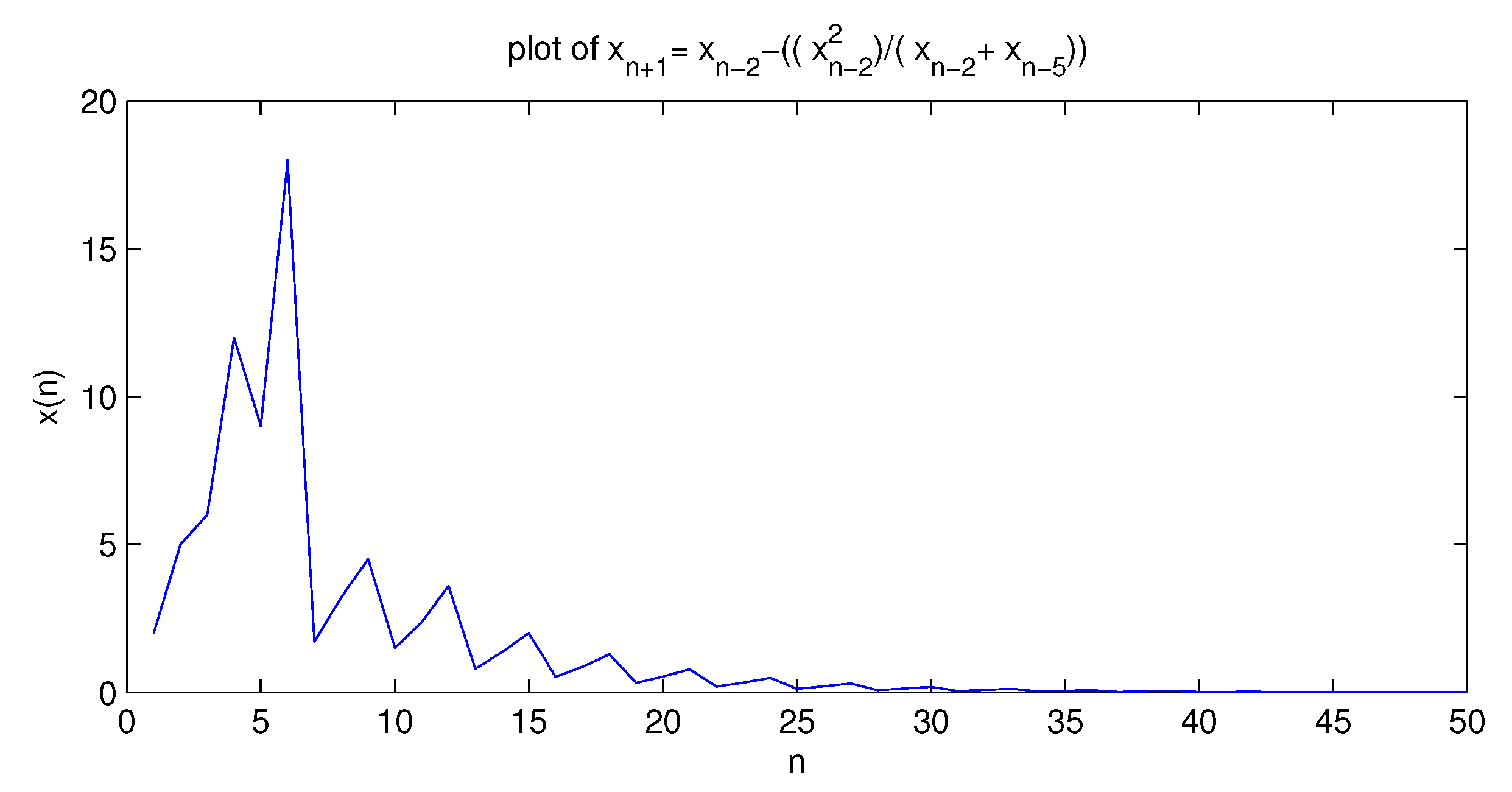
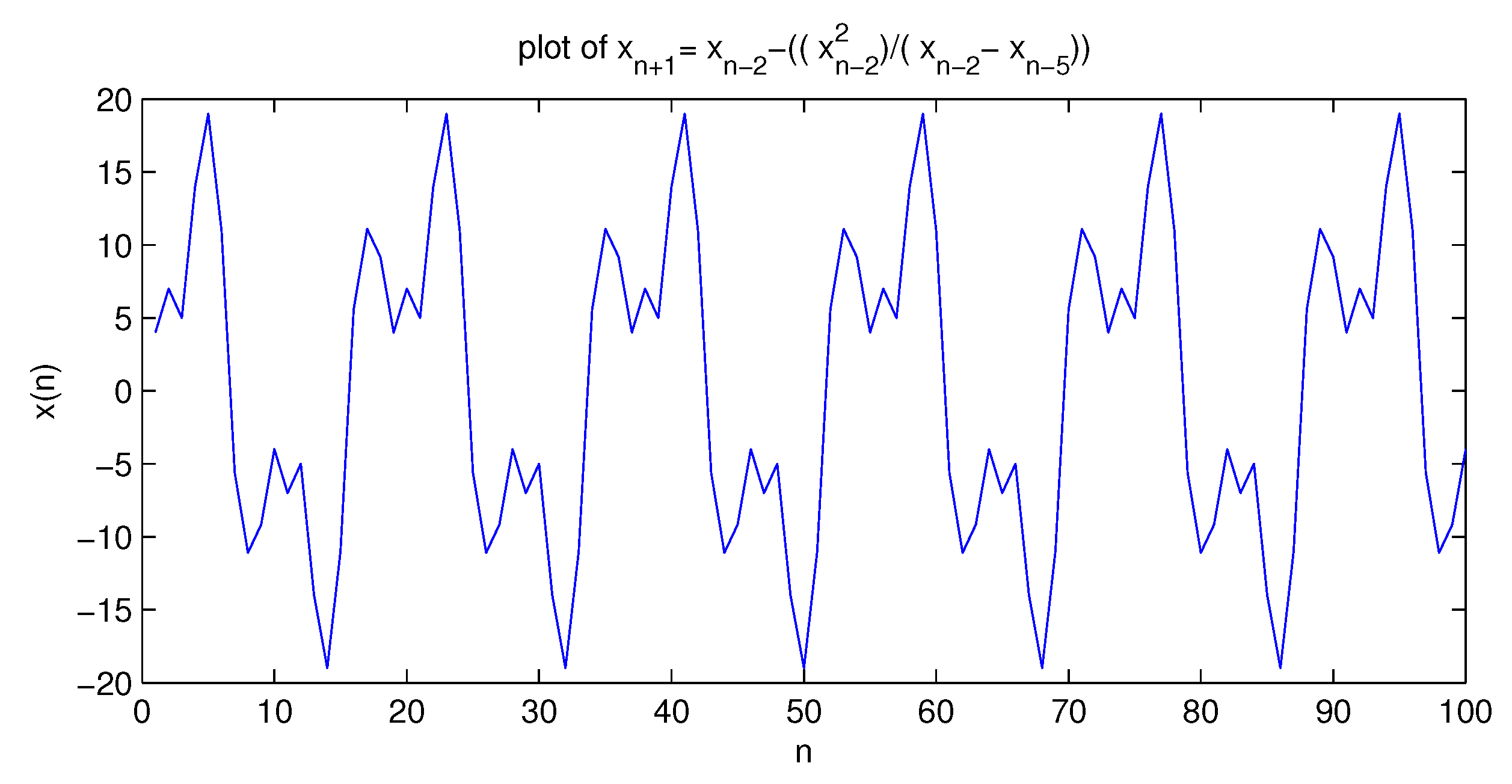
5. Special Cases of Equation (1.1)
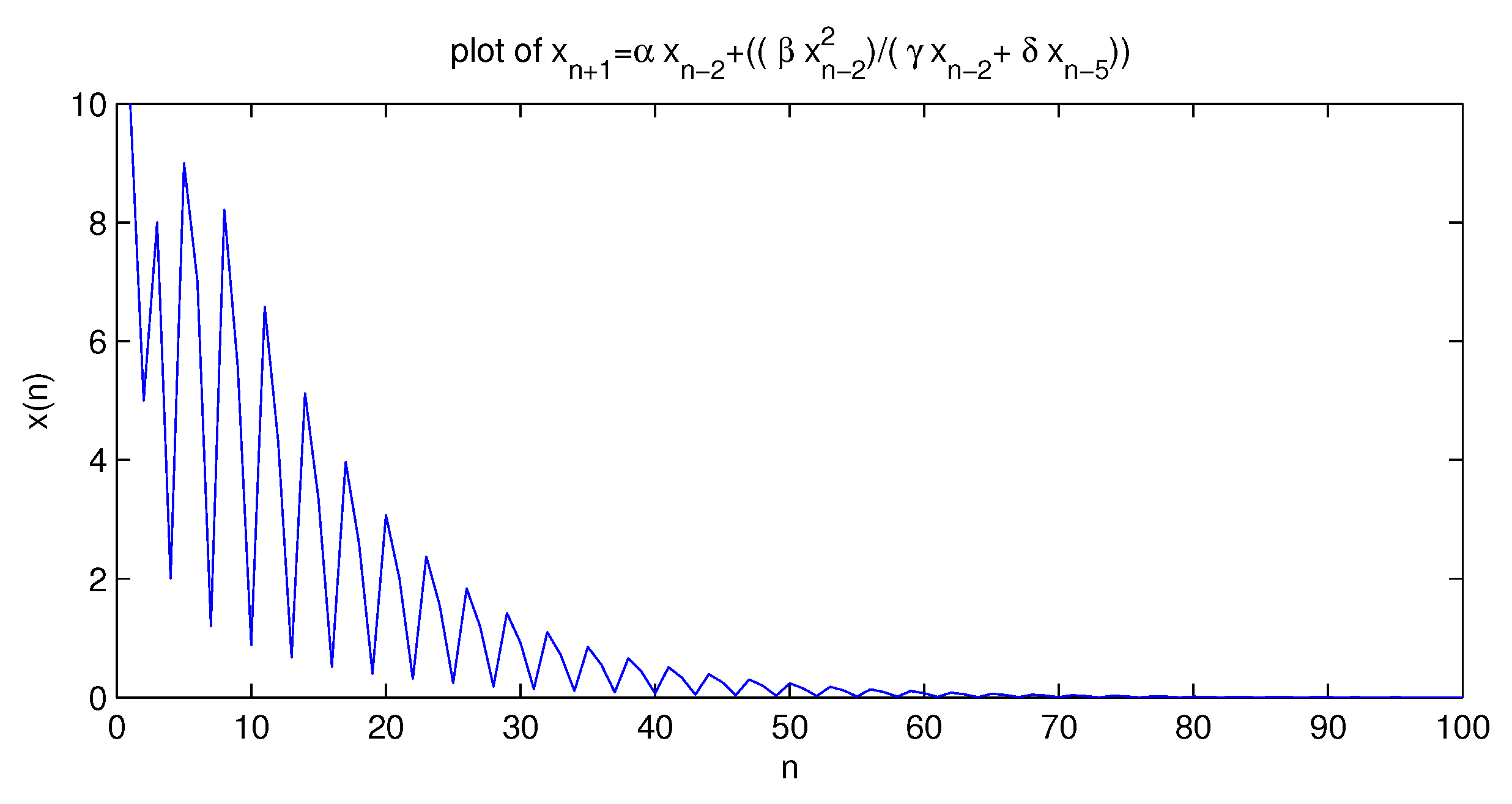
5.1. First Equation
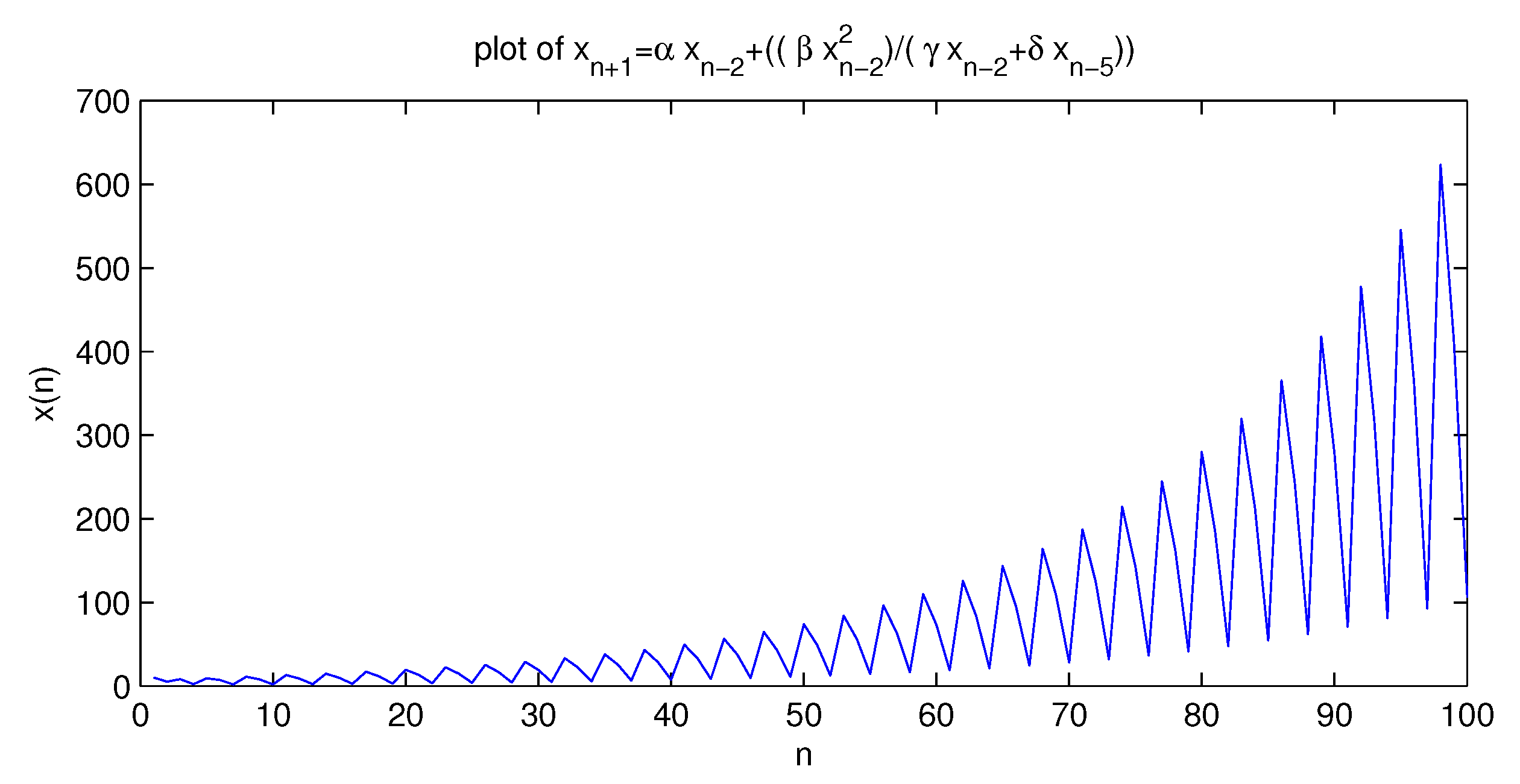
5.2. Second Equation
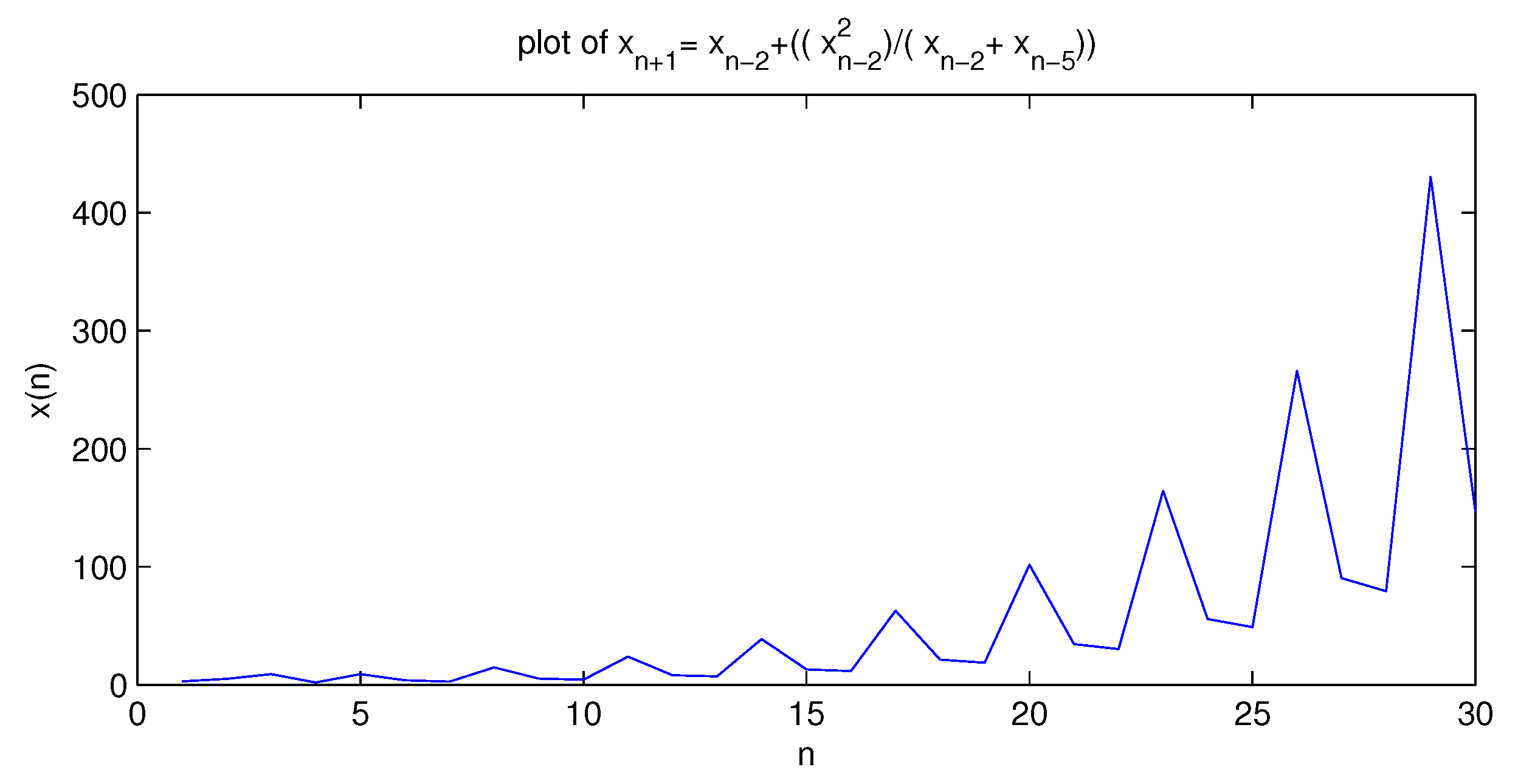
5.3. Third Equation
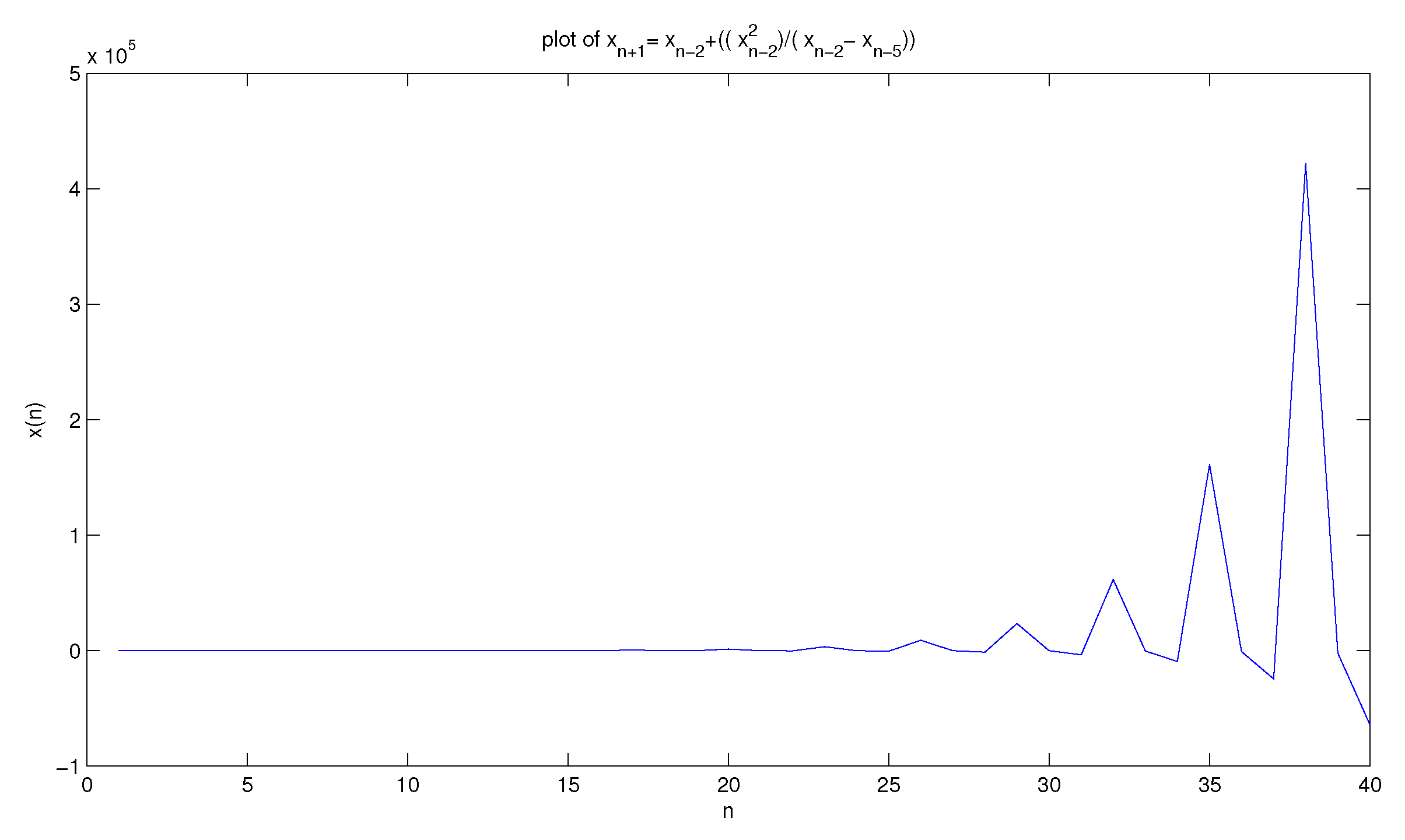
5.4. Fourth Equation
6. Conclusions
Acknowledgments
Author Contributions
Conflicts of Interest
References
- Ahmed, A.M.; Youssef, A.M. A solution form of a class of higher-order rational difference equations. J. Egyp. Math. Soc. 2013, 21, 248–253. [Google Scholar] [CrossRef]
- Alghamdi, M.; Elsayed, E.M.; El-Dessoky, M.M. On the Solutions of Some Systems of Second Order Rational Difference Equations. Life Sci. J. 2013, 10, 344–351. [Google Scholar]
- Asiri, A.; Elsayed, E.M.; El-Dessoky, M.M. On the Solutions and Periodic Nature of Some Systems of Difference Equations. J. Comput. Theor. Nanosci. 2015, 12, 3697–3704. [Google Scholar] [CrossRef]
- Das, S.E.; Bayram, M. On a System of Rational Difference Equations. World Appl. Sci. J. 2010, 10, 1306–1312. [Google Scholar]
- Din, Q. Qualitative nature of a discrete predator-prey system. Contemp. Methods Math. Phys. Gravit. 2015, 1, 27–42. [Google Scholar]
- Din, Q. Stability analysis of a biological network. Netw. Biol. 2014, 4, 123–129. [Google Scholar]
- Din, Q.; Elsayed, E.M. Stability analysis of a discrete ecological model. Comput. Ecol. Softw. 2014, 4, 89–103. [Google Scholar]
- Elabbasy, E.M.; El-Metwally, H.; Elsayed, E.M. On the Difference Equation . Acta Math. Vietnam. 2008, 33, 85–94. [Google Scholar]
- Elabbasy, E.M.; Elsayed, E.M. Dynamics of a rational difference equation. Chin. Ann. Math. Ser. B 2009, 30, 187–198. [Google Scholar] [CrossRef]
- El-Dessoky, M.M.; Elsayed, E.M. On the solutions and periodic nature of some systems of rational difference equations. J. Comput. Anal. Appl. 2015, 18, 206–218. [Google Scholar]
- El-Metwally, H.; Elsayed, E.M. Qualitative Behavior of some Rational Difference Equations. J. Comput. Anal. Appl. 2016, 20, 226–236. [Google Scholar]
- El-Moneam, M.A. On the dynamics of the solutions of the rational recursive sequences. Br. J. Math. Comput. Sci. 2015, 5, 654–665. [Google Scholar] [CrossRef] [PubMed]
- Elsayed, E.M. Qualitative behaviour of difference equation of order two. Math. Comput. Model. 2009, 50, 1130–1141. [Google Scholar] [CrossRef]
- Elsayed, E.M. Solution and attractivity for a rational recursive sequence. Discret. Dyn. Nat. Soc. 2011, 2011, 982309. [Google Scholar] [CrossRef]
- Elsayed, E.M. Solutions of rational difference system of order two. Math. Comput. Mod. 2012, 55, 378–384. [Google Scholar] [CrossRef]
- Elsayed, E.M. Behavior and expression of the solutions of some rational difference equations. J. Comput. Anal. Appl. 2013, 15, 73–81. [Google Scholar]
- Elsayed, E.M. Solution for systems of difference equations of rational form of order two. Comput. Appl. Math. 2014, 33, 751–765. [Google Scholar] [CrossRef]
- Elsayed, E.M. On the solutions and periodic nature of some systems of difference equations. Int. J. Biomath. 2014, 7, 1450067. [Google Scholar] [CrossRef]
- Elsayed, E.M. New method to obtain periodic solutions of period two and three of a rational difference equation. Nonlinear Dyn. 2015, 79, 241–250. [Google Scholar] [CrossRef]
- Elsayed, E.M. Dynamics and Behavior of a Higher Order Rational Difference Equation. J. Nonlinear Sci. Appl. 2016, 9, 1463–1474. [Google Scholar]
- Elsayed, E.M.; Ahmed, A.M. Dynamics of a three-dimensional systems of rational difference equations. Math. Methods Appl. Sci. 2016, 39, 1026–1038. [Google Scholar] [CrossRef]
- Elsayed, E.M.; Alghamdi, A. Dynamics and Global Stability of Higher Order Nonlinear Difference Equation. J. Comput. Anal. Appl. 2016, 21, 493–503. [Google Scholar]
- Elsayed, E.M.; El-Dessoky, M.M. Dynamics and global behavior for a fourth-order rational difference equation. Hacet. J. Math. Stat. 2013, 42, 479–494. [Google Scholar]
- Karatas, R.; Cinar, C.; Simsek, D. On positive solutions of the difference equation . Int. J. Contemp. Math. Sci. 2006, 1, 495–500. [Google Scholar]
- Saleh, M.; Aloqeili, M. On the difference equation Appl. Math. Comput. 2006, 176, 359–363. [Google Scholar] [CrossRef]
- Yalçınkaya, I. On the difference equation . Discret. Dyn. Nat. Soc. 2008, 2008, 805460. [Google Scholar] [CrossRef]
- Elsayed, E.M.; El-Dessoky, M.M.; Alzahrani, E.O. The Form of The Solution and Dynamics of a Rational Recursive Sequence. J. Comput. Anal. Appl. 2014, 17, 172–186. [Google Scholar]
- Elsayed, E.M.; El-Dessoky, M.M.; Asiri, A. Dynamics and Behavior of a Second Order Rational Difference equation. J. Comput. Anal. Appl. 2014, 16, 794–807. [Google Scholar]
- Elsayed, E.M.; El-Metwally, H. Stability and solutions for rational recursive sequence of order three. J. Comput. Anal. Appl. 2014, 17, 305–315. [Google Scholar]
- Elsayed, E.M.; El-Metwally, H. Global behavior and periodicity of some difference equations. J. Comput. Anal. Appl. 2015, 19, 298–309. [Google Scholar]
- Elsayed, E.M.; Ibrahim, T. F. Solutions and periodicity of a rational recursive sequences of order five. Bull. Malays. Math. Sci. Soc. 2015, 38, 95–112. [Google Scholar] [CrossRef]
- Elsayed, E.M.; Ibrahim, T.F. Periodicity and solutions for some systems of nonlinear rational difference equations. Hacet. J. Math. Stat. 2015, 44, 1361–1390. [Google Scholar] [CrossRef]
- Halim, Y.; Bayram, M. On the solutions of a higher-order difference equation in terms of generalized Fibonacci sequences. Math. Methods Appl. Sci. 2015. [Google Scholar] [CrossRef]
- Ibrahim, T.F.; Touafek, N. Max-type system of difference equations with positive two-periodic sequences. Math. Methods Appl. Sci. 2014, 37, 2562–2569. [Google Scholar] [CrossRef]
- Ibrahim, T.F.; Touafek, N. On a third order rational difference equation with variable coefficients. Dyn. Contol Disc Imput Syst. Appl. Algo. 2013, 20, 251–264. [Google Scholar]
- Jana, D.; Elsayed, E.M. Interplay between strong Allee effect, harvesting and hydra effect of a single population discrete-time system. Int. J. Biomath. 2016, 9, 1650004. [Google Scholar] [CrossRef]
- Khaliq, A.; Elsayed, E.M. The Dynamics and Solution of some Difference Equations. J. Nonlinear Sci. Appl. 2016, 9, 1052–1063. [Google Scholar]
- Khan, A.Q.; Qureshi, M.N. Global dynamics of a competitive system of rational difference equations. Math. Methods Appl. Sci. 2015, 38, 4786–4796. [Google Scholar] [CrossRef]
- Khan, A.Q.; Qureshi, M.N.; Din, Q. Asymptotic behavior of an anti-competitive system of rational difference equations. Life Sci. J. 2014, 11, 16–20. [Google Scholar]
- Kocic, V.L.; Ladas, G. Global Behavior of Nonlinear Difference Equations of Higher Order with Applications; Kluwer Academic Publishers: Dordrecht, The Netherlands, 1993. [Google Scholar]
- Kulenovic, M.R.S.; Ladas, G. Dynamics of Second Order Rational Difference Equations with Open Problems and Conjectures; Chapman & Hall / CRC Press: London, UK, 2001. [Google Scholar]
- Kurbanli, A.S. On the Behavior of Solutions of the System of Rational Difference Equations. World Appl. Sci. J. 2010, 10, 1344–1350. [Google Scholar]
- Simsek, D.; Cinar, C.; Yalcinkaya, I. On the recursive sequence Int. J. Contemp. Math. Sci. 2006, 1, 475–480. [Google Scholar]
- Touafek, N. On a second order rational difference equation. Hacet. J. Math. Stat. 2012, 41, 867–874. [Google Scholar]
- Yalcinkaya, I.; Cinar, C. On the dynamics of difference equation . Fasc. Math. 2009, 42, 141–148. [Google Scholar]
- Yazlik, Y.; Elsayed, E.M.; Taskara, N. On the Behaviour of the Solutions of Difference Equation Systems. J. Comput. Anal. Appl. 2014, 16, 932–941. [Google Scholar]
- Yazlik, Y.; Tollu, D.T.; Taskara, N. On the solutions of a max-type difference equation system. Math. Methods Appl. Sci. 2015, 38, 4388–4410. [Google Scholar] [CrossRef]
- Zayed, E.M.E.; El-Moneam, M.A. On the rational recursive sequence Commun. Appl. Nonlinear Anal. 2005, 12, 15–28. [Google Scholar]
- Zayed, E.M.E.; El-Moneam, M.A. On the rational recursive sequence . Commun. Appl. Nonlinear Anal. 2008, 15, 47–57. [Google Scholar]
© 2016 by the authors; licensee MDPI, Basel, Switzerland. This article is an open access article distributed under the terms and conditions of the Creative Commons by Attribution (CC-BY) license (http://creativecommons.org/licenses/by/4.0/).
Share and Cite
Khaliq, A.; Elsayed, E.M. Qualitative Properties of Difference Equation of Order Six. Mathematics 2016, 4, 24. https://doi.org/10.3390/math4020024
Khaliq A, Elsayed EM. Qualitative Properties of Difference Equation of Order Six. Mathematics. 2016; 4(2):24. https://doi.org/10.3390/math4020024
Chicago/Turabian StyleKhaliq, Abdul, and E.M. Elsayed. 2016. "Qualitative Properties of Difference Equation of Order Six" Mathematics 4, no. 2: 24. https://doi.org/10.3390/math4020024
APA StyleKhaliq, A., & Elsayed, E. M. (2016). Qualitative Properties of Difference Equation of Order Six. Mathematics, 4(2), 24. https://doi.org/10.3390/math4020024

