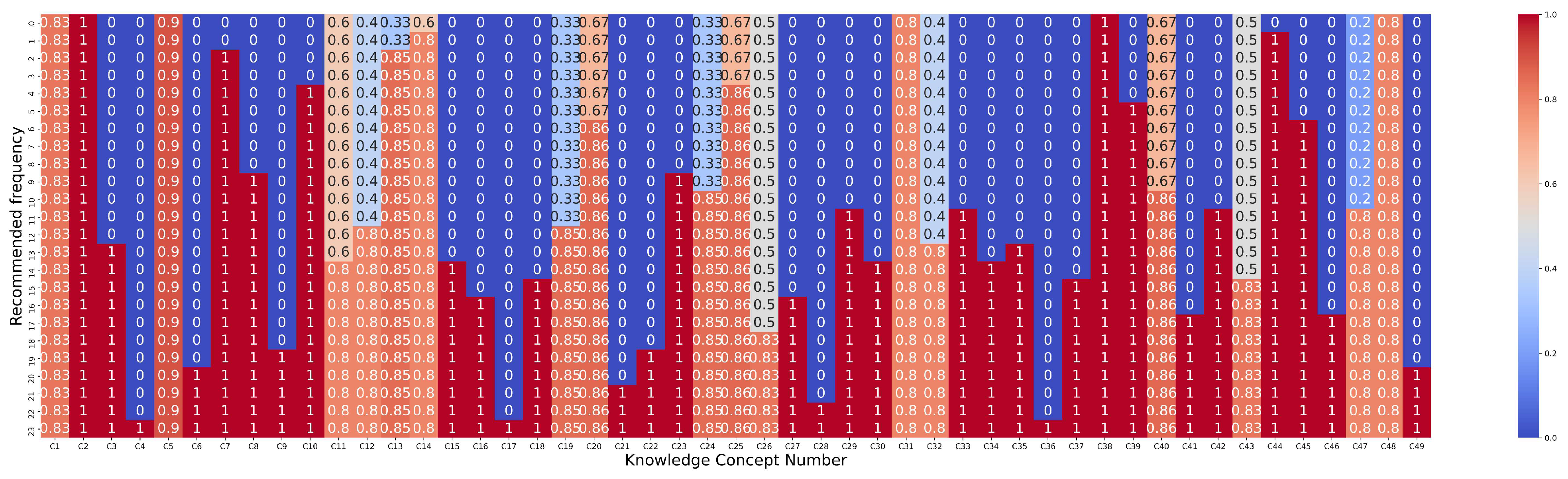
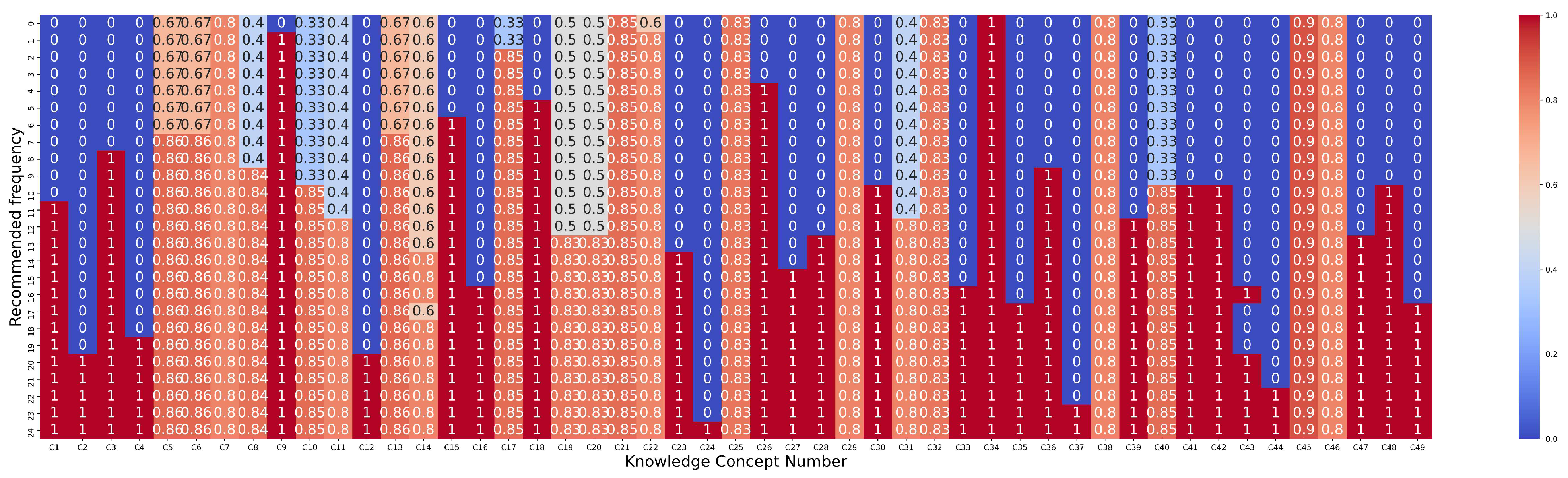
A Knowledge Tracing Model Based on Hierarchical Heterogeneous Graphs

Abstract
1. Introduction
- (1)
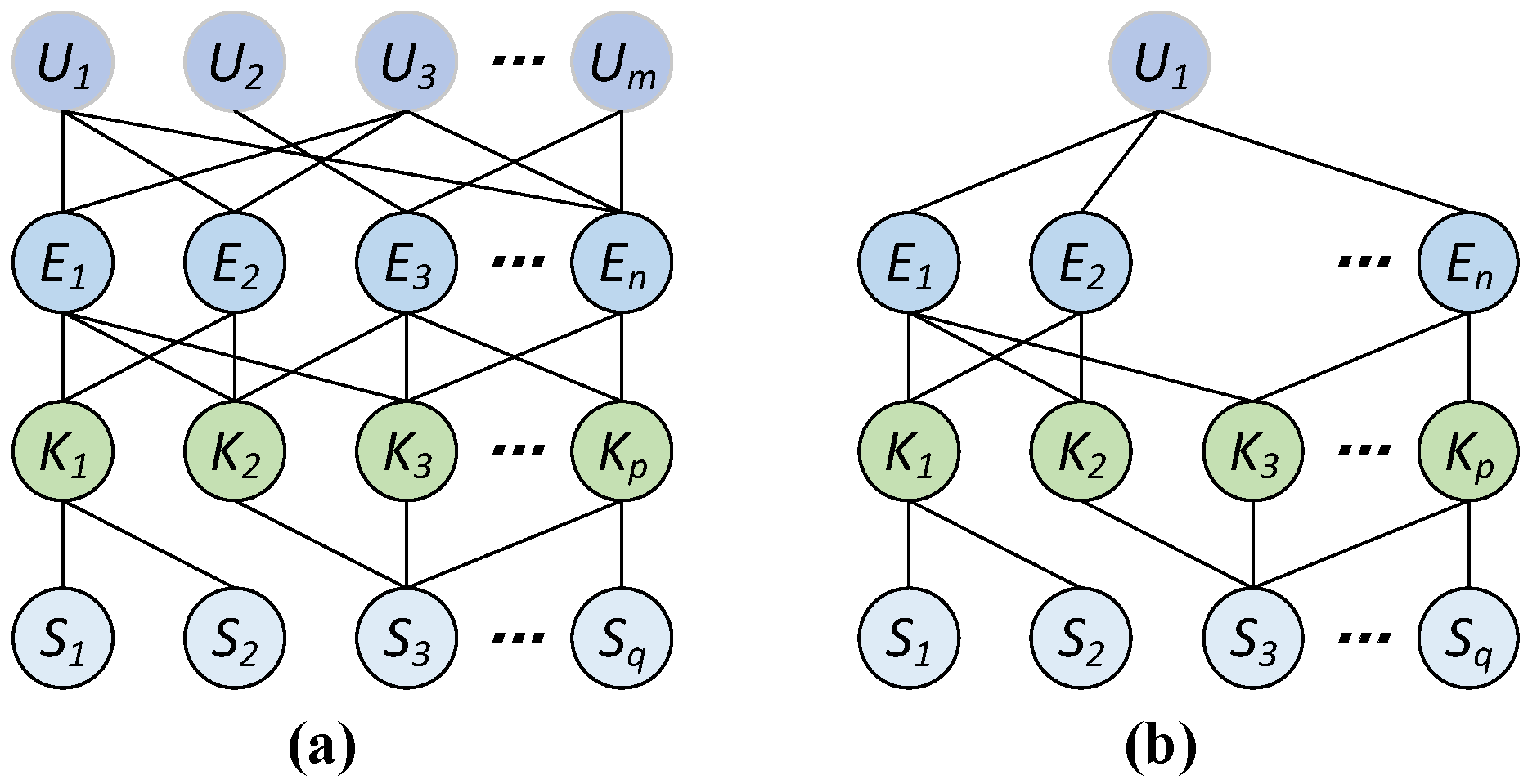
- A hierarchical heterogeneous graph among students, exercises, and knowledge points is constructed to capture the complex relationships among various nodes and enhance the model’s representation ability.
- (2)
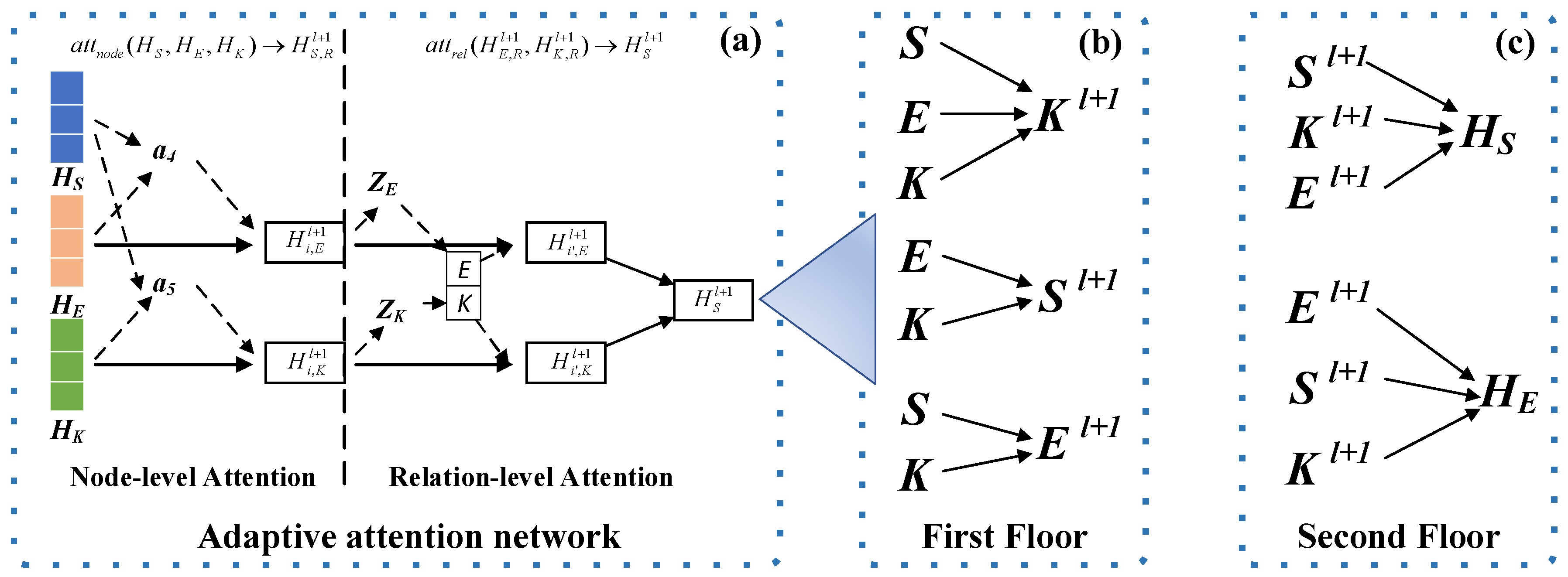
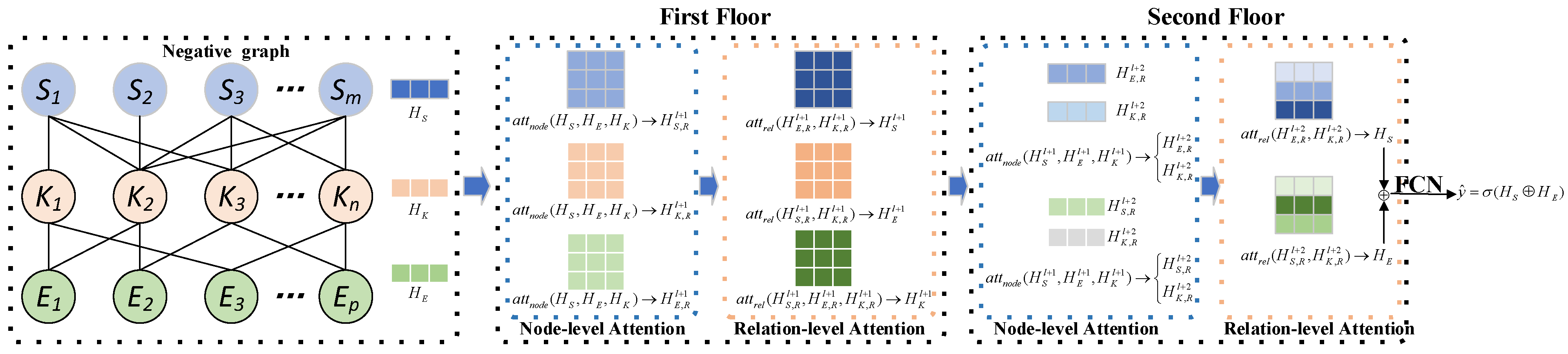
- The hierarchical attention mechanism is employed to achieve information transmission and aggregation between nodes. By integrating the information of students, exercises, and knowledge points, the student nodes and exercise nodes are represented. Compressed attention is adopted for information fusion.
- (3)
- A hierarchical heterogeneous graph was constructed for the ASSISTments dataset, and comprehensive simulation experiments were subsequently conducted to evaluate model performance and validate the effectiveness of the proposed approach.
2. Related Work
2.1. Graph-Based Knowledge Tracing
2.2. Hierarchical Heterogeneous Graph
3. HHGKT Model
3.1. Construction of Hierarchical Heterogeneous Graph and Node Embedding
3.2. Node-Level Attention
3.3. Relation-Level Attention
3.4. Two-Layer Attention Mechanism
3.5. Contrastive Enhanced Learning
3.6. Prediction Modul
4. Result Analysis and Discussion
4.1. Experimental Data
4.2. Experimental Benchmarks
4.3. Experimental Results
4.3.1. Comparative Experiments
4.3.2. Ablation Experiments
4.3.3. Visualization of Experimental Results
5. Conclusions
- (1)
- The representation of the knowledge space structure will affect educational computation. Compared with heterogeneous graphs and tree graphs, hierarchical heterogeneous graphs can better represent the complex relationships in the knowledge space.
- (2)
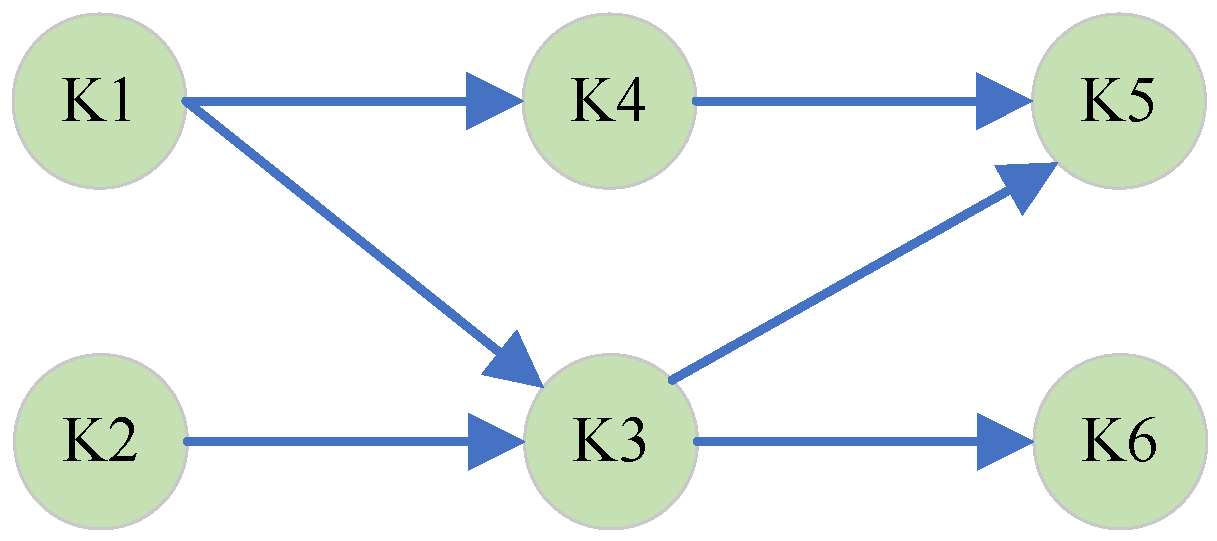
- The correlation between exercises and knowledge concepts as well as the dependency between knowledge concepts have a greater impact on knowledge tracing models. In educational computation (such as knowledge tracing, learning path recommendation, and learning resource recommendation), the influence of the dependency between knowledge concepts should be fully considered.
- (3)
- The diagnostic results of learning outcomes vary across different learning objectives. Therefore, the construction of knowledge tracing models should be tailored to specific learning goals.
Author Contributions
Funding
Data Availability Statement
Conflicts of Interest
References
- Suo, J.X.; Zhang, L.P.; Yan, S.; Wang, D.Q.; Zhang, Y.W. Review of interpretable deep knowledge tracing methods. J. Comput. Appl. 2025, 45, 2043–2055. [Google Scholar]
- Huang, S.W.; Liu, Z.H.; Luo, L.Y.; Zhao, Z.Y.; Wang, C. Research on Bayesian knowledge tracking model integrating behavior and forgetting factors. Appl. Res. Comput. 2021, 38, 1993–1997. [Google Scholar] [CrossRef]
- Piech, C.; Bassen, J.; Huang, J.; Ganguli, S.; Sahami, M.; Guibas, L.; Academy, K. Deep knowledge tracing. In Proceedings of the 28th International Conference on Neural Information Processing Systems, Montreal, QC, Canada, 7–12 December 2015. [Google Scholar]
- Nakagawa, H.; Iwasawa, Y.; Matsuo, Y. Graph-based knowledge tracing: Modeling learner proficiency using graph neural network. In Proceedings of the 2019 IEEE/WIC/ACM International Conference on Web Intelligence, New York, NY, USA, 13–17 October 2019. [Google Scholar]
- Song, X.; Li, J.; Lei, Q.; Zhao, W.; Chen, Y.; Mian, A. Bi-CLKT: Bi-graph contrastive learning-based knowledge tracing. Knowl.-Based Syst. 2022, 241, 108274. [Google Scholar] [CrossRef]
- Yan, Q.Y.; Si, Y.Q.; Yuan, G.; Wang, Z.X. Student-Problem Association Based Heterogeneous Graph Knowledge Tracing Model. ACTA Electron. Sin. 2023, 51, 3549–3556. [Google Scholar]
- Ju, S.G.; Kang, R.; Zhao, R.M.; Sun, J.P. Deep Knowledge Tracing Model Based on Embedding of Fused Multiple Concepts. J. Softw. 2023, 34, 5126–5142. [Google Scholar] [CrossRef]
- Song, X.Y.; Li, J.X.; Tang, Y.F.; Zhao, T.; Guan, Z. JKT: A joint graph convolutional network based deep knowledge tracing. Inf. Sci. 2021, 580, 510–523. [Google Scholar] [CrossRef]
- Wang, C.; Ma, D.; Xu, H.R.; Chen, P.F.; Chen, M.; Li, H. SA-MGKT: Multi-graph knowledge tracing method based on self-attention. J. East China Norm. Univ. Nat. Sci. 2024, 5, 20–31. [Google Scholar] [CrossRef]
- Wu, T.; Ling, Q. Fusing hybrid attentive network with self-supervised dual-channel heterogeneous graph for knowledge tracing. Expert Syst. Appl. 2023, 225, 120212. [Google Scholar] [CrossRef]
- Xie, P.Z.; Li, G.J.; Li, D. Knowledge Tracing Model Based on Exercise-Knowledge Point Heterogeneous Graph and Multi feature-Fusion. Comput. Sci. 2025, 52, 197–205. [Google Scholar] [CrossRef]
- Zhang, W.Q.; Wang, H.R.; Zhu, G.F. Temporal Convolutional Knowledge Tracing Method with Heterogenous Graph Neural Network. J. Chin. Comput. Syst. 2024, 45, 2823–2829. [Google Scholar]
- Xie, W.Z.; Liu, W.; Hu, D.W.; Cui, Z.H.; Zhao, Y.B. Dynamic knowledge tracking driven by multi-view comparison learning. Appl. Res. Comput. 2025, 42, 3325–3332. [Google Scholar]
- Qiao, Z.; Wang, P.; Fu, Y.; Du, Y.; Zhou, Y. Tree Structure-Aware Graph Representation Learning via Integrated Hierarchical Aggregation and Relational Metric Learning. arXiv 2020, arXiv:2008.10003v2. [Google Scholar]
- Song, L.Y.; Liu, Z.Z.; Zhang, Y.; Li, Z.H.; Shang, X.Q. Cascade Graph Convolution Network Based on Multi-level Graph Structures in Heterogeneous Graph. J. Softw. 2024, 35, 5179–5195. [Google Scholar] [CrossRef]
- Tian, Y.; Zhang, C.; Guo, Z.; Huang, C.; Metoyer, R.; Chawla, N. RecipeRec: A Heterogeneous Graph Learning Model for Recipe Recommendation. arXiv 2022. [Google Scholar] [CrossRef]
- Abdelrahman, G.; Wang, Q. Deep graph memory networks for forgetting-robust knowledge tracing. IEEE Trans. Autom. Control 2023, 35, 12. [Google Scholar] [CrossRef]
- Heffernan, N.T. ASSISTments. Available online: https://sites.google.com/site/assistmentsdata/ (accessed on 15 May 2025).
- Wu, Z.; Huang, L.; Tang, H.Y. SGKT: Session graph-based knowledge tracing for learner performance prediction. Expert Syst. Appl. 2022, 206, 117681. [Google Scholar] [CrossRef]
- Yang, Y.; Shen, J.; Qu, Y.R.; Liu, Y.F.; Wang, K.R.; Zhu, Y.M.; Zhang, W.N.; Yu, Y. GIKT: A graph-based interaction model for knowledge tracing. In European Conference on Machine Learning and Knowledge Discovery in Databases; Springer: Cham, Switzerland, 2021; pp. 299–315. [Google Scholar]
- Tong, H.; Zhou, Y.; Wang, Z. HGKT: Introducing Problem Schema with Hierarchical Exercise Graph for Knowledge Tracing. arXiv 2020, arXiv:2006.16915. [Google Scholar] [CrossRef]




| Dataset | SNum | ENum | KNum | ANum-KE | PCAE | PIAE | RNum |
|---|---|---|---|---|---|---|---|
| ASSIST09 | 3816 | 14,375 | 101 | 142.3 | 0.6433 | 0.3567 | 276,413 |
| ASSIST12 | 17,611 | 41,073 | 233 | 176.3 | 0.4281 | 0.5719 | 1,819,504 |
| ASSIST17 | 15,273 | 2833 | 98 | 28.9 | 0.5619 | 0.4381 | 662,869 |
| Model | Accuracy | AUC | Precision | Recall | F1 |
|---|---|---|---|---|---|
| DKT | 0.7662 | 0.7433 | 0.5944 | 0.8092 | 0.6413 |
| DKVMN | 0.7967 | 0.7459 | 0.6428 | 0.8109 | 0.6638 |
| GKT | 0.7244 | 0.7056 | 0.6211 | 0.7437 | 0.6593 |
| GIKT | 0.7890 | 0.7389 | 0.6196 | 0.8075 | 0.6579 |
| HGKT | 0.8047 | 0.7805 | 0.6388 | 0.8209 | 0.6641 |
| SGKT | 0.7975 | 0.7312 | 0.6357 | 0.8193 | 0.6617 |
| SPKT | 0.8251 | 0.7844 | 0.6934 | 0.8504 | 0.6833 |
| HHGKT | 0.8286 | 0.8028 | 0.7115 | 0.8677 | 0.7024 |
| Model | Accuracy | AUC | Precision | Recall | F1 |
|---|---|---|---|---|---|
| DKT | 0.7306 | 0.7269 | 0.6248 | 0.8406 | 0.6817 |
| DKVMN | 0.7873 | 0.7423 | 0.6177 | 0.8083 | 0.6564 |
| GKT | 0.7352 | 0.7125 | 0.6315 | 0.6499 | 0.6631 |
| GIKT | 0.7757 | 0.7391 | 0.6027 | 0.8183 | 0.6488 |
| HGKT | 0.8079 | 0.7790 | 0.6403 | 0.8277 | 0.6695 |
| SGKT | 0.8135 | 0.7512 | 0.6474 | 0.8289 | 0.6708 |
| SPKT | 0.8158 | 0.7616 | 0.6480 | 0.8296 | 0.6728 |
| HHGKT | 0.8290 | 0.7782 | 0.6617 | 0.8427 | 0.6991 |
| Model | Accuracy | AUC | Precision | Recall | F1 |
|---|---|---|---|---|---|
| DKT | 0.7277 | 0.7035 | 0.6203 | 0.8372 | 0.6718 |
| DKVMN | 0.7268 | 0.6988 | 0.6198 | 0.8343 | 0.6701 |
| GKT | 0.7152 | 0.7112 | 0.6284 | 0.7403 | 0.6562 |
| GIKT | 0.7613 | 0.7357 | 0.6146 | 0.8218 | 0.6577 |
| HGKT | 0.7962 | 0.7748 | 0.6372 | 0.8239 | 0.6649 |
| SGKT | 0.7924 | 0.7356 | 0.6397 | 0.8218 | 0.6632 |
| SPKT | 0.8027 | 0.7501 | 0.6427 | 0.8286 | 0.6684 |
| HHGKT | 0.8104 | 0.7583 | 0.6499 | 0.8317 | 0.6728 |
| variant | ASSISTment2009 | ASSISTment2012 | ASSISTment2017 | |||
|---|---|---|---|---|---|---|
| Accuracy | AUC | Accuracy | AUC | Accuracy | AUC | |
| HHGKT-f1 | 0.7951 | 0.7734 | 0.7819 | 0.7528 | 0.7764 | 0.7346 |
| HHGKT-kk | 0.8107 | 0.7944 | 0.8053 | 0.7691 | 0.7933 | 0.7482 |
| HHGKT-ek | 0.8146 | 0.7988 | 0.8093 | 0.7711 | 0.7984 | 0.7503 |
| HHGKT-sk | 0.8127 | 0.7975 | 0.80466 | 0.7681 | 0.7962 | 0.7486 |
| HHGKT-cl | 0.8072 | 0.7847 | 0.7933 | 0.7587 | 0.7849 | 0.7369 |
| HHGKT | 0.8286 | 0.8028 | 0.8290 | 0.7782 | 0.8104 | 0.7583 |
| λ | ASSISTment2009 | ASSISTment2012 | ASSISTment2017 | |||
|---|---|---|---|---|---|---|
| Accuracy | AUC | Accuracy | AUC | Accuracy | AUC | |
| 0 | 0.8072 | 0.7847 | 0.7933 | 0.7587 | 0.7849 | 0.7369 |
| 0.1 | 0.8237 | 0.8069 | 0.8271 | 0.7753 | 0.8089 | 0.7527 |
| 0.2 | 0.8286 | 0.8028 | 0.8290 | 0.7782 | 0.8104 | 0.7583 |
| 0.3 | 0.8255 | 0.8036 | 0.8220 | 0.7735 | 0.8077 | 0.7519 |
| 0.4 | 0.8219 | 0.8007 | 0.8213 | 0.7719 | 0.8024 | 0.7495 |
| 0.5 | 0.8174 | 0.7982 | 0.8188 | 0.7676 | 0.7998 | 0.7436 |
Disclaimer/Publisher’s Note: The statements, opinions and data contained in all publications are solely those of the individual author(s) and contributor(s) and not of MDPI and/or the editor(s). MDPI and/or the editor(s) disclaim responsibility for any injury to people or property resulting from any ideas, methods, instructions or products referred to in the content. |
© 2026 by the authors. Licensee MDPI, Basel, Switzerland. This article is an open access article distributed under the terms and conditions of the Creative Commons Attribution (CC BY) license.
Share and Cite
Li, B.; Zhang, Y.; Du, H.; Cheng, Y.-C. A Knowledge Tracing Model Based on Hierarchical Heterogeneous Graphs. Mathematics 2026, 14, 500. https://doi.org/10.3390/math14030500
Li B, Zhang Y, Du H, Cheng Y-C. A Knowledge Tracing Model Based on Hierarchical Heterogeneous Graphs. Mathematics. 2026; 14(3):500. https://doi.org/10.3390/math14030500
Chicago/Turabian StyleLi, Bin, Yan Zhang, Hongle Du, and Yeh-Cheng Cheng. 2026. "A Knowledge Tracing Model Based on Hierarchical Heterogeneous Graphs" Mathematics 14, no. 3: 500. https://doi.org/10.3390/math14030500
APA StyleLi, B., Zhang, Y., Du, H., & Cheng, Y.-C. (2026). A Knowledge Tracing Model Based on Hierarchical Heterogeneous Graphs. Mathematics, 14(3), 500. https://doi.org/10.3390/math14030500